
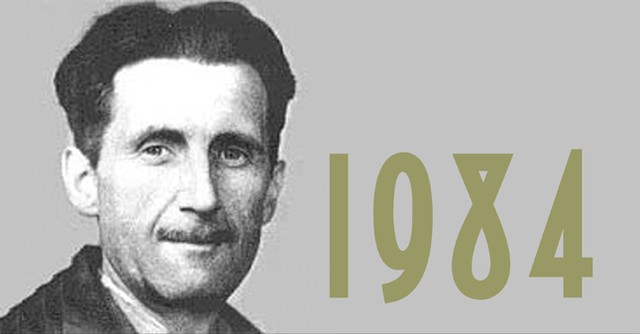
George Orwell worked at the British Ministry of Information during World War II. From 1941 to 1943, Orwell worked for the BBC, broadcasting propaganda talks to India. His wife worked in the ministry’s censorship division. It became the model for the Ministry of Truth in Orwell’s world-famous novel Nineteen Eighty-Four.1 The Ministry of Truth’s motto was, ‘Who controls the past controls the future: who controls the present controls the past.’ We learned that the BBC told us the truth, but that was part of the propaganda. The alternatives were Nazi Germany and, later, the Soviet Union. They had their own propaganda that nazis and communists believed. No social order is objectively the best. We cooperate by believing stories, such as religions and ideologies. We can’t do without them. If we stop believing them, our societies fall apart. Every order needs a story.
The Cold War was a decades-long standoff between the West and the Soviet Bloc. Two opposing myths and corresponding political-economic systems competed for global dominance: businesses aiming for profit, with their funny advertisements selling harmful products like cigarettes, versus the humourless communist cadres who wouldn’t murder us for profit but for their socialist ideals. It included a propaganda war. Western propaganda touted our freedom to choose a cigarette brand and flavour as a way to express our unique personality. Smoking a brand made us feel special. The communist propaganda claimed that cigarette manufacturers murder us for profit. People in communist countries had no brands or flavours to choose from, so they didn’t feel special or unique. Yet they held spectacular military parades every year, flaunting their tanks and missiles.
In those days, Great Britain executed secret black propaganda operations that included forged documents, controlled news agencies, and enlisted journalists to disrupt its enemies and protect its interests. These operations aimed to encourage a reaction, incite violence, or foment racial tensions.2 The BBC cooperated with the UK secret services to prevent people with communist sympathies from entering the staff. In the Netherlands, secret services planted news stories3 or employed experts on the radio and television.4 You can never be sure whether the news you read or hear is fully factual. That is why people increasingly came to distrust the mainstream media.
The mainstream media usually doesn’t spread fake news. Yet, they omit relevant facts and perspectives, which you might call lying by omission. That can be as bad. The Dutch public broadcaster NOS reportedly passed every fact check for five years.4 Most notably, people on the right have criticised the selection of news stories and how the NOS presented them as having a leftist bias. Fascist media like Ongehoord Nederland spread fake news, but also report on stories and perspectives other broadcasters don’t. That makes it hard to get to the facts. You have to figure it out yourself using various sources. In 2026, Ongehoord Nederland caused uproar for claiming that Adolf Hitler had made some good points about the globalist elites, leading to renewed calls to disband the broadcaster.
Revolutions don’t require freedom of opinion or social media. They have happened in the past. Orders work as long as most of us think they work. Orders collapse once we stop believing the myths underpinning them. That usually happens when things fall apart. Repression may uphold the order, but it can fail. Every order comes with myths that are, to some degree, false. As long as things seem okay, we accept the order’s fairy tales, no matter how blatantly false they are. The Chinese already had a way to deal with that problem. Their emperor had the mandate of heaven, which is like being appointed by God, so no one questioned their rule, unless there were bad omens such as famines or civil war, which were signs that he had lost it. In that case, a pretender might take over, and the one who succeeded would henceforth be emperor and have the mandate.
Western leaders have used false flags or invented stories about weapons of mass destruction and spread them via the media. The US started the Vietnam War after falsely claiming the North Vietnamese navy had attacked US ships in the Gulf of Tonkin. The US invaded Iraq after falsely claiming the country had a stash of weapons of mass destruction. The former US Ambassador to the United Nations, Madeleine Albright, once said sanctions on Iraq were worth the deaths of half a million Iraqi children, which was the estimated death toll of the sanctions the West had imposed on Iraq. In the West, people were allowed to criticise their leaders’ actions. Freedom of opinion exposed the myth of the liberal order being the best. That was impossible in the Soviet Union and China. It brought the West closer to the truth that no order is objectively the best.
Had the West not enjoyed military and economic superiority, the liberal order might have collapsed earlier. Life under Soviet, Muslim or Nazi rule would have been quite different. The myths we believe in arise from an interplay of historical forces, in which religions, ideologies, and other myths, such as those of national greatness, compete to organise people. You can call these myths ‘mind bugs’. Their evolutionary purpose is to help our genes survive and spread. The myths we now believe in have survived the competition. They are also models of reality, so they are often correct to some extent. The freedom of opinion in the West stems from a belief in objective truth, established through the investigation of facts and the examination of possible explanations. That has been a foundational pillar of the West’s success, as it brought us science.
The weak point of the whole endeavour is that we imagine our realities, which opens a can of worms, as you can connect the dots in infinite ways if you ignore facts that contradict your views, which we are wired to do, since we are creatures who cooperate based on myths. The measure of success is survival, not truth. And with the rise of connectivity, imaginations can cross-pollinate, leading to an explosive rise in freak thinking. These mind bugs are infectious, so we will go down fighting over our fantasies. And so, in the end, only The Truth can save us. Those who deny it are suicidal morons who will drag us down with them. You can’t win debates with morons who live in their own fantasy worlds, so The Truth can only come by force.
Myths like freedom of the press have power. Believing them can make them work. The euro has value because we believe it has. The value of the euro is something we imagine. There is more freedom of opinion in the West than in other places. Still, those who pose a threat to the order know that there are limits to freedom of opinion. Julian Assange founded WikiLeaks, which published documents obtained by hackers, thereby exposing human rights violations by the US secret services. The United States considered these revelations a national security threat. On 1 November 2019, UN Special Rapporteur on torture, Nils Melzer, wrote, ‘While the US Government prosecutes Mr Assange for publishing information about serious human rights violations, including torture and murder, the officials responsible for these crimes continue to enjoy impunity.’6 Yet we wouldn’t have known about Assange had it not been for freedom of the press.
Every social-political order comes with a story explaining why it is the best. Without an inspiring myth, we can’t have order. The foundations of our orders are stories like a prophet receiving a revelation from God, the founding fathers drawing up a constitution with great wisdom, or a she-wolf raising the founders of the empire. Most of the time, revolutions and civil wars are worse than dealing with the omissions and falsehoods in the stories that hold the order together. But not always. It is why revolutions do happen, but are rare. As long as we don’t believe the same stories, we will fight each other. The orders we have today are the outcome of a competition, not some objective measure of quality. The success of orders depends on, sometimes, arbitrary circumstances. Had the first Chinese emperor not standardised the script and chosen pictograms rather than phonetic characters, there would be no China today.
In today’s globalised world, there are several competing stories. There is a Christian story, an Islamic story, a socialist story, numerous nationalist stories, a story about slavery and the civil rights movement, a conspiracy theorist’s tale, the story of indigenous peoples, a Hindu story, a Chinese story spanning 2,000 years of greatness, and several others. These stories figure into identity politics, so the Chinese like tales about China’s greatness. Finally, there is a liberal story of individual freedom centred on the Magna Carta, the European Enlightenment, the Glorious Revolution, the American and French Revolutions, universal suffrage, and the overcoming of fascism in World War II, in which D-Day, rather than Stalingrad, serves as the hallmark event. Children in the West learned it at school. It is a skewed version of history to explain why the liberal order is the best.
These stories are falling apart in this globalised world. None of them can unite us. The Magna Carta and the Glorious Revolution mean nothing to Chinese, Indians or Africans who look back at a colonial past of oppression and exploitation. If you aren’t a Christian or a Muslim, Christianity and Islam strike you as odd. Others show little interest in China’s rich history or the stories of the indigenous peoples of the Americas. And the Hindu caste system makes only sense to Hindus. We are imaginative creatures and invent new myths, adding to the confusion. The belief in different stories will ruin us, so freedom of opinion is overrated. Only The Truth can save us now. And then, we all have to believe it and accept the consequences. Otherwise, we are doomed. And so, we need a Ministry of Truth telling us what to believe.
Latest revision: 27 June 2026
Featured image: 1984 and a photo of George Orwell. Public domain.
1. Orwell, 1984 and the Ministry of Information. Dr Marc Patrick Wiggam. School of Advanced Study, University of London (2017). [link]
2. Britain’s secret ‘black propaganda’ operations. John McEvoy (2026). Declassified UK.
3. Nederlandse media drukten artikelen af die waren geschreven door veiligheidsdienst BVD. Bart Funnekotter, Joep Dohmen (2023). NRC.
4. Geheime diensten gebruiken ‘onafhankelijke experts’ om publiek debat te sturen. Sebastiaan Brommersma (2024). Ftm.nl.
5. Mediabiasfactcheck.com. Netherlands Radio and Television Association (NOS) – Bias and Credibility. (2023).
6. UN expert on torture sounds alarm again that Julian Assange’s life may be at risk. United Nations (2019). [link]

