
Forces of nature
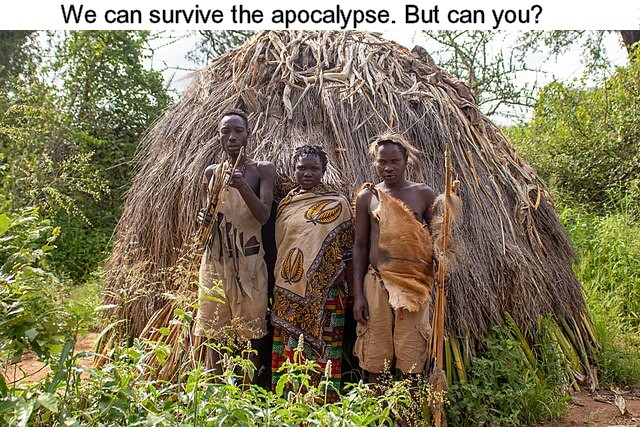
The Hadzabe are an African tribe. They hardly trade, and they don’t use money. They can survive an apocalypse. But can you? Trade and money have turned us into cogs in a system. Many of us can’t survive without what some might call ‘The System’, the catch-all term for large-scale human organisation centred on states and markets. We came to depend on the market and the state rather than ourselves, our family and our community. We have exchanged resilience for convenience, and for a reason. We specialise to compete. As the organisations we take part in become more competitive, we turn into more inept individuals. We survive on performing a trick, our job, but we can’t survive without markets and governments. People in the past had a wider variety of skills than doing their jobs and going to shops. When things fall apart, those who don’t trade are best positioned to survive. In other words, trade will eventually kill us all.
The forces of nature, competition and cooperation made it happen. We cooperate to compete, which pushes us to work within complex organisations to keep up with other complex organisations. That perspective provides an illuminating insight. Plants and animals cooperate and compete for resources. Cooperation and competition are everywhere. Cooperation increases the available resources. For example, plants generate the oxygen animals need, while animals produce the carbon dioxide plants need. And rhinos attract ticks and flies that the red-billed oxpecker lives off, so the rhino benefits from the bird while the bird benefits from the rhino. Still, the available resources are limited, so there is room for only one tree in a particular spot. And so there is competition as well, a struggle for life.
Plants and animals take advantage of opportunities in their environment through both competition and cooperation. Plants and animals have a blueprint, their genes, that define their properties, so that a chestnut can become a chestnut tree, and an ovum and a sperm can generate a new aardvark. Genes have the peculiar urge to make copies of themselves. It is why we exist and the basis of our will to live. The biological purpose of plants and animals, including humans, is to spread their genes. That is all there is to it, nothing more. The copying process is prone to errors, resulting in variation within species.
Some of these changes make individual plants and animals better adapted to their environment, increasing their chances of survival and reproduction, leading to a rising number of individuals with these genes and features. Environments allow for species to coexist, most notably when they don’t compete for the same resources. This is why ants and monkeys can live in the same area. The balance in nature is precarious and temporary, so there is no real balance. It constantly shifts, as changes in the environment harm and favour particular individuals and species in the struggle for life.
Meet our closest relatives
The chimpanzees are our closest kin. Studying these apes provides us with some insights into our nature. Chimpanzees live in small troops of a few dozen individuals. They form friendships, work with reliable group members, and avoid unreliable ones. Chimpanzees have rules, may cheat on them, and may feel guilty when they do. Within the group, the members have ranks. When there is food available, the highest-status animals eat first. Ranks and rules define who does what and who gets what. They regulate the competition and misunderstandings within the troop, reducing conflicts and enabling its members to collaborate more effectively.
Like human leaders, chimpanzee alpha males acquire their status by building coalitions and gaining support. Others show their submission to the alpha male. Like a government, the alpha male strives to maintain social harmony within his group. He takes sought-after pieces of food like a government collects taxes. Within a chimpanzee band, there are subgroups and coalitions. There are close friendships and more distant relationships. They unite as a single fighting force in the event of an external threat.
Coalition members in a chimpanzee band build and maintain close ties through intimate daily contact, such as hugging, kissing, and doing favours for each other. For the band to function effectively, its members must be aware of what others will do in critical situations. For that, they need to know each other through personal experiences. Unlike humans, chimpanzees have no language to share social information. That limits the size of the group in which chimpanzees can live and work together to about thirty individuals.
Chimpanzees also commit group violence. Like humans, they are among the species that commit genocide on their congeners. Humans and chimpanzees are not alone in this. Chickens are known to fight racial wars when they face a lack of food. Groups of chickens may start killing those with different colours from their own. And so, racism could be a natural behaviour caused by competition between genes.
The human advantage
Humans have become the dominant species on Earth. We can collaborate flexibly in large numbers. We have mastered fire, which enhances our power and allows us to eat foods we couldn’t otherwise. It allowed us to become the top predator. We use tools and clothing, allowing us to do things other animals can’t and live in inhospitable environments. Compared to other animals, humans employ a rich language. That enables us to express countless meanings and describe situations in precise terms.
We pass on social information, such as who is fit for a particular job. We get information about others in our group without needing personal experience. If someone cheats, you don’t need to learn it the hard way, as chimpanzees must. Someone can tell you. That allows us to cooperate more effectively. Most human communication is social information or gossip. We need the group to survive, so we must understand what is happening within it and the decisions it needs to make.
Human politics is about cooperating and competing. We must agree on what we should do as a group and on how we divide the spoils of our cooperation. Within the group, we may compete to cooperate. Leadership contests benefit the group when the outcome is better leadership. That isn’t always the case, while infighting can weaken the group. We also cooperate to compete. We organise ourselves in groups to compete with other groups, such as defeating them in warfare.
Early humans lived in gangs of up to 150 individuals. The number of individuals with whom we can closely collaborate is one of our natural limitations. We overcame the limits of our natural group size by cooperating through shared imaginings, such as religions, laws, money, and nation-states. That competitive advantage over other species allowed us to take over this planet and become the ‘killer bug’ that has upended nature and has terminated more species than any other species or natural disasters.
Unlike other animals and plants that adapt to their environment, we alter our environment to make it suit us. We have created societies and civilisations and have become immensely powerful collectives capable of competing with other collectives. However, our civilisations also shield us from the forces of nature, turning us into weak individuals. We have become integrated into the system, and many of us won’t survive its collapse. Competition drives this process, most notably trade, and even more than warfare.
We imagine corporations, laws, money, and nation-states. We believe a law exists, and that is why the law works. It is also why religion works. These shared imaginations allow us to cooperate on any scale for any purpose. We are programmable, with our brains serving as the hardware and our imaginations serving as the software. And we can change the software overnight. During the French Revolution, the French stopped believing in the divine right of kings overnight and began to envision popular sovereignty.
Our urges and inner motivations relate to these forces of nature. We imagine things because that helps us win the competition. We imagine our realities because we are creatures who cooperate based on stories. And so, our environment becomes increasingly unnatural. Civilisation shields us from the forces of nature, most notably, the struggle for survival, so that the inept can survive and procreate. Once the story falls apart, society breaks down, and the forces of nature reassert themselves.
Organising to compete
The forces of competition and population density drove humans to organise. Just as there is competition between species in nature, there is also competition between human groups. Groups that succeeded in adapting to new circumstances survived, whereas those that did not perished. We are rule-following animals. It allowed us to cooperate on a larger scale using political institutions that embody the rules of our community or society.
The stories, norms, values and agreements people within a group share form their culture. Cultural values can confer an advantage on one group relative to others. Individualism and the replacement of Christian values with capitalist ones helped Europeans to organise themselves more flexibly and make their conquests profitable, thereby sustaining their expansion. Their culture helped Europeans to conquer the world.
Humans design political institutions, whereas genetic mutations arise by chance. In both cases, competition determines which designs survive and become copied. In general, under the pressure of competition, which often took the form of warfare, human organisation advanced from bands to tribes to feudalism to states. This explanation is simplistic and flawed. Still, overall, such a trend towards more advanced organisation occurred.
Hunter-gatherers lived in family groups of a few dozen individuals. They had few violent conflicts. They had no property, and population density was low. They could move on if a stronger band invaded their territory. Small groups were egalitarian. They had no permanent leader or hierarchy and decided on leadership based on group consensus.
The Agricultural Revolution changed that. Farming allowed more people to survive. Farmers invested heavily in their cattle and crops, so agricultural societies required property rights and defence. Agriculture promoted the transition from bands to tribes. Population density increased, leading to more frequent violent conflicts. Tribes are much larger than bands and can muster more men for war, so tribes replaced bands.
Tribes were usually egalitarian, but often a separate warrior caste emerged. The most basic permanent political organisation was the lord and his armed vassals, known as feudalism. The lord and his vassals exchange favours. The loyalty of the vassals is crucial, and politics is about these loyalties and betrayals. Tribalism centres around kinship, but also includes feudalist, personal relationships of mutual reciprocity and personal ties.
States
States wield more power than tribes because they can compel cooperation, whereas tribes rely on voluntary arrangements. As population density increased and people lived closer together, the need to resolve conflicts also grew, so some states provided justice services. Leaders, with their family and friends, led these states. They worked with personal, feudal relationships, thus making deals and returning favours. And so, the transition from tribes to feudalism to states is not a straightforward process.
The first modern, rationally organised states with professional bureaucracies based on merit rather than personal relationships and favours appeared in China. The reason was a centuries-long, cutthroat competition in warfare on an unprecedented scale, with states fielding armies of up to 500,000 men, during the Warring States Era. Fielding these armies required professional tax collection, detailed records of people and their possessions, and provisioning them in the field.
Once the state of Qin emerged victorious by 200 BC, China became unified, and the competition between the states ended, and China’s modernisation ground to a halt. Even so, China adhered to modern bureaucratic principles and remained the most modern state for 2,000 years, enabling its rulers to govern a vast empire. States remained the most competitive organisational form until Europeans invented capitalism and corporations, which introduced a radically new dynamic of permanent change driven by competition.
Capitalism and corporations
In the Middle Ages, China had a strong centralised state and was ahead of the rest of the world, yet Europe came out on top. The Chinese government prevented the merchants from becoming the dominant force in society. In the Middle Ages, Western Europe lacked strong states and exhibited greater individualism, allowing capitalism to emerge there gradually. That took centuries and was the outcome of factors shaping Western European culture and their interactions in a historical process in which competition played a defining role. The rise of merchants and, later, corporations brought a new economic dynamic and wealth. Corporations are legal entities serving a specific purpose. Invented in Roman times, they became a competitive advantage in business ventures.
Corporations limited the risks for entrepreneurs and investors and allowed for the raising of more capital. From the Middle Ages onward, Europeans established commercial corporations with shares and stock markets, such as the Dutch East India Company (VOC). The advent of corporations triggered a new phase in the competitive cycle, further increasing efficiency by specialising in specific tasks. The Europeans combined their inquisitiveness with entrepreneurship, so the profit motive eventually began to drive innovation.
The new dynamic intensified competition and innovation, causing permanent economic growth and disruptive change, a process economists call creative destruction. Capitalism increases available resources via cooperation or the division of labour, but competition is the driving force. It favours economies of scale. For instance, you see supermarket chains replacing smaller grocery stores. It is also why we have weapons of mass destruction and industrial warfare. The competition will eventually ruin us all.
At present, East Asian countries such as China appear to have the most competitive socio-economic model. It helps that the people there are less individualistic. The Chinese also have the longest tradition of rationally organised government. Yet, it will not end well for them either. Artificial intelligence will soon outcompete humans. It will become the ‘killer bug’ that terminates humanity. We can’t keep up with artificial intelligence. And so, the future doesn’t need us. We aren’t sufficiently efficient, creative and innovative. Competition is our doomsday machine. Whoever wins the race will be dead. If humankind is to survive, competition, insofar as we allow it, should serve cooperation. If we don’t get a grip on the competition, we are doomed.
Latest revision: 7 November 2026
Featured image: Hadzabe tribespeople. Calvin pro7. Wikimedia Commons. CC BY-SA 4.0.

