Doomsday Machine

Forces of nature

How did we get where we are today? Nature’s driving forces are competition and cooperation. This perspective provides a great deal of insight into what happened. Plants and animals cooperate and compete for resources. Cooperation and competition are everywhere. Cooperation increases the available resources. Plants generate the oxygen animals need, while animals produce the carbon dioxide plants need. Still, the available resources are limited. There is only room for one tree on that spot. And so, there is a competition called the struggle for life, where the fittest survive.

Plants and animals are opportunistic, taking advantage of opportunities whenever possible, with the help of both competition and cooperation. Plants and animals have a blueprint, their genes. These genes have the urge to make copies of themselves. It is why we exist and the basis of our will to live and our sexual desires. And so, the biological purpose of plants and animals, including humans, is to spread their genes. That is indeed a most peculiar purpose. The copying of genes is prone to errors. And so changes occur, resulting in variation within species. It is why people vary in appearance and character.

Some changes make individual plants and animals better adapted to their environment, thereby increasing their chances of survival and reproduction, resulting in a rising number of individuals with these features. Environments allow for several species to coexist, most notably when they don’t compete for the same resources. It is why ants and monkeys can live in the same area. The balance in nature is always precarious, as changes in circumstances can favour different species. And so, introducing foreign species in places where they have no natural predators can lead to pests.

Like other social animals, humans operate in groups. Social animals benefit from group cooperation, which enhances their chances of survival. Within the group, competition can arise, resulting in rankings and struggles among members. Cooperating in groups also helps us to compete with other groups, usually in warfare. And groups can form coalitions to compete with coalitions of different groups. Stories enable humans to work together in groups of any size, which then further increases the competition between these groups.

Meet our closest relatives

Chimpanzees are our closest kin. Studying these apes provides us with insights into our nature. Chimpanzees live in small troops of a few dozen individuals. They form friendships, work with reliable group members, and avoid those who are unreliable. Chimpanzees have rules, may cheat on them, and can feel guilty when they do. Within the group, the members have ranks. When there is food available, the highest-status animals eat first. Ranks and rules regulate competition within the troop, reducing conflicts and enabling its members to collaborate more effectively.

Like human leaders, chimpanzee alpha males acquire their status by building coalitions and gaining support. Others show their submission to the alpha male. Like a government, the alpha male strives to maintain social harmony within his group. He takes sought-after pieces of food like a government collects taxes. Within a chimpanzee band, there are subgroups and coalitions. There are close friendships and more distant relationships. They unite as a single fighting force in the event of an external threat.

Coalition members in a chimpanzee band build and maintain close ties through intimate daily contact such as hugging and kissing, and doing each other favours. For the band to function effectively, its members must be aware of what others will do in critical situations. For that, they need to know each other through personal experiences. Unlike humans, chimpanzees have no language to share social information. That limits the size of the group in which chimpanzees can live and work together to about thirty individuals.

Chimpanzees also commit violence in groups. Like humans, they are among the species that commit genocide on their congeners. Humans and chimpanzees are not alone in this. Chickens are known to fight racial wars when they face a lack of food. Groups of chickens may start to kill those with different colours from themselves. And so, racism could be a natural behaviour caused by competition between genes.

The human advantage

Humans have become the dominant species on Earth. We can collaborate flexibly in large numbers. We have mastered fire, which enhances our power and allows us to eat foods we couldn’t otherwise. It allowed us to become the top predator. We use tools and clothing, allowing us to do things other animals can’t and live in inhospitable environments. Compared to other animals, humans employ a rich language. That enables us to express countless meanings and describe situations in precise terms.

We pass on social information, such as who is fit for a particular job. We get information about others in our group without needing personal experience. If someone cheats, you don’t need to learn it the hard way like chimpanzees must, but someone can tell you. That allows us to cooperate more effectively. Most human communication is social information or gossip. We need the group to survive, so we must understand what is happening within our group and the decisions our group needs to make.

Human politics is about cooperating and competing. We must agree on what we should do as a group and on how we divide the spoils of our cooperation. Within the group, we may compete to cooperate. Leadership contests benefit the group when the outcome is better leadership. That isn’t always the case, and infighting can weaken the group. We also cooperate to compete. We organise ourselves in groups to compete with other groups, such as defeating them in warfare.

Early humans lived in bands of up to 150 individuals. The number of individuals with whom we can closely collaborate is one of our natural limitations. We overcame the limit of our natural group size by cooperating based on shared imaginings, such as religions, laws, money, and nation-states. That competitive advantage over other species allowed us to take over this planet and become the ‘killer bug’ that has completely upended nature and has terminated more species than any other species.

Unlike other animals and plants, which adapt to their environment, we have altered our environment to suit us. We have created societies and civilisations and have become immensely powerful collectives to compete with other collectives. However, our civilisations also shield us from the forces of nature, turning us into weak individuals. We have become integrated into the system, and many of us won’t survive a collapse of civilisation. It is crucial to understand that competition drives this process.

We imagine corporations, laws, money, and nation-states. We believe a law exists, and that is why the law works. It is also why religion works. These shared imaginations allow us to cooperate on any scale for any purpose. We are programmable, with our brains serving as the hardware and our imaginations serving as the software. And we can change the software overnight. During the French Revolution, the French stopped believing in the divine right of kings overnight and began to envision the sovereignty of the people.

Organising to compete

The forces of competition and population density drove humans to organise. There is a competition between groups of humans. Just as there is a competition between species in nature, there is also a competition between human groups. Groups that succeeded in adapting to new circumstances survived those that did not. We are rule-following animals. Once we start to cooperate on a larger scale, we need political institutions that embody the rules of a community or society.

Humans design political institutions while genetic mutations emerge by chance. Still, competition determines which designs survive and become copied. In general, under the pressure of competition, which mainly was warfare, human organisation advanced from bands to tribes to feudalism to states. The experts deem this explanation simplistic and flawed. Still, overall, that trend towards more advanced organisation occurred.

Hunter-gatherers lived in family groups of a few dozen individuals. They had few violent conflicts, probably because they had no property, and population density was low. Hunter-gatherers could move on if a stronger band invaded their territory. Small groups were egalitarian. They often had no permanent leader or hierarchy and decided on their leaders based on group consensus.

The Agricultural Revolution changed that. Farming allows more people to survive. Farmers invest heavily in their cattle and crops, so agricultural societies need property rights and defence forces. Agriculture promoted the transition from bands to tribes. Population density increased, leading to more frequent violent conflicts among people. Tribes are much larger than bands and can muster more men for war, so tribes replaced bands.

Tribes were usually egalitarian, but a separate warrior caste often emerged. The most basic form of political organisation was the lord and his armed vassals, known as feudalism. The lord and his vassals exchange favours. The loyalty of the vassals is crucial, and politics is about these loyalties and betrayals. Tribalism centres around kinship, but also includes feudalist, personal relationships of mutual reciprocity and personal ties.

States yield more power than tribes because they force people to cooperate, while tribes work with voluntary arrangements. As population density increased and people lived closer to each other, the need to regulate conflicts also grew, so some states also provided justice services. Leaders, with their family and friends, led these states. They worked with personal, feudal relationships, thus making deals and returning favours. And so, the transition from tribes to feudalism to states is not a straightforward process.

The first modern, rationally organised states with professional bureaucracies based on merit rather than personal relationships and favours appeared in China. The reason was a centuries-long cut-throat competition of warfare on an unprecedented scale, with states having armies of up to 500,000 men, in the period now known as the Warring States Era. Fielding these armies required professional tax collection, with records of people and their possessions, as well as the provisioning of soldiers in the field.

Once the state of Qin emerged victorious by 200 BC, China became unified, and the competition between the states ended, and China’s modernisation ground to a halt. Even so, China adhered to modern bureaucratic principles and remained the most modern state for 2,000 years, enabling its rulers to govern a vast empire. States remained the most competitive organisational form until Europeans invented capitalism and corporations, which would cause a radical new dynamic of permanent change driven by competition.

Capitalism and corporations

China had a strong centralised state that prevented the merchants from becoming the dominant force in society. In the Middle Ages, Europe had no strong states, so capitalism could gradually emerge in Europe. The rise of merchants and later corporations brought a new economic dynamic and wealth. Corporations are legal entities serving a specific purpose. Invented in Roman times, they included the state, municipalities, political groups, and guilds of artisans or traders.

From the Middle Ages onward, Europeans introduced commercial corporations with shares and stock markets such as the Dutch East Indies Company (VOC). The advent of corporations triggered a new phase in the competitive cycle, further increasing efficiency by specialising in specific tasks. The Europeans combined their entrepreneurship with inquisitiveness, so eventually the profit motive began to drive innovations as well.

The new dynamic intensified competition and innovation, causing permanent economic growth and disruptive change, a process that economists call creative destruction. Capitalism increases available resources via cooperation or the division of labour, but competition is the driving force. As long as that remains so, competition rather than our desires determines what our future will look like.

Currently, China may have the most competitive socio-economic model, potentially outcompeting those of the West. But it will not end well for them either. Artificial intelligence may soon outcompete humans. It may become a ‘killer bug’ that ends humanity. We can’t keep up with artificial intelligence. The future doesn’t need us. We aren’t sufficiently efficient and innovative. Competition is our first and foremost problem. It is our doomsday machine. Competition, insofar as we allow it, should be at the service of cooperation rather than the opposite. If we don’t do that, we are doomed.

Featured image: Tower of Babel by The Tower of Babel (1569). Public Domain.

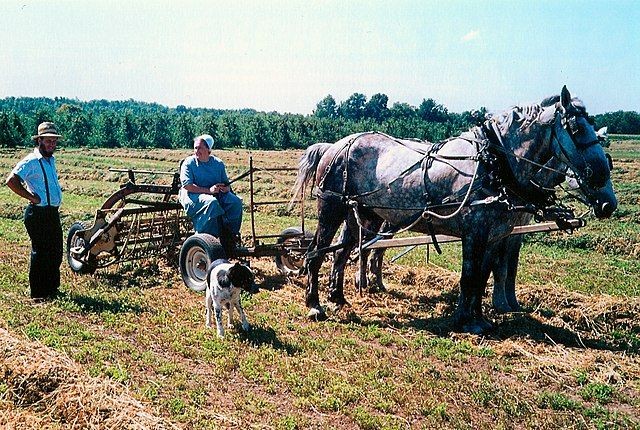
Amish family, Lyndenville, New York. Public domain.

The Last Day

Imagine there is a lake in a distant forest. On its surface grows a plant. Its leaves darken the water, so all life below it dies. The plant was at first tiny, and it has been there for 1,000 days. But it doubles in size every day. So, here is a question. If the plant blankets half the lake, how many days are left to save the life there? The correct answer is one day. Behold the power of exponential growth. If the plant depends on life in the lake, it will also die.

Behold the power of exponential growth. The plant doubles in size each day. And so, it covers the entire lake tomorrow. It doesn’t matter how long it has been there already. It stops growing once there is no more room. As soon as the lake is fully covered, life in the lake ends. And if the plant depends on that life, it will also die.

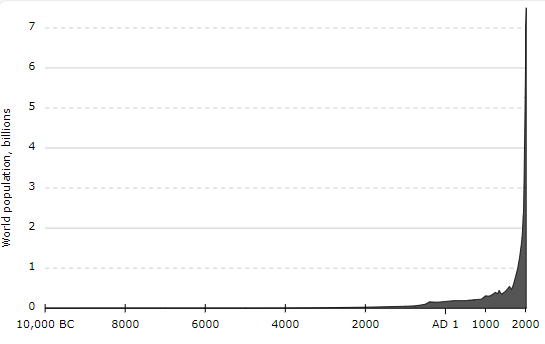
The lake represents the Earth, the plant humanity, and the leaves are people like you and me. The graph above shows the human population numbers over the last 12,000 years. These numbers had been very low for a long time. In 1804, there were one billion people. Since then, the human population has gone berserk. There were two billion humans in 1927, three billion in 1960, four billion in 1974, five billion in 1987, six billion in 1999, seven billion in 2011, and eight billion in 2022.

The experts expect the number to decline in the future. Only, how will that decline occur? That is anyone’s guess. The signs are ominous. Currently, humans use nearly twice as many resources as the Earth can deliver.1 We can do that for a short while, but it will end badly. The lifestyles of the rich are unsustainable, but so are the number of children many people have. Rich people with many children are the worst. Continuing their current lifestyles will lead to an apocalyptic event, and it will happen sooner rather than later.

We live on the proverbial last day before a dramatic trend change in resource consumption. How it will play out is up to us.


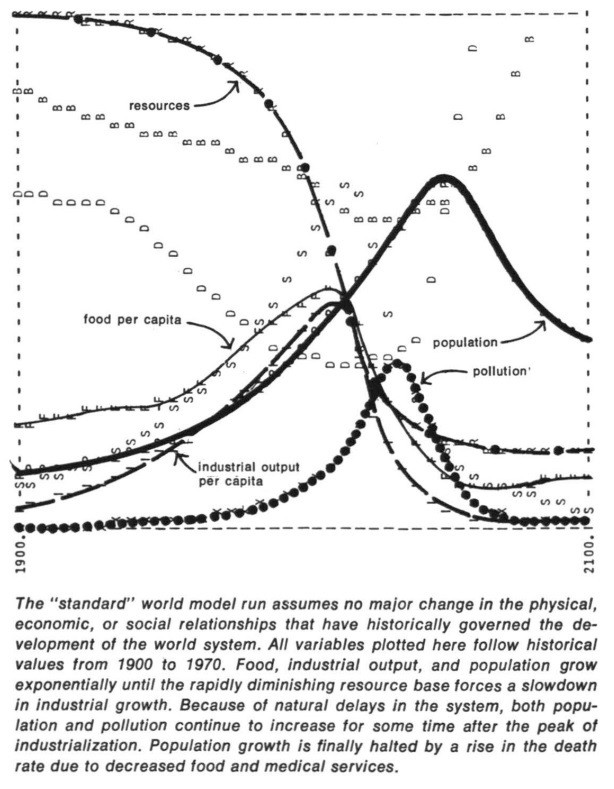
In 1972, a group of scientists known as the Club of Rome ran a computer programme predicting an apocalypse when natural resources would run out shortly after 2000 AD.2 Their computer printed out a scary diagram detailing how, demonstrating we should be very, very afraid. So far, the reckless have had numerous opportunities to point out how foolish the cautious have been, and the ultimate laughing stock is the man with the sign saying, ‘The end is near.’

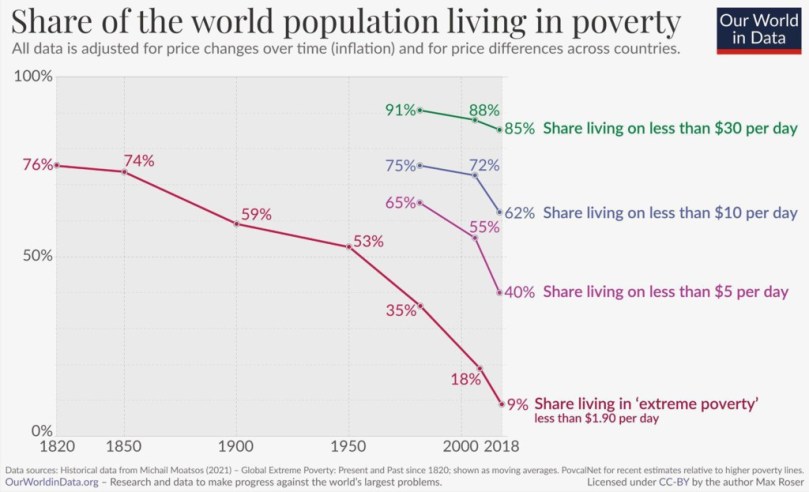
Share of teh world population living in poverty
Share of the world population living in poverty. CC-BY. Max Roser. OurWorldInData.org.

According to the World Bank, extreme poverty dropped from 76% of the world’s population in 1820 to 9% in 2018. Their definition of extreme poverty is dubious, but it is beyond doubt that the percentage of destitute people has declined. The Club of Rome lacked sufficient and precise data, and unanticipated developments affected the outcome. New technologies enable the extraction of more resources and the more efficient use of existing ones. Some oil reserves have become accessible with new or improved extraction methods. And if you use the oil to produce a solar panel, you get several times as much energy during the solar panel’s lifespan as from burning the oil itself.

Essential resources, such as oil and freshwater, are becoming increasingly scarce or may soon be in short supply.3 With current consumption levels, proven oil reserves may last until the 2060s. Total oil reserves are more than twice as large, but pumping the remaining oil could be costly,4 while climate change could prevent us from burning it. PFAS, microplastics, and other pollutants are everywhere and accumulating in our bodies. Brain samples collected in early 2024 measured, on average, about 0.5% plastic.5

Life has never been better for most people. Are we on the verge of the apocalypse? The problem is growth in a limited area. When there is growth, the increases add to the existing total. The plant can’t grow beyond the pond’s size, so once it reaches its limits, for every leaf that grows, another must die. The Earth is stressed. We disrupt the balance in nature, but we can’t predict what will happen and when. We can’t overuse the Earth for long. The day before growth ends could be our best.

Scientists have identified nine processes that regulate the Earth’s stability and resilience. These are climate, biosphere, land use, freshwater, nutrients, ozone, aerosols, and ocean acidity. These processes have boundaries that are unsafe to cross. By exceeding these boundaries, we risk triggering irreversible environmental changes that could lead to catastrophic consequences for both human civilisation and natural ecosystems, these scientists argue. As of 2024, we have breached six of these nine planetary boundaries.

Humankind has gone batshit crazy. We delude ourselves into thinking that economic growth will solve our problems. We are like cancer cells telling each other that our aggressive growth strategy has paid off handsomely so far, so that more cancer will make things better. That is, of course, until the host dies.

Barring an apocalyptic event, such as the planet reaching a tipping point due to climate change, World War III, or a technology like artificial intelligence or genetic engineering going wrong and out of control, doom will likely be piecemeal, occur over decades, and not affect everyone equally. Many might survive and enhance themselves using technology, turning themselves into post-humans. If we compare humanity’s lifespan with 1,000 days, we live on the proverbial last day.

We can step out. The Old Order Amish, also known as Pennsylvania Dutch, live modestly and choose which technologies they use. More and better stuff doesn’t make us happier once we have enough, feel secure, and live in a supportive community. Surveys suggest the Old Order Amish are happier than the average citizen. They show us that we can live simply and don’t need new technologies and products. We don’t have to go that extreme. We can choose the technologies we use and make different choices. And our lifestyles need not be that austere as long as we don’t stress the Earth.

Latest revision: 2 July 2025

Featured image: Amish family, Lyndenville, New York. Public domain.

1. overshoot.footprintnetwork.org
2. The Limits to Growth. Donella H. Meadows, Dennis L. Meadows, Jørgen Randers, William W. Behrens III (1972). Potomac Associates – Universe Books.
3. Theworldcounts.com. Depletion of Natural Resources.
4. Plummeting ‘Energy Return on Investment’ of Oil and the Impact on Global Energy Landscape. Siddharth Misra (2023). Journal of Petroleum Technology.
5. Microplastics are infiltrating brain tissue, studies show: ‘There’s nowhere left untouched’. The Guardian (2024).

Confucius. Gouache on paper (ca 1770)

Fairness Matters

Working and sharing in groups

Humans are social animals cooperating in groups. We divide the workload and share the fruits of our efforts. How we do that is a matter of economics. The group might be a band of hunter-gatherers, a corporation or a society. We agree, either by negotiation, custom or force, on who does what and who gets what. Otherwise, we can’t work together. In a society, this agreement is called the social contract. It helps if we think the arrangement is fair. Violations of fairness provoke strong negative feelings. What is fair isn’t always straightforward. Some people contribute more to the effort than others, either because of willingness or ability. And some people have more needs than others.

Monkeys also have a sense of fairness. During a study, researchers found that if one ape received less valuable rewards for the same work than its partner, such as less tasty foods, it could become angry and reject the reward. You can become frustrated if your colleague gets a higher reward for the same job. Children have a sense of fairness early on. Giving one person more than another without reason can surprise toddlers. Children also wish to see you help those they like and harm those they dislike. They already prefer people similar to them (the in-group) to children who are different (the out-group).1

We believe that those who contribute more to a group’s success deserve more. If a venture’s success hinges on a single person’s efforts, we may reward this person more. It is an excuse for high pay for CEOs of large corporations. In a competitive environment, a CEO can make the difference between failure and success, while a factory worker can’t. When we cooperate, we are more willing to share, but in competition, we are more willing to accept inequality. In sports, the winner gets everything. Yet, if a team wins, the members share the prize, even if the team’s success depended on a few talented players.1

Moral fundamentals

The golden rule says you should treat others the way you want to be treated. Yet, the treatment people desire varies, depending on character traits or culture. For example, some people desire attention while others wish to be left alone. That may be an individual preference or a cultural trait. Apart from individual preferences and culture, there are general rules. Contributing to the group and not harming others in the group are the most basic ones. Yet, we may differ on the practical implications.

A most crucial issue is the groups we identify with. We cooperate and compete in groups, and what we consider good is good for the groups we identify with. The group can be a family, gang, organisation, tribe, nation, or humanity. And we can identify with multiple groups, so that you can run into conflicts of interest. Something can be good for business but bad for the community. We also differ on what is beneficial and harmful. Groups may face questions such as whether it is a good idea to go to war with another gang.

An interesting question is whether moral rules are innate or learned. If our sense of fairness is innate, moral rules apply to everyone. If it is learned behaviour, fairness is a matter of taste. If someone is helpful, we react positively. If someone acts harmfully, we react negatively. Infants already do that.1 And so, some of our moral conduct appears innate, and relates to being helpful or doing harm. Being helpful and not causing harm are the most basic moral rules, despite our disagreements in practical situations.

Ideas regarding fairness can be learned or cultural. Researchers tested children from several cultures to see how they would react to unequal rewards between them and another child when they were in control and could either accept or reject the deal. They always rejected deals that were unfavourable to them. In some cultures, older children rejected options that would have unfairly benefited them. Refusing a bad deal seems a natural instinct, but forgoing an unfair good deal is learned behaviour.1

Another, very fundamental, rule is might makes right. The powerful make the rules. What we believe is right and wrong greatly depends on power structures. The West conquered the world because of its cultural values, which included an entrepreneurial spirit driven by greed and inquisitiveness. The medieval Christian values were quite different. Its success leads many to believe that the liberal world order of capitalism and liberal democracy is good, even though we now face its failure. And so, only might can fix this issue.

The mistakes we make

Are we responsible for our choices? What is the influence of choice on fairness? During an experiment in which pairs of students performed a task together, one student received the pay. The one receiving the pay was randomly picked. Those who received the pay could choose how much they would give to the other. Receiving pay was a matter of luck, and most people believed it was unfair and were willing to share the pay.

Adding a choice, for instance, between getting a small reward or participating in a lottery to get the full reward, changes the picture. That made the participants less willing to share. If both participants opted to participate in the lottery, we think it is fair that one of them wins. People often think poverty is a choice, as poor people decide not to get an education or divorce, and, as a result, can’t work full-time.1

They made these choices, but sometimes they lacked better alternatives or believed that they did. Possibly, the small reward was not enough to live off, and participating in the lottery gave a chance of getting enough. The alternative to a divorce can be living with an abusive spouse. But then again, you could have paid attention before marrying. Perhaps a good education was too expensive, or you were unqualified, but you still have options and may even have a significant influence on your life.

If we don’t face the consequences of our choices, choices stop mattering. The unfairness of that becomes clear if two individuals with similar opportunities make different choices. If one decides to spend his money while the other saves for retirement, we think it is unfair to tax the latter to pay for the former’s retirement. In this case, it might be better not to have options and implement a mandatory retirement savings scheme.

In nature, there is no excuse for failure. Those who fail bear the consequences. It has a disciplining effect. Shielding people from the consequences of their failures is problematic. Their failure may be due to bad luck, like having a poor upbringing. And that is unfair. A society could help these people. Yet, the disciplining effect of bearing the consequences of your actions is essential to keep societies from collapsing.

Progressives focus on equality and seek to promote equal outcomes for everyone, but disparities in health, education, and wealth persist. Wealth inequality is partly due to the accumulation of capital and partly to individual circumstances and life choices. Conservatives think that working hard and making the right choices should make you better off.1 Some societies invest in equal opportunities, for instance, by investing in the education of underprivileged children.

Luck is everywhere

Luck is never fair, but it is everywhere. Some live long, some die early, some have love, some remain alone, some are healthy, and some suffer from severe illnesses. It isn’t always possible to fix that. Your place of birth, the upbringing you received, your education, and the opportunities you had in life affect your success in society. Successful people often think that their brilliance and hard work are the reasons for their success. Efforts and talents matter, but your success is also a matter of luck.

If we could eliminate luck, that would be fairer. Yet, not rewarding success, even when it comes from luck, results in undesirable outcomes as it promotes failure. If a group’s success depends on the risk-takers, the hard workers, or the talented, an extra reward can inspire them to do their utmost. Low-skilled labourers receive low wages because they are interchangeable. A minimum wage can help to reduce inequality.

The economy works with the forces of nature, which are cooperation and competition. We cooperate in groups, such as corporations, to compete or cooperate with other groups, which can also be corporations. These corporations operate in markets, so they sell their products at market prices and pay market wages. In a village economy, villagers can distribute the fruits of their endeavours in ways they see fit. Yet when markets exist, people may seek better deals outside the village, thereby undermining the community.

The shadow of the past

The past casts a shadow over the present. We live with the consequences of past developments. Your country of birth, as well as the family you grow up in, affects your life opportunities. The emergence and spread of capitalism have transformed the world. It brought a dramatic increase in wealth, but it came with exploitation. Today, there is a massive wealth inequality driven by economic relationships that some classify as exploitative and others as voluntary agreements.

Organisation and trade contribute to surplus value, but those in control take that surplus. Trade practices could turn into outright theft. An example is what the British East India Company did. It collected taxes in India and used a portion of them to purchase Indian goods for British use. Instead of paying for them, merchants obtained these goods for free by buying them from peasants and weavers with money they had taken as taxes. Through this scheme and other scams, the British stole from India.2

Had that theft not occurred, the Indian peasants and weavers would have been better off. Yet, they didn’t have a capitalist mindset like the greedy English merchants, and they wouldn’t have invested their money into new production methods and facilities to increase India’s capital. The wealthy British traders invested part of the proceeds of their thievery in the London Stock Exchange in ventures such as steam-powered factories. That capitalist spirit eventually raised living standards around the globe, including India.

History advantages some people and disadvantages others. In India, the caste system determines what jobs you can do. Some women in India have to clean toilets for $1,50 per month because of the caste in which they were born.2 The Indian caste system is a relic from the past. Those who inherit estates may think they deserve them because their grandparents wisely invested the money taken from poor Indian farmers, while those who have no such parents inherit nothing. Inheritance looks a lot like the caste system.

It may seem strange that we think that the caste system is unjust, while we think that inheriting large estates is okay. Yet, rules exist to make a society functional. If you can hand over your assets to your children, it can stimulate you to save or build a business, which can be beneficial to the economy. The caste system brings no such benefits. Yet, in a time where we face a capital excess combined with billionaires running politics, the inheritance of large estates has become a serious problem that needs addressing.

Latest revision: 5 May 2026

Featured image: Confucius (possibly the inventor of the Golden Rule)

1. The Price of Fairness (film). Alex Gabbay (2017).
2. Independence Day: How the British pulled off a $45 trillion heist in India. The India Times (2023).

Model Thinking

The limitations of one-dimensional thinking

The Hegelian dialectic is about argument, counterargument and resolution. It locks us up in thinking along a one-dimensional line with two opposites. Perhaps the best solution is outside that line. The debate about capitalism versus socialism dragged on for over a century and has dominated world politics. But markets and states can’t create agreeable societies on their own. Much of politics is theatre rather than reasoning and solving questions. We often think of good versus evil rather than the advantages and disadvantages of alternatives. We might find better solutions if we can meaningfully model humans and their interactions.

The limitations of thinking along a line like capitalism versus socialism become clear once you represent a line in a field. Suppose the grey area reflects the possible solutions, and the red dot is the optimal solution. If you reason along the black line, you only consider solutions on that line. If you design solutions by only thinking about how free markets should be and how much government interference we need, you might never consider the prevailing values in society. Your reasoning ignores human values. Thinking that markets and governments can solve society’s ailments is simplistic.

A line has one dimension. A plane has two dimensions, like the freedom of markets and shared values in society. You can represent three variables in a cube. For instance, you may add the state of technology as an additional variable. You won’t find the best solution if you think along a plane inside a cube. The number of variables can be higher. Freedom of markets and values in society are vague notions you can break down into dozens of more concrete variables. And if you have variables, you need ample data to estimate their impact. That data can be inconclusive. How do you know some other variable you didn’t think of didn’t interfere with the outcome? Despite all the models they used, central banks didn’t foresee the 2008 financial crisis. So yes, models can be wrong.

Still, models can be helpful. Our minds have constraints. We often take a perspective and reason from there. A socialist economist might tell us why capitalism fails but not what is wrong with socialism. There are economic theories that explain specific phenomena under certain conditions. And you might find additional answers in psychology, sociology, or even history. You might want to know what is wrong with your ideas before trying. You can run the idea through those theories. And that might give new insights. You can’t be sure you are right, but you can eliminate errors using models.

Natural Money is a research into an interest-free financial system. It draws from economic theories, monetary economics, banking, psychology and even history. I reviewed that idea with the help of existing theories and historical evidence to investigate how it might work in practice. During the process, issues came to light that I hadn’t thought of. Once interest rates in Europe went below zero, a resistance against negative interest rates manifested. Savers are irrational and prefer 2% interest and 10% inflation over -2% and 0% inflation.

It suggests we measure our gains and losses in our currency rather than purchasing power. And behavioural economics says we give more weight to losses than gains. The 4% loss in interest income impresses us more than the 10% reduction in inflation. These irrational emotions are human nature. It seemed pointless to try to convince savers that they were better off. Once I realised that, I could look for a fix for this awkward human feature by making negative interest rates appear as inflation.

The insights models give

Economic theories are models. Models are simplifications or abstractions. They can be loose and without numbers, like raising interest rates leads to lower economic activity. They can go into detail and include mathematics and predict that raising interest rates by 1% will slow economic growth by 0.5%. Models have limitations. Reality is much more complex than we can comprehend, so a model’s predictions are often off the mark. Still, models require us to use logic to establish which ideas might work under what circumstances by analysing an issue from different perspectives.

Proverbs can disagree with each other. Two heads are better than one, but too many cooks spoil the broth. And he who hesitates is lost while a stitch in time saves nine. Contradictory statements can’t be simultaneously correct, but both can be correct in different situations or times. Hence, we want to know which advice is best in which situation or what combination works best.

Models usually are better than uneducated guesses, and using a combination of models can lead to better outcomes than using a single model. That is why weather forecasters use up to fifty models to make a weather prediction. People who use a single model do poorly at predicting. They may be correct occasionally, just like a clock that has stopped is sometimes accurate, and endlessly tout their few successes while forgetting about their endless list of failures. These people will never learn anything from experience.

Intelligent people use several models and their judgement to determine which models best apply to the situation. Only people using multiple models together make better predictions than mere guessing, but they can be wrong. Models help us think more logically about how the world works and eliminate errors we would make otherwise. They can also give us insights into phenomena we wouldn’t get otherwise. To illustrate that, we can use models to investigate why people of the same ethnicity often live together and why revolutions are difficult to predict.

Sorting and peer effects

Groups of people who hang out together tend to look alike, think alike and act alike. If you look at the map of Detroit, you see people of the same ethnicity living together. Blue dots represent blacks, and red dots represent whites. We can’t change our skin colour, so if we hang around with people who look like us, that is sorting. We also adapt our behaviour to match that of others around us. When you hang around with smokers, you may start smoking too. Alternatively, if you hang out with people that don’t smoke, you might quit smoking. That is the peer effect. Both sorting and peer effects create groups of similar people who hang out with each other. Models can help us understand how these processes work. The phenomena seem straightforward, but we can model them.1

Schelling’s segregation model gives a possible explanation for how segregation works. Schelling made a model with individuals following simple rules. Suppose everyone lives in a block with eight neighbours. Red boxes represent homes where rich people live, and grey boxes are homes where poor people dwell. The blank box is an empty home. Assume now that everyone has a threshold of similar people who will make them stay.

A rich person might stay as long as at least 30% of his neighbours are rich. Assume a rich person lives at X. In this case, three out of seven or 43% of the neighbours are rich, like the person living at X. If one of the wealthy neighbours moves out, and a poor person takes that place, 29% of the neighbours will be rich, and the person living at X will move.

You can use a computer to simulate how that works out over time. Assume there are 2,000 people; 1,000 are poor, represented by yellow dots, and 1,000 are rich, represented by blue dots. Suppose they are distributed randomly at the start, and everyone wants to live amongst at least 30% similar people. In that case, the average is 50% alike, and only 16% are unhappy because less than 30% of their neighbours are alike. As a result, people start to move, and you will end up with a situation where the average is 72% similar and 0% unhappy.

Even when everyone likes to live in a diverse neighbourhood where only 30% of their neighbours are like them, segregation occurs. Segregation may not be the intention of the individuals involved, as they might be tolerant people requiring only a minority of similar people living in their neighbourhood.1 Whether that is the case is a different question. But if it is so, and if we believe segregation is undesirable, managing the ethnic makeup of neighbourhoods makes sense.

Peer effects cause people to act alike. Contagious phenomena are peer effects. They often start suddenly, seemingly out of nowhere. In uprisings and revolutions, extremists frequently determine what happens, for example, with uprisings such as the French, Bolshevik and Maidan revolutions. In hindsight, several pundits saw it coming, but things could have proceeded differently. It is difficult to predict revolutions. Granovettor’s model gives a possible explanation as to why that is so.

Suppose there is a group of individuals. Each individual has a threshold for participating in an event like an uprising and will join if at least a specific number of others join. If your threshold is 0, you do it anyway. If your threshold is 50, you start if you see 50 participants. The outcome varies depending on the thresholds of other people that might get involved.

Suppose there are five individuals, and the behaviour is wearing a suit. One individual has a threshold of 0, one has a threshold of 1, and three have a threshold of 2. The following will happen: one individual starts wearing a suit because her threshold is 0. The second individual joins because his threshold is 1. Then, the three remaining individuals join in because their threshold is 2.

If the thresholds had been 1, 1, 1, 2, 2, nobody would have worn a suit despite the group, on average, being more open to the idea. If the thresholds had been 0, 1, 2, 3, 4, and 5, everyone would have worn a suit after five turns, even though the group, on average, was less keen on doing this. In this case, extremist suit-wearers determine the outcome.

It indicates collective action is more likely to happen with lower thresholds and more variation. The influence of variation is surprising. It might explain why it is challenging to predict whether or not something like an uprising will happen. Not only do you need to know the average level of discontent, but you must also see the spread of discontent among the population and connections between individuals and groups.1

The proof is in the pudding

Do similar people hang out together because of sorting or the peer effect? That is the identification problem. Sometimes, it is clear. Segregation by race occurs due to sorting. Other situations are less clear. Often, you can’t tell whether it is sorting or peer effect because the outcomes are the same. Happy people hang out with each other, as do unhappy people. Both sorting and peer effects may have caused this.1

Models provide new insights, like why similar people hang out together and why revolutions are difficult to predict. Other models help us investigate what might happen under which circumstances. Thus, models explore the dimensions of complex questions and help us identify the spots where the best solutions dwell. In this way, models can assist us. For instance, if we intend to make everyone contribute to a good cause, we might want to model humans to see how we can do that. But not everyone is the same.

If we see humans as rational beings with good intent, we can convince them with arguments to do the right thing. If we see humans as religious creatures, an inspiring story can make them do it. If we think humans are calculating individuals, incentives and punishments can make them do the right thing. If we see humans as status seekers driven by pride seeking recognition, we might achieve the objective by telling them how great they are. You may get the best result if you use a combined approach.

Model or myth?

You can look at a model in several ways. How well does it explain the facts? How well does the model predict future events? Is the model correct? Is the model useful for a purpose? All models come with limits. They can be simplifications that explain a particular selection of events or predict specific future events. We also have worldviews that are our models of reality. We are creative thinkers and connect the dots in different ways. Our worldviews might be fiction mixed with facts. But a model doesn’t need to be correct to be helpful. Worse, irrational beliefs might save you. Believing is about surviving, not about being right. That is why humans are religious creatures. An example can illustrate that.

The replacement theory alleges that the elites aim to replace white populations with non-whites through mass migration and lowering the birth rate of whites. That can ‘explain’ mass migration and lowering birth rates of whites, and also pro-life activists trying to ban abortion because the abortion rates of whites are lower than those of non-whites. You might even believe there is a sinister anti-white force operating behind the pro-life movement, probably Jews. It explains the facts neatly as long as you ignore evidence to the contrary. The theory is so flimsy that it is hard to believe that rational, intelligent people would think it is correct. Only the rationality of a belief is not in its correctness.

Had the Native Americans believed from the onset that whites were an evil race with nefarious inclinations, not humans, but trolls from a dark place where the Sun never shines who were planning to murder them, so that they had to eliminate these pale abominations at all costs, they might have fared better in the centuries that followed. But there was no reason to believe that when the first starving whites washed ashore. You had to be crazy to think that. And if the natives had eliminated the whites and prospered, critics might later have argued it had been unnecessarily cruel to genocide these pale faces. But in this case, an irrational belief might have saved them from disaster.

Most immigrants have no evil intent and seek a better future for themselves and their children. Business elites may need additional labour or aim for low wages. Immigration is a way to achieve that. Political elites may try to keep the peace by promoting diversity. Western countries signed humanitarian treaties to allow asylum seekers. In recent decades, policies in Europe and the United States aimed to limit immigration. However, immigration continues unabated and has led to a border crisis in the United States, and the theory gives a so-called explanation.

Renaud Camus is the intellectual father of the modern replacement theory. According to Camus, replacement comes from industrialisation, de-spiritualisation and de-culturisation. Materialistic society and globalism have created a replaceable human without national, ethnic, or cultural specificity. Camus argued that the great replacement does not need a definition, as it is not a concept but a phenomenon. Indeed, the predominant liberal ideology in the West is globalist and serves the interests of the capitalists. And if money becomes our primary measure of value, other values lose meaning.

Humans cooperate based on shared myths like religions and ideologies. The replacement theory is a shared myth. It helps bond the group members and prepare them for collective action. That might be limiting migration, sending back migrants, or even a race war. The myth needs not to be correct but helpful for its purpose. If you fear the consequences of mass migration or are living together with far-right people, it is rational to accept the myth. It can generate collective action or make you acceptable within the group.

Critics argue that the replacement theory can be an excuse for right-wing violence. In a similar vein, multiculturalism can be an excuse for left-wing violence. In both cases, there are examples, and the perpetrators often have mental health issues. In 2002, a left-wing extremist assassinated a Dutch anti-immigration politician after another had been permanently handicapped in a previous attack sixteen years earlier. In 2011, a Norwegian right-wing terrorist assassinated 77 people in a bid to prevent a ‘European cultural suicide’. Most of them were whites.

Modern multiculturalism is also a myth. Multicultural societies supposedly have people of different races, ethnicities, and nationalities living together in the same community. In multicultural communities, people retain, pass down, celebrate, and share their unique cultural ways of life, languages, art, traditions, and behaviours, or so we are told. In most cases, it is not a reality. Ethnic groups often live in separate quarters, and cultural differences can cause trouble. But the purpose of the myth is to keep the peace.

Once you accept a myth, it becomes a faith, and you start ignoring evidence to the contrary. That may be why progressives and conservatives drift apart on this issue. It is a survival mechanism. We can’t foresee the future. Maybe multicultural societies will disintegrate and descend into gang violence and civil war. Alternatively, multiculturalism may promote world peace. For both outcomes, plausible scenarios exist. Your future and that of your children are on the balance, so it is natural to have strong feelings about the matter and rally around a myth that can generate the collective action you think is needed.

Latest revision: 13 April 2024

Featured image: Line And Dot On A Grey Rectangle. The artist wishes to remain anonymous because who wants to be as famous as Piet Mondriaan?

1. Model Thinking. Scott Page. Coursera (2014). [link]

Storming of the Bastille and arrest of the Governor M. de Launay on 14 July 1789.

Liberty, Equality, Brotherhood

Social struggle forever?

The motto of the French Revolution, based on the ideals of the European Enlightenment, was ‘Liberty, equality, and brotherhood.’ It means that we should all be free and equal, as brothers and sisters. That was a tad ambitious back then, and it still is today, because human nature is not particularly forthcoming. There was also some liberty, equality, and brotherhood elsewhere, but developments in the West came to decide the history of the world. The European Enlightenment turned these values into abstract ideals that we could fight wars over. The French Revolution and the subsequent spread of Enlightenment ideas across Europe by French armies led by Napoleon prompted the German philosopher Hegel to formulate his dialectic of progress.

Hegel laid out the ideological conflict between progressives and conservatives that would dominate Western societies over the next two centuries. Better ideas would replace poorer ones in a competition that includes revolution and warfare, he prophesied. One particular branch of progressivism was Marxism. Marx believed that the organisation of societies stem from unenlightened self-interest, thus our willingness to accept the myths of the elites and our unwillingness to accept the facts. We would be better off if we knew the facts. Intellectuals at the time came to agree that much of the Bible was fiction. Add to that that Jesus hadn’t shown up for 1,800 years.

Religion kept people dumb and obedient. Christ taught that the meek would inherit the Earth. Marx taught that the meek should rise against their oppressors to achieve Paradise themselves. In the Soviet Union, communists started a state-run economy. In the West, socialists pressed for labour reforms and higher wages. Once workers in Western societies had come to live the good life, the Marxists moved on to try to liberate other oppressed groups. Critical Theory, also known as Cultural Marxism, examines and criticises society and culture using the social sciences and the humanities. The question remains: what is oppression and what is not? And if liberating requires repression, would the end still justify the means?

Max Horkheimer described Critical Theory as seeking to liberate human beings from the circumstances that enslave them. You can free yourself from thoughts such as believing your job or role is natural or divinely ordained. And you can free yourself and your group from the oppression of another. Critical Theory examines power structures, societal roles, cultures and their alternatives. You can ask yourself why most members of parliament are men. Is it culture, human nature, or power structures? Critical Theory leads nowhere if it tries to liberate us from human nature. Still, culture can greatly affect our conduct. Critical Theory can lead to a new power structure of opinion-makers who tell you what you should think, as the clergy did in the past.

The critical theorists suspect the existence of conspiracies of those in power to keep the oppression going, such as men in positions of power aiming to keep women out of positions of power. There is something like an old boys’ network. Men being in power has consequences for the rules in society. If men are in control, they make the rules and determine what constitutes acceptable conduct in relationships between men and women. Most complaints about improper behaviour come from women complaining about men. What men might consider harmless, women might see as intimidating. And so, women started the MeToo movement. Humans are genetically nearly identical, so differences in behaviour between groups are mostly cultural. To illustrate the point, the ancestors of civilised Danes, Swedes, and Norwegians are raping and pillaging Vikings.

Conservatives object to Critical Theory, claiming it promotes divisions within society. They might claim the order is natural. Are blacks and whites not very different, and does that not explain their success in life? And, men should treat women right, but aren’t gender roles natural? And if you dress like that, should you complain about men making remarks? Do we need political correctness officers who tell us what we should and shouldn’t say? Why do we need a new language? Does replacing the word slave with enslaved person change anything for the better? What people believe is acceptable and reasonable changes over time, and that change often comes from activism. Women have fought for the right to vote. Now most people accept it. Social justice causes have made societies more agreeable. Still, there is a limit to what we can achieve, and when order falls apart, civilisation will prove to be a thin veneer that will be gone before we know it.

The long road to end slavery

One noteworthy example of Hegelian progress is the end of slavery. It was a long struggle as it took more than 1,000 years, at least if you reason from the Western perspective. And it involved political activism and war. Most ancient societies had classes like slaves, serfs, free men, nobility, and priests. We pursue social status, not only for ourselves but also for the groups we belong to. We divide societies into social classes, while conquerors often enslaved the conquered. It helps to explain why ending slavery took so long, or why raising blacks to equality with whites aroused strong negative sentiments among whites. In the past, most people considered slavery normal or natural, but our values and culture have changed. There were also entrenched interests within societies. Slave owners were usually wealthy and powerful. In 1860, they were the elite in the Southern United States.

One of the first efforts to end slavery and serfdom in Western Europe began in the 7th century with Queen Balthild, a former slave, who forbade the sale and trade of Christians within Frankish borders. In 1102, the Council of London banned ‘the infamous business, prevalent in England, of selling men like animals.’ Around 1220, the Sachsenspiegel, a German law code, condemned slavery as ‘a violation of man’s likeness to God.’ The argument for abolishing slavery was a Christian view on human dignity. There was also an economic reason. Cities provided economic opportunities, and serfs flocked to them, prompting lords to compete for labour. It made serfdom in Western Europe untenable.

By 1500 AD, slavery and serfdom were rare in Western Europe, but by then, slavery began to take off in the colonies. Christians could still enslave non-Christians. A similar historical process would unfold, officially ending slavery more than three centuries later. Shortly after 1500, Spain banned the slavery of Native Americans but allowed unpaid forced labour or corvée called Encomienda. It made the natives serfs on paper but slaves in practice as the corvée extended. The natives weren’t sturdy enough for hard physical labour and died of diseases brought by the Europeans.

European plantation owners needed a more sturdy workforce. European traders brought them from Africa by boatloads, crammed them into cargo holds, and chained them, leaving little room to move, to maximise profits by efficient use of available space. Slavery was common in Africa. Tribespeople captured and enslaved members of other tribes. The European slave trade dramatically increased demand for slaves and made it a lucrative business, so hunting people for profit became commonplace. Unhygienic conditions, dehydration, dysentery, and scurvy caused one out of six to die during the voyage. Between 1526 and 1860, slave traders put an estimated 12.5 million Africans on ships in Africa, and 10.7 million survived the trip to the Americas.

Slave owners didn’t see slaves as humans, but as animals or cargo. On 1 January 1738, the Dutch slave ship De Leusden sank near the coast of Suriname. Over 600 Africans died because the crew had boarded up the hatches on the orders of the captain, thus not even allowing them to swim for their lives. In his diaries published in The Voyage Of The Beagle, Charles Darwin wrote that slaves would regularly receive beatings and torture for insignificant offences, mistakes or for no reason at all. When Darwin wrote these notes, public opinion in Great Britain was shifting, and Britain was about to abolish slavery in its colonies. There was also an economic reason. The Industrial Revolution had taken off, and the British economy no longer depended as much on slave labour as it had in the past.

History of blacks in the United States

The abolition of slavery became the central issue in the 1860-1865 US Civil War. The Northern states had abolished slavery soon after the American Revolution. Their economies didn’t depend on slave labour. That was different in the South. The invention of the cotton gin had turned into a boon to the cotton industry and greatly increased the demand for slave labour. By 1860, slave plantations in the United States produced two-thirds of the global cotton supply. Remarkable efficiency improvements came from tracking each person’s output and punishing those who failed to meet their production targets. These punishments usually were beatings.

The dispute leading to the Civil War was over whether to allow slavery in the new territories in the West. The controversy came to a head when Abraham Lincoln, who opposed slavery’s expansion, became president, and Southern states seceded. Lincoln, hoping to reunite the country, didn’t plan to abolish slavery in the South at first. That changed when a peace deal remained out of sight, and the North needed soldiers to fight the war. Lincoln then signed the Emancipation Proclamation on 1 January 1863, which freed the slaves and allowed them to enlist in the army. Many slaves escaped and fled to the North to obtain their freedom and to join the Northern Army.

At the time, Frederick Douglass, an influential black writer, complained about the unequal pay of black soldiers, who earned less than white privates. The North’s weak response to the cruel treatment of black prisoners of war by the South also angered him. He forced his way into President Lincoln’s office, and the two men came to know each other. It was a learning experience for both. Lincoln learned how slavery affected the lives of black people, while Douglass came to understand the political reality. Most whites weren’t ready for black emancipation. Not much later, John Wilkes Booth assassinated Lincoln for promising blacks suffrage. That was a bit too much equality for many whites at the time.

After the Civil War, whites regained control in the South. Paramilitary groups, such as the Ku Klux Klan and the White Man’s League, disrupted political campaigning, ran officeholders out of town, lynched black voters, and committed voter fraud. The federal government didn’t stop it. Voting for blacks became more restrictive with literacy requirements combined with the underfunding or closing of black schools. States and counties introduced laws to enforce racial segregation, the so-called Jim Crow laws. Successful blacks faced violence, destruction of their businesses and killing by violent mobs of whites. The most famous example of that is the Tulsa massacre of 1921.

Racial segregation officially ended in the 1960s after the civil rights movement took on the issue. Television made non-violent resistance under the leadership of Martin Luther King a success. Scenes of police violence highlighted the oppression of blacks, and the world could see it. It damaged the credibility of the United States, which was at the time in a propaganda war with the Soviet Union to win the hearts and minds of formerly colonised peoples. That forced President Kennedy to act. And one century after Lincoln signed the Emancipation Declaration, he signed the Civil Rights Act. Both presidents acted for political reasons rather than moral ones. Since then, everyone in the United States has been equal before the law, even though not always in practice.

Something went wrong somewhere

In December 1992, I went on holiday to Florida. My travel agent had strongly advised me not to enter a particular quarter in Miami where blacks lived. Yet, I accidentally drove into that district and tried to book a hotel room there. The lady behind the counter was kind enough to talk me out of it. She said, ‘Folks like you shouldn’t come here, you know.’ Whites weren’t welcome there. And the area seemed okay, as I had also accidentally driven through a real ghetto, where the blacks living there gazed at me, making me think that they saw me as an alien invading their territory. Few whites dared to go there, so it must have been a spectacle for them. That was very unlike the Netherlands, as I was about to move to a neighbourhood where a considerable number of blacks also lived.

A few months earlier, a jury had acquitted four Los Angeles policemen of the beating of Rodney King, a black taxi driver, despite the evidence being clear. Fury erupted, incited by grievances about racial and economic inequality, and the city burned. Something had gone wrong somewhere. The ‘something’ and the ‘somewhere’ are not as straightforward as in the past. Multicultural societies in Europe face similar issues. The success of immigrants often relates to their ethnic background. Education didn’t matter much to enslaved blacks in the United States, and later on, during the Jim Crow years, their education was wilfully neglected. That likely contributed to a culture where education didn’t matter.

Another factor contributing to the persistence of racial inequality in the United States might have been the disintegration of families from the 1960s onwards, which particularly affected blacks. The disappearance of industrial jobs made the situation worse. In 1965, Senator Daniel Moynihan warned that the rise of out-of-wedlock births among blacks would cause a disaster. He argued that black men couldn’t become good husbands and fathers without jobs, which were the means to support a family. It would cause divorce, child abandonment, out-of-wedlock births, and households headed by women living on welfare. And without a positive role model of a providing father with a job who also looks after his sons, young males are more likely to enter a life of crime.

The report came at a time when the Civil Rights movement was fighting segregation and white racism. Hence, civil rights leaders attacked the report as an example of white patronising, cultural bias, and racism. It was not the right time to discuss the issue, as white racism still hindered the progress of blacks. Blacks weren’t allowed to go to the same schools and universities as whites. The report helped to create the black welfare queen stereotype. The trend is broader, but the disintegration of the family affected blacks more than other groups. Black mothers were more often on welfare, raising kids who were more often committing crimes. Some argue that blacks are no good, but despite these issues, the majority of them do okay. And behavioural issues are mostly cultural. And so, the descendants of raping and pillaging Vikings can be Danes, Swedes, and Norwegians.

here likely is a relationship between the strength of communities and families and success in society. You have an advantage when you grow up in a stable environment with married parents. Married parents can invest more time in raising and providing for their children. It doesn’t explain why Muslims often perform poorly in European societies, as they usually have strong family ties. And so, there is more to the issue. Attitudes towards education and society also matter. Blacks and Muslims may feel resentment and think that society is not for them. Blacks may say it is a white man’s world. And if you believe you aren’t a fully recognised member of society and never will be because you are black or Muslim, you are less likely to participate and contribute positively.

In 2013, the acquittal of a neighbourhood watch in the fatal shooting of the 17-year-old Trayvon Martin gave rise to the Black Lives Matter movement. Martin had no convictions. The police had once found jewellery in his possession, but couldn’t prove he had stolen it. The death of George Floyd in 2020 is another noteworthy case. A police officer knelt on Floyd’s neck for over nine minutes while Floyd was handcuffed and lying face-down in the street, contributing to his death. Floyd allegedly had used a counterfeit twenty-dollar bill. He had served eight jail terms for petty crimes. The problem with Black Lives Matter is that their case has little merit. Blacks are three times as likely to be killed by the police as whites, but six times as likely to be convicted of a crime. Relative to the number of violent crime suspects per race, the police killed fewer blacks than whites.

On a MAGA-related message board, you find countless instances of the misdemeanour of blacks. On a BLM-related message board, you find a similar count of racist incidents by whites, like harassing and scoulding blacks for no reason, often by MAGA people. That is only the United States, which is by far not the most racist country in the world. Otherwise, Barack Obama couldn’t have been president. In most places, it is worse. It would help if everyone were equal before the law, but even that comes with complications.

There is a bias against blacks in the justice system, leading to 20% prison time for the same offences compared to whites. Likely, the cause is not racism, but comes down to issues like access to better lawyers or the suspect knowing what the judge wishes to hear because of sharing the same culture. As far as the fatalities are concerned, the cause is police brutality. In the United States, police fatalities are 33 per 10 million inhabitants per year, in league with countries like Angola, Colombia, Mali and Sudan, which is 30 times as much as countries like Germany, Portugal, Sweden, and the United Kingdom.

It comes with the level of lethal violence Americans accept. In the United States, you can get away with shooting a cleaning lady trying to open the wrong door. In Europe, that would be murder. And in the United States, everyone can carry a gun, so the police are more on edge, making them more inclined to shoot first and ask questions later. And so, making a race issue out of it, as BLM did, and ignoring the elevated crime levels among blacks in the United States, can make people angry, as does making heroes out of criminals. Floyd wasn’t killed while saving the rainforests or helping out poor people.

Historical perspective

We view things from today’s perspective and assess the past through today’s values. It doesn’t help to understand history or social changes. Slavery has long been normal in many parts of the world. The Bible does not speak out against it. That Christians gradually came to reject it is a remarkable historical development. Slave owners thus didn’t think they were doing anything wrong. They could be kind people, and still treat their slaves cruelly. Darwin wrote, ‘I was present when a kind-hearted man was on the point of separating forever the men, women, and little children of a large number of families who had long lived together.’ He could only do that if he didn’t view slaves as people. Among the Nazis exterminating Jews in the concentration camps were family men who cared for their wives and children. Most of us are capable of allowing or contributing to atrocities.

Those of us who eat meat contribute to the animal suffering in the meat industry, which is as horrific as the Holocaust, even though it concerns animals rather than humans. Animals don’t differ as much from us as many of us like to imagine. We buy clothes made by children in Bangladesh who work twelve hours six days a week in filthy factories. Many people in Europe and the United States condone the cruel treatment of immigrants because they think there are too many, and giving them humane treatment would invite more to come over. And it is correct. The ICE brutality led many illegal immigrants to flee the United States. Future generations may view our conduct as appalling as we view slavery today, but only if we have a better world in the future.

Seeing the abolition of slavery as a historical process and acknowledging the limits of our compassion helps us understand why it took so long and that slavery can return or has never fully ended. There were moral and economic issues involved. Slavery was common in most traditional societies, but had ended in Western Europe by 1,500 AD. Europeans then turned the slavery of blacks into a commercial enterprise of unprecedented scale and brutality, making it a pillar of the European capitalist economy. European Christians engaged in the slave trade, but Christianity also contributed to the end of slavery.

That is because Christianity proclaimed a fundamental equality of human souls. Christian churches approved of slavery and benefited from it, but they aimed to convert indigenous peoples. These conversions themselves were often brutal, but by doing so, European Christians admitted that indigenous peoples were humans worthy of conversion. And if they were Christians, enslaving them conflicted with the Christian principles Europeans imagined, because they were not in the Bible. The Western ideal of equality has its roots in Christendom. Europeans gradually began to apply the principle of equality to people of other races, which then helped to end slavery.

Slavery ended more easily where the economics were more favourable. The Industrial Revolution became the new engine of economic growth, so the slave trade and slavery contributed less to the economy. Factory workers were cheap and often lived on the brink of starvation, so the capitalists’ bottom line didn’t suffer from abolishing slavery, except in the South of the United States, which went to war for slavery, thus proving Marx’s point that economics has a considerable, if not decisive, effect on the class structure in societies. Yet, ending slavery didn’t magically create a better world, nor did the end of segregation solve inequality, so there still remain serious issues.

Latest update: 24 April 2024

Featured image: Storming of the Bastille and arrest of Governor M. de Launay on 14 July 1789. ublic domain.