
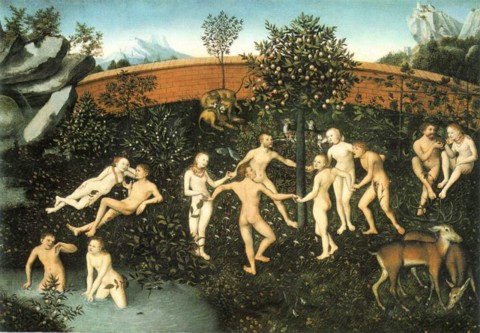
The wolf and the lamb
Since time immemorial, people have been dreaming of utopias where life is good, people live safely, and there is enough for everyone. The Bible begins with the Garden of Eden, where Adam and Eve lived happily and had no worries. With the means we have today, a utopian society is possible, yet it somehow doesn’t happen. That is because a permanent paradise with peace and harmony is unnatural. It breeds complacency. Circumstances change, the arrangement is upset, some take advantage, and chaos may ensue. We may have good places for a while, but they will eventually disappear due to the struggle for existence. Humans, like other organisms, compete and cooperate.
Humans, like other organisms, compete and cooperate. We cooperate in groups to compete with other groups. And there is competition within groups. And in the case of humans, that regularly involves murder and warfare. The competition generates a never-ending pressure to beat others, for otherwise we will lose the race. It helps us adapt to changing circumstances, but as humans increasingly create those circumstances, competition has become a destructive force. Competition makes Paradise a pipe dream for hippies high on LSD and Christians. Isaiah once prophesied, perhaps after taking in a load of mushrooms (Isaiah 11:6-9),
The wolf will live with the lamb.
The leopard will lie down with the goat,
the calf and the lion and the yearling together.
And a little child will lead them.
The cow will feed with the bear,
their young will lie down together,
and the lion will eat straw like the ox.
The infant will play near the cobra’s den.
And the young child will put its hand into the viper’s nest.
They will neither harm nor destroy
on all of my holy mountain.
For the earth will be filled with the knowledge of the Lord
as the waters cover the sea.
As the enlightened observers of the happenings in the wild might already have figured out, nature does not punish the evil, but it punishes the weak. The wolf will not let the lamb in peace, nor will the cow and the bear share a meal. It is not in their nature to do so. Living in a paradise would require a miracle of the most unnatural kind, something that can only happen in fairy tales, like the sheep joining forces to exterminate the wolves and round up the goats to fence them in. It is not like sheep to do so.
In Eden, humans only ate plants, or so the scriptures tell. There was no bloodshed, no murder, not even of animals. Compared to humans, wolves are harmless creatures. Once Paradise was lost, Cain smashed Abel’s head. That would not be the first thing wolves would do. It explains why, despite our efforts to achieve a utopian society, it still eludes us. We have the means to provide everyone with an acceptable standard of living and live in peace, but we fail to make it a reality because it goes against our nature.
Struggle for existence
The struggle for life in nature is chaotic and brutal. Cells cooperate in organisms to compete with other cells that have also organised themselves in organisms. Organising relates to the words ‘organ’ and ‘organism’, as organisms have organised themselves into organs that specialise in particular tasks. Organisms, as you might know, are plants and animals, and humans are animals. The best-adapted survive. That can put a premium on organising, as it provides participants with more resources or enables them to beat the competition by specialising. Bees have queens, worker bees, and drones. The cooperation schemes of cells and organisms are orders. Orders thus emerge from competition. Simple lifeforms like amoebas and flies have advantages of their own, such as self-reliance, which allows them to survive without complex orders. A few droppings and corpses are all flies need. Orders may collapse due to changing circumstances, such as climate change in an ecosystem or a foreign invasion in a society.
There is some balance in nature, but it is always in flux like a market with supply and demand. If foxes prey on rabbits, the fastest rabbits and the smartest foxes survive. When there is a surplus of rabbits, foxes can catch more of them and raise more young. As a result, foxes multiply and eat more rabbits, and the rabbit surplus turns into a deficit, and foxes go hungry. It is a brutal process in which rabbits get eaten, and foxes starve. The fast-growing bamboo, however, exceeds the slowly procreating panda bear’s munching capabilities. That allowed the animal to develop its cool, relaxed nature. So, if food is abundant and you breed barely, you can live in a paradise. Look at those pandas! That’s the way you do it! That’s how you live in Paradise!
Humans have disturbed the balance in nature more than any other species ever did. Nature as it once was before humans came is long gone. Humans brought rabbits to Australia, and they bred like rabbits. There were no foxes there, so the rabbit population exploded, upsetting the ecosystem. Humans then introduced a disease that killed the rabbits. The disease eventually spread through Europe, thinning out the fox’s favourite food source and upsetting the ecosystem there as well. Foxes, being smart animals, adapted and sought other meals. The rabbit’s demise sealed the fate of other animals, such as the grouse in Nijverdal, which was not as speedy as the rabbit and went extinct. It would have been possible to preserve the grouse by shooting foxes. That would create a paradise for the grouse, an unnatural order without predators, so a park rather than nature. Indeed, a paradise is unnatural, more like a garden rather than pristine nature.
Invasive species
Human activities have led to the spread of non-native species across ecosystems worldwide, such as rabbits in Australia and a rabbit-killing disease in Europe. You may have heard of Pablo Escobar’s ‘cocaine hippos,’ which, without natural predators or African droughts to slow them down, multiplied rapidly in South America, causing stress on the local ecosystem. Foreign species can disrupt the balance of nature. Many die off, but some thrive and become pests. The American red crayfish is an invasive species in the Netherlands that wreaks havoc among native fish and plant species. They didn’t come over the ocean by themselves. Humans brought them in. Invasive species can become a new food source for other species. Crayfish are a good source of protein.
Humans are the most disruptive species and have ruined most of nature to create living space for themselves. It is a matter of competitive advantage. Humans took over because they could. No one stopped them. Their genes, rather than a command in the Bible, drove them to exploit their environments and multiply. Fairy tales about the preciousness of nature were to no avail. The spread of humans resembles the spread of a pest. When Europeans gained a competitive advantage over others because they had more advanced organisation methods and technology, allowing them to conquer other areas, their genes multiplied and spread across the world.
After having created a paradise for themselves, Westerners grew complacent, and foreigners came to their lands. While Westerners were busy maximising their utility by indulging themselves in excessive consumption and value-adding jobs in the bullshit economy, the immigrants’ genes took advantage of the situation. Westerners require spacious housing, fulfilling jobs, spouses who add something meaningful to their lives and may forego having children to lead a good life. Immigrants settle for small spaces and simple lives, may have arranged marriages or not marry at all and have more children. In this way, descendants of immigrants replace the native population.
Relative advantages and disadvantages disturb the balance, which is always precarious and shifting. You can compare both situations to the development of a pest. It promotes unease among the disadvantaged group, making them feel overrun, which may lead to tensions and violence. The competition between genes generates these feelings. Your country and traditions are precious to you because your genes wish to survive and spread. The same is true for racism. There are also cultural problems and a competition between cultures. Behavioural differences between cultural groups can cause harm and lead to strife. Yet, nature doesn’t care who survives nor their cultures.
It is why peace and stability can only be maintained in an unnatural state that regulates competition in a social contract. It requires everyone to accept the order and share a common set of values, norms, and rules. To prevent disturbance of the balance, the situation must be stable, as if time has stopped. We must also stop overexploiting the planet. Otherwise, the balance will shift unfavourably. And there are always people taking advantage of others’ weaknesses. And so, there can’t be a paradise in the real world. Massive force is not enough. Nuking a place to kill the weeds doesn’t help. The weeds will return before anything else. Having a paradise requires full control over all that transpires. As Isaiah wrote, ‘For the earth will be filled with the knowledge of the Lord.’
Chimpanzees versus bonobos
Chimpanzees and bonobos are our closest relatives. Chimpanzees live in patriarchal groups led by a dominant alpha male. In chimpanzee bands, males hold higher ranks than females. Male chimpanzees are larger and more aggressive. They form dominance hierarchies where they vie for the alpha position. Human bands may have a big man, who settles conflicts and distributes favours. His position remains up for grabs. A rival can challenge his position. To remain in power, he must keep his followers happy by doling out stuff. That is human politics. High-ranking chimpanzee males form coalitions to consolidate power, maintain order, and intimidate rivals or lower-ranking females. Chimpanzees can be violent, and sometimes commit genocide on rival groups.
Bonobos live in matriarchal groups where females hold the highest ranks and lead through collective power, cooperation, and alliances. Rather than ruling through force, female bonobos secure their dominance by banding together to intimidate or attack males who step out of line. Male bonobos fight, and females might castrate unruly males, effectively amounting to a breeding programme that keeps the males docile. Hence, there is also violence among bonobos, but less than among chimpanzees. The female-led organisation in bonobo groups works in the following ways:
- Female bonobos form lifelong bonds with one another. When a male tries to assert dominance or steal food, females unite to put him in his place.
- Males remain with their mothers for life. High-ranking mothers support their sons, allowing them to rise in the hierarchy and mate.
- As females have the power, they get first access to desirable food sources.
- Rather than intimidation and violence, bonobo politics involves sex to reduce stress, ease tensions, and form social bonds.
In human societies, male dominance is the norm, so in that sense, we are like the chimpanzees. We mostly live in patriarchal arrangements. Humans are a highly programmable species, and cultures are our programming, allowing for female leadership. Our nature might resist it, but not enough to prevent it, because bonobos are genetically as close to us as chimpanzees. Yet you can witness from misogynist comments that women in leadership positions get that it may be cultural and go against our inner nature. Monogamous relationships may not work for many, but they can promote group success by reducing male infighting over mating opportunities, which can lead to violence. And as a side benefit, it prevents the spread of sexually transmitted diseases.
Garden of Eden
In the original tale of the Garden of Eden, the Goddess created man as a companion for the woman by making her give birth to him. The rib story is obviously fake, making it a lasting monument of mass indoctrination demonstrating the degree to which we are willing to believe fairy tales. The Garden of Eden was a matriarchal society. The man left his parents to live with his wife. Men existed to please their wives. They weren’t even fathers, so children were the women’s seed. That is how Eve gave birth to Adam as a ‘virgin’. To obfuscate that fact, which was a core belief of the first true Christians, the Virgin Mary giving birth to Jesus came to replace it. The Fall made woman the servant of the man, the story goes, because of her desire for him, for which he was created.
The Garden of Eden is not a natural state of affairs, but a cultural construct, as human organisation defaults to patriarchy. Bands of hunter-gatherers could avoid conflict by moving on, allowing for greater freedom in gender roles, such as matriarchy. Men were not as important, as they didn’t have to risk their lives to defend the women and children. With the advent of agriculture and permanent settlements, defence became of the utmost importance. Men fought and murdered to plunder or to protect property. In the Bible, Abel was the first casualty. Men are more violent than women. About 95% of the prison population consists of men. Most men don’t abuse women, and women can be abusive also. Still, men do nearly all the raping and culture can go a long way in civilising them.
Men are the way they are because the struggle for survival made them that way. In uncivilised conditions, that is an advantage. Yet, in more civilised environments, it becomes problematic. And when women don’t need a man to provide for them or to protect them, they become pickier. Single women, on average, are happier than single men. As a result, female-centred societies cause distress with men, as male-oriented societies do for women. Humans can’t create a paradise on their own and need God because they are more like chimpanzees than bonobos. As Paradise is not a natural state, but a cultural one, we need to engineer it. And that is not enough. Someone needs to fully control the process, as the balance is always precarious and shifting with winners and losers.
Latest revision: 3 September 2026
Featured image: The Golden Age. Lucas Cranach the Elder (ca. 1530). Wikimedia Commons.

