
When I was sixteen, the school newspaper suddenly retired. The editors lacked inspiration. It had become an infrequent occurrence, marked by political activism over cruise missiles and little to do with the school itself. They tried a new name, School Hangover, because the old name, Athok, was rather uninspiring, but for some reason, it didn’t bring in a new wave of writerly inspiration. My experience with the funny newspaper I made with my cousin led me to figure that I could be a school newspaper editor. My friend Arjen found it a good idea and contacted Erik to join the editorial board. Arjen believed Erik was a popular guy, which could help the newspaper. And even though I didn’t like him, I accepted him on the editorial board. Erik was an annoying individual. We had fought. He proved to have good writing skills, and his editorials filled the first page.
And so, the editorial board became Arjen, Erik and me. Arjen suggested adding another guy without writing skills to the board for his muscle. It probably was a joke, but I am not entirely sure. We figured we could write 6 pages every 3 weeks instead of 100 pages once or twice a year. We named the paper Ikzwetsia after a humorous paper that circulated among the fifth-graders a few years earlier. A classmate, Hendrik, added a few drawings. We filled the rag with juicy gossip about teachers and fabricated stories to make it more amusing. To show you what it was like, here are a few gossip items,
Mr. Van den Brink’s lessons from economics are not particularly interesting. Remarks from pupils, such as, ‘The snow goes more up than down,’ make this clear.
During a heated discussion, the truth came out. ‘We teachers are not people,’ said Mr. Blaak from mathematics. We had always thought this, but never dared to publish it.
At the school’s back entrance, a garbage container has been defaced with the inscription ‘new janitors’. So far, no one has dared to open this container.
Mr. Nauta from business accounting recently walked to the emergency building 400 without glasses, while he was supposed to be in the main building. He explained this coincidence with the strange statement, ‘You can only see from the inside if someone is crazy.’ Mr. Nauta forgot to mention that this can also be noticed in someone’s words.
There were also some rude jokes, like,
There is a particularly great interest in Mr. W in Hollywood. This interest has been the case since it became known that the ET doll is broken.
Some teachers were in a difficult spot. If we were aware of that, we didn’t make jokes about them, or we complimented them in disguise,
Mr. Kamps, from religion, does not believe in paranormal phenomena. So, we have at least one normal teacher walking around the school.
Mr Kamps had lost his son. These news items were facts mixed with fiction. There had never been any interest in Mr W******** in Hollywood, but he somewhat resembled ET. Somebody had written ‘new janitors’ on a garbage container. The part about no one daring to open it was a joke. Mr Kamps definitely said he didn’t believe in paranormal phenomena. Finally, Mr Nauta likely had forgotten his glasses and ended up in the wrong building, and he did explain the coincidence with that bizarre remark, but I wasn’t there when it happened. We also had political jokes like,
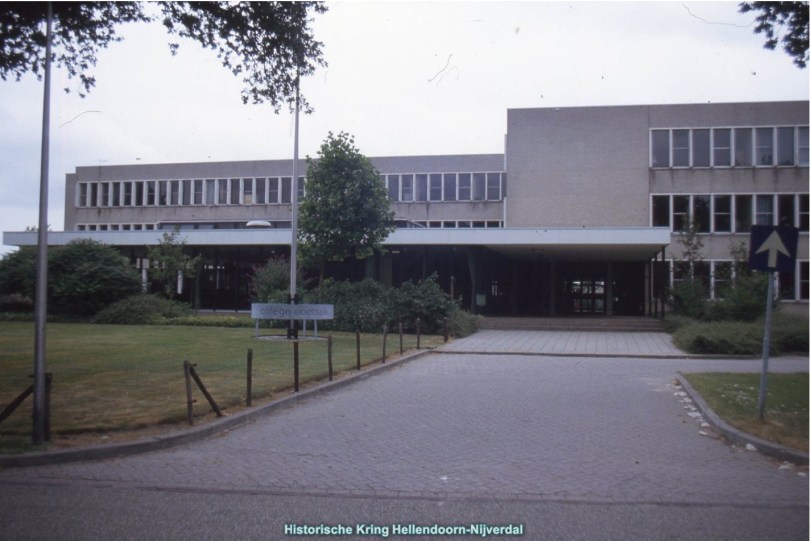
College Noetsele may be used in the film ‘Alexander Dobrin.’ In this multi-million dollar American feature film, several shots of the school building will appear. The film deals with the deplorable conditions in the Soviet gulags.
The conditions in the Soviet gulags were deplorable, and Americans were spending big on propaganda, selling us that message, or so was the intended meaning. Another item mentioned that a teacher, Mr Koster, was to take part in the film, as Karl Marx statue, that is. He looked a bit like Karl Marx and had the same posture and beard, so that’s why, not to mention the fact that he was an active member of the radical-left political party PPR (Political Party of Radicals). There was also a film section. A group of film enthusiasts who believed themselves to be cultured organised film evenings at school. Their film selection centred on artistic content. Not all of these films proved suitable for a conservative Protestant school. One of them, Narayama, featured a scene in which a man had sex with a dog. It generated a lot of ado, or, as Erik put it, ‘The suspense became too much for some people.’ They had left the building. Art must have a deeper meaning, and if that is absent, it must shock people.
Geraldine wrote some of the film commentaries. She was a girl in my class with a striking hairstyle, was a bit alternative, dressed in an outspoken way, and flaunted her interest in art and literature. Once she had written a particularly lengthy commentary on the classic All About Eve, I had shortened it a bit to fit the page, which offended her, probably because she believed the editing violated her artistic integrity. I didn’t see my writing as art, so it had to fit the available space, but she might have had a different view and believed that space had to adapt to her writing. Marilyn Monroe, who was building her career, played a small part in the film All About Eve, a noteworthy coincidence as it would later turn out.
In the paper, I indulged myself in writing an imaginary story about the school, a crime detective series with the Cultural Council, which had, amongst its tasks, overseeing the school newspaper. It had a secret service stealing the newspaper’s secrets. The editors were the police detectives solving the crime. It was a loony story featuring a teacher disguised as a standing twilight lamp, a preparation for a theatrical play that looked like a love affair between two teachers, a wild-west-style shoot-out and a dangerous-looking Basset hound with a degree in psychology. And it contained witticisms like, ‘He lay there as lifeless as a football match in Enter.’ Some children came from Enter, a village near Rijssen, and the guys were fanatic supporters of the local football club Enter Vooruit (Enter Forwards). So, apart from them, everyone had a good laugh.
Ikzwetsia became popular very fast and was a headache for the school board. Children brought copies home. Some parents complained, while other parents enjoyed reading the rag. We presumed the name Ikzwetsia would be telling enough, as it referred to the Dutch word for talking nonsense. But some people took it seriously nonetheless, so we added a cautionary note on the front page, saying, ‘Whoever takes this rag seriously is not taken seriously.’ Unlike the previous school paper, we didn’t need money from the school board. We covered the expenses with subscription fees. Sales also covered the funny newspaper’s costs, and we didn’t intend to become the school’s official newspaper, so I had prepared a budget.
Latest revision: 10 June 2026
Featured image: College Noetsele by Historische Kring Hellendoorn-Nijverdal, from MijnStadMijnDorp, CC-BY 4.0
 The Plan For The Future