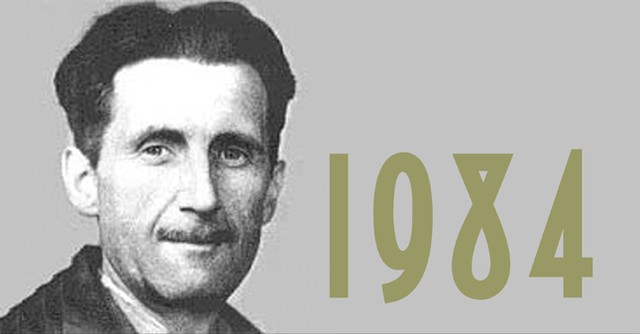
1984 and photo of George Orwell. Public domain.

Every Order Needs a Story

George Orwell worked at the British Ministry of Information during World War II. From 1941 to 1943, Orwell worked for the BBC, broadcasting propaganda talks to India. His wife worked in the ministry’s censorship division. It became the model for the Ministry of Truth in Orwell’s world-famous novel Nineteen Eighty-Four.1 The Ministry of Truth’s motto was, ‘Who controls the past controls the future: who controls the present controls the past.’ We learned that the BBC told us the truth, but that was part of the propaganda. The alternatives were Nazi Germany and, later, the Soviet Union. They had their own propaganda. No social order is objectively the best. We cooperate by believing stories, such as religions and ideologies. We can’t do without them. If we stop believing them, our societies fall apart. Every order needs a story that justifies its existence.

The Cold War was a decades-long standoff between the West and the Soviet Bloc. Two opposing myths and corresponding political-economic systems competed for global dominance: businesses aiming for profit, with their funny advertisements selling harmful products like cigarettes, versus the humourless communist cadres who wouldn’t kill us for profit but only for their socialist ideals. The Cold War included a propaganda war. Western propaganda touted our freedom to choose a cigarette brand and flavour as a way to express our personality. Smoking a brand made us feel special. The communists claimed that cigarette manufacturers kill us for profit. People in communist countries had no brands or flavours to choose from, so they didn’t feel special or unique. Yet, they held spectacular military parades every year, in which they flaunted their tanks and missiles.

In those days, Great Britain executed secret black propaganda operations that included forged documents, controlled news agencies, and enlisted journalists to disrupt its enemies and protect its interests. These operations aimed to encourage a reaction, incite violence, or foment racial tensions.2 The BBC cooperated with the UK secret services to prevent people with communist sympathies from entering the staff. In the Netherlands, secret services planted news stories3 or employed experts on the radio and television.4 You can never be sure whether the news you read or hear is fully factual. That is why people increasingly came to distrust the mainstream media.

Still, the mainstream media usually doesn’t spread fake news. They more often omit relevant facts and perspectives, which you might call lying by omission. The Dutch public broadcaster NOS reportedly passed every fact check for five years.4 Most notably, people on the right have criticised the selection of news stories and how the NOS presented them as having a leftist bias. Fascist media like Ongehoord Nederland more often spread fake news, but also report on stories and perspectives other broadcasters don’t. Like MAGA, they challenge the myths underpinning the liberal order and aim to replace them with their own. Revolutions don’t require freedom of opinion or social media. They happened in the past. Orders work as long as most people are happy with them. Orders collapse once people stop believing the myths underpinning them. Yet, every order comes with myths that are, to some degree, false. Nationalism and tribalism cause warfare.

Freedom of opinion exposed the myth of the liberal order being the best. Western leaders have used false flags or invented stories about weapons of mass destruction and spread them via the media. The US started the Vietnam War after falsely claiming the North Vietnamese navy had attacked US ships in the Gulf of Tonkin. The US invaded Iraq after falsely claiming the country had a stash of weapons of mass destruction. The former US Ambassador to the United Nations, Madeleine Albright, once said sanctions on Iraq were worth the deaths of half a million Iraqi children, which was the estimated death toll of the sanctions the West had imposed on Iraq. In the West, people were allowed to criticise their leaders’ actions. That was impossible in the Soviet Union and China. It brought the West closer to the truth that no order is objectively the best.

Had the West not enjoyed military and economic superiority, the liberal order might have collapsed earlier. Life under Soviet, Muslim or Nazi rule would have been quite different. The myths we believe in arise from an interplay of historical forces, in which religions, ideologies, and other myths, such as those of national greatness, compete to organise people. You can call these myths ‘mind bugs’. Their evolutionary purpose is to help our genes survive and spread. The myths we now believe in have survived the competition. These myths are also models of reality, so they are often correct to some extent. The freedom of opinion in the West stems from a belief in objective truth, established through the investigation of facts and the examination of possible explanations. That has been the foundational pillar of the West’s success, as it brought us science.

The weak point of the whole endeavour is that we imagine our realities, which opens a can of worms, as you can connect the dots in infinite ways if you ignore facts that contradict your views, which we are wired to do, since we are creatures who cooperate based on myths. The measure of success is survival, not truth. Yet, in the end, only the truth might save us. And with the rise of connectivity, imaginations can cross-pollinate, leading to an explosive rise in freak thinking. Yet, there is one truth, and we may pinpoint it by eliminating contractions with observed facts. If only the truth can save us, those who deny it are suicidal morons who will drag us down with them. You can’t win debates from morons as we imagine our realities, so making them accept the truth may require force.

Had the Church succeeded in repressing free thinking in the Middle Ages, which included replacing the Christian ethic of modesty with the merchant’s ethic of greed and flaunting wealth, modernisation wouldn’t have happened, and the Western mindset would have looked more like the Islamic worldview in the Middle Ages than the West as it is today. If you believe that objective truth exists, whether you think to know it or seek it, pursuing it brings progress, so you would favour freedom of opinion to spread your message or to find out what the truth is. It gave the West a competitive advantage, so freedom of opinion has become ingrained in Western culture. It became part of a dynamic that never stops, driven by the competition between corporations and between nation-states.

Freedom of opinion is also a myth. Still, a myth has power. Believing a myth can make it work. The euro has value because we believe it has. Once we stop believing that, the euro becomes worthless. The value of the euro is something we imagine. So, there is more freedom of opinion in the West than in most other places. Yet, those who pose a threat to the order know that there are limits to freedom of opinion. Julian Assange founded WikiLeaks, which published documents obtained by hackers, thereby exposing human rights violations by the US secret services. The United States considered these revelations a national security threat. On 1 November 2019, UN Special Rapporteur on torture, Nils Melzer, wrote, ‘While the US Government prosecutes Mr. Assange for publishing information about serious human rights violations, including torture and murder, the officials responsible for these crimes continue to enjoy impunity.’6

Every social-political order comes with a story explaining why it is the best. Without an inspiring myth, we can’t have an order. The foundations of our orders are stories like the founding fathers drawing up a constitution with great wisdom, or a she-wolf raising the founders of the empire, as in ancient Rome. Most of the time, revolutions and civil wars are worse than dealing with the omissions and falsehoods in the stories that hold the existing order together. But not always. That is why revolutions do happen, but are rare. But as long as we don’t believe the same stories, we will fight each other. The orders we have today are the outcome of a competition, not some objective measure of quality. The success of an order depends on the circumstances, and also whether we believe in them.

In today’s globalised world, there are several competing stories. There is a Christian story, an Islamic story, a socialist story, numerous nationalist stories, a story about slavery and the civil rights movement, a conspiracy theorist’s tale, the story of indigenous peoples, a Hindu story, a Chinese story spanning 2,000 years of greatness, and many others. Often, these stories figure into identity politics, so the Chinese like tales about China’s greatness. Finally, there is a liberal story of individual freedom centred on the Magna Carta, the European Enlightenment, the Glorious Revolution, the American and French Revolutions, universal suffrage, and the overcoming of fascism in World War II, in which D-Day, rather than Stalingrad, serves as the hallmark event. Children in the West learned it at school. It is a skewed version of history to explain why the liberal order is the best.

These stories are falling apart in this globalised world. And they can’t unite us, which will lead to more wars and conflicts. The Magna Carta and the Glorious Revolution mean nothing to Chinese, Indians or Africans who look at a colonial past of oppression and exploitation. If you aren’t a Christian or a Muslim, Christianity and Islam strike you as odd. Others show little interest in China’s rich history or the stories of the indigenous peoples of the Americas. The Hindu caste system makes only sense to Hindus. We are imaginative creatures and invent new myths. Some believe them, adding to the confusion. The belief in different stories will ruin us. And so, freedom of opinion is overrated. We need a story that can unite us all and is obviously true. Only The Truth can save us now. And then, we all have to believe it and accept the consequences. Otherwise, we are doomed.

Latest revision: 16 May 2026

Featured image: 1984 and a photo of George Orwell. Public domain.

1. Orwell, 1984 and the Ministry of Information. Dr Marc Patrick Wiggam. School of Advanced Study, University of London (2017). [link]
2. Britain’s secret ‘black propaganda’ operations. John McEvoy (2026). Declassified UK.
3. Nederlandse media drukten artikelen af die waren geschreven door veiligheidsdienst BVD. Bart Funnekotter, Joep Dohmen (2023). NRC.
4. Geheime diensten gebruiken ‘onafhankelijke experts’ om publiek debat te sturen. Sebastiaan Brommersma (2024). Ftm.nl.
5. Mediabiasfactcheck.com. Netherlands Radio and Television Association (NOS) – Bias and Credibility. (2023).
6. UN expert on torture sounds alarm again that Julian Assange’s life may be at risk. United Nations (2019). [link]

US Declaration Of Independence

What a Social Order Needs to Be

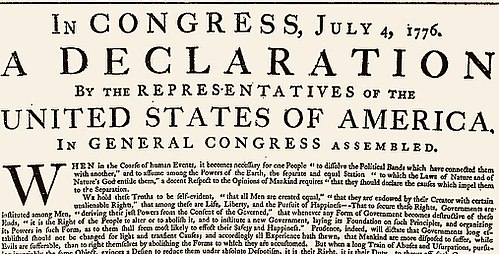
Humans imagine that they have rights and obligations and belong to social classes. This is what is meant with social order. There has been a variety of rights and obligations and social classes throughout history.1 Societies usually have a ruling class who invents the social order and benefits the most from it. A social order needs some kind justification to convince everyone to accept the rules that come with it. That is where religion comes in. You can compare the Code of Hammurabi, a Babylonian law from 1750 BC, with the United States Declaration of Independence from 1776 AD.

The Code of Hammurabi declares that the Babylonian social order is based on universal and eternal principles of justice dictated by the gods. It divides people into three classes, nobility, ordinary people and slaves. The code then sets out all kinds of laws and punishments for transgressions. The United States Declaration of Independence begins with the following words:

“We hold these truths to be self-evident, that all men are created equal, that they are endowed by their Creator with certain unalienable rights, that among these are life, liberty, and the pursuit of happiness.”

On closer inspection 3,500 years didn’t make a lot of difference. The eternal principles are replaced by self-evident truths but the order still needed divine support. There is no mentioning of classes. All men are created equal. But the devil is in the detail. Women and slaves did not have these unalienable rights when the constitution was written. Only nobility was done away with as businesspeople were the new ruling class. In the 200 years that followed slavery was abolished and women received equal rights before the law, but businesspeople are still the ruling class.

Saying that people are equal and have equal rights is problematic. People are not equal in their abilities as well as their opportunities. For example, we can imagine the right to live but we all die. Some people die young while others live very long. Many people are poor and have no access to good education. Some are rich and can go to the best universities. Still, we imagine that people have equal rights, just like the Babylonians imagined that people are divided into classes.

Social orders are the result of history, economics, and politics. Ideas are at the basis of them. Equality is a revolutionary and modern idea that has gained ground during the last centuries. It has affected political orders on every corner of the globe. Even the worst dictators now say in public that all people are equal.

A social order is also a collective imagination. A social order doesn’t exist in reality as such, but only in the minds of people. If people agree on a social order, whether it is a division into classes or the notion that everyone is created equal, it can be stable. Social orders bring peace and stability and that is the most compelling reason to have them. If people agree on a social order they can cooperate more easily as the order settles many matters that would have to be negotiated otherwise. A reason why certain social orders prevail over others is because they create more powerful societies.

Featured image: United States Declaration of Indepence

1. Sapiens: A Brief History Of Humankind. Yuval Noah Harari (2014). Harvil Secker.

Liberal democracy

A definition

Democracies are often called liberal democracies. So what is a liberal democracy and why might it be the best way of government? There are no easy answers to these questions nor is there agreement on these matters. Liberalism emphasises the value of individuals while democracy is rule by majority. These two principles can be at odds.

Liberal democracies have elections between multiple political parties, a separation of powers into different branches of government, the rule of law in everyday life, an open society, a market economy with private property, the protection of human rights, civil rights, civil liberties and political freedoms for everyone.1

Liberals believe that individuals and social groups have conflicts of interest. The social order must deal with these conflicts and resolve them in a peaceful manner. To achieve such a feat, all parties must be reasonable and there should be a balance of powers. No party should be able to force its will upon others.2 It is an important reason why liberals stress the importance of individual rights.

Democracy means that government decisions require the consent of the majority of the citizens. In most cases the citizens elect a parliament that does the decision making for them. Sometimes citizens can vote for individual proposals in referendums. In reality many democratic countries aren’t fully democratic because not all government decisions are supported by a majority of the citizens.

Principles

Liberal democracy is based on a social contract, which is an agreement amongst the members of society to cooperate for mutual benefits. For instance, labourers may accept capitalism if they get a share of prosperity. That deal turned out to be more attractive than state ownership of the means of production.

Liberalism has two principles that can be at odds, namely non-interference with people’s lives and realising everyone’s potential. In this vein there are two branches of liberalism:

  • Economic liberalism promotes freedom of the markets as well as free trade and claims that the state should be of minimal size and not interfere with people’s lives.
  • Social liberalism claims that the state should help to realise the potential of people by promoting their freedom to make choices, which includes ending poverty.

Each liberal democracy more or less embraces these values. Liberal democracies come with a market economy and respect for the rights of individual citizens. Governments interfere with the lives of people and try to promote their happiness and to realise their potential. The conflicting nature of both principles makes liberal democracies differ with regard to freedom of markets and government interference.

In the United States liberalism has a different meaning. There it is another word for social liberalism or democratic socialism. In Europe the definition of liberalism is broader and this is also the definition used here. In the 17th century liberal ideas began to emerge in what is called the European Enlightenment. Around the year 1700 the philosopher John Locke came up with the following basic principles for a liberal state:

  • a social contract in which citizens accept the authority of the state in exchange for the protection of their rights and property and maintaining the social order;
  • consent of the governed, which means that state power is only justified when the people agree;
  • separation of church and state, which means that the state doesn’t favour a specific religion and does not require a religious justification.3

Is it the best form of government?

Liberal democracy is part of the European cultural heritage. Proponents claim that it is the best form of government. These universalist claims are sometimes contested on the ground that they are a form of western cultural imperialism. Another argument is that there is no guarantee that liberal democracy leads to better decisions. From a religious perspective people argue that our Creator may prefer a different kind of social order and government, possibly even a theocracy.

The argument in favour of the universalist claims is that liberal democracy emerged out of a historical process that took centuries in which rational arguments played a decisive role. The European Enlightenment challenged existing practices in government on the basis of reason. Ideas that emerged out of the European Enlightenment were tried out in different ways and refined further. Europeans also invested heavily in educating their citizens. This produced a culture of reason and compromise as well as a massive body of practical experience and best practises.

There is also no guarantee that other forms of government lead to better decisions. In an open society better information can be available so well-educated citizens in a culture of reason and compromise may make better decisions. There are a few democracies that live up to these expectations so it can work out that way. And we may not be able to determine what kind of order God desires. If our Creator is all-powerful then the emergence and spread of liberal democracy may not be God’s plan.

One of the biggest problems facing liberal democracy is high expectations. Liberal democracy itself does not guarantee a reliable government that is both efficient and effective nor does it ensure a flourishing economy. This has led to disappointments. A failed and corrupt government can’t simply be turned into a success by allowing elections. Liberal democracy works best with a well-educated population in a culture of reason and compromise that doesn’t allow for corruption and abuse of power.

On the moral front there are a few issues too. Liberal democracy promises equal treatment for all people. In reality people aren’t treated equal nor do they have equal opportunities. There is discrimination based on ethnicity, gender or sexual preferences. And poor people have fewer opportunities than rich people. Still, the goal of equal treatment and equal opportunities can be something to strive for. It may be better to aim for such goals and fail from time to time than not having these goals at all.

If liberalism promotes tolerance then how to deal to intolerant people? Should their intolerance be tolerated? If people do not accept liberal values, should they be educated or should these values be imposed? And are free markets the best way of organising the economy or is government involvement advised? If the economy is served by stability, should dissent that causes instability be suppressed? An excessive or unnecessary use of force can undermine the foundation of liberal democracy as liberal democracy is based on reason and convincing people by argument. And indeed it is possible that liberal democracy can be overturned.

History

The preconditions for liberalism had already emerged in Western Europe during the Middle Ages. There was a larger degree of individualism than elsewhere. Liberalism itself emerged during the sixteenth century. At the time Europe was ravaged by devastating religious wars. After several decades of warfare Europeans grew tired of the conflict and began to tolerate religious differences. Some catholic countries accepted protestant minorities while many protestant countries accepted catholic minorities. Germany was almost equally divided. At the time Germany consisted of small states that had either protestant or catholic rulers.

This religious tolerance was at first more or less an uneasy truce. No party had been able to gain the upper hand. Religious minorities at first didn’t receive equal rights. They were only tolerated. Over time the case for religious tolerance became more widely accepted. It was based on two major arguments.

  • The argument of ignorance which states that only God knows who is on the right path and who is doomed so humans shouldn’t judge others.
  • The argument of perversity which states that cruelty is at odds with Christian values and that religious persecution strengthens the resolve of the persecuted.1

The concept of tolerance expanded into a general concern for the rights of individual citizens. In the 17th century liberal ideas were spreading. The Glorious Revolution of 1688 in England limited the power of the king. The rights of individuals were written down in the Bill of Rights. Parliament became the most powerful political institution based on the principle of consent of the governed. The 1776 Declaration of Independence of the United States was based on liberal principles too. It states that all men are created equal and have certain unalienable rights like life, liberty, and the pursuit of happiness.2

The founding fathers of the United States were also early liberals. The United States Constitution reflects this view. The aim of the United States Constitution is, amongst others, to safeguard the rights of individuals against the state. A large group of Americans believe that individual rights should prevail against democratically elected governments. The widespread support for gun ownership in the United States comes from a distrust of the state as a protector of life, liberty and possessions.

Democracy had not been a seriously considered since classical antiquity. It was believed that democracies are inherently unstable and chaotic due to the changing whims of the people.1 The violence during the French Revolution supported these views. It began as a popular uprising incited by liberal ideas but it soon turned into chaos and bloodshed. Order was restored by a despot ruler named Napoleon Bonaparte who did much to spread liberal reforms throughout Europe by ending the feudal system, emancipating religious minorities and imposing a liberal code of law. The spread of liberal ideas proved to be lasting and democracy was to follow a century later.

The Industrial Revolution started a period of accelerated and constant change that was disastrous for many who found themselves on the losing side. The ruling class changed. Nobility was replaced by a new elite of business people. The position of craftsmen was undermined by factories. And workers in factories laboured under miserable conditions for low wages. There were three major ways of confronting these changes:

  • Conservatives tried to hold on the old order of community, religion and nobility.
  • Socialists tried to overturn the elite of business people by giving power to workers.
  • Liberals tried to manage the change, thereby implicitly supporting the order in which business people were the ruling class.

Liberalism often coincides with the interests of business people. They have possessions and some are rich. They feared that the poor might vote for handing over their possessions to the poor. Socialism became the embodiment of this fear. Liberals were at first inclined to limit the right to vote to people who pay taxes because this excluded poor people from voting. When the threat of socialism became subdued and socialists were willing to compromise, liberals came to accept democracy based on the principle of one person one vote.

In the 19th century European countries held vast colonial empires. These colonies were kept for profit. It was generally believed that the people in these colonies had to be educated before they would be able to govern themselves. The colonial era helped to modernise these countries and most Europeans at the time believed that the oppression and the economic exploitation were justified on these grounds. There were only a few dissenters, for instance the Dutch writer Multatuli.

Liberal democracy faced a few major crises like World War I, the Great Depression and World War II. World War I demonstrated that liberal democracy and free trade weren’t a guarantee for peace and stability. The Great Depression once again challenged liberal democracy as the Soviet Union remained unaffected while Nazi Germany was able to recover and achieve full employment while other countries were still struggling. And during World War II Nazi Germany overran most democratic countries in Europe.

After World War II the European colonies became independent. The Soviet Union came to dominate Eastern Europe and China became a communist country. The United States became the protector of liberal democracy but also a number of dictatorships. This era is called the Cold War and it lasted until the Soviet Union dismantled itself after allowing the peoples of Eastern Europe to make their own choices. Major challengers of liberal democracy nowadays are the one-party system in China and political Islam.

The citizens of Hong Kong and Taiwan don’t like to lose their freedoms. Chinese too probably prefer freedom if they have a choice. And the Islamic State has shown Muslims all around the globe that political Islam can easily turn into a reign of terror. The foundations of liberal democracy may be strong, but a collapse of the global economy may turn be a more serious threat to liberal democracy than the alternatives. Reason can easily disappear once people become fearful of the future.

Reasons for success and limitations

The success of liberal democracy is therefore not a historical necessity. Liberal democracy might never have been invented or dictatorships could have gained the upper hand. That didn’t happen. Communist and fascist dictatorships came and went. Perhaps liberal democracy is a temporary phenomenon but we can’t know that now. Only the future can tell. There are a number of causes that might explain the strength of liberal democracy.

  • Liberal democracy is based on the consent of the governed so it is has the consent of the governed by default while other forms of government do not.
  • Science greatly contributes to the success of states and science is best served with an open debate that liberal democracy provides.
  • The economy greatly contributes to the success of states and the economy is best served with individual rights that liberal democracy provides.

A despot ruler or a ruling party in a one-party system might have the consent of its subjects, but if not, only force remains for the ruler or the party to maintain power. Liberal democracies usually resolve such issues peacefully through elections, making liberal democracy more stable by default. Intellectual freedom is helpful to science while economic freedom is helpful for the economy, so liberal democracy can be a potent force. Only when leadership is required, liberal democracy might not always be adequate.

Liberalism has no higher moral value than the individual, which is peculiar because the individual human is an insignificant part of this universe. And individualism may be at odds with human nature as humans are social animals. Humans are not atomic beings that choose to cooperate for mutual benefit like liberalism supposes. Cooperation is part of human nature and not a choice individuals deliberately make.

It is the success in cooperation that makes a society win out. Liberalism gives a framework for living together in peace as long as all major parties are reasonable and willing to compromise. This makes larger scale cooperation possible and that can make a society successful. For instance, the United States integrated people from different cultural backgrounds, which contributed to the success of the United States as a nation.

It is said that history is written by the victors. Strength may be the reason why liberal democracy prevailed. Liberal philosophers have tried to provide a moral justification for liberal democracy or they may have opposed it or they may have tried to improve it. Liberal democracy emerged out of thought and action, experiment and failure, and it was a process that took centuries. Philosophers like Locke contributed to its success as they set out the goals people could strife for.

Apart from individualism, liberal societies lack a higher purpose. From a scientific viewpoint there is no higher purpose to this universe. The moral codes humans live by are not more than an agreement. Only when this universe is created for a purpose there is a reason for our existence. But moral individualism can be dangerous. The challenges humanity is currently facing, most notably living within the limits of this planet, most likely requires making individuals subject to a higher causes like the survival of humanity and caring for the planet.

1. Liberal democracy. Wikipedia.
2. Liberalism: The Life of an Idea. Edmund Fawcett (2015). Princeton University Press.
3. History of liberalism. Wikipedia.