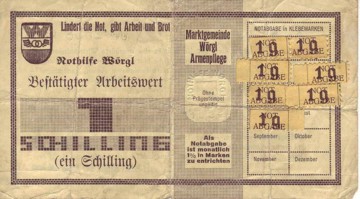
Wörgl bank note with stamps. Public Domain.

Miracle of Wörgl

In the middle of the Great Depression, the Austrian town of Wörgl was in deep trouble and prepared to try anything. Of its population of 4,500, 1,500 people were without a job, and 200 families were penniless. Mayor Michael Unterguggenberger had a list of projects he wanted to accomplish, but there was not enough money to carry them out. These projects included paving roads, erecting streetlights, extending water distribution across the whole town, and planting trees along the streets.1 2

Rather than spending the remaining 32,000 Austrian Schilling in the town’s coffers to start these projects, he deposited them in a local savings bank as a guarantee to back the issue of a currency known as stamp scrip. A crucial feature of this money was the holding fee. The Wörgl money required a monthly stamp on the circulating notes to keep them valid, amounting to 1% of the note’s value.1 2 An Argentine businessman named Silvio Gesell had come up with this idea in his book The Natural Economic Order.

Nobody wanted to pay for the monthly stamps, so everyone spent the notes they received. The 32,000 schilling deposit allowed anyone to exchange scrip for 98 per cent of its value in schillings. Hardly anyone did this because the scrip was worth one Austrian schilling after buying a new stamp. But people did not keep more scrip than they needed. Only 5,000 schillings circulated. The stamp fees financed a soup kitchen that fed 220 families.1 2

The municipality carried out the intended works, including new houses, a reservoir, a ski jump and a bridge. The key to this success was the fast circulation of the scrip money within the local economy, fourteen times higher than the schilling. It increased trade and employment. Unemployment in Wörgl dropped 25% while it rose in the rest of Austria. Six neighbouring villages copied the idea successfully. The French Prime Minister, Édouard Daladier, visited the town to witness the ‘miracle of Wörgl’ himself.1 2

In January 1933, the neighbouring city of Kitzbühel copied the idea. In June 1933, Mayor Unterguggenberger addressed a meeting with representatives from 170 Austrian towns and villages. Two hundred Austrian townships were interested in introducing scrip money. At this point, the central bank decided to ban scrip money.1 2

Since then, several communities have issued local scrip currencies. None of them was as successful as the currency of Wörgl. The reasons probably are:

  • There was no economic depression, and the economy could support interest, so introducing scrip money had little effect.
  • If scrip money is not widely accepted, people will exchange it for regular currency if they can’t use it.

In Wörgl, the payment of taxes in arrears generated additional revenues for the town council, which the town council spent on public projects. Once the townspeople had paid their taxes, they would have run out of spending options and might have exchanged their scrip for schillings to avoid paying for the stamps. That never happened because the central bank halted the project.

There are, however, a few issues to consider. The economy of Wörgl did well without issuing debt because the money kept circulating. A negative interest rate induces people to spend the money they have, so no new money has to be borrowed into existence to stimulate the economy. A holding fee makes negative interest rates possible as you do not have to pay it when lending money. For instance, lending out money at an interest rate of -2% is more attractive than paying 12% for the stamps. If we can uncover the conditions for it to work, remove its flaws, and plan for the consequences, we can have a usury-free financial system.

Natural Money

Introducing negative interest rates in the global financial system may have great benefits. The website Naturalmoney.org features an in-depth research of the feasibility and consequences of negative interest rates.

Read More

If you like this post, then you might also like:

Joseph in Egypt

Ancient Egypt had a similar type of money for more than 1,000 years. There is an account in the Bible that may explain how this money came into existence.

Read More

The future of interest rates

In the long run most capital ends up in the hands of the capitalists. Negative interest rates are the logical consequence.

Read More

Latest revision: 6 April 2024.

Featured image: Wörgl bank note with stamps. Public Domain.

1. The Future Of Money. Bernard Lietaer (2002). Cornerstone / Cornerstone Ras.
2. A Strategy for a Convertible Currency. Bernard A. Lietaer, ICIS Forum, Vol. 20, No.3, 1990. [link]

Witbreuksweg dormitory

Meaningful Coincidences

On 15 July 2011, two television towers in the Netherlands caught fire. One collapsed spectacularly. There had never been a fire in a television tower in the Netherlands. These television towers had been there for over fifty years. And there were only twenty-four of them. A few people speculated about these incidents having a common cause.1 The towers are in different areas, making a common cause unlikely unless there is intent. After all, what is the chance of two aeroplanes crashing into both towers of the World Trade Center in New York on the same day? Only there was no evidence suggesting intent or a common cause. That makes it very mysterious.

Consider this coincidence from Bermuda, which is near the mysterious Bermuda Triangle. In 1975, a 17-year-old boy had a deadly accident while riding his moped. He died exactly a year after his 17-year-old brother died in an accident while riding the same moped in the same intersection and collided with the same taxi with the same driver, carrying the same passenger. Repeating patterns may have contributed to the incident. Perhaps it was a dangerous point where accidents frequently occurred. The passenger may have visited Bermuda once a year and taken a taxi from the airport to the same destination each time.

In 1992, I was bicycling in Groningen, where I lived at the time. On the way, a car door suddenly opened just before me. I could barely avoid a collision. About ten minutes later, on the same trip, it happened again with another car on another road. Never before or after this trip had a car door opened in front of me, even though I had made bicycle trips nearly every day for several decades. It is odd. But what are the odds?

Those incidents might be random events. Many things happen all the time, so bizarre accidents occur by chance. It doesn’t require a Supreme Puppet Master to make them happen. It may be hard to calculate the probability of an event like two television towers catching fire in one country in one day, but it is very low. Only, the number of possible strange incidents is very high.

But how low and how high? That matters tremendously. If there are a million possible events, and the chance of one happening on any given day is one in a million, we should not be surprised when one does. On average, an event like that should happen every day. If it is one in a trillion, and such an event occurs quite frequently, we are on to something, because, on average, it should happen once every million days.

The number of possible strange coincidences is infinite, so it shouldn’t surprise us that simple coincidences, such as a car door opening in front of me twice on a single bicycle trip, happen from time to time. It is, however, odd that it happened twice on one trip and never on any other. Coincidences come in different types. The more intricate a coincidence is, the less likely it is to occur. Indeed, some complicated coincidences are far less likely to occur than two car doors opening on one bicycle trip.

The following falls in the latter category. Once, I entered a do-it-yourself store. There was a couch near the entrance. The price tag of € 389 caught my attention. As a student, I lived in dormitory 389 on the campus. Price tags often end with a nine, so there was nothing suspicious about it, I concluded. Strange things had happened, so I tried to convince myself that it was not unusual. I realised it would be far more curious to find a price tag of € 401, as I had also lived in building 401, and price tags rarely end in a 1.

A few seconds later, I ran into a pile of bags of potting soil. These bags had a conspicuous lettering ’40l’, indicating they contained 40 litres of potting soil. That was close enough to 401 to be intriguing. There were no other types of bags on the spot. Potting soil is available in 10, 20, 25, 40, and 50-litre sizes. Sacks of 40 litres also come with markings such as ’40L’ and ’40 litres’. Hence, the ’40l’ was indeed remarkable.

Two years later, I returned to the same store. These bags of potting soil, marked ’40l’, stood conspicuously stacked near the entrance, reminding me of the previous incident. There was no couch, and I did not see a € 389 price tag there. I contemplated this while fetching the item I planned to buy. Its price tag was €3.89, and I had gone to the store to purchase that one item.

That is far less likely to happen than two car doors opening before me on the same bicycle trip. The events interacted with my thoughts, and the sequel made it even more improbable. The car doors opening could be a coincidence, but the do-it-yourself store incident should boggle the mind, provided one is allowed to think. In one of those dormitories, I met a most peculiar Lady. Since then, a series of noteworthy coincidences have transpired, reminding me of that. This coincidence thus also fits into this scheme, further heightening its peculiarity.

To make the coincidence happen, the bags of potting soil had to be in place, so I would run into them just after thinking of 401. And later, I had to go there to buy an item for € 3.89. And it goes much further than that. The scheme encompasses the item having a price tag of € 3.89, and my having lived in dormitories 389 and 401. That is most peculiar indeed. So much can go wrong. Imagine the bags’ content being 50 litres, the lettering being different, or me visiting another do-it-yourself store or buying another item the second time, and the scheme would fall apart. Perhaps it is a mere coincidence, but it is less likely than two car doors opening in front of me during the same bicycle trip.

On the evening of 11 October 2025, my wife and I watched episode ‘Demon 79’ of the Netflix series Black Mirror. The story played in Great Britain in 1979. It turned out that the murder of two people by a psychotic shoe saleswoman, following orders of a demon disguised as Boney M band member Bobby Farrell, proved insufficient to ward off the apocalypse. The apocalypse proved to be a nuclear war. After watching it, I went to bed. The next morning, I first read the news headlines on the teletext page 101 of the Dutch public television, and found out that two people had died at age 79, actress Diane Keaton and singer Joost Nuissl. So, two people died, thus not enough to ward off nuclear war. Two days later, on 14 October 2025, a NATO exercise named Steadfast Noon began. It included dropping fake atomic bombs above the area where I live. ‘You can sleep peacefully,’ a NATO spokesman added.

Latest revision: 14 October 2025

Featured image: Number 381 dormitory. University Of Twente (2013). [copyright info]

1. Onderzoek: Hoe konden twee zendmasten vandaag in brand vliegen? Algemeen Dagblad (15-07-2011). [link]