
Master of my own destiny?

It’s a miracle

In early 1993, I started to look for a job. My first application was for an IT traineeship at Cap Gemini. They had sixteen vacancies. Some 1,600 people applied, of which they selected 200 for a series of tests. I was one of them. Before these tests began, other applicants told stories about assessments and job interviews they had gone through. The economy fared poorly, so there weren’t a lot of jobs. Many graduates were already searching for a long time. It was discouraging, so I expected to remain unemployed for quite a while.

That was not meant to be. The tests went well, and they invited me for an interview and some more psychological tests. On my way to the appointment, a guy I knew from dormitory Witbreuksweg 389-2 came sitting on the opposite seat on the train. He asked me why I was wearing a suit. I told him about the interview. Then he started to laugh loudly. ‘Your tie is a mess,’ he said, ‘Let me fix it for you.’ He then arranged the tie correctly.

If this event, which appeared accidental at the time, hadn’t happened, they may not have hired me. The interview and the tests went well. My misfortune because of not fitting in during my student years made me investigate cultures and cultural differences. It wasn’t hard for me to translate the expectations of Cap Gemini concerning its employees into test answers. And so, the test results made it appear as if I fitted perfectly into the corporate culture of Cap Gemini. Cap Gemini stressed I was the master of my own destiny. It was one of their company slogans.

They hired me and sent me to a junior programming class to prepare for my first assignment. My self-confidence was low as I had manipulated the test. Perhaps, I didn’t fit in. And it was shortly after the encounter with Suzanne. I was afraid to turn up because I felt unfit for the job. These feelings receded once the class had started. We learned about programming. I was often joking about a programme I was planning to write. I nicknamed it DoEverything as it was supposed to do everything, which is noteworthy because we may be part of such a programme.

My classmates often discussed what car they would choose once they were on the job. I was the only one planning to use public transport. Not surprisingly, I was not a model employee. One classmate, a cheerful guy from the Eindhoven area named Ad, expressed his amazement about the fact that I passed all the tests. ‘There were 1,600 applicants. And they picked you? It’s a miracle! How could that happen?’ Ad and I had a good laugh about it. His last name referred to Burgundy. In the Netherlands, a Burgundian lifestyle denotes enjoyment of life and good food, most often found in the vicinity of Eindhoven. And Ad radiated this lifestyle. He seemed the personification of it. His first name and the region he came from make another peculiar coincidence in light of later developments.

With regard to the work that awaits us

My first assignment was on a project at the Groningen office of Cap Gemini. I became part of a team of six with a few colourful personalities. Our customer had hired us but didn’t come up with work. For months we had nothing to do, but we had a lot of fun. And I had more fun than I ever had during my student years. Our project manager was ambitious. He organised project meetings and demanded progress reports he could present to senior management even though we did nothing. One of us was a graduated linguist, so he used his skills to produce eloquently written progress reports. For instance, he wrote, ‘With regard to the work that awaits us, we can only assume a wait-and-see attitude.’

Another guy was a hippie and had been part of the squatters’ movement. He always wore the same orange sweater. Perhaps, he had two orange sweaters, but I am not sure. He was the type of guy who might wear the same sweater for months. He often made fun of the project leader and his ambitions. At the time, Windows was gradually becoming the standard operating system. It had new features like WAF files for sounds. Some team members played around with these features, so if I started my computer, it sometimes made an unexpected noise. I had so much time on my hands that I familiarised myself with database administration. After a few months, the work came in, so the project manager was busy managing our work. He constantly demanded progress updates.

We soon realised we would miss our deadline at the end of July. Before the project manager went on a holiday, he discussed the situation with our customer and arranged a new deadline date at the end of August. Once he was gone, things suddenly went smoothly, so we met the original deadline date in July, possibly because the project manager stopped managing us. When he returned, the programmes were already running at the customer’s site. His superiors praised him for delivering a month ahead of schedule. He was on his way to a great career. Perhaps he received a bonus too.

There is room for improvement

The next job was restructuring a database at a telecommunications company. I had some database knowledge. And my managers were impressed that I had familiarised myself with database administration. And so, I did get that job. The company doubted the capabilities of their database administrator, so they hired me to reorganise one of their databases. They took this delicate task out of the hands of their own database administrator and gave it to me, a novice with little experience. And so, their database administrator didn’t like me from the start. And I didn’t follow his advice because he was a bungler. After all, that was the reason they hired me. And he was showing off his expertise by using incomprehensible language, so I often had no clue what he was talking about.

It was a highly political environment. The telecommunications company had been a government operation for a long time, but the government had just privatised it and put its shares on the stock market. The board wanted to purge the old-fashioned government bureaucrats from management positions. And the department I worked for was led by a risk-averse bureaucrat fearing for his job. If something went wrong, his head might roll. And the database administrator might have felt that his position was on the line too. He often complained about me to his manager. And the manager passed on these complaints to Cap Gemini. I also had a team leader who knew the situation and gave a more accurate depiction of what I was doing to his manager and my account manager. That is why they didn’t take me off the job.

And I caused a major accident. To reorganise the database, I needed a list of the tables in the production database and their sizes. Production is the database that matters. The data in the production database is precious. For that reason, I had no access to the production database. There are also databases for development and testing. But I needed production data, so I prepared a file named tablelist.sql containing a query that delivered the necessary data. And for once, they allowed me to access the production database using a tool called SQL Plus. I could start the script by typing @tablelist and pressing enter. I started typing @t. The system didn’t respond, so I pressed enter to see if there was any response at all. And then, I saw the system respond with table dropped, table dropped, table dropped. I cancelled it, but it was already too late. Some precious data was already gone. The operators restored a backup of the previous night, so a day’s work was lost. The database administrator had left a file named t.sql in the SQL Plus directory, dropping all the tables. It was an accident waiting to happen. And even though everyone knew that, the incident reflected poorly on me. With the benefit of hindsight, it was odd. How much bad luck can you have?

Because of the fuss, Cap Gemini sent me to a course called Professional Skills. I was not politically sensitive, and that could be a handicap when you work at the site of a customer. I was aware of that as I had a way of formulating things clearly, so I considered it a good idea. And the course taught me something. For instance, positive framing can contribute to a better atmosphere. You can call it political correctness. So if it is a complete mess, you can say, ‘There is room for improvement.’ Even though it is the same mess, it sounds a lot better. After all, a consultant’s primary responsibility is not to solve problems but to make money for Cap Gemini by making the customer happy. I let it all pass by, concentrated on my task and successfully finished the database restructuring job.

My next assignment was at the real estate department of the telecommunications company. They hired me to make database queries in their financial system for management information. Usually, managers or salespeople wanted a report promptly. It was always very important and, of course, very urgent. I called them jokingly life-and-death queries. It took a few hours to write a query, check the validity of the output, and deliver the report. By then, it often wasn’t needed anymore. The availability of the data rather than necessity created a demand for these reports. In other words, the reporting usually wasn’t that important. Over time, I found patterns in their requests, so I made a set of standard queries with parameters and delivered 90% of the reports on the spot. No one had ever thought of that, so they saw me as a genius and hired me for a longer time to work on their systems.

Hit the moving target

Cap Gemini emphasised the concept of employability. You were responsible for your employment by ensuring your skills were in demand. ‘Hit the moving target,’ is what they called it, referring to the constantly changing market for skills. You must be there where the demand for skills is. During a company meeting, they once gave us toy guns to aim at moving targets on a large projection screen in the front of the room.

Times were changing, and I had been working on the obsolete systems of the real estate department for a few years. My manager and I agreed I had to catch up with the latest developments. In 1995 and 1996, two new development tools, Oracle Developer/2000 and Designer/2000, came to the market. And so, they sent me far away from home, to Zeist, where Cap Gemini had started an Oracle Developer/2000 software factory, a marketing term for a group of people working with Oracle Developer/2000. Zeist was far from home, so I stayed in a hotel nearby. The newest tool was Oracle Designer/2000, and Oracle introduced it when I worked at the software factory. It had a promising future. Designer/2000 could generate Developer/2000 programmes, so you didn’t need to write them yourself. I gained experience with Developer/2000 and also Designer/2000. After a year, I hoped for a Designer/2000 assignment near home.

My manager agreed, but there was trouble brewing once again. An account manager came up with a prospective assignment. I knew him. He was a rough guy who only cared about his bonus. People like him might have done well in the Wild West, playing poker, staring down opponents and engaging in brawls in saloons. I told him that I specifically aimed for a Designer/2000 assignment as I had invested much time and effort in Designer/2000. He said, ‘The customer is planning to switch to Designer/2000, and you can play a role in that process.’ He didn’t disclose any additional information. His vagueness put me on high alert, and I presumed he was planning to dupe me. And so, I warned him that I would decline the job if it wasn’t Designer/2000.

I contacted my manager and discussed the situation with him. I had invested much time in Developer/2000 and Designer/2000 and had been away from home for a year. I would rather stay away from home a few months more if needed to get a proper Designer/2000 assignment. Designer/2000 was just released, so work had yet to come in. If you intend to hit a moving target, you must aim just in front of it, considering the direction of the movement. It takes time for the bullet to arrive at the target. By then, the target had already moved a bit further. So, I was already there, where the target would soon be. And there was plenty of work at the software factory. And so, I asked him if I could decline the job if it wasn’t Designer/2000. He said that sales targets were important and we all must do our bit. But I was supposed to be the master of my own destiny. Knowing that my Designer/2000 skills would soon be in high demand, I said I would look for another employer if that would be his stance. He then gave in.

But the account manager pressed on, ready to make the kill. Before the interview with the customer, another department of the telecommunications company, we once more discussed the assignment. And again, he didn’t say much more than, ‘They are planning to switch to Designer/2000, and you can play a role in that process.’ Once more, I warned him in no uncertain terms. And despite his name being Warner, he didn’t appear to understand what a warning was. Still, his name was endowed with a whiff of coincidence. Then came the interview. The department manager told me they planned to use Designer/2000, but their people would do the Designer/2000 work. They needed me to maintain their obsolete systems. And my resume was perfect as I had been looking after the old programmes of their real estate department for a long time. That was the role I could play in the process. And the account manager knew that all along.

Assuming that the account manager was ready to close the deal and seal my fate, I declined and said I wasn’t informed about the nature of the assignment. And so, I humiliated the account manager in front of the customer and made Cap Gemini lose face. The account manager probably had believed he could get away with it. Indeed, I didn’t want to cause a fuss again, but I thought Designer/2000 to be crucial for my future employment. After all, life is a bitch. If you end up with obsolete skills, you end up unemployed. A few weeks later, I did get a Designer/2000 assignment in Groningen, so close to home that I could bike to work again. Later, my manager said that my actions were unprecedented and had raised several eyebrows. On closer inspection, I could have been a model employee, and more than Cap Gemini might have hoped for.

Walking out of Paradise, once again

After moving to Sneek, I looked for a job near home. There was a vacancy for a software designer at FBTO, an insurer in Leeuwarden. It later turned out that the job included being a project leader. The insurer had split the IT department into smaller teams working for a business unit. Every three weeks, we planned our tasks for the coming three weeks, and a business unit representative determined the priorities. It worked well as we had fewer political games, like business units competing for resources. The IT department was well organised compared to what I had seen elsewhere. This way of running IT departments has become commonplace two decades later.

The team knew what they were doing, so I felt redundant as a project leader. There is no point in managing people who know what to do. The atmosphere was friendly. I had grown accustomed to grim conditions, so I felt out of place. I could have gotten used to the friendliness but not the job itself. All those documents, meetings, and priorities were boring. Building information systems was much more fun. I was qualified for Oracle, but FBTO didn’t use Oracle. I decided to try my luck as a freelance Oracle Designer/2000 developer and database administrator. And so, I walked out of Paradise again, but this time out of my own will. After all, Cap Gemini had taught me that I was the master of my own destiny. But an ominous incident would soon suggest that I was not.

Latest revision: 7 January 2023

Featured image: Cap Gemini logo
The future of interest rates

There is a relationship between the amount of capital in a market economy, wealth inequality, savings, the level of debt, and interest rates. If an economic depression or a world war can be avoided, this relationship may decide the future of interest rates, and interest rates may go negative. If this makes you yawn, you have read the message already, and you can proceed with more exiting ventures like checking out what your friends are doing on Facebook or Instagram.

If instead you are thrilled by the idea of knowing more about this relationship, you may continue reading. Interest rates are the result of supply and demand for money and capital. Money and capital differ from consumer goods like coffee and services like haircuts. Money is a medium of exchange. You use money to buy and sell consumer goods and services. And capital isn’t consumer goods or services either. Capital is used to make these consumer goods and services. Hence supply and demand for money and capital need a separate explanation.

The price of money

A kilogram of coffee might cost € 7 in France and $ 8 in the United States. But what does that mean? Is coffee more expensive in the United States than in France? That entirely depends on the price of the dollar and the euro. If one dollar is worth € 0.80 then $ 8 is € 6.40, which is less than € 7. The price of the euro and the dollar change every day because of changes in supply and demand in the market for euros and dollars. But the price of euros and dollars is not the price of money, at least according to economists.

When economists talk about the price of money, they do not mean the price of dollars and euros. They talk about the interest rate. The supply and demand for money and capital determine the interest rate, hence the interest rate is the price of money. This price has a relation with the returns on capital because investments in capital are an alternative to lending. Money isn’t produced and consumed like coffee. If you borrow money, you may have to return it with interest. Borrowers may pay for the use of money, not for the money itself.

There are people and corporations that have savings as well as people and corporations that need money for consumption or investment. So there is supply and demand for money. But what determines the supply and demand for money and therefore the interest rate? It begins with the choice people have when spending their income. They can choose between consumption and saving. Savings can be used for investments in corporations to make products and services in the future.

Consumption versus investment

Economists sometimes use a simple model consisting of only households and businesses to explain things like consuming and saving. Households consume the stuff businesses make. In order to make that stuff, businesses need investment capital provided by households from their savings. It is important to notice that some households borrow and some businesses save, but on balance households save while businesses borrow to invest.

Households can do two things with their income. They can either use it for buying stuff, which is consumption, or save so that businesses can invest. For example, if you are a plumber and need to buy a new van for your business, which is an investment, you may have to forego a new car for your family, which is consumption, to save money for the van. You could also borrow the money for the van so that you can buy the family car too, but in that case someone else has to save so that you can borrow.

If people spend a lot of money on consumption, businesses sell a lot of stuff and make great profits. Businesses may be willing to invest so that they can sell even more and make even more profits. But if there are only a few savings because people spend a lot of money on consumption, so businesses might fear they can’t borrow and may be willing to pay higher interest rates, so that interest rates go up.

When interest rates go up, some businesses may abort their investment plans as they don’t expect to make enough money to pay for the interest. At the same time, more households may be willing to save. So when interest rates go up, the demand for money goes down and the supply of money goes up.

On the other hand, if households save a lot of money and do not consume, there are a lot of savings, but businesses are not willing to invest because they have trouble selling stuff and making profits. In that case households fearing that they don’t receive interest on their savings are willing to lend at lower interest rates, and interest rates go down. But how do households choose between consuming and saving?

Time preference

Economists believe that your choice between saving and borrowing depends on your time preference as well as the interest rate. Time preference is your willingness to forego your needs or desires in the present in order to fulfil your needs or desires in the future. An example can illustrate this. Assume that you want to buy a new car. You want that new car now but you don’t have the money. You can either wait and save to buy the car later or you can borrow to buy the car now.

Assume the car costs € 10,000. If the interest rate is 10%, you may realise that borrowing money to buy the car will cost you dearly. If you pay back € 1,000 each year, you repay the loan in 10 years. Over that period you pay € 5,500 in interest so the car will cost you € 15,500 instead of € 10,000. The alternative is to wait and save money to buy the car.

If you can manage saving € 1,500 per year and the interest rate on savings is also 10%, you could buy the car after less than six years. But then the car only costs you € 8,250 because you receive € 1,750 in interest. At an interest rate of 10% borrowing money to buy this car costs nearly twice as much as saving.

That may convince you to save and drive your old car for six more years. If the interest rate is lower, you may find borrowing more attractive than saving because you would rather have the new car now. Your time preference tells how strong your desire is to have the car now rather than later. It determines the interest rate you are willing to pay. Not surprisingly, different people have different time preferences.

Time preferences affect interest rates. Suppose that you want to borrow money for a new car. Suppose that you can only borrow the money from John. John has € 10,000 but he wants to buy a car too. Time preferences are going to decide whether or not John is going to lend you this money. If your time preference is 7% and John’s time preference is 5%, he will keep his old car for a while and lend the money to you. He may do this because he expects to buy a bigger car once you have repaid your loan with interest.

The interest rate could be anywhere between 5% and 7% depending on your and John’s negotiating skills. You won’t borrow at interest rates above 7% and John won’t lend at interest rates below 5% but any interest rate between 5% and 7% is acceptable to both you and John. In this way time preferences affect interest rates.

When interest rates go down, more people may borrow and fewer people may save because of their time preferences. If the interest rate is 4%, John may buy that bigger car now and borrow the money to buy it. If the interest rate is 8%, you would save to buy the car. When interest rates rise, more people may opt for saving instead of borrowing. The interest rate may move to where supply equals demand, which depends on the time preferences of lenders and borrowers but also on the demand for investment capital.

Capitalist spirit

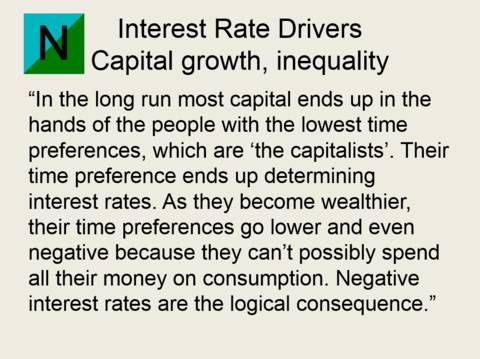
Time preference only works for ordinary people. There are other people too. They are called capitalists. You probably have heard about them. Capitalists think differently. They suffer from a condition called capitalist spirit, which is having little or no time preference. Capitalists think that money spent on a frivolous item is money wasted, because when you invest your money, you end up with more money that you can invest again.

Capitalists save regardless of the interest rate. They rather invest in the distant future when they are dead than spoil their money on frivolous items during their lifetimes. Consequently capitalists end up with a lot of money when they die. What’s the point of that? Capitalists invest in businesses that make the frivolous items ordinary people enjoy. Ordinary people wouldn’t have invested their money, but spent it on frivolous items instead so that these items wouldn’t have been produced in the first place.

Perhaps you think that all capitalists are wealthy. But that isn’t true. Anyone who saves as much as he or she can regardless of the interest rate can be called a capitalist. What is important here, is that the capitalists as a group own most capital, and because capitalists own so much money and capital, and keep on saving and investing, there is a surplus of savings. And if there is a surplus of savings at an interest rate of zero, the interest rate should be negative according to the law of supply and demand.

Convenience

When you lend money to someone else you can’t use it yourself. There may be a new mobile phone you want to buy, but alas, you have lent out your money. This is not convenient. But then you remember with a smile on your face that you will be able to buy the phone but also an additional hip phone cover next year because you receive interest on that loan. So, if you don’t receive interest on your money, you may not bother lending it out because you may suddenly need it. Interest rates on long-term loans are higher than interest rates on short-term loans because the longer you can’t use your money, the less convenient it is.

When you deposit money at a bank, you lend it to the bank but you can still use it any time. That is possible because when you make payment, for example for legal advice, this money ends up the account of the lawyer. The bank will then be borrowing this money from the lawyer instead until she uses it to pay someone else. This is convenient so you are willing to lend money to a bank. For that reason interest rates on current accounts and checking accounts are low. Having money in a bank account is more convenient than cash so the bank may even charge you for having an account.

Risk

Lending out money can be risky. There are two types of risk. First the borrower may not pay back the loan. That could make you reluctant to lend. So if someone of questionable integrity wants to borrow money from you, and you fear that she may not pay back, she could offer you a very high interest rate so that you might think, ‘Well, she may not pay back, but the interest rate is very attractive, so I’ll take my chances and do it anyway.’

Second, money may become worth less in the future. This is called inflation. If there’s a lot of inflation then the money that buys a mobile phone today may only buy a phone cover next year. In that case you may spend your money right away on a mobile phone before it is too late. That is unless someone wants to borrow the money from you and offers a very high interest rate, so that your can buy a better model next year.

The business of a bank is to know its customers. For that reason lending money to a bank is less risky than lending out money to an individual or a corporation. And because banks are supposed to be good at managing risk, they can borrow at lower interest rates, meaning that interest rates on bank accounts are lower than those on loans.

And because banks know their customers and lend to many different people, they can manage risk better than you can and lend at lower interest rates than you are willing to because if you lend money to a someone you don’t know, you may desire a higher interest rate because you don’t know whether he or she is going to repay the loan.

Returns on investments

If you have money, you could invest it in corporations or real estate. Corporations pay dividends and real estate pays rent. If the rents and dividends are higher than the interest rate you get by lending out your money, you may prefer investing to lending. But investing is more risky than lending. If sales are sluggish, profits may go down and dividends may be cut, but lenders still get their interest. Nevertheless investments are an alternative to lending, so if investments offer better yields, you may opt for investing.

If someone wants to borrow money from you, the interest rate must be high enough otherwise you may invest this money instead. Other people who have money are in a similar position. Borrowers need to offer attractive interest rates in order to be able to borrow. Similarly, if dividends and rents are low, people with money may prefer lending to investing, so that borrowers can negotiate lower interest rates. In this way the returns on investments affect interest rates on loans.

The type of money used

The properties of money can affect interest rates. Just imagine that apples are money and you are saving to buy a house. If someone wants to borrow 1,000 apples from you, and promises to repay those 1,000 apples after 10 years when you plan to buy your house, you would gladly accept this generous offer. You may even accept an offer of 900 apples because that is better than letting your apples rot. In this case you would settle for a negative interest rate. But you would only do so if there are no alternatives.

If you could make 10% per year in the stock market, you could exchange your apples for Apple stock because their gadgets are in great demand and outrageously expensive. In that case, it doesn’t matter that apples rot and you could demand interest on a loan. But if returns on the stock market are low or when stock prices are fluctuating so wildly that you can’t sleep at night, you may prefer the offer of 900 apples.

If the money had been gold, you would never accept such an offer, even when the stock market is doing terrible. You can always keep your gold in a safe deposit box. Similarly, you wouldn’t accept negative interest rates on euros or dollars because you can take your money from the bank and store the bank notes in a safe deposit box. The problem with this is that if you put money in a safe deposit box, other people can’t use it for buying and selling stuff. And this can cause an economic depression.

Central banks

It is often said that central banks set the interest rate. But how do they do that? Central banks can print money. If central banks believe that the interest rate is too high, they print more money so that there is additional supply and interest rates go down. On the other hand, if central banks believe that the interest rate is too low, they print less money so that interest rates go up. If the central bank says that it sets the interest rate to 3%, this means that it will print precisely enough money to keep the interest rate at 3%.

Why do central banks print money? Money isn’t produced and consumed like coffee. If you borrow money, it has to be returned with interest. Most money is debt so where does the interest come from? Capitalists let their money grow on their bank accounts so the money to pay the interest from must come out of thin air. Individual borrowers may be able to repay their debts with interest but on aggregate borrowers can’t.

More money needs to be borrowed to pay for the interest. That’s why the total amount of debt increases each year. And if people aren’t borrowing enough, the central bank may print more money to prevent a financial crisis.

Sometimes people don’t borrow enough to keep the economy going and sometimes they borrow too much so that the economy is overheating. Central banks adapt their money printing to prevent these things from happening. Central banks raise interest rates and print less money (or stop printing money or even destroy money) when they want people and businesses to borrow less and they lower interest rates and print more money when they want people and businesses to borrow more.

The future of interest rates

Interest rates went down because capitalists acquired more and more capital over the years and kept on saving and investing regardless of the interest rate. In the past returns on capital have mostly been higher than the economic growth rate while most returns were reinvested so that a growing part of total income was for capitalists. As capitalists reinvested most of their capital income, this is not sustainable in the long run.

interestvers
Capital income (red) versus total income with capital income growing faster than total income

The graph above shows how total income and capital returns (in red) develop if the economic growth rate is 2%, the return on capital is 5%, capital income starts out as 10% of total income, and all capital income is reinvested. After 25 years the economic pie has grown faster than interest income and more is available for wages. At some point interest income starts to rise faster than total income, and less becomes available for wages. And after 80 years there’s nothing left for wages.1

This graph explains a lot about what is going on in reality. When wages started lagging, people couldn’t afford to buy all the stuff corporations made. As a consequence business profits, which is capital income, went down. In the short run it was possible to prop up business profits by allowing people go into debt to buy more stuff. But at some point people couldn’t borrow more unless interest rates went down. As capital income went down, capitalists became willing to lend money at lower interest rates, allowing people to borrow more to buy stuff. As interest rates went lower, more and more people went into debt because interest rates moved below their time preferences.

Nowadays most people are borrowing from the capitalists, for instance via mortgages, car loans, and credit cards, but also via governments as governments borrow from the capitalists too. Many people and governments can’t afford to borrow more. Interest rates are already near zero and may need to go negative if the law of supply and demand is going to do its job. In that case capitalists may start handing out money to the rest of us so that we can keep on buying the stuff their corporations make.

Capitalists may only lend at negative interest rates if money is like apples and not like gold.2 When interest rates are negative, people may buy land or real estate so that the prices of these properties may rise. Property taxes are often based on the value so properties may become less attractive at higher prices. Alternatives are gold or bitcoin, but at some point gold or bitcoin may become so expensive that the risk of losing money on these investments could deter people from buying more. Nevertheless, these alternatives put a constraint on how low interest rates can go. Interest rates must remain attractive for investors.

1. The End Of Usury. Bart klein Ikink (2018). Naturalmoney.org. [link]
2. Feasibility Of Interest-free Demurrage Currency. Bart klein Ikink (2018). Naturalmoney.org. [link]