The time we live in
Due to a severe shortage of time-travelling equipment, you can’t choose the time you live in. Apart from that, you have more options than ever, at least if you have enough money. If you lived in Germany in 1620, you couldn’t go on vacation by aeroplane to Spain, watch television, or keep the rest of the world in the loop about your life on Instagram. And you didn’t know what happened in other countries. Look at all the choices we have today. There are shampoos for every hair type from several brands. And that is just shampoo. In 1620, you washed your hair with water or not at all. Today, countless products are on the market to cater for every possible desire. Everything has been made easy.
Yet due to all these wonderful but mostly senseless options and unprecedented comfort, allowing us to become dumb and inept, we are facing a zombie apocalypse. It can make intelligent people go mad. The Unabomber railed against modernisation in his manifesto. He was right about where things were heading. Modernisation encompasses much more than we realise, so blowing up buildings and murdering scientists isn’t going to change that. Also, the kind advice of Mahatma Gandhi proved to be of no avail. Modernisation is not primarily about technological change. It is the change in how we live and organise ourselves. We have lost our self-reliance and have become cogs in the system.
Today, you can order a pizza with your smartphone, and someone will deliver it at your doorstep. No one did that a century ago, even though meal delivery was technically possible, as telephones, bicycles and motorised vehicles already existed. Not cooking your meals and letting someone deliver them is a lifestyle change. It requires organisation. The ingredients must be present at the pizza restaurant, employees must be available during opening hours, and financial service providers should handle online payments. Everything must operate like clockwork. In the past, villagers grew vegetables and cooked their meals themselves. There were few organisational dependencies. There were a planting season and a harvesting season, along with daily routines like milking cows and eating meals.
The modern level of organisation requires us to live by the clock. Our forebears didn’t have clocks, agendas, and appointments. These things came with the Industrial Revolution. Operating a factory requires workers to be present, so employers and employees agreed on working hours. Raw materials had to arrive on time. Time became money. Being late, or not being present, was costly. The scale of the investments and the pressures of competition meant that factories were only profitable if everyone kept to their schedules. Trains had to run on time as well, to bring people to their jobs and appointments. The idea of time changed. People in the past thought of seasons rather than hours and minutes.
Modernisation came with a transition from communities to societies. Not long ago, most people lived in villages with their families, and they did their work at home or near home. They didn’t work for corporations. The Industrial Revolution changed that. Large-scale production requires large markets, the free movement of labour and capital, a trained workforce, and later, due to technological advances, also a highly skilled workforce, hence more and more schooling.
People who had previously lived in villages moved to towns to work in factories. Nation-states and national languages replaced local governments and local dialects. Nation-states set up schools to turn people into citizens destined to play their role in a larger society. Individuals learned to identify with nation-states rather than villages. It changed how people lived and looked at themselves. In his book Identity, Francis Fukuyama gives a fictional example of a nineteenth-century German peasant who became a factory worker,
Consider a young peasant, Hans, who grew up in a small village in Saxony. Hans lived a fixed life in the village. He lived in the same house as his parents and grandparents. He was engaged to a girl whom his parents found acceptable. The local priest had baptised him. And he planned to continue working on the same plot of land as his father. Hans never asked himself, ‘Who am I?’ The people around him already had answered that question for him. Then he heard that opportunities were opening up in the rapidly industrialising Ruhr valley, so he travelled to Düsseldorf to get a job in a steel factory there.
Hans is now living in a dormitory with hundreds of young men like himself, coming from all over northwestern Germany. People speak different dialects. Some of the people he meets are not German at all but Dutch or French. He is no longer under the thumb of his parents and local priest and finds people with different religious affiliations than those in his village. He is still committed to marrying his fiancée, but some local women have caught his interest. He feels a bracing sense of freedom in his life.
At the same time, Hans is troubled. Back in his village, friends and relatives surrounded him. They knew him and would support him during sickness or a poor harvest. He does not have that kind of certainty about the new friends and acquaintances he has made and is wondering if his new employer, a big corporation, will look after his interests. He heard that Communist agitators were pushing to create a trade union in his factory, but he has heard bad things about them and does not trust them either. His part of Germany had become part of a large empire, of which he can feel proud, but it is barrelling forward to an uncertain future. He feels lonely, disconnected and nostalgic for his village, but for the first time, Hans can choose how to live his life.
Hans’ story characterises the transition from community to society. Industrialisation led millions of Europeans to move from their villages to cities in the nineteenth and twentieth centuries. Today, the same happens in countries like India and China. Hans didn’t think, ‘Who am I?’ Nevertheless, his view of himself changed. He had more choices than in the village. Did he become happier? That remains unclear. In areas with little industrialisation, cities also grew. In 1800, only 7% of the world’s population lived in cities. In 2023, it was nearly 60%.
Once traditional values become optional, you experience freedom. Or you may feel confusion and a longing for the clarity of the tradition once provided. Society, rather than your community, now answers the question of who you are and what group you belong to. Hans was no longer a villager in Saxony, his father’s son who would inherit his farm, but a Protestant from Germany. Nationality, ideology and religion came to define us.
Later, the number of identity groups proliferated. Twenty-first-century consumerist societies have a variety of identity groups, and the Internet makes it easier for like-minded people to find each other. Identity comes with a variety of product choices. You can identify yourself as a Madonna fan, a football club supporter, or a prepper. Marketers use and create these identities to sell us their merchandise. For preppers, it is canned food to survive the coming apocalypse.
Modernisation thus profoundly changed people’s lives, and today few areas remain unaffected by the all-pervasive power of the money economy. It brought, among others, urbanisation. People have been moving to cities since the Industrial Revolution, and in the West of the Netherlands, the area called Holland, even earlier. Yet, for a long time, modernisation didn’t upset life in villages, where most people still lived and depended on their families and communities.
My father loves to talk about the old times. He lived on a small farm. Before he went to school, he milked the cows. There were lots of other chores as well. My mother’s childhood had also been like that, but she rarely discussed it. One of the few things she told me was how she and her mother caught and slaughtered chickens. Most people have lived like them for ages, and all of a sudden, that all changed. My parents have seen it happen. By the time I was born, it was a done deal.
Life in the past was not great, a meagre existence even, but there was no apocalyptic threat, except in religious literature. Today, that threat has become real and imminent. Yet, God has left the scene, or at least in the Netherlands. On message boards with American conservatives, I sense a more apocalyptic atmosphere. The apocalypse is an outcome of an interaction among science, technology, and society, driven by business economics, which, by some not-so-miraculous coincidence, happened to match the studies I pursued at the university. And because of my father’s storytelling, I had some ideas about village life in the past. But what was it really like? That requires a more thorough investigation.
When God has left the scene
What was life before modernity? Shortly after World War II, life in most Dutch rural villages was still overly traditional. What changed, and how did it happen? ‘How God Disappeared from Jorwerd’ by Geert Mak is a village history of Jorwerd, a Frisian village, during the so-called Silent Revolution of 1945 to 1995, when traditional life gave way to modernity. One change was that most villagers stopped visiting the church. Jorwerd is part of the scene you see from the train if you travel from Sneek, where I live, to Leeuwarden, the Frisian capital, where I work. Now, isn’t that yet another noteworthy coincidence? The title of the book, combined with Jorwerd being part of that scenery, eventually made me read it, also because of my interest in modernisation sparked by the project I was working on, while experts praised the book for offering deeper insight into this matter.
Jorwerd consists of a church and a small square, with a few dozen houses and pastures. Yet every village, no matter how tiny, has a long history with locals who lived there and are now long forgotten. In the past, villages were closed-off places of endless boredom fought with countless folk tales, and where the fair was the main event of the year. Villagers had plenty of time to work out the details of their arrangements. As Mak put it,
In villages in the past, the shared rhythm of life had often evolved into a system of detailed protocols that kept society ticking along like a clock’s mechanism. Nothing was left to the unpredictable. There were rules for everything. For example, who to visit and when, who was invited to weddings and funerals, who came for a visit to a newborn, what to eat and drink on those occasions, how new neighbours were to be welcomed, who had to look after horses on certain occasions. It was all according to an ingrained pattern of long-term reciprocity. But the times for rising and for sowing, planting, and harvesting were also fixed, as were the methods of working, all according to one great unwritten standard.
Villagers could ritualise their lives like that because every year was more or less the same, and the village was the central unit of organisation. The past was not great, drenched in boredom and poverty. To pass the time, the village established a drama club and a few other groups, such as a local department of the rural women’s association. Yet, these didn’t exist a few centuries ago. Rather unsurprisingly, the past is not a time the villagers wish to return to,
Now the old divide between city and countryside has largely been bridged, and both ways of life complement each other more than they are opposites. Over the years, the village has lost not only a certain tranquillity and tradition, but also much of its isolation, stifling atmosphere, repression, cruelty, poverty, and want. And if anyone is aware of this, it is the villagers themselves. No one wants to return to milking in the cold November rains, or toiling in the hot hayfields, or the fears of floods, diseases, and plagues.
Parenting was up to their parents and the villagers. And children on farms had to do a lot of work, so my father was not an exception. My father gave two accounts, on different occasions, of how villagers dealt with parenting problems. In one account, things like child molestation remained unnoticed or uncorrected. In the other account, the village priest or others would take measures. The latter seemed more like how he believed things should be, and sometimes happened. At least, the government was nowhere to be seen, so it entirely depended on the villagers. It is not easy to say which is better, as there have also been abuses in institutions.
Villagers avoided conflicts, as they could drag on and poison the atmosphere for years or even decades. Jorwerd had such a conflict over the village hall, as it went at the expense of the pub’s business. As villagers identified with their village, there was some rivalry with neighbouring villages. Still, village life had its benefits, and problems didn’t scale up as they do in cities. In villages, there was more oversight. Villages also provided a social safety net for the weak. Autism seemed not to exist in the past. Not only was there no diagnosis, but villages provided a stable and predictable environment that most autists could cope with. Mak explains,
Unnoticed, a divide had developed within our highly developed society: that between the fast and the slow. The slow were not pitiful or disadvantaged. They were, however, ‘clumsy’. They were the ones who were too slow for contemporary social contacts and networks, preventing them from getting or keeping jobs. They were people who struggled with modern relationship patterns, causing their friendships to stagnate. Sometimes, they were families who lacked the discipline to keep their spending within limits in a consumer society, sinking into crime or accumulating nearly insurmountable debts. They were also the boys and girls who could not cope with the complicated and often undisciplined education system, causing them to fail to complete any schooling.
These slowpokes and clumsy people had always existed and will always remain. In the past, they usually did low-level work, but it was work nonetheless. There was little care, but it was care they understood. There were relationships that, in the eyes of the city dweller, offered little variety—for example, the eternal and exclusive association with relatives—but that family was there nonetheless. For years, the countryside was an oasis for the clumsy. The villages offered support and structure. Moreover, the villages gave them the value they deserved, for there was much to be learned from the slow and the clumsy, even if these were matters of a different order than the usual.
Villages had certain strong principles. The first was reciprocity, often in the form of assistance to kin and neighbours. It operates via detours and over the long term. You help others, and others help you. It occurs at the communal rather than the individual level. Another principle was that the young were subject to their elders. The environment was stable, so experience was more critical than today. With today’s rapid changes, youngsters often know better than their parents. Or as Mak put it,
When society changes rapidly, parents and children clash. The older generation inevitably views life differently from the younger one, and rightly so, for they must survive in different worlds. Such rifts can also occur within a person’s own life, leading to an internal conflict. In a world where everything is predetermined, as Jorwerd was until 1945, there is a strong likelihood that what a person expects will actually come to pass. In societies undergoing major changes, the predictability of the individual life course has vanished. Expectations that had been raised suddenly fail to materialise.
In villages, the individual was subject to the collective. Rural villages survived through stability and predictability. It doesn’t mean that they were conservative, with the soft terror of gossiping mothers-in-law prying on your every move. Jorwerd was fairly liberal. Yet, individualism led to unpredictable conduct, threatening the stability and predictability that were the pillars upon which the community rested. So, if you did something unusual in a village, you had to explain yourself.
Those principles are declining. Unlike in other areas, such as France, where rural areas have depopulated, Dutch villages have become suburbs without a suburban atmosphere because the Netherlands is small and densely populated, so there is always a town nearby. Jorwerd is close to Leeuwarden. Outsiders bought homes in the village. They don’t form long-term reciprocal ties with other villagers, partly because they work in the city and buy all they need in shops. In the past, the women of Jorwerd looked after the elderly, but as more women have jobs, that tradition is dying as well. The fair changed from a self-made village event into a consumption-centred activity with spectacle to entertain visitors. News items about neglected livestock showed that farmers no longer looked after each other. It became a matter for animal protection authorities. And youngsters had cars so that they could go out in Leeuwarden or even Groningen.
In the past, there were plenty of short tales that locals told each other to pass the time. A chronicle writer has recorded hundreds. These tales were often scary and rude, and sometimes involved bloodshed. Germanic gods had somehow survived in some of these stories in curious shapes. These tales were the collective memory of villages. Yet, the memory of real events was not more than a century, in most cases. So, some villagers might know about farms going ablaze in the 1930s if their parents or grandparents had told them, but after three generations, actual history had gone lost.
Television greatly contributed to the decline of social life in the village. Before television arrived, the goings-on in the village were what people knew about and talked about, but television turned local events into a sideshow. The consequences of television are hard to underestimate. It changed life everywhere. Gossip about celebrities replaced gossip about villagers. You can see how other people live and think on television. You learn about other options. Norms and values changed as a result. Among others, marriage gradually became a less obvious choice. The great power of television lies in its ability to replace words with images. A picture can say more than a thousand words. And then there was the neglect of village potential by the municipality,
Most of the major changes in Jorwerd, such as filling in the harbour and the new housing developments, had originated with the residents themselves. Later on, however, such initiatives were rarely approved. For instance, the path to the sportsfield was a quagmire. When Willem Osinga proposed fixing it up with a handful of men over a few Saturday afternoons, using some leftover paving stones, with the municipality merely needing to supply a load of sand, that plan was flatly rejected. The municipality eventually did the work itself at the cost of 30,000 guilders. ‘We could have done a lot of other things in the village with that money,’ Osinga grumbled.
Mak’s book falls into the same category as One Hundred Years of Solitude by Gabriel García Márquez, a village history set in Colombia. Yet, as Márquez’s tale is fictional, Mak’s book is a journalistic account of actual events, less spectacular but more insightful. Before World War II, most inhabitants of Jorwerd were poor and often worked in jobs and trades on the side to get by. As they grew wealthier, the villagers could more easily sustain community life by buying groceries at a local shop and getting drunk at the local pub. Yet once they had cars, they went to supermarkets and pubs in the city. Farming became a capital-intensive rather than a labour-intensive business. Farm jobs disappeared, and interest payments replaced wages. Most farms closed down. Those that survived did so by increasing scale. And with capital came specialisation. These developments combined into a silent murderer of village life. Or as Mak put it,
Decline is rarely the result of an open confrontation. It is almost always a complex and treacherous course, a process that unfolds from below, with nothing yet noticeable on the surface. Just as cities at the peak of their existence often already contain all the elements of their decline, just as trading companies, banks, and large corporations often experience a final flourishing, more luxuriant than ever, while the signals announcing their doom are already audible, so it was also for the blacksmith, the carpenter, and the other tradespeople of this small village.
Local businesses flourished initially in the 1960s and 1970s, profiting from trends that would eventually finish them off. The carpenters would work on farm enlargements and new homes. Local grocers could survive first because strong brands set minimum prices for their produce, thereby preventing larger supermarket chains from undercutting them. Vertical price ties, the Dutch called the arrangement. The producer set the retail price. Yet, economists argued that these were cartel-like agreements that went at the expense of consumers. Once these minimum prices were gone, the local grocers went out of business in droves. The local blacksmith initially profited from selling refrigerators and other appliances because local people trusted him as the expert on machines. Yet, eventually, the arrival of modern appliances ended his business. Mak explains,
Unlike the butcher shop and the local grocer, the village blacksmith’s demise had little to do with turnover, newcomers, and mobility, but everything to do with technological progress, increasing complexity, and the resulting specialisation. The blacksmith’s problem is perhaps easier to translate into an image. Just open the hood of an oil heater from 1970 and the hood of a compact gas burner from 1995. What do we see? On the oil heater, we discern a few taps, a chimney damper, and a simple but sophisticated float mechanism. If something breaks—which rarely happens, because there hardly is anything that can break—a few taps and some fiddling with the float mechanism are often sufficient. But now look at the small central heating burner from a quarter of a century later. We stare into a tangle of wires, relays, thermostats, automatic valves, electronic control systems, membranes, couplings, pumps, and double safety devices—a crammed industrial mini-complex of pipes and electronics. That was the village blacksmith’s problem.
Regulations further contributed to the blacksmith’s fate. Installing and maintaining modern gas heaters required him to take courses to obtain the necessary certificates. Having unqualified people working with them was dangerous. The blacksmith was a generalist who understood a wide range of simple appliances, from heaters and farm equipment such as tractors and milking machines to washing machines, which were at first simple mechanical devices but grew more complex over time. The jobs the blacksmith did came to be the domain of a range of specialists. Modernisation is an intricate process involving a general rise in opulence, the advent of cars as private transport, an increase in complexity that leads to specialisation, and a wider array of choices that leads to centralisation. And it all occurred in an era of rising opulence, so without hardship. As Mak put it,
Just as with the small farmers, these were not tragedies. It was not young people in the prime of their lives who went bankrupt, but older, nearly retired people who, as the old notary put it, ‘quietly capitulated to the flow of time.’
The community economy didn’t get wasted by the market without a struggle. The conflict occurred within families, often between parents, who were loyal to the village, and their children, making it a generational issue,
‘We have to live off the village, so the village has to live off us too,’ the carpenter said to his children. Most of the villagers agreed. ‘But then they need to have fresh produce,’ the children protested. ‘And to be honest, it is much, much cheaper in Leeuwarden.’
The village economy died with that generation, and with a whisper. Social life in the village also declined, even though there is generally still more social cohesion in villages than in cities. The villagers still take care of each other. On 25 August 1951, the church tower collapsed early in the morning, around 5 AM, out of the blue, after standing there for 900 years. The villagers hung around chit-chatting on the square near it much of the day, so the tower collapsing at such a quiet hour was an instance of good fortune. In 1995, the tower could have collapsed at any time of the day, without hurting anyone. Geert Mak’s How God Disappeared from Jorwerd is not a spectacular story with heroes and great exploits. The most profound revolution in the history of humankind remains largely ignored and recorded in a few books that few people read.
The end of rural life as it existed for ages came with great distress. Farming is a way of life you are born into. Departing from it can come with a loss of identity and purpose. Due to the rationalisation of operations and increases in scale, most farms closed, often after a protracted struggle for the farmer, and suicides of those who couldn’t cope. By 1995, investments to comply with environmental regulations were often a reason to quit. Yet, those who quit usually had no financial worries as they could sell the farm and retire. As land and the rights to hold livestock were valuable, retired farmers were often millionaires.
It was harder on the men, who hadn’t learned to discuss their feelings. Usually, their wives or the bank would bring up the matter of stopping. And for young men, farming would often mean a life of loneliness, with only cows as their companions. And so, the remaining farmers often do it on principle rather than for rational business considerations, to be connected with tradition, the land, the animals, and nature, or, like artists, because farming is the only thing they wish to do. According to Mak,
In 1995, special matchmaking courses were organised to help young farmers find wives, as hardly any young women wanted to become farmers anymore. Advertisements featuring women appeared in agricultural trade journals; women from Poland and Russia were keen to stand by the side of a serious, single farmer.
Until recently, life barely changed over the centuries, and then, suddenly, everything changed. The story of Jorwerd, despite its unique details, is the story of millions of villages around the world that have lost their role as the basis for community and economic life, and of the social consequences that follow from that change. The processes that ruin us are pervasive. Warding off the apocalypse and maintaining an acceptable standard of living require a great deal of social engineering, as they entail regulating forces of nature that are hardly amenable to control. The unpredictability of the consequences of changes is our main adversary. And so, we need to halt time, as the Amish do, and select which products and technologies we allow.
Economies of scale
Societies are communities on a larger scale. Communities provide solidarity between individuals who know each other. In a community, there is social control. Shared values keep a community together. If the community is supportive, others help you, and you help them in return. Not all communities are like that. In some villages, neighbours steal from each other. And even if you live in a supportive community, life isn’t great if you don’t fit in. And so, we shouldn’t have romantic views about families and communities, but they are our natural way of living. Societies with states and markets are cultural constructs. With the help of culture, humans can cooperate on any scale, but this can cause psychological distress because our natural environment is a band or a village.
What was once informal, a tacit agreement in communities, became formalised as law in societies. People don’t know each other personally. Instead of neighbours helping each other, states provide welfare while bureaucratic controls replace social controls. If adequately applied, bureaucratic rules are less arbitrary than the support you get from your community. The help you get depends on your community’s supportiveness and on whether others like you. On the other hand, people misuse bureaucratic systems and may cheat. Within a village, that is harder to do, as everyone knows you, and if you misuse community solidarity, people will notice and may stop helping you.
Living within families and communities is our natural way of life. Still, we can also imagine ourselves as part of identity groups that share characteristics such as a religion or a nationality. The benefits of scale in war and economics promoted larger-scale cooperation. For a society to function, those who live in it must identify themselves with it and its values. Nationalism has often been a means of achieving that. Sharing a culture and a language creates a common identity. A strong society with responsible citizens makes a difference because markets and governments can’t create an agreeable society on their own. Sharing a culture and a language helps, but it isn’t required. An ideology or religion can achieve the same.
If civilisation breaks down, we will not gracefully return to villages and subsistence farming. Communities have given way to societies in which people rely on markets and governments rather than on neighbours and family. They go to the supermarket for groceries and don’t grow their own food, nor do they make or mend their clothes. They expect to buy what they need on the market and the government to care for them when they can’t. Many of us won’t survive without electricity. What drove us into this corner? It is competition and the benefits of scale, and a belief in progress. With fewer resources and energy, it makes sense to organise more things locally. Reducing competition by reducing the benefits of scale and favouring local industries can also help.
Latest revision: 4 October 2026
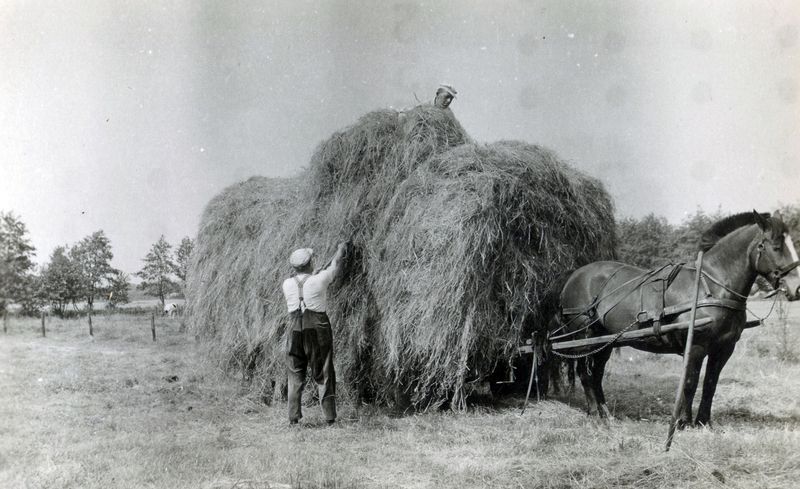
Featured image: Picture from Vragender where my father came from (1949). http://www.oudvragender.nl.