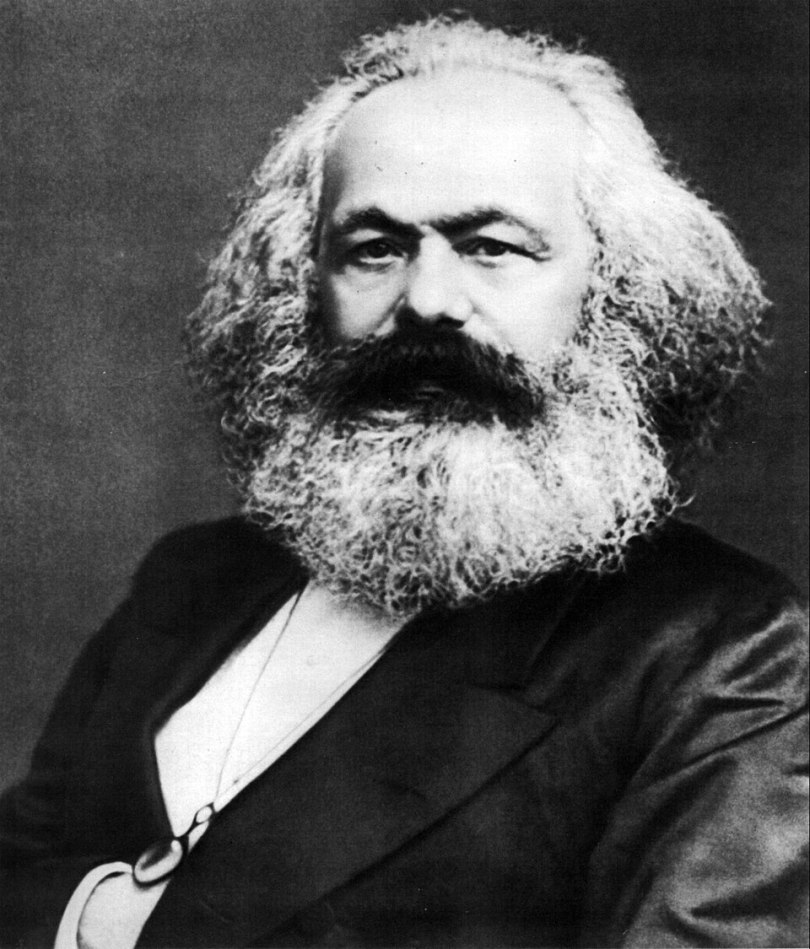
A portrait of Karl Marx

Marxism

Core beliefs

Marx sees human history in terms of class struggle. Hegel had an idealist concept of a struggle of ideas driving history. The Marxist view of history holds that change arises from the material interests of classes, particularly those of the ruling and working classes. Individuals can play key roles at certain moments in history, but change depends on economic and class factors. There is an unavoidable historical progress from primitive to advanced, so from primitive societies, to feudalism, to bourgeois capitalism, which would finally end in workers owning the means of production, so socialism.

The second core Marxist idea is the law of value under capitalism. Capitalism is a system of production for the profit of the owners of the means of production, who exploit those who own nothing but their ability to work. Labour creates all the things and services that we use and need, but the value of that labour is appropriated by the owners of the means of production as ‘surplus value’ over and above what labour receives for its work. That surplus value is accumulated as capital, which adds value to labour. A worker with the proper equipment can produce far more widgets than one without.

Marx’s theories have little standing in economics, but that is not the strength of Marxism. It lies in recognising that the organisation of societies depends on economic factors, with competition as the hidden driving force. We work in corporations because that gives a competitive advantage, which affects the organisation of societies. The simple fact that we have time zones with standardised times is a result of the Industrial Revolution and train schedules. And Marx offered keen insights into what is wrong with capitalism, but these were 19th-century views, so translating them into modern equivalents can be illuminating.

Value is subjective

Marx claimed that capitalists’ profits come from appropriating the value that workers create, so stealing it. He based his claim on the labour theory of value, which economists of his time considered valid. The theory says that the price of an item equals the cost of labour required to make it, thus including the labour to produce the raw materials. If making a pair of shoes takes twice as much labour as making a pair of trousers, shoes cost twice as much as trousers. Marx asked himself, ‘If that is correct, how can there be profits?’ It is because the theory is wrong, not because capitalists are appropriating the value that workers create. There is no objective measure of value.

On the market, the price of an item depends on what people are willing to pay for it, not on what it costs to make. Otherwise, you could work a year on building a better mousetrap and sell it for €50,000. Nobody will buy a €50,000 mouse trap. However, after spending another €50,000 on building a brand in a marketing campaign, you might sell that same mousetrap for €200,000. That is because value is subjective. It might seem stupid to buy a €200,000 mousetrap, but if you have too much money and showing off the mousetrap makes you attractive to the ladies, it may be worth it.

Marx drew the incorrect conclusion that labour gives a product value, when it is entrepreneurship that does. Businesspeople organise the production and distribution of goods and services, which includes hiring labour, managing customer and supplier networks, making estimates about future consumer desires, or creating them with marketing campaigns, and doing all of this at a profit, as the operation requires capital. Marx overlooked that part of capitalism. That is why communist countries are poor. They don’t have entrepreneurs. As we near the end of humanity, with the profit motive as the primary cause, leaving it there would be a fatal mistake.

Value is what we believe it is. Nothing is sacred. Everything is for sale, including the rainforests and even the Earth. The so-called owners think it is all theirs and can do with it as they please. In a communist dictatorship, the government tells you what to believe. In the market, a story becomes true if you can sell it. That is why businesses advertise products that are bad for us. As money represents power, we stare into the moral abyss. That is why communists called their newspapers The Truth.

In a world without someone telling us what the truth is, there is no truth, and communism is just another message on the marketplace. The communists appealed to the workers’ self-interest. And that was a poor sell because workers were worse off under communism. It is why communism was doomed to fail, not because it is impossible to live like communists. Early Christians did. Rather than concluding he had just proven the labour value theory wrong, Marx claimed capitalists stole from their employees.

Silvio Gesell made the astute observation that the problem is not entrepreneurs and profits but passive interest income. Plenty of people live off their capital without contributing anything, except perhaps by bringing in capital to produce things we don’t need. Gesell aimed for a society where capital has no privilege, so where there is no passive capital income, but where people can put their talents to good use and are rewarded for taking risks and making the right decisions. And if we terminate the bullshit economy, which includes status products like €200,000 mousetraps, that could create a fairer economy.

Fulfilling work

Marx further said that producing for markets alienates us from what we make. Many workers experience this. It is why Dilbert comics are so successful. Marx claimed we could be free, creative beings, but the modern, technologically developed world dictates our lives. Marx believed that ending the market mechanism and replacing it with democratic planning would liberate us. So if workers received what they owed and we replaced capitalism with democratic planning, we would live in a paradise where we could do the jobs we like and have everything we need.

That is a silly idea. There will be long lines of people who wish to be actresses, but few want to be cleaners. Likewise, communes don’t attract farmers and construction workers, but artists and Reiki healers. We need food and homes, not art and quacks. Work is doing something useful. If it isn’t useful, it isn’t work, but a hobby. Even if everyone contributes, planning will never do as well as markets. You could live with that if you have enough and have no worries. You might want a pear, but you could settle for an apple. And you have heard of oranges but never tasted one.

Capitalism causing misery

Marxists claim that capitalism causes misery as adding capital means doing more with fewer workers, which reduces the need for labour, pushing wages below the subsistence level and leaving workers to starve. In the 19th century, most economists believed wages would remain close to the subsistence level. If wages increased, more people would survive, expanding the labour supply. That would cause wages to decrease, so that more people would starve. The market would keep population levels in check. Marxists argue that making more stuff with fewer people was impossible because the unemployed couldn’t buy it. So, there would be either underconsumption or overproduction.

Marx himself held a slightly different view. Capitalist production occurs only if it is profitable. The drive for more production undermines the profitability of that production, Marx believed. Capitalists compete against each other to gain market share and a larger share of profits appropriated from workers. To gain an advantage, they resort to labour-saving technology to reduce costs and increase labour productivity. Marx argued that profit comes from labour, so investment in machines replacing labour may increase productivity, but at the expense of profitability. It would eventually lead to the halting of production and the layoff of workers. That didn’t happen because of Say’s Law.

Due to higher production efficiency and increased production, items became cheaper, so consumers had money to spend on other items. And humans can create money from thin air. When capitalists produce more, they must sell their merchandise, and, if necessary, they can encourage people to borrow money. And so, the general level of opulence rose. Marx had vastly underestimated human ingenuity in finance, marketing and job creation in the services sector and government, the so-called bullshit jobs in the bullshit economy. These jobs make sense because they solve problems in an increasingly complex society, but didn’t exist before as people lived simpler lives.

Scientific and rational

Marx believed that his theories were scientific and rational. He devised a theory of history using Hegel’s dialectic, arguing that power structures in society reflect economic conditions. To Marx, it was not new ideas challenging the status quo but economic conditions that drove historical change. He would say that the status quo of serfdom in Europe ended because towns challenged it by providing alternative jobs for serfs. Lords had to compete with them for their labour. And so, employer-employee relationships replaced serfdom, which became the new status quo.

Marx also believed nationalism was a temporary phase, imposed by economic conditions. Industrialisation required larger markets, thus societies rather than communities. Nationalism allowed the elites to divide and rule the working class. And because capitalism would eventually bankrupt itself, Marx predicted, as if it were a logical certainty, communism would replace employer-employee relationships, and everyone would become free and equal. In reality, people weren’t free or equal under communism, and a new elite of party bureaucrats replaced the capitalists.

Marx aimed to violently overturn the existing capitalist order through revolution, whereas Hegel believed that the French Revolution and the Napoleonic Wars had been necessary to replace the feudal or aristocratic order with a new order grounded in European Enlightenment ideals. Karl Marx became the prophet of the most successful cult in recent history. In many ways, Marxism became Christianity without God, by claiming there is a plan behind history, that there will be an End Time, a communist revolution, after which we will live in Paradise. Marx raised concerns that are still valid today:

  • Instead of saying we will enter the communist paradise as a historical necessity, we may argue that the script is that we are about to enter God’s Paradise, which could be a Hegelian synthesis of the Marxist challenge to the existing bourgeois order.
  • Instead of saying capitalists steal value from workers, you can argue that we work to make the rich richer. Despite economic growth in advanced economies, many workers still can hardly get by. And that is not because they are all lazy or stupid.
  • Instead of saying the system alienates us from what we produce, you can argue that we are part of a system over which we have no control. We can’t democratically decide on ending the creative destruction of this planet and humanity.
  • Instead of saying that capitalism causes misery, it has improved billions of lives, at great cost perhaps. Yet it will end in a disaster due to excessive resource consumption or technological development caused by out-of-control competition.

Feature image: A portrait of Karl Marx. Public Domain.

Property Rights

Property rights play a central role in economic organisations. The concept originates in agricultural societies. To hunter-gatherers, property has little meaning. A hunter-gatherer band carries hardly any items and moves around to find food, so there was no point in owning things. Owning nothing and being happy was the state of humankind in the Garden of Eden. That changed with agriculture. After the Fall, Adam had to toil to make a living. You aren’t going to work hard to plant and grow crops or to raise and feed livestock if someone else takes them. The protection of property from thieves and other tribes is one reason humans organised themselves into tribes and states. Yet traditional societies usually had no private property. In most cases, family groups or villages held ownership, and clan leaders or elders made decisions.

Privately owned property and individualism became commonplace in Western Europe first. The Church wished to inherit the property of Christians who had no heir. That is harder to do if a clan owns the property, so the Church promoted private property to let the Church inherit the property of Christians who had no heirs. Individual property rights and women’s right to own property led to the end of family groups headed by my male clan leaders. And it promoted individualism.1 In the Middle Ages, after clans had disintegrated, feudal lords held most property, which the Church could inherit. Feudalism was, in principle, a voluntary agreement. Lacking a clan, a serf sought the protection of a lord. A serf had rights, like the right to protection by his lord. The development paved the way for modern capitalism, which led Europe to lead the process of modernisation.

The communist experiment has demonstrated that the absence of property rights causes shortages and sometimes famines. Another argument for property ownership is the tragedy of the commons. Individuals who act out their own self-interest deplete or spoil a shared resource, ruining it for everyone. If you share items like tools with your neighbours, you might run into conflicts if some neighbours care less about them or use them more. All pay for these shared items, but some benefit more than others, and some people might not benefit and only pay. A solution is ownership. Either we all own these items individually, or, if that is more efficient, we rent them from someone who owns them. Collective ownership can work better if there is social trust within the group, which requires members’ trustworthiness. It usually works best with family and friends and, in the past, with clans.

You can look at the role of property from different perspectives. One is the competitiveness of societies. Property rights have made societies more competitive, which is why they have prevailed. If someone else takes away what you make, you stop working. If people work harder, there is more to go around. Another perspective is how property rights contribute to an agreeable society. Property ownership may prevent shortages and famine. Property rights are often limited. One reason is to protect other people’s property. If you own a plot of land between other homes, you may not be able to build the home you like. Then you pay property taxes. And so ownership is often incomplete. And somehow, most property ends up in the hands of a few, who come to control society, making it less agreeable to others. Billionaires now determine what happens.

The problem we face is that societies function poorly without property. The pursuit of personal gain motivates us to work and be productive. Yet, property rights as they are now, and the pursuit of profit that comes from them, are among the ingredients in the toxic cocktail that is about to terminate humankind. Working hard to get ahead as we do now is suicide, while removing the incentive to be productive is disastrous. And interest income, so the leeching by the rich, is bleeding societies, while complexity is increasingly weighing on us in the form of rules and taxes, and the costs more often outweigh the benefits. That is why we must make the economic reward system align with the goals of our survival and contribution to society, including the role of property.

Featured image: screenshot from a WEF video promoting sharing items like cars

1. The Origins of Political Order. Francis Fukuyama (2011). Farrar, Straus and Giroux.

The Price of Money

Interest: the price of money

When a book is €7 in France, what does that mean? If it is $8 in the United States, is it more expensive there than in France? It depends on the exchange rates of the dollar and the euro. If the dollar is worth €0.80, then $8 equals €6.40, which is less than €7. The exchange rates of the euro and the dollar depend on supply and demand in the foreign exchange market. However, the price of money is not the same as the price of currencies.

When economists talk about the price of money, they mean the interest rate. The supply and demand for funds determine the interest rate, as well as the available funds for lending and the demanded funds for borrowing. When many want to borrow and few plan to lend, the interest rate rises. When only a few want to borrow, or when a lot of funds are available for lending, the interest rate drops.

Economists distinguish between money and capital markets. Money markets provide short-term funding, typically less than a year, whereas capital markets provide long-term financing. Several factors affect the supply and demand of funds in the money and capital markets. These are:

  • Ordinary people value the present over the future, and the degree to which we do affects the interest rate. They suffer from time preference.
  • Capitalists are very special people. They save and invest anyway, even at low interest rates. They are endowed with a capitalist spirit.
  • Returns on other investments affect the money and capital markets because they must be attractive relative to alternatives.

Time preference

Suppose you are a hatter and have just sold a hat for €50. You could rush to the nearest phone shop and buy that fancy phone cover you saw yesterday. Alternatively, you could save up to buy a new smartphone later, once you have sold more hats. You could even save for your retirement. The odds are that the money will be gone before the month is over, and that you have acquired a phone cover or some other gewgaw. If this applies to you, economists will diagnose you with a condition called time preference.

Economists assume that we have a time preference, meaning we prefer to satisfy our desires now rather than later. You want the latest smartphone model now rather than later, and you may even wish to borrow money to buy it now. Individual time preferences vary. Your time preference is the degree to which you value the present above the future, which you can express in an interest rate. If the market interest rate is above your time preference, you save, and if it is below, you borrow.

Time preferences differ for different people. Mary may save if interest rates are above 4%, and borrow once they are lower. John may save as long as interest rates are above 6% and borrow when they are below 6%. Alex might save if interest rates are above 5%, but may not borrow if interest rates are below 5%. The result is that as interest rates rise, the supply of funds for lending increases and the demand for funds for borrowing decreases. The market interest rate will be where supply and demand are equal.

Capitalist spirit

Time preference is an ailment plaguing ordinary people. Their designated role in the economy is to consume. Other people think differently. Economists have diagnosed them with a condition called a capitalist spirit, which is the opposite of time preference. They are the capitalists. Capitalists believe that money spent on a frivolous item is money wasted. That is because if you save and invest your money, you will end up with more money to reinvest.

Capitalists don’t suffer from time preference. Their designated role is to invest. And so, they end up with a lot of money when they die. What’s the point of that? Capitalists invest in businesses that make the frivolous items ordinary people consume. Ordinary people wouldn’t have invested their money. They would have spent it on frivolous items instead, so that these items wouldn’t have been there in the first place.

Capitalists have a lot of money. They don’t stop investing when interest rates are lower. They can’t help themselves. They have a capitalist spirit, just as ordinary people can’t help themselves because of their time preference. When they run out of things to invest in, they lend their money at lower interest rates. Again, it is the law of supply and demand at work. If capitalists have a lot of money while other people cannot borrow because they can’t afford to pay the interest, interest rates drop.

Investment returns

There is no point in investing if you don’t get more in return. These returns end up as corporate dividends or as rent from real estate. If these returns are high, you may prefer investing over lending. Investing is risky. If sales are sluggish, corporations may cut their dividends, but lenders still get their interest. When a business goes bankrupt, lenders receive their money first, while investors get what’s left over. And that could be nothing.

When someone wants to borrow money from you, the interest rate must be attractive compared to the investments you can make. Otherwise, you may prefer to invest and receive dividends and rents despite the risks. In this way, interest rates on other investments affect those on loans. Banks dominate the markets for borrowing and lending, so we choose between investing and keeping a deposit at a bank.

Risk

When you lend out your money, the borrower may not repay. So, if a stranger wants to borrow some money from you, she could offer you a high interest rate so that you might think, ‘I don’t know her, but she may pay back, and the interest rate is attractive, so I’ll do it.’ Money can lose value due to inflation, so inflation is another risk for the lender. If the money that buys a smartphone today only buys a phone cover a few years later, you spend that money on a smartphone right now. That is, unless someone wants to borrow your money from you and offers a high enough interest rate, so that you save for a newer model that you expect to need a few years down the line.

A bank’s business is to know its customers, so lending to a bank is usually less risky than lending to an individual or a company. When you have money in a bank account, you have lent it to your bank. Banks are supposed to be good at managing risk, so you accept a lower interest rate on your deposit than you would on a loan to an individual or a corporation. Banks know their customers well and lend to many different customers, so they can manage their risks and lend at lower interest rates than you could. Interest is the price paid for distrust. If investors trust the debtors and the value of the money, they expect inflation to be low, which means interest rates are lower.

The government and the central bank play a central role in limiting banking risk. Banks charge interest on loans, which leaves debtors short of money. That is, unless depositors spend their money or someone else borrows the principal plus the interest. Like other Ponzi schemes, the usury scheme collapsed from time to time, leading to defaults and economic hardship. To prevent that, the government borrows money, and the central bank prints it into existence, bringing it into circulation so debtors can repay their debts with interest. But with governments and central banks propping up the usury scheme, debts continue to grow, which may eventually lead to a usury-financial apocalypse.

Convenience

When you lend your money to someone else, you can’t use it yourself. There may be a new smartphone you want to buy, but alas, you have lent out your money. That is inconvenient. Then you remember with a smile that you will have the phone and a hip phone cover next year because you received interest. So, if you don’t receive interest on your money, you may not bother lending it out because you may need it.

When you deposit money at a bank, you lend it to the bank, but you can still use it at any time. If you use that money to pay for legal advice, it ends up in the lawyer’s account, and the bank borrows it from the lawyer until she uses it to pay the barber. Having cash on hand is convenient. Economists call this liquidity preference. We accept low interest rates on current accounts because they are as convenient as cash.

Properties of money

The properties of money can affect interest rates. Imagine that apples are money, and you save to buy a house. If someone wants to borrow 1,000 apples from you and promises to pay back 1,000 apples after 5 years, when you plan to buy the home, you probably accept this generous offer. You may even accept an offer of 900 apples, since that is better than letting your apples rot. In this case, you would settle for a negative interest rate.

You would only do so if you have no better alternatives. If you can make 10% per year in the stock market with Apple stock because their gadgets are in great demand and outrageously expensive, you would exchange your apples for Apple stock. It doesn’t matter if the apples rot. If someone wants to borrow money from you, you demand interest. Our money rots, even though not as much as apples. We call it inflation.

If the money had been gold, you wouldn’t accept the offer, even when the stock market is doing terribly. You can keep your gold in a safe deposit box, and you have 0% interest. Similarly, you wouldn’t accept negative interest rates on euros or dollars because you can take banknotes and store them in a safe deposit box. If many people do so, that interrupts the circular flows, and the economy may suffer.

Discounting

Discounting is about determining the present value of future money using the interest rate. When interest rates are above zero, one euro in the present is worth more than one in the future. That is because you can receive interest on that euro. If the interest rate is 5%, one euro turns into €1.05 in a year. In other words, €1,050 over a year is worth €1,000 today, so the present value of €1,050 over a year is €1,000.

How much is a cash flow of €1,000 in a year worth in the present? That is the reverse calculation. The formula for the present value of a single future cash flow is:

Present Value = Future Cashflow / (1 + (Interest Rate / 100)) ^ Number of Years

If there are multiple future cash flows, you add up their present values. An example can illustrate this. Assume that the interest rate on government bonds is 3%, and you own a 5% government bond that still has two years to go before the principal of €1,000 will be repaid. You will also receive €50 in interest after one year and another €50 in two years when the principal is due.

If you plan to sell the bond today, you want to know its present value. There are two cash flows. You will first receive €50 after one year. The present value of that cash flow is: €50 / (1 + (3 / 100)) ^ 1 = €48.54. After two years, you will receive an additional €1,050. The present value of that amount is: €1,050 / (1 + (3 / 100)) ^ 2 = €989.73. And so the present value of the bond is €48.54 + €989.73 = €1,038.27.

At higher interest rates, the value of the bond declines. If the interest rate is 5%, its present value is (€50 / (1 + (5 / 100)) ^ 1) + €1,050 / (1 + (5 / 100)) ^ 2 = €47.62 + €952.38 = €1000 exactly, which is to be expected. At lower interest rates, the bond will be worth more. At an interest rate of 2%, the present value is (€50 / (1 + (2 / 100)) ^ 1) + €1,050 / (1 + (2 / 100)) ^ 2 = €49.02 + €1,009.23 = €1,058.25.

At lower interest rates, bonds are worth more. That is also true for other assets that generate cash flows, such as stocks and real estate. The present value of the future dividends and rents increases when interest rates decline. When interest rates are lower, people can borrow more for a home, so that house prices may go up.

Engine of growth

Credit means trust. When you invest, you expect to receive a profit. You anticipate something that isn’t there yet. You imagine that it will be there in the future. In the past five hundred years, trust in the future mostly paid off. If you don’t trust the future, you put your money in a piggy bank or invest in something that keeps its value during an economic collapse, such as gold or land. Banks create money out of thin air, believing that the debtor’s future revenues will pay for the principal and the interest.

That is why the economy must grow. It is the growth imperative promoted by interest charges. When expectations fail to materialise, investors stop investing, and interest payments on existing debt damage the economy by sucking money out of the circular flows. When growth is lacking, governments and central banks keep the economy afloat by going into debt or printing currency and bringing these funds into circulation. When money circulates, businesses profit, employ people, and pay interest.

Interest keeps the economy going by making those with a surplus lend it to those with a deficit. That is why economists think that banning interest will cause an economic disaster. When economic growth is low and expectations aren’t met, investors stop investing, and the money stops flowing. Had the money been perishable like apples, they would still invest, even when returns were low, or lend their money at a negative rate. We see that happening. After accounting for inflation, interest rates are often negative.

Featured image: Ara Economicus. Beverly Lussier (2004). Wikimedia Commons. Public Domain.

Cyclists. By FaceMePLS from The Hague, The Netherlands - Buitenleven / Country Life. Wikmedia Commons. CC BY 2.0.

Something Went Wrong Somewhere

The bullshit economy

Today, few people produce all that we need. The remainder have found bullshit jobs in the bullshit economy. In several advanced economies, 1-3% of the population works in agriculture. In the past, that was over 90%. They produced barely enough for their own needs. Now these few per cent make the food for everyone, and more people suffer from obesity than famine, while the world’s population has increased from less than one billion to over eight billion. The efficiency increase is astounding. But if a few people do all that we need, then the rest are transforming energy and resources into waste and pollution by producing non-essential goods and services.

These activities make sense because they generate profits for investors or serve some common good. In the current political economy, some are essential, so you can’t simply terminate all these activities. The economic system is a system. Actions have consequences, many of which we can’t foresee. Still, we could manage without gadgets, social media, air travel, and many other things. It is hard to say precisely what the bullshit economy is, but most of it concentrates on the following areas:

  • law and consultancy;
  • communication, information and media;
  • policy making and bureaucracy;
  • management;
  • entertainment and tourism;
  • finance and trade;
  • technology, computers and software.

Usually, most of the attention goes to the government, so policy making, bureaucracy, and also welfare. That blinds us from what happens in the private sector. In ‘advanced’ economies, bullshit probably generates more than 50% of GDP, and it might be as much as 75%. And so a banker once noted,

A cyclist is a disaster for the country’s economy. He doesn’t buy cars and doesn’t borrow money to buy. He doesn’t pay for insurance policies. He doesn’t buy fuel or pay for maintenance and repairs. He doesn’t use paid parking. He doesn’t require multi-lane highways. He doesn’t get fat. Healthy people are neither needed nor beneficial for the economy. They don’t buy medicine. They don’t go to hospitals or doctors. Nothing gets added to the country’s gross domestic product. On the contrary, every new McDonald’s restaurant creates at least 30 jobs: 10 cardiologists, 10 dentists, 10 dietitians and nutritionists, and, obviously, people who work at the restaurant itself.

Now you get the picture. The bullshit economy is about making money, not providing needs. Returns in agriculture are meagre compared to those of tech giants. And we could survive without tech giants, but not without food. To illustrate the money-generating power of the bullshit economy, you can compare the returns on an investment in the Chinese stock markets versus the US stock markets. If you had invested $1,000 in the MSCI China in 2011, in a real economy that produces things, you would have had $1,670 by November 2025.

Had you instead put your money in the S&P 500, in a bullshit economy of social media, lawsuits, unaffordable healthcare, Hollywood, finance, vampire capital scams, marketing and sales, you would have had $6,700. And that was the timeframe during which China caught up to, or even overtook, the United States. At least, the rich are doing fine. The latest hype is artificial intelligence. Soon, capitalists may no longer need workers. That vision of a coming capitalist paradise may have kept the stock market going.

Social networks, retail and financial services depend on physical infrastructure, such as roads and electricity grids. Without concrete, copper and fibre optics, there would be no data centres, no electricity, no internet, and no parcel deliveries. The bullshit economy depends on physical labour and infrastructure. But the money is not in physical labour and infrastructure. A few mega corporations, such as NVIDIA, Microsoft, Apple, Google, and Amazon, reap the benefits, while nothing they do is something anyone needed fifty years ago. Bullshit is where the money is. In this sense, the US economy has become the most ‘advanced’. It helped that the US has always been a nation of salespeople.

And so, yet another Wall Street wiz kid developed the Degenerate Economy Index, which tracks companies enabling gambling, day trading, and memecoin speculation. By October 2025, it had returned 130% since its inception in May 2023. The index includes 13 public companies providing computing power, mobile devices, cloud services, and social networks, as well as Bitcoin. The 130% return over 18 months occurred during a period of market uncertainty, rising interest rates, the collapse of regional banks, and the flailing commercial real estate market. The growth came from bullshit.1

In the Financial Times, a fellow named Tek Parikh claimed that fifty years ago, the assets held by the top 500 US companies were mainly tangible, such as factories, equipment, and inventory. Today, most of their assets are intangible, including intellectual property, brand value, and marketing networks. In the US, spending on intangible assets surpassed tangible investments as a share of GDP in the late 1990s. The gap has widened ever since. These intangibles drive US productivity growth. Parikh excitedly asserts that this transformation helps to explain the high concentration, exceptionalism and bubble-like valuations in the US stock market.

Information technology unlocks value, which is a marketing term for selling more bullshit or intensifying the competition. Buying a widget for €10 and selling it for €20 because you own a brand generates more wealth than labouring to make it for €8 and selling it for €10. A brand is capital that makes dirt look like gold to people willing to pay the price of gold for it, so it is something intangible, not a factory. Coca-Cola sells the same soda for five times the price to suckers who buy a ‘Coca-Cola feeling.’ The owners of the brands make producers compete, so producers have low margins, and their employees toil for low salaries in sweatshops. They hire a celebrity to tout the brand’s exclusiveness, and then they rake in the money. It costs a few euros to make a Gucci bag that sells for €2,500.

Social networks, retail and financial services depend on physical infrastructure, such as roads and electricity grids. Without concrete, copper and fibre optics, there would be no data centres, no electricity, no internet, and no parcel deliveries. The bullshit economy depends on physical labour and infrastructure. But the money is not in physical labour and infrastructure. A few mega corporations, such as NVIDIA, Microsoft, Apple, Google, and Amazon, reap the benefits, while nothing they do is something anyone needed fifty years ago. Bullshit is where the money is. In this sense, the US economy has become one of the most ‘advanced,’ leaving Europe to bite the dust.

Yet another Wall Street wiz kid developed the Degenerate Economy Index, which tracks companies enabling gambling, day trading, and memecoin speculation. By October 2025, it had returned 130% since its inception in May 2023. The index includes 13 public companies providing computing power, mobile devices, cloud services, and social networks, as well as Bitcoin. The 130% return over 18 months occurred during a period of market uncertainty, rising interest rates, the collapse of regional banks, and the flailing commercial real estate market.

The current economic organisation squeezes producers of necessities to employ more people in the bullshit economy to make money for investors from transforming natural resources and energy into waste and pollution. Economists call it efficient and wealth creation. Genetic engineering may increase crop yields. That may benefit farmers, but competition in farming keeps average returns low. Most profits go to the corporations that engineered the crops. In a typical bullshit economy, migrants do the hard labour at low wages, as the native population occupies itself with value-creating activities in the bullshit economy because that is where the money is.

No limits to our desires

As an ancient Persian story goes, the inventor of chess once presented the game to the country’s ruler. The king, much impressed by the game, offered the inventor any reward he desired. If there were ever to be a top three stupidest promises in the history of humankind, any reward someone wants will surely make it on that list. The inventor asked for a single grain of rice for the first square of the chessboard. Then, two grains for the second, four for the third, until the last square. The ruler, baffled by this seemingly small price, agreed. His treasurer later made the calculation and regretfully informed him that it was impossible to pay the inventor. There wasn’t enough rice in the world. The ruler then did the only sensible thing and ordered this man executed for his greed.

Humans don’t lack desires. The Bible tells that Eve and Adam wished to acquire the knowledge of the gods. And there are no limits. Otherwise, we wouldn’t live in someone’s personal fantasy world. When we have enough, we want more. It could be a larger home, a sports car, or an adventurous trip. Had that not been the case, we could have worked a few hours daily, had all we needed, and been content with what we had. Instead of living happily in a utopian society, we work hard to turn Earth into a wasteland by converting energy and raw materials into waste and pollution until we can’t keep up, and robots and artificial intelligence will replace us. On the bright side, that already happened, and artificial intelligence has generated this world, including us. That opens up new possibilities.

More material wealth and new inventions haven’t made us happier, yet we still hope they will. Between 1970 and 2024, income per person in the US rose a whopping 265%.2 Still, about 40% of Americans can’t make ends meet. Many feel more miserable than their grandparents did fifty years ago. It is also a lifestyle problem that economic growth can’t fix. What was once a luxury or didn’t even exist has now become a necessity. It is not only that. The gains mostly went into the pockets of the rich, and many poor people are hardly better off. It is not the first time that humans sacrificed quality of life for growth.

Our distant forbears switched from hunting and gathering to growing crops and herding cattle. That dramatically increased food production. Like us today, these poor suckers thought that if they worked harder, they would have more food and their lives would be better. Yet, more children survived, and they remained on the brink of famine. Even worse, their diets became less varied, leading to poorer health. They often ate tasteless porridge, while their forebears had nuts, berries, and fruits to chew on. They lived in unhygienic settlements where they contracted more infectious diseases. They suffered more from violence as farmers had to defend their crops and animals against thieves. And so, peasants were much more miserable than hunter-gatherers who lived before them.3

Since time immemorial, most people had barely enough, so frugality was a virtue and wastefulness a vice. Parents taught their children to be satisfied with what they had, which was not much. Few scraps remained unused. When my father wished for a toy, he would take a branch from a tree and turn it into a toy himself, at least when he had time to play and didn’t have to do chores at the farm. He didn’t know better and was quite satisfied with whatever toy he could create from a tree branch. His mother didn’t throw away food. And if his trousers had a hole, she would mend them. They were poor, but had enough. If they needed a costly item, they saved for it. Our virtues have evolved. In a time of excessive production and consumption, restraint and patience are not good for the economy.

The economy must grow. Otherwise, investors lose trust, the financial system collapses, and the economy will follow suit. And so, the excess production needs willing consumers to gobble it up. Otherwise, investors lose money. To prevent this catastrophe, consumerism became the new ethic. Businesses use psychology, advertisements, and the media to convince us to indulge ourselves. It is our moral duty to buy more stuff. That is what we want to hear, so the adherents of the religion of consumerism at least do as their preachers tell them. Today, many children have mountains of toys they never play with.

Growth, including economic growth, is exponential. Increases come on top of previous ones. It is unsustainable. Economists argue that efficiency improvements reduce resource and energy consumption, but the opposite happens due to the Jevons Paradox. Efficiency improvements make products more affordable, allowing more people to purchase them. To add insult to injury, innovation brings new products to the market. The combination of efficiency improvements, innovation, and our unlimited desires will ensure that we take as much as we can until there is nothing left.

An extreme case is information technology. Since the 1970s, computers have become over a million times as powerful. Their capacity and numbers grew far more, perhaps over a trillion times, so computers consume over a million times more energy and resources than they did in the 1970s. And what for? We don’t need computers. Otherwise, people in the 1960s would have died horrible deaths from a lack of information technology. Had you studied history, you could have known that countless generations have survived without it. Here is where economic growth comes from nowadays. Somehow, influencers selling us more stuff and replacing us with artificial intelligence creates a productivity miracle.

Our inner drives

Since the Industrial Revolution, schedules and appointments have determined people’s lives. We work at designated intervals. Trains must be on time. Roads must have more lanes to prevent congestion. We save time by travelling faster, eating ready-made meals, utilising cleaning services, and buying new items rather than mending them. And still we hurry because of schedules, appointments, and long working hours. As nations become ‘developed’, more people get sucked in, join the treadmill, and become cogs in a system over which we have no control but that determines our destiny.

A 2025 report from Microsoft claims that employees are experiencing an ‘infinite workday’ of constant emails, meetings and notifications. They check their emails as early as 6 AM, juggle meetings through the afternoon and stay online well into the night. According to Microsoft’s data, employees are interrupted every 2 minutes by meetings, emails, or messages, and receive an average of 117 emails and 153 Teams messages each workday. Many are feeling overwhelmed.4 Humans can’t keep up for much longer, and artificial intelligence and robots will take over, as they are more dependable and never complain. And that will turn humans into useless consumers of resources and energy.

Why can’t we work for three days or for twenty hours per week? It must be possible. What is the point of working hard to turn the planet into a wasteland and let artificial intelligence replace us? What is the point? And why the hurry? It is how the system works. Time is money, so we live by the clock. A high standard of living requires capital, thus profits for its owners. Everyone must be present during working hours. A business can only be profitable when operations run smoothly. Corporations incur losses if raw materials, workers, or repair crews arrive late. Competitors will put them out of business. That is because operations have become optimised, so a few people produce all we need, while we entertain the remainder in the bullshit economy to generate profits for investors.

Trade and finance drive the system. Economists argue that trade and finance bring prices down and offer us more choice. There are shampoos for every hair type, from several brands. Yet, there is a catch. We work harder or risk losing our jobs to provide better service at a lower cost. Traders buy where it is cheapest, and bankers move their money where it yields the highest returns, resulting in global competition where everyone competes against everyone. That is why several countries deindustrialised and became service economies. They moved from producing to adding value and became a bullshit economy.

We work so efficiently that a few people produce everything we need, leaving a surplus of labour needing employment. Many of us work in bullshit jobs. We may work hard, but in doing so, we waste resources and energy performing these jobs. Modern societies have become complex, so bullshit jobs make economic sense. You can become an influencer or trade crypto. Free-market proponents say that value is subjective and that the market is the ultimate judge of usefulness, which is also an opinion, and a fatal mistake, also. If it is profitable to terminate us, the markets will ensure it happens. Markets have no morals, and the ethic of the merchant is no ethic at all.

The system hooks into our inner drives, most notably our natural desires for security, comfort, and status. Squirrels gather and store nuts to get them through the winter. They pile up more nuts than needed. But they aren’t nuts. You can’t be sure what the winter will bring. A few more nuts can make a difference. Yet, as the total nut count increases, the likelihood of that decreases. We save for a rainy day, retirement, or to give our children a good start. Our desire to amass assets stems from our survival instinct. As you approach your destined appointment with that scythe-wielding fellow, that urge dissipates.

The system hooks into our inner drives, most notably our natural desires for security, comfort, and status. Squirrels gather and store nuts to get them through the winter. They pile up more nuts than needed. But they aren’t nuts. You can’t be sure what the winter will bring. A few more nuts can make the difference between perishing and survival. We save for a rainy day, retirement, or to give our children a good start in life. Our desire to pile up assets stems from our survival instinct. As you grow older and approach your destined appointment with that scythe-wielding fellow, that urge dissipates.

As a child, I had won over a thousand marbles. My gains came at the expense of other children at school. Yet, I sought to win more. What was the point? That I had never thought about. Having more marbles was pointless, except that I could marvel at them like Scrooge McDuck could spend time looking at his money in his warehouse. I was not that different from a greedy billionaire. And unlike most people, I still haven’t lost my marbles.

We are social animals, and we compare ourselves to others. If you want to belong to a group, you often need what others have as well. If you are a fan of FC Barcelona, you buy items from the fan shop and attend football matches to fund the outrageously overpaid players with your hard-earned money. Many of us seek status. For men, status gives mating opportunities. No matter how old, annoying or ugly a billionaire may be, he attracts good-looking fashion models. Those who can afford it buy Gucci bags, Ferrari cars, and Rolex watches, only to show others that they can. It would be a waste to give money to the poor. I also didn’t hand out marbles to those who didn’t have any.

Our capitalist religion teaches us that we deserve a reward for our excellence in ruining God’s creation. After all, it is hard work. And if we buy these luxuries, some of that wealth will trickle down to the children working in the sweatshops that produce them. It is an inefficient way to end poverty and requires more resources than are available. Humanity’s current lifestyle already requires more than two Earths to sustain. And if everyone lived like the affluent, 80% of the people would have to die. But humans are not creatures of logic. We are social animals who cooperate based on fairy tales.

Ideally, you can achieve a higher status by being helpful to others or contributing to society. That motivates us to help and contribute. And we are thankful to those who bring food to the table. It is the businesspeople who pay for our groceries. You wouldn’t have anything to eat if they weren’t busy squeezing money out of something, even when we could do without that something, and even if it is slowly poisoning us. We would be starving in the capitalist economy if we didn’t make and trade all that useless stuff. And not everyone is fit to run a business. It is why we value entrepreneurs so much.

Tell me true, tell me why, was Jesus crucified?
Was it for this that Daddy died?
Was it you? Was it me?
Did I watch too much TV?
Is that a hint of accusation in your eyes?
If it wasn’t for the Nips
Being so good at building ships
The yards would still be open on the Clyde
And it can’t be much fun for them
Beneath the rising sun
With all their kids committing suicide
What have we done?

Pink Floyd, The Post War Dream

The Japanese have worked hard to get ahead, putting the British shipyards out of business, only to see their kids committing suicide. The Chinese are following suit. Why can’t we be happy? It is not that the Japanese didn’t have enough. When you have enough, you don’t need more. Jesus said that it is easier for a camel to go through the eye of a needle than for a rich person to enter the kingdom of God. The phrase ‘you’ll own nothing, and you’ll be happy’ appeals to our deepest fears of a dismal future in which we starve while being fed propaganda. We prefer a fatal excess of material goods to the bliss of the needy North Koreans. Somehow, we think that the choice is between capitalism and socialism. Can’t there be something better?

Economic growth in the European Union has lagged behind that of the United States in recent decades. And due to its stellar growth, China has overtaken Europe. Europeans work fewer hours and retire earlier than Americans. Europe doesn’t innovate as much because Europeans are more risk-averse than Americans. Europe has fewer billionaire venture capitalists willing to take risks with their excess capital on new ideas that are usually products or services no one needs, but generate money for investors.

Europe has more regulations and fragmented markets. It lacks tech corporations like Apple, Facebook, Google and Microsoft. Still, without the products of the Dutch corporation ASML, there would be no Apple, Facebook, Google and Microsoft. And also no NVIDIA. The most crucial tech industry is still in Europe. Europeans have fewer children, so the population is ageing and close to declining. European worker productivity lags as Europe has fewer money-generating bullshit activities. European and US manufacturing output have fared similarly since 2000. And if you correct for purchasing power, European countries do better. Life in the US is more expensive, which boosts GDP.

Some say Europe is becoming an open-air museum, a place to visit for those who want to see how life was in the past. Still, Western Europe has less poverty than the US, and Europeans live longer. Europe looks more like Paradise than the United States or China. Are Europeans happier? The World Happiness Report puts eight European nations in the top ten. Only happiness is hard to measure. Finland is number one on the list, but it also has high alcoholism and suicide rates. Like Americans, Europeans increasingly fear the future and vote for fascist parties and leaders.

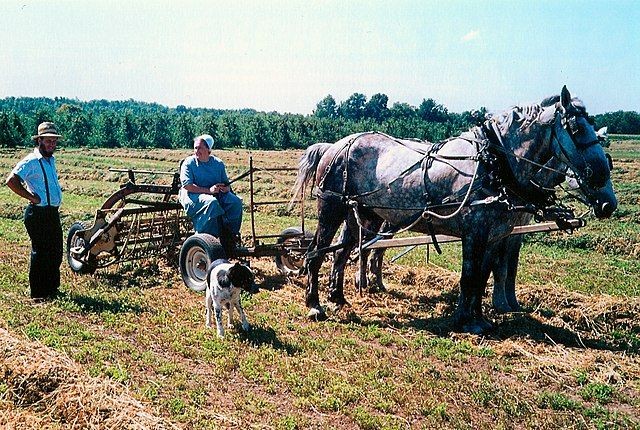
Will we never be satisfied, no matter how rich we are? Or do the statistics not reflect real life? Or is it perception because we live by stories rather than facts? Or do people sense that things are heading in the wrong direction? Discussing statistics is tricky. Talking about open-air museums. The Old Order Amish are happy people. They don’t need much to live in Paradise. And they don’t have statistics. Only a Paradise can’t do without a strong protector, thus an 800-pound gorilla who scares the hell out of potential invaders. Europe and the Pennsylvania Dutch could count on the protection of the US Army. But who will keep God’s Paradise safe? Captain Obvious has the answer.

Modernisation

You can only say that things are heading in the wrong direction if you expect disaster or when you have a vision of how things should be. Otherwise, there is no right or wrong direction. The ecological apocalypse may kill billions, and technological development could end humanity, but are these terrible things? It depends on whether you think humanity is precious, which is merely an opinion. Modernisation has had its critics. They weren’t that stupid, except for believing we have a choice and can change the system. We might if we are all on the same page, but that requires a miracle.

Mahatma Gandhi believed industrialisation wouldn’t solve the problems plaguing the Indian poor. He urged Indian villagers to remain self-sufficient in food, make their clothes, and avoid the temptation of mass-produced consumption goods. When Gandhi lived, most Indians were hardly better off than their forebears had been before British colonisation. Today, poverty in India has declined dramatically. The Unabomber claimed in his manifesto that the Industrial Revolution had initiated a process that would eventually destroy humanity through technology and end freedom by forcing us to adapt to machinery.

We shouldn’t romanticise the past. Billions are still poor, but poverty has declined. The Industrial Revolution created an engine of permanent change, driven by competition, economies of scale, and innovation. We have become cogs in a system over which we have no control. Communities disappeared, giving way to societies. And the competition never ends. Humans emerged as winners in a contest between species known as the struggle for survival. They then turned into the destroyers of other life on Earth.

Humans innovate faster than other species. We have eliminated the competition, taken over the planet and killed many of the plants and animals that once lived there. The remaining wildlife lives in a few reservations. Artificial intelligence will soon outcompete us. The driver of competition is trade. Without trade, two countries can’t compete, not even two villages, for that matter. And that is our ultimate challenge. The prospect of continued competition is mass destruction. So it would be better to stifle all innovation with red tape than to let things continue as they do. It is a matter of life and death.

Why things are getting more evil

What we see as good benefits something, and what we see as evil harms something. So what you think is good or evil depends on the something you have in mind, what you believe is beneficial and harmful, whether you believe intent matters, and what you think the consequences of choices are. And so there is room for debate. Intent is an interesting issue. You can make the same choice, such as euthanasia, out of compassion, out of cruelty, or based on a principle you believe in. Consequences may also matter. Evil intent can have favourable outcomes, while good intent can bring disaster. That has been an argument in defence of capitalism. The capitalism-socialism debate originates in divergent views on law and morality within the Western tradition.

In the Anglo-Saxon world, with the Common Law, individuals are sovereign, and ethical philosophy is pragmatic. It means that moral rules are a social agreement, so good and evil depend on popular sentiment; freedom is the ability to do as you please, and outcomes matter more than intent. In continental Europe, with Civil Law, the lawmaker is sovereign, thus the king or the people in a democracy, and idealism dominates ethical philosophy, most notably in Germany. It means that good and evil are absolute, freedom means liberating yourself from your lower urges, thus becoming rational and morally upright, and intent matters more than outcomes. Adam Smith was a pragmatist from Great Britain, while Karl Marx was an idealist from Germany.

Adam Smith, the founder of modern capitalist thought, argued in his book ‘The Wealth of Nations’ that self-interest in a market economy promotes overall economic well-being, as ‘it is not from the benevolence of the butcher, the brewer, or the baker that we expect our dinner, but from their regard to their own interest.’ In other words, self-interest rather than benevolence fills our stomachs. Conversely, socialist systems, despite being invented with good intentions, led to poverty and famine, so they are evil. Traditional moral systems regarded self-interest as evil and benevolence as good. Capitalism thus comes with an inversion of that morality, and it ultimately became greed is good. It reflects pragmatic moralism rather than an idealistic or absolutist take on ethics.

Capitalism rewards individuals for their ability to generate money by transforming natural resources and energy into waste and pollution, by producing things we don’t need in a competition that will end in disaster. Whatever intentions the greedy may have, their efforts bring about an apocalyptic catastrophe that some major religions have long predicted. We can be pragmatic and judge the greedy not by their intent but by the outcomes. And we can be idealistic or absolutist, arguing that markets have no morals. Individual market participants may possess moral values, but markets never do. There are always people willing to do the trade. When there is demand, there will be supply. The trader’s ethic is no ethics at all. Money corrupts everything, including the government, and that is why things are getting more evil.

Karl Marx wrote in his famous book that capital is dead labour that, like a vampire, only lives by sucking living labour. In capitalism, the dead eat the living, which eventually leads to a zombie apocalypse as predicted by ancient Christian prophets. The specifics of the events do not precisely match those in the Book of Revelation, and somehow they never do, despite the frantic efforts of religious people to prove otherwise. But every sizeable inheritance or successful launch of a new corporation that gets us hooked on things we don’t need is the birth of a new zombie.

And the innovation never stops. Vampire capital, or private equity, is the latest brainchild of capital owners to suck more money out of us. The giants, such as Apollo Global Management, Blackstone, and the Carlyle Group, control $8 trillion in assets. Over 18,000 private funds operate in the US, mainly investing in medium-sized companies. The figure grew by more than 50% in the last five years. According to McKinsey consultants, global private equity assets reached $13 trillion in 2023.5

Here comes just one example. There are countless others. About 70% of nursing homes in the United States are for-profit. They have increasingly merged into larger chains, often owned by private equity firms. Two-thirds of the nursing homes’ cash flow comes from Medicaid. The company Manor Care had 25,000 beds and was the second-largest nursing home chain in the country by 2017. A private equity firm, The Carlyle Group, acquired it in 2007 through a leveraged buyout.

Carlyle sold the land on which the nursing homes stood to a company specialising in providing real estate to healthcare providers. Carlyle pocketed the proceeds from the land sale and used them to pay off the debt incurred in acquiring Manor Care. Manor Care then had to pay rent using its Medicaid revenues, while Carlyle took the operating profits. With this new rent burden, Manor Care’s margins contracted. Carlyle then insisted on cutting positions and wages.5

The quality of care deteriorated as the chain struggled financially and laid off staff. In the wake of the private equity purchase of Manor Care, nurse staffing fell, and resident deaths increased by 11%. Bills, mainly to Medicare, increased by 8%.6 Code violations soared. Lawsuits from relatives spiralled, and Manor Care went bankrupt in 2018. That was a lot of money for lawyers, also. There are plenty of examples. When a private equity firm acquires a doctor’s practice, it starts employing profit-boosting strategies, including surprise billing. Private equity firms remove doctors from insurers’ networks, allowing them to bill patients for far more than insurers would pay.

Then there is Big Pharma. Pharmaceutical corporations pay doctors for prescribing their drugs. Their marketing efforts contributed to the opioid crisis in the United States. An example is Purdue Pharma, which developed, manufactured, and aggressively marketed opioids for decades, causing addiction and overdose deaths. After the settlement, the Sackler family, who long owned the corporation, walked away with billions. Many Americans don’t trust their healthcare system, nor do they trust pharmaceutical corporations. These feelings, the COVID-19 vaccine scare and conspiracy theories led to an estimated 200,000 fatalities in the US because of not taking these vaccines.7

Big Pharma funds healthcare research, so there is reason to be sceptical, or even distrustful. On the other hand, many ‘independent research’ and ‘independent magazines’ are a business model for quacks and snake-oil salespeople, who sell alternative treatments and sensational stories. Quackery is even more lethal and driven by that same profit motive. And the death toll of not taking the vaccines likely vastly outstripped the number of people who died from them. It is a sign of something more troubling. Money has corrupted US healthcare, along with the rest of US society, to the point that not only is trust in healthcare collapsing, but trust in society itself is as well. And with good reason. Americans pay more for healthcare than anyone else, while they hardly live longer than Cubans, a destitute people suffering under a failed communist experiment.

We live by stories

Most of us wouldn’t be so depraved as to do what the private equity firms do. If you are rich already, how can you be so evil that you want to make money out of denying the elderly their care or defrauding unsuspecting patients? That is because markets have no morals, and the merchant’s ethics are no ethics at all. There is money in it, and it is legal, so it happens, because money is our highest value rather than caring for patients and the elderly. But it is profoundly evil. Jesus said that you can’t serve both God and money. The Dutch call this issue ‘the merchant and the vicar.’ You are either on the side of good or on the side of money. There is no compromise. So far, money always wins. In that sense, and some other ways as well, Marxism is Christianity without God. And that is no coincidence.

To change our course, we need a new foundation for our culture, values, and way of life, but that requires a new world religion. Traditional peoples saw nature as sacred. Likewise, we can see God’s creation as sacred. We are here to keep it rather than to destroy it. In 1854, the Native American Chief Seattle gave a speech when the US government wanted to buy their land. A redacted version of his oration became a rallying cry within the environmentalist movement. In that version, Seattle reportedly said,

How can you buy or sell the sky, the warmth of the land? The idea is strange to us. Every part of this earth is sacred to my people. We are part of the earth, and it is part of us. The white man does not understand our ways.

One portion of land is the same to him as the next, for he is a stranger who comes in the night and takes from the land whatever he needs. He leaves his father’s grave behind, and he does not care. He kidnaps the earth from his children, and he does not care.

We might understand if we knew what the white man dreams, what hopes he describes to his children on long winter nights, and what visions he burns into their minds so they will wish for tomorrow. But we are savages. The white man’s dreams remain hidden from us.

Chief Seattle and his people had lived simple lives in their own Eden. He saw that the white man was on a road to nowhere. He dreams, not much unlike the poor sobs who invented agriculture 10,000 years ago, that if he works hard, his life will be better. Today, nearly everyone else follows the white man’s path and many work even harder than the white man. Poverty is declining worldwide, but the Earth can’t sustain our lifestyles. And artificial intelligence may soon make us obsolete. Will we ride towards our destruction, or can we be content with having enough? And how do we get there? That is not merely an economic question. It begins with our values and the dreams we live by.

Featured image: Bicyclists. By FaceMePLS from The Hague, The Netherlands – Buitenleven / Country Life. Wikmedia Commons. CC BY 2.0.

1. Investor Insanity? The Degenerate Economy Index Up 130%. Boaz Sobrado (2025). Forbes.
2. Real gross domestic product per capita in chained 2017 dollars (A939RX0Q048SBEA). Federal Reserve Bank of St. Louis.
3. Sapiens: A Brief History of Humankind. Yuval Noah Harari (2014). Harvil Secker.
4. American workers are stuck in an ‘infinite workday,’ according to Microsoft report: ‘People are feeling very burnt out’ Sophie Caldwell (2025). CNBC.com.
5. Private equity: vampire capital. Michael Roberts blog (2024).
6. Private equity: health care’s vampire. Steffie Woolhandler, David U. Himmelstein, Elizabeth Schrier, and Hope Schwartz (2024). Statnews.com.
7. Estimated preventable COVID-19-associated deaths due to non-vaccination in the United States. National Library of Medicine. Katherine M Jia, William P Hanage, Marc Lipsitch, Amelia G Johnson, Avnika B Amin, Akilah R Ali, Heather M Scobie, and David L Swerdlow.

Amish family, Lyndenville, New York. Public domain.

Economic Development

Before the Industrial Revolution

Before the Industrial Revolution began in England, European crafts and sciences had already advanced. During the Middle Ages, inventions such as gunpowder, eyeglasses, the compass, the printing press, the mechanical clock, the windmill, and the spinning wheel had reached Europe from China or the Middle East. What made Europe culturally different was its individualism. In the 14th and 15th centuries, a new spirit emerged in Italian merchant towns like Venice, Florence, and Genoa. It was the spirit of the merchant which subsequently spread throughout Europe.

And so, Europeans gradually abandoned their traditional Christian values and developed a capitalist spirit by pursuing worldly wealth and pleasure rather than modesty and bliss in the afterlife. There were merchants elsewhere, but the populace held them in low regard because of their depraved ethics, as greed was their core value. It was the pursuit of profit that drove European explorations and colonialism. Making money became the new moral virtue, alongside inquisitiveness, creating a dynamic that would change the world.

During the 16th and 17th centuries, Europeans explored the world and invented the microscope, the steam turbine, the telescope, and the steam pump. Modern science began when Nicolaus Copernicus calculated the trajectories of the planets by assuming that they revolved around the Sun. Isaac Newton later formulated the laws of motion. Europeans expanded their colonial empires, thereby increasing the size of their markets, a prerequisite for the mass production that industrialisation was to bring.

The British were the most successful. Supported by a strong navy, they built the largest colonial empire. They also invented modern banking, creating money out of thin air or financing capital by imagining future revenues. In 1689, the British had the Glorious Revolution, which, like many revolutions, was about taxation. Businesspeople then took over the government. Taxation henceforth required the consent of the taxed, thus, property owners. And the state became a venture of the propertied classes, like the Dutch Republic, the wealthiest nation at the time, already was.

The taxpayers didn’t like to pay for ineptitude and corruption, so the quality of the British state improved, and the state used its military to support the colonial business ventures of the propertied classes. Great Britain had easily accessible coal deposits and developed a large coal mining industry. Due to a lack of firewood, coal had become England’s primary heating source. As mine pits grew deeper, they became prone to flooding. With no transport costs, a coal-fired steam engine to pump water out of the mine became cheaper than manually pumping with buckets.

Ignition

Trade with the colonies promoted British industries, resulting in high living standards and wages in England. In England, coal was easily accessible, so energy was cheap. In Great Britain, the aristocracy had an entrepreneurial spirit and paid taxes, making the British government a reliable borrower. Banking innovations, most notably the creation of money, made British capital markets more efficient. And so, Great Britain had low interest rates, so a low price for capital. The first machines were clumsy and inefficient, but high wages, cheap capital and affordable energy made them profitable.

This combination of factors is why the Industrial Revolution started in England rather than elsewhere. Wages in France were lower, while the banking system was less developed. The rent-seeking French aristocracy didn’t pay taxes, making the French government an unreliable borrower. Thus, interest rates in France were higher. Once the first machines were in operation, inventing new ones or improving existing ones became profitable, so British engineers got busy enhancing the steam engine’s efficiency and inventing contraptions like the spinning jenny and the cotton gin.

The fuel consumption of steam engines dropped from 44 pounds of coal per horsepower-hour in 1727 to 3 pounds in 1847, making it economical to use the steam engine for other purposes, such as trains. The dramatically improved fuel efficiency, combined with other improvements, made it economical to mechanise production elsewhere where wages were lower, interest rates were higher, or energy was more expensive. That allowed the Industrial Revolution to spread to other countries.1

It was a watershed moment. Until then, inventions were rare. Scientists made them out of curiosity. However, from then on, the profit motive generated a permanent drive to pursue knowledge and new technologies and to invent new products. In this way, economising through innovation and scale became a constant, unstoppable process that economists call creative destruction. Factories needed scale to operate profitably, while inventions birthed new industries and made others obsolete.

Humans have started a fire in their midst that continues to grow. We can’t stop it. A classic book on the Industrial Revolution used at universities is David Landes’ The Unbound Prometheus. According to Greek mythology, Prometheus stole fire from the gods and gave it to humans. The Greek supreme deity, Zeus, punished him for his act. The story parallels the biblical story of the Fall. The Industrial Revolution unleashed the unlimited fire of the gods that will devour us.

Since the Industrial Revolution, the general level of opulence has risen dramatically, though it was hardly noticeable at first. Industrialisation made craftspeople in the clothing industry destitute as they couldn’t compete with factories. Everyone else profited from cheaper cloth. Mechanisation made existing products like cloth more affordable, so people had money to spend on new products like light bulbs, making investing in new inventions profitable. Economists call it Say’s Law. More supply generates new demand.

Due to these innovations, production costs decreased, and industrialisation became profitable where wages were lower, energy was more expensive or interest rates were higher. Industrialisation first took off in Europe and North America, but not elsewhere. One reason is that Europeans had become innovation-minded and eagerly adopted new technologies like railroads and telegraphs. These first technologies were simple, thus easy to apply, but the Chinese and others remained reluctant to use them.2

Standard development recipe

Western Europe followed quickly, helped by the French Revolution and Napoleon Bonaparte’s reforms. The French Revolution wiped out the corrupt old French regime and replaced it with a modernised, efficient bureaucracy. The aristocrats lost their power. The French introduced civil registries, rationalised the law code, standardised weights and measures by introducing the metric system with kilograms and metres, and made everyone drive on the right side of the road. Napoleon’s armies then spread these reforms over Europe. Napoleon did to Europe what the first Chinese emperor did to China 2,000 years earlier. Both reigned shortly but left a lasting legacy.

Countries Napoleon didn’t conquer, such as Great Britain, continued to drive on the wrong side of the road and use arcane measures like miles and ounces. And only in Great Britain do aristocrats still influence politics through the House of Lords. To catch up, Western Europe and the United States followed a standard recipe consisting of the following elements:

  • Creating a national market by eliminating internal tariffs and building railroads.
  • Developing domestic industries by using external tariffs.
  • Instituting banks to finance investments and stabilise the national currency.
  • Establishing a mass education system to upgrade the labour force.

These measures had enormous social consequences, which we now refer to as modernisation. Societies came to replace communities. It was the age of nationalism. With the help of mass education, everyone learned the national language, and local dialects disappeared. People learned to identify with their nation rather than their kin and village. The outcome was that modern humans rely on markets and the state more than on their family and community.

Other countries implemented the same recipe but with modifications due to local economic factors. Factory layouts that operated at a profit in Europe were loss-making elsewhere. If energy were expensive, the operation would become more cost-effective using fewer machines and more labour. Japan was the first non-Western country to follow. The Japanese had to deal with local circumstances. High interest rates made investment capital expensive, so Japanese factories held no stockpiles of raw materials and semi-finished products but let their suppliers make them when needed. So, when interest rates rose in the late 1970s and early 1980s, Western industries couldn’t compete with Japan.

There are varying views on why industrialisation succeeded in some countries but not in others. If you dare to generalise, you can make the following observations:

  • East Asian countries like Japan, South Korea, Taiwan, and later China modernised successfully. They had a sense of nation and experience with rational government administration. Their bureaucrats and businesspeople successfully implemented modernisation projects.
  • Latin American countries were less successful. They were former colonies lacking national identities. Their white elites neglected the education of indigenous people. There were a few large estates and hardly any small-scale farmers. Wealth inequality prevented the development of a middle class.
  • The Soviet Union modernised with the help of state planning. Industrialisation of heavy industries succeeded, allowing the Soviet Union to defeat Nazi Germany. Agricultural reforms were a disaster, and consumer products were of poor quality. By the 1970s, it became clear the Soviet Union couldn’t keep up with the West.
  • Several countries in the Middle East modernised with dictators implementing socialist development models based on the experiences in the Soviet Union. Some Arab countries became wealthy from oil revenues. Few countries in the Middle East have developed industries that compete in international markets.
  • Africa lagged. African borders didn’t match the tribes living there, so there was no sense of nationhood. There have never been states in most of Africa. European colonisers ended traditional forms of government and property rights, contributing to poor governance and corruption. Africans started with a disadvantage.

Industrial politics

There are requirements for a modern economy, though a country doesn’t need to meet all of them. A capable government and an educated workforce can turn a situation around. Japan has few natural resources, but has become one of the most advanced countries in the world. It was the first non-Western country to industrialise. Japan was also lucky. After World War II, it had access to US markets because it was a close ally of the United States, which needed it to help it export its way into prosperity. Argentina had fertile land and was one of the wealthiest countries by 1900, but it has since then gone downhill. To successfully modernise, a country probably needs:

  • a capable government that understands economics and is business-friendly
  • an educated workforce as workers must read, write and use technology
  • businesspeople, investment capital, and sufficiently ensured property rights
  • a large enough market, thus a sizeable middle class
  • an industrial policy, thus picking industries to compete in international markets, helping to develop them, and supporting them with tariffs or subsidies

There are several kinds of industrial politics. Neo-liberal politics aim to pursue economic growth by promoting trade, lowering taxes, and reducing regulations. Unrestricted trade allows areas and people to specialise and compete to produce more and better products, enhancing overall opulence. It also promotes a race to the bottom at the expense of our future. Industries go where wages are lowest or where they can dump their waste and avoid paying for government services.

Making the economy sustainable and people-friendly also requires industrial policies, such as reducing competition and introducing regulations and controls. And it requires ending imports from countries that don’t adhere to the same ethical standards. A sustainable, people-friendly economy can only exist on a level playing field with other economies that adhere to the same standards. These measures increase costs and reduce living standards. An extreme case is the Old Order Amish. They choose to be self-sufficient and live simple lives. Their economic model resembles community economics.

Community economics aims to enable people in a community to help each other by buying and selling goods and services using local currencies. It never became a worldwide success because communities lack the scale for self-sufficiency. There is also a lack of commitment, which is something the Amish do have. Few people barter their labour or goods in their community if they can get better deals elsewhere. Commitment is vital. Without it, there will be black markets with merchants smuggling in illicit goods.

Featured image: Amish family, Lyndenville, New York. Public domain.

1. The British Industrial Revolution in Global Perspective. Robert C. Allen (2014). Cambridge University Press.
2. Sapiens: A Brief History of Humankind. Yuval Noah Harari (2014). Harvil Secker.