What Are The Odds?

The law of large numbers

On 11 November 2017 (11-11), I went to Groningen with my wife and son by car. While driving, I noticed the date and time displayed on the car’s clock. The date was 11-11, and the time was 10:35. It made me think, ‘Wouldn’t it be nice to look at the clock at exactly 11:11 today because it is 11 November (11-11).’ Within a second, I noticed the distance recorder standing at 111.1. It had been 111.1 kilometres since I last filled up. Peculiar coincidences can occur by chance. With eight billion people on this planet and so many things transpiring, these things happen.

An example illustrates this. Imagine you have five dice and make a throw. A remarkable incident is throwing five sixes. If you roll the five dice only once, it probably doesn’t happen. On average, it only occurs once every 7,776 times. But if you throw the dice a million times, it happens 128 times on average.

If a reset of the distance recorder occurs every 500 kilometres, the chance of 111.1 kilometres appearing on it is one in 5,000. The distance recorder was not far from the clock, so I would probably have noticed a peculiar number on it after seeing the date. The probability of the distance recorder being on 111.1 might have been 0.02%. The likelihood of the thought about 11:11 popping up on 11 November is difficult to establish, but in my case, it was not low.

The birthday problem demonstrates strange coincidences happen more often than we might think. If you share a birthday with another person in a small group, it might strike you as odd, but the chance of someone sharing a birthday with another person is already 50% in a group of 23. However, two people sharing a birthday is not a mind-blowing coincidence. It is not as remarkable as the incident with the distance recorder.

When you are a member of this group, the probability of you being one of the persons sharing a birthday is much smaller, namely 6%. Meaningful coincidences are likely to happen, but less likely to you. So, if many people experience the same and think it is merely a coincidence because coincidences occur more often than you might think, they suffer from what you might call a collective delusion. Imagine a group of 24 all sharing a birthday with one other group member, so they share 12 birthdays, and they all think, ‘Nothing exiting to see here. The odds of me sharing a birthday with another person in this group are over 50%.’

Taking a smaller sample reduces the likelihood of meaningful coincidences. If you randomly pick two people, the chance of them having the same birthday is only 0.3%. So, if you run into someone else who happens to share your birthday, and it happens again with the next person, it is noteworthy. If it happens another time with the following individual, you might wonder whether there is more to this universe than mere chance. The more elaborate a scheme, the less likely it is to transpire. The probability of three people sharing a birthday in a group of 23 is 1.3%, and for five, it is only 0.0002%. If your life is riddled with elaborate, meaningful coincidences, you might start to believe that you have a critical role in the universe.

Possible avenues to circumvent the law of large numbers

There may be a way to find out there is no such thing as coincidence. If some of the most significant historical events come with peculiar coincidences, that might be more telling for two reasons. First, there are only a few, so the law of large numbers doesn’t apply. After all, it is a small sample. Suppose no intelligence is coordinating events in this universe. In that case, it is less likely that meaningful coincidences will turn up in this sample, and elaborate schemes will be unlikely to emerge. Second, if the most significant historical events come with peculiar coincidences, it becomes more likely that history is scripted than when peculiar incidents transpire in someone’s personal life.

To make the argument, you need to answer questions like, what are the most important historical events, and what are peculiar coincidences? Events such as the sinking of the Titanic or the Kennedy assassination might not qualify, even though the coincidences surrounding them form a strange and elaborate scheme. The extent of these schemes might compensate for that, but it is hard to tell. The beginning and the end of World War I meet the requirements. D-Day, the fall of the Berlin Wall, and the terrorist attacks of 11 September 2001 are among the most important historical events.

And what should I think of the number of meaningful coincidences in my life? It is not possible to establish the likelihood of that happening. You can make assumptions to arrive at an idea. A highly unusual coincidence, such as the do-it-yourself store incident, could be likened to throwing five sixes with five dice. The chance of such an event happening in any year in any life could be one in 7,776. If something similar transpires again that year, it is like throwing five sixes twice in a row. The chance of that would be one in 60,000,000. On average, 120 people would experience something similar each year. But what if more similar incidents occur in one life? Or if 100,000 people have this instead of 120?

I have shared a few of my coincidence stories on the Reddit/SimulationTheory message board. Others also experience similar situations. Only the people on that message board are not a random group, but a select group of individuals who believe we live in a simulation, often because they have witnessed similar phenomena. Some of these stories are as remarkable as mine. I can’t verify these tales, but I believe most aren’t frauds because similar things happened to me. The question remains whether they have seen strange incidents occurring in the numbers I have seen.

There is a point where you must admit that these things are not merely coincidental. We can’t establish that point objectively. The number of possible unusual events is infinite, so the chance of something strange happening, such as the do-it-yourself store incident, could be higher than we intuitively think. It seems impossible to accurately estimate the odds. Still, without intelligence coordinating events in this universe, we should expect these incidents to be distributed more or less evenly across all people and time frames.

Even then, significant deviations from the average are possible. Lightning strikes only a few people. It happens to some people twice, which might seem odd, but there is nothing suspicious about that. If lightning strikes one in 10,000 people once, then one in 100,000,000 gets hit twice. But how would you explain if one person ran into lightning ten times, and this individual did nothing unusual? Statistically, it can happen. More likely, there is a cause, such as living in a dangerous spot. There is a point where we must assume these stories are evidence of us living in a simulation. We can’t establish that point precisely, but whether we live inside a simulation or not doesn’t depend on our assessment. We are, however, inclined to see causes behind remarkable situations or events, but they may be accidental.

The limits of our minds

We are good at attributing causes, but we do poorly at estimating the likelihood of an event. The psychologist Daniel Kahneman provided an example. It is a study of the incidence of kidney cancer in the counties of the United States. The research revealed a remarkable pattern. The incidence of kidney cancer was the lowest in rural, sparsely populated counties in traditionally Republican states in the Midwest, the South, and the West.1 So what do you make of that?

You probably came up with reasons why kidney cancer is less likely to occur in these counties, such as a healthy rural lifestyle or low pollution levels. You probably did not think of randomness. Consider then the counties in which the incidence of kidney cancer is the highest. These counties were also rural, sparsely populated, and in traditionally Republican states in the Midwest, the South, and the West.1

How can that be? Those counties all had small populations. And with smaller samples come more sizeable deviations from the average. Our intuition makes connections of causality, but our reason does not verify whether it could just be randomness. We like to think some cause makes unusual things happen, while they might be random accidents.

When we consider the most significant historical events, we run into problems if we use this small sample to establish that someone is ‘writing history’. On the other hand, comparing this sample to a sparsely populated rural county may not be apt. It is more fitting to compare this sample to the royal family, as it encompasses the most significant events in history. If a high incidence of kidney cancer were to turn up in the royal family, an experienced physician would tell you it is probably not a random issue.

I am a single individual, the smallest possible sample. Some people get struck by lightning twice. It could even happen three or four times, but the chance of it happening ten times is so insignificant that no one will ever experience that unless they live in a hazardous spot. Is the number of meaningful coincidences in my life enough to rule out chance? That number is extraordinarily high. It is not chance. The question arises: Am I just a random individual, or do I live in a dangerous location, or has destiny given me a unique role, such as proving that we live in a simulation? Others have this, too. And so, a lengthy series of peculiar incidents doesn’t suffice to believe the latter.

The things that could have happened but did not

In 1913, the ball fell on a black number twenty-six times in a row at the roulette wheel at the Casino de Monte-Carlo. Some people lost a fortune by betting the ball would fall on red the next time. They did not realise the chance of the ball choosing a red number never changed. The ball does not remember where it went the previous times. If we represent black with a B and red with an R and assume, for simplicity’s sake, there is no zero, we can write down falling twenty-six times on black like so:

B B B B B B B B B B B B B B B B B B B B B B B B B B

The probability of the ball falling on black twenty-six times in a row is one in 67,108,864. That is a long shot. What might surprise you is that the following combination of black and red numbers is precisely as likely to occur:

R B B R B R R B R B B R R B R R B R B B R R B B R B

You wouldn’t be thrilled if that happened unless you became a millionaire by betting on this particular series of twenty-six. And even then, you wouldn’t think of the 67,108,863 sequences that did not materialise. We tend to consider only the things that did happen, but we rarely think of all the things that could have transpired but didn’t. Events such as the ball falling on black twenty-six times in a row impress us. And I am even more impressed because twenty-six happens to be my lucky number.

This argument applies to meaningful coincidences but not to a prediction materialising, as such a feat may imply that all the other things couldn’t have happened. If I say with firm conviction that the coming sequence of black and red would be R B B R B R R B R B B R R B R R B R B B R R B B R B and it happens as I predicted, I may have the gift of prophecy. The chance of me being accidentally right was one in 67,108,864.

Imagine the probability of you sitting here reading this page on a tablet or a mobile phone, but as a prediction from 3,600 years ago. Imagine Joseph telling the Pharaoh: ‘I see (your name comes here) reading a pile of papyrus pages, not real papyrus pages, but papyrus pages appearing on something that looks like a clay tablet. Do not be afraid, dear Pharaoh, for it will happen 3,600 years from now. But if we do not set up this grain storage, it will not happen, so we must do it. And by the way, Egypt will starve otherwise.’

The chance of this prediction coming true was not one in 67,108,864, nor was it one in 1,000,000,000,000,000,000,000. Adding more zeroes doesn’t help. The chance is far smaller than any number you can ever write down. It is so close to zero that no one can tell the difference. Nevertheless, you sit here reading this text, perhaps even on a tablet. How could this happen? The answer to this mystery is that many things could have occurred but did not; however, something had to happen, and that is what transpired. In any case, Joseph couldn’t have made such a prediction by accident.

The licence plate number

What about the reference to the end date of World War I on the licence plate of Franz Ferdinand’s car? Few historical events are as significant as the start and end of World War I. And so, the law of large numbers doesn’t apply here. It is one of the most important historical events, thus part of a sample comparable to the royal family. A mere accident seems unlikely. The assassination could have gone wrong; cooler heads might have prevailed, or the war could have proceeded differently, ending on a different date.

It might have been possible to guess the end date of World War I once it had started. If you presumed that the war would not take more than twenty years, a random guess of the end date could be correct one in every 7,305 times. But something doesn’t add up here. Hardly anyone expected the war to last longer than a few months. The licence plate originates before the war. The assassination succeeded after a series of mishaps. If the licence plate number contained a prediction, that prediction included the assassination succeeding, Franz Ferdinand dying in this particular car, and this event being the trigger for the war.

That is hard to do. And so Mike Dash in the Smithsonian noted, ‘This coincidence is so incredible that I initially suspected that it might be a hoax.’2 Only, it is not a hoax, so investigative minds could have probed other options, but they did not. Conspiracy theorists also ignored it, even though this incident agrees with their beliefs of a secretive plan being behind history.

In the conspiracy scene, a story circulates about a Freemason named Alfred Pike, who allegedly disclosed a secretive plan of the Freemasons to bring about the New World Order. Pike supposedly predicted both world wars with uncanny precision in 1871. Nobody had ever heard of this plan before 1959, when an ‘investigator’ ‘uncovered’ it. Contrary to the licence plate number, the story has no substance. It is a hoax. In the Netherlands, they would call it a monkey sandwich story.

Seeing meaning

Authors use symbolism, hidden meanings, themes, and stylistic figures. Events in their lives, as well as the writings of other authors, influence their writings. Literary critics look for those meanings. You can check out what experts wrote about the poem The Waste Land by T. S. Eliot. You will be surprised. Some authors marvel at what literature critics discover in their works. Apart from intention, there can be an unconscious influence. And so, seeing meaning is more like an art than a science. A scientist would argue there is no proof and that it is baseless speculation because science isn’t about meaning.

He spent a number of years at this project
And now he knows how an electron behaves

The Nits, Mountain Jan

You can’t understand intentions and meaning from investigating the conduct of electrons. Meaning in literature is often intentional. If someone wrote the script running the events in this world, the author might do what other authors do. And so, the licence plate number on Franz Ferdinand’s car could signal foreknowledge of future events or even control over them. The sceptics argue from a scientific perspective, while those who see meaning act like literary critics. Who is right about the meaning of AIII 118 depends on whether there is a script and, therefore, an author.

Sceptics might claim that AIII 118 is a random sequence of characters, but we see a reference to the end date of World War I. That is how our minds work. The argument is odd. If you take it to the extreme, this text is also a random array of characters, as is any book or report. And still, you read words and sentences that have meaning to you. Indeed, the licence plate number would have remained unnoticed if the war had not ended on 11 November 1918.

However, the war ended on 11 November 1918. AIII 118 is the car’s licence plate number that drove Franz Ferdinand to his appointment with his destiny. And destiny is the message the licence plate number radiates. It suggests premeditation concerning the assassination, the start of the war and its end on 11 November 1918. That is a meaning we can see without too much imagination. There are plenty of instances and locations where this sequence of characters could have turned up, so their presence in this particular spot is noteworthy. AIII 118 on a fish barrel in Vienna wouldn’t have attracted attention. Ditto for the licence plate number ABII 117 on that particular car.

Sceptics can also be fanciful. Austrians speak German. Armistice in German is Waffenstillstand. So why does it not read WIII 118? Or even better, W1111 1918? If someone sends you a message, you don’t quibble about such details. If I said ‘hello’ to you, you wouldn’t ask me why I didn’t utter the word ‘hi’ instead. That is, unless you are a philosopher with a lot of idle time and have a hobby of questioning everything. Great Britain, the United States and France were all major participants in the war. These countries all use the term armistice. And if the sceptics come with outlandish arguments, you have won the argument. Only, they disagree. Not seeing meaning is the art of being a moron. Communication with morons is, therefore, problematic.

Asking yourself which licence plate numbers were available in the Austrian-Hungarian Empire may be a better idea. You could check which combinations fit the purpose. There aren’t that many options. Perhaps, you end up with just one match: AIII 118. That makes it harder to believe that this sequence of characters is meaningless. This scheme became even more inconceivable because the war ended on 11 November (11-11), the most peculiar date of the year.

Only a few historical events are as important as the assassination of Archduke Franz Ferdinand and the Armistice of 11 November 1918. You can think of D-Day, the fall of the Berlin Wall, and 9/11. The coincidence scheme surrounding D-Day is extensive, and the recurrence of dates is intriguing. The involvement of Hans van Mierlo is also mind-boggling. It also relates to the Curse of the Omen, a film released on the anniversary of D-Day, as well as the untimely passing of Senator Robert Kennedy on 6 June (6/6) and Martin Luther King on 4 April (4/4) 1968. A historian correctly predicted the fall of the Berlin Wall in 1989, while the coincidences surrounding the terrorist attacks of 11 September 2001 are dumbfounding. In other words, this incident doesn’t stand alone.

A final argument may be that such extensive or peculiar coincidence schemes don’t appear in other historical events that are equally significant, such as the American, French, Chinese, and Russian revolutions. These events are marked by a few peculiar coincidences, such as Thomas Jefferson and John Adams having their appointments with the Grim Reaper on the same day, which happens to be 4 July, thus Independence Day. That is noteworthy, but perhaps not sensational. The parallels between Napoleon Bonaparte and Adolf Hitler might also raise some questions. Somehow, the licence plate number of Franz Ferdinand’s car is more exceptional, most notably because of it being so precisely predictive.

The Chinese Revolution of 1911 began on 10 October 1911. It marked the end of 2,000 years of imperial rule in China. The date, 10 October (10/10), is not as remarkable as 11 November (11/11), even more so because there are no related coincidences. The Russian Revolution led to the establishment of a communist empire that lasted for seven decades. A bad omen marked the coronation of the last Czar of Russia, Nicholas II. The communists later murdered him and his family. You can ask why these events don’t seem part of a coincidence scheme. It is like asking why several members of the Royal Family don’t have kidney cancer. Well, they haven’t. That’s all there is to it. Perhaps, it is not satisfactory to philosophers with a lot of time on their hands, but it will have to do.

Hindsight bias

And then there is the benefit of hindsight. Countless strange incidents could have occurred, but they didn’t. We notice only things that did happen and don’t think of those that didn’t. That is hindsight bias. The sample of the most significant historical events comes with the benefit of hindsight. There is a danger to that approach, and it is unacceptable in science. It is like selecting only the data that confirms your theory. You might have a theory about gravity, saying that all objects will fall to the ground. And you prove your theory by ignoring the heavenly objects and the birds in the sky, so everything you investigate falls to the ground. It later turned out that gravity works that way, and ignoring the heavenly objects and the birds in the sky put you on the right track.

With hindsight, you know things you can’t learn in advance. Hindsight knowledge is also a favourite tool of critics when something goes wrong. However, when you use hindsight to find evidence, your critics argue you can’t. That’s how the critics play their game. They might clip a bird’s wing feathers and then ask the bird to prove it is a bird by flying. But if you use clipped birds to prove your theory of gravity, they might criticise you for that as well. You can’t beat your critics in their game. No evidence will ever convince them. So I won’t try. This wasn’t science in the first place, but metaphysical speculation.

Using hindsight, thus, is the only way to conduct this investigation, as we can’t predict the occurrence of meaningful coincidences. If this universe is genuine, we can’t establish that it is authentic. However, if it is a simulation, we may discover it is a simulation. So, if there is meaning, we must look for it to find it. We should be careful, as we are inclined to see intent when it could have happened accidentally. With that in mind, it is still fair to say that meaningful coincidences related to the most important historical events are likely not mere coincidences. Combined with the other evidence, we can establish that we live inside virtual reality, probably a simulation created by an advanced post-human civilisation.

Latest revision: 24 July 2025

1. Thinking, Fast and Slow. Daniel Kahneman (2011). Penguin Books.
2. Curses! Archduke Franz Ferdinand and His Astounding Death Car. Mike Dash (2013). Smithsonian. [link]

Port and lighthouse overnight storm with lightning in Port-la-Nouvelle in the Aude department in southern France. Maxime Raynal.

The Curse of The Omen

Rumours go that some films, such as The Poltergeist, Superman, and Rosemary’s Baby, have been cursed. Numerous accidents have occurred, causing people to believe that these films have a jinx.1 Not all of these arguments are particularly convincing, as accidents happen. They usually have no relation to a movie, even when several actors of the same cast have had bad luck. However, there is one noteworthy exception, the infamous curse of The Omen, the curse of curses in the film scene.

Danny Harkins wrote on Cracked.com: ‘No film in history has had worse luck than The Omen. Hell, nothing in history has had worse luck than The Omen.’2 The Omen came with billboards featuring a 666 logo inside the title and the uplifting slogan, ‘You have been warned. If something frightening happens to you today, think about it. It may be The Omen.’ And the cheery notice, ‘Good morning, you are one day closer to the end of the world,’ and a conclusion stating, ‘Remember, you have been warned.’

In the script of The Omen, the wife of the American ambassador to Italy gave birth to a son. The child died almost immediately. A priest then convinced him to switch his son with an orphan without telling his wife. Mysterious events soon started to haunt them. The child turned out to be the Antichrist. The Omen was first released on 6 June 1976 (6/6), also the anniversary of D-Day. The date refers to the number 666, as the last digit of 1976 is also a 6. The film’s length is 111 minutes, thus a triple-digit number like 666.

These ominous ingredients made The Omen an ideal candidate for a hefty curse. Two months before the filming started, the son of lead actor Gregory Peck committed suicide. In the film, he is the father of the child who died. When Peck went to the film set of The Omen, lightning struck his plane. A few weeks later, lightning struck executive producer Mace Neufeld’s flight. A lightning bolt in Rome just missed producer Harvey Bernhard, which you might call unbelievable luck, but the number of lightning bolts involved was also incredible. Later, the IRA bombed the hotel in which Neufeld was staying.1 He also survived that.

A plane hired by the studio to take aerial shots was switched at the last moment by the airline. The people who took the original aeroplane were all killed when it crashed on take-off. That is, again, incredible luck, but if you think there is a curse in operation, it is eerie nonetheless. An animal handler who worked on the film set died two weeks after working on the film when he was eaten alive by a large feline, possibly a tiger.1

And then there is the non-fatal accident of Stuntman Alf Joint that seriously injured and hospitalised him when a stunt went wrong on the set of A Bridge Too Far in Arnhem in the Netherlands, less than a year after the production of The Omen. He jumped off a building and missed the inflatable safety bags. It nearly killed him. Joint said he felt a push even though nobody was near him.1 These accidents weren’t exceptional. These things happen. Their number might be noteworthy, but so far, they are not evidence of the infamous Curse of the Omen.

However, the following should make you wonder. On Friday, 13 August 1976, special effects consultant John Richardson drove through the Netherlands with Liz Moore. Both were working on A Bridge Too Far. They became involved in a car accident that killed Moore. The gruesome accident is said to have been eerily similar to a scene Richardson had designed for The Omen. The story goes that the accident happened near a road sign stating a distance of 66.6 kilometres to the town of Ommen, a name very similar to Omen. And it happened on Friday the thirteenth.1 Now, that begins to look like a curse.

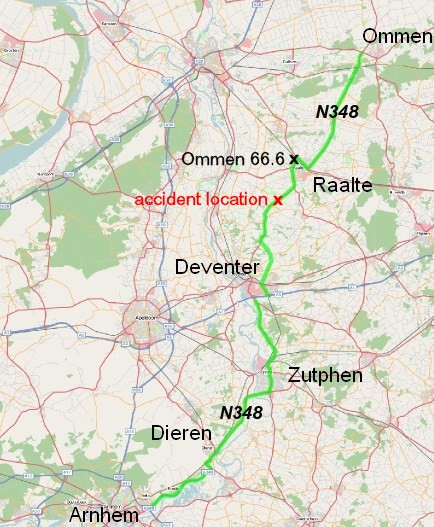
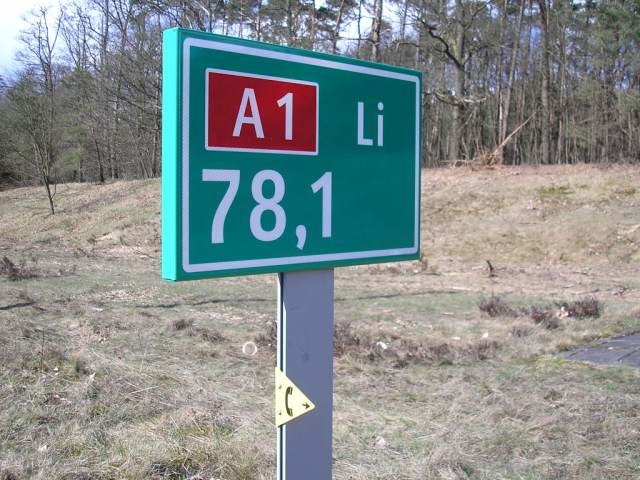
That caught my attention. Road signs in the Netherlands don’t give distances in fractions of kilometres. Only kilometre markers come with fractions. Near Raalte is a junction where Route N348 to Ommen meets Route N35, connecting to Enschede via Nijverdal. This location corresponds with kilometre marker 66.6 on Route N348. I am familiar with the area because I lived nearby, in Nijverdal, as a child. Road signs indicating the direction to Ommen are near this Anti-Christ marker, which I first noticed after returning from a funeral. It appeared to me that this junction should be the site of the crash.

Route N348 from Arnhem to Ommen

And so I came to investigate the curse. In 2015, I started an inquiry. A journalist from the local newspaper, De Stentor, helped me. He delved into the issue and emailed me on 14 April. He had managed to find a former police officer from the area. According to the police officer, the accident indeed occurred near Raalte on Route N348, but not at the intersection near marker 66.6, but between Raalte and Deventer, near Heeten, where Route N348 intersects with the Overmeenweg. This location corresponds with the kilometre marker 60.0. The police officer told the journalist he remembered the car crash very well.3

According to the police officer, the accident happened when he was on duty. A man and a woman had parked their car in a parking lot alongside Route N348. When they drove away in the direction of Deventer, they entered the wrong lane and collided head-on with an oncoming vehicle driven by a resident of Nijverdal. The view was somewhat limited because of two gentle curves in the road. He added that there was no road sign with ‘Ommen’ near the crash site.3

The woman died on the spot. The car was destroyed and disposed of at a fire station. It turned out that the couple were foreigners involved in the production of A Bridge Too Far, the police officer told the journalist. He suspected that Richardson, accustomed to driving on the left side of the road, was not paying attention to the traffic.3

On television, Richardson said, ‘It was certainly very odd because it happened on Friday the thirteenth.’ He added, ‘Right opposite the point where the accident happened, was an old mile-post with nothing but sixes on it.’ He also noted, ‘What spooked me even more was when I discovered it was on a road to a place called Ommen.’ It appears that Richardson has misread kilometre marker 60.0 and has taken the zeroes for sixes. The numbers might have been worn out if it were an old post, like Richardson said.

Kilometre marker at the A1 at km 78.1. Public Domain.

Producer Alan Tyler, who made a documentary about the curse of The Omen, noticed odd things while working on it. The strangest thing was that he had two different camera crews filming in separate locations, but all the footage showed the same fault. It did not seem satanic to him, but it made him wonder. It is at least remarkable that kilometre marker 66.6 is near a road sign stating the direction to Ommen on the same road where the car crash occurred, so I came to investigate the curse, most notably because of what happened next.

When I compiled my findings after receiving the email from the journalist, a few curious events occurred. After reading the email, I took a glance at my stock portfolio. Apart from a few mutual funds, I owned stocks in three corporations. One of them was Heymans, a constructor. It came with a quote of € 13.13. Another position was Macintosh, a retail company. I owned 500 of these, and the price was € 2.626. Hence, the total value was € 1,313. It was peculiar because the car crash happened on Friday the thirteenth. Meanwhile, Macintosh is bankrupt. Heymans’ stock dropped 60% after the company ran into trouble.

That seems a bit of a curse already, and it suggests poor stock-picking skills on my part. But there was more to come. That evening, I had an appointment with a contractor who came to make a tender for renovating my bathroom. He came from Almelo while I lived in Sneek. He cancelled because his van had broken down earlier that day. He could take two routes from Almelo to Sneek: via Nijverdal, crossing Route N348 near kilometre marker 66.6, or the alternative route via Ommen.

My Google search for ‘Ommen 666’ was linked to the Hondentrainingsneek.nl website. At first glance, it appeared to be a site for dog training in Sneek, but it seemed a bit fishy. Somehow, ‘Ommen 666’ had been inserted into topic titles such as ‘Dog Training Terry Ommen 66.6km.’5 The texts on the website were incoherent, with a few references to Ommen 66.6. It is noteworthy that I currently live in Sneek and previously lived in Nijverdal, as my enquiry revealed that Richardson crashed into the car of a resident of Nijverdal.

A final, and also highly peculiar, titbit is that my wife has a heart condition that caused her to visit the St. Antonius hospital in Sneek around the same time I began investigating the curse. Her doctor’s name was Oomen, which sounds like the word ‘omen.’ She visited Dr. Oomen several times over a few years and underwent an operation in 2018 at the St. Antonius hospital in Nieuwegein. Nieuwegein translates to ‘New Joke.’ There are two St. Antonius hospitals in the Netherlands: the one in Sneek and the group to which the hospital in Nieuwegein belongs. There is something odd about The Omen, or perhaps this universe, where strange incidents occur.

If you like this post, then you might also like:

History’s oddities

US Presidents Thomas Jefferson and John Adams were both involved in drafting the US Declaration of Independence that was signed on 4 July 1776. Both died on 4 July 1826, fifty years after the Declaration of Independence. There are more of such oddities in history.

Read More

11 September coincidences

What may strike you about the coincidences surrounding 11 September 2001 is that many of them could have happened accidentally but that the combination of these incidents might be too improbable to be just coincidence.

Read More

Featured image: Port and lighthouse overnight storm with lightning in Port-la-Nouvelle in the Aude department in southern France. Maxime Raynal from France. CC BY 2.0. Wikimedia Commons.

Other image: Route N348 from Arnhem to Ommen. User Michiel1972 (2007). Wikimedia Commons.

1. Curse of The Omen and other Hollywood hexes. Barry Didcock (2012). Scotland Herald. [link]
2. The Insane True Stories Behind 6 Cursed Movies. Danny Harkins (2008). Cracked.com. [link]
3. Email exchange with De Stentor. Theplanforthefuture.org. [link]
4. Curse or coincidence?… ‘Conspiro Media’ re-examines the grisly chain of events connected to those involved in the ’70s horror flick, ‘The Omen’… Matt Sergiou (2014).
conspiromedia.wordpress.com. [link]
5. Dog training Terry Ommen 66.6km. Theplanforthefuture.org. [link]

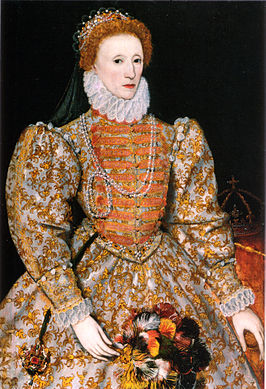
The "Darnley Portrait" of Elizabeth I

History is Her Story, Part 2

God can become an ordinary person to play a role in Her story. Several well-known women in history may have been avatars of God. This is the second episode. The first episode can be found via the following link: History is Her story part 1.

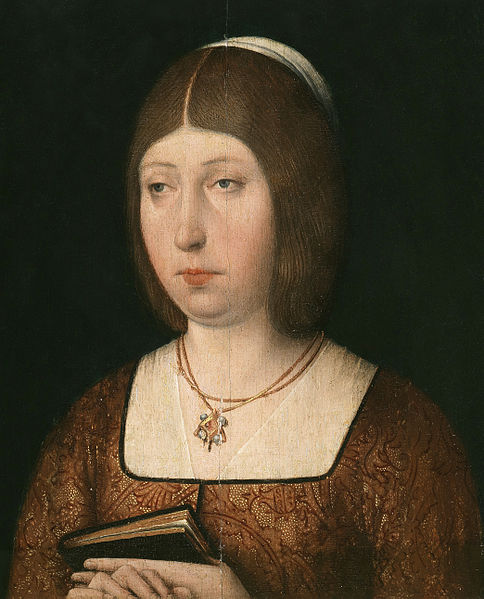
Isabella I Of Castile
Isabella I Of Castile.

Isabella I of Castile

We learned who discovered America, but not the person behind the scenes who financed his mission and made it happen. And by the way, the same person who sent Columbus on his journey also created Spain. Queen Isabella I (1451-1504) was Queen of Castile and one of the most influential historical figures. She was the second child of King John II of Castile. At the time, two countries, Castile and Aragon, dominated the area. Isabella’s half-brother, Henry, was the heir to the throne.

Isabella became a pawn in Henry’s political ambitions. He forced Isabella into several betrothals and attempted to marry Her to King Alfonso V of Portugal. Later, as part of an agreement to restore peace after a rebellion, Isabella was to be betrothed to Pedro Giron, Master of the Military Order of Calatrava. Isabella prayed that the marriage would not take place. Don Pedro suddenly fell ill and died on his way to meet Isabella. That prayer worked better than voodoo.

Henry didn’t have a male heir. Isabella made Henry sign an agreement, making Her his successor to the throne. Henry made another effort to arrange a marriage, but Isabella refused and secretly arranged a wedding with Ferdinand of Aragon. In doing so, Isabella created Spain by uniting both kingdoms. After Isabella secured the throne, She initiated several successful reforms in government, finance, legal code, and policing.

Isabella’s actions had a lasting impact on world history. Her political manoeuvring in dynastic politics created Spain. Isabella sponsored Christopher Columbus’s mission to reach the Indies by sailing west. On his way, Columbus bumped into America. A film about this event is titled 1492: Conquest of Paradise. That is noteworthy for two reasons. First, there is the word Paradise. And second, the number 1492 refers to the initials and possibly the birthday of this peculiar Lady. That might be a clue.

Katharina von Bora

Katharina von Bora (1499-1552) was the wife of Martin Luther, who initiated the Protestant Reformation. Katharina had several suitors, but none of them became Her husband. She told Luther’s friend and fellow reformer, Nikolaus von Amsdorf, that She would be willing to marry only Luther or von Amsdorf. Luther was unsure whether he should marry at all. A woman who wanted him made him change his mind. As Roman Catholic priests were celibate, their marriage set a precedent for Protestant family life and clerical marriage.

Von Bora had been a nun interested in the Protestant Reformation and dissatisfied with cloistered life. Conspiring with several other sisters, Von Bora contacted Luther. They asked for his assistance. Luther sent a merchant who regularly delivered herring to the convent. The nuns escaped by hiding in his covered wagon among the fish barrels.

Von Bora bred and sold cattle and ran a brewery to provide for their family, the numerous students who boarded with them, and her husband’s visitors. During epidemics, she operated a hospital with a staff of nurses. Luther called her ‘Boss of Zulsdorf’ after the farm they owned. Based on Luther’s descriptions, his wife, whom he nicknamed ‘Herr Käthe’, exerted control over his life like a master.

After Martin Luther died in 1546, Von Bora’s fortunes turned sour. Wars destroyed Her property, and She became impoverished. She fled due to war, the Black Death, and crop failures. During Her last flight, she was thrown from her cart into a watery ditch and fell ill. She reportedly said on her deathbed, ‘I will stick to Christ as a burr to cloth.’ Does it mean, ‘See you again in the next life?’

Many Protestants and Germans consider Martin Luther a prophet. And prophets might be married to God. The book The Virtual Universe discusses the assassination of Martin Luther King on 4 April 1968 as part of an elaborate coincidence scheme that includes the Lincoln and Kennedy assassinations. King’s last name might imply that Martin Luther was a king like Jesus, thus a prophet of great importance.

The
The “Darnley Portrait” of Elizabeth I

Elizabeth I

Queen Elizabeth I of England (1533-1603) was one of the most successful monarchs in history. Her reign laid the foundation for the Anglo-Saxon world domination. She depended on trusted advisers like William Cecil. She also established the Church of England, a Protestant Church with Catholic elements, of which She became the supreme governor. Elizabeth was moderate and religiously tolerant.

Great Britain became a great power. Elizabeth was cautious in foreign politics, tried to avoid conflict, and half-heartedly committed to the wars England fought. In 1585, England could no longer avoid war with Spain because it had supported the Dutch in their fight for independence from Spanish rule. In 1588, the English defeated the Spanish Armada, and the remainder of the fleet sank in a storm, marking the end of Spanish dominance over the seas and paving the way for British supremacy.

A curious sequence of events led to Elisabeth becoming Queen of England. Upon hearing of Her accession to the throne, She reportedly quoted the twenty-third line of the 118th Psalm: ‘It is the Lord’s doing, and it is marvellous in our eyes.’ Elizabeth’s unmarried status inspired a cult of virginity. She said She was married to England like God was married to Israel. Some poetry and portraits depicted Elisabeth as a virgin goddess.

Computable article about Armada
Computable article about the Armada

During a walk in 2009, I pondered whether or not Elizabeth had been an avatar of God. When I returned home, there was a copy of the weekly magazine Computable in the letterbox. The front page featured an article about a distributed database system called Armada. That might be another hint.

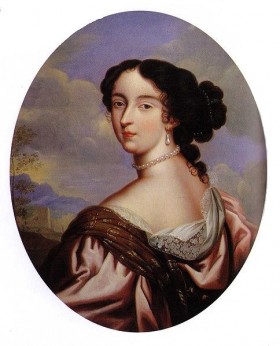
Françoise d'Aubigné, Marquise de Maintenon
Françoise d’Aubigné, Marquise de Maintenon

Françoise d’Aubigné

Françoise d’Aubigné (1635-1719) was the second wife of King Louis XIV, also known as the Sun King. He was vain and waged numerous wars. His lavish Palace of Versailles had no equal. Louis’ magnificence was over-the-top and equally unparalleled. His reign lasted over 72 years, the longest of any sovereign in recorded history. During his first marriage, he had several mistresses.

Louis was more faithful to his second wife, Françoise d’Aubigné. Françoise never became queen, but She had considerable clout in the royal court. Louis was also pious. He saw himself as the protector of the Catholic Church. He made his devotions daily regardless of where he was. Under Françoise’s influence, Louis became even more religious.

Louis XIV was the epitome of the divine right of kings. This doctrine states that the king is appointed by God and, therefore, not accountable to anyone except God. That doctrine might come in handy for the Messiah in the end times. A quote attributed to Louis is, ‘The state, that is me.’

As a teenager, I was a member of the School Council. The school bureaucrats had lengthy discussions after the Financial Commission had overstepped its bounds. One of them argued that it was a the-state-that-is-me situation. It could be a hint that Louis was God’s husband. I doubted it, and tossed a coin, and Françoise made it to the list. Another toss of a coin eliminated Catherina the Great from the list.

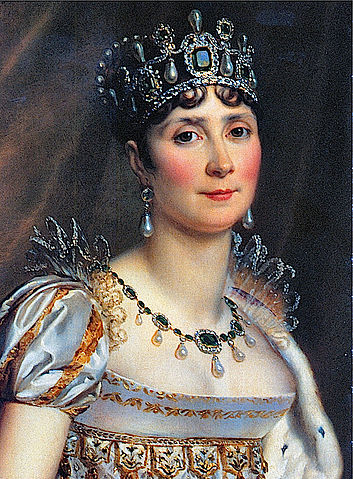
Empress Josephine in Coronation Robes
Empress Josephine in Coronation Robes. François Gérard

Joséphine de Beauharnais

Joséphine de Beauharnais (1763-1814) was the first wife of Napoleon Bonaparte. She was his greatest love. After the execution of Her first husband during the French Revolution, She had affairs with several leading political figures. Napoleon, who was six years younger, fell in love with Her and sent Her many love letters. Napoleon’s love for Joséphine cooled somewhat after discovering She had a lover on the side. He then began affairs with other women but remained in love with Joséphine and married Her.

Napoleon Bonaparte’s lasting legacies include the civil registries with first and last names, the metric system (metres, grammes, and litres), and legal reform, embodied in the Napoleonic Code. The well-structured and accessible law code was a milestone, replacing a patchwork of feudal laws. It has influenced the whole world. The Napoleonic Code is the most widely adopted legal system. About 120 countries use it, but not Great Britain, which also rejected the metric system.

Napoleon was not a favourite of the British, or perhaps it was a British conservative attachment to incoherence and feudal institutions, so they held on to their lords, laws, miles and pints. Unlike the rest of Europe, the British now drive on the wrong side of the road and have left the European Union to rid themselves of David Cameron. He later returned as Minister of Foreign Affairs, so Brexit failed. Napoleon tried to unite Europe, and that project appeared close to succeeding.

Through the children from Her first marriage, Josephine became the grandmother of Napoleon III and the great-grandmother of Swedish and Danish kings and queens. The reigning houses of Belgium, Norway and Luxembourg also descend from Josephine. She, however, didn’t give Napoleon any children. Napoleon believed he needed an heir, so they divorced. Napoleon then married Marie Louise, an Austrian archduchess. It was not love that drove him, but calculation. Marie Louise bore him a son who died at the age of 21. His family line died out, so the divorce proved pointless. Her family line lived on. Napoleon’s last words on his deathbed were, ‘France, the army, the head of the army, Josephine.’

There are some remarkable parallels between Napoleon Bonaparte and Adolf Hitler. Napoleon Bonaparte was born on the island of Corsica, which became part of France. Later, Napoleon Bonaparte became the leader of France. Adolf Hitler was born in Austria, a country that became part of Germany. And Adolf Hitler became the leader of Germany. Both men were involved in a coup on 9 November (9/11 in European notation). Both started a military campaign in Russia that led to their downfall. That emboldened the current leadership in Russia, leading them to think they are safe in Moscow.

Napoleon Bonaparte and Adolf Hitler both came to power by a coup, ending an unstable republic. They both turned Europe into a battlefield. Both ventured into Africa, and both faced defeat in Egypt. They both waged war on two fronts because they attacked Russia after failing to defeat England. These parallels are intriguing as if Hitler were Napoleon’s reincarnation. Their wives were noteworthy as well. Concerning Josephine de Beauharnais, I didn’t receive a hint, but the thought isn’t far-fetched. Informed deduction is impossible anyway, leaving me with guessing the obvious.

Lucretia Garfield
Lucretia Garfield. Library of Congress.

Lucretia Garfield

Lucretia Garfield (1832-1918) was the wife of US President James A. Garfield. A disgruntled public office seeker assassinated him in 1881, shortly after he took office. He lingered in the Twilight Zone for two and a half months before dying. Lucretia stayed at his bedside and received public sympathy, which might be ill-deserved, as it now turns out. They were both 26 when they married on 11 November 1858, referencing 11:11. During the Civil War, James Garfield had an affair as a general.

He later confessed it to his wife, who seemingly forgave him. On 12 January 2010, a previously unknown $10,000 life insurance policy on President Garfield’s life surfaced in a family scrapbook.1 Lucretia Garfield had opened it 45 days before the assassination of Her husband. It is a most notable coincidence that might indicate foreknowledge.

My son was fond of the comic character Garfield. In 2006, a mysterious parcel addressed to him was delivered to us by mail. It contained some Garfield items, including a coffee cup with the lettering ‘It is good to be king.’ The sender of the parcel was unknown. We made several enquiries, but nobody conceded to having sent it. Until today, the sender remains unknown. That might be a clue.

Eurocentrism

This list is Eurocentric. Most people on the list come from Europe. Eurocentrism emphasises European culture or Western ideas and theories without much regard for other cultures. That can offend people from different cultures and the Woke. For the last 500 years, most of the action has centred in Europe, and today’s world is so profoundly affected by European ideas and culture that you might call the world European. Those who oppose Eurocentrism propose eccentric ideas like the knowledge of indigenous peoples being on equal footing with science invented in the West. They suggest that if you have AIDS or cancer, you don’t need to take the treatments invented by science, but you might as well consult your local witch doctor.

As a cultural relativist, I don’t believe Western culture is superior. It set in motion a process that is about to end human civilisation. That is also what the tale of the Fall says. We would have been better off running naked in the jungle. If it had been up to me, the list would have been more diverse, but I don’t make the decisions. After watching the Netflix documentary about Queen Nzinga of Ndongo and Matamba and reading her life story on Wikipedia, I found her to be a worthy candidate for being an avatar of God and better suited than some of the women on the list. Nzinga could fill a gap between Queen Elizabeth I and Françoise d’Aubigné. And I tried to fill in the gaps on the list.

More than filling a hole is required to qualify. Nzinga’s life story didn’t provide clues to work with, like Queen Isabella I, who prayed that her marriage would not come to pass, and then her suitor died. Nor did a noteworthy coincidence happen, like with Queen Elizabeth I, when a magazine featured an article about a database system called Armada. Again, I tossed a coin, which was my favourite way of resolving such matters, but the outcome suggested God didn’t want me to think that Queen Nzinga had been Her avatar. Catherine the Great would also have made a proficient gap filler. She also didn’t make it to the list.

Latest revision: 15 July 2025

Featured image: The “Darnley Portrait” of Elizabeth I. Wikipedia. Public Domain.

1. https://commons.wikimedia.org/wiki/File:Garfieldlifeinsurancepolicyback.jpg

Getting Used to Strangeness

Eleven is the fool’s number in the Netherlands. 11 November (11-11) is when the Councils of Eleven are elected. It marks the beginning of the carnival season, which culminates in the celebrations of Carnival in February. In the former Roman Catholic areas of the Netherlands, forty days of fasting ended with a feast of excessive eating and drinking, in which people dressed in costumes. Nowadays, people only opt for feasting and excess. Fasting and contemplation are bad for business. In any case, in the Netherlands, eleven is associated with oddity.

Eleven is also the first double-digit number. To me, eleven symbolises a strange event. After all, it is the fool’s number. 11:11 symbolises a repetition of such an event or two related peculiar incidents. That is the nature of coincidences. Something unusual might happen. That can make you wonder, but if something similar or related happens again shortly afterwards for unexplained reasons, that could be amazing.

Several incidents in my life are noteworthy because of a repetition in an unlikely manner. One, while visiting my father in Nijverdal, I drove on a narrow road nearby. An oncoming car hit my rear-view mirror, and it broke off. A few weeks later, my father had the same type of accident in his car. To the best of my knowledge, no one I know has ever had an accident of this kind.

My son Rob had two bicycle accidents that injured him. The first was near our home, just before the home of a retired physician who could help him with his injuries. The second accident occurred during our holiday in Ameland, just before the home of a retired physician who could have helped him. That is odd, even more so because these were the only two bicycle accidents he had ever had.

In the Autumn of 2008, a strange accident occurred before our house in Sneek. A car had crashed into a lamppost. The lamppost broke off. Two men stepped out and hared away. A few years later, I realised the accident may have been a prelude to the array of unusual events that followed. That day, I bicycled towards IJlst, a village near home. Near IJlst, I found the remains of a broken-off lamppost. That was remarkable, even more so because our house is on the road to IJlst, which is the same road.

In August 2014, we were waiting for a traffic light near our home in Sneek. In the car ahead of us sat a guy who looked like my cousin. And so I told my wife. My cousin and I had been best friends for over a decade. We made a funny newspaper together. Immediately after I finished speaking, four trucks from the transport company Leemans came from the right. My cousin had once decorated a truck of Leemans. When I was eighteen, I went on holiday with him, hitchhiking through Scandinavia. A truck driver from Leemans brought us to Sweden.

I hadn’t seen a Leemans truck in my home town before. They were there because of railroad construction work. My cousin came from Haaksbergen, a village near Enschede. In June 2015, we left Nijverdal after visiting my father. Haaksbergen was in the news because of a shooting incident.1 Haaksbergen had been on the news a few times because of electricity failures,2 3, skating contests,4 and a monster truck accident.5 I told my wife, ‘Haaksbergen is often in the news.’ Just after I had finished speaking, we passed a truck of Leemans parked by the side of the road.

In 2014, a woman rang our doorbell. Her father was about to turn eighty. He had lived in our house during the 1950s. She wanted to give him a tour of his old home as a birthday present. She made an appointment to visit us the following Saturday. She showed up with her sister and father. I gave them a tour around the house. A few hours later, the doorbell rang again. My wife opened the door to an elderly lady with her daughter and son-in-law. They asked if they could see the house because she had lived there in the 1960s. Both families had taken up this idea independently and hadn’t spoken to each other. And nothing of that kind had transpired before or afterwards.

In July 2014, we went on holiday to Sweden and Norway. My son wanted to visit Hessdalen Valley in Norway. People have spotted mysterious lights there. Those lights look like orbs and are known as the Hessdalen orbs. Some people have claimed they were UFOs. When we were in Hessdalen, we went to a viewing point on a hilltop. A few Norwegian guys had been there already for hours, hoping to photograph a UFO. We did not see anything unusual. We took some pictures of the surroundings. After we had returned home, we noticed orbs in one of the photos we had taken there. Orbs on photographs are a phenomenon unrelated to the Hessdalen orbs. Still, it is remarkable.

My wife and I had one specific person with whom we couldn’t get along. What is remarkable about it is that they both have the same last name, and there is no connection between these conflicts. And their last name is not very common. In my wife’s case, the person had been a friend previously. This friend wanted the friendship to become closer, but my wife didn’t. My wife doesn’t dare to offend others, so instead of stating plainly what she wanted, she decided not to see this friend again. Now, this former friend wasn’t easy-going, and nearly all her friendships ended in conflict, so there may be more to it. She was rich, volatile, overbearing, and easily offended. She didn’t have to work for a living but could buy anything she wanted because she had inherited a fortune, making her spoiled. She sometimes drove her husband crazy, but he couldn’t leave her because she had the money, or so my wife said. And so, he lived in a golden cage. My wife had succeeded in remaining her friend for decades, which is probably an epic achievement.

I had trouble with the lawyer in the office next door. He wanted me to cut down the trees in my garden, which I did not. That displeased him. Most notably, he took offence at the pine tree in my front yard, which dispensed needles in the Autumn and also had branches that invaded his territory, or at least the air above it. I was accommodating, trying not to let the dispute escalate, so I allowed him to prune the trees, and I also pruned them. When pine needles ended up in his garden, I often removed them, which I was not obliged to do, as these legally were his needles in his garden. But that wasn’t enough. He believed he could order me. And he became angry when I didn’t do what he wanted or forgot to remove the needles from his garden. You know how lawyers are. They try to intimidate you, even when they have a weak hand. There is a Dutch television programme, De Rijdende Rechter (The Travelling Judge), where neighbours fight out their petty judicial conflicts, and a judge makes rulings, so I proposed bringing the case there.

There was no risk that we would have ended up on television. Otherwise, I would have had second thoughts before making such a proposal. Losing a petty conflict with me would make him lose face, as he was a lawyer. He came from a poor family and had long been a car salesman, but had become a lawyer. He talked with a slight elite accent, so a bit with ‘a hot potato in the mouth’ as the Dutch would say, but not much, and so close to Dutch without a local accent that it is hard to tell the difference, so that I might just be imagining it because I don’t like him. At least he gave me the impression that he saw me as a peasant he could order around. Such a man wouldn’t risk losing face. He backed off, perhaps not for that reason, but who knows? Out of frustration, he dumped the pine needles he found in his garden in my garden several times. For several years, I avoided him so the conflict would not escalate. He later turned the office into his home and became my next-door neighbour. Assuming he had had years to calm down and think it over, I contacted him again. Now, we have a reasonable understanding. I later realised that it is indeed odd that he has the same last name as my wife’s former friend.

Latest revision: 28 August 2025

Featured image: Orbs on a photograph taken at Hessdalen, Norway (2014).

1. Schietpartij Haaksbergen, politie geeft beelden vrij en toont auto schutter. RTV Oost (7 May 2015) [link]
2. Leger helpt Haaksbergen bij stroomstoring. Nu.nl (26 November 2005). [link]
3. Stroomstoring treft Haaksbergen en omgeving. De Volkskrant (29 March 2007). [link]
4. Natuurijsbaan. Wikipedia. [link]
5. Derde dode door ongeluk monstertruck Haaksbergen [link]

Halloween cat from Poland. User Silar.

Ghost Stories

The first thing someone told me about ghosts was that they are fake. That person was probably a schoolteacher. Before that, I hadn’t heard of spooks. Ghosts are fairy tales, the teacher said at primary school. Several years later, I went on a school trip and visited the Singraven Estate near Denekamp. The custodian told us that a spook dwelt inside the manor, upsetting things, but he added that we shouldn’t fear it. We could safely enter. It is better not to put faith in spooky stories about venues that depend on tourist income. The facts that are beyond doubt aren’t spectacular. They are lame indeed.

As a teenager, I also visited Twickel Castle in Delden, located near Denekamp, but it did not have such a spooky reputation. I recently learned that this castle also has ghostly phenomena. The castle doesn’t advertise itself as a ghostly venue, which makes the claim more believable. Only one source on the Internet mentions it. If it is true, the laws of physics went out the window, at least temporarily. The author preferred that I quote her work. She wrote,

Recently I heard a strange tale from the phlegmatic steward of Twickel Castle in Delden. An English restorer who had come to restore some antique cupboards was given permission by her to stay overnight in an attic room of the castle. After he had been there for a few days, she saw that he had put his mattress on the floor.

She asked him why he slept on the floor and not on the bedstead? He answered her unmoved that he had been pushed out of bed for three consecutive nights. To prevent it from happening again, he had decided to sleep on the floor from then on. He had not been bothered since then. The steward asked him if he didn’t find that creepy? His answer was calm and clear: ‘No, I’m from England.’1

That is what the stiff upper lip is about. You might not believe it if you haven’t witnessed similar things occurring in your own house. So that is why I am inclined to believe it. There are plenty of ghost tales that go around. Most are hearsay. On the Internet, you can find lists of ghost tales like 10 Eerie Real-Life Paranormal Encounters to Creep You Out on Listverse.com.2 The list is fact-checked, which means the stories happened unless witnesses lied and got away with it. You are about to read one story from that list. It was also on CNN. The CNN article allows paranormal investigators to share their unscientific claims about crisis apparitions. An explanation that doesn’t conflict with science is that we live inside a virtual reality. So, here is the story,

Nina De Santo was closing her New Jersey hair salon when she saw Michael, one of her customers, standing outside the shop’s window. He had become a good friend. He had been going through a tough time after his wife left him. Nina had tried to cheer him up. When she opened the door, Michael seemed happy and transformed. He smiled at her and said he wanted to thank Nina for everything she had done for him. They chatted, and each went their way. The following day, Nina received a call from one of her employees. Michael’s body had been found the previous morning, nine hours before Nina had spoken to him at the salon. He had committed suicide.2

In 2014, a couple named the Simpsons asked the regional news channel Fox43 in the United States to visit their haunted house in Hanover, York County. DeAnna Simpson, the wife, mentioned that entities were haunting the home. She and her husband had lived there for seven years. She caught ‘ghosts’ on film. They had scratched or even attacked the guests. DeAnna had invited priests, paranormal researchers, and the crew of the TV show The Dead Files into her home, who then uncovered ‘evidence’ of ‘grisly deaths’ that had occurred there.3 When the Fox43 staff came in, something invisible scratched their photographer.

In March 2018, my wife woke me up in the middle of the night. She said, ‘The bathroom door is locked, and our son is sleeping in his bed.’ You can only lock the door from the inside. The lock needs force, so this can’t happen by accident. My wife feared a burglar was hiding inside. I took a knife from the kitchen to unlock the door while she was standing behind me, holding a heavy object to smash into the head of the burglar. Only, I never believed there was a burglar. So many unusual things had happened already. And I was right. There was no burglar.

So, what to make of this? The goings-on at Twickel Castle and the Hanover house are undoubtedly peculiar. Nina De Santo’s story is mind-boggling. In my home, the laws of physics didn’t always fully apply either. It made me wonder. I have seen it happen, and so has my wife. And if there is no naturalistic explanation, is this evidence of ghosts? Not necessarily. If you believe ghosts are real, you think science is crap. And I don’t. The simulation can play into our imaginations and fears. And ghosts are as unreal as we are. There may not be more to it than that. That at least makes sense.

Latest revision: 18 July 2025

Featured image: Halloween cat from Poland. User Silar (2012). Wikimedia Commons. Public Domain.

1. Betoverd door: haunted houses. Theracoppens.nl.
2. 10 Eerie Real-Life Paranormal Encounters to Creep You Out. Listverse.com (2022).
3. A haunted Hannover home. Civilwarghosts.com. [link]
4. Why those TV ghost-hunting shows are transparently fake. Scott Craven (2019). The Republic. [link]