Visions of Paradise

Law and moral sentiments

Mainland Europe and the Anglo-Saxon world, and most notably, the United States, are culturally related but have significant differences in views on law and morality that underpin their societies. These differences greatly influenced history, but their causes also lie in history. In the Middle Ages, individualism was already strong in Western Europe. While England developed its law system, the bureaucracy of the Catholic Church introduced Roman civil law on the continent. It had the following outcome:

  • Common law has become the basis of law in Great Britain and many of its former colonies, including the United States. Individuals are sovereign. Common law works bottom-up by generalising rules from judges’ verdicts in individual cases.
  • Civil law has become the basis of law in mainland Europe and most other countries. The lawmaker is sovereign, thus the king or the people as a collective via parliament. It works top-down by applying general rules to individual cases.

Common law resulted from the efforts of English kings to build a coherent law system based on local practices. In 1215, the Magna Carta limited the power of the English kings. England then had a strong state where the rule of law limited the king’s power. There also was individual liberty in Western Europe. There were few strong states while merchants ran independent cities. Still, the rule of law later came from the state’s power because of the differences in law foundations. These differences relate to views on ethics:

  • In Great Britain, philosophy, including ethical philosophy such as David Hume’s, is pragmatic. It says moral rules are an agreement in society, so good and evil depend on popular sentiments, freedom is being able to do as you please, and outcomes matter more than intent.
  • In continental Europe, idealism dominates philosophy, including ethical philosophy, such as that of Immanuel Kant. It says good and evil are absolute, freedom means liberating yourself from your lower urges, thus becoming rational and morally upright, and intent matters more than outcomes.

If ethical rules are relative, they emerge from popular sentiments, thus bottom-up, and if they are absolute, they come from principles and work top-down. The English philosopher John Locke imagined the state as a voluntary agreement of individuals to cooperate for mutual benefit. If you believe in individual sovereignty and moral relativism, that must be why there is a state. But it is incorrect. We will not voluntarily agree to a state if there is none but fight each other until there is one.

These differences later shaped the debate on the economic system, hence the intellectual battle between capitalism and socialism. Adam Smith wrote a practical recipe for running an economy in the British tradition. In continental Europe, the debate became fundamentalist and infused with moral sentiments. Frédéric Bastiat claimed socialism is an organised plunder of private property, while Karl Marx argued that capitalists steal the value workers create.

In the United States, with its moral pragmatism founded on individual freedom, the collectivist ideology of socialism never caught on. Still, progressives in the United States pursued reforms to rationalise the government according to modern bureaucratic principles, and there were unions. Great Britain became caught in the middle as Brits had a more favourable view of government than Americans and a strong socialist movement.

When, after World War II, the Soviet Union became an existential threat to the United States because the communists planned to overturn the capitalist order with violent revolutions and were building a large army, the defence of individual autonomy and moral pragmatism itself turned into an idealist moral crusade, also because the Soviets aimed to end religion and persecuted religious people. Most US citizens identified as Christians, so they came to see the Soviet Union as an evil, godless empire.

Hegelian Dialectic and Marxism

Around 1807, the German idealist philosopher Georg Wilhelm Friedrich Hegel devised a theory of how history would unfold according to God’s plan. It would occur by challenging the prevailing ideas and social order. The French Revolution had just swept away the old aristocratic French regime. The French adopted revolutionary new ideas from the European Enlightenment, modernised their government and introduced an army of conscripts, allowing Napoleon to conquer Europe and spread these ideas and reforms. Hegel was the proverbial fly on the wall, taking it all in. He was impressed. That was progress! Modern ideas wipe out old ones. A bureaucratic government with conscripts eliminated an aristocracy with mercenaries. The German Christian idealist philosophers like Kant and Hegel, and later, atheists like Marx, Nietzsche, and Heidegger, dedicated themselves to hard questions pragmatic people would never bother to spend a lifetime on.

As a profoundly religious man, Hegel thought that our knowledge and ideas progressed and that God’s plan worked like so. He believed humanity had a collective consciousness in which these ideas reside. He surmised we are progressing towards our final destination, God’s Paradise, by replacing our prevailing ideas with better ones. An example is our views on slavery. Slavery existed since time immemorial and was generally accepted, but most of us now see it as evil. These views we all share are what Hegel meant by collective consciousness. It evolves over time and thus progresses according to a stylised scheme called Hegelian dialectic. It works like this:

(1) there is a status quo (the thesis)
(2) new ideas or conditions challenge the status quo (the antithesis)
(3) from the challenge emerges a new status quo (the synthesis)

A synthesis is a more profound truth rather than a compromise. You can’t bargain on the truth. Hegelian dialectic is a ruthless pursuit of truth and accepting its consequences. Hegel is the philosopher of progress, not economic or scientific, but progress in society and its institutions. It is nearly impossible to overestimate his influence on politics in the centuries that followed as it often was about progressives versus conservatives, thus applying new ideas from philosophy and the sciences versus keeping things as they are. Not all new ideas are better, so the outcome can be that nothing changes. Ideally, the synthesis is the best solution that emerges from the challenge of the status quo. If the new ideas are superior, they wipe out the old ones. That requires revolution and violence, such as the French Revolution and the Napoleonic wars.

Being more pragmatic, the British reformed in smaller steps. The principal problem with Hegelian dialectic is that the scheme can have disastrous consequences if you don’t know everything. Your logic can be perfect, but if your assumptions are not, a small oversight can cause ruin, as in Barataria. Chaos theory says why. The leading conservative British thinker, Edmund Burke, aimed to improve the government, but only if necessary, because changes have unpredictable consequences. The British could do that because they already had a government open to reforms, while the French did not. A revolution was their only option to rid themselves of the corrupt old regime and clean the slate.

Karl Marx took the bait. We could achieve paradise ourselves here on Earth, he claimed. Scholars had already found out that much of the Bible was fiction, and Charles Darwin had just published On The Origin of Species with evidence indicating plants and animals emerged in a competition between species that has lasted millions of years rather than being created in six days 6,000 years ago. The sciences had proven religion wrong, so Marx thought religion keeps people dumb. Christians would wait for Jesus, who hadn’t shown up for over 1,800 years, and not take matters into their own hands. Marx also noted that Christians had betrayed their religion by adopting the ethics of the merchant. According to Acts, early Christians lived like communists.

Marx claimed capitalists profit by stealing some of the value workers create. He based his allegation on the labour theory of value, which economists of his time considered valid. The theory says that the price of an item equals the cost of labour required to make it, thus including the labour to produce the raw materials. If making a pair of shoes takes twice as much labour as making a pair of trousers, shoes cost twice as much as trousers. Marx then asked, ‘If that is correct, how can there be profits?’ It is because the theory is wrong. There is no objective measure of value. In a market economy, the price of an item depends on what people are willing to pay for it, not what it costs to make it. Otherwise, you could work a year on building a better mousetrap and sell it for € 50,000. Perhaps, after spending another € 50,000 on building a brand in a marketing campaign, you can sell it for € 200,000. That is how markets work.

Value is what we believe it is. Nothing is sacred. Everything is for sale, including the rainforests and even the Earth. The so-called owners think it is all theirs and can do with it as they please. In the market, a message becomes true if you can sell it. It works with advertisements or denying climate change. It is the evil in the ethics of the merchant, and because money represents power, we stare into the moral abyss. If you ever wonder why communists called their newspapers The Truth, that is why. But in a world without God, there is no truth, and communism is just another message on the marketplace. The communists appealed to the workers’ self-interest. And that was a poor sell because workers were worse off under communism. It is why communism was doomed to fail, not because it is impossible to live like communists. Early Christians did. Rather than concluding he had just proven the labour value theory wrong, Marx claimed capitalists stole from their employees.

Marx further said that producing for markets alienates us from what we make. Many workers experience this. It is why Dilbert comics are so successful. Marx claimed we could be free, creative beings, but the modern, technologically developed world dictates our lives. Marx believed ending the market mechanism and replacing it with democratic planning would liberate us. So if workers received what they owed and we replaced capitalism with democratic planning, we would live in a paradise where we can do the jobs we like and have everything we need. That is a silly idea. Many want to be a Hollywood star, but few want to be a cleaner. Immigrants do those jobs. Communes don’t attract farmers and construction workers but artists and reiki healers. We need food and homes, not art and quacks. Work is doing something useful, and if it isn’t useful, it isn’t work. And even if everyone contributes, planning will never do as well as markets. You could live with that if you have enough. You might want a pear, but you could settle for an apple. And you have heard of oranges but never tasted one.

Marx also claimed that capitalism causes misery as adding capital means doing more with fewer workers, which reduces the need for labour, pushing wages below the subsistence level and leaving workers to starve. At the time, most economists believed wages would remain close to the subsistence level. If wages increased, more people survived, expanding the labour supply. And so, wages would decrease, and more people would starve. The market would keep population levels in check. Marx argued that making more stuff with fewer people was impossible because the unemployed couldn’t buy it, and capitalism would bankrupt itself. It didn’t happen because of Say’s Law, as things became cheaper. And we can create money from thin air. When capitalists produce more, they must sell their merchandise, and you can make people borrow money, so the general level of opulence rises. Marx vastly underestimated human ingenuity in finance, marketing and job creation in the services sector and government, the so-called bullshit jobs in the bullshit economy. These jobs make sense because they solve problems in our complex society, but we could do without many of them when we live simpler lives.

Marx believed he was scientific and rational. He devised a theory of history using Hegel’s dialectic, arguing that power structures in society reflect economic conditions. To Marx, it was not new ideas challenging the status quo but economic conditions driving change in history. He would say that the status quo of serfdom in Europe ended because towns challenged it by providing alternative jobs for serfs. Lords had to compete with them for their labour. And so, employer-employee relationships replaced serfdom, which became the new status quo. Marx also believed nationalism was a temporary phase, as economic conditions imposed it on us. Industrialisation required larger markets, thus societies rather than communities. Nationalism allowed the elites to divide and rule the working class. And because capitalism would eventually bankrupt itself, Marx predicted, as if it was a logical certainty, communism would replace employer-employee relationships, and everyone would become free and equal. In reality, people aren’t free or equal under communism, and a new elite of party bureaucrats replaced the capitalists.

Marx’s plan for the future included violently overturning the existing capitalist order in revolutions like the French Revolution and Napoleonic wars. Karl Marx became the prophet of the most successful cult in recent history. Despite the failure of communism, the capitalism-socialism debate continues because Marx raised pressing concerns that are still valid today:

  • Instead of saying capitalists steal value from workers, you can argue we work to make the rich richer. Despite stellar economic growth in the United States, many workers still can hardly get by. And that is not because they are all lazy or stupid.
  • Instead of saying the system alienates us from what we produce, you can argue we are part of a system over which we have no control. We can’t democratically decide on issues like implementing artificial intelligence.
  • Instead of saying capitalism causes misery, we can argue it improved billions of lives, but it probably ends in a total disaster. We may know for sure once the ecological or technological apocalypse materialises.
  • Instead of saying we will enter the communist paradise as a historical necessity, we may argue the script is that we are about to enter God’s Paradise, which could be a Hegelian synthesis of Marx’s challenge of the existing capitalist order.

The moral void

European moral idealism and American moral relativism have consequences you might not think of. German philosophers from the Frankfurt School, knowing our religion, if we have one, depends on our birthplace, that Jews invented the Abrahamic God and that much of the Bible is fiction, sought more absolute foundations of morality, such as equality or preventing harm to other people. They embrace LGBT rights like marriage, as there is no objective moral reason to deny them. Even if you think gay marriage is unnatural because a gay couple can’t produce offspring, there still is no objective moral reason to deny them these rights, no matter what the Bible says. Idealism also drove Germans to endanger their energy security by closing nuclear plants and betting on solar and wind.

American moral relativism drives conservative Christians to impose their views on others, as they don’t ask hard questions, ignore evidence contradicting the Bible, and think they can do as they please rather than act as a rational, morally upright person. Critical theory, thus cultural Marxism or Woke, comes from German philosophers daring to ask hard questions to seek the absolute foundation of morality. Critical theorists also indulge in speculation. Many of their theories lack solid evidence. Believing, like Marx, that their ideas are superior, the Woke use Hegelian dialectic to attack conservative Christianity and impose their views on society. That is why Woke people are so annoying. In recent years, that debate has escalated rather than synthesised. It has turned into a culture war.

Conservative Christians, most notably those in the United States, are a peculiar bunch. Humans are the most destructive species that ever roamed the Earth, and there are far too many of them, so it is evil to ban abortions. If there is a moral objective measure for preserving a life, it is its degree of sentience. A human newborn can only suck milk, and no one remembers being born, while cows, horses and pigs stand upright and walk after birth. A cow or a pig is more conscious than a ten-week-old fetus, yet we slaughter them by the millions after treating them horribly in conditions as miserable as concentration camps. It is a Holocaust. You can better be dead long before you are born. Christians corrupted Jesus’ teachings to take away women’s rights and claim trans people are evil after giving God a sex change. They harp about an alleged conspiracy of Satanic child molesters in government while electing a sex offender who regularly attended Epsteins parties.

Liberals might think many Christian conservatives are crazy to believe raving nutcases like Qanon, but we cooperate using shared imaginations, so it is perfectly normal human behaviour. How do you think religions survive despite the facts disproving them? And the only measure of success is success. Truth hardly ever is the reason why beliefs prevail. Even scientists have invisible imaginary friends like gravity. Believing that gravity exists makes you succeed in engineering. The foundations of liberalism and socialism are also incorrect, like human nature being inherently good. We like to think we are good, so these ideologies have been successful. And success breeds stupidity. If you fail, you might ask the correct questions, but when you are successful, you have no reason to. And so, rational government is an uphill battle against our inner nature, and real change is only possible after complete failure. Christianity is much closer to the truth. We are morally depraved, incapable of fixing ourselves, unworthy of God’s grace, and in need of a saviour.

Liberals are wrong and foolish because the evolution theory they believe in says the struggle for existence is brutal. They should have reasoned, like Friedrich Nietzsche, that God is dead and that the strong should rule the weak. Somehow, they couldn’t rid themselves of their Christian slave morality. The former right-wing Dutch politician Pim Fortuyn called them the Leftist Church. Without God, we get lost in the moral void, and it is pointless to try to achieve Paradise on Earth. After several wars to impose liberal Western values on countries like Vietnam, Iraq and Afghanistan, we can say good intentions usually make things worse rather than better. Why send money and weapons to a corrupt country like Ukraine to let it fight against an even more corrupt country like Russia? And why do liberals support the corrupt establishment of big banks, big pharma, the mainstream media and the military-industrial complex they objected against in the past? But many Christian conservatives don’t even make a small effort to become slightly less evil, like skipping meat one day per week. Appeals to moral reason infuriate them. And now the crazies organise a witch hunt against science and the rule of law. The road to hell may be paved with good intentions, but being intentionally evil is a shortcut.

Suppose Jesus was human like us with the knowledge of his time, which non-religious biblical scholars would agree on, and someone else finds himself in his position today. What could he do? He could wait for God to tell him, but if God doesn’t, he might think, like Marx, that he has to figure it out himself. As far as we can infer from the scriptures, Jesus acted independently but according to God’s will. He was like an actor following a script. His successor has the benefit of today’s knowledge, including the simulation hypothesis and the sobering outcome of the communist experiment. He might grasp the greater picture. The Marxist challenge of the existing order could have been God’s way of showing us the choices we face, our alternatives, their consequences, and what the synthesis might look like. That makes Hegel one of the greatest prophets of modern history.

Most people in the West now believe there is no alternative to capitalism, even though we may need some socialism or government to contain its ills. That could make our economy less competitive, which could cause us to lose the competition. So, in the end, there is no alternative, not because we can’t live happily in another economic system but because other systems can’t compete. Other ethical systems can’t compete with the ethics of the merchant either, which says you can do as you please and take what you can. It is much easier to break a collective effort like combating climate change than to build it. Only one major country needs to step out. In competition, those with the most depraved ethics win. The Dutch would say the merchant always wins from the vicar.

Only there needs to be an alternative. The profit motive is the severest threat humanity has ever faced. It pushes for permanent innovation, a process of creative destruction over which we have no control. We have started a fire in our midst that grows until it consumes us. Our greed is its fuel, and we can’t stop it. We may soon destroy ourselves creatively. We can’t kill the beast, the system, and the beast within ourselves, our greed. Communism is oppressive, kills creativity, and promotes stagnation by eliminating the profit motive. That sounds awesome because that is precisely what we need.

It looks like a cure. If your disease is cancer, and the cure is chemotherapy, you take the poison, and you accept becoming sick and losing your hair. Otherwise, you die. You could visit a witch doctor or a quack, and you also die. Many fall for snake oil salespeople because science doesn’t always have the correct answers. But despite their limitations, the sciences and the evidence from history are our best knowledge. If capitalism and communism are the only options, a sensible person chooses communism. Communism has brought a lot of misery, and we haven’t seen the end of civilisation yet, so we can still believe it will work out fine as long as markets remain operational and bring together supply and demand. That is perhaps the biggest lie ever.

If you don’t get by now why the ethic of the merchant is the greatest evil of all times, you are a moron, and there is no point in trying to convince you. By electing Donald Trump, Americans demonstrated their willingness to let Satan run their country. If following Satan seems the lesser evil, then something must be profoundly wrong. The corrupt old order of the military-industrial complex, big pharma, big banks and other interest groups seeking to profit from the state has ended the legitimacy of the US government. The other candidate and the billionaires backing her believed they could buy the presidency by spending billions on her political campaign. And for the record, Donald Trump isn’t Satan, not even the Antichrist, but just a huckster with the most depraved moral values and the ultimate embodiment of the ethics of the merchant, the ultimate evil.

In a world without God, there is no justice. And we can’t halt our descent into the moral abyss. And we have the ultimate proof. Once the technology is there, some of us will become like gods, live for thousands of years, make virtual worlds in which they force everyone to comply with their wishes, and murder people for merely standing in the way or for any other arbitrary reason. It is why we exist. God is an individual from an advanced humanoid civilisation who wants to have some fun. You are nothing, even less than a worm, as a genuine worm decides for itself how to grovel and when. Let that be a warning. And you own nothing. Believing you are entitled to something is thinking you can steal from God. With these words, I conclude my sermon. Now, let us pray.

In a world without God, there is no justice. And we can’t halt our descent into the moral abyss. And we have the ultimate proof. Once the technology is there, some of us will become like gods, live for thousands of years, make virtual worlds in which they force everyone to comply with their wishes, and murder people for merely standing in the way or for any other arbitrary reason. It is why we exist. God is an individual from an advanced humanoid civilisation who wants to have some fun. You are nothing, even less than a worm, as a genuine worm decides for itself how to grovel and when. Let that be a warning. And you own nothing. Believing you are entitled to something is thinking you can steal from God. With these words, I conclude my sermon. Now, let us pray.

Third ways

There have been several attempts to come to a synthesis of capitalism and socialism, which is often called the Third Way. The challenge of Marxism, the antithesis of capitalism, fuelled a lively debate about economic systems in the second half of the 19th and the first half of the 20th century. Silvio Gesell, who wrote Barataria, was one of the central figures in this debate, as was Henry George in the United States. Since the Cold War, the debate has narrowed down into a struggle of communism versus capitalism or individual freedom versus enforced collectivism. With the collapse of the Soviet Union, the discussion in the West ended with the conclusion that Marx may have had valid concerns, but we can’t fix them, and his solutions are counter-productive. The Chinese government, however, kept innovating and remained determined to make socialism work.

You can’t compromise with ultimate evil. That reasoning made the Soviets replace markets with state planning. And it made their repression so ruthless and bloody. Millions died of starvation, and millions more ended up in concentration camps. In the end, it is better to be a slave in Paradise than a free man in hell, except when hell looks like Paradise and Paradise is like hell. But profit and greed corrupt everything. Self-regulation under neoliberalism, thus allowing corporations to set and enforce their rules, demonstrated why corporations need a tight leash and operate for public benefit rather than private profit. So, the question remains whether a third way is possible at all. Or can we only make socialism work better and more agreeable?

Such a change requires the support of a large majority of the people. The Russians lost faith in the Soviet experiment as central planning produced poor outcomes. Still, the Chinese economy has baffled the proponents of capitalism. The Chinese allow the profit motive to exist as long as businesses conform to the Chinese Communist Party’s objectives. State ownership of enterprises further ensures that. Similarly, you can allow profit motive within society’s goals and place large corporations in sovereign wealth funds. To clarify the discussion, as there is confusion in terminology, it may be best to provide you with definitions of economic systems. Their differences centre around ownership of resources, capital, and labour.


resourcescapitallabour
communismstatestatestate
socialismstatepublicprivate
third way / mixedvariesvariesprivate
capitalismvariesprivateprivate

Under communism, the state owns everything, including your labour. You can’t even decide on the job you take. Under socialism, you can choose your occupation, but capital is public, thus owned by workers or the state, and the state owns the natural resources. In mixed economies, ownership of natural resources and capital varies. You may own the ground, but if oil is underneath, it may belong to the state. There may be state-operated corporations like railways alongside private corporations. And you are free to choose your occupation. Under capitalism, everything is private. There may be public services, but there are no public corporations. And few countries give their resources away for free, and governments nearly always want a piece of the action. Not even the United States is fully capitalist. Libertarians think that is the problem, so if we gut the government and make everything private, the invisible hand, thus greed and competition, will fix things as if being foolish doesn’t help, being more foolish might.

The same model still gives different outcomes under different circumstances. A crucial factor is the culture or spirit of the nation. There were substantial differences in living standards in the Soviet Block. Czechoslovakia did relatively well. Yugoslavia suffered from high unemployment, but the Slovenian unemployment rate never exceeded 5%, while Macedonia and Kosovo had rates of over 20%. These were extreme differences within one country and the same system. China has developed its economic model, a state-run socialist market economy, which now outcompetes the West. Its success depends on the Chinese people’s hard work and ingenuity, China’s long-standing tradition of a modern bureaucratic government, and Confucianist ethics, making the government work in the public interest. The Chinese had a modern bureaucratic government on rational principles 2,000 years before Europe. And so, this economy wouldn’t have emerged elsewhere.

Making idealism work still requires pragmatism because good intentions can give horrible outcomes. Americans are pragmatic and gung-ho, thus eager to get things done. So once they realise God’s vision for the future goes against some core principles of American society, like individual liberty and capitalism, they might reverse course and take up the challenge with zeal. Europeans are not like that. They have a wait-and-see attitude at best. The Germans will try to engineer an even better system. The Dutch will deliberate the proper procedure and hire consultants to write reports. The Italians will bumble. And the French will go on strike. Many Americans are also more religious and more willing to embark upon an outlandish plan if they believe it is the way forward.

Free Economy

There are other options than communism or socialism. They can be safe as long as the ethic of the merchant doesn’t reassert itself. As soon as you allow it, the moral depravity spreads like cancer and will destroy society, like in the tale about the imaginary island Barataria. Only communism and brute repression are 100% safe. Religion can inspire us to stay public-spirited and be content with what we have. So if God exists and sends a messiah, we could play it less safely because whatever happens is God’s will.

For a while, Barataria had an economy with free enterprise and private ownership of homes but without capitalists, bankers, and merchants. Barataria had no income taxes, but the lands were public, and farmers rented them, which paid for the small government. Because the Baratarians were public-spirited and helped each other, and most notably, because there were no merchants, they didn’t need much government. That might be as close to Paradise as we can get. But it will only work if we live simple lives.

Silvio Gesell believed in economic self-interest as a natural and healthy motive for satisfying our needs by being productive. He aimed for free and fair competition with equal chances for all. He proposed the end of legal and inherited privileges, so the most talented and productive rather than the most privileged would have the highest incomes without distortion by interest and rent charges.

After experiencing an economic depression in Argentina in the 1890s, Gesell found that economic returns sometimes didn’t meet investors’ minimum requirements. It caused investors to put their cash in a vault like Scrooge McDuck, emptying the money flows and collapsing the economy. A holding fee can keep the currency in circulation, as low returns are more attractive than paying that fee, which amounts to a negative interest rate. Gesell’s economic system was well-known in Germany as the free economy.

European Union

European economies are mixtures of capitalism and socialism. Many Brits found the union too socialist and bureaucratic, so they left. These sentiments relate to the age-old differences in law and morality. The European Union tries to tame the beast of capitalism with regulations, which may fail if the competition continues and intensifies, but many Europeans now live a good life. Well-being is hard to measure, but European societies are among the world’s most agreeable if you believe the rankings. And if every country kills innovation with legislation like the bureaucrats of the European Union, we wouldn’t need to fear artificial intelligence, genetic engineering or any other new technologies.

Europe has a collectivist tradition with Christian and socialist roots with worker and consumer protection laws. Europeans live longer than Americans, partly because the European Union has banned unhealthy foods available in the United States. At the same time, governments run the healthcare systems, so most healthcare is for the public interest rather than private profit. In Europe, it is harder for corporations to pass business-friendly legislation by bribing politicians. That is also because Europeans believe in the common good more than Americans do. Like the invisible hand, our imaginary invisible friend, the common good, has a few magical powers.

As in the United States, immigrants do much of the hard manual labour in Western Europe, often for lower wages, without these protections and crammed in poor housing. There is a profit in dodging regulations for shady merchants. Western Europeans may be lazy because they work 36 hours per week and have five weeks of holidays each year. Still, their lives are the closest to what life should be in Paradise, except that European energy and resource consumption require a drastic 75% cut to make their economies sustainable. But if we dismantle the wasteful bullshit economy and set the right priorities, we could work fewer hours than Europeans do today and still have an agreeable life.

Nazi Germany

The Nazis produced an economic miracle during the Great Depression. The success came from deficit spending for rearmament and limiting trade with the outside world, so the expenditures boosted the German economy while not causing trade deficits. It is similar to Keynesian economics. It worked like the miracle of Wörgl, except that the German government accrued a large debt while the council of Wörgl did not.

Factories were idle, and many people were unemployed, so the scheme didn’t result in high inflation. Price, wage and rent controls also helped keep inflation in check, but it hurt small farmers. The Nazi economy was a mixture of state planning and capitalism. Germany was rearming and preparing for war. It was a war economy. Countries organising for war take similar measures to mobilise their industries for warfare.

Yugoslavia

Yugoslavia was socialist rather than communist. It combined state planning with markets and decentralised decision-making or worker self-management. The Yugoslav economy fared much better than that of fully communist countries. The country was more open, and living standards were higher. However, it began to suffer from mass unemployment, and the economy collapsed in the 1980s as it couldn’t compete with capitalist economies. Generous welfare spending further contributed to Yugoslavia’s economic demise.

The oil crisis of the 1970s magnified the economic problems, and foreign debt soared. The country implemented austerity measures like rationing fuel usage and limiting the imports of foreign-made consumption goods. Unlike the Soviet Union, Yugoslavia had been able to feed its people until then. From the 1970s onwards, the country became a net importer of farm products. Yugoslavs were free to travel to the West. Emigration helped the economy by reducing unemployment and bringing in foreign currencies as emigrants returned money home to support their families.

Its openness to foreign competition contributed to the collapse of the Yugoslav economy. Yugoslav consumer products were often inferior to Western products. To compete, businesses laid off workers to become more efficient. The Yugoslav economic system might have worked if all countries had operated their economies like Yugoslavia. Yugoslav products would have sufficed if there were no better alternatives. Mass unemployment might not have materialised in that case, and Yugoslavia could have managed, perhaps, with less generous welfare. That is a few maybes, but it is plausible.

China

The stories of Airbus and Boeing demonstrate that state ownership of large businesses can work better than private ownership. Boeing was the industry leader but ruined itself by focusing on shareholder profits. Reducing quality brought short-term cost savings, boosted the stock price, and generated management bonuses. That seemed all fine until the Boeing aeroplanes began dropping from the sky. The largest holders of Airbus stock are European states, allowing the corporation to focus on long-term goals. The state-owned aeroplane industry is one of the few areas where Europe is still at the top.

Traditional communism gave subpar results, but the Chinese managed to get it right. The Chinese socialist market economy (SME) has private, public and state-owned enterprises (SOEs). China is not capitalist, as the Chinese Communist Party (CCP) retains control over the country’s direction. It is a command state-market economy like Nazi Germany was. Unlike Nazi Germany, which aimed for maximum self-reliance and ran on military spending, the Chinese economy integrated into the world economy and ran on exports. It resembles other Asian Tigers, such as Japan and South Korea.

The CCP’s vision behind starting market reforms is that China was underdeveloped and that a fully developed socialist planned economy would emerge once the market economy fulfilled its historical role, as Marx prophesied. Thus, the CCP believes it has incorporated a market economy into the Chinese socialist system. Others call it state capitalism, as the SOEs that comprise a large portion of the economy operate like private-sector firms and retain their profits without returning them to the government.

China eliminated extreme poverty, which declined from over 90% in 1980 to less than 1% today. It also became the world’s leading manufacturing economy and the world’s leading producer of unnecessary items that end up in our landfills. Despite its leadership in renewable energy and electric cars, China has also become the world’s leader in pollution and carbon dioxide emissions. However, China’s status as an exporter distorts the picture. By importing from China, other economies appear to be less pollutant.

The Chinese economic model forces corporations to align with society’s goals and make profit secondary. At the same time, it achieves acceptable living standards. It is modern and outcompetes the US and European models. If our society’s goals change from growth to sustainability and happiness, the Chinese economic model can help align corporations with public policies. China is a dictatorship, but its economic model will also work in democracies. Airbus provides the evidence.

State control and ownership of businesses, like China’s, also seem to be the only viable way to pursue political goals such as protecting nature and reducing poverty. Business objectives like profit should be secondary to these political goals. With state ownership, you can ban products or subsidise others without harming or favouring private entrepreneurs, thereby removing the incentive for corruption. China is on the right track as political objectives precede profit. And so we have evidence. China’s economy produced spectacular results, so we can have confidence that it will bring us acceptable living standards while allowing us to live in harmony with nature and end poverty.

Latest revision: 24 December 2024

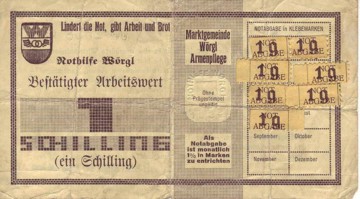
Wörgl bank note with stamps. Public Domain.

Short Introduction

End of growth

The last 200 years have been an era of exceptional economic growth, unlike anything the world has ever seen. Like any exponential phenomenon in a limited room, that growth will end. The best comparison is cancer. If it goes untreated, the host dies. The end of growth, whether it is by death of the host or treatment, has implications for capital, which is addicted to positive returns made possible by squandering planetary reserves. For most of history, there was a shortage of capital. But for the first time, there is a massive excess invested in the bullshit economy, transforming energy and resources into waste and pollution to make money for investors by producing and marketing non-essential products and services in a competition that is about to make humans redundant.

For most of history, economic growth has been negligible. However, it averaged 1.5% over the last two centuries and will soon return to zero, or possibly even lower, perhaps much lower. That has implications for returns on investments, the financial system and interest rates. Investors have become hooked on positive returns, so there must be growth. Otherwise, they lose confidence. It is grow or die, but growth will kill us. And so, we face the prospect of an economic collapse and a collapse of civilisation. We are near a technological-ecological apocalypse. There is a dark force operating behind the scenes that makes us commit suicide. It is usury, or the charging of interest on debts. It makes capital addicted to growth.

The survivors may debate the precise cause of the collapse. I have already received a newsletter email from a pundit claiming that a lack of very cheap oil is leading to debt problems. Future generations may blame the planet for being finite, rather than seeing that human beings were so foolish as to build their civilisation on usury, so that it can only survive through economic growth. Before modern times, humans managed to live without economic growth, as there was hardly any capital and no interest-bearing debt. Past civilisations facing usury-induced economic collapses either disappeared, banned interest, or instituted debt cancellations.

The past 200 years have indeed been exceptional, and that miracle was primarily due to low interest rates. Efficient financial markets promoted growth by depressing interest rates, allowing economic growth to finance the interest. That has blinded us from the financial apocalypse that is upon us. Low interest rates have already brought us unprecedented wealth, albeit at the expense of the planet and future generations. When economic growth returns to sustainable levels, the interest on outstanding debt can collapse the world economy and bring down human civilisation. Luckily, a usury-free financial system for a future without growth already exists: Natural Money.

The nature of usury

Suppose Jesus’ mother had opened a retirement account for Jesus just after his birth in 1 AD at the Bank of the Money Changers next to the Temple in Jerusalem. Suppose she had put a small gold coin weighing three grammes in Jesus’ retirement account at 4% interest. Jesus never retired, but he promised to return. Suppose now that the bank held the money for this eventuality. How much gold would there be in the account in the year 2020? It would be an amount of gold weighing twelve million times the mass of the Earth. There isn’t enough gold to pay out Jesus if he returns.

And so the usurers hope he doesn’t come back, also for other reasons, of course. And for every lending, there is borrowing. The bank is merely an intermediary. There must be people in debt for an amount of gold weighing twelve million times the mass of the Earth. That would never happen. The scheme would have collapsed long before that, and the debtors would have become the serfs of the money lenders. That is why religions like Christianity and Islam forbade charging interest on money or debts.

The usurers have found a way around the issue. Our money isn’t gold anymore. Banks create money from thin air, so the nature of usury has changed. When you go to a bank and take out a loan, such as a car loan, you get a deposit and a debt, which the bank creates on the spot through two bookkeeping entries. You keep the debt, but the deposit becomes someone else’s money once you purchase the car. When you repay the loan, the deposit and the debt vanish into thin air. You must repay the loan with interest. If the interest rate is 5% and you have borrowed €100 for a year, you must return €105.

Nearly all the money we use is created from loans that borrowers must repay with interest. If our borrowing creates money, and we repay our debts with interest, then we may do so by borrowing the interest. That is also what happens in reality, and that is why debt levels continue to rise. So, where does the extra €5 come from? Here are the options:

  • Borrowers borrow more.
  • Depositors spend some of their balance.
  • Borrowers fail to repay their loans.
  • The government borrows more.
  • The central bank prints the money.

Problems arise when borrowers don’t borrow more, and depositors don’t spend their money. In that case, borrowers as a group are short of funds, and some of them are unable to repay their loans. If too many borrowers can’t pay at once, a financial crisis occurs. To prevent that from happening, the government borrows more, and the central bank prints money. They bring that money into the economy, allowing debtors to pay off their debts with interest. Interest compounds to infinity, and there is no limit to human imagination, so frivolous accounting schemes can go a long way before they collapse.

Necessity of interest

We take interest for granted, and economists believe that the economy needs it. Without lending and borrowing, a modern capitalist economy would have been impossible; without interest, loans would also be impossible. Money is to the economy what blood is to the body. If lending and borrowing halt, money stops flowing, and the economy comes to a standstill. That is like a cardiac arrest, which, if untreated, is fatal. And that is also why the financial press reads the lips of central bankers as if our lives depended on it. They manage the flow. Lenders have reasons to demand interest. These are:

  • When you lend out money, you can’t use it yourself. That is inconvenient. And so, you expect compensation for the use of your money.
  • The borrower may not repay the loan, so you desire compensation for that risk.
  • You can invest your money and earn a return. To lenders, the interest rate must be attractive relative to other investments.

That has been the case for a long time, and economists have gradually become quite good at explaining the past. Since then, we have seen financial innovations and are now facing the end of growth. Changes in the economy and the economic system may lead to the end of interest on money and debts. These are:

  • You can use the money in a bank account at any time. You can use the money you have lent as if it were cash. And a debit card is more convenient than cash.
  • Banks spread their risks, central banks help out banks when needed, and governments guarantee bank deposits, so bank deposits are as safe as cash.
  • There is a global savings glut. There are ample savings and limited investment options, which can make lending at negative interest rates attractive.

Negative interest rates are possible. In the late 2010s and early 2020s, the proof came when most of Europe entered negative interest-rate territory. The ECB was unable to set interest rates below -0.5%. Had it set interest rates even lower, account holders would have emptied their bank accounts and stuffed their mattresses with banknotes to avoid paying interest on their deposits, disrupting the circular flows.

As interest rates couldn’t go lower, the ECB took extraordinary measures, flooding the banking system with new money to boost the economy. Had there been a holding fee on cash, interest rates could have gone lower, and there would have been no need to print money. It has happened before. The Austrian town of Wörgl charged a holding fee on banknotes during the Great Depression, which led to an economic miracle by making existing banknotes circulate better rather than printing new money. Ancient Egypt had a similar payment system for over a thousand years during the time of the Pharaohs.

Miracle of Wörgl

In the midst of the Great Depression, the Austrian town of Wörgl was in dire straits and prepared to try anything. Of its population of 4,500, 1,500 people were jobless, and 200 families were penniless. Mayor Michael Unterguggenberger had a list of projects he wanted to accomplish, but there wasn’t enough money to fund them all. These projects included paving roads, installing street lights, extending water distribution throughout the town, and planting trees along the streets.1

Rather than spending the remaining 32,000 Austrian Schilling in the town’s coffers to start these projects, he deposited them in a local savings bank as a guarantee to back the issue of a currency known as stamp scrip. A crucial feature of this money was the holding fee. The Wörgl money required a monthly stamp on the circulating notes to keep them valid, amounting to 1% of the note’s value. The Argentine businessman Silvio Gesell first proposed this idea in his book The Natural Economic Order.2

Nobody wanted to pay for the monthly stamps, so everyone spent the notes they received. The 32,000 schilling deposit allowed anyone to exchange scrip for 98 per cent of its value in schillings. Few did this because the scrip was worth one Austrian schilling after buying a new stamp. But the townspeople didn’t keep more scrip than they needed. Only 5,000 schillings circulated. The stamp fees paid for a soup kitchen that fed 220 families.1

The municipality carried out the works, including the construction of houses, a reservoir, a ski jump, and a bridge. The key to this success was the circulation of scrip money within the local economy. It circulated fourteen times as often as the schilling. It increased trade and employment. Unemployment in Wörgl decreased while it rose in the rest of Austria. Six neighbouring villages successfully copied the idea. The French Prime Minister, Édouard Daladier, visited the town to witness the ‘miracle of Wörgl’ himself.1

In January 1933, the neighbouring city of Kitzbühel copied the idea. In June 1933, Mayor Unterguggenberger addressed a meeting with representatives from 170 Austrian towns and villages. Two hundred Austrian townships were interested in introducing scrip money. At this point, the central bank decided to ban scrip money.1 The depression returned, and in 1938, the Austrians turned to Hitler, as they voted to join Germany.

Since then, several local scrip monies have circulated, but none has been as successful as the one in Wörgl. In Wörgl, the payment of taxes in arrears generated additional revenue for the town council, which it then spent on public projects. Once the townspeople had paid their taxes, they would have run out of spending options and might have exchanged their scrip for schillings to avoid paying for the stamps. That never happened because the central bank halted the project.

The economy of Wörgl did well because the holding fee kept the existing money circulating. A negative interest rate encourages people to spend their money, eliminating the need to borrow and keeping the money circulating in the economy. It demonstrated that the economy required a negative interest rate. A holding fee makes negative interest rates possible, as lenders do not have to pay it after lending the money. The one who holds the money pays the charge. That can make lending money at an interest rate of -2% to a reliable borrower more attractive than paying 12% for the stamps.

Joseph in Egypt

In the time of the Pharaohs, the Egyptian state operated granaries for over 1,500 years. Wheat and barley were the primary food sources in Egypt. Whenever farmers brought their harvest to one of the granaries, state officials issued them receipts stating the amount of grain they had brought in. Egyptians held accounts at the granaries. They transferred grain to others as payment or withdrew grain after paying the storage cost.

The Egyptians thus used grain stored in their granaries for making payments. Everyone needed to eat, so grain stored in the granaries had value.1 Due to storage costs, the money gradually lost its value. With this kind of money, you might have interest-free loans. If you save grain money, you pay for storage. And so, lending the money interest-free to a trustworthy borrower can be attractive. There is no evidence that this happened.

The origin of these granaries remains unclear. Probably, the state collected a portion of the harvests as taxes and stored them in its facilities. The government storage proved convenient for farmers, as it relieved them of the work of storing and selling their produce. And it made sense to have a public grain reserve in case of harvest failures.

The Bible features a tale that supposedly explains the origin of these granaries. As the story goes, a Pharaoh once had a few dreams that his advisers couldn’t explain. He dreamed about seven lean cows eating seven fat cows and seven thin, blasted ears of grain devouring seven full ears of grain. A Jewish fellow named Joseph explained those dreams to the Pharaoh. He told the Pharaoh that seven years of good harvests would follow, followed by seven years of crop failures. Joseph advised the Egyptians to store food for meagre times. They followed his advice and built storehouses for grain. In this way, Egypt managed to survive seven years of scarcity.

The money gradually lost value to cover the storage cost of the grain. It works like buying stamps to keep the money valid, like in Wörgl. Both are holding fees. The grain money circulated for over 1,500 years until the Romans conquered Egypt around 40 BC. It did not end in a debt crisis, which suggests that a holding fee on money or negative interest rates can create a stable financial system that lasts forever.

Storing food makes sense today, even when it costs money. Harvests may become more unpredictable due to global warming and intensive farming. We only have enough food in storage to feed humanity for a few months as it is unprofitable to store more. Food storage ties up capital, so there is also interest cost. But you can’t eat money, so storing food to deal with harvest failures is as sensible now as it was in the time of the Pharaohs. It reveals the stupidity of our current thinking. Our survival needs to be financially viable. Just imagine how that will play out once artificial intelligence and robots can replace us.

Natural Money

The miracle of Wörgl suggests that a currency with a holding fee could have ended the Great Depression. A myth circulating in the interest-free currency movement is that had the Austrian central bank not banned the experiment, the Great Depression would have ended, Hitler wouldn’t have come to power, and World War II wouldn’t have happened. That is a tad imaginative, to say the least, but a holding fee could have allowed for negative interest rates, and they could have prevented the Great Depression from starting in the first place. That is a lot of maybes.

And such money can last. The grain money in ancient Egypt provided a stable financial system for over 1,000 years. The grain backing provided financial discipline. The holding fee prevented money hoarding that could have impeded the flow of money. The money, however, didn’t promote interest-free lending, so the Egyptian state regulated lending at interest to prevent debt slavery. Egyptian wisdom literature condemned greed and exploitative lending, encouraging empathy for vulnerable individuals.

A holding fee of 10-12% per year punishes cash users. If the interest rate on bank accounts is -2%, an interest rate of -3% on cash is sufficient to prevent people from withdrawing their money from the bank. That becomes possible once cash is a separate currency backed by the government, on which the interest rate on short-term government debt applies. Banknotes and coins thus become separate from the administrative currency. So, if the interest rate on the cash currency is -3%, one cash euro will be worth 0.97 administrative euros after one year. And now, we have a definition of Natural Money:

  • Cash is a separate currency backed by short-term government debt and has the negative interest rate of short-term government debt.
  • Natural Money administrative currencies carry a holding fee of 10-12% per year, allowing for negative interest rates.
  • Loans, including bank loans, have negative interest rates. Zero is the maximum interest rate on debts.

Consequences

Natural Money doesn’t fundamentally alter the nature of bank lending. Banks borrow from depositors at a lower rate to lend it at a higher rate. With Natural Money, banks may offer deposit interest rates of -2% to lend it at 0% instead of borrowing it at 2% to lend it at 4%. A maximum interest rate of zero, however, has a profound impact on lending volume, as it severely constrains it, most notably speculative lending and usurious consumer credit, and it favours equity financing over borrowing in business. The strict lending requirements affect business loans, leading to deleveraging.

Businesses still need to attract capital. To address the issue, Natural Money features a distinction between regular banks and investment banks. Regular banks can guarantee promised returns and have government backing because the payment system is a public service. Investment banks invest in businesses and take risks. They are comparable to Islamic banks. Investment banks don’t guarantee returns. Depositors take on risk to get better returns, but they might incur losses or temporarily have no access to their deposits.

While the maximum interest rate restricts lending, the holding fee provides a stimulus, thereby stabilising the financial system. When the economy slows down, interest rates decrease, and more money becomes available for lending as risk appetite increases, making lending at zero interest more attractive. Conversely, if the economy booms, interest rates increase, and the maximum interest rate curtails lending. Consequently, central banks don’t need to set interest rates and manage the money supply, and governments don’t need to manage aggregate demand with their spending.

Reasons to do research

Stamp scrip and other kinds of emergency money have helped communities in times of economic crisis. The economic miracle of Wörgl during the Great Depression of the 1930s, however, was exceptional. The payment of local taxes inflated the impact of the money. Many townspeople had been late on their taxes, but once the economy recovered, they had the money to pay them. Some even paid their taxes in advance to avoid paying the holding fee. It generated additional revenues for the town, which it could spend on the projects. It provided a boost that would have petered out once the villagers had paid their taxes.3 It was not a miracle. It was too good to be true. Still, there is more to it.

Once interest rates reach zero, the markets for money and capital cease to function as interest rates can’t go lower. Money is to an economy what blood is to a body, so it must flow. When the money stops flowing, the effect is like a cardiac arrest, and the economy is in dead waters. To keep the money circulating, those with a surplus must lend it to those with a deficit, and the interest rate should be where the supply and demand for money are equal. When that interest rate reaches zero, lenders stop lending because the return is not worth the risk, so they wait for interest rates to rise. Money then ends up on the sidelines, leading to cardiac arrest, which can be the start of an economic depression.

It happened during the Great Depression. If interest rates had been lower, the markets for money and capital could have remained in operation. We have seen negative interest rates in Europe for nearly a decade. They could have gone lower had there been a holding fee on cash, or even better, a negative interest rate that is just low enough to prevent people from hoarding it. Once interest rates can go lower, a usury-free global financial system may be possible. That gives rise to several questions. Is it possible? Under which circumstances? What are the benefits and the drawbacks? What are the implications for individuals, businesses and governments? And how does it affect the financial system?

There is no alternative

Several other monetary reform proposals do not view the financial system as a system, which it is, and that isn’t hard to guess because the term ‘financial system’ already implies this. You can’t attach the wings of a Boeing to an Airbus and expect the thing to fly. The financial system is a complex system with numerous relationships, many of which existing reform proposals overlook. For instance, if you end the central bank, the economy will crash immediately, even if it is flying smoothly. And that isn’t even hard to find out.

The payment system is a key public interest, so governments and central banks stand behind it. Most banks are private corporations driven by profit. They take risks that might bring down the economy. And so, governments and central banks make regulations and oversee the banks. And banks create money, from which they profit, and we all pay for it via inflation. That is not good, but replacing the system with something worse is worse, like the word ‘worse’ implies.

There is no lack of ill-conceived proposals. And most fail to address the primary underlying cause of the dysfunction of the financial system, which is charging interest on money and debts, commonly known as usury. An inflation-free, stable financial system is possible. It may not even need central banks. But a sound reform proposal sees the financial system as a complex system with intricate relationships that interact with one another.

And so, Natural Money comes with a systems approach that aims to uncover the relevant relationships in the financial system and the consequences of changing them. It means that Natural Money is a comprehensive design. The gravest error you can make is to pick only the elements you like. That design will never fly. Nor would an Airbus take off with Boeing wings. So, you either buy Airbus or Boeing. In the case of Natural Money, that is not an option. There is no alternative.

Latest revision: 1 November 2025

Featured image: Wörgl bank notes with stamps

1. The Future Of Money. Bernard Lietaer (2002). Cornerstone / Cornerstone Ras.
2. The Natural Economic Order. Silvio Gesell (1918).
3. A Free Money Miracle? Jonathan Goodwin (2013). Mises.org.

The Dark Side

Trade and finance


Capitalism has lifted billions out of poverty, but there is a dark side. Trade and finance, thus the profit motive, drive the system we live in. Most notably in the past, ordinary people regarded merchants and bankers with suspicion. In popular culture, trade and banking were the domains of people of questionable ethics. It is hard to pin down the issue, but they do not only bring the good things in life. Everywhere you see the death and destruction they cause. The ethic of the merchant is profit, nothing else. We think we can’t do without trade and finance, but can we do without moral values? The distinction between trade and crime is elusive. When governments fight the drug trade, they intervene in the market for opioids and prevent businesspeople from doing business.

Supply and demand always equalise at a given price, thanks to entrepreneurs. Hermes, the Greek god of trade, was also the god of thieves. Like thieves, traders don’t like toil and produce, but live off other people’s work. That is a caricature. Trade can be useful. Competition can be tough. And we can’t live without trade anymore, because we buy everything we need in the market, and many things we don’t need as well. Still, as the number of unnecessary products and services increases, trade proliferates. The pace at which we transform energy and resources into waste and pollution hastens as traders facilitate a competition, so we end up supporting an ever-expanding class of traders with our labour. The alternative is to produce as much as possible locally and accept a lower standard of living. That was Mahatma Gandhi’s advice.

Jesus Christ chased the money changers from the temple. Yet, in The Parable of the Talents, Jesus said that you must put your qualities to work. Talents were money, so it could mean putting your money to work. Jesus also said that it is easier for a camel to go through the eye of a needle than for a rich man to enter the kingdom of God. And so, you can take your pick and pimp your argument with Jesus’ words. Was Jesus a socialist or a capitalist? It is silly to think in such terms. Jesus lived 2,000 years ago, when economics as a field didn’t exist. Someone claiming to be Paul added that the love of money is the root of all sorts of evil. The Jewish writer Jesus Sirach noted, ‘A merchant can hardly avoid doing wrong. Every salesman is guilty of sin.’ Sirach made a few other peculiar remarks, like, ‘A man’s wickedness is better than a woman’s goodness. Women bring shame and disgrace.’ And so, you’d better take his words with a grain of salt.

Trade is a brutal force, and eliminating it might require drastic measures that few people have the stomach for. The Taliban are among the exceptions. You get the idea. You must first define what is good and what is evil, and then do whatever it takes, believing that the alternative is worse. And that is a belief because we don’t know the future. The prohibition in the United States led to increased crime. Is the drug problem in the Netherlands, where they are more relaxed on the issue, worse than in the United States? The opposite might be true. Yet, lax enforcement made the Netherlands a hub in the international drug trade for a while. And drugs are ruining millions of lives. Is eliminating the drug trade worth the effort? Perhaps, if we succeed. But then, we may have to learn from the Taliban.

Markets have no morals, and the ethic of the merchant is no ethics at all. The individual businessperson may have moral values and refrain from a trade, but traders as a group never do. Whatever you desire, it is for sale. Greed, or the pursuit of profit, drives trade. Still, you can’t run a business if the operations don’t cover the costs. Yet, if the business doesn’t provide anything essential, and consumes energy and resources, it had better not exist. Traditional moral systems accept that you should be able to make a living, but they hold that greed is wrong. We have gone a long way since then. Today, we see trade as mutually beneficial, so we believe that those who engage in a trade do so voluntarily because they all benefit, or believe they do.

The pursuit of wealth, regardless of the consequences, became not only the foundation of our economic system but also of our moral values. And so, Friedrich Hayek could write, ‘The disdain for profit is due to ignorance and to an attitude that we may, if we wish, admire in the ascetic who has chosen to be content with a small share of the riches of this world, but which, when actualised in the form of restrictions on others, is selfish to the extent that it imposes asceticism, and indeed deprivations of all sorts, on others.’ Our ethic is that we can do as we please, as if consequences don’t exist. And the ascetic is selfish when he says everyone should live like him. It is moral depravity at its finest. And so, what was once good has become evil, and what was once evil has become good.

Economists would even say that someone who is altruistic maximises personal utility, so that altruism becomes a selfish act. And the ascetic tries to maximise his personal utility by attempting to force others to live like him. An economist can’t imagine that we would do something good for the sake of goodness. The problem is not self-interest as such, but greed or the merchant’s ethic, and the difference isn’t clear. In any case, we have a suicidal appreciation of wealth. Had we looked down on riches and luxury and aspired to have just enough and do with less, this world could be a much better place.

Many merchants are people like you and me without evil intent. Shop owners make a living by providing their customers with a service. They are often people who care, not the greedy, evil kind that run Wall Street or sell weapons to warring factions in Africa. Still, something is profoundly wrong with trade. Individual merchants may have ethical values, but markets never have them. And trade drives the creative destruction that will ultimately destroy us. Yet, suppressing trade promotes illicit markets and crime. And so, we accept the drawbacks, thinking the alternatives are worse. And that is a fatal mistake.

A pragmatic approach is that outcomes matter more than intent. If the result of evil intent, such as greed, is good, it is good. And if the outcome of good intent is terrible, it is wrong or perhaps even evil. If factory owners destroy artisans’ businesses and pay their employees low wages, but overall opulence increases as clothing becomes cheaper, then it is good. Likewise, if a country switches to socialism out of good intentions, but the population starves, it is evil. Before the Industrial Revolution, nearly everyone was as miserable as today’s poorest. Capitalism has lifted billions out of poverty. So why bother?

Trade and finance became the engine of growth, bringing industrialisation, modernisation, colonisation, the slave trade, mass migration, the loss of livelihoods for craftspeople, and the depopulation of the countryside. Various movements, such as socialists, anti-globalists, religious groups, small-is-beautiful, environmentalists, and also the Nazis, attempted to provide alternatives to the current order with their visions of Paradise. They all failed. The system is a brute force driven by our sentiments and urges. As consumers, we crave the best service at the lowest price, and as investors, we desire corporations to increase their profits. And we don’t think about the consequences.

Usury: the destroyer of civilisations

Money is to the economy what blood is to the body. It must flow. Otherwise, the economy will die. If we stop buying stuff, businesses go bankrupt, we become unemployed, the government receives no taxes, and everything comes to a standstill. That never happens because we spend money on necessities like fast food, smartphones, and sneakers. When we buy less, the economy slows, and we enter a recession, or if it gets worse, a depression. Businesses disappear, and people become unemployed and depressed. Usually, the economy recovers, but it may take time, sometimes decades. It is why we must keep buying stuff, and even more, to make the economy grow.

In the past, when borrowers couldn’t repay their debts, they became the moneylenders’ serfs. It is why several ancient civilisations had regular debt cancellations and why religions like Christianity and Islam forbade interest on money or debts. Usury is paying for the use of money, which is a profoundly evil practice. The evil of it lies in the money flows. We all need a medium of exchange. A simple explanation helps to clarify the issue. Imagine the Duckburg economy running on 100 gold coins. With these 100 gold coins, everyone has enough money, and the Duckburg economy operates smoothly. Scrooge McDuck owns ten, but he is a miser and doesn’t use them to buy items from others.

The economic flows of Duckburg now suffer a 10-coin shortfall. Products then remain unsold, and several ducks lose their jobs. To prevent that, Scrooge McDuck can lend these coins for one year at 10% interest to ducks who come short, so the money keeps flowing. At the end of the year, the economy is 11 short. Scrooge McDuck then lends 11 coins at 10%. In this way, he will own all the coins after 25 years. Scrooge McDuck can implode the Duckburg economy by keeping the money in his vault. When the citizens of Duckburg become desperate, Scrooge McDuck can buy their homes, let them pay rent, and become even richer. If you think that is smart, you have the ethics of a merchant. It demonstrates why, in traditional popular culture, merchants and bankers were evil.

Two things have changed since then. Starting with the Industrial Revolution, economic growth picked up, which helped to pay for the interest charges. The nature of money has also changed. It isn’t gold anymore. Nowadays, banks create money from thin air, so the nature of usury has also changed. When you go to a bank and take out a loan, such as a car loan, you get a deposit and a debt that the bank creates on the spot by creating two bookkeeping entries. The deposit becomes someone else’s money once you purchase the car. When you repay the loan, that bank deposit and the debt disappear. You must repay the loan with interest. If the interest rate is 5% and you have borrowed € 100 for a year, you must return € 105.

Nearly all the money we use is deposits created from loans that borrowers must return with interest. Banks might pay interest on deposits. The depositors of a bank act like Scrooge McDuck. They have more money than they need and keep it in the account at interest. If they have borrowed € 1,000,000 at 5% interest, they must return € 1,050,000 after a year. Where does the extra € 50,000 come from? Here are the options:

  • borrowers borrow more;
  • depositors spend some of their balance;
  • borrowers don’t pay back their loans;
  • the government borrows more or
  • the central bank prints the money.

Problems arise when borrowers don’t borrow and depositors don’t spend their money. In that case, borrowers are € 50,000 short, and some can’t repay their loans. If many borrowers can’t, you have a financial crisis. Borrowers can reduce their spending to pay off their debts, leading to a slowdown of the economy. The economy is also unstable due to investor expectations. They expect more in the future. If debts remain unpaid or people stop spending, they incur losses and may lose trust and stop investing.

If they lose trust, they stop investing, less money flows into the economy, businesses go bankrupt, people become unemployed, and more borrowers get into trouble. As a result, even less money flows, causing banks to go bankrupt. Economists call it deflationary collapse. That happened in the 1930s, causing the severest economic depression in modern history. There was no money in the economy because lenders feared losing it. To prevent that from happening, governments run deficits and central banks print currency whenever there are shortages in the money flows. With interest on debts, these things are hard to avoid. But if the system never collapses, debts and interest payments only grow.

The 2008 financial crisis could have been much worse than the 1930s, potentially leading to the collapse of civilisation as we know it. That was due not only to the accumulation of far more debts but also because most people now live in cities, where they have become dependent on markets and governments. In the 1930s, most people still lived in the countryside. Central banks prevented a collapse by printing trillions of US dollars, euros, and other currencies. The shortfall was that enormous. We now buy our necessities in shops and rely on the government to keep the system running. We have not only become the usurers’ hostages, but also the hostages of markets and governments.

Barataria: an economic fairy tale

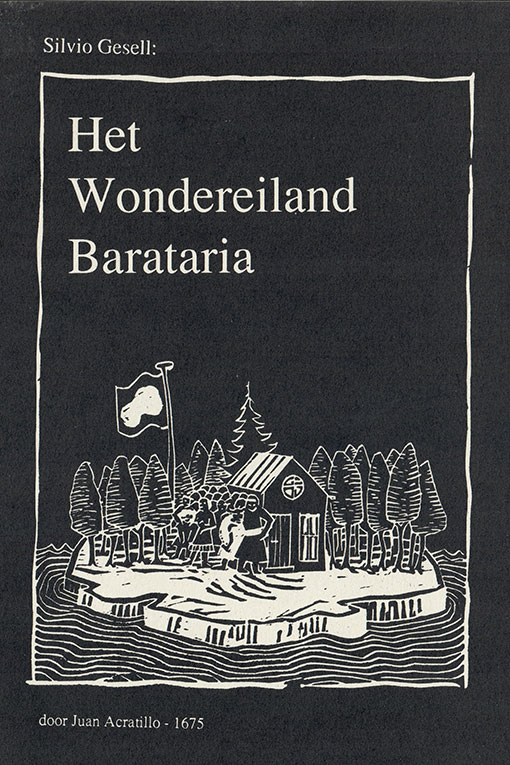
Money equals power, and the lure of riches corrupts us, so the alternatives to the system of trade and usury have failed. They can’t compete. A few people step out, but it is like a rehab from a consumption addiction. It is a sober life while everyone around you keeps on living the good life. After us, the deluge is the prevailing mood. The deluge is already taking off. Storms feed on the warming sea water and leave their burden on our shores. But what are our options anyway? In the early 1990s, the Strohalm Foundation published The Miracle Island Barataria, an economic parable by the Argentinian-German economist Silvio Gesell.1 I rewrote the narrative somewhat to better highlight its message. Gesell explores three options: (1) communism or socialism, (2) a market economy without traders and bankers, and (3) a fully capitalist economy.

In 1612, a few hundred Spanish families landed on Barataria, an island in the Atlantic, after their ships had sunk. The Spanish government believed they had drowned, so no one searched for them, and they became an isolated community. They worked together to build houses, shared their harvests, and had meetings in which they decided about the affairs that concerned everyone. It was democracy and communism. After ten years, the teacher, Diego Martinez, called everyone into a meeting. He noted that working together and sharing had helped them build their community, but the islanders had become lazy. They came late to work, took long breaks, and left early. They spent their time at meetings discussing what to do, but much work remained undone.

‘If someone has a good idea, he must propose it in a meeting to people who don’t understand it. We discuss it but usually we don’t agree or we don’t do what we agree upon. And so, nothing gets done and we remain poor. We could do better if we have the right to the fruits of our labour and take responsibility for our actions,’ Martinez said, ‘The strawberry beds suffered damage because no one had covered them against night frost.’ He mentioned several other examples. Martinez said, ‘If the strawberries are yours, you protect them. And if you have a promising plan you think is worthwhile and you can keep the earnings, you do it yourself and hire people to help you.’

He proposed splitting the land into parcels and renting them to the highest bidder to finance public expenses. Fertile lands would fetch a higher price than barren ones, giving everyone an equal opportunity to make a living. He also proposed introducing ownership so the islanders would feel responsible for their property. But with property, you need a medium of exchange or money. The islanders decided to use potatoes as money. Everyone needed potatoes. They had value, so they were good money.

Potatoes are bulky, thus difficult to carry, and they also rot. At the next meeting, Santiago Barabino proposed setting up a storehouse for potatoes and issuing paper money, which could be exchanged for potatoes when needed. So, you had banknotes of 1, 2, 5 and 10 pounds of potatoes. The Baratarians agreed. The notes had a date of issue and gradually lost their value to cover the storage cost and rot. If you returned the banknote to the potato storage after a year, you received 10% less. And because the issue date was on the banknote, buyers and sellers knew its value.

For several years, Barataria had banknotes representing stored potatoes. Their value declined over time to pay for the storage and the rot. Borrowers didn’t pay interest. If you had savings, you would lend them to trustworthy villagers if they agreed to return notes representing the same weight. The notes lost value, making everyone spend their money quickly and store items and food in their storehouses. The general level of opulence rose, but there were no poor or rich people. There were no merchants buying things at a low price to sell them at a high price. Businesses didn’t pay interest, and there were no merchants, so things were cheap in Barataria. The chronicle notes that the islanders acted as good Christians and helped each other.

Then Carlos Marquez had a new idea. He addressed Baratarians, ‘How many losses do housewives suffer from keeping food in their storehouses? We shouldn’t put our savings in perishable products, but money with stable value. We can back our money with something we don’t need and doesn’t deteriorate. The Pinus Moneta is a nut we can’t eat, and doesn’t rot,’ he said, ‘We don’t have to back money with a commodity of value like potatoes. The things we buy and sell give the money its value. If we do that, we can buy things when we need them and don’t have to store them ourselves.’

What a great convenience that would be. It seemed too good to be true. Diego Martinez argued against the proposal. He told his fellow islanders that a medium of exchange passes hands. It remains in circulation. But savings stay where they are unless those who are short of money borrow them and pay interest. You end up paying interest to use the currency you need to buy the things you need. His argument was to no avail. And that is the price of democracy. People often decide about questions they don’t understand.

Most islanders preferred to spend their time getting drunk in the pub instead of studying the issues of government. And if you are doing well, you can’t imagine that seemingly insignificant errors can ruin you. Marquez spoke passionately, while Martinez warned cautiously, saying things were fine as they were and he couldn’t foresee the consequences. That swayed opinions. The islanders switched to money backed by the Pinus Moneta. This money didn’t lose its value. That made it attractive to save money.

Suddenly, everyone tried to exchange their supplies for the Pinus Moneta, causing mayhem in the marketplace. Everyone brought everything they had to the market. But no one could sell their goods because everyone wanted money. That was until the company Barabino & Co came up with a plan. Barabino & Co. set up a bank with accounts that Baratarians could use for saving and making payments. Everyone could bring their money to the bank and receive an extra 10% after a year. The naive Baratarians agreed. They could have known there weren’t enough nuts of the Pinus Moneta to pay the interest. And they didn’t ask themselves how Barabino & Co. would generate the profits to pay that interest. With this borrowed money, Barabino & Co. bought goods from the islanders and deposited money into their accounts, but Barabino & Co. only purchased food and seeds.

The following spring, Barabino & Co. hiked food and seed prices. Most islanders paid more for food and seeds than they received in interest. They went into debt with Barabino & Co. With the profit, Barabino & Co. bought the next harvest and cranked up food prices even further. Soon, Barabino & Co. owned everything. Most were in debt and worked hard, but a few wealthy people lived off interest income. They didn’t work and lived a life of luxury on the interest on their accounts. The Baratarians needed money to pay for the items they bought from Barabino & Co. They had to borrow this money from Barabino & Co. and pay interest to use it. There weren’t enough nuts to pay back all loans with interest, so the islanders went further into debt year after year. They paid interest on money the bank created out of thin air, giving it to the wealthy. That is usury.

The Baratarians worked harder and grew more creative in earning money. The islanders invented, produced and sold more products, most notably wooden items made from the trees on the island. Not everyone could keep up, and more people lived in the fields. At least, the economy grew, and the Baratarians grew accustomed to luxuries they hadn’t had before. They had wooden chairs, boxes, ornaments, toys, outhouses, carts and tables. The islanders had managed without these items before, but now, they believed they needed them.

The change came with other unfavourable consequences. The Baratarians became agitated, deceitful, and immoral. Crime rose as everyone desired the luxuries that the rich enjoyed, and for which they didn’t have to work. Of their Christian faith, not much remained except an empty shell. They were busy making money. Then came the day the Baratarians had cut down all the trees on the island. They suddenly lacked the wood needed to make the tools for harvesting their crops, and they starved. That was the day the Pinus Moneta lost its value. After all, you can’t eat money.

Adam Smith and the Wealth of Nations

The tale tells how devious acts contributed to an outcome most of us now deem desirable. By selling our souls to the money god, most of us have a better life than people in the Middle Ages. That improvement came with wars, colonialism, the slave trade, pollution, and miserable working conditions, and ultimately, it could bring the end of human civilisation. With the help of saving and investing, capitalists build their capital. Capitalism is about making sacrifices in the present by saving to have a better future via investing. It also led to a mindless process called competition via innovation and economies of scale. Economists call it creative destruction.

In the original tale, the wood didn’t run out, but the British rediscovered the island to find a class society much like theirs. The story tells how devious acts contributed to an outcome most of us now deem desirable. By subjecting ourselves to this system of trade and usury, most of us live a more agreeable life than people in the Middle Ages. It came with wars, colonialism, the slave trade, pollution, miserable working conditions, the destruction of communities and societies, and, eventually, the end of human civilisation. With the help of saving and investing, capitalists build their capital. Capitalism involves making sacrifices in the present by saving to have more in the future via investing. You can always do better. It promoted competition via innovation and economies of scale. But there is no ultimate goal, a vision of Paradise, only creative destruction without end.

The Baratarians were in debt, worked hard and were creative. Those who couldn’t keep up became homeless. As there was never enough money to pay back the principal with interest, the Baratarians went deeper into debt, worked even harder and became more creative by inventing and selling new products, producing an economic boom that ended in starvation once the trees were gone. It looks like the problem we face. The Earth’s resources are finite, and interest accumulates to infinity. Our money becomes worthless once there is nothing left to buy or sell.

Adam Smith, the founder of modern capitalist thought, claimed that pursuing our private interests promotes the public good. A baker doesn’t bake bread to serve the community but to make a living. It is why we have something to eat. The baker doesn’t want to lose customers, so he bakes what they desire. Otherwise, they go to his competitor. Smith believed it would work out well as humans are moral creatures. We temper our behaviour as it affects others. Therefore, moral relativists could argue that we don’t need public interest. The private interest will do just fine. But it is not how markets operate. We may have ethical values, but markets never have them. The least scrupulous usually wins the competition, so the greater evil usually wins in the markets. We have found that out and now want governments to oversee the markets.

Factory owners didn’t consider the plight of the artisans they put out of business or the miserable working conditions of their workers. They would have gone out of business if they had done so. Moral considerations don’t drive business decisions, so psychopaths end up in high places in corporate management.2 These psychopaths in business provide us with harmful products like cigarettes, prostitution, gambling casinos, and semi-automatic rifles. They expand their market by advertising their wares. A merchant will say, ‘If I don’t supply the market, someone else will, so why not profit from death and destruction myself?’ The merchant then claims liberty is the highest value, and restricting markets equals oppression, thus the ultimate evil. Why not let everyone buy cocaine and semi-automatic rifles? It increases GDP. These are the morals of the merchant we now live by.

Without self-interest and trade, we would be poorer, and poverty was Smith’s primary concern. Increasing production was the way out. Self-interest and trade were the tools to achieve that. It succeeded marvellously. Since the Industrial Revolution, production increases have lifted billions of people out of poverty. Adam Smith argued:

  • The division of labour drives production increases. If you specialise in a trade, you can do a better job or produce more at a lower cost.
  • A market’s size limits the division of labour. Transport costs limit market sizes. Energy cost drives the volume and distance of trade.
  • Merchants preferred precious metals as money. It enabled them to store their gains, allowing them to wait for opportunities to make financial profits.

Producers produce items at different times, in different locations, and in different quantities than consumers need. That is why we trade. Traders bridge those gaps by storing, transporting, and dividing goods. Trade promotes large-scale production and labour efficiency, so fewer people provide for our necessities. That allows for more fanciful products and services and industries, thus a higher standard of living.

The evil empire of trade and usury

Economic and financial power translates into military power. The Europeans didn’t finance their conquests with taxes but with the profits from their colonial enterprises. No one likes to pay taxes, but everyone loves a profit. The scheme thus became an unprecedented success. Venture capitalists paid for the first ships, hoping to find new trade routes and riches. And they found them. The Europeans reinvested their profits, so their capital grew, and their financial and military strength increased.

After the bourgeoisie had taken control of the British government during the Glorious Revolution, the British state became a venture of the propertied class, like the Dutch Republic already was. The Dutch Republic, run by merchants, was the most successful and wealthiest nation at the time. The British imported knowledge of Dutch governance by appointing a Dutch governor as their king. In the following centuries, Great Britain became the world’s largest empire.

The British bourgeoisie benefited from a functioning state and was willing to pay for it. The storyline is that taxation became legitimate as it had the consent of the taxed. The British bourgeoisie didn’t like to pay for corruption or ineptitude, so the state’s performance improved.3 With its secured and enlarged tax base, the clamp down on corruption and ineptitude, the invention of modern banking, including a central bank, trust in British financial markets improved, and Great Britain could borrow more at lower interest rates.

It helped Great Britain to defeat France, a country with twice as much wealth and twice as large a population. In France, the wealthy didn’t pay taxes, and the government was always short of funding. France defaulted on its debts several times. The French government was inept and corrupt, which made lenders unwilling to lend to it. The British economic successes, thus having a large market, low interest rates, and high wages, helped to ignite the Industrial Revolution.

During the Napoleonic age, several European countries modernised their governments into modern bureaucracies, with career paths based on qualifications and merit. The British later also modernised their administration, aligning it more with the rational principles of government that other European countries had adopted after the French Revolution.4 The benefits of the division of labour imply it is better to let bureaucrats run bureaucracies and businesspeople run businesses. You don’t let government bureaucrats run a business, nor do you allow your businesspeople to run the government.

The United States followed a different path. When the Founding Fathers set up their new state based on the modern principles of their time, they were ahead of Europe. They introduced regular elections for the president and parliament and a separation of powers between the administration, parliament and the judiciary, thus creating checks and balances to prevent dictatorship or mob rule. The US also became the first democracy. All free men had received the right to vote by 1820.4 Several European countries later followed suit.

The US administration, however, didn’t become a modern professional bureaucracy at first, and the US government remained plagued by corruption, cronyism, and the presence of unqualified individuals. Politicians gave their supporters government offices when they won the election.4 In 1881, a disgruntled man who had campaigned for US President Garfield and sought a diplomatic job as compensation shot the president. Appointing people for political reasons had become unthinkable in most of Western Europe. Modernisation efforts in the US began in the 1880s, took decades, and never fully succeeded. Political appointments are now making a comeback.

The founding fathers had set up the United States as an oligarchic republic run by the propertied classes, similar to Great Britain and the Dutch Republic. Rather than leaning on a clean government like the British elites, the American elites learned to employ corruption, for instance, via campaign financing, bribing judges, and funding think tanks that advise the US government. After World War II, the United States emerged as a superpower, and the gold-backed US dollar became the currency used in international trade. To finance its military, the US began to run deficits in the 1960s and ended the exchangeability of the US dollar for gold in 1971. The US dollar then became the de facto reserve currency, most notably because oil-exporting countries continued to accept the US dollar.

The US dollar’s reserve status allowed the US elites to employ the productive capacity of the rest of the world for their empire. Foreign countries delivered goods and labour in exchange for US dollars, which the United States printed out of thin air. The US financial elites in institutions like the World Bank and the IMF pushed developing countries into US dollar debts, which made them depend on exports to serve the US empire. As a result, the domestic economy of the United States began to suffer from the Dutch disease. The Dutch natural gas exports created a demand for the guilder, which drove up the Dutch currency and made Dutch industries uncompetitive in the 1970s.

The Dutch remedied the issue in the 1980s by making a collective national agreement between the government, employers, and unions to keep wage increases below those of its competitors for several years. Demand for the US dollar, however, increased, not because of exports, but because of foreign nations being dependent on it, pushing up its value and eroding the competitiveness of American manufacturing. And the US didn’t need to correct that issue, because of the US dollar’s reserve status.
The US dollar has become an international store of value, and so has US government debt. There was even pressure to go into debt, to satisfy the global demand for US dollars. As a result, deficits have escalated further, and the American economy depends on controlling the world’s financial markets. The American empire is now the Evil Empire of Trade and Usury, the Babylon of our time. However, the end of an empire doesn’t always turn things for the better.

Latest revision: 7 August 2025

Featured image: cover of The Miracle Island Barataria

1. Het wondereiland Barataria. Silvio Gesell (1922).
2. 1 in 5 business leaders may have psychopathic tendencies—here’s why, according to a psychology professor. Tomas Chamorro-Premuzic (2019). CNBC.
3. The Origins of Political Order: From Prehuman Times to the French Revolution. Francis Fukuyama (2011).
4. Political Order And Political Decay. Francis Fukuyama (2015).

Coin hoard

What is money?

Why do we have money?

Money was invented because trade would be difficult without it. For example, if you are a hatter in need of legal advice, then without money, you have to find a lawyer who craves a hat. That is unlikely to happen. Maybe there is a fisherman dreaming of a hat, but he can’t give you legal advice. Maybe there is a lawyer in need of a hairdo instead of a hat. With money, all these problems disappear like magic. You can buy the services of the lawyer so that she can go to the barber. After that, the barber can buy some fish so that the fisherman can buy a hat from you.

Despite these mind-blowing advantages humans didn’t need money for a long time because they lived in small bands and villages where everyone depended on each other and everyone helped each other. This meant, for example, that when a fisherman needed a hat, you would make a hat for him, and if you needed anything, someone else would provide it to you. You did someone a favour so that he or she was obliged to do something back. Villagers produced most of what they needed themselves. Trade with the outside world was limited and was done with barter.

Uses of money

Later cities, kingdoms and empires emerged. People living in cities, kingdoms and empires didn’t know each other so it became difficult to track whether or not everyone was contributing. Favours and obligations didn’t suffice. They were replaced by a formal system for making payments and tracking contributions and obligations. Commerce and tax collection needed a means of payment as well as administration. It is therefore not a coincidence that writing and money were invented around the same time in the same area. The earliest writings were bookkeeping entries. Money has the following uses:

  • buying and selling stuff (payment) so money is a medium of exchange
  • saying how much something is worth, so money is a unit of account
  • keeping track of contributions and obligations (saving and borrowing) so money is a store of value.
catdog
Nickelodeon character CatDog

Money being a medium of exchange as well as a store of value is like your pet being a cat as well as a dog. The result is not really a success. The parts of the pet may often quarrel, for example, because the dog part wants to play while the cat part wants to sleep. If someone keeps some money for a rainy day and does not spend it, others cannot use this money for buying stuff. And this can be a problem. A simple example can explain this.

Imagine that everyone decides to save all his or her money. Nothing would be bought or sold anymore. All businesses would go bankrupt and everybody would be unemployed. All the money that has been saved would buy nothing because there isn’t anything to buy anymore. This is a total economic collapse.

In reality, it doesn’t get that bad as people always spend on basic necessities like tablets and mobile phones, and perhaps food. When people only spend money on necessities there is an economic depression, which is not as bad as a total economic collapse but still very bad. Saving can make you poorer, but only when there are too many savings already. Savings are used to invest in businesses and hire workers to make products and services. Only if there are more savings than investments, does money remain unused.

The value of money

Money has no value when there isn’t any stuff to buy or when there aren’t any other people to trade with. Imagine that you get the offer to be dropped alone on a remote and uninhabited island in the Pacific with 10 million euros. Probably you would decline the deal, even if you can keep your mobile phone. It is other people and stuff that give money its value. But how? The answer is remarkably simple. The value of money is just a belief.

People are willing to work for money and sell their stuff for money. And because others do this, you do the same. For example, you may think that euro notes have an appalling design as well as an unpleasant odour, but nevertheless, you desire to own them because other people want them too. The euro’s value is based on the belief that other people accept euros for payment.

This is just a belief as the following example demonstrates. Suppose that you wake up one day to hear on the news that the European Union has been dissolved overnight. Suddenly you may have second thoughts about your precious stockpile of foul-smelling unstylishly decorated euro banknotes.

You may ask yourself in distress whether or not your precious bank notes still have any value. What is the value of the euro without the European Union? You may find yourself hurrying to the nearest phone shop in an effort to exchange this pile of banknotes for the latest model mobile phone.

And to prove this point even further, suppose that the phone shop gladly accepts your euros. Suddenly they become desirable again and you may start to have second thoughts about that latest model you are about to buy. It may not remain hip for much longer, so you may change your mind again and prefer to keep your precious euros because there may be a newer model next month. So, because the shop wants your euros, you wants them too.

Types of money

At first, money was an item that people needed or desired. Grain was one of the earliest forms of money. Everybody needed food so it was easy to make people believe that others accept grain for payment. In prison camps during World War II cigarettes became money because they were in high demand. Even non-smokers accepted them because they knew that other people desired them very badly. For that reason, cocaine can be money too.

Wares like grain, cigarettes and cocaine have disadvantages. They degrade over time so they aren’t a very good store of value. This makes them a great medium of exchange because people won’t save them. An example can demonstrate this. Imagine that apples are money and you want to buy a house. A house costs 120,000 apples but your monthly salary is just 2,500 apples of which you can save 1,000. It takes 10 years of saving to buy a house. Soon you will discover that apples rot and that you will never be able to buy a house. Then you will spend all your apples right away.

Saving is difficult with apples. This is where gold and silver come in. Gold and silver do have not much use, but humans were always attracted to shiny stuff. Gold is rare so a small amount of gold can have a lot of value because some people feel a strong desire for shiny stuff. Gold and silver coins can be made of different sizes and purity so that they are suitable for payment and can be used as a unit of account.

More importantly, gold and silver do not deteriorate in quality like apples, grain or cigarettes. They do not even rust after 1,000 years. This makes gold and silver an excellent store of value. But this should make us suspicious. A perfect cat makes a lousy dog so a perfect store of value can fail the test for being a good medium of exchange. People can store gold and silver so that there is less money available for buying and selling stuff. And this can cause an economic depression as we have seen.

Governments create money too, for example by printing “10 euro” on a piece of paper. Governments require by law that this money should be used for payments and taxes. This makes people believe that others accept this money too. Government money is called fiat currency or simply currency. The authority of a government is limited to the area it controls so in the past government currencies had little value outside the country itself unless this money consisted of coins containing gold or silver.

In fact, another reason why gold and silver are attractive as money is that the value of gold and silver does not depend on the authority of a government. This made gold and silver internationally accepted as money. In the 19th century, most government currencies could be exchanged for a fixed amount of gold. This is the gold standard. The gold standard boosted trade because gold was internationally accepted as money.

Most money is debt

Debts can have value and so debts can be money too. This may seem strange or even outrageous, but money is just a belief. For example, money is the belief that you can exchange a hat for money and then exchange this money for legal advice. Hence, if you believe that the debtor is going to pay, you can accept his or her promise to pay as payment. And if others believe this too, you can use this promise to pay someone else.

So if the fisherman promises you to pay next week for the hat you just made, you could say to the lawyer that you expect the fisherman to pay in a week, and ask her if you can pay in a week too. The lawyer could then ask the same of the barber and the barber could ask the same of the fisherman. If all debts cancel out then there is no need for cash. Most of the money we currently use is debt. In most cases, debts don’t cancel out and there are many more people involved so it would be complicated to keep track of all debts and savings. That is where banks come in.

Featured image: Close up of coin hoard CC BY-SA 2.0. Portable Antiquities Scheme from London, England (2010). Wikimedia Commons.

Other images: Nickelodeon character CatDog, Sméagol character from The Lord of the Rings [copyright info]

Shepherd and sheep in Saudi Arabia

Scheme of History

The Abrahamic religions, Judaism, Christianity and Islam contradict each other on several issues, most of them minor, with the most important one being whether Jesus is merely human or the Son of God. In hindsight, it is possible to summarise the grand scheme of God’s plan via Biblical themes or historical developments.

Creation: God created the world and assigned humans as its caretakers. Humans are created in the image of God. Hence, God is somewhat like us, which aligns with us being simulations created by an advanced post-human civilisation.

Fall: Humanity’s disobedience brought evil into the world. Humans wished to know the truth themselves and become like God. Ambitions are humanity’s main problem. The Tower of Babel represents the collapse of advanced civilisation.

Covenant and Kingdom: God made covenants with Abraham, Moses, David, and also with Muhammad to establish Her people and rule. The spread of the Abrahamic religions is a prerequisite for the establishment of the Kingdom of God.

Messiah: By the Fall, humans set the path to the apocalypse in motion by acquiring knowledge. Averting it is a global collective-action problem that requires everyone to adhere to the same social contract. By his sacrifice, Jesus laid the groundwork.

Exile and Return: Israel’s exile to Babylon symbolises humanity’s exile from Eden, with the messiah providing the way back home. The simple life in Eden is the opposite of the advanced civilisation of Babylon, so Paradise is a return to nature.

Restoration: The final chapter of the biblical story promises a new heaven and a new earth, where God restores creation and dwells with Her people in the New Eden. The Quran stresses this particular interpretation.

Apart from these Biblical themes, there is a historical scheme. In short, it is:

  • Creating a tradition of monotheism out of Judaism with the help of Zoroastrianism.
  • Creating a tradition of reason and objective enquiry, starting with Greek philosophy.
  • God revealing Herself to Jesus, thereby contradicting the Jewish religion.
  • Resolving that confusion, turning Christianity into a baffling religion.
  • Making monotheism uncompromising and spreading it via Christianity and Islam.
  • Letting the Greek tradition of reason and objective enquiry revive in Europe.
  • That tradition came to include science and ideas of social progress.
  • It included ideologies and social experiments, giving us insights to build on.
  • The uncovering of the plot in which religion meets reason and objective enquiry.
  • Building a utopian society in which humanity survives with the help of a messiah.
  • Quite possibly, humankind lives happily ever after, like in a fairy tale.

Latest update: 15 May 2026