
Before the Industrial Revolution
Before the Industrial Revolution began in England, European crafts and sciences had already advanced. During the Middle Ages, inventions such as gunpowder, eyeglasses, the compass, the printing press, the mechanical clock, the windmill, and the spinning wheel had reached Europe from China or the Middle East. What made Europe culturally different was its individualism. In the 14th and 15th centuries, a new spirit emerged in Italian merchant towns like Venice, Florence, and Genoa. It was the spirit of the merchant which subsequently spread throughout Europe.
And so, Europeans gradually abandoned their traditional Christian values and developed a capitalist spirit by pursuing worldly wealth and pleasure rather than modesty and bliss in the afterlife. There were merchants elsewhere, but the populace held them in low regard because of their depraved ethics, as greed was their core value. It was the pursuit of profit that drove European explorations and colonialism. Making money became the new moral virtue, alongside inquisitiveness, creating a dynamic that would change the world.
During the 16th and 17th centuries, Europeans explored the world and invented the microscope, the steam turbine, the telescope, and the steam pump. Modern science began when Nicolaus Copernicus calculated the trajectories of the planets by assuming that they revolved around the Sun. Isaac Newton later formulated the laws of motion. Europeans expanded their colonial empires, thereby increasing the size of their markets, a prerequisite for the mass production that industrialisation was to bring.
The British were the most successful. Supported by a strong navy, they built the largest colonial empire. They also invented modern banking, creating money out of thin air or financing capital by imagining future revenues. In 1689, the British had the Glorious Revolution, which, like many revolutions, was about taxation. Businesspeople then took over the government. Taxation henceforth required the consent of the taxed, thus, property owners. And the state became a venture of the propertied classes, like the Dutch Republic, the wealthiest nation at the time, already was.
The taxpayers didn’t like to pay for ineptitude and corruption, so the quality of the British state improved, and the state used its military to support the colonial business ventures of the propertied classes. Great Britain had easily accessible coal deposits and developed a large coal mining industry. Due to a lack of firewood, coal had become England’s primary heating source. As mine pits grew deeper, they became prone to flooding. With no transport costs, a coal-fired steam engine to pump water out of the mine became cheaper than manually pumping with buckets.
Ignition
Trade with the colonies promoted British industries, resulting in high living standards and wages in England. In England, coal was easily accessible, so energy was cheap. In Great Britain, the aristocracy had an entrepreneurial spirit and paid taxes, making the British government a reliable borrower. Banking innovations, most notably the creation of money, made British capital markets more efficient. And so, Great Britain had low interest rates, so a low price for capital. The first machines were clumsy and inefficient, but high wages, cheap capital and affordable energy made them profitable.
This combination of factors is why the Industrial Revolution started in England rather than elsewhere. Wages in France were lower, while the banking system was less developed. The rent-seeking French aristocracy didn’t pay taxes, making the French government an unreliable borrower. Thus, interest rates in France were higher. Once the first machines were in operation, inventing new ones or improving existing ones became profitable, so British engineers got busy enhancing the steam engine’s efficiency and inventing contraptions like the spinning jenny and the cotton gin.
The fuel consumption of steam engines dropped from 44 pounds of coal per horsepower-hour in 1727 to 3 pounds in 1847, making it economical to use the steam engine for other purposes, such as trains. The dramatically improved fuel efficiency, combined with other improvements, made it economical to mechanise production elsewhere where wages were lower, interest rates were higher, or energy was more expensive. That allowed the Industrial Revolution to spread to other countries.1
It was a watershed moment. Until then, inventions were rare. Scientists made them out of curiosity. However, from then on, the profit motive generated a permanent drive to pursue knowledge and new technologies and to invent new products. In this way, economising through innovation and scale became a constant, unstoppable process that economists call creative destruction. Factories needed scale to operate profitably, while inventions birthed new industries and made others obsolete.
Humans have started a fire in their midst that continues to grow. We can’t stop it. A classic book on the Industrial Revolution used at universities is David Landes’ The Unbound Prometheus. According to Greek mythology, Prometheus stole fire from the gods and gave it to humans. The Greek supreme deity, Zeus, punished him for his act. The story parallels the biblical story of the Fall. The Industrial Revolution unleashed the unlimited fire of the gods that will devour us.
Since the Industrial Revolution, the general level of opulence has risen dramatically, though it was hardly noticeable at first. Industrialisation made craftspeople in the clothing industry destitute as they couldn’t compete with factories. Everyone else profited from cheaper cloth. Mechanisation made existing products like cloth more affordable, so people had money to spend on new products like light bulbs, making investing in new inventions profitable. Economists call it Say’s Law. More supply generates new demand.
Due to these innovations, production costs decreased, and industrialisation became profitable where wages were lower, energy was more expensive or interest rates were higher. Industrialisation first took off in Europe and North America, but not elsewhere. One reason is that Europeans had become innovation-minded and eagerly adopted new technologies like railroads and telegraphs. These first technologies were simple, thus easy to apply, but the Chinese and others remained reluctant to use them.2
Standard development recipe
Western Europe followed quickly, helped by the French Revolution and Napoleon Bonaparte’s reforms. The French Revolution wiped out the corrupt old French regime and replaced it with a modernised, efficient bureaucracy. The aristocrats lost their power. The French introduced civil registries, rationalised the law code, standardised weights and measures by introducing the metric system with kilograms and metres, and made everyone drive on the right side of the road. Napoleon’s armies then spread these reforms over Europe. Napoleon did to Europe what the first Chinese emperor did to China 2,000 years earlier. Both reigned shortly but left a lasting legacy.
Countries Napoleon didn’t conquer, such as Great Britain, continued to drive on the wrong side of the road and use arcane measures like miles and ounces. And only in Great Britain do aristocrats still influence politics through the House of Lords. To catch up, Western Europe and the United States followed a standard recipe consisting of the following elements:
- Creating a national market by eliminating internal tariffs and building railroads.
- Developing domestic industries by using external tariffs.
- Instituting banks to finance investments and stabilise the national currency.
- Establishing a mass education system to upgrade the labour force.
These measures had enormous social consequences, which we now refer to as modernisation. Societies came to replace communities. It was the age of nationalism. With the help of mass education, everyone learned the national language, and local dialects disappeared. People learned to identify with their nation rather than their kin and village. The outcome was that modern humans rely on markets and the state more than on their family and community.
Other countries implemented the same recipe but with modifications due to local economic factors. Factory layouts that operated at a profit in Europe were loss-making elsewhere. If energy were expensive, the operation would become more cost-effective using fewer machines and more labour. Japan was the first non-Western country to follow. The Japanese had to deal with local circumstances. High interest rates made investment capital expensive, so Japanese factories held no stockpiles of raw materials and semi-finished products but let their suppliers make them when needed. So, when interest rates rose in the late 1970s and early 1980s, Western industries couldn’t compete with Japan.
There are varying views on why industrialisation succeeded in some countries but not in others. If you dare to generalise, you can make the following observations:
- East Asian countries like Japan, South Korea, Taiwan, and later China modernised successfully. They had a sense of nation and experience with rational government administration. Their bureaucrats and businesspeople successfully implemented modernisation projects.
- Latin American countries were less successful. They were former colonies lacking national identities. Their white elites neglected the education of indigenous people. There were a few large estates and hardly any small-scale farmers. Wealth inequality prevented the development of a middle class.
- The Soviet Union modernised with the help of state planning. Industrialisation of heavy industries succeeded, allowing the Soviet Union to defeat Nazi Germany. Agricultural reforms were a disaster, and consumer products were of poor quality. By the 1970s, it became clear the Soviet Union couldn’t keep up with the West.
- Several countries in the Middle East modernised with dictators implementing socialist development models based on the experiences in the Soviet Union. Some Arab countries became wealthy from oil revenues. Few countries in the Middle East have developed industries that compete in international markets.
- Africa lagged. African borders didn’t match the tribes living there, so there was no sense of nationhood. There have never been states in most of Africa. European colonisers ended traditional forms of government and property rights, contributing to poor governance and corruption. Africans started with a disadvantage.
Industrial politics
There are requirements for a modern economy, though a country doesn’t need to meet all of them. A capable government and an educated workforce can turn a situation around. Japan has few natural resources, but has become one of the most advanced countries in the world. It was the first non-Western country to industrialise. Japan was also lucky. After World War II, it had access to US markets because it was a close ally of the United States, which needed it to help it export its way into prosperity. Argentina had fertile land and was one of the wealthiest countries by 1900, but it has since then gone downhill. To successfully modernise, a country probably needs:
- a capable government that understands economics and is business-friendly
- an educated workforce as workers must read, write and use technology
- businesspeople, investment capital, and sufficiently ensured property rights
- a large enough market, thus a sizeable middle class
- an industrial policy, thus picking industries to compete in international markets, helping to develop them, and supporting them with tariffs or subsidies
There are several kinds of industrial politics. Neo-liberal politics aim to pursue economic growth by promoting trade, lowering taxes, and reducing regulations. Unrestricted trade allows areas and people to specialise and compete to produce more and better products, enhancing overall opulence. It also promotes a race to the bottom at the expense of our future. Industries go where wages are lowest or where they can dump their waste and avoid paying for government services.
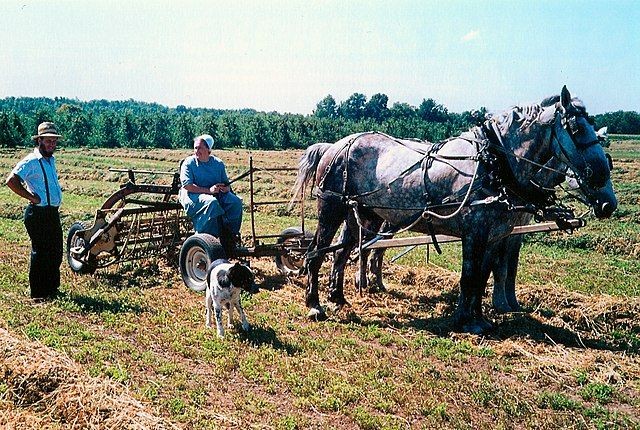
Making the economy sustainable and people-friendly also requires industrial policies, such as reducing competition and introducing regulations and controls. And it requires ending imports from countries that don’t adhere to the same ethical standards. A sustainable, people-friendly economy can only exist on a level playing field with other economies that adhere to the same standards. These measures increase costs and reduce living standards. An extreme case is the Old Order Amish. They choose to be self-sufficient and live simple lives. Their economic model resembles community economics.
Community economics aims to enable people in a community to help each other by buying and selling goods and services using local currencies. It never became a worldwide success because communities lack the scale for self-sufficiency. There is also a lack of commitment, which is something the Amish do have. Few people barter their labour or goods in their community if they can get better deals elsewhere. Commitment is vital. Without it, there will be black markets with merchants smuggling in illicit goods.
Featured image: Amish family, Lyndenville, New York. Public domain.
1. The British Industrial Revolution in Global Perspective. Robert C. Allen (2014). Cambridge University Press.
2. Sapiens: A Brief History of Humankind. Yuval Noah Harari (2014). Harvil Secker.
 The Plan For The Future