
Utopian dreams
A few centuries ago, nearly everyone lived in abject poverty. Most people had barely enough to survive. In the Middle Ages, 30% of the children died, often of malnutrition or diseases. And so, Thomas Hobbes wrote in 1651 that man’s life was poor, nasty, brutish, and short. It has been that way since time immemorial. Around 1800, Thomas Malthus concluded that humans live in a permanent state of misery. Once we have more food and resources, more children will survive, so that we will always be on the brink of starvation. At the time, only one billion humans were roaming the Earth, searching for a meal.
Two centuries later, a miracle had occurred, and it was unexpected if you had lived in 1800 or before. Today, more than eight billion people live on this planet, and less than one billion live on the brink of starvation. The life expectancy in the poorest countries exceeds that of the Netherlands in 1750, the wealthiest nation before the Industrial Revolution. At first glance, it looks like Paradise. Available food and resources have increased faster than the population. Capitalism and fossil fuels enabled this growth. We now use more resources than the planet can sustainably provide, so an apocalypse is in the air.
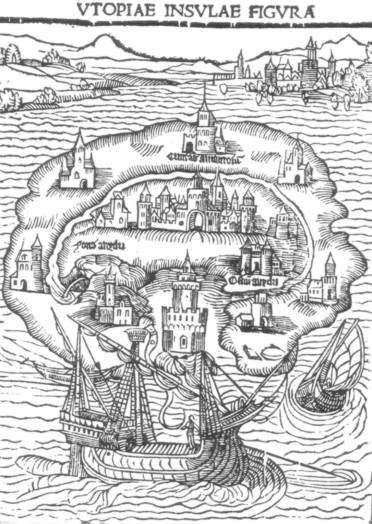
In 1516, Thomas More wrote a novel about a fictional island, Utopia. Life in Utopia was good. The Utopians had a six-hour workday and had enough because everyone took only what they needed. Utopia means ‘nowhere,’ but the name resembles eutopia, which means ‘a good place.’ More may have intended the pun. There is more than enough for all of us. So, why can’t we all work a few hours per day, live peaceful lives and have enough? A well-functioning society requires a set of values and a culture to support it.
Utopian dreams aren’t new. According to the Bible, humankind once lived in the Garden of Eden, where people lived simple lives and were happy with what nature provided. Jesus said, ‘Look at the birds of the air; they do not sow or reap or store away in barns. God feeds them.’ There have since then been utopian dreams of peace and sharing. Most utopian dreamers think of a better world while leaving the hard work to others. In reality, utopian societies are not perfect and are oppressive to those who don’t fit in. Usually, their ideologues define the ideal human as hard-working and public-spirited.
Third ways
There have been several attempts to arrive at a synthesis of capitalism and socialism, often called a third way. The challenge of socialism, the antithesis of capitalism, fuelled a lively debate about economic systems in the second half of the 19th and the first half of the 20th century. Silvio Gesell, who wrote Barataria, was one of the central figures in this debate, as was Henry George in the United States. Since the Cold War, that debate has narrowed down to a struggle between communism and capitalism, or between individual freedom and enforced collectivism. After the collapse of the Soviet Union, the feeling in the West is that capitalism is superior and that there is no alternative.
The Soviets have tried to bring communism into practice. They replaced markets with state planning and repression. Due to the forced collectivisation of farms, millions died of starvation. Millions more ended up in prison labour camps. The end of communism led many people to believe that a better future lay ahead. But many of the economic problems we face today stem from faith in capitalism and the idea that governments can manage its drawbacks. And so, the question remains: is a third way possible? The Chinese have kept innovating and remained determined to make socialism work. It did so by making the Chinese economy more capitalist. However, the state still runs much of it.
The Russians lost faith in the fairy tale of socialism as central planning produced poor outcomes. Still, the Chinese economy has baffled the proponents of the capitalist myth. The Chinese allow the profit motive to exist as long as businesses conform to the Chinese Communist Party’s objectives. State ownership of enterprises further ensures that. The Chinese have demonstrated that you can submit the profit motive to a society’s goals and place large corporations in sovereign wealth funds. But competition still determines the outcome. We are in a rat race that will probably not end well.
The Chinese political economy is more advanced than Western models in that it subordinates the economy to political goals while promoting prosperity for China’s population. In many fields, China has surpassed the West. So if we were to agree on humanity’s goals, political control works better than pure capitalism. Chinese culture contributed to China’s development. Several Asian nations with similar cultures have also successfully modernised their economies. Modernisation is also a cultural shift from reliance on families and communities to markets and states.
The failures of capitalism and socialism come from the fact that both are models of reality, thus simplifications, and that the oversights in both models come with disastrous consequences. We are religious animals who want to believe in fairy tales like capitalism and socialism. The proponents of these systems blame their failures on execution rather than on the systems themselves. To clarify the discussion and address confusion about terminology, it may be helpful to provide definitions of economic systems. Their differences centre around ownership of resources, capital, and labour.
| resources | capital | labour | |
| communism | state | state | state |
| socialism | state | public | private |
| third way / mixed | varies | varies | private |
| capitalism | varies | private | private |
Under communism, the state owns all there is, including your labour, so you can’t even decide on the job you take. Under socialism, you can choose your occupation, but capital and natural resources are public, thus owned by workers or the state. In mixed economies, ownership of natural resources and capital varies. You may own the ground, but if there is oil underneath, the oil may belong to the state. There may be state-operated corporations, such as railways, alongside private corporations. Under capitalism, everything is private. There may be public services, but there are no public corporations. Few countries give their resources away for free. Governments want a piece of the action.
One crucial oversight is culture. There were substantial differences in living standards in the Soviet Bloc. Czechoslovakia did relatively well. Yugoslavia suffered from high unemployment, but the Slovenian unemployment rate never exceeded 5%, while Macedonia and Kosovo had rates of over 20%. These were extreme differences within a single country and under the same system. Likewise, capitalism also promoted varying results. Latin America remained poor despite having mostly right-wing regimes. Cultures change, and an advantage can turn into a disadvantage. Success breeds complacency, and to stay competitive, you have to regularly ‘reinvent’ yourself.
China has developed its economic model, a state-run socialist market economy, which now outcompetes the West. Its success depends on the Chinese people’s hard work, discipline, and ingenuity, as well as China’s long-standing tradition of modern bureaucratic government and Confucian ethics, which enable the government to work in the public interest and the people to respect authority. Chinese culture thus helped them to achieve this. China’s economic success resembles that of neighbouring countries with similar cultures, such as Japan and South Korea. The Japanese and South Korean economic successes also involved state planning and the state organising industries.
Free economy
There are other ways of organising the economy besides communism and socialism. These are community economics and religious economics, so economies founded on a moral system. Economic thinking centres around the division of tasks between the market and the state. There is little room for moral systems and communities. Religion can make people pursue other goals in life than maximising economic utility, while communities can produce most of the essentials, as they did in the past. Barataria had an economy with private enterprise and home ownership, but without capitalists, bankers, or merchants. The Baratarians were a community sharing a religion.
Silvio Gesell believed in economic self-interest as a natural and healthy motive for satisfying our needs through productive activity. He aimed for free and fair competition with equal opportunities for all. He proposed the end of legal and inherited privileges, so the most talented and productive, rather than the most privileged, would have the highest incomes without distortion by interest and rent charges. Henry George believed that society gives land its value through public services. George thought that a land tax would benefit the overall economy and could replace other taxes.
After Argentina experienced an economic depression in the 1890s, Gesell found that returns sometimes failed to meet investors’ minimum requirements. It caused investors to put their cash in their pockets, disrupting money flows. It regularly caused economic hardship and unemployment. Gesell proposed a holding fee on currency to keep the money in circulation, as low returns are more attractive than paying the surcharge, which amounts to a negative interest rate. Gesell’s economic system was well known in Germany as the free economy. In Wörgl, the holding fee on money proved a successful recipe to revive the economy during an economic depression.
European Union
European economies are mixtures of capitalism and socialism. Many Brits found the union too socialist and bureaucratic, so they left. The European Union tries to regulate capitalism a bit too much to the taste of many Britons. Overall, Western Europeans live a relatively good life. Well-being is hard to measure, but European societies are among the world’s most agreeable, at least if you believe the rankings. And if every country kills innovation with legislation like the bureaucrats of the European Union, we wouldn’t need to fear artificial intelligence, genetic engineering or other new technologies. But this political-economic model will probably not survive the competition for much longer.
Europe has a collectivist tradition with Christian and socialist roots, as well as worker and consumer protection laws. Europeans live longer than Americans, partly because the European Union has banned unhealthy foods that are available in the United States. At the same time, governments run the healthcare systems, so most healthcare is for the public interest rather than private profit. In Europe, it is harder for corporations to pass business-friendly legislation through bribery of politicians. That is also because Europeans have more faith in the common good than Americans do. Like the invisible hand, our imaginary invisible friend, the common good, has a few magical powers of its own.
Immigrants do much of the hard manual labour in Western Europe, often for low wages, so they help many Europeans lead agreeable lives. They frequently live in poor housing. Others may find Western Europeans lazy, as they work 36 hours per week and have five weeks of holidays each year. Europe is losing the competition, or at least that is what the experts think. Still, the lives of people in Western Europe may be the closest to what life should be in Paradise, except that European energy and resource consumption would be unsustainable if everyone lived like that. The demise of the European Dream shows that competition is the reason why we can’t live in Paradise forever.
Nazi Germany
The Nazis produced an economic miracle during the Great Depression. Their success came from deficit spending for rearmament and from restricting trade with the outside world, so government expenditures boosted the German economy without causing trade deficits. It is similar to Keynesian economics. It worked like the miracle of Wörgl, except that the German government accrued a large debt while the council of Wörgl did not.
Factories were idle, and many people were unemployed, so the scheme didn’t lead to high inflation. Price, wage and rent controls also helped keep inflation in check, but they hurt small farmers. The Nazi economy was a mixture of state planning and capitalism. Germany was rearming and preparing for war, so it was also a war economy. Countries organising for war take similar measures to mobilise their industries for warfare.
Yugoslavia
Yugoslavia was socialist rather than communist. It combined state planning with markets and decentralised decision-making or worker self-management. The Yugoslav economy fared better than that of fully communist countries. Yugoslavia was more open, and living standards were higher. Eventually, Yugoslavia couldn’t compete with more capitalist economies. The oil crisis of the 1970s magnified the economic problems. Foreign debt soared. Generous welfare spending further contributed to Yugoslavia’s financial woes. The case of Yugoslavia highlights the issues that plague utopian economies.
The country implemented austerity measures, such as rationing fuel use and limiting imports of foreign-made consumer goods. Yugoslavia had been able to feed its people until then, but from the 1970s onwards, the country became a net importer of farm products. Yugoslav citizens could travel to the West. Emigration helped the economy by reducing unemployment and bringing in foreign currencies as emigrants returned money home to support their families. The Yugoslav economy collapsed in the 1980s.
Openness to foreign competition contributed to the demise of the Yugoslav economy. Yugoslav consumer products were inferior to foreign products. To compete, businesses laid off workers. The Yugoslav economic system might have worked if every country had operated its economy like so. Yugoslav products would have sufficed had there been no better alternatives. In that case, mass unemployment wouldn’t have materialised, and Yugoslavia could have managed, perhaps with less generous welfare. Utopian economics can only work when the economy encompasses the entire world.
China
The stories of Airbus and Boeing demonstrate that state ownership of large businesses can work better than private ownership. Boeing was the industry leader, but ruined itself by focusing on shareholder value. Reducing quality brought short-term cost savings, boosted the stock price, and generated management bonuses. That seemed all fine until Boeing’s aeroplanes began dropping from the sky. The largest holders of Airbus stock are European states, allowing the corporation to focus on its long-term goals. The state-owned aeroplane industry is one of the few areas where Europe is still at the top.
Traditional Soviet-style communism yielded subpar economic results, but the Chinese continued to innovate. The Chinese socialist market economy (SME) has private, public and state-owned enterprises (SOEs). China is not capitalist, as the Chinese Communist Party (CCP) retains control over the country’s direction. It is a command state-market economy like Nazi Germany was. Unlike Nazi Germany, which aimed for maximum self-reliance, the Chinese economy integrated into the global economy. It depends on exports, like those of other Asian Tigers such as Japan and South Korea. China’s advantages include a massive market, which enables it to achieve economies of scale, the world’s longest tradition of rationally administered states, and a culture shared with some other East Asian countries that enabled the Chinese to develop quickly.
The ideological vision behind China’s market reforms was that China was underdeveloped and that a fully developed socialist planned economy would emerge once the market economy fulfilled its historical role, as Marx prophesied. The CCP claims it has incorporated a market economy into the Chinese socialist system. The CCP leadership looks at its project through an ideological lens. Proponents of capitalism might argue that China is more capitalist than the West, given its success. Had China failed, the same people would have blamed it on socialism. Others call it state capitalism, as the SOEs that comprise a large share of the economy operate like private-sector firms and retain their profits rather than returning them to the government. On economic organisation, the West can learn from China.
China eliminated extreme poverty, which declined from over 90% in 1980 to less than 1% today. It also became the world’s leading manufacturing economy and the world’s leading producer of unnecessary items that end up in our landfills. Despite its leadership in renewable energy and electric cars, China has also become the world’s leading polluter and carbon dioxide emitter. China’s status as a manufacturer and exporter distorts the picture. By importing from China, other economies appear less polluting. Those who have visited China long and often enough to have an informed picture agree on the following:
- China is ahead of the West in several crucial fields. Its economy is more efficient. The West, as it operates now, is losing the competition.
- Cities are clean, and violent crime levels are low. There is intensive surveillance, which we in the West consider intrusive.
- There is a lot of corruption. Unlike in many other countries, Chinese corruption promotes economic growth by bribing people to get things done.
- China is a dictatorship, but citizens have options to criticise and influence the government. If you aren’t a troublemaker, you are relatively free.
- China represses dissenters and has put millions of people in internment camps to re-educate them and turn them into Chinese citizens.
Chinese corporations align with the Communist Party’s societal goals. There is a profit motive, but profit is secondary. The government can provide support through subsidies. In that sense, the Chinese economy looks like that of the Soviet Union. This model achieves acceptable living standards. At present, China outcompetes the United States and Europe in many fields. If our society’s goals are sustainability and happiness, this economic model can help align corporations with public policies.
State control and ownership of businesses, as in China’s, can be a viable way to pursue political goals such as protecting the environment and reducing poverty. Business objectives, such as profit, can become secondary to political goals, provided that corporations receive support when needed. With state ownership, it becomes feasible to ban products or subsidise others without harming or favouring private entrepreneurs. What China has demonstrated is that a politically steered economy can be competitive and achieve acceptable living standards. And so, we should have confidence that a political economy grounded in moral values can achieve acceptable living standards.
Getting to Denmark
In 1997, my wife and I visited a town in Venezuela. The shops there had armed guards. Shopkeepers believed that they needed these security measures. Not surprisingly, I didn’t feel safe there. If you need guns to protect yourself, something is wrong with society. Perhaps criminals had free rein, and you could not trust the police. Starting a business in Venezuela seemed unwise. I have also been to Denmark. The difference is astounding. Venezuela is an extreme case, and so is Denmark. In the 2024 Corruption Perceptions Index, Denmark ranked first, with the lowest level of corruption in the world. Venezuela was at the bottom. Compared to the rest of the world, Denmark is a Paradise.
Poverty, inequality, and the absence of the rule of law go hand in hand. Without a rule of law, you and your property are unsafe, and building a flourishing society becomes impossible. Some societies are more agreeable than others. Economists understand the rule of law as secure property rights, but it is more important that citizens feel safe and can conduct their affairs in peace. High-quality societies don’t come easy. It is tough to have a capable government, the rule of law, and accountability to the citizens simultaneously. One measure the Danes took to preserve their society was limiting migration, but it would be better if all societies were as agreeable as Denmark’s.
That is possible. Denmark became the way it is because of its unique history. The Danes turned from raping and pillaging Vikings into the peaceful nation it is today. Cultures can change dramatically. Danish history includes the Protestant Reformation. The German sociologist Max Weber argued that the Protestant ethic contributed to the rise of modern capitalism. This ethic includes education, hard work, thrift, and moral uprightness. And that affects attitudes towards graft. The ethic was most present in North-West Europe. Formerly Protestant countries are the least corrupt. But every country can achieve the same. Singapore, Uruguay and Japan are also among the least corrupt countries.
So, what is life in a high-trust society? Everyone is a good citizen. The government is clean. No one misuses state benefits. There is no crime. You feel safe on the streets. You can trust the police. The rules apply to everyone equally. A government can’t create a good society. It merely reflects society. A government can’t enforce laws when its citizens don’t believe in and don’t live by them. Denmark is a cohesive society. People feel connected to each other and share the same values. Becoming a global society like Denmark is an unlikely future for humanity, and getting to Denmark is a utopian dream. Unless, of course, unless a miracle happens. Only religion can move mountains.
Latest revision: 6 December 2025
Featured image: Illustration for the first edition of Utopia by Thomas More.
1. Leviathan. Thomas Hobbes (1651).
 The Plan For The Future