
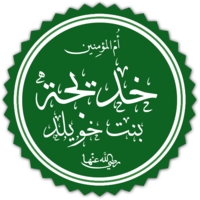
Bride of Muhammad
Mother of the Believers is a title Muslims give to the wives of Muhammad. It best suits his first wife, Khadijah bint Khuwaylid. According to Islamic sources, Khadijah was a wealthy widow and Muhammad’s employer. She had been married twice and had children from those marriages. Khadijah was a very successful merchant. Khadijah’s trade caravan equalled the caravans of all other traders of the Quraysh put together. Khadijah neither believed in nor worshipped idols, which was uncommon. Khadijah didn’t travel with Her trade caravans but employed others to trade on her behalf. Muhammad was one of them.
Muhammad attracted Her interest. He was twenty-five, and Khadijah was forty when She proposed to him. The woman proposing a marriage to the man was indeed unusual, most notably given the time and place where it occurred. She was wealthy and way out of Muhammad’s league, so that he wouldn’t have considered it. The marriage between Khadijah and Muhammad was both happy and monogamous. When he was without Her on one of his journeys, Muhammad never had any desire for other women. They had six children, of whom four daughters survived.
Muhammad returned home, shocked after the Archangel Gabriel appeared to him for the first time. He told Khadijah what had happened, trembling, no doubt. She comforted him like a mother and supported him thereafter. Khadijah’s moral support made Muhammad believe in his mission, and Her financial support was indispensable. Apart from a wife, Khadijah was thus like a mother to Muhammad, in the likeness of Eve and Adam. She was Muhammad’s boss in more ways than one. Like Jesus, Muhammad married God. However, unlike the Bride of Christ, the Bride of Muhammad is still well-known. Only after Khadijah’s death did Muhammad marry several other women.
Quran origins
Muslims believe that the Quran was revealed to Muhammad by God, with the Archangel Gabriel serving as the intermediary. The Quran lacks chronological order and repeats itself. Scholars believe its historical accuracy is inferior to that of the Bible in describing the same events. And so, you might find it hard to believe that this scratchy collection of sayings, which Muslims claim has unparalleled artistic value and is so brilliantly composed that it is beyond the capabilities of even the brightest minds to reproduce, is the word of God and meant to correct corruptions in previous Jewish and Christian scriptures, as Muslims claim. But if you don’t know Arabic and rely on a foreign translation, you cannot assess the Quran’s artistic value. And God works in mysterious ways. The first Muslims memorised the verses and didn’t write them down.
Memorising such a lengthy text for decades is prone to errors. And the Muslims fought several battles that took the lives of some of those who knew these verses. To reduce the risk of verses going lost in this manner, the early Muslims divided the task of memorising the Quran and assigned multiple men to recall the same verses. How well they did that is anyone’s guess. It explains a great deal about why the Quran is the way it is. Those who later wrote down the Quran didn’t edit the verses or present them chronologically because humans shouldn’t distort God’s words. If only early Christians had shown that kind of reverence for their scriptures, Christianity would have been an entirely different religion.
Historical analysis suggests that much of the Quran originated from previously extant Zoroastrian, Jewish, and Christian sources. The Arab desert was far from Rome, so local Christians could hold deviant views that the Church considered heretical, such as that Jesus didn’t die for our sins, that Jesus was human and not the Son of God and that Jesus didn’t die on the cross but that there had been some ploy to make people believe that. The Quran mentions that Jesus created birds from clay and breathed life into them (3:48-49, 5:109-110). The Gospel of Thomas mentions this. Speaking from the cradle, Jesus defended his mother against accusations of sexual immorality (Quran: 19:27-30).
Parts of the Quran have no previously known sources. They could have been part of God’s message that the Archangel Gabriel supposedly dispatched to Muhammad. The Quran also adds a few juicy details to existing stories that the Jews have failed to mention in their Bible. These might have been local tales circulating in the area. An example is King Solomon gathering an army of ghosts, men and birds, entering the valley of the ants, and ants talking to each other (Quran 27:15-18),
Indeed, We granted knowledge to David and Solomon. And they said in acknowledgement, ‘All praise is for God Who has privileged us over many of His faithful servants.’
And David was succeeded by Solomon, who said, ‘O people! We have been taught the language of birds, and been given everything we need. This is indeed a great privilege.’
Solomon’s forces of ghosts, humans, and birds were rallied for him, perfectly organised.
And when they came across a valley of ants, an ant warned, ‘O ants! Go quickly into your homes so Solomon and his armies do not crush you, unknowingly.’
In virtual reality, these things can happen. We have no evidence, but some things are more plausible than others. Talking ants are as believable as a serpent talking to Eve. Still, Muslims claim Muhammad was the last prophet before the End Times and that the Quran corrects mistakes and omissions in the Jewish and Christian scriptures. At first glance, this is not particularly convincing, but the Quran contains a few discrepancies that seem more meaningful in hindsight:
- The Quran discusses Adam’s creation extensively but says little about how Eve came to be. The story of the rib is absent. The Quran claims that humans originate from one soul (Quran 39:6), like the creation in God’s image (Genesis 1:27).
- The Quran doesn’t blame Eve for the Fall. Eve and Adam transgressed together. One passage explicitly blames Adam (Quran 20:120-121).
- There is no original sin in Islam. The Quran states that Eve and Adam repented, and God forgave them (Quran 2:37, 7:23). The Quran doesn’t claim that Jesus was a redeemer for the sins of humankind.
- The Quran names Jesus the Son of Mary and confirms the virgin birth, thereby implying that Jesus had no father, and because Christians call him the Son of God, it opens up the possibility that God’s name was Mary.
- In the Quran, God orders the angels to prostrate before Adam, while the New Testament says that the angels must bow before Jesus, implying that Jesus could be Adam. The repeated mention could signal importance.
- Finally, the Quran stresses the return to Paradise 147 times. Although the Jewish and Christian scriptures pay little attention to our return to Eden, the Quran mentions it so often that it could be of the utmost importance.
God ordering the angels to bow before Adam and Satan refusing to do so was a Jewish theme that some Christians, and later the Muslims, took over. One of the earliest accounts of Satan’s fall as a result of the conflict with Adam comes from the Life of Adam and Eve, a retelling of their lives from around 200 AD. God first formed, animated, and endowed Adam with the image and likeness of his creator. The archangel Michael brought him to bow before God. God then confirmed the creation of Adam in His image and likeness. Then, Michael summoned the rest of the angels and ordered them to bow before Adam, but Satan refused. The sevenfold repetition of this theme in the Quran suggests that there may be more to it than some obscure story entering the Quran by accident.
The Hidden Secret
The Quran claims that God is the greatest schemer (Quran 3:54, 7:99, 8:30, 10:21, 13:42) and capable of deception (Quran 4:88, 5:41, 11:34, 14:4). The existence of different religions and theological disputes is part of God’s plan. Otherwise, the message of Islam would have been more convincing. After 1400 years, that message has yet to convince 80% of the world’s population. The Quran is said to contain a hidden secret. Chapter 74 of the Quran is named The Cloaked One or The Hidden Secret. The former name is the translation of its title, while the latter refers to its content. The cloaked one is Muhammad. The chapter further mentions that 19 angels guard hell. The conflating of cloak and hidden secret suggests a disguise. About the number 19, the Quran says (Quran 74:31),
“We have made their number [that of the angels] only as a test for the disbelievers so that the People of the Book [Jews, Christians and Zoroastrians] will be certain, and the believers [Muslims] will increase in faith, and neither the People of the Book nor the believers will have any doubts, and so that those hypocrites with sickness in their hearts and the disbelievers will argue, ‘What does God mean by such a number?’ In this way, God leaves whoever He wills to stray and guides whoever He wills. And none knows the forces of your Lord except He. And this description of hell is only a reminder to humanity.”
Muslims insist it contains a clue proving the divine origin of the Quran. The verse suggests that the number 19 holds significance beyond the number of angels mentioned. In 1974, a fellow named Rashad Khalifa claimed to have discovered a mathematical code hidden in the Quran based on the number 19. It gave rise to a numerological cult and countless films on YouTube made by beard-wearing men that can bore you to death.
Numbers are meaningless, but the Quran implies there is more to that number and that it contains a proof of some kind, a hidden secret. So, what could the hidden secret be? Chapter 19 is titled ‘Mary’ and is about the Virgin Mary, the stand-in for God, the Mother Goddess. The hidden secret may be that God’s name was Mary, something only God could know. The cloak may refer to God appearing as a man while being a woman, or to the Virgin Mary, as the veil that conceals God’s identity.

Virgin birth
The Quran corroborates the virgin birth of Jesus (Quran 4:171) and claims that Jesus is not the Son of God, thereby implying that Jesus had no father. The virgin birth is a miracle of the Mother Goddess. Christians invented that tale because, if God is Jesus’ Father, then he can’t have a human father. Jesus was Adam, the Son of Eve, so it also replaced Adam’s birth from the Virgin Eve. The Quran consistently names Jesus the Son of Mary (Quran 2:87, 4:171, 61:6), while Christians call him the Son of God. Perhaps there was a Christian tradition in the Middle East that did so. Archaeologists excavated near the location commonly known as Armageddon, a 5th-century AD Greek inscription stating ‘Christ, born of Mary.’1 The odd thing is that it doesn’t say Son of God.
The Quran claims God has no children and that Jesus was not God’s son (Quran 6:100-102, 17:111, 18:4-5, 19:88-92). The reason is that the Meccan supreme deity, Allah, had a wife and children before God claimed this title. And the Virgin Mary wasn’t God either. The repetition of the phrase Son of Mary suggests importance. It stresses that God is not Jesus’ father, and it may imply that God’s name is Mary.
The star and crescent became the symbol of Islam. This symbol has a long history predating Islam, as it was associated with a Moon goddess. The moon represents the woman, and the star the child (Genesis 37:9). Hence, the Islamic symbol is akin to the Madonna and Child, or to the relationship between Khadijah bint Khuwaylid and Muhammad. She was fifteen years older and could have been his mother. The Son of God thus means Son of Mary, as Mary Magdalene was God. The appropriate picture is the Madonna and Child, along with the crescent-and-star symbol of Islam. And so, the same symbolism sneaked into Islam in the same sneaky fashion as it did with the Madonna and Child in Christianity, which is very sneaky indeed, and adds substance to the saying, ‘God works in mysterious ways.’
Return to Eden
Like Christians, Muslims believe Jesus will return (Quran 4:159, 43:61). Even more crucial, however, is our return to Eden, only sparsely mentioned in the Jewish Bible (Ezekiel 36:22-38) and the New Testament (Revelation 22:1-5). The Quran refers to Eden using terms like Gardens and Paradise 147 times, or 3 * 7 * 7. If you’re into numbers with religious significance, that is most remarkable. It is even more significant because humans wrote and edited the Bible, so if there are magic numbers in it, some scribe probably did that during a lifetime of boredom and number crunching. The Quran, however, is the result of decades of oral recitation, during which parts were changed or lost. And none of the reciters knew the entire Quran by heart. After several decades, they wrote down the verses as the reciters remembered them, without a significant redaction process.
God ordering the angels to prostrate before Adam seven times in the Quran is more miraculous than Jesus saying seven times ‘I am’ in the Gospel of John. The latter is not even a miracle, because someone could have done that intentionally, and probably did. In that sense, the Quran is uncorrupted by humans. The numerological signs, such as verse 36:36, which says that God created everything in pairs, and the fact that 36 is six times six, are God’s jokes. In all likelihood, no human ever decided to arrange the verses to create such a pair within a pair in a verse that says God created everything in pairs. Paradise is supposedly the final destination of the righteous. The Quran refers to the Garden of Eden with phrases such as ‘fruits from that garden’ and ‘spouses.’ For instance (Quran 2:25),
And give good tidings to those who believe and do righteous deeds that they will have gardens [in Paradise] beneath which rivers flow. Whenever they are provided with a provision of fruit from there, they will say, ‘This is what we were provided with before.’ And it is given to them in likeness. And they will have therein purified spouses, and they will abide therein eternally.
The promise of spouses in Paradise was a ploy to make horny young men fight for Islam without fear of death. And it worked well as the initial blitz of Islam was nearly as spectacular as Hitler’s. The New Eden is a central theme in the Quran, while the Jewish Bible and the Gospel hardly mention it. The repetition implies that it is of the utmost significance. Here, the Quran corrects Judaism and Christianity. Jews and Christians view God’s plan as a journey from the depraved city of Babylon to God’s city of Jerusalem, the New Jerusalem. Instead, we might go to the New Eden, as it is the core of the final revelation given to Muhammad, at least if we take repetition as a sign of importance. God’s plan, thus, is to bring us to the Final Gardens of Paradise, modelled after Eden.
The idea of a New Jerusalem in Judaism and Christianity has a historical origin. The Jews compiled most of their scriptures during their exile in Babylon and shortly after. Babylon was a centre of empire and civilisation. After the Jews had returned to Israel, they interpreted their journey as a move from the depraved city of Babylon to God’s city of Jerusalem. They received assistance from the Persian leader Cyrus the Great, who conquered the Babylonian Empire and permitted the Jews to return to their homeland. Christians took over this theme. If we go from Babylon to Eden, we get a new theme. Babylon represented advanced civilisation. In Eden, life was simple. That is where this seems to be heading.
Latest revision: 16 October 2025
1. 1,500-year-old ‘Christ, born of Mary’ inscription found in Israel. Mark Milligan (2024). Heritage Daily.
Featured image: top small written Arab phrase “Umm ul Muminin”(Mother of the believers), then in centre Big written “Khadijah”, and bottom small written Arab honour phrase ‘Radhi allahu anha.’
 The Plan For The Future