
The time we live in
We can’t choose the time we live in, but when and where we live determines our options. If you lived in Germany in 1620, you couldn’t go on vacation by aeroplane to Spain, watch television, or post about your life on Instagram. And you didn’t know what happened in China. Look at all the choices we have today. There are shampoos for every type of hair and from several brands. And that is just shampoo. In 1620, you washed your hair with water or not at all. Today, countless products are on the market to cater for every possible desire. Everything has been made easy. But despite the infinite options and comfort, we have no choice but to live in a civilisation heading for collapse.
My life has always been comfortable. We had a car, television and central heating. But life hasn’t always been like that. My parents had a very different childhood. It was the life most people led since time immemorial. My grandparents were subsistence farmers. They grew most of their crops themselves. They had a few animals they could slaughter. The winters were cold. There was only one stove. At first, they had no electricity, telephone, car, radio or television. And that was just two decades before I was born. My son grew up with computers, the Internet and smartphones.
My father loves to talk about the old times. Before he went to school, he milked the cows. There were lots of chores. My mother’s childhood had also been like that, but she rarely discussed it. My mother’s family was reticent, while my father’s family was outgoing. Their lives completely changed in two decades. Not so long ago, most people lived in villages and worked with their hands using their judgment. Nowadays, many of us live in cities, sitting behind screens, watching graphs and checking parameters. Our lives are very different from those of our grandparents. People in the past depended on family and community. Today, many of us rely on the market and the state.
My father’s life
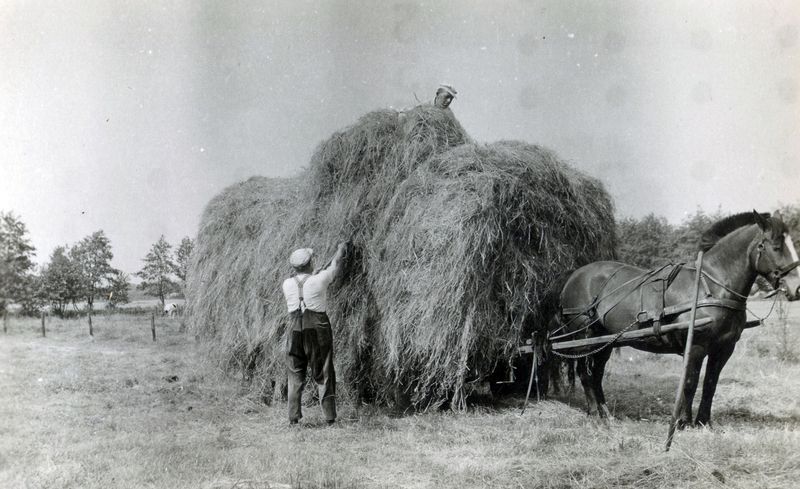
My father grew up on a remote farm near Vragender, a small village in a rural area. They had no machines and relied on horses to do the heavy work. My mother grew up on an even more remote farm near Beltrum in the same region. They were Catholics. My mother had three sisters and three brothers. My father had two brothers and two sisters. My parents’ parents grew a few crops. They had a horse, a few cows, pigs, and chickens. Neighbours were important. If a farmer fell ill, they would step in and run the farm. Shortly after World War II, my father’s father erected a windmill with batteries. Electricity from the grid came in 1952.
My father recalled that the local shop owner came by and showed them a radio. My grandfather didn’t like to spend money on a luxury item, so the shop owner said he could try the radio a month for free. After a month, my grandmother and aunt discovered a radio show and wanted to keep it. And so, they pressed my grandfather into buying a radio. In the same fashion, a television came in a decade later. My father recalled when he saw a car for the first time. He was biking with his father and said, ‘When I grow up I want to have a car too.’ My grandfather tried to teach him some realism, ‘You will never own a car. Only the physician, the notary and the mayor have cars.’
In the 1960s, the Netherlands had become wealthy. I was born in 1968 and have never known poverty. It may be easy to forget that most people in history have been poor and that many people today still are. But my father often reminded me of how his life was. Our comfortable lives come from hard work. We shouldn’t take it for granted. My father worked long hours as a manager of a road construction company. ‘To give us a good life,’ he said. He truly loved his job.
My father is an outdoorsman and a hunter, and he knows how to slaughter animals. He is well aware of what happens in nature, such as the struggle for survival in the animal kingdom. Most people nowadays go to the supermarket to buy their food. At best, they have a vague notion of farmers, crops, and livestock. My father grew up on a farm, so he finds it hard to accept that city people are concerned about farm animals’ living conditions. ‘They know nothing about farm life or nature,’ he says.
My father is politically conservative, innovation-minded, and interested in improving things and new technologies. He often talks about his career at the road construction corporation, where he had worked most of his life. He started as a foreman, later became regional manager, and ended up on the board. He worked hard to get ahead. He studied while others watched television.
As a manager, he was keen on learning the newest management techniques from Japan, such as giving people in the workplace more responsibility to manage their affairs. He believed in progress. When the first home computers became available, he bought one for me. ‘Computers will be the future, so you must learn about them,’ he told me in 1984.
My father worked hard. But what good did it bring? Resources are running out because we made poor choices like building roads and driving cars. My father sees other problems. There are too many regulations, frauds with public funds, immigrants, big corporations not paying taxes, dictators starting wars, people obstructing building projects with litigation, and greedy managers. Somehow, things didn’t get better. But why? With technological change came changes in how we live. Our forbears lived in communities. Today, we live in societies.
Modernisation
Modernisation is not primarily about technological change. It is about the dramatic changes in how we live and organise ourselves. You can order a pizza with your smartphone. No one did that a century ago. Not cooking your meal is a lifestyle change. It requires organisation. The ingredients must be present at the pizza restaurant, and employees must be present at opening hours to prepare and deliver the meals. Everything has to work like clockwork.
Thus, a crucial change was living by the clock. Our forebears didn’t have clocks, agendas, or appointments. It began with the Industrial Revolution. Operating a factory requires workers to be present when the factory is in operation. Employers and employees agreed on working hours. Time became money. Being late was costly. Trains had to run on schedule to bring people to work and appointments.
Another crucial change was the transition from communities to societies. Not long ago, most people lived in villages with their families and didn’t work for corporations. Their social life happened within the family and the community. The Industrial Revolution changed that. Large-scale production requires large markets, the free movement of labour and capital, and communication between strangers.
People who had previously lived in villages moved to towns to work in factories. Nation-states and national languages replaced local governments and local dialects. Nation-states set up schools to turn people into citizens who could play their role in a larger-scale society. Individuals learned to identify with nation-states rather than villages. It changed how people lived and looked at themselves,
Consider a young peasant, Hans, who grew up in a small village in Saxony. Hans lived a fixed life in the village. He lived in the same house as his parents and grandparents. He was engaged to a girl whom his parents found acceptable. The local priest had baptised him. And he planned to continue working on the same plot of land as his father. Hans never asked himself, ‘Who am I?’ The people around him already had answered that question for him. Then he heard that opportunities were opening up in the rapidly industrialising Ruhr valley, so he travelled to Düsseldorf to get a job in a steel factory there.
Hans is now living in a dormitory with hundreds of young men like himself, coming from all over northwestern Germany. People speak different dialects. Some of the people he meets are not German at all but Dutch or French. He is no longer under the thumb of his parents and local priest and finds people with different religious affiliations than those in his village. He is still committed to marrying his fiancée, but some local women have caught his interest. He feels a bracing sense of freedom in his life.
At the same time, Hans is troubled. Back in his village, friends and relatives surrounded him. They knew him and would support him during sickness or a poor harvest. He does not have that kind of certainty about the new friends and acquaintances he has made and is wondering if his new employer, a big corporation, will look after his interests. He heard that Communist agitators were pushing to create a trade union in his factory, but he has heard bad things about them and does not trust them either. His part of Germany had become part of a large empire, of which he can feel proud, but it is barrelling forward to an uncertain future. He feels lonely, disconnected and nostalgic for his village, but for the first time, Hans can choose how to live his life.
Hans’ story characterises the transition from community to society. Industrialisation made millions of Europeans move from their villages to the cities in the nineteenth and twentieth centuries. Today, the same happens in countries like India and China. Hans didn’t think, ‘Who am I?’ Nevertheless, his view of himself changed. He had more choices than in the village. Did he become happier? That remains unclear. In areas where there is little industrialisation, cities also grew. In 1800, only 7% of the world’s population lived in cities. In 2023, it was nearly 60%.
Once traditional values become optional, you experience freedom. Or you may feel confusion and a longing for the clarity of the tradition once provided. Society, rather than your community, now answers the question of who you are and what group you belong to. Hans was no longer a villager in Saxony who was his father’s son and would inherit his farm, but a Protestant from Germany. Nationality, ideology and religion came to define us.
Twenty-first-century consumerist societies have a variety of identity groups, and the Internet makes it easier for like-minded people to find each other. Identity has become a choice like buying products in a supermarket. You can identify yourself as a Madonna fan, a supporter of a soccer club, or a prepper. Marketers use these identities to sell us their merchandise. In the case of preppers, canned foods to survive the coming apocalypse.
Larger scale
Societies are communities on a larger scale. Communities provide solidarity between individuals who know each other. In a community, there is social control. Shared values keep a community together. If the community is supportive, others help you, and you come to their aid. Not all communities are like that. And even if you live in a supportive community, life is not great if you don’t fit in. So we shouldn’t have romantic views about communities. They are a way of organising like states and markets, with benefits and drawbacks.
What was informal as a tacit agreement in communities became formalised as law in societies because people don’t know each other personally. Instead of neighbours helping each other, societies provide welfare. Bureaucratic controls replace social controls. If adequately applied, bureaucratic rules are less arbitrary because the support you get from your community may depend on the cohesion within your community and how much others like you. On the other hand, some people misuse bureaucratic systems and cheat on taxes and benefits.
The people living in a society must identify themselves with it and share its values. Otherwise, they might commit acts of violence, engage in crime, cheat on taxes, or misuse welfare. It helps when everyone identifies with that society. Societies coincide with nation-states, so nationalism has often been a way to achieve that. Sharing a culture and a language creates a common identity. A strong society with responsible citizens makes a difference because markets and governments can’t create agreeable societies alone. Sharing a culture and a language helps, but it isn’t required. A shared ideology or religion can achieve the same.
We will not gracefully return to villages and subsistence farming when civilisation breaks down. Communities have given way to societies where people rely on markets and governments rather than neighbours and family. They go to the supermarket for groceries and don’t grow food themselves, nor do they make or mend their clothes. They expect to buy what they need on the market and the government to care for them when they can’t. They won’t survive an electricity failure that lasts more than a month. What drove us into this corner? It is competition and the benefit of scale. We can’t compete in the market without specialising and innovating, and the promise of wealth lures us into leaving communities to enter societies. And so, lifestyles have entirely changed. And it may happen again in the coming decades.
Latest revision: 21 August 2024
Featured image: Picture from Vragender where my father came from (1949). http://www.oudvragender.nl.
 The Plan For The Future