
Identity groups
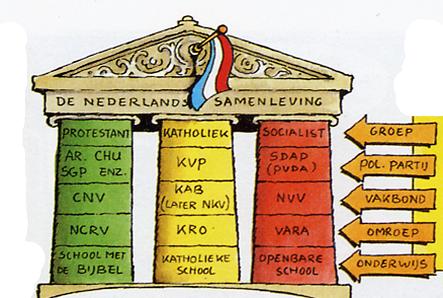
Dutch society has long centred around religious and ideological identity groups. The Dutch have a word for it: pillarisation. A pillar is vertical and encompasses all social classes, including doctors and factory workers. Dutch social life occurred within their identity group, and the Dutch had few contacts with outsiders. The pillars had their own sports clubs, political parties, unions, newspapers, and broadcasters. Roman Catholics and Protestants also had their own schools and hospitals. It was living apart together, so like being married while sleeping in separate bedrooms and having very little sex or not at all.
Dutch society consisted of three pillars: Protestant, Roman Catholic, and Socialist. Each of them represented 30% of the population. The Protestants had split into smaller groups, each with its own specific views on the Bible. Protestants were more literal in their interpretation of the scriptures, which has led to some irreconcilable disputes. The remaining 10% of the Dutch were liberals. The liberals were less organised and opposed pillarisation, but they also had a political party, a newspaper, and a broadcaster.
Strong communities are close-knit, share norms and values, and have social obligations. The pillar organisations focused exclusively on their communities. Similar arrangements existed in other countries, but the Netherlands was known for it. In the Netherlands, none of these groups dominated society. The shared Dutch identity and the state kept these relationships cooperative. The pillars thus supported Dutch society. Pillarisation was not a success everywhere. The arrangement had long helped Lebanon, but eventually the country collapsed into a civil war with interventions of foreign powers such as Israel and Syria.
The Dutch were renowned for their tolerance, which at times approached indifference. The identity groups accepted each other and minded their own affairs. After 1800, there was no longer any threat of civil war. The 1848 revolutions passed the Netherlands as the king promptly implemented liberal reforms. Leadership played a significant role. The leaders of the pillars were willing to compromise, and the members of the identity groups merely followed their leaders, thereby ensuring peaceful relations in society.
Identity issues nonetheless dominated Dutch politics at times. There were several petty disputes. An example is that on 11 November 1925, the cabinet fell when the Catholic ministers resigned after Parliament accepted an amendment introduced by a small Protestant faction to eliminate funding for the Dutch envoy to the Vatican. A Protestant government faction had supported the amendment.
None of the identity groups dominated society. Instead, they had to make deals with each other. On identity issues, Roman Catholics and Protestants helped each other. They arranged for schools and hospitals to retain a religious identity and for the state to fund them as public schools and hospitals. The Socialists made deals on working conditions and social benefits with Catholics and Protestants.
Pillarisation in the Netherlands began to take shape at the close of the nineteenth century. Dutch society was built upon the pillars. The arrangement allowed groups with different identities to coexist peacefully and gradually integrate. From the 1960s onwards, the pillars lost their meaning, and the Dutch became one nation. Pillarisation can be helpful if you believe in a shared destiny for the nation-state but have different backgrounds that prevent short-term integration. In this sense, it is a variation on multiculturalism.
Dutch broadcasting system
Both commercial and state media have issues, at least if you value honest reporting and diversity of opinion. Most of today’s large media outlets are part of a few large conglomerates and vulnerable to a takeover by a leader and his billionaire cronies, so that you end up with the worst of both. That has occurred in Russia and Hungary, and it is now happening in the United States. The Dutch had a solution. In 1930, the Dutch government enacted the Broadcasting Time Decisions and Radio Regulations laws. Broadcasters were required to represent an identity group in society, and the state oversaw content to ensure it was neither inappropriate nor subversive.
Initially, there were four large broadcasters, namely KRO (Catholic), NCRV (Protestant), VARA (socialist) and AVRO (liberal) and some smaller ones. Later, membership counts determined airtime, allowing for new entrants, such as EO (evangelical), TROS (entertainment), and Veronica (more entertainment). Another change was allowing advertisements. Allowing more entertainment and advertising eroded the system’s original intent, making it more like commercial media.
As the Dutch government had outlawed commercial radio and television and only allowed public broadcasting, the police took illegal radio broadcasters off the air. In 1960, the commercial radio broadcaster Veronica started challenging the existing order by broadcasting from the sea, outside the Dutch territorial waters. It signalled the start of a long struggle. The Dutch government was reluctant to open the broadcasting system to commercial interests because of the supposed detrimental effects on society. It eventually succumbed to the pressure and made Veronica a public broadcaster in 1975.
Veronica soon gained the largest membership count. Low-level entertainment is popular with the public but ill-suited for public broadcasting. Yet, the compromise allowed the Dutch government to block commercial television for another fifteen years. By 1989, satellite television had taken off, and Dutch commercial television began broadcasting from Luxembourg. At the same time, the basis for the broadcasting system, the pillarisation, had largely disappeared, and admitting entertainment had eroded the original mission.
Today, the Dutch broadcasting system is a costly relic of the past. Members pay a low fee, and taxes pay for most of the budget. The distinction between commercial television and public broadcasters is unclear. Public broadcasters air entertainment programming, while news on commercial television adheres to the same journalistic standards. The foundation of the system was identity groups that have disappeared. Membership counts have also dropped. About 20% of Dutch adults are members of a broadcaster, which is probably half of what it was a few decades ago. There have been several rounds of budget cuts. Still, this concept aims to address the issues the media face today.
Latest update: 29 June 2026

