
Social struggle forever?
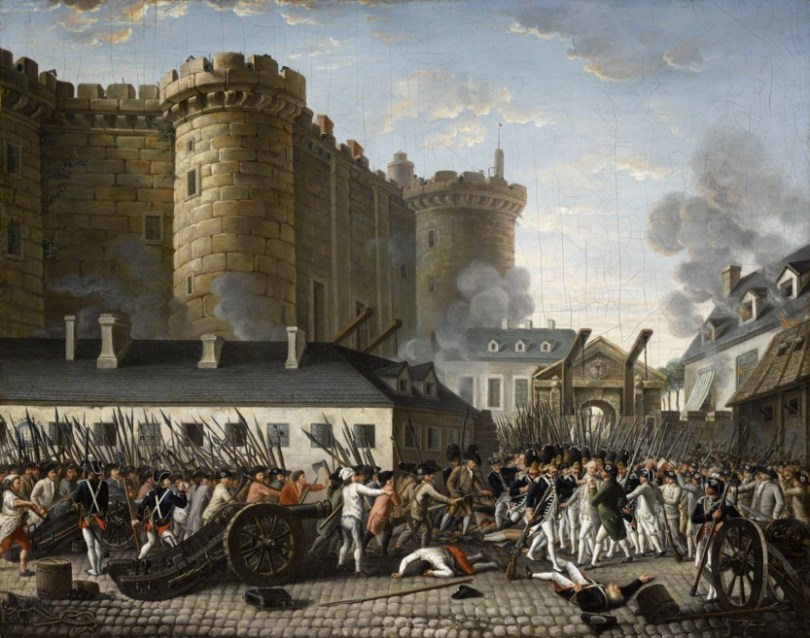
The motto of the French Revolution, based on the ideals of the European Enlightenment, was ‘Liberty, equality, and brotherhood.’ It means that we should all be free and equal, as brothers and sisters. That was a tad ambitious back then, and it still is today, because human nature is not particularly forthcoming. Values like liberty, equality, and brotherhood existed elsewhere, but developments in the West came to shape world history, making them the most worthy of investigation. The European Enlightenment turned these values into abstract ideals that apply to everyone. The French Revolution and the subsequent spread of Enlightenment ideas across Europe by French armies led by Napoleon prompted the German philosopher Hegel to formulate his dialectic of progress. That would be how God’s plan would operate, he figured. Yet there probably would have been no French Revolution had there not been an American Revolution a few years earlier. Well, talking about unforeseen consequences, let’s go out on a few limbs.
The Americans came to reject the English king’s authority. That proved an opportunity to base the brand-new country’s constitution on recently developed Enlightenment ideas, such as basing sovereignty on the people and holding that people are born equal and have unalienable rights, including the right to pursue happiness. These wonderful-sounding words also enthralled blacks, women, and natives, which was not what the property-owning American whites had in mind. Yet, once written down, the fairy tale began to inspire others, creating a lasting achievement that changed the world. The French soldiers, who had fought alongside the American revolutionaries, brought these ideals home. These ideas then motivated the French revolutionaries and, later, the Russian communists to overthrow and murder monarchs God had put in place. And so, the American Revolution became the spark that ignited a fire in Europe and, later, even in China, which became a republic after over 2,000 years as a monarchy.
The Americans came to reject the English king’s authority. That proved an opportunity to base the brand-new country’s constitution on recently developed Enlightenment ideas, such as basing sovereignty on the people and holding that people are born equal and have unalienable rights, including the right to pursue happiness. These wonderful-sounding words also enthralled blacks, women, and natives, which was not what the property-owning American whites had in mind. Yet, once written down, the fairy tale began to inspire others, creating a lasting achievement that changed the world. The French soldiers, who had fought alongside the American revolutionaries, brought these ideals home. These ideas then motivated the French revolutionaries and, later, the Russian communists to overthrow and murder monarchs God had put in place. And so, the American Revolution became the spark that ignited a fire in Europe and, later, even in China, which became a republic after over 2,000 years as a monarchy.
As for the intentions of the American revolutionaries, they were not all that enlightened. George Washington, the first American president, wished to rob Native Americans of their lands, which the British were trying to prevent. Washington was a land speculator who had purchased that land even though the people living there hadn’t sold it. The settlers’ intentions were one reason many natives sided with the British. After America had won the War of Independence, Washington organised military campaigns to ethnically cleanse tribal lands, burning down villages of the native tribes, destroying their crops, and forcing them to relocate. And so, the Iroquois nicknamed him ‘Town Destroyer’.
It is not that Washington was destitute and had to feed his hungry children, as he was well-to-do. No, he was a man of ambition pursuing the American Dream. The Tea Tax, which sparked the outrage that led to the Declaration of Independence, was actually a good deal that would lower tea prices. But not paying taxes without having a representation in the British Parliament was at least one moral principle the unruly mobs could agree on. When drawing up the Constitution, the founding fathers were divided on several issues, such as the powers of the state, equal representation (so that all votes count equally), and slavery. The outcomes of the ensuing lawmaking process were compromises, resulting in a shaky Constitution that left the country with arcane curiosities like voter registration, gerrymandering, and the president not necessarily having the popular vote, and for a while, slavery in the South.
Many European thinkers saw these Enlightenment ideas as the way to social progress. Unlike the British, the French had an incompetent government. And unlike in Great Britain, the aristocracy didn’t pay taxes, so the tax burden fell on ordinary people, so the French had reason to complain. As a result, the Enlightenment ideas fell on fertile ground in France. After the French Revolution, Napoleon’s armies spread them throughout Europe. It is indeed a remarkable historical accident. Progress was in the air. Hegel then laid out the ideological conflict between progressives and conservatives that would dominate Western societies over the next two centuries. Better ideas would replace poorer ones in a competition that includes revolution and warfare, he prophesied.
One particular branch of progressivism was Marxism. Marx believed that the organisation of societies stems from unenlightened self-interest, thus our willingness to accept the myths of the elites and our unwillingness to accept the facts. At the time, intellectuals came to agree that much of the Bible was fiction. And Jesus still had not shown up after 1,800 years. Religion kept people dumb and obedient, Marx reasoned.
Christ taught that the meek would inherit the Earth. Marx taught that the meek should rise against their oppressors to achieve Paradise themselves. In the Soviet Union, communists started a state-run economy. In the West, socialists pressed for labour reforms and higher wages. Once workers in Western societies had come to live the good life, the Marxists moved on to liberate other oppressed groups. Critical Theory, also known as Cultural Marxism, examines and criticises society and culture using the social sciences and the humanities. The question remains: what is oppression and what is not? And if liberating requires repression, would the end still justify the means?
Max Horkheimer described Critical Theory as seeking to liberate human beings from the circumstances that enslave them. You can free yourself from thoughts such as the belief that your job or role in society is natural or divinely ordained. And you can free yourself and your group from another’s oppression. Critical Theory examines power structures, societal roles, cultures and their alternatives. You can ask yourself why most members of parliament are men. Is it culture, human nature, or power structures? Critical Theory leads to serious problems if it tries to liberate us from human nature. Still, culture influences our conduct, so there is room for change. Cultural attitudes affect the amount of sexual abuse. Still, it would be an illusion to think we can eradicate it. It will always be a man’s problem despite cultural influences. And Critical Theory can lead to a new power structure of opinion-makers who tell you what you should think.
The critical theorists suspect the existence of conspiracies of those in power to keep the oppression going, such as men in positions of power aiming to keep women out of positions of power. There is something like an old boys’ network. Men being in power have consequences for the rules in society. If men are in control, they make the rules and determine what constitutes acceptable conduct in relationships between men and women. Most complaints about improper behaviour come from women complaining about men. What men might consider harmless, women might see as intimidating. And so, women started the MeToo movement. Humans are genetically nearly identical, so differences in behaviour between groups are mostly cultural.
Conservatives object to Critical Theory, claiming it promotes divisions within society. They might claim the order is natural. Men should treat women right, but aren’t gender roles natural? And if you dress like that, should you complain about men making remarks? Do we need political correctness officers who tell us what we should and shouldn’t say? Why do we need a new language? Does replacing the word ‘alderman’ with ‘alderperson’ change anything for the better? What people believe is acceptable and reasonable changes over time, and that change often comes from activism. Women have fought for the right to vote. Now most people accept it. Social justice causes have helped to make societies more agreeable. Still, there is a limit to what we can achieve, and when order falls apart, civilisation will prove to be a thin veneer, and gone before we know it.
The long road to ending slavery
One noteworthy example of Hegelian progress is the end of slavery. It was a long struggle, as it took more than 1,000 years, at least if you reason from the Western perspective, and that is the most fruitful approach, as the West shaped the world. It involved political activism and war. Most ancient societies had classes like slaves, serfs, free men, nobility, and priests. We pursue social status, not only for ourselves but also for the groups we belong to. We divide societies into social classes, while conquerors often enslaved the conquered. It helps to explain why ending slavery took so long, or why raising blacks to equality with whites aroused strong negative sentiments among whites. And even when we are equal before the law, cultural differences can make us unequal in reality. In the past, most people considered slavery normal or natural, but our values and culture have changed. There were also entrenched interests within societies. Slave owners were usually wealthy and powerful. In 1860, they were the elite in the Southern United States.
One of the first efforts to end slavery and serfdom in Western Europe began in the 7th century with Queen Balthild, a former slave, who forbade the sale and trade of Christians within Frankish borders. In 1102, the Council of London banned ‘the infamous business, prevalent in England, of selling men like animals.’ Around 1220, the Sachsenspiegel, a German law code, condemned slavery as ‘a violation of man’s likeness to God.’ The argument for abolishing slavery was a Christian view on human dignity. There was also an economic reason. Cities provided economic opportunities, and serfs flocked to them, prompting lords to compete for labour. It made serfdom in Western Europe untenable.
By 1500 AD, slavery and serfdom were rare in Western Europe, but by then, slavery began to take off in the colonies. Christians could still enslave non-Christians. A similar historical process would unfold, officially ending slavery more than three centuries later. Shortly after 1500, Spain banned the slavery of Native Americans but allowed unpaid forced labour or corvée called Encomienda. It made the natives serfs on paper but slaves in practice as the corvée extended. The natives weren’t sturdy enough for hard physical labour and died of diseases brought by the Europeans.
European plantation owners needed a sturdier workforce. European traders brought them from Africa by boatloads, crammed them into cargo holds, and chained them, leaving little room to move, to maximise profits by efficient use of available space. Slavery was common in Africa. Tribespeople captured and enslaved members of other tribes. The European slave trade dramatically increased demand for slaves and made it a lucrative business, so hunting people for profit became commonplace in Africa. Unhygienic conditions, dehydration, dysentery, and scurvy caused one out of six to die during the voyage. Between 1526 and 1860, slave traders put an estimated 12.5 million Africans on ships in Africa, and 10.7 million survived the trip to the Americas.
The European slavery of Africans was chattel. The slaves, and also their children, were the property of their owners and had no rights. There are other forms of slavery, such as the slavery and serfdom that existed in Europe during the Middle Ages, in which slaves had rights and sometimes could own property. The same was true for most slavery in Africa before the Europeans arrived. The Mamluks in Egypt bought enslaved boys from abroad, raised them as Muslims, and let them work in the military.
Yet, these other forms of slavery were brutal as well, and the difference with chattel slavery could be negligible. In the era of the Atlantic slave trade, North African Muslim pirates captured and enslaved over 1 million Europeans by raiding coasts and ships. They came as far as England. Europeans bought some of them back for ransom, but the others had miserable lives. The Arab slave trade, which lasted 13 centuries, involved over 17 million people. In the Saharan region alone, more than 9 million African captives were deported, and two million died on the roads. For the individual slave, the owner’s character mattered most for the living conditions.
The Europeans didn’t see African slaves as humans, but as cargo. On 1 January 1738, the Dutch slave ship De Leusden sank near the coast of Suriname. Over 600 Africans died because the crew had boarded up the hatches on the orders of the captain, thus not even allowing them to swim for their lives. Yet, in Europe, the mood began to change, and more people came to oppose slavery. In his diaries published in The Voyage Of The Beagle, Charles Darwin wrote that slaves would regularly receive beatings and torture for insignificant offences, mistakes or for no reason at all. When Darwin wrote these notes, public opinion in Great Britain was shifting, and Britain was about to abolish slavery in its colonies. There was also an economic reason. The Industrial Revolution had taken off, and the British economy no longer depended as much on slave labour as it had in the past.
History of blacks in the United States
The abolition of slavery became the central issue in the 1860-1865 US Civil War. The Northern states had abolished slavery soon after the American Revolution. Their economies didn’t depend on slave labour. That was different in the South. The invention of the cotton gin turned into a boon to the cotton industry and greatly increased the demand for slave labour. By 1860, slave plantations in the United States produced two-thirds of the global cotton supply. Efficiency improvements came from tracking each person’s output and harshly punishing those who failed to meet their production targets. Slaves who tried to escape faced brutal physical punishments like whippings, branding, or maiming. As the South’s wealth was based on slavery, it wasn’t willing to end it.
A noteworthy figure in the abolition movement was John Brown, a man of strong religious conviction, who believed himself to be ‘an instrument of God, raised to strike the death blow to slavery in the United States.’ He saw it as his sacred obligation. The opposition against slavery was broader, but Brown became dissatisfied with their pacifism. He came to propagate radical action, saying, ‘I, John Brown am now quite certain that the crimes of this guilty land will never be purged away but with blood.’ He led a number of anti-slavery volunteers during the Civil War in Kansas about the issue of whether the state would enter the Union as a slave state or a free state, which led to his execution for treason in 1859.
The dispute leading to the Civil War was over whether to allow slavery in the new territories in the West. The controversy came to a head when Abraham Lincoln, who opposed slavery’s expansion, became president, and Southern states seceded. Lincoln, hoping to reunite the country, didn’t plan to abolish slavery in the South at first. That changed when a peace deal remained out of sight, and the North needed soldiers to fight the war. Lincoln then signed the Emancipation Proclamation on 1 January 1863, which freed the slaves and allowed them to enlist in the army. Many slaves escaped and fled to the North to obtain their freedom and to join the Northern Army.
At the time, Frederick Douglass, an influential black writer, complained about the unequal pay of black soldiers, who earned less than white privates. The North’s weak response to the cruel treatment of black prisoners of war by the South also angered him. He forced his way into President Lincoln’s office, and the two men came to know each other. It was a learning experience for both. Lincoln learned how slavery affected the lives of black people, while Douglass came to understand political reality. Most whites weren’t ready for black emancipation, so a politician could only do so much. Not much later, John Wilkes Booth assassinated Lincoln for promising blacks suffrage.
After the Civil War, whites regained control in the South. Paramilitary groups, such as the Ku Klux Klan and the White Man’s League, disrupted political campaigning, ran officeholders out of town, lynched black voters, and committed voter fraud. The federal government didn’t stop it. Voting for blacks became more restrictive with literacy requirements combined with the underfunding or closing of black schools. States and counties introduced laws to enforce racial segregation, the so-called Jim Crow laws. Successful blacks faced violence, destruction of their businesses and killing by violent mobs of whites. The most famous example of that is the Tulsa massacre of 1921.
Racial segregation officially ended in the 1960s after the civil rights movement took on the issue. Television made the nonviolent resistance led by Martin Luther King a success. Scenes of police violence highlighted the oppression of blacks, and the world could see it. It damaged the credibility of the United States, which was at the time in a propaganda war with the Soviet Union to win the hearts and minds of formerly colonised peoples. That forced President Kennedy to act. And one century after Lincoln signed the Emancipation Declaration, he signed the Civil Rights Act. Both presidents acted for political reasons rather than moral ones. One can only admire the marketing that made these self-interested political acts look like righteous moves, but fairy tales inspire people, so it had a positive effect. Since then, everyone in the United States has been equal before the law, even though not always in practice.
Something went wrong somewhere
In December 1992, I was on holiday in Florida. My travel agent had advised me not to enter a particular quarter in Miami where blacks lived. Yet, I accidentally drove into that district twice and tried to book a hotel room there. The lady behind the counter was kind enough to talk me out of it. She said, ‘Folks like you shouldn’t come here, you know.’ She meant whites. And the neighbourhood seemed okay. I had also accidentally driven through a ghetto, where the blacks living there gazed at me. It was different in the Netherlands, so the presence of blacks didn’t worry me. And I was about to move to a neighbourhood where a considerable number of blacks lived. The Netherlands has no history of antagonised race relationships like the United States has. There were issues, but not the kind of hatred you saw in the United States.
Months earlier, a jury had acquitted four Los Angeles policemen of the beating of Rodney King, a black taxi driver, despite the evidence being clear. Fury erupted, incited by grievances about racial and economic inequality, and the city burned. Something had gone wrong somewhere. The ‘something’ and the ‘somewhere’ are complicated issues. Had they been easy to resolve, we would have done so by now.
In the West, culture has become more of a determinant of success than privileges and institutions. The success of immigrants is related to their ethnic background. Education didn’t matter much to enslaved blacks in the United States, and later on, during the Jim Crow years, their education was willfully neglected. Whatever the cause is, blacks in the United States put less value on education than other groups. They might want to be successful at sports rather than to become an engineer. And sports are a waste of time and energy. You don’t eat food produced by sports nor do you live in a home built by sports. A question remains: how would blacks in the United States have fared had whites not stood in their way for so long?
Another factor contributing to the persistence of racial inequality in the United States could be the disintegration of families, which particularly affected blacks. The disappearance of industrial jobs worsened the situation. Such explanations are speculative. There is evidence supporting it and evidence to the contrary. If it were so, there would be other factors as well. In 1965, Senator Daniel Moynihan warned that the rise of out-of-wedlock births among blacks would cause a disaster. He argued that black men couldn’t become good husbands and fathers without jobs to support a family. It would cause divorce, child abandonment, out-of-wedlock births, and households headed by women living on welfare. Without a positive role model of a providing father with a job who looks after his sons, young males are more likely to enter a life of crime, Moynihan argued.
The report came at a time when the Civil Rights movement fought segregation and white racism. Civil rights leaders attacked the report as an example of white patronising, cultural bias, and racism. These issues have diverse causes, so you can be right while the person you disagree with can be right too. As people take sides, the result is a political struggle rather than a resolution. The report helped to create the black welfare queen stereotype. Blacks were more often on welfare. Also, the relationship between broken families and crime is plausible yet difficult to prove. The neighbourhood you grow up in, the people you meet and the friends you get also affect your choices and economic opportunities. In his report When Work Disappears, William Julius Wilson attributed high unemployment in urban, largely black neighbourhoods to structural changes in the economy.
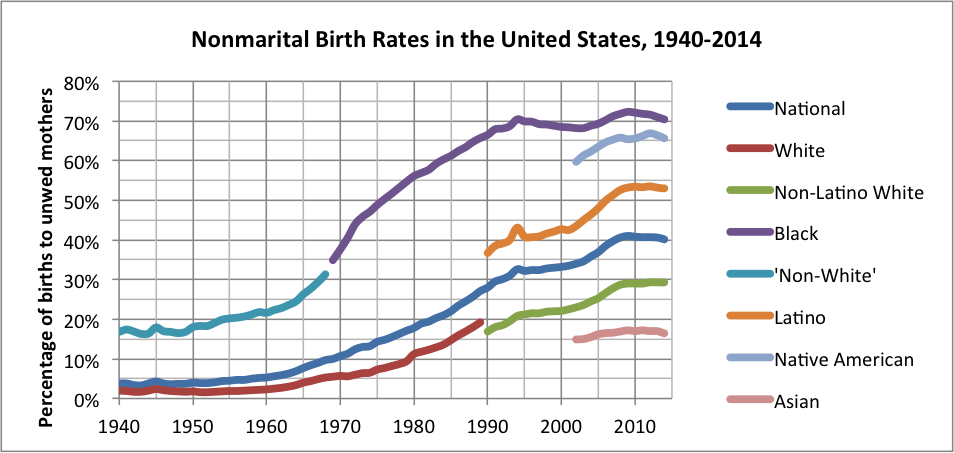
The supposed relationship between the strength of communities and families and success in society comes from the idea that you have an advantage when you grow up in a stable environment with married parents who can invest more time in raising and providing for their children. However, it doesn’t explain why Muslims often perform poorly in European societies, as they usually have strong family ties. Attitudes towards education and society also matter. Blacks and Muslims may feel resentment and think that society is not for them. Blacks may say it is a white man’s world. To Muslims, the success of the West and the Jews is at odds with the supposed superiority of Islam. If you believe you aren’t a fully recognised member of society and never will be because you are black or Muslim, you are less likely to participate.
In recent years, white males increasingly drop out of the labour force in the United States, choosing a life of gaming or being drunk or high. Conservatives tend to blame this on immigrants, or the termination of DEI policies and rounding up illegal immigrants by the Trump administration did nothing to change that. Many of these men lack a decent work ethic. Welfare and low drug prices allow for these lifestyles.1
In 2013, the acquittal of a neighbourhood watch in the fatal shooting of the 17-year-old Trayvon Martin gave rise to the Black Lives Matter movement. Martin had no convictions. The police had once found jewellery in his possession, but couldn’t prove he had stolen it. The neighbourhood watch tried to apprehend Martin for being in the neighbourhood where burglaries had occurred. He claimed self-defence because Martin resisted with force. The death of George Floyd in 2020 is another noteworthy case. A police officer knelt on Floyd’s neck for over nine minutes while Floyd was handcuffed and lying face-down in the street, contributing to his death. Floyd said that he couldn’t breathe. The police officer ignored him. Floyd allegedly had used a counterfeit twenty-dollar bill. He had served eight jail terms for petty crimes.
The Black Lives Matter movement turned the brutality of American police into a race issue. Had Floyd been white, would the police officer have treated him differently? That may well be the case. Was Martin racially profiled? Likely so. Perhaps someone else was the burglar. Get blacks pulled over more often by the police? Sure. Yet, blacks are three times as likely to be killed by the police as whites, but six times as likely to be convicted of a violent crime. Relative to the number of violent crime suspects per race, the police killed fewer blacks than whites. That makes it hard to separate the two issues. There is no excuse for racism, but also not for crime, and if you look at the numbers, the latter is the bigger problem. Floyd wasn’t saving the rainforests or helping out poor people. He was a petty criminal. You shouldn’t make heroes out of criminals. You also shouldn’t erect statues and make heroes out of traitors who fought to preserve the institution of slavery.
The jury justice system adds a complication. Well-known is the case in which a jury acquitted O.J. Simpson of the 1994 double murder of Nicole Brown Simpson and Ronald Goldman. The panel had 9 blacks, which made people question the verdict, believing the jury to be racially biased. In many more cases, the jury mainly consists of whites, especially in cases that involve blacks. Jury justice is seriously unprofessional, and one issue is that jurors’ race may impair their judgment. Research suggests that blacks get 20% to 30% more prison sentences than whites in similar cases. Access to better lawyers can also play a role, as does cultural bias, so a white person knows better what a white judge wants to hear than a black person because they share the same culture. Still, a reduction in the crime level to the level of whites would help blacks much more than correcting the racial bias in the justice system.
Culture also affects the nature of crimes. Sweden has long been one of the least violent countries with one of the most progressive justice systems. Yet, in recent years, gang violence among immigrant groups, often with young perpetrators, has led the Swedes to revise their system, as it wasn’t effective in dealing with this new type of gangsters. It is a problematic path. As culture affects the nature of crimes, immigrants may receive more severe punishments for similar crimes because of the assumption that they require different treatment due to their cultural attitudes. Maybe community service doesn’t work so well with people who grew up in a violent place.
There is also a lot of nonsense flying around. What to think of the statistic that blacks in the United States are seven times as likely to be exonerated after a wrongful arrest? That riles some people up. Yet, there is nothing remarkable about that if blacks are seven times as likely to be arrested because they are seven times as likely to commit a crime. The racial bias, if there is one, is likely much smaller, so perhaps they are seven times as likely to be convicted while being six times as likely to commit a crime. The sooner we get over it, the sooner we can move forward and do something about it, for there is much wrong with white culture as well. It is why we are in this mess in the first place. Had there been no capitalism and the Atlantic slave trade, the blacks would still be in Africa, living their life in Eden like they always did. Whether they would have been better off that way, is a matter of personal taste.
And regardless of conduct, there is racism. Blacks face more racism than others, except where they are the majority. Humans are xenophobic creatures, and the skin colour of blacks stands out. Even language works against them, as the words ‘black’ and ‘dark’ are associated with evil. On the Dutch island of Curacao, where there is racial mixing, lighter skin is more appreciated, or so an islander once told me. Solving the issue begins with accepting that it is natural for humans to exclude those who are different. Apart from differences in conduct, unfamiliarity is an obstacle to acceptance. Humans are xenophobic creatures and may hate, bully and ostracise others for differences in views, appearance and conduct. So, familiarity and similar conduct can help reduce these issues.
The cause of the high number of black fatalities at the hands of the police is brutality rather than ethnic profiling. In the United States, police fatalities are 33 per 10 million inhabitants per year, in league with countries like Angola, Colombia, Mali and Sudan, which is 30 times as much as countries like Germany, Portugal, Sweden, and the United Kingdom. It comes with the level of lethal violence Americans accept. In the United States, you can get away with shooting a cleaning lady trying to open the wrong door. In Europe, that would be murder. In Europe, a neighbourhood watch would also do prison time for shooting an unarmed person. In civilised society, that works better. That requires the police to do their job. And in the United States, everyone can carry a gun, so the police are on edge, making them shoot first and ask questions later.
Historical perspective
We view things from today’s perspective and assess the past through today’s values. It doesn’t help to understand history or social changes. Slavery has long been normal in many parts of the world. The Bible does not speak out against it. That Christians gradually came to reject it is a remarkable historical development. Slave owners thus didn’t think they were doing anything wrong. They could be kind people and still treat their slaves cruelly. Darwin wrote, ‘I was present when a kind-hearted man was on the point of separating forever the men, women, and little children of a large number of families who had long lived together.’ He could only do that if he didn’t view slaves as people. Among the Nazis exterminating Jews in the concentration camps were family men who cared for their wives and children. Most of us are capable of allowing or contributing to atrocities.
Those of us who eat meat contribute to the animal suffering in the meat industry, which is as horrific as the Holocaust, even though it concerns animals rather than humans. Animals don’t differ from us as much as many of us like to imagine. We buy clothes made by children in Bangladesh who work twelve hours six days a week in filthy factories. Many people in Europe and the United States condone the cruel treatment of immigrants because they think there are too many, and that migration undermines their societies, and giving them humane treatment would invite more to come over. And that is correct. ICE brutality led many illegal immigrants to flee the United States. Future generations may view our conduct as appalling as we view slavery today, but only if we have a better world in the future. If we end up in a Mad Max world ruled by warring gangs, few would care.
Seeing the abolition of slavery as a historical process and acknowledging the limits of our compassion helps us understand why it took so long and why slavery has never fully ended. Moral beliefs and economic issues were involved. Slavery was common in most traditional societies, but had ended in Western Europe by 1,500 AD. Europeans then turned the slavery of blacks into a large-scale commercial enterprise, making it a pillar of the European capitalist economy. European Christians engaged in the slave trade, but Christianity also contributed to the end of slavery.
Christianity proclaimed a fundamental equality of human souls. Christian churches approved of slavery and benefited from it, but they also aimed to convert indigenous peoples. These conversions themselves were often brutal, but by doing so, European Christians admitted that indigenous peoples were humans worthy of conversion. And if they were Christians, enslaving them conflicted with the Christian principles Europeans imagined. Muslims lived by that same principle, but the Muslim world has been a sideshow in world history, and by extension, the Muslim slave trade. The Western ideal of equality has its roots in Christendom. Europeans gradually began to apply the principle of equality to people of other races.
Slavery ended once the economic situation allowed it. The Industrial Revolution became the new engine of economic growth, so the slave trade and slavery contributed less to the economy. Factory workers were cheap and often lived on the brink of starvation, so the capitalists’ bottom line didn’t suffer from abolishing slavery, except in the South of the United States, which went to war over slavery, thus proving Marx’s point that economics has a considerable, if not decisive, effect on the class structure in societies. Ending slavery didn’t magically create a better world, nor did ending segregation solve inequality.
Slavery can return at any time if the conditions favour it or if a stronger power emerges to re-establish it. If so, it will come with a new myth telling us that slavery is the best system for reasons like humans being unworthy of freedom because they feel entitled to what is not theirs, and as a result, ruin this planet with their insatiable desires. That is the irony of history or God’s sense of humour. It could be chattel slavery in which God owns you and your children, and where you have to contribute positively to God’s society. Those who go along with it will own nothing and be happy. After all, it is better to be a slave in Paradise than to be free in hell.
Latest update: 2 October 2026
Featured image: The storming of the Bastille and the arrest of Governor M. de Launay on 14 July 1789. Public domain.
1. Why So Many Men Aren’t Working. Keith Humphreys and Brent Orrell (2026). The Atlantic.

