
Thus spoke Chief Seattle
To traditional peoples, nature is sacred. In 1854, the Native American Chief Seattle gave a speech when the United States government wanted to buy the land of his tribe. A screenwriter later rewrote it. His revised version became a religious creed within the environmentalist movement. It strikes at the heart of the matter. Nothing is sacred anymore. The pursuit of money destroys our values and planet. We may think we own the land, but we do not. We may think we control our destiny, but we do not. Whatever befalls Earth befalls the children of the Earth. Thus spoke Chief Seattle,
The Great Chief in Washington sends word he wishes to buy our land.
The Great Chief also sends us words of friendship and goodwill. This is kind of him, since we know he has little need of our friendship in return. But we will consider your offer. For we know that if we do not sell, the white man may come with guns and take our land.
How can you buy or sell the sky or the warmth of the land? This idea is strange to us.
If we do not own the freshness of the air and the sparkle of the water, how can you buy them from us?
We will decide in our time.
What Chief Seattle says, the Great Chief in Washington can count on as truly as our white brothers can count on the return of the seasons. My words are like the stars. They do not set.
Every part of this earth is sacred to my people. Every shining pine needle, sandy shore, mist in the dark woods, clearing, and humming insect is holy in my people’s memory and experience. The sap that courses through the trees carries the memories of the red man.
The white man’s dead forget the country of their birth when they go to walk among the stars. Our dead never forget this beautiful earth, for it is the mother of the red man.
We are part of the earth, and it is part of us. The perfumed flowers are our sisters[;] the deer, the horse, the great eagle, these are our brothers. The rocky crests, the juices in the meadows, the body heat of the pony, and man―all belong to the same family.
So, when the Great Chief in Washington sends word that he wishes to buy our land, he asks much of us.
The Great Chief sends word that he will reserve us a place so that we can live comfortably. He will be our father, and we will be his children.
But can that ever be? God loves your people but has abandoned his red children. He sends machines to help the white man with his work and builds great villages for him. He makes your people stronger every day. Soon, you will flood the land like the rivers that crash down the canyons after a sudden rain. But my people are an ebbing tide; we will never return.
No, we are separate races. Our children do not play together, and our old men tell different stories. God favours you, and we are orphans.
So we will consider your offer to buy our land. But it will not be easy, for this land is sacred to us. We take our pleasure in these woods. I do not know. Our ways are different from your ways.
This shining water that moves in the streams and rivers is not just water but the blood of our ancestors. If we sell you land, you must remember that it is sacred and that each ghostly reflection in the clear water of the lakes tells of events and memories in the life of my people. The water’s murmur is the voice of my father’s father.
The rivers are our brothers. They quench our thirst. The rivers carry our canoes and feed our children. If we sell you our land, you must remember, and teach your children, that the rivers are our brothers and yours, and you must henceforth give rivers the kindness you would give any brother.
The red man has always retreated before the advancing white man, as the mist of the mountain runs before the morning sun. But the ashes of our fathers are sacred. The graves are holy ground, and so these hills, these trees, this portion of the earth is consecrated to us. We know that the white man does not understand our ways. One portion of land is the same to him as the next, for he is a stranger who comes in the night and takes from the land whatever he needs.
The earth is not his brother but his enemy, and he moves on when he has conquered it. He leaves his father’s grave behind, and he does not care. He kidnaps the earth from his children. He does not care. His father’s grave and his children’s birthright are forgotten. He treats his mother, the earth, and his brother, the sky, as things to be bought, plundered, and sold like sheep or bright beads. His appetite will devour the earth and leave behind only a desert.
I do not know. Our ways are different from your ways. The sight of your cities pains the eyes of the red man. But perhaps it is because the red man is a savage and does not understand.
There is no quiet place in the white man’s cities. There is no place to hear the unfurling of leaves in spring or the rustle of the insect’s wings. But perhaps it is because I am a savage and do not understand. The clatter only seems to insult the ears. And what is there to life if a man cannot hear the lonely cry of the whippoorwill or the arguments of the frogs around a pond at night? I am a red man and do not understand. The Indian prefers the soft sound of the wind darting over the face of a pond and the smell of the wind itself, cleansed by a midday rain or scented with pinion pine.
The air is precious to the red man, for all things share the same breath―the beast, the tree, the man, they all share the same breath. The white man does not seem to notice the air he breathes. Like many dying for many days, he is numb to the stench. But if we sell our land, you must remember that the air is precious to us, that the air shares its spirit with all the life it supports. The wind that gave our grandfather his first breath also received his last sigh. And the wind must also give our children the spirit of life. And if we sell you our land, you must keep it apart and sacred, as a place where even the white man can go to taste the wind sweetened by the meadow’s flowers.
So we will consider your offer to buy our land. If we decide to accept, I will make one condition: The white man must treat the beasts of this land as his brothers.
I am a savage, and I do not understand any other way. I have seen a thousand rotting buffalo on the prairie, left by the white man who shot them from a passing train. I am a savage, and I do not understand how the smoking iron horse can be more important than the buffalo that we kill only to stay alive.
What is man without the beasts? If all the beasts were gone, men would die from a great loneliness of spirit. For whatever happens to the beasts soon happens to man. All things are connected.
Whatever befalls the earth befalls the sons of the earth.
You must teach your children that the ground beneath their feet is the ashes of our grandfathers. So that they will respect the land, tell your children that the earth is rich with the lives of our kin. Teach your children what we have taught our children, that the earth is our mother. Whatever befalls the earth, befalls the sons of the earth. If men spit upon the ground, they spit upon themselves.
This we know. The earth does not belong to man; man belongs to the earth. This we know. All things are connected like the blood which unites one family. All things are connected.
Whatever befalls the earth befalls the sons of the earth. Man did not weave the web of life; he is merely a strand in it. Whatever he does to the web, he does to himself.
No, day and night cannot live together.
Our dead go to live in the earth’s sweet rivers, and they return with the silent footsteps of spring. It is their spirit, running in the wind, rippling the surface of the ponds.
We will consider why the white man wishes to buy the land. What is it that the white man wishes to buy, my people ask me. The idea is strange to us. How can you buy or sell the sky, the warmth of the land, the swiftness of the antelope? How can we sell these things to you, and how can you buy them? Is the earth yours to do with as you will, merely because the red man signs a piece of paper and gives it to the white man? If we do not own the freshness of the air and the sparkle of the water, how can you buy them from us?
Can you buy back the buffalo once the last one has been killed? But we will consider your offer, for we know that if we do not sell, the white man may come with guns and take our land. But we are primitive, and in his passing moment of strength, the white man thinks that he is a god who already owns the earth. How can a man own his mother?
But we will consider your offer to buy our land. Day and night cannot live together. We will consider your offer to go to the reservation you have for my people. We will live apart and in peace. It matters little where we spend the rest of our days. Our children have seen their fathers humbled in defeat. Our warriors have felt shame, and after defeat, they turn their days into idleness and contaminate their bodies with sweet foods and strong drinks. It matters little where we pass the rest of our days. They are not many. A few more hours, a few more winters, and none of the children of the great tribes that once lived on this earth or that roam now in small bands in the woods will be left to mourn the graves of a people once as powerful and hopeful as yours.
But why should I mourn the passing of my people? Tribes are made of men, nothing more. Men come and go like the waves of the sea.
Even the white man, whose God walks and talks with him as a friend to friend, cannot be exempt from the common destiny. We may be brothers, after all; we shall see. One thing we know, which the white man may one day discover―our God is the same God.
You may think now that you own Him as you wish to own our land, but you cannot. He is the God of man, and His compassion is equal for the red man and the white. This earth is precious to Him, and to harm the earth is to heap contempt on its Creator. The whites, too, shall pass, perhaps sooner than all other tribes. Continue to contaminate your bed, and you will one night suffocate in your own waste.
But in your perishing, you will shine brightly, fired by the strength of the God who brought you to this land and, for some special purpose, gave you dominion over this land and the red man. That destiny is a mystery to us, for we do not understand when the buffalo are all slaughtered, the wild horses are tamed, the secret corners of the forest heavy with the scent of many men, and the view of the ripe hills blotted by talking wires. Where is the thicket? Gone. Where is the eagle? Gone. And what is it to say goodbye to the swift pony and the hunt? The end of living and the beginning of survival.
God gave you dominion over the beasts, the woods, and the red man for some special purpose, but that destiny is a mystery to the red man. We might understand if we knew what the white man dreams―what hopes he describes to his children on long winter nights―what visions he burns onto their minds so that they will wish for tomorrow. But we are savages. The white man’s dreams are hidden from us. And because they are hidden, we will go our own way. Above all else, we cherish the right of each man to live as he wishes, however different from his brothers. There is little in common between us.
So we will consider your offer to buy our land. If we agree, it will be to secure the reservation you have promised. Perhaps we may live out our brief days as we wish there.
When the last red man has vanished from this earth, and his memory is only the shade of a cloud moving across the prairie, these shores and forests will still hold the spirits of my people. For they love this earth as the newborn loves its mother’s heartbeat.
If we sell you our land, love it as we’ve loved it. Care for it as we’ve cared for it. Hold in your mind the memory of the land as it is when you take it. And with all your strength, mind, and heart, preserve it for your children, and love it as God loves us all.
One thing we know. Our God is the same. This earth is precious to Him. Even the white man cannot be exempt from the common destiny. We may be brothers, after all. We shall see.
A religious desire for Eden
Perhaps you care for this planet, but what do you mean by that? When the last white rhino is dead, the Earth is still there. We may survive the demise of the rainforests. Humans have finished off other species for thousands of years. Why stop now? Nature doesn’t care. Predators kill prey, and natural disasters kill animals. Why should we care? Mr Lind, a professor at the University of Texas, noted that saving the planet has become the religion of politicians, business elites, and intellectuals in the West, replacing Christianity’s earlier mission of saving individual souls.1 He added that environmentalism is rooted in German 19th-century Romanticism, with a bias against organised society and civilisation and a pantheistic awe before an idealised Nature. In other words, environmentalists suffer from a religious desire for Eden.
In doing so, Mr Lind tapped into another 19th-century German tradition, that of Friedrich Nietzsche. Nietzsche hoped to leave traditional morality behind, saying, ‘God is dead.’ Religions like Christianity, Nietzsche claimed, were ruses to enslave us with a false sense of right and wrong under rules imposed by a priestly caste. And so do environmentalists, Lind implied. Nietzsche favoured the values of the strong to those of the weak embodied in Christianity and socialism. Slaves think in terms of good and evil rather than better and worse because they resent the ruling class. Nietzsche hoped to liberate us from our self-induced slavery and realise our full potential.
Mr Lind argued we should do away with false sentiments, saying, ‘There are costs to mitigating climate change as well as benefits, and rational people can prefer a richer but warmer world to a poorer but slightly less warm one. These individual policies benefit humanity, so there is no need to justify them on the basis of a romantic creed that defines the planet or the environment.’ That appears nice and dandy from behind the desk of Mr Lind’s air-conditioned Texas room. He says rational people might prefer money to a cooler climate. If it is too hot in France, you can go to the beach in Denmark. A few people may die due to heat stroke or extreme weather. We will be wealthier, so why care? We never cared. Cars kill one million people per year. That didn’t stop us from driving them.
A philosophy of connectedness
As our production and consumption increase, new problems emerge faster than we can solve existing ones with laws, technology, targets and other solutions. New technology, rules and controls don’t solve these problems. Meanwhile, millions of poor people try to escape their misery and look for a better future in wealthy countries. Is there a relation between these issues, and what is it? In the 1990s, the environmentalist group Strohalm wrote a booklet named Towards a Philosophy of Connectedness.2
It gives a vision for a sustainable and humane society centred around community solidarity. The principal founder of Strohalm is Henk van Arkel, a dedicated individual who remained its driving force for decades. He doesn’t blame anyone in particular. We are all part of the problem.
Everything is interconnected. Our actions have consequences, even though we may not know or ignore them. Wall Street traders who sold bad mortgages caused the financial crisis. Dumping plastic in a river, buying clothes made by children, or posting hateful comments on a message board has consequences. Western thinking, reflected in the scientific method, deconstructs reality to analyse the parts. In this way, the whole can get lost. Not seeing the whole can make us act irresponsibly. A single hateful comment doesn’t make someone take a semi-automatic rifle and shoot innocent people, nor would driving a single car change the climate. Still, hate makes people murder innocent people and driving cars contributes to climate change. If we accept that, we remain locked inside a cynical and uncaring world. It is our neglect. Good intentions can worsen things, but we can learn and do better next time. The alternative is turning evil.
Actions have consequences. We can’t look the other way if we hope to live in Paradise. We have to do the best we can to prevent harm. Our vision of harm fails us. If the relationship between our actions and the harm is remote or not proven, we feel free to do as we please. And that is the road to hell. And so, we have the choice of being free in hell or becoming a slave in Paradise. It is not slavery, as we understand it, the exploitation of one group of people by another, but slavery in Nietzsche’s sense, which is living under a self-imposed moral system that limits our options. And money shouldn’t be our highest value, which it is in the liberal-capitalist world. God owns this world, so it is not ours to destroy. The Sacredness of Creation is a religion. We need a new starting point and foundation for our culture, beliefs, thinking, and our place in the universe because we must change how we live.2
Latest revision: 20 August 2024
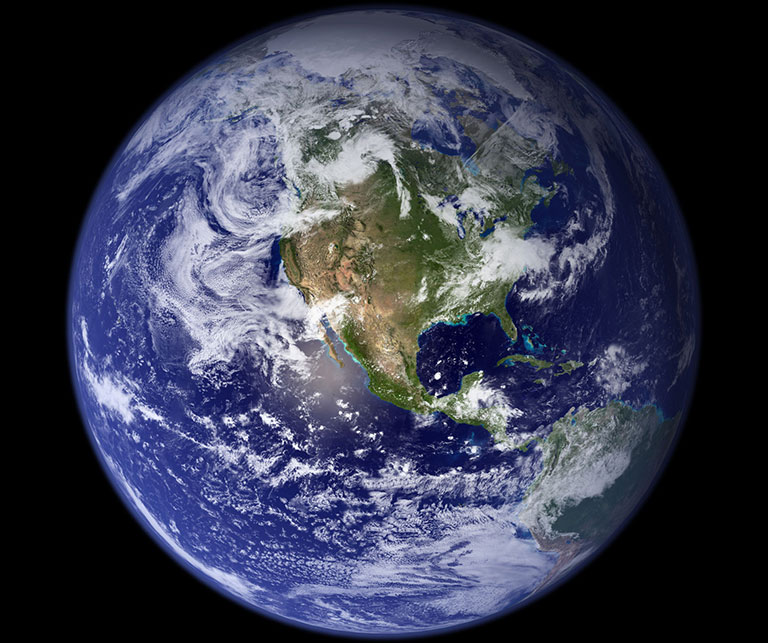
Featured image: Earth from space. Public Domain.
1. Why I Am Against Saving the Planet. Michael Lind (2023). Tabletmag.com.
2. Naar een filosofie van verbondenheid. Guus Peterse, Henk van Arkel, Hans Radder, Seattle, Pieter Schroever and Margrit Kennedy (1990). Aktie Strohalm.
 The Plan For The Future