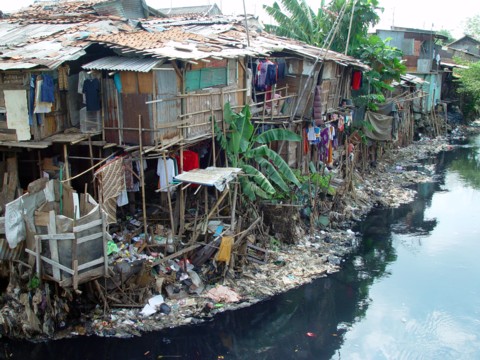
Slums in Jakarta

Extreme living

Overdoing things

In 1994, Princess, a friend from the United States, visited me in Groningen, where I lived at the time. Before we went out to the supermarket in the local mall, I took a shopping bag with me. Princess remarked on the shopping bag as if it were something peculiar. You could get a new one at the supermarket, she said. I answered that it was wasteful to fetch a new bag from the shop. She then called me an environmental extremist. I had no car and travelled by train, so that might have made her think this. I already believed that Americans are wasteful consumers, so her remark confirmed my prejudice. Taking a shopping bag with you is a minor inconvenience, but where does it stop? In other words, what will life be like after the apocalypse?

Perhaps Princess was right. Most of my clothes are over twenty years old. Some come from a thrift shop. There are holes in my underwear. My excuse is that no one sees my underwear. Sometimes I take a bath when there is plenty of solar and wind energy. I have an electric heater to heat the water. When the sun doesn’t shine, I sometimes warm up a litre of water and take a washcloth to wash myself. Compared to taking a shower, it saves over 95% in energy and water. Now and then, I succumb to temptation and take a shower or a bath. And I can’t help but eat scraps others leave behind, or when my son still lived with us, use paper towels he had discarded after hardly using them.

Waste and spillage unnerve me. I had a poorly insulated old home. It caused distress, making me anxiously oversee my natural gas consumption. I could easily pay the bill, so it wasn’t that. Insulating my house and only heating the living room resolved my emotional issues. As a side benefit, I reduced my energy bill by 70%. Still, I can’t stop brooding over new ways to lower my energy consumption even further. I do office work and can work at 17 degrees Celsius with warm clothes and gloves. My mother once said that I overdo things. Buying second-hand is what poor people do. My parents were raised in poverty and had worked hard, so they could buy new things and enjoy luxuries.

I don’t want to upset others, so I try to act inconspicuously. Everyone should live a simple life, but for a long time, my argument was, ‘Who am I to tell others what to do?’ Later, the excuse became, ‘Who is going to believe me?’ It is not always possible to guess what disturbs others. Or I might forget. Once, I wore worn-out clothes to a family party. My father was not amused. That was an oversight. My father thinks it is disrespectful to the hosts. They don’t take offence, and I don’t take offence at my family’s excessive consumption. That has been their upbringing. They must know they turn our planet into a wasteland. But everyone else lives the good life, so what is the point?

What is normal?

Who is an extremist depends on what we consider normal. Today, we think it is normal to live at the expense of poor people and future generations. It is normal to aspire to a luxury yacht and extravagant living. You may not be able to afford it, but you can dream of it. That is the American Dream. My life is rather ordinary, albeit with a few luxuries. I don’t engage in extreme measures like turning off the heating or getting rid of my car. I might have done so if I had lived alone, but my wife doesn’t want it. It is not enough, but there is no point in scrapping comfort if you are the only one doing it. What is the point of living without comfort if others go on driving SUVs and taking holidays by aeroplane?

The only way to do it is to do it together. Wasteful lifestyles can’t remain the norm much longer, so if we don’t change, disaster is likely. We can manage. My great-grandparents hardly left the village they lived in. They had no car, no television, and probably had never been to Germany. That seems like extreme living now. But it is not as hard as it appears. The 80/20 rule states that, for many outcomes, roughly 80% of the consequences come from 20% of the causes. It means that for those who aren’t poor, an 80% reduction in consumption would reduce their well-being by 20%.

The Netherlands has a mild climate. Winters have become significantly milder in recent decades, so there is hardly any frost. Cuts in energy use will cause discomfort but little suffering. In many other locations, the situation is quite different. I once read a story of a guy in rural Ohio who had lived off the grid for one winter and shared his experience on a message board. He woke up to a harsh reality. Things freeze and break down. You can easily get injured and incapacitated. He will not do it again. And he couldn’t do without a car. More experienced people gave him tips. One commenter suggested that he should move to a warmer location. Alaska has its version of the 15-minute city, Whittier, where all 200 residents live in one building, complete with necessities like a shop and a church.

Time is money or convenience

In 2002, when I was unemployed for a few months, I tried my hand at an allotment garden. It was a lot of work. It got me a few vegetables I could buy cheaply at the supermarket. Once I had a job again, I gave it up. Not so long ago, most people grew their food because they were poor. They had no other job, so they had the time. There were no agricultural machines, so it was manual labour. Today, home-grown food is uneconomical. Working 1 hour at the office might buy the food that takes 40 hours of work if you grow it yourself. It is an economic calculation. If I could earn more by producing food than working at the office, I would quit my job and grow food. That is why few people grow their own food.

You can save money by cooking your own meals instead of eating out or ordering takeout. Alternatively, you could work more, and if you make more money than you save by cooking, eating out is economically optimal. Usually, you don’t make these calculations. I never go to the canteen at work. I spread my bread before going to work instead. Many people take the convenience to save time, often because they have no time due to their work commitments. They say that time is money. So, time equates to money or convenience. People who work in restaurants have jobs that wouldn’t exist if we cooked our own food. Many of these jobs are bullshit jobs.

The consumerist economy is about squandering resources and energy to make money. Advertisements tell us how easy a product is and how much time or trouble it saves us. They don’t tell us how many hours we work for it. Eating out is convenient, but you have to work longer hours to pay for it. You could work less when you cook your meals yourself. If you forego ease, you can have more time. In the past, people had time to grow their food or mend their clothes. That is a lot of work, but food and clothes were more expensive, or incomes were lower. Buying new clothes meant more work than mending the old ones, because they had to work more hours to afford them. It was economically efficient to mend clothes and grow food because they were poor.

Wealth and poverty

My closet still features clothes from forty years ago. My mother bought them when I was a teenager. Most clothes don’t last that long. The fashion industry is the second-largest polluter. It generates, among others, mountains of waste, including landfills of unsold clothes, 20% of the world’s water pollution, and 10% of global carbon emissions. The economy is about selling more stuff to generate profits. The latest trend is fast fashion, so clothes that fall apart after you have worn them a few times. Your clothes won’t last a season, and new ones are cheap, so you can always stay fashionable.

The world’s largest waste producer, China, is making new clothes affordable for everyone, including the poorest. New clothes from China have become cheaper than second-hand from Europe. Africans can now buy new clothes. And so, Africa is now finally becoming economically developed, thus consumerist and wasteful like the rest of the world. Today, many Africans have newer clothes than I have.

Who is rich and who is poor? To me, wealth is how long you can survive on your capital. So, if your expenses halve, and your capital remains the same, you are twice as rich. The wealth of humanity is how long we can sustain our lifestyles. At present, human consumption levels are unsustainable because they exceed the planet’s capacity. If we could consider this planet ours, which we can’t, we are eating up our capital. We are poor but could be rich and live off the interest of our capital if we reduce our consumption to sustainable levels. And if you have a capitalist spirit like me, and think ahead, you are willing to save and invest in the future.

Living without a car

Many car owners work one day per week to pay for their car. Using public transport may take longer, but without a car, you can skip one working day each week or retire earlier. And you can think further. Why should you make that trip? In the past, people hardly ever left their village. If your aunt celebrated her birthday and lived thirty kilometres away, you didn’t go. And no one was offended. You didn’t go anywhere. There were festivals in your village that you could attend. Once or twice a year, there was some entertainment. For the rest of the time, you had to entertain yourself or bore yourself. That is extreme living.

For many years, I didn’t have a car, despite having a job that required one. I lived in a remote city. My job was there, or at least 200 kilometres from home, so I had to stay in a hotel. In that case, I took a train to a station nearby and parked my bicycle there. In either case, I went to my work by bike, either from my home or from the hotel. Using public transport requires planning, extra time, and sometimes considerable sacrifice. I remember taking a thirty-minute walk through the snow to reach an office outside the city centre, as buses only went there during rush hour. And then there was all that waiting at train stations. It saved me money, allowing me to buy a house. After all, time is money.

After I met my wife, we could borrow her mother’s car if we needed one, or we rented one. When her mother’s car fell apart in 2003, I bought my own, a second-hand 1998 Opel Astra, which has now survived over 320,000 kilometres. But I still go to work by public transport. And I use public transport for trips, if it is not too much trouble. Later, I began thinking about ways to reduce energy consumption. One way was combining trips. So, if I visited my sister, I also visited my father. That saved 200 kilometres of driving. We went to the forest nearly weekly, a 60-kilometre round trip to see some trees. There are parks near home. And so, we walk in these parks instead.

Turning down the heating

My grandparents had no central heating. It was cold inside their home, and it could even freeze. They warmed themselves at the stove in the living room, the only warm place. Central heating is a luxury we can do without. In 2022, Vlad the Empire Builder decided to launch a special military operation in Ukraine, leading to the termination of cheap Russian gas supplies to Europe. Natural gas prices skyrocketed for a while. To save energy, many people resorted to extreme measures, such as turning down the heating or only heating the living room. Some even turned off the heating entirely and put on a warm vest or a coat. You may not want to go that far, but heating only the living room makes sense.

Newspapers in the Netherlands featured a series about people who cut their energy use. Take, for example, Adri from Yerseke and his wife, who heat the living room of their 1906 home with a modern AC unit. They have insulated the walls, installed high-efficiency windows, and installed solar panels on the property. They consume 2,400 kWh of electricity and generate 3,000 kWh per year. Their natural gas use is nearly zero, as they shower only occasionally and wash themselves with a washcloth. Switching from central heating to an AC in the living room is probably what generates the most savings.

In our living room, the winter temperature is 19°C. I also made some changes in recent years, such as insulating poorly isolated rooms. An AC is now the primary source of heating. Only if the AC can’t maintain the temperature does the central heating come into play. As a result, the remainder of the house remains barely heated, which is where most of the cost savings come from. I work in a small room in the attic with an electric heater. When working there in the winter, I may wear warm clothes and gloves, and put an electric pillow on my lap. When you choose to do these things, it feels much better than when you must because you can’t afford the energy bill. But it is how we should live.

Growing your own food or local farming

Growing food is a lot of work. I had an allotment garden for one season. Sneek had clay soil, which is sturdy, thus not easy to till. The cost savings were negligible, probably less than the plot’s rent. Vegetables and potatoes in the supermarket are affordable, so the allotment garden wasn’t worth the hassle. I suspect we will live simpler lives in the future, yet I don’t foresee 90% of the population working in agriculture, as was the case in the Middle Ages. In wealthy countries, that number might rise, but not above 10% I suspect.

We will still have much more energy than we had for most of history. We will discontinue unnecessary economic activities and allocate a greater share of our resources to agriculture. And so, agriculture will probably remain largely mechanised and carried out by professional farmers. Today, farmers sell their produce to national and even global markets. European wine ends up in the United States, and California wine ends up in Europe. That is resource inefficient.

High energy prices may revive diversified farming for local and regional markets, as well as growing crops in their respective seasons. That was also the case in the past. Today, we have supermarkets. Selling local products may require a separate distribution channel, such as a person collecting produce from farmers and selling it to local customers. Several foods require centralised industrial processing for safety reasons, but a wide range of foodstuffs is suitable for local production and consumption.

Not throwing away

Recycling costs energy and doesn’t fully recover all the waste. So, what about not throwing things away in the first place? You can recycle glass by dumping it in a glass container, but turning it into new glass costs energy. And there is so much packaging. You go to a shop, buy a bottle, and throw away the old one when it is empty. That is normal. An outlandish suggestion is to have a tank in the supermarket where we can refill our reusable bottles. And we could bring bags with us for bread and fruit.

There are some considerations. It might not be a good idea for perishable foodstuffs. It is also advisable not to mix skin care products with detergents. It is best to use separate bottles designed for each substance to prevent accidental mixing. The hardest part is that we have to bring these bottles and bags to the shop. We have to plan and take the bottles and bags with us. That is an inconvenience that modern consumers might consider outrageous.

Finally, there are a few extreme ideas that might get you out of your comfort zone. You can save energy and water by showering or bathing less frequently and using a washcloth instead of a shower or a bath. You warm a bit of water, add some soap, and there you are. Some people change clothes daily. Once or twice a week can be enough in many cases. You can also switch to less frequent underwear changes, such as every other day instead of daily. Washing your clothes less frequently saves energy and extends their lifespan.

Latest revision: 29 November 2025

1. Welcome To Whittier, Alaska, A Community Under One Roof. NPR (2015).

Book: The Virtual Universe

Several religions claim that a god or gods have created this universe. The simulation hypothesis explains how this might have happened. We could all live inside a computer simulation run by an advanced post-human civilisation. But can we establish that this is indeed the case?

The evidence suggests that we live inside a simulation. It even allows us to infer the purpose of our existence. This book does not promote a specific religion. It follows science, but science has its limits. It can’t tell whether the world we live in is real.

Still, the sciences can support the argument that this world is a simulation, as they have established the natural laws that guide reality. If breaches of these laws occur, such as paranormal incidents with credible witnesses, we have evidence indicating that this world is not real.

We have just invented virtual reality. We can utilise virtual reality for both research and entertainment purposes. If the technology to create virtual worlds becomes affordable, most worlds will exist for entertainment, such as games or inventing stories where we can make our dreams come true.

The latter requires control over everything that happens, which is the situation we appear to be in. With our current knowledge, the world makes the most sense as a simulation created by an advanced post-human civilisation to entertain someone we can call God.

In this book, you can find answers to the following questions:

  • Is there something more than science can explain?
  • Is there a plan behind all that happens?
  • What are virtual worlds?
  • How can we know things and determine whether we live in a virtual world?
  • How can we explain things science can’t explain?
  • What are the simulation hypothesis and simulation argument about?
  • Can we improve the simulation argument to establish whether we are living in a simulation?
  • Why does our existence not need to be a miracle?
  • What reasons might post-humans have to create virtual worlds?
  • Can we infer from the properties of our universe that we live in a simulation?
  • What can we say about the evidence of spooks?
  • What is real about UFOs?
  • Do curses exist?
  • Do meaningful coincidences indicate that there is a script?
  • Is there some point to numeric coincidences like 11:11?
  • What happens after we die?
  • How can mediums sometimes be uncannily accurate?
  • Are there strange coincidences in history?
  • Are there an excessive number of strange coincidences surrounding the 11 September 2001 terrorist attacks?
  • What are the consequences of predetermination, and how does it affect our lives?
  • Is it possible to establish that we live in a story by using meaningful coincidences as evidence?
  • So, can we establish beyond a reasonable doubt that we live inside a simulation?
  • And can we establish the purpose of our existence?

After reading this book, you know you live inside a simulation.

The book is freely available under the CC BY-SA 4.0 licence.

You can download your free EPUB here:

https://drive.proton.me/urls/A32TV9FZFM#VK1pUJozUJy5

You can download your free PDF here:

https://drive.proton.me/urls/KNS1R6XKNG#6nawGfcicKuv

Or from here:

The book is freely available as an e-book on Kobe:

https://www.kobo.com/ebook/the-virtual-universe

The book is also available as a Kindle on Amazon. Amazon requires a minimum price, so it is available at that price:

Latest revision: 6 September 2025

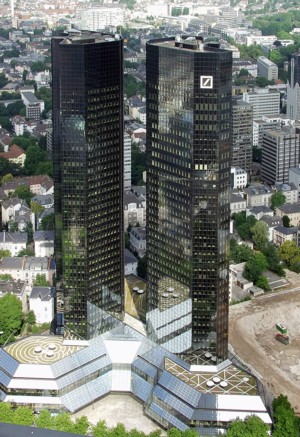
Deutsche Bank Towers in Frankfurt am Main

What Is the Use of banks?

Turning debt into money

The previous episode about money discussed some imaginary trades between you, a hatter, a lawyer, a barber and a fisherman. It is shown that if people promise to pay this might suffice for payment. So if the fisherman promises you to pay next week for the hat you just made, you could say to the lawyer that you expect the fisherman to pay in a week, and ask her if you can pay in a week too. The lawyer could then ask the same of the barber and the barber could ask the same of the fisherman. If all these debts cancel out then no cash is needed.

In most cases, debts cannot be cancelled out so easily. A hat may cost € 50, legal advice € 60, a hairdo € 30, and the fish € 20. If you are the hatter, you could lend € 10 to the barber and the lawyer could lend € 20 to the fisherman. Perhaps the lawyer doesn’t trust the fisherman because he smells fishy. But if the lawyer trusts the barber and the barber trusts the fisherman then the lawyer could lend € 20 to the barber and the barber could lend € 20 to the fisherman.

That could become complicated quite easily. And this is where banks come in. Banks can lend money because they know the financial situation of their customers. The fisherman can borrow money from his bank to make payments because the bank knows that he has an unstable but good income and a vessel that can be sold for cash if needed.

If the fisherman borrows money to pay for the hat you made, this money ends up in your account. You can use it to pay the lawyer. And so the fisherman’s debt becomes the lawyer’s money until she uses it to pay the barber. People that have a deposit lend money to the bank and the bank is lending this money to those who have a loan, in this case, the fisherman. Depositors trust the bank even though they do not know the people the bank is lending money to.

Most people think of money as coins and banknotes but more than 90% of the money just exists as bookkeeping entries in banks. When a fisherman borrows money from his bank, he can spend it on a hat. This means that the bank creates money and that this money is debt. Most of our money is debt so the value of money depends on the belief that debtors pay back their debts. This seems scary and it keeps quite a few people awake at night.

Some people argue that debts and banking are frauds because they are based on a belief. But banks and debts help to boost trade and production by creating money that doesn’t exist to start businesses that don’t yet exist to make products which will be bought by the people those businesses will hire with this newly created money. Banking and debts are the basis of the capitalist economy.

Banking as bookkeeping

Banking is more or less just bookkeeping and balance sheets. Balance sheets can be used to explain the magic trick banks do, which is creating money. Balance sheets are simple. There are no intimidating formulas, only additions and subtractions. The important thing to remember with balance sheets is that the total of the amounts on the left side must always equal those on the right side.

On the left is the value of your stuff and your money. On the right side is the value of your debts. Your net worth is what remains when you sell all your stuff and pay off your debts. It is on the right side too in order to make it equal to the left side. Your net worth can be a negative value. If that is the case, you might be bankrupt because you can’t repay your debts by selling your assets. The left side is named debit and the right side is called credit. Your balance sheet might look like this:

debit
 
credit
 
house
€ 100,000
mortgage
€ 80,000
other stuff
€ 50,000
other loans
€ 30,000
cash, bank deposits
€ 20,000
your net worth
€ 60,000
total
€ 170,000
total
€ 170,000

When you buy a car, you own more stuff, but also another loan or fewer bank deposits as you have to pay for the car. This is because debit always equals credit. When you drive the car, it goes down in value, as does your net worth, because debit always equals credit. If your salary comes in, your bank deposits as well as your net worth rise because debit always equals credit. If you pay down a loan, the amount in your bank account, as well as the amount of your loan, goes down because debit always equals credit. If debit doesn’t equal credit then you have made a calculation error.

Also for a bank, the total of the amounts on the left side must always equal those on the right side, so that debit always equals credit. Your debt is on the debit side of the bank’s balance sheet. You have borrowed this money from your bank. The bank owns this loan. Your bank deposits are on the credit side of the bank’s balance sheet. The loans of the bank are paid for by deposits. Banks lend money to each other. This may happen when you make a payment to someone who has a bank account at another bank. Your bank may borrow this money from the other bank until another payment comes the other way. The balance sheet of a bank may look like this:

debit
 
credit
 
mortgages and loans
€ 70,000,000
deposits
€ 60,000,000
loans to other banks
€ 10,000,000
deposits from other banks
€ 20,000,000
cash, central bank deposits
€ 10,000,000
the bank’s net worth
€ 10,000,000
total
€ 90,000,000
total
€ 90,000,000

How banks create money

Banks create money. How do they do that? It is easy if you understand balance sheets. Assume that you, the hatter, the lawyer, the barber, and the fisherman all have € 10 in cash. Together you decide to start a bank. You all bring in the € 10 you own so that you all have a deposit of € 10 and the bank has € 40 in cash. The bank allows everyone to withdraw deposits in cash. This is no problem as long as the total of deposits equals the total amount of cash. After everyone has put in the deposit, the bank’s balance sheet looks as follows:

debit
 
credit
 
cash
€ 40
your deposit
€ 10
  
deposit lawyer
€ 10
  
deposit barber
€ 10
  
deposit fisherman
€ 10
total
€ 40
total
€ 40

First, there was only € 40 in cash. Now there are € 40 in bank deposits too. You might think that the bank created money. Only, that isn’t true because the depositors can’t spend the cash unless they take out their deposits. In other words, the depositors don’t have more money at their disposal than before. If you look at the total, there is still € 40. This is bookkeeping. You have to write down the total twice as debit must equal credit.

But now things are going to get a bit wild. The fisherman comes to you and he wants to buy a hat. The hat costs € 50 but the fisherman has only € 10 in his account. To make the sale possible, the bank is going to do its magic. The fisherman calls the bank and asks if he can borrow some money. The bank grants him a loan of € 40 and puts the money in his deposit account so that he can spend it. And look:

debit
 
credit
 
cash
€ 40
your deposit
€ 10
loan fisherman
€ 40
deposit lawyer
€ 10
  
deposit barber
€ 10
  
deposit fisherman
€ 50
total
€ 80
total
€ 80

Who says that miracles can’t happen? The deposits miraculously increased from € 40 to € 80 so € 40 is created from thin air. There is still only € 40 in cash but the fisherman’s debt created new money. This is how banks create money. And that is only because bank deposits are money. This is all there is to it. So much for the mystery. The fisherman then pays € 50 for the hat. And so it becomes your money:

debit
 
credit
 
cash
€ 40
your deposit
€ 60
loan fisherman
€ 40
deposit lawyer
€ 10
  
deposit barber
€ 10
  
deposit fisherman
€ 0
total
€ 80
total
€ 80

And now comes the dreadful part that keeps some people fretting. Everyone can take out his or her deposits in cash. There are € 80 in deposits and only € 40 in cash. If you go to the bank and demand your € 60 in cash, the bank would go bankrupt, even when the fisherman pays off his loan the next day. You could bankrupt the bank by buying € 50 in fish with cash. If you go to the bank to get € 50 in cash it would not be there so the bank would go bankrupt before the fisherman can pay off his loan with the same cash.

A bank could get into trouble in this way even when debtors repay their debts. Clever minds already figured out a solution. Central banks can print money too. If the European Central Bank (ECB) prints € 20 on a piece of paper and lends this money to the bank, there would be enough cash to pay out your deposit. Banning the use of cash and only using bank deposits for payments would be another option. So, after the ECB deposited € 20 in cash, the bank’s balance sheet might look like this:

debit
 
credit
 
cash
€ 60
your deposit
€ 60
loan fisherman
€ 40
deposit lawyer
€ 10
  
deposit barber
€ 10
  
deposit fisherman
€ 0
  
deposit ECB
€ 20
total
€ 100
total
€ 100

After you pay the fisherman, he can pay off his loan, and the bank will have enough cash to pay out all deposits. The bank can repay the central bank and everything is fine and dandy again. In this case the bank could not meet the demand for cash but the value of cash and loans wasn’t smaller than the deposits (the bank’s debt). After the fisherman pays back his loan and the bank pays back the ECB, the bank’s balance sheet might look like this:

debit
 
credit
 
cash
€ 40
your deposit
€ 10
loan fisherman
€ 0
deposit lawyer
€ 10
  
deposit barber
€ 10
  
deposit fisherman
€ 10
  
deposit ECB
€ 0
total
€ 40
total
€ 40

If banks can’t create money, trade would be difficult. If the hat is € 50, the legal advice € 60, the hairdo € 30, and the fish € 20, and you, the lawyer, the barber and the fisherman all have only € 10, nothing can be bought or sold. If the bank lends € 40 to the fisherman, he can buy a hat from you, you can buy legal advice from the lawyer, the lawyer can buy a hairdo and the barber can buy fish. Debt is the basis of the capitalist economy. Nearly all money is debt, and without debt, the economy would come to a standstill.

How much money can banks create?

The amount of money a bank can create is limited by the bank’s capital, which is the bank’s net worth. Regulations stipulate that banks should have a minimum amount of capital. This is the capital requirement. If the capital requirement is 10%, and the bank’s capital is € 10,000,000, it can lend € 100,000,000, provided that there are enough deposits. If the bank makes a loan, a new deposit is created. If the deposit leaves the bank, the bank must borrow it back from another bank or cut back its lending. That is because debit must always equal credit.

debit
 
credit
 
mortgages and loans
€ 70,000,000
deposits
€ 60,000,000
loans to other banks
€ 10,000,000
deposits from other banks
€ 20,000,000
cash, central bank deposits
€ 10,000,000
the bank’s net worth
€ 10,000,000
total
€ 90,000,000
total
€ 90,000,000

When a deposit leaves the bank, it ends up at another bank. The other bank can use it for lending, provided that it has sufficient capital. There may be a reserve requirement, which is a minimum of cash and central bank deposits the bank must hold. If the reserve requirement is 10%, the bank can lend out as much as ten times the amount of cash and central bank reserves it has available. In the past, reserve requirements were important as people often used cash and could go to the bank to demand their deposits in cash. For that reason banks needed to hold a certain amount of cash.

Featured image: Deutsche Bank building CC BY-SA 4.0. Raimond Spekking. Wikimedia Commons. Public Domain.

Coin hoard

What is money?

Why do we have money?

Money was invented because trade would be difficult without it. For example, if you are a hatter in need of legal advice, then without money, you have to find a lawyer who craves a hat. That is unlikely to happen. Maybe there is a fisherman dreaming of a hat, but he can’t give you legal advice. Maybe there is a lawyer in need of a hairdo instead of a hat. With money, all these problems disappear like magic. You can buy the services of the lawyer so that she can go to the barber. After that, the barber can buy some fish so that the fisherman can buy a hat from you.

Despite these mind-blowing advantages humans didn’t need money for a long time because they lived in small bands and villages where everyone depended on each other and everyone helped each other. This meant, for example, that when a fisherman needed a hat, you would make a hat for him, and if you needed anything, someone else would provide it to you. You did someone a favour so that he or she was obliged to do something back. Villagers produced most of what they needed themselves. Trade with the outside world was limited and was done with barter.

Uses of money

Later cities, kingdoms and empires emerged. People living in cities, kingdoms and empires didn’t know each other so it became difficult to track whether or not everyone was contributing. Favours and obligations didn’t suffice. They were replaced by a formal system for making payments and tracking contributions and obligations. Commerce and tax collection needed a means of payment as well as administration. It is therefore not a coincidence that writing and money were invented around the same time in the same area. The earliest writings were bookkeeping entries. Money has the following uses:

  • buying and selling stuff (payment) so money is a medium of exchange
  • saying how much something is worth, so money is a unit of account
  • keeping track of contributions and obligations (saving and borrowing) so money is a store of value.
catdog
Nickelodeon character CatDog

Money being a medium of exchange as well as a store of value is like your pet being a cat as well as a dog. The result is not really a success. The parts of the pet may often quarrel, for example, because the dog part wants to play while the cat part wants to sleep. If someone keeps some money for a rainy day and does not spend it, others cannot use this money for buying stuff. And this can be a problem. A simple example can explain this.

Imagine that everyone decides to save all his or her money. Nothing would be bought or sold anymore. All businesses would go bankrupt and everybody would be unemployed. All the money that has been saved would buy nothing because there isn’t anything to buy anymore. This is a total economic collapse.

In reality, it doesn’t get that bad as people always spend on basic necessities like tablets and mobile phones, and perhaps food. When people only spend money on necessities there is an economic depression, which is not as bad as a total economic collapse but still very bad. Saving can make you poorer, but only when there are too many savings already. Savings are used to invest in businesses and hire workers to make products and services. Only if there are more savings than investments, does money remain unused.

The value of money

Money has no value when there isn’t any stuff to buy or when there aren’t any other people to trade with. Imagine that you get the offer to be dropped alone on a remote and uninhabited island in the Pacific with 10 million euros. Probably you would decline the deal, even if you can keep your mobile phone. It is other people and stuff that give money its value. But how? The answer is remarkably simple. The value of money is just a belief.

People are willing to work for money and sell their stuff for money. And because others do this, you do the same. For example, you may think that euro notes have an appalling design as well as an unpleasant odour, but nevertheless, you desire to own them because other people want them too. The euro’s value is based on the belief that other people accept euros for payment.

This is just a belief as the following example demonstrates. Suppose that you wake up one day to hear on the news that the European Union has been dissolved overnight. Suddenly you may have second thoughts about your precious stockpile of foul-smelling unstylishly decorated euro banknotes.

You may ask yourself in distress whether or not your precious bank notes still have any value. What is the value of the euro without the European Union? You may find yourself hurrying to the nearest phone shop in an effort to exchange this pile of banknotes for the latest model mobile phone.

And to prove this point even further, suppose that the phone shop gladly accepts your euros. Suddenly they become desirable again and you may start to have second thoughts about that latest model you are about to buy. It may not remain hip for much longer, so you may change your mind again and prefer to keep your precious euros because there may be a newer model next month. So, because the shop wants your euros, you wants them too.

Types of money

At first, money was an item that people needed or desired. Grain was one of the earliest forms of money. Everybody needed food so it was easy to make people believe that others accept grain for payment. In prison camps during World War II cigarettes became money because they were in high demand. Even non-smokers accepted them because they knew that other people desired them very badly. For that reason, cocaine can be money too.

Wares like grain, cigarettes and cocaine have disadvantages. They degrade over time so they aren’t a very good store of value. This makes them a great medium of exchange because people won’t save them. An example can demonstrate this. Imagine that apples are money and you want to buy a house. A house costs 120,000 apples but your monthly salary is just 2,500 apples of which you can save 1,000. It takes 10 years of saving to buy a house. Soon you will discover that apples rot and that you will never be able to buy a house. Then you will spend all your apples right away.

Saving is difficult with apples. This is where gold and silver come in. Gold and silver do have not much use, but humans were always attracted to shiny stuff. Gold is rare so a small amount of gold can have a lot of value because some people feel a strong desire for shiny stuff. Gold and silver coins can be made of different sizes and purity so that they are suitable for payment and can be used as a unit of account.

More importantly, gold and silver do not deteriorate in quality like apples, grain or cigarettes. They do not even rust after 1,000 years. This makes gold and silver an excellent store of value. But this should make us suspicious. A perfect cat makes a lousy dog so a perfect store of value can fail the test for being a good medium of exchange. People can store gold and silver so that there is less money available for buying and selling stuff. And this can cause an economic depression as we have seen.

Governments create money too, for example by printing “10 euro” on a piece of paper. Governments require by law that this money should be used for payments and taxes. This makes people believe that others accept this money too. Government money is called fiat currency or simply currency. The authority of a government is limited to the area it controls so in the past government currencies had little value outside the country itself unless this money consisted of coins containing gold or silver.

In fact, another reason why gold and silver are attractive as money is that the value of gold and silver does not depend on the authority of a government. This made gold and silver internationally accepted as money. In the 19th century, most government currencies could be exchanged for a fixed amount of gold. This is the gold standard. The gold standard boosted trade because gold was internationally accepted as money.

Most money is debt

Debts can have value and so debts can be money too. This may seem strange or even outrageous, but money is just a belief. For example, money is the belief that you can exchange a hat for money and then exchange this money for legal advice. Hence, if you believe that the debtor is going to pay, you can accept his or her promise to pay as payment. And if others believe this too, you can use this promise to pay someone else.

So if the fisherman promises you to pay next week for the hat you just made, you could say to the lawyer that you expect the fisherman to pay in a week, and ask her if you can pay in a week too. The lawyer could then ask the same of the barber and the barber could ask the same of the fisherman. If all debts cancel out then there is no need for cash. Most of the money we currently use is debt. In most cases, debts don’t cancel out and there are many more people involved so it would be complicated to keep track of all debts and savings. That is where banks come in.

Featured image: Close up of coin hoard CC BY-SA 2.0. Portable Antiquities Scheme from London, England (2010). Wikimedia Commons.

Other images: Nickelodeon character CatDog, Sméagol character from The Lord of the Rings [copyright info]

Joseph interpreting the Pharaoh's dream

Joseph in Egypt

Money with a holding fee existed in ancient Egypt for over 1,500 years. Egypt had storehouses of grain run by the state. Grain was the primary food source for the Egyptians. When farmers came with their harvest, they would get a receipt telling how much they brought in and on what date. A baker could return the receipt and exchange it for grain after paying for the storage cost and loss due to degradation.

The origins of the grain storage remain unclear. The government collected taxes in kind, thus a portion of the harvest, and had to store it. The government storage probably proved convenient for farmers as they didn’t have to keep and sell their grain, which was a significant convenience. And it made sense to have a public grain reserve in case the harvests failed.

The Egyptians used these receipts as money, as grain was a commodity everyone needed. Because of the storage costs, the receipts gradually lost value. With this kind of money, you might have interest-free loans. Someone in possession of this money who likes to save it will lose by storing it and can keep his capital intact by lending it without interest. There is no evidence that this happened.

The grain storage relates to a story in the Bible. It is fiction but might tie money with a holding fee to the Abrahamic religions. As the story goes, the Pharaoh had dreams his advisers couldn’t explain. He dreamt about seven lean cows eating seven fat cows and seven thin and blasted ears of grain devouring seven full ears of grain.

Joseph explained those dreams to the Pharaoh. He told the Pharaoh that seven years with good harvests would come, followed by seven years with crop failures. He advised the Egyptians to store food. They followed his advice and built storehouses for grain. In this way, Egypt survived the seven years of scarcity (Genesis 41):

When two full years had passed, Pharaoh had a dream: He was standing by the Nile when out of the river, there came up seven cows, sleek and fat, and they grazed among the reeds. After them, seven other cows, ugly and gaunt, came up out of the Nile and stood beside those on the riverbank. And the cows that were ugly and gaunt ate up the seven sleek, fat cows. Then Pharaoh woke up.

He fell asleep again and had a second dream: Seven heads of grain, healthy and good, were growing on a single stalk. After them, seven other heads of grain sprouted–thin and scorched by the east wind. The thin heads of grain swallowed up the seven healthy, full heads. Then Pharaoh woke up; it had been a dream.

In the morning, his mind was troubled, so he sent for all the magicians and wise men of Egypt. Pharaoh told them his dreams, but no one could interpret them for him. Then, the chief cupbearer said to Pharaoh, ‘Today I am reminded of my shortcomings. Pharaoh was once angry with his servants, and he imprisoned me and the chief baker in the house of the captain of the guard.

Each of us had a dream the same night, and each dream had a meaning of its own. Now, a young Hebrew was there with us, a servant of the captain of the guard. We told him our dreams, and he interpreted them for us, giving each man the interpretation of his dream. And things turned out exactly as he interpreted them to us: I was restored to my position, and the other man was hanged.’

So Pharaoh sent for Joseph, and he was quickly brought from the dungeon. When he had shaved and changed his clothes, he came before Pharaoh. Pharaoh told Joseph, ‘I had a dream, and no one can interpret it. But I have heard it said of you that when you hear a dream you can interpret it.’ ‘I cannot do it,’ Joseph replied to Pharaoh, ‘but God will give Pharaoh the answer he desires.’

Then Pharaoh said to Joseph, ‘In my dream, I was standing on the bank of the Nile, when out of the river there came up seven cows, fat and sleek, and they grazed among the reeds. After them, seven other cows came up–scrawny and very ugly and lean. I had never seen such ugly cows in all the land of Egypt. The lean, ugly cows ate up the seven fat cows that came up first. But even after they ate them, no one could tell they had done so; they looked just as ugly as before. Then I woke up.

‘In my dreams I also saw seven heads of grain, full and good, growing on a single stalk. After them, seven other heads sprouted–withered and thin and scorched by the east wind. The thin heads of grain swallowed up the seven good heads. I told this to the magicians, but none could explain it to me.’

Then Joseph said to Pharaoh, ‘The dreams of Pharaoh are one and the same. God has revealed to Pharaoh what he is about to do. The seven good cows are seven years old, and the seven good heads of grain are seven years old; it is one and the same dream. The seven lean, ugly cows that came up afterwards are seven years old, and so are the seven worthless heads of grain scorched by the east wind: They are seven years of famine.

‘It is just as I said to Pharaoh: God has shown Pharaoh what he is about to do. Seven years of great abundance are coming throughout Egypt, but seven years of famine will follow them. Then, all the abundance in Egypt will be forgotten, and the famine will ravage the land. The abundance in the land will not be remembered, because the famine that follows it will be so severe.

The reason the dream was given to Pharaoh in two forms is that the matter has been firmly decided by God, and God will do it soon. ‘And now let Pharaoh look for a discerning and wise man and put him in charge of the land of Egypt.

Let Pharaoh appoint commissioners over the land to take a fifth of the harvest of Egypt during the seven years of abundance. They should collect all the food of these good years that are coming and store up the grain under the authority of Pharaoh to be kept in the cities for food. This food should be held in reserve for the country, to be used during the seven years of famine that will come upon Egypt, so that the country may not be ruined by the famine.’

The plan seemed good to Pharaoh and to all his officials. So Pharaoh asked them, ‘Can we find anyone like this man, one in whom is the spirit of God?’ Then Pharaoh said to Joseph, ‘Since God has made all this known to you, there is no one so discerning and wise as you. You shall be in charge of my palace, and all my people are to submit to your orders. Only with respect to the throne will I be greater than you.’ So Pharaoh said to Joseph, ‘I hereby put you in charge of the whole land of Egypt.’

During the seven years of abundance, the land produced plentifully. Joseph collected all the food produced in those seven years of abundance in Egypt and stored it in the cities. In each city, he put the food grown in the fields surrounding it. Joseph stored up huge quantities of grain, like the sand of the sea; it was so much that he stopped keeping records because it was beyond measure.

The seven years of abundance in Egypt came to an end, and the seven years of famine began, just as Joseph had said. There was a famine in all the other lands, but in the whole land of Egypt, there was food. When all of Egypt began to feel the famine, the people cried to Pharaoh for food. Then Pharaoh told all the Egyptians, ‘Go to Joseph and do what he tells you.’

When the famine had spread over the whole country, Joseph opened these storehouses and sold grain to the Egyptians, for the famine was severe throughout Egypt. All the countries came to Egypt to buy grain from Joseph because the famine was severe in the whole world.

The story further tells how the Egyptians became the serfs of the Pharaoh (Genesis 47):

There was no food in the whole region because the famine was severe. Both Egypt and Canaan wasted away because of the famine. Joseph collected all the money found in Egypt and Canaan as payment for the grain they were buying and brought it to Pharaoh’s palace.

When the money of the people of Egypt and Canaan was gone, all of Egypt came to Joseph and said, ‘Give us food. Why should we die before your eyes? Our money is used up.’ ‘Then bring your livestock,’ said Joseph. ‘I will sell you food in exchange for your livestock since your money is gone.’

So they brought their livestock to Joseph, and he gave them food in exchange for their horses, their sheep and goats, their cattle and donkeys. And he helped them through that year with food in exchange for all their livestock.

When that year was over, they came to him the following year and said, ‘We cannot hide from our lord that since our money is gone and our livestock belongs to you, there is nothing left for our lord except our bodies and our land.

Why should we perish before your eyes–we and our land as well? Buy us and our land in exchange for food, and we, with our land, will be in bondage to Pharaoh. Give us seed so we may live and not die, and the land may not become desolate.’

So Joseph bought all the land in Egypt for Pharaoh. The Egyptians, one and all, sold their fields because the famine was too severe for them. The land became Pharaoh’s, and Joseph reduced the people to servitude from one end of Egypt to the other.

Joseph told the people, ‘Now that I have bought you and your land today for Pharaoh, here is seed for you so you can plant the ground. But when the crop comes in, give a fifth of it to Pharaoh. The other four-fifths you may keep as seed for the fields and as food for yourselves and your households and your children.’

‘You have saved our lives,’ they said. ‘May we find favor in the eyes of our lord; we will be in bondage to Pharaoh.’ So Joseph established it as a law concerning land in Egypt -still in force today- that a fifth of the produce belongs to Pharaoh.

A settlement of storage costs took place when someone brought in the receipts. The receipts gradually lost value over time to cover the storage cost. It was similar to buying stamps to keep the money valid, like in Wörgl. The grain money remained in circulation after the introduction of coins around 400 BC until the Romans conquered Egypt around 40 BC. The grain money survived for over 1,500 years. It was not a financial crisis that ended it, but the Roman conquest. It suggests a holding fee on money or negative interest rates can be the basis of a stable financial system that lasts for eternity.

Finally, there is a wisdom that we can easily overlook. Storing food makes more sense than saving money, even when you make losses on the storage. Today, the weather grows increasingly unpredictable due to global warming, so massive harvest failures become increasingly likely. Storing food makes more sense than ever in a time when people cling to money more than ever, and there is only enough food in storage to feed humanity for a few months. It doesn’t require a rocket scientist to figure that Joseph’s advice to the Pharaoh to store food for meagre times makes more sense than ever.

Latest revision: 13 January 2024

Featured image: Joseph interpreting the Pharaoh’s dream. Illustrations for La Grande Bible de Tours. Gustave Doré (1866). Public Domain.