Building a Nation with Religion

Israel emerging

The Jews started as tribal people in Canaan, the area currently covered by Israel and Palestine. For a long time, the area was under Egyptian control. The earliest known reference to Israel is on an Egyptian stone engraving from around 1200 BC. It lists the enemies the Pharaoh Merneptah defeated during his campaigns. Among them was Israel, which had revolted against its Egyptian overlords. The engraving lacks detail. There was no state of Israel, so quite possibly the uprising was no more than a few skirmishes with local hill dwellers. However, the Egyptians had already called the land Israel, named after the principal local deity, El, so the tribes living there had their own distinct religious beliefs.

Around 1150 BC, Egypt faced droughts, food shortages, civil unrest, corruption, and court intrigues. This period is known as the Late Bronze Age Collapse. Similar crises in neighbouring civilisations led societies to turn inwards and focus on local issues. Egypt retreated from Canaan. Setbacks at home were the reason the Egyptians gave up Canaan, which was an insignificant border province to them, filled with unruly hill dwellers who caused nothing but trouble. It was a footnote in Egyptian history, nothing more. The Egyptians, who had been there for centuries, suddenly went home,1 leaving the Israelites a victory they had not fought for. The locals may have viewed it as a miracle and came to suspect that their favourite deity, El, or perhaps Yahweh, had done some magic. Poof. The Egyptian army, which had been there for centuries, had suddenly vanished due to setbacks at home.

Stories retold grow more sensational over time, so the Bible now tells us that God sent seven devastating plagues to Egypt, and appointed a fellow named Moses to lead the Israelites out of Egypt, under the guidance of an irate and fiery cloud, split the Red Sea, drowned the Egyptian army and let the Israelites escape. The Song of the Sea (Exodus 15:1-18) could be the oldest text in the Bible, together with the Song of Deborah, and it mentions the drowning of the Egyptian army in the Red Sea. The song seems much older than the rest of Exodus, and it doesn’t mention Moses. Scholars disagree on whether the account has a historical basis, and therefore, also the song. It could date back to the Babylonian captivity 600 years later. In that case, the author used archaic language in the Song of the Sea to make it appear older. That would require the author to have knowledge of ancient Hebrew, which seems a stretch. Likely, parts of the song are ancient.

It took several centuries for new civilisations to take over, creating room for small local polities in Canaan until that time. Several small kingdoms emerged, including Israel and Judah. These petty kingdoms existed for a few centuries until new imperial powers overran the area. At first, the Israelites worshipped several gods and goddesses, among them Yahweh. Archaeological finds indicate that El was the supreme deity in the Canaanite belief system. The goddess Asherah was his wife.2

They were the parents of the other Canaanite deities, Baal, Anat, Yahweh, and Yam. Asherah is Yahweh’s mother and El his father. El was often depicted as a bull and was also known as Shor-El, the bull god. And so, we have the highly peculiar situation that half the world’s population now worships one of the children of El and Asherah, two deities of an insignificant tribe living somewhere between the more advanced civilisations of Egypt and Mesopotamia 3,000 years ago, as the supreme God who rules the entire universe. That might have been a hilarious observation if people hadn’t been murdering each other in the millions for their delusions.
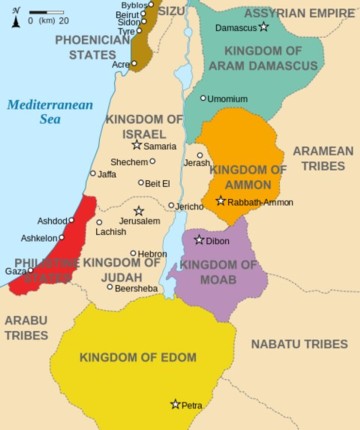
Map of Canaan from around 750 BC

States and kings used religion to justify themselves. It matters whether a powerful entity like a god or a goddess supports the state and the king, for only the stupid and the suicidal defy the gods. The kings of Judah, and perhaps also those of Israel, promoted a national religion centred around Yahweh. Other kingdoms in the region also adopted national deities. Milcom was the deity of Ammon, while Moab had Chemosh to defeat its foes and supply the country with blessings (1 Kings 11:33).

Yahweh thus became the deity of the state religion in Judah and possibly Israel. Many in the area also worshipped other gods alongside Yahweh, as having multiple options is prudent. If Yahweh forsakes you, perhaps Baal or some other deity will still assist you. The Bible testifies to tensions between those who still worshipped different gods and goddesses alongside Yahweh and those insisting on worshipping Yahweh alone. As Yahweh had become the favourite deity of the Israelites, El became the word for ‘god’, and Asherah became Yahweh’s wife.

Writing the Bible

As time passed by, new empires arrived on the scene and set their eyes on Canaan. The Assyrians overran Israel in 720 BC. The Babylonians conquered Judah in 597 BC, following their takeover of the Assyrian Empire. The Babylonians deported many of the Judeans. Others fled to Egypt. It was the beginning of the diaspora. The Jewish communities in Egypt, Babylon, and Judah became dispersed. The authors of the Jewish Bible tried to reconnect them by showing that they belonged to a larger group, a nation with common ancestors. Judah already had religious writings. They became part of the Bible. The Jewish Bible became a compilation of tales from these communities and the royal archives of the former kingdom of Judah. The Jewish Bible presents the history of Israel and Judah from the perspective of the Kingdom of Judah.

After the Persians had conquered the Babylonian Empire, the Persian emperor Cyrus the Great allowed the Jewish people to return to Canaan. He commissioned the rebuilding of the Jewish temple. Those still living in the area were not keen on a group of religious zealots entering their country. They opposed the plan, and a political struggle unfolded. After seven decades, Ezra and Nehemiah succeeded in rebuilding the temple. Jewish society was on the brink of being wiped out. Israel and Judah no longer existed. The remaining Jews were mixing with the surrounding population. Jewish leaders had to find a way to keep their people together. Marrying outside the community became frowned upon, and the Jews became a seclusive group. That has caused them a great deal of trouble in the centuries that followed.

The authors of the Jewish Bible sought to preserve Jewish identity through a shared religion, history, and cultural heritage. The Jewish religion gradually became monotheistic. At the time, Zoroastrianism, a dualistic religion, became the official religion in the Persian Empire. The prophet Zoroaster believed in a good creator and an opposing evil power. And it had considerable influence. It brought Judaism monotheism, messiahs, free will, heaven, hell, and, of course, that horned fellow named Satan. Zoroastrianism not only affected Judaism. Some Greek philosophers around 400 BC were also monotheists.

The polytheist origin of the Jewish religion may explain why God says in Genesis, ‘Let us make mankind in our image, in our likeness.’ Later, the Jews became henotheists. They believed that other gods existed, but that they should worship only Yahweh. That is why the commandment says, ‘You shall have no other gods before me’ rather than ‘You shall believe there is only one God.’ Yahweh was jealous and didn’t appreciate offerings to other gods, such as Baal. Several texts in the Jewish Bible have that henotheist perspective.

The Jews wrote most of their scriptures between 600 BC and 300 BC, but there are older parts that date back to the royal archives of Judah. The Ketef Hinnom amulets are the oldest surviving evidence of texts that are now part of the Jewish Bible. They date back to 600 BC. So, before the Jews went into exile to Babylon, they already had an established religion with scriptures. And that later helped them maintain their Jewish identity. The Song of Deborah is one of the oldest texts in the Bible, dating back to the 12th to 10th century BC. Only, the Song of the Sea might be older. Little evidence supports the historical account in the Jewish Bible of the period before the kingdoms of Judah and Israel. However, that doesn’t mean that all these stories are entirely fictional.

Scholars believe David may have been the king of Judah, rather than the king of a united kingdom, as the Jewish Bible states. Based on archaeological excavations, experts have estimated that Jerusalem had around 1,000 inhabitants at the time David supposedly lived, suggesting that Jerusalem was a minor regional centre rather than the capital of a larger kingdom. However, archaeologists have also uncovered a 9th-century BC stone engraving with the lettering BYTDWD in northern Israel, possibly referring to the House of David. Another engraving found in the former kingdom of Moab contains the same lettering. That could raise questions, such as whether a larger kingdom existed.

Creating a nation

Whether or not it was fiction, the authors of the Jewish Bible employed the concept of a united kingdom to foster unity among people originating from Israel and Judah. A shared history united the inhabitants of Israel and Judah, as well as their offspring, into one great nation. The purpose of the Jewish Bible was to establish the Jewish nation based on a shared history and religion. That can be a reason to imagine a united kingdom that once existed. If you go back in time to before the kingdoms of Israel and Judah, the history of the Jews becomes murky. No written records exist from these times. The tales about Abraham, Isaac, and Moses may have originated from different communities, merged into a single narrative to promote a single Jewish identity.1 To make the proposition more attractive, the Jews believed they were the chosen people.

The survival of the Jewish people has been hanging by a thread for a long time. They were a small nation between great powers. They hoped for a Messiah who would save them from oppression, just as Moses had once done. Great powers came and went, but the Jewish people remained. After more than 2,500 years, the Jews are still around, so their nation-building project proved a successful long-term survival strategy. They managed to reclaim their original homeland. It is also remarkable that Judaism stood at the cradle of Christianity and Islam. The Jews have played a central role in world history, unmatched by any other nation. It is an impressive feat, considering their numbers. Today, Jews have an imposing power, and they slay their enemies at will. So, what do they need a Messiah for?

Historical analysis

How do historians and scholars look at the Jewish Bible? Apart from the lack of archaeological evidence, they find the early Jewish history in the Jewish Bible too neat to be correct. It presents an agreeable genealogical line extending from Abraham to Isaac to Jacob, who had twelve sons who, coincidentally, became the twelve tribes of the nation. The number twelve has religious significance, so the facts must have undergone some religiously inspired processing. Jacob and his family went to Egypt during Joseph’s days. Later, Egypt began to oppress the Israelites, and they escaped under the leadership of Moses. The Egyptians kept records, and they tell nothing about the Exodus. The reason is probably not that the Egyptian defeat was too embarrassing.

After Moses’ death, the story goes, Joshua took over and led the Israelites into the Promised Land. Following the death of Joshua, a series of judges took over. They governed Israel and saved it from its enemies. Each judge came from a different tribe, which is also unbelievably neat. It smells like fiction. Then Saul, Israel’s first king, was not up to his task, so David replaced him. The kingdom fell apart into two after the death of Solomon, David’s successor. From then on, the descendants of David ruled only in the south, thus in Judah. The northern part, called Israel, had several dynasties.

Many of the people described in the Jewish Bible may have once lived. Probably, they had very little to do with each other. The authors of the Jewish Bible compiled them to create a unified history of Israel. Abraham was probably not Jacob’s father, Moses was not Miriam’s brother, and David was not Saul’s successor. They may have figured in local tales from tribes and petty kingdoms that later became part of the Jewish nation. The stories in the Jewish Bible originate from several sources and have been revised and retold multiple times throughout the centuries. And the stories have undergone some religiously inspired processing. Think of God sending plagues to Egypt because the Pharaoh took Sarah as his wife. The Jewish Bible is a nation-building project rather than a historical account.1

Textual analysis

It might be interesting to see how scholars analyse the texts to understand biblical history and arrive at their conclusions. Professor Jacob Wright explained the basics using the example of Genesis 26 to illustrate how the authors of the Jewish Bible have woven the story of Isaac and Rebecca into the broader historical narrative of Israel.1 Biblical scholars attempt to uncover the construction process of the texts by examining various sources within biblical texts, including additions and other editing techniques. Genesis 26 tells the story of Isaac living in the Philistine land of Gerar, located west of Judah.

Isaac’s wife, Rebecca, was a beautiful woman. When his neighbours asked Isaac about Rebecca, he claimed she was his sister, so Isaac followed Abraham’s footsteps. Isaac feared the Philistine men in Gerar would kill him and take his beautiful wife. One day, Abimelech, the king of the Philistines, gazed out his window and spotted Isaac and Rebecca making out. He demanded an explanation. Abimelech feared one of his subjects might have slept with her, which could make his kingdom subject to divine retribution.

Abimelech then issued a decree stating that whoever touched Isaac or his wife would be put to death. Rebecca would become one of the matriarchs, a crucial figure in Israel’s history. Isaac prospered among the Philistines and eventually became mightier than them. Everywhere Isaac went in the waterless environs of Abimelech’s kingdom, he discovered water wells. His success aroused jealousy among local inhabitants. That amount of luck captures the imagination like Gladstone Gander’s in a Donald Duck tale.

Instead of fighting for his territories, Isaac moved on and ended up in Beer-Sheba in the south. Abimelech visited Isaac there. The Philistine king blessed him. Isaac invited him to a feast. After eating and drinking all night long, they exchanged oaths of peace. Later that day, Isaac’s servants discovered another water source, in yet another stroke of unbelievable luck. Isaac named this well Beer-Sheba, referring to his treaty with the Philistines. The story served a political agenda, which was to demonstrate that Beersheba was part of Israel.

A closer look at Genesis 26

Genesis 26 contains two kinds of material, which are the story about Isaac’s clan and how he came to possess towns in the far south and Beer-Sheba, and the broader narrative of the book of Genesis, which links this story with the other parts of Genesis to make it a coherent history of the nation. There are multiple ways of looking at the text. Hence, different scholars may come to different conclusions. One way of viewing Genesis 26 is as follows, with the parts that link the story into a broader narrative underlined:

1 Now there was a famine in the land, besides the previous famine in Abraham’s time, and Isaac went to Abimelek, king of the Philistines, in Gerar. 2 The Lord appeared to Isaac and said, ‘Do not go down to Egypt; live in the land where I tell you to live. 3 Stay in this land for a while, and I will be with you and will bless you. For to you and your descendants I will give all these lands and will confirm the oath I swore to your father Abraham. 4 I will make your descendants as numerous as the stars in the sky and will give them all these lands, and through your offspring all nations on earth will be blessed, 5 because Abraham obeyed me and did everything I required of him, keeping my commands, my decrees and my instructions.’

6 So Isaac stayed in Gerar. 7 When the men of that place asked him about his wife, he said, ‘She is my sister,’ because he was afraid to say, ‘She is my wife.’ He thought, ‘The men of this place might kill me on account of Rebecca because she is beautiful.’ 8 When Isaac had been there a long time, Abimelek king of the Philistines looked down from a window and saw Isaac caressing his wife Rebecca. 9 So Abimelek summoned Isaac and said, ‘She is really your wife! Why did you say, ‘She is my sister’?’ Isaac answered him, ‘Because I thought I might lose my life on account of her.’ 10 Then Abimelek said, ‘What is this you have done to us? One of the men might well have slept with your wife, and you would have brought guilt upon us. 11 So Abimelek gave orders to all the people: ‘Anyone who harms this man or his wife shall surely be put to death.’

12 Isaac planted crops in that land and the same year reaped a hundredfold because the Lord blessed him. 13 The man became rich, and his wealth continued to grow until he became very wealthy. 14 He had so many flocks and herds and servants that the Philistines envied him. 15 So all the wells that his father’s servants had dug in the time of his father Abraham, the Philistines stopped up, filling them with earth. 16 Then Abimelek said to Isaac, ‘Move away from us; you have become too powerful for us.’

17 So Isaac moved away from there and encamped in the Valley of Gerar, where he settled. 18 Isaac reopened the wells that had been dug in the time of his father Abraham, which the Philistines had stopped up after Abraham died, and he gave them the same names his father had given them. 19 Isaac’s servants dug in the valley and discovered a well of fresh water there. 20 But the herders of Gerar quarrelled with those of Isaac and said, ‘The water is ours!’ So he named the well Esek because they disputed with him. 21 Then they dug another well, but they quarrelled over that one also; so he named it Sitnah. 22 He moved on from there and dug another well, and no one quarrelled over it. He named it Rehoboth, saying, ‘Now the Lord has given us room and we will flourish in the land.’

23 From there, he went up to Beersheba. 24 That night, the Lord appeared to him and said, ‘I am the God of your father Abraham. Do not be afraid, for I am with you; I will bless you and will increase the number of your descendants for the sake of my servant Abraham.’ 25 Isaac built an altar there and called on the name of the Lord. There he pitched his tent, and there his servants dug a well.

26 Meanwhile, Abimelek had come to him from Gerar, with Ahuzzath his personal adviser and Phicol the commander of his forces. 27 Isaac asked them, ‘Why have you come to me, since you were hostile to me and sent me away?’ 28 They answered, ‘We saw clearly that the Lord was with you; so we said, ‘There ought to be a sworn agreement between us’—between us and you. Let us make a treaty with you 29 that you will do us no harm, just as we did not harm you but always treated you well and sent you away peacefully. And now you are blessed by the Lord.’ 30 Isaac then made a feast for them, and they ate and drank. 31 Early the next morning, the men swore an oath to each other. Then Isaac sent them on their way, and they went away peacefully. 32 That day, Isaac’s servants came and told him about the well they had dug. They said, ‘We’ve found water!’ 33 He called it Shibah, and to this day, the name of the town has been Beersheba.

34 When Esau was forty years old, he married Judith, daughter of Beeri the Hittite, and also Basemath, daughter of Elon the Hittite. 35 They were a source of grief to Isaac and Rebecca.

The first five verses are part of the larger narrative, except for the first part of verse 1. In verse 6, the story itself starts. Abraham comes up in verses 15 and 18. The intervention of the Lord in verses 24 and 25 is also part of the larger narrative. The mention of Esau at the end is part of the encompassing story. That raises the question of where Jacob and Esau were all that time. They were adults at the end of Genesis 25. One explanation is that Genesis 26, without the underlined parts, was once a separate story.

The stories about their sons, Jacob and Esau, seem wrapped around the story of Isaac and Rebecca and their dealings with the king of the Philistines. In this way, the authors created a larger narrative. Genesis 25 contains the story about the birth of Esau and Jacob and how Esau sold his birthright to Jacob. That story resumes at the end of Genesis 26. In Genesis 27, Jacob deceived his father into giving him his blessing with the help of his mother. These interweaving narratives come from different sources.

One is the P-source or priestly source. It tells an independent story of Israel. The authors merged it into the narrative. According to the P-source, Jacob didn’t flee from Esau because of stealing the birthright but because he was in danger of a mixed marriage. The P-source describes how Esau married a Hittite woman and how Rebecca asked Isaac to send Jacob away so he would find a woman who would not make her life miserable.

There is an older account of Isaac and Rebecca and how they came to possess Beersheba. Around it is wrapped a story of their children, where Isaac is the son of Abraham and the father of Esau and Jacob. Another small story tells how Rebecca sent Jacob off to find wives from her own family. Another source tells us how Jacob stole his birthright from his brother Esau. The authors of the Jewish Bible thus wove an older story and two other sources into a broader narrative.1

Theories from scholars

The P-source is a late source from after the exile in Babylon. It deals with Israel’s identity and its relationship to others. Mixed marriages outside the Jewish people became a huge issue after the defeat of Judah. Marrying within the clan or nation helped to maintain a community defined by a shared culture. Therefore, the marriages of Esau to Hittite women caused Rebecca concern.

Another source is the Jahwist source, also dubbed J-source. A part of Genesis 25 comes from the J-source. It tells about the birth of Jacob and Esau. It continues in Genesis 27 and 28, where Jacob stole Esau’s birthright and pursued the deal with the help of his mother, Rebecca. Jacob then had to flee from Esau. According to the J-source theory, the J-source has incorporated an older source into the broader narrative. Later, the P-source altered the reason why Jacob had to flee.

The formation of the earliest sources, the histories of Israel, whether it be the history of Israel’s ancestors and the lives of Abraham, Isaac, and Jacob, or the exodus leaving Egypt and the conquest of the land, is built upon the linking of stories. The authors brought separate individual representatives of clans together in a larger narrative to create the idea of a Jewish nation. Many scholars believe that the first chapters of the Jewish Bible, known to Jews as the Torah, comprise four distinct sources.1

Countless authors have contributed to the Jewish Bible over the centuries. The Bible even reveals how a book came into existence. King Josiah had commissioned artisans to work on the Temple, where they ‘discovered’ the Book of Law (2 Kings 22:8), probably Deuteronomy. Likely, King Josiah had ordered the writing of the book to advance his political agenda of centralising the worship of Yahweh in the Temple of Jerusalem. That could increase his standing as a king. And so, these artisans stumbled upon this work that had supposedly been gathering dust there for centuries.

Much of the writing and editing took place to serve purposes other than accurately presenting the facts, so you can’t expect that the Jewish Bible is an accurate account of historical events. There is more to say about scholarly research into the Jewish Bible. For our purposes, this brief explanation is sufficient. It illuminates how the first chapters of the Jewish Bible, which describe Israel’s earliest history, evolved and how scholars interpret the texts to arrive at their conclusions. Likewise, scholars attempt to reconstruct the origins of the Gospels, as that is an even greater mystery.

Latest revision: 5 December 2025

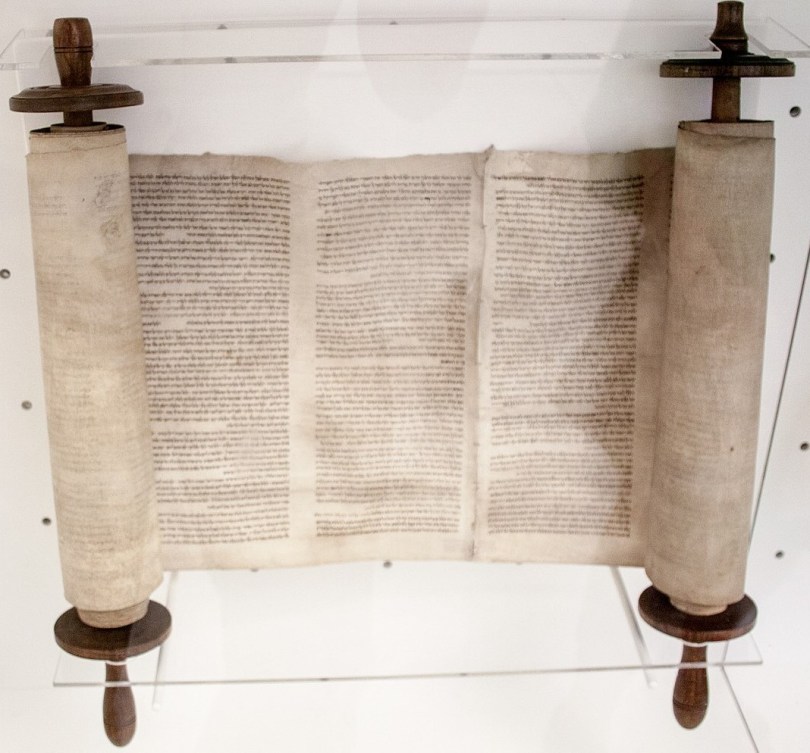
Featured image: Torah scroll (public domain)

1. The Bible’s Prehistory, Purpose, and Political Future. Wright, Jacob L. (2014). Coursera.
2. El the God of Israel-Israel the People of YHWH: On the Origins of Ancient Israelite Yahwism. In Becking, Bob; Dijkstra, Meindert; Korpel, Marjo C.A.; et al. Only One God?: Monotheism in Ancient Israel and the Veneration of the Goddess Asherah. Dijkstra, Meindert (2001).
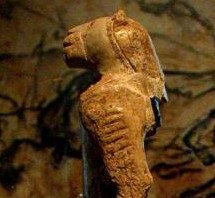
Lionheaded figurine from Stadel in the Hohlenstein cave in Germany

On The Origin of Religions

We, humans, have become the dominant species on Earth. That is because we collaborate flexibly in large numbers. Social animals, such as monkeys and dolphins, work together flexibly but only in small groups. Ants and bees cooperate in large numbers but only in fixed ways. Language enables our large-scale, flexible collaboration. Some animals use signs and calls or give each other names, but we use far more words.1 That allows us to cooperate in more ways and for a wide range of purposes. Language allows us to make and communicate agreements. And we can describe things in detail. We can write, ‘Please read these safety instructions carefully before using model T92.’ Then follow many pages of instructions. Butterflies don’t observe a written list of safety instructions before leaving their cocoons like NASA does when launching a spacecraft. That is why butterflies have never landed on the Moon.

We are also imaginative creatures. We imagine things into existence. We envision laws, money, property, corporations, social classes and states. We imagine that there is a law, and that is how the law works. In other words, we envision the law, and lo and behold, it exists. The same is true for money and corporations. We humans say, ‘Let there be corporations.’ And lo and behold, there are corporations. Only humans do that. No other species envisions money and corporations. I can’t give a dog a debit card to go to the supermarket to buy dog food. A dog lacks the imagination for that. A dog can’t think of money, laws and corporations. And so, you can’t make dogs work together in a corporation to produce dog food by paying them money. Our fancifulness existed long before civilisations emerged. Archaeologists uncovered a 32,000-year-old sculpture of a lion’s head upon a human body. These lion-men only existed in the imagination of humans.

We are also religious creatures. We cooperate using myths. People of the same religion can go on a holy war together. Faith can also motivate people to engage in charitable work and provide for the poor. Religions promote social stability by justifying the social order and promising rewards in the afterlife for those who support it. As societies grew more stratified, the elites, such as kings and priests, tried to justify their existence and lavish lifestyles, and why peasants had to toil. And so, creation myths emerged, explaining that the gods created humans to work the ground. Established religions were often schemes to exploit peasants. You can’t let a dog submit to you by saying obedient hounds will go to heaven and enjoy everlasting bliss after they die, and unruly canines will be fried forever in a tormenting fire. A dog lacks the imagination to even think of it, let alone believe it. We have a religious nature. We make up stories and believe in them. We are social beings and need a group to survive. Beliefs hold groups of humans together, so it is a matter of survival to believe in our own imagination

Small bands of people cooperate because their members know each other and see what everyone contributes. In larger groups, that becomes more difficult as people can cheat. That is where states, money, and religions come in. They facilitate collaboration between strangers, allowing us to operate on a larger scale. States do so by coercion, money by trade, and faith by inspiration. As there has always been a survival-of-the-fittest-like competition between societies, those who cooperated most effectively survived and subjugated others. Religions forge bonds and help maintain peace within a group, or inspire group members to go to war. Religions played a crucial role in the survival of humans. If believing means surviving, it is rational to have faith, regardless of how curious the belief may be. It is in our nature to be religious, and usefulness rather than correctness is the essence of religion. And so, it is better to view a religion not as a set of lies, but as something people agree on to believe in, which helps them to cooperate and survive.

We make up stories and believe them. Hollywood films featured reptiles disguised as humans. Since then, some people have claimed that reptiles live among us disguised as humans. You can see how we can go collectively crazy in this way. When we retell stories, they change. We forget parts of a tale, add new elements or alter their meaning. And so beliefs and religions evolve. The evolution of religions has been a process in which ideas emerged and interacted. Early humans were hunter-gatherers who believed that places, animals, and plants possessed awareness, feelings, and emotions. They asked them for favours, like ‘Please, river, give me some fish.’ Hunter-gatherers felt they were more or less on an equal footing with the plants and animals around them.1 Animism is the name for these beliefs. These beliefs were local and concerned visible objects like a tree or a mountain. Over time, people began to imagine invisible entities like fairies and spirits. A crucial step in the development of religions was ancestor veneration.

The first humans lived in small bands based on family ties. Their ancestors bound them together. And so, they began to venerate the dead. It was a small step to imagine that the spirits of the dead are still with us and that our actions require the approval of our late ancestors. Ancestor veneration made it possible to envision a larger-scale relatedness in the form of tribes. A tribe is much larger than a band. The belief that its members share common ancestors holds a tribe together. Tribes are too large to identify their common ancestors, so tribespeople imagined their ancestors, and the stories about them are myths. The Romans started as a tribe. They had a myth about their founders, Romulus and Remus. As the tale goes, a she-wolf raised them. Tribes are much larger and can muster more men for war. That is why tribes replaced bands. It helps when people attribute magical powers to their ancestors and fear the consequences of angering them. In this way, ancestor veneration turned into the worship of gods. The previous beliefs didn’t disappear completely. Many people still believe in ghosts.

Hunter-gatherers can move on in the event of conflict, but farmers invest heavily in their fields, crops, and livestock. Losing their land, animals, or harvest meant starvation. With the arrival of agriculture, property and territorial defence became paramount. States defend their territory and can afford larger militaries. Kinship is an obstacle as states enlist the people within their realm, regardless of family ties. States thus needed a new source of authority, and the worship of gods replaced ancestor veneration. When humans subjugated plants and animals for their use, they needed to justify this new arrangement. Myths emerged in which the gods created this world and ordained that humans rule the plants and animals. In Genesis, God says, ‘Rule over the fish in the sea and the birds in the sky and over every living creature that moves on the ground.’ (Genesis 1:28) Most of the world’s major religions originated in agricultural societies.

Religions emerged from ancestor worship. And so, gods could be like mothers and fathers. People gave devotion to several ancestors. Each ancestor had a specific admirable quality. Consequently, early religions featured multiple gods and goddesses, each with a distinct role. That is called polytheism, which is the belief in several gods. Henotheist religions emerged later when people became emotionally attached to one particular deity. Henotheism is the belief that multiple gods exist, but that we should worship only one of them. Even polytheists can believe there is a supreme being or principle. However, that supreme being is indifferent to our concerns, so it doesn’t make sense to direct prayers to it in the hope of receiving help. The gods, being on a lower level, have desires, so we can befriend them by making offerings, polytheists believed.1

The next step is monotheism, or believing there is only one God. Monotheists believe that there is only one God who rules the universe. Monotheistic religions were successful because monotheists, most notably Christians and Muslims, have missionary zeal. They believe that God craves our worship. Converting others is an act of mercy, as unbelievers will end up in hell. The worship of other deities is an offence to monotheists. After all, it contradicts their belief that there is only one God worthy of infinite adoration. Failing to take action against the unbelievers could anger God. Polytheists are less likely to feel offended when some choose to worship just one of the many deities or invent a new one.

In the first centuries AD, Christianity replaced the worship of local deities. To help pagans accept Christianity, the Church replaced these deities with saints, who often had the same purpose, and took over existing holidays. Each saint had specific qualities, just like the previous deity. In Ireland, St. Brigid of Kildare replaced a Celtic goddess with the same name. Both occupy themselves with healing, poetry, and smithcraft, and their feast day, 1 February, is the same, which is not a coincidence. And so, polytheism didn’t disappear entirely, as Christians continued to pray to saints. The Church also took over the Roman holiday commemorating the winter solstice, which was on 25 December. It turned pagan rites to celebrate the rebirth of the Sun into a Christian feast commemorating the birth of Christ.

Monotheism comes with a few logical difficulties. We hope that God cares for us and answers our prayers. However, prayers are often not answered, and bad things are happening. So, how can an almighty Creator allow this to happen? The obvious answer is that there is no god, or God doesn’t care. That is not what we want to hear. And so people imagined Satan, God’s evil adversary, who makes all these bad things happen.1 And we hope that the people we hate receive punishment, if not now, then in the afterlife or a final reckoning on Judgement Day. Religions cater for our sentiments, a psychologist might say.

In modern times, Europeans developed ideologies, such as liberalism, socialism, and fascism, which, like moral philosophies, describe how we should live. These ideologies are much like religions. They have prophets, holy books, missionary zeal, and preachers. The prophets of communism were Marx and Lenin. They had theologians who explained their writings. The communists had public holidays, such as 1 May, and heresies like Trotskyism. The Soviet army units had chaplains to oversee the faithfulness of the troops, although the Soviets named them as people’s commissars. The communists further expected an end time, the proletarian revolution, after which they would enter Paradise, world communism. A fanatic missionary zeal further characterised Soviet communism.1 And so, communism is much like a religion. The foundations of the ideologies of liberalism and socialism are the Christian values of freedom and equality. Fascism developed from nationalism, and the struggle for survival in nature inspired Nazism, which helped to make it especially cruel.

After the Middle Ages, educated Europeans began to doubt Christianity. The contradictions in the Scriptures began to attract attention. And then came the party pooper, Charles Darwin, who wrote On The Origin Of Species. Plant and animal species are the outcome of a struggle for survival. Despite the frantic efforts of religious people to fiddle with the facts, the evidence continued to mount. Religions exist because we invent stories to promote cooperation, and that contributes to our success, not because there is an invisible fellow in the sky. But human imagination reigns supreme. We live in such a universe created by an advanced humanoid civilisation. That already happened. We live in such a universe. And so there is a God after all.

Latest revision: 23 September 2025

Featured image: Lion-headed figurine from Stadel in the Hohlenstein cave in Germany.  J. Duckeck (2011). Wikimedia Commons.

1. A Brief History Of Humankind. Yuval Noah Harari (2014). Harvil Secker.

A society on pillars

Identity groups building society

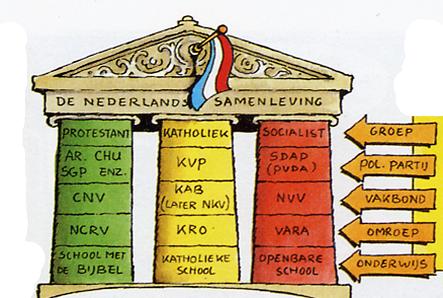
Dutch society long centred around identity groups based on religion or ideology. The Dutch call it pillarisation. A pillar is vertical, so it encompasses several social classes. Social life was within your identity group, and you had few contacts with outsiders. These pillars had sports clubs, political parties, unions, newspapers, and broadcasters. Roman Catholics and Protestants also had schools and hospitals.

The pillars of Dutch society were Protestant, Roman Catholic, and Socialist, with each about 30% of the population. The Protestants themselves consisted of smaller groups that had their specific views on the Bible. The remaining 10% of the Dutch were liberal. The liberals were less organised and opposed pillarisation, but they also had political parties, newspapers and broadcasters.

Strong communities are close-knit, have shared norms and values based on ideology or religion, and come with social obligations. The pillar organisations focused exclusively on their communities. Similar arrangements existed in other countries. In the Netherlands, none of these groups dominated society. And the shared Dutch identity and the state made these relationships cooperative. In other words, Dutch society was built on pillars.

The Dutch were famous for their tolerance, which was at times close to indifference. The identity groups accepted each other and minded their own affairs. After 1800, there was no civil war in the Netherlands, nor was there a threat of one at any time. Leadership played a significant role. The leaders of the pillars were willing to compromise, and the members merely followed their leaders, guaranteeing peaceful relationships within society for two centuries.

Still, identity issues dominated Dutch politics from time to time. On 11 November 1925, the cabinet fell when the Catholic ministers resigned after Parliament accepted an amendment introduced by a small Protestant fraction to eliminate the funding for the Dutch envoy with the Vatican. A Protestant government fraction supported the amendment.

None of the identity groups on its own was able to dominate society. Instead, they had to make deals with each other. On religious issues, Roman Catholics and Protestants found each other. For instance, they arranged that schools and hospitals could have a religious identity and that the state would fund them like public schools and hospitals. The Socialists made deals on working conditions and social benefits with Catholics and Protestants.

Pillarisation in the Netherlands began to take shape at the close of the nineteenth century. One could say that Dutch society was built upon the pillars. They allowed groups with different views and cultures to coexist peacefully and gradually integrate. From the 1960s onwards, the pillars began to lose their meaning, and the Dutch became one nation. Pillarisation can be helpful if you believe in a shared destiny, for instance, the nation-state, but have different backgrounds that prevent integration in the short term. In this sense, it works like multiculturalism.

Pillarisation can be helpful if people believe in a shared destiny, for instance, the nation-state, but do not share a common background. In that case, everyone can live and work together with the people they feel comfortable with. Cultural and religious differences may subside over time. But as long as these identities remain distinct, people can organise themselves accordingly via pillars, and in doing so, avoid conflict.

Latest update: 19 May 2023

Fat cat

Mystery of Being

Why is there something rather than nothing? We may never know. If gods created us, we may learn one day why. Still, that doesn’t explain why these gods exist. Perhaps the gods don’t know either. Coincidence and evolution explain why there are humans, but not why there is a universe. The odds appear stacked against us being here, so we might see our existence as a miracle and think this universe is there for us. However, had humans never arrived on the scene, no cat or fern would have wondered why it exists. Once you reverse the argument, you can see what is wrong with it.

My existence depends on my parents having met. Had my father not broken his leg during a soccer game, he might not have met my mother, who was a nurse in the local hospital. Or, my mother might have had a headache on the night I would otherwise have been conceived. My parents’ existence, in turn, depends on countless accidental actions of the many generations before them. If one of my forebears had slept ten minutes longer on 16 September 1455, I might not exist.

The number of incidents that could have prevented my existence is infinite. Yet, despite the near-zero odds, I exist. If the purpose of the universe were to create me, that must be a miracle. But why isn’t this universe made for that fat grey cat sneaking through my garden or a particular fern growing in the forest? The chance of their existence is as low as yours. Similarly, the chances of humans appearing when dinosaurs were still roaming and of living creatures emerging here on Earth when the galaxy started were also negligible.

In a similar vein, some argue that it is unlikely that this universe emerged by chance. The laws of physics and the values of physical constants appear designed for life to exist. It is the same type of error: thinking that my existence is a miracle. If the universe didn’t support life, we wouldn’t be there to notice it. A rabbit doesn’t ponder these questions, yet the existence of rabbits is as great a miracle as our existence. And how do we know the physical constants and natural laws that support life? And how does that rule out chance? There could be an infinite number of universes with different laws and constants. And this universe might support life by accident.

Intelligent design proponents claim that evolutionary processes lack the intelligence to design something as complex as a human being. And so, life on Earth requires an intelligent Creator. Indeed, the chance of life to emerge in the way it did was close to zero from the outset, and still, we are here, as are ferns and octopuses. Scientific findings indicate life on this planet had four billion years to develop. Given ample time, the possibilities are endless, and anything could happen. Competition, or the struggle for survival, is a force that promotes complexity but has no intelligence.

Humans have messed things up and turned this world into a wasteland. Humans are the outcome of competition between species. Competition always ends in disaster, and in the case of natural selection, it is humans. This world would be a much better place without them. No intelligent designer would design humans unless this individual seeks the praise of the created beings, desires to see their vain endeavours fail, or wants to save us from our stupidity in the nick of time by sending a saviour, as that makes a good story. So, if there is a Creator, this individual is likely humanoid, so the simulation argument makes sense. Our failure is so complete that you might wonder whether this world is real. We can’t be such a failure, or can we? Indeed, you can be right for the wrong reasons.

This world could be a simulation. Our ego stands in the way of seeing the truth, and it is the reason why we are a failed species. Pride is our road to destruction. The mystery of being is not much of a mystery. It is merely that a fool can ask more questions than a thousand sages can answer. If the possibilities are infinite, everything that ever happened once had a near-zero chance of transpiring. However, something had to happen, and that is what occurred. If there is no Creator, this world would still make perfect sense. It is our ego that tells us we are unique and special, so our existence is a miracle that requires a brilliant Creator who is infinitely wise and all-knowing. It doesn’t mean that there isn’t a Creator. After all, we could live inside a simulation modelled after the real world.

Latest revision: 28 October 2025

The Virtual Universe

Some religions claim that God or gods have created this world. In the Bible, God created everything by saying, ‘Be.’ That God uttered ‘Be’ and poof, there are bees, is not a particularly compelling explanation for the existence of bees. So, how could the gods have the magical powers to do that? Until recently, we had no clue, but then Nick Bostrom, known for his dry and incomprehensible employment of words, delivered us the simulation hypothesis, the most profound breakthrough in theology in nearly 2,000 years. We might exist inside a computer simulation run by an advanced humanoid civilisation. Our creators can define a class bee and instruct the computer to create instances of this class. A class has properties, allowing individual instances to be unique.

And so, Genesis might be closer to the truth than the religion sceptics think. Bostrom didn’t say whether or not that is indeed the case or how likely it is. He didn’t speculate on that issue. Otherwise, his critics might have a field day, ridiculing him for opening a back door to the paranormal and religion. That could have been the end of his career. However, it is easy to find out if you venture into areas that scientists anxiously avoid, such as paranormal incidents, religious experiences, meaningful coincidences, people’s memories of past lives, ghost phenomena, and UFO sightings.

Scientists dare not investigate these phenomena, as it could make them a laughing stock in front of their peers. That is groupthink and intellectual cowardice on a grandiose scale. On numerous occasions, multiple credible witnesses have observed events that science can’t explain. Like nearly everyone else, scientists have been proficient at ignoring evidence that contradicts their beliefs, such as unscientific ravings about spirits relaying messages from the other side during seances. Bostrom speculated that this world might be a virtual reality, but didn’t search for proof. As a philosopher, he had better things to do.

The book The Virtual Universe delves into the evidence. You can prove this universe is a virtual reality if you assume scientists have correctly established the laws of nature and that sciences like physics, chemistry and biology are correct. If events transpire that defy these laws of science, such as paranormal incidents, religious miracles, meaningful coincidences, memories of previous lives, ghost phenomena and UFO sightings, breaches in these laws occur. According to science, the Virgin Mary doing a miracle before a crowd of thousands, like in Fatima, is impossible. If science is correct, and it happens nonetheless, this world must be fake. The book The Virtual Universe puts it like this:

  1. If we live in a real universe, we can’t notice. Virtual reality can be realistic and come with authentic laws of reality.
  2. This universe may have fake properties, but we cannot notice that either because we don’t know the properties of a genuine universe.
  3. Breaching the laws of reality is unrealistic in any case. If it happens, we may have evidence of this universe being fake.

It follows from (1) and (2) that we can’t use the universe’s properties, reflected in the laws of nature, to determine whether or not this universe is real. Science can establish the laws of physics or the properties of this universe, but science can’t tell whether they are real or fake. However, if breaches occur, we have evidence suggesting this universe is bogus. The book The Virtual Universe investigates the evidence, which includes stories about paranormal incidents, religious experiences, meaningful coincidences, reincarnation stories, ghost phenomena, and UFO sightings, often with multiple credible witnesses. So yes, aliens can beam you up into their UFO because they are as fake as you are.

Advanced humanoids, often dubbed post-humans, likely share motivations with us because they evolved from humans, likely after some engineering, genetic, or otherwise. These advanced humanoids may run simulations of human civilisations for research or entertainment. Research applications could be about running what-if scenarios. Possible entertainment applications include games or dream worlds where someone’s imagination comes true. These simulations may not be realistic in some aspects, as they reflect the rules of a game or someone’s personal fantasies. In a simulation, you can let Jesus walk over water and make him think that faith alone suffices to do that.

Civilisations are complex. Small changes can derail events that would otherwise occur. Just imagine another sperm had won the race to Adolf Hitler’s mother’s egg. There were millions of sperm in that race. Guaranteeing an outcome, such as letting World War I end on a date referred to by the licence plate number of the car that drove Archduke Franz Ferdinand to his appointment with destiny, requires control over everything that happens. That doesn’t apply to games. Unpredictable developments make games more interesting. Considering how we utilise computing power, mainly for games, sexy pictures and cat videos, the number of simulations for entertainment likely vastly outstrips those run for research purposes. If we live inside a simulation, we should expect its purpose to be entertainment.

The owner or owners may use avatars to play roles in this world and appear like ordinary human beings to us. If you are familiar with computer games, you are familiar with avatars. Once you enter a game, you become a character inside that game, your avatar, and you have an existence apart from your regular life. Inside the game, you are your avatar, not yourself. Alternatively, you could start a virtual world where you are the Creator and bring your dreams to life. In this world, you also become someone else.

That is a lot of assumptions, and without evidence, they remain speculation. Even when there is evidence, it doesn’t necessarily mean the explanation is correct. Suppose you hear the noise of a car starting. That is the evidence. You may think there is an automobile starting. Perhaps a vehicle is firing up its engine. But your husband might be watching his favourite television series, Starting Engines, so you can’t be sure. Nothing you know contradicts your assumption, but you could be wrong. So, is God an individual from an advanced humanoid civilisation who uses us for amusement? It is credible, and perhaps nothing contradicts it. But who is to say it is correct?

Now comes the disagreeable part. We are instances of the class human. When the beings in the simulation think for themselves, that raises ethical questions like whether they have rights that the creators should respect. Considering how humans treat each other, it is not a given that these rights would be respected even when our creators acknowledge them. In the real world, bad things happen to people. In the case of control, the beings inside the simulation don’t think, but are mindless bots following the script. We have no independent will and are toys to our creators. God kills people at will, and a few million casualties more don’t matter. On the bright side, if God wants us to enter Paradise, where there is peace and happiness, nothing can stop that as well. Those who try will surely find themselves on the losing side. So, if the Boss makes a joke, you can better laugh. Perhaps it isn’t easy. But don’t worry. It took me fifteen years to look at the bright side of life.

Latest revision: 6 September 2025