There is a joke that goes like so. Teach a parrot to say supply and demand, and you have an economist. Economics is all about supply and demand. To understand the market economy, you should know the law of supply and demand. Not surprisingly, this is one of the most important laws in economics, even though this law is often wrong. This law states that the price is where supply and demand are equal. An example of the coffee market can clarify that.
If coffee is free, people might like to drink lots of coffee. But producers cannot make coffee for free. They go bankrupt if coffee is free because they have costs, for instance, employees and equipment. A price of € 3 per kilogramme may not cover all their expenses. Some producers can produce cheaper than others because they have more efficient production facilities. When the price is € 5, a few producers might make a profit and start making coffee.
That may not be enough to satisfy the demand that is out there. The low-cost producers have a limited production capacity. They may come up with 650 kilogrammes of coffee. Consumers might want to gobble up 1,700 kilogrammes if the price is only € 5 per kilogramme. In that case, there would be a shortage of 1,050 kilogrammes. Consumers who fear that they get nothing might offer more money, so the price of coffee rises.
When coffee becomes more expensive, some consumers might not be able to afford coffee. Others may buy less because they have other expenses like beer and milk. On the other hand, some producers can make a profit at this price and start producing. So when the price increases, supply goes up, and demand goes down.
At € 10 per kilogramme, every producer may make a profit, even those with high costs, and producers may come up with 2,000 kilogrammes. Consumers may only buy 600 kilogrammes because it is too expensive, resulting in a surplus of 1,400 kilogrammes. Producers may try to sell their surplus at lower prices before it gets spoiled to recover some of their costs. When prices are lower, consumers are willing to buy more. High-cost producers cannot make a profit and stop making coffee. So when the price decreases, demand goes up, and supply goes down.
The price may settle where supply equals demand. When the price is € 7, producers may make 1,200 kilogrammes, and consumers may gobble up 1,200 kilogrammes. So € 7 per kilogramme could be the price of coffee according to the law of supply and demand. The law often does not work as more issues play a role, but the law suffices for a basic understanding of markets. A graph can illuminate the discussion so far:
The graph shows the quantities of coffee demanded and supplied at different prices. When the price increases, demand goes down, and supply goes up. The downward-sloping black dashed line represents demand. The upward-sloping black line represents supply. If the price is low, the supply is small, and demand is high, leading to a shortage. At € 5, there will be a shortage of 1,050 kilogrammes as demand is 1,700 kilograms while supply is only 650 kilogrammes.
If the price is high, there is little demand and plenty of supply, leading to a surplus. If the price is € 10, there will be a surplus of 1,400 kilograms as supply is 2,000 kilograms and demand is only 600 kilograms. The lines of demand and supply cross at 1,200 kilograms and a price of € 7. Supply and demand match 1,200 kilograms, and € 7 is the price according to the law of supply and demand.
In reality, things often differ a lot from this simple model. There may be different qualities of coffee at their own price. In some markets, there is a lot of competition, and corporations hardly make a profit. Other markets lack competition, and corporations make huge profits. And there hardly ever is an equilibrium as the factors that influence supply, demand, and price constantly change. Nevertheless, simple examples like this one help to explain how a market economy works.
Featured image: Ara Economicus. Beverly Lussier (2004). Wikimedia Commons. Public Domain.
Until very recently nearly everyone lived in abject poverty. Most people had barely enough to survive. In 1651 Thomas Hobbes depicted the life of man as poor, nasty, brutish, and short. Yet a few centuries later a miracle had happened. Many people are still poor but more people suffer from obesity than from hunger while the life expectancy in the poorest countries exceeds that of the Netherlands in 1750, the richest country in the world in the wake of the Industrial Revolution.
In 1516 Thomas More wrote his famous novel about a fictional island named Utopia. Life in Utopia was nearly as good as in the Garden of Eden. The Utopians worked six hours per day and took whatever they needed. His book inspired writers and dreamers to think of a better world while leaving the hard work to entrepreneurs, labourers and engineers. Today many of us have more than they need but still we work hard and feel insecure about the future.
Why is that? The answer lies within the nature of capitalism. It is not enough that we just work to buy the things we need. We must work harder to buy more, otherwise businesses go bankrupt, investors lose money, and people will be unemployed and left without income. In other words, the economy must grow. That worked well in the last few centuries, and it brought us many good things, but it may be about to kill us now.
People in traditional cultures didn’t need much. They were easily satisfied. Many modern people in capitalist societies believe they never have enough. You can always go for a bigger house, a more expensive car, or more luxury items. Many of us do not need more but the advertisement industry makes us believe that we do. We believe in scarcity even when there is abundance. And so the economy must grow. That is what they tell us.
But what are the consequences of this belief? If you eat too much this is great for business profits. And if you become obese as a consequence and need drugs for that reason, you again contribute to business profits so this is even better. Meanwhile we are using the resources of this planet in a much faster pace than nature can replenish. Humanity is standing before the abyss. Civilisation as it is will not continue for much longer. The end is near.
What has this to do with interest? If we want more products and services, we need more businesses, so we need investments. To do investments, we need savings. And to make people save, we need interest to make saving attractive. Consequently investments need to be profitable to pay for the interest. But there can be too much of a good thing. If we don’t need more stuff, we don’t need more savings, and interest rates go down.
A sustainable and humane economy?
Is it possible for humanity to live in harmony with itself and nature? We work harder than ever before and in doing so we destroy life on this planet. It seems hard to change this. If you organise production differently then your products might not be sold at a price that covers the cost to make them. In a market economy the value of a product is the price it fetches in the market. Marketing often comes down to inflating the market price of a product or a service to make more profit.
In the past there have been two fundamentally different approaches to the economy. For instance, before Germany became united in 1990, there were a capitalist and a socialist Germany. Socialist Germany ensured that everyone was employed. People in socialist Germany had enough but they had little choice as to what products they could buy. For instance, in socialist Germany there were two kinds of yoghurt while there were sixty in capitalist Germany.
And there was little freedom in socialist Germany. The secret police were everywhere. When Germany became united the socialist economy collapsed. Socialist corporations suddenly were bankrupt because no-one wanted to buy the products they produced. The ensuing reorganisation of the economy led to mass lay-offs and a staggering rise in unemployment. Ultimately 60% of the jobs in the former socialist firms disappeared.
Many lives and communities in former socialist Germany were destroyed. And people suddenly felt insecure about their future as businesses had to compete and make a profit in order to survive. In a market economy efficiency considerations determine what is produced. These efficiency considerations are the result of customer preferences as well as the requirement to make a profit. Loss-making businesses usually can’t attract capital in a market economy.
The quest for efficiency results in fewer and fewer people producing the things we need. To keep everyone employed in a capitalist economy unnecessary products and services must be produced, causing a rapid depletion of scarce resources as well as lots of waste. At least in theory we work can a few hours per day so we have more time for our mobile phone and each other. It may also be possible to free up resources to address poverty and other social problems.
And what has this to do with interest? The profit a corporation is expected to make should be higher than the interest rate in the markets for money and capital. Because what’s the point in making the effort and taking the risk of running a business if you can get the same return on a savings account? And so it appears that with negative interest rates corporations with zero profits can survive and that the economy doesn’t need to grow.
Share of Labour Compensation in GDP at Current National Prices for United States
The road to inequality
Not so long ago an economist wrote a book that sent a shock-wave through the economic world because of stating a major cause of wealth inequality, which is that the return on capital usually is higher than the rate of economic growth. Capitalists reinvest most of their profits so capital usually grows faster than the economy most of the time. It can be proven beyond any doubt that capital can’t grow faster than the economy forever. Something will have to give at some point.
And what has this to do with interest? Interest is any return on capital. Interest income is the income of capitalists. That includes business profits and interest on bonds. The graph shows that labour income as part of the economy has diminished in recent decades in the United States. And that is because the capital share of national income has risen. In the past depressions and wars destroyed a lot of capital. Since 1945 there hasn’t been a serious depression or a world war.
The capitalist economy is like a game of monopoly. First everyone is doing great and capital is built in the form of housing and hotels. At some point some people can’t pay their bills anymore. To keep the game going, the winners can lend money to the losers. But at some point the losers can’t pay the interest any more. To keep the game going, interest rates must be lowered, so they can borrow more. But at some point some people can’t pay the interest again.
This happens in the real economy too. In a game of Monopoly we can start all over again. In the real economy that’s not an option. It would mean closing down factories in another great depression or destroying houses in another world war. So the game must continue. In Monopoly the rich can lend money at negative interest rates to the rest so that they can pay their bills. In the real economy this may be possible too.
Monopoly features a scheme that looks like a universal basic income. Every time you finish a round you get a fixed sum of money from the bank. At some point the bank may end up empty. The rich can then lend money to the bank at a negative interest rate to pay for it. It might seem a stupid thing to do because Monopoly is just a game. But the real economy is not. It may need an income guarantee for everyone financed by the rich.
An outline of the future economy
Can we have an economy that is humane and in harmony with nature? A few centuries ago no-one would have believed that we could live the way we do today and most people would have believed that it is more likely that unicorns do exist. If excess resource consuming consumption is to be curtailed, fewer options for consumers remain, for instance there may only be organic products, and supermarkets in the future might look a bit like those in former socialist Germany.
That may not be so bad. People in socialist Cuba live as long as people in the United States despite the United States spending more on healthcare than any other country in the world. Cubans eat no fast food so they live a healthier life style. And Cubans suffer less from a negative self image than people who are exposed to the advertisement industry. Advertisements aim to make us unhappy with ourselves and what we have in order to make us buy more products and services.
Like in former socialist Germany there isn’t much freedom in Cuba. If the government is to regulate the fat content in fast food or the sugar content in sodas then we lose our freedom to become obese. Alternatively, the government could even end our freedom to destroy life on this planet and kill our children. That may be oppression. But the alternative may be a collective suicide of humanity. Even though socialism failed we may have to pick the best parts out of it and integrate them into a market economy.
If the most resource consuming non-essential activities are to be axed, entire industries will be wiped out like in socialist Germany. One can think of making air travel sustainable and what that will with ticket prices. It is bad for economic growth. Many people would not like this. Still, life in a future sustainable market economy can be much more agreeable than life in Cuba or former socialist Germany.
So what has this to do with interest? A dramatic change to make the economy sustainable can cause a massive economic shock like the Great Depression. The economy can soon recover if interest rates can go negative. Before you say that it is more likely that unicorns exist, this has been tested during the Great Depression. The outcome is dubbed the Miracle of Wörgl. And evidence for the existence of unicorns has not yet been so forthcoming.
If interest rates are low then the creators of ideas and makers of things are rewarded more. They are the entrepreneurs and labourers rather than the owners of capital. It is in the spirit of Silvio Gesell who believed that labour and creativity should be rewarded and not the passive ownership of capital. Only when there is a shortage of capital or more demand for goods and services than there is supply, people need to be encouraged to save.
The economy is already constrained by a lack of demand rather than supply. That will be even more so when excessive consumption is to be curtailed and the rich have fewer options to spend their money on. And so it may become possible to fund an income guarantee with income taxes as well as negative interest on government debt. This can improve the bargaining position of labourers.
It is better to have an income guarantee rather than a universal basic income because that would be cheaper. There is little to gain from handing out money to people that already have enough. And the scheme should provide an incentive to work. A simple example can explain how that might work out. Assume there is an income guarantee of € 800 per month and a 50% income tax. The following table shows the consequences for different income groups.
Perhaps it doesn’t feel right that people are being paid for doing nothing. But nowadays people are paid for producing and selling things we do not really need and by doing so they endanger our future. Someone who does nothing at all can be worth much more for society than a travelling salesperson, a trader on Wall Street or a constructor who builds mansions for the rich. Of course it is better that people do something useful and useful people should be rewarded for their efforts, but doing nothing is always better than doing something stupid, and having zero value is always better than having negative value.
Another question is how this can be paid for? The Miracle of Wörgl shows us that the economy can flourish without growth when interest rates are negative so that most people will be employed. Money can still be a motivator to run a business or to go to work but less so than in the present. It doesn’t have to stop people from starting a business. Many entrepreneurs didn’t intend to become rich. They just wanted to be an entrepreneur or believed in the product they were making or selling. Still, there is no doubt whatsoever that a humane economy in harmony with nature will be very different from the economy of today.
Featured image: Slums built on swamp land near a garbage dump in East Cipinang, Jakarta Indonesia. Jonathan McIntosh (2004).
Other images: Share of Labour Compensation in GDP at Current National Prices for United States. FED. Public Domain
What is truth, and what is knowledge? Philosophers have been discussing these questions for thousands of years. It is the domain of knowledge theory, also called epistemology. It deals with truth, belief, and the justification of beliefs. It aims to answer questions such as: What do we know? What does it mean that we know something? And what makes beliefs justified? We usually acquire knowledge in two ways:
by induction, which is using observations to formulate general rules or theories, and
by deduction, which is applying those rules and theories to specific situations.
How does that work? Let’s give an example. After carefully investigating the records of people who have lived and still live, you conclude, with the help of induction, that people typically die before they reach 120. Using this rule and deduction, you infer you will die before the age of 120. That seems straightforward, but there are pitfalls, so philosophers continue to discuss these issues.
There is a difference between rules and theories. A rule is that if A occurs, B happens. A theory is that A causes B. If we can’t observe A, the theory assumes its existence. A then exists in our imagination. The explanation of electricity assumes the existence of electrons and their behaviour. We can’t see electrons, not even with a powerful microscope. We can do experiments to see how electricity behaves. We presume the conduct of electricity proves the existence of electrons, so experiments demonstrate their existence. It is like living in the dark and assuming that cows exist, even though we have never seen them. We have theorised that such animals say moo, so our hearing of moos proves the existence of cows. So if we hear moo, that must be a cow.
We are imaginative beings. Our knowledge involves imagination. We imagine electrons and gravity. Dogs can’t imagine electrons or gravity, so they can’t build electric cars or aeroplanes. Electrons and gravity may exist in our imagination, but they point at something real. Otherwise, objects wouldn’t fall to the ground, and we wouldn’t drive electric cars. This discussion of knowledge theory is a historical account. New ideas usually build upon previous thoughts. This treatise discusses Western philosophy. Western thinkers have been the most inquiring. As a result, the Scientific Revolution began in Europe. Science is the result of thinking, but it has also greatly influenced thought. It started with the ancient Greeks. What distinguished them from other traditions was their rational thinking.
Classical philosophy
Some 2500 years ago, Greek philosophers speculated about the nature of reality. Some claimed everything consisted of fire, water, earth and air. Later, a few philosophers argued that the building blocks of reality are small particles called atoms. These atoms differ in size and shape for different materials. The objects we see are groups of atoms stuck together. Democritus argued that the universe merely consisted of atoms in the void. That is already close to what we believe today. Speculation about the nature of reality, such as whether matter consists of atoms, is metaphysics.
Metaphysics is about how we perceive reality. We connect the dots in a particular way. It is our imagination. We can believe that everything consists of fire, water, earth and air, or we can think that atoms are the building blocks of everything around us. It was speculation because these atoms were invisible, and the Greeks had no microscopes to verify their existence. By assuming atoms exist and have different shapes and sizes, you can explain the presence of various substances. You can also do that by presuming everything consists of fire, water, earth and air. Only we find atoms more convincing.
The ancient Greeks also pondered other issues. Some figured that the Earth is a sphere. When you look at the sea, you see the horizon slightly curved, and boats disappear in the distance before their sails do. A philosopher named Xenophanes doubted religion. He realised that people believed that the gods were like themselves. Black people believed the gods were black, while red-haired people thought they were red-haired. Xenophanes claimed it was impossible to know the gods and how they looked. It was an early form of scepticism.
And why should you worship the Greek gods if the Persians and the Egyptians bow before other gods? If your birthplace determines your beliefs, your beliefs are likely false. The sophists were philosophers who had come into contact with different cultures. They claimed that absolute knowledge is impossible. Everything is subjective, they argued. This view is called relativism. Socrates is known for his dialogues in which he debated the sophists.
According to Socrates, there is absolute truth, even though we don’t know that truth. His pupil Plato later claimed that ideas are the basis of knowledge and that ideas, not objects, are the building blocks of reality. His view is called idealism. It relates to deduction. Plato’s pupil Aristotle asserted that knowledge comes from observation. His approach is called empiricism. It works like induction. Both methods come with problems. If you imagine a unicorn, you have the idea of a unicorn, and the idealist could claim unicorns exist. On the other hand, if you see a unicorn after eating some mushrooms, the empiricist could also say unicorns exist.
And so, knowledge can always be called into question. If no one has ever seen a unicorn, this isn’t definite proof of their non-existence. These creatures could still be hiding deep down in the forests. And perhaps eating mushrooms enhances your senses, allowing you to see things that would otherwise remain hidden. For that reason, scepticism emerged. There were two groups of sceptics. The first claimed that nothing is certain. They aimed to refute the claims of other philosophers. The second argued it is better to postpone judgment until the matter is sufficiently clarified.
These ideas revived in Europe in the late Middle Ages. It was after classical philosophers’ texts had turned up in Arab libraries. European philosophers like Thomas Aquinas and William of Ockham were also theologians. They believed that there was no difference between theology and science. Over time, science and religion went their separate ways. Their paths separated. Today, science requires empirical evidence, while religion doesn’t. Scientists test assumptions, such as the existence of electrons, with experiments that others can verify. In religion, evidence is often personal, such as most appearances of the Virgin Mary, and experiments like checking the answers to prayers never yield anything substantial.
The most obvious explanation is usually correct, or what occurs most often is most likely the case. If you see something flying in the sky, it probably isn’t Superman. And so, it is rational first to ask yourself, ‘Is it a bird? Is it a plane?’ Once you have ruled out these possibilities, you can conclude, ‘No, it is Superman!’ William of Ockham is known for his simplicity principle, Ockham’s Razor. It says the explanation with the fewest required assumptions is preferable. If what you prayed for comes to pass, you could check whether it might be a coincidence before claiming it is God answering your prayer. The latter requires God’s existence, and that this supposed infinitely powerful being, which rules billions of galaxies, listens to your particular request while ignoring countless others. In contrast, coincidence doesn’t require that many assumptions.
Modern philosophy
In 1492, Christopher Columbus sailed to America. Ancient sources, including the Bible, didn’t mention this enormous, lurking continent stretching from the North Pole to the South Pole. A little later, Nicolaus Copernicus claimed that the Earth revolved around the Sun rather than the other way around, which everyone believed until then. Traditional knowledge had failed dramatically. Copernicus had the luck of dying soon. The Catholic Church prosecuted Galileo Galilei for claiming Copernicus was right and the Bible was wrong.
At the same time, Protestants challenged the authority of the Catholic Church by making religion a personal matter. If you had reason to believe something, it could be correct. Religion is about your conscience rather than what the Church teaches. The number of issues on which we can disagree is infinite, so we have 45,000 branches of Christianity today. The ensuing religious wars ravaged Europe and ended without a clear winner.
And who was right? There can be only one truth. Merely believing something doesn’t make it true. However, questioning the existence of God was initially out of the question. European philosophers sought a rational foundation for religion, attempting to base it on verifiable claims, an effort known as deism. The project failed because it was impossible to establish the properties of the invisible fellow in the sky that everyone imagined.
The confusion spurred renewed scepticism and a new search for the foundations of knowledge. As philosophers from continental Europe, such as René Descartes, Gottfried Leibniz, and Baruch Spinoza, argued, our senses are deceptive. Therefore, only rational thinking can generate knowledge. This school is called rationalism, but it was a refurbished idealism.
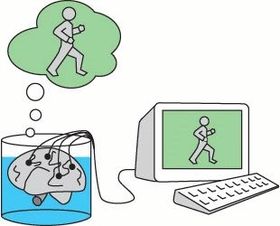
a brain in a vat believing itself to be a person who is walking
In a thought experiment similar to the brain-in-a-vat scenario, Descartes questioned everything the senses register. Your brain could be inside a vat filled with a life-supporting liquid and connected to a computer that generates the impression you are walking. What is beyond doubt, according to Descartes, is that you exist, even when you are just a brain-in-a-vat. And you can establish this fact through thinking. ‘I think, therefore I exist,’ he concluded.
Other philosophers from Great Britain, such as Francis Bacon, Thomas Hobbes, John Locke, and David Hume, argued that knowledge comes from observations. It was a renewed empiricism. A philosophical divide emerged between idealist continental Europe, most notably Germany and France, and empiricist Great Britain, and later the United States. The duck test is an example of pragmatist empiricism. It says that when something looks, quacks, and walks like a duck, it probably is a duck. It is not a coincidence that a US writer rather than a German philosopher invented it.
The divide affected moral philosophy and views about society. The empiricist view holds that ethical rules are whatever people agree on, thus reflecting society’s sentiments. The idealist vision is that morals are absolute and apply to everyone. Idealistic schemes to improve society, with religious claims to be the truth, such as Marxism, came from continental Europe. Pragmatic thinkers, including Adam Smith, the intellectual father of Capitalism, came from Great Britain or the United States. Smith attempted to describe what had happened and offer practical guidance on how to manage an economy.
It was an era marked by advances in the natural sciences. These advances were the result of thought. And the advances, in their turn, spurred thinking. It was the combination of observation and thought that led to scientific progress. You can investigate the effect of gravity on the motion of objects. You can do so by dropping an iron ball from a tower. You can release the ball from different heights and measure how long it takes for the ball to hit the ground. The table below contains the results of these measurements.
Height (in metres)
Time (in seconds)
0.05
0.10
0.50
0.32
1.00
0.45
5.00
1.01
10.0
1.43
50.0
3.19
It requires considerable thought to get the formula representing the relationship between height and fall time: fall time = 9.81 * √ (2 * height). For instance, 3.19 = 9.81 * √ (2 * 50.0). If the tower is only 50 metres high, you cannot measure how long it will take for the ball to fall from 100 metres. With the help of the formula, you can calculate the fall time without the need for measuring it: 9.81 * √ (2 * 100) = 4.52 seconds. It is the combination of observation and thinking that made this possible.
Finding the mathematical formula that matches the data is like solving a jigsaw puzzle. This method of reasoning is induction. It is establishing a general rule based on observations. You can never be sure the outcome is correct. Using your sightings and induction, you might conclude that all swans are white. And if you go to the Moon to drop an iron ball from a tower over there, you will discover that the relationship between height and fall time is different from Earth.
Another way of reasoning is deduction. It involves working from assumptions to conclusions using logical reasoning. If the premises are all justified and the rules of logic are correctly applied, then the inference must be correct. Thus, deduction is applying general rules to specific situations. If all humans are mortal (first premise), and Socrates is a human (second premise), then Socrates is mortal (conclusion). Also, if the relationship between height and fall time is fall time = 9.81 * √ (2 * height) (first premise), and the tower is 100 metres (second premise), then the fall time is 4.52 seconds (conclusion).
The scientific method combines thinking, induction and deduction. Simply put, a scientist uses observations and thinking to produce a theory. You need observations to find the formula representing the relationship between height and fall time. The observations alone are not enough. It requires some puzzling to find the formula. Once you have found the formula, you can use deduction and experiments to check its validity. You can calculate how long it will take for a ball to fall to the ground from 321 metres. You can go to the top of the Eiffel Tower to drop the ball and measure how long it takes before it hits the ground. If the measurement equals the calculated time, the theory works.
Kant and Hegel
The German philosopher Immanuel Kant didn’t settle for a duck test. Germans get to the bottom of things. He aimed to uncover the foundations of our knowledge. Kant realised knowledge arises from observation (empiricism), but we can’t know anything without thinking (idealism). We interpret observations. We recognise differences, count instances and think of cause and effect. Our thinking imposes its structure upon our observations. It is our nature. If we see a tree, we see branches and leaves. We see that the leaves are green and that the branches are brown. We see a difference between a tree and a deer. We can count trees. The concept of a tree encompasses other ideas, such as branches, leaves, greenness, and brownness.
We view the world through our framework, which is language. Without the word tree, we don’t see trees. So, if we only have the words animal and plant, a tree is a plant to us, and we don’t see a difference between trees, bushes, grass, and ferns. We don’t know reality or the things in themselves (relativism). We attach the categories to our perceptions. Speculation about the nature of reality, such as asking whether trees, gravity, or electrons exist, is pointless. Kant is also famous for attempting to find a rational foundation for absolute moral rules.
Subsequent idealist philosophers disagreed. They believed the mind creates reality, so absolute knowledge is possible. They argued that reality is subject to our perception, allowing us to uncover it. The fall of a ball is subject to mathematical laws invented by the human mind. You can claim gravity causes the ball to fall, even though gravity exists only in our imagination. Imagining gravity enables us to predict how long it takes for a ball to reach the ground after being dropped from a tower. Our predictions coming true corroborate the existence of Sir Isaac Newton’s imaginary invisible friend, gravity. You can poke fun at gravity this way, but gravity has proven to be a trustworthy companion, more dependable than many people you can see and touch.
The most notable idealist philosopher was Georg Wilhelm Friedrich Hegel. He argued that we increase our knowledge over time, so there is progress. If we dig deeper, we may learn more about trees, for example, where their roots are. The more we know, the closer we come to the absolute truth. However, by decomposing reality into parts and analysing them, we lose the essence of the whole. We are part of reality and interact with it. Hence, we are one with everything around us and history. We can comprehend reality only in this way. And in doing so, we might find the ultimate answer, which is why we exist. Hegel was also a religious man, so he expected us to discover God at the end of our quest for knowledge.
Seeking knowledge is a process that never stops. You can ask yourself, ‘Is the way I look at the subject correct and adequate? Have I not forgotten something?’ After we arrive at a conclusion, our experiences and thoughts continue, or the situation changes, and we may later come to a different belief. Hegel called it dialectic. Our knowledge increases. It pushes forward, leading to progress. Hegel’s dialectic has three phases:
an initial thought or assertion (thesis),
a contradicting or supplementing argument (antithesis, negation),
and the integration of the two into an improved insight (synthesis).
Contemporary philosophy
Kant ended the idea that metaphysics gives us knowledge. Philosophers became less ambitious from then on. One reaction was pragmatism. The theory of evolution may suggest that we hold beliefs to survive and reproduce. Pragmatic American thinkers, such as Charles Sanders Peirce and William James, viewed thinking as a means of solving problems. They were not interested in truth or the nature of reality. Another approach, hermeneutics, with German thinkers like Wilhelm Dilthey and Martin Heidegger, concerns human communication. Dilthey argued that natural sciences are about interpreting observations while the humanities are about meaning and, in the case of Heidegger, what it means to exist.
Others embarked upon a renewed search for the foundations of knowledge. Analytical philosophers such as Bertrand Russell and Ludwig Wittgenstein believed that the primary tools of philosophers were language and logic. They aimed to develop a new method to gather knowledge. There is an outside world, and language expresses facts about that reality, or so they argued. This view is known as realism, which is closely related to empiricism. They claimed there are justified true beliefs. Jane might think something is true based on what she knows. If this is indeed the case, her belief is justified.
Karl Popper introduced the idea of falsification. You can never prove a hypothesis is correct, but you can prove it is wrong when you find contradicting evidence. That is also scientific progress because knowledge increases. The theory you believed in is incorrect. You might think all swans are white as long as you only see white swans. Once you spot a black swan, your theory is proven wrong. From then on, you think most swans are white while some are black. It is the way knowledge progresses. The belief that most swans are white and some are black is closer to the truth than the idea that all swans are white, even if a red swan is lurking somewhere out there that no one has ever seen.
Scientific theories must be falsifiable. Otherwise, they aren’t scientific. Scientific theories must enable us to make predictions that we can test. As long as these predictions come true, we assume the theory is correct. We can’t be certain, but the theory works for us. You can go out and look for swans and check their colour. Your theory says they must be either black or white. You can use the mathematical formula reflecting the relationship between height and fall time to calculate the fall time from 100 metres. If you do an experiment and the outcome differs from the calculation with the formula, the theory is wrong unless your measurement or computation is in error.
Edmund Gettier criticised the notion of justified true beliefs. You can be correct for the wrong reasons. Suppose Jane looks at her watch. It says it is two o’clock. She believes it. She doesn’t know it stopped exactly twelve hours earlier. Her belief is thus not justified. The watch accidentally gives the correct time, so her belief is true nonetheless.
As our knowledge increases, our understanding of reality changes. Philosophers call that a paradigm. Thomas Kuhn noted that scientific paradigms change over time. A scientific paradigm is a theory or system of ideas that dominates a field, such as physics. Existing theories don’t explain everything. The theories that clarify the most phenomena and leave the fewest unexplained are the best and form the paradigm in the field. The paradigm of your knowledge of swans is that swans can be black or white. It is better than your previous belief that they are all white. When you discovered a black swan, your paradigm shifted. You changed your opinion.
Unexplained phenomena, such as unexpected instrument readings, might indicate that the paradigm is incorrect. As long as no better explanation is available, most scientists attribute them to errors. At some point, the evidence accumulates that the theory is erroneous. Then a scientist develops a better hypothesis, and out of the confusion, a new paradigm emerges. Newton’s laws have long been the paradigm in physics. However, when scientists developed more precise instruments in the 19th century, they gave readings that Newton’s laws couldn’t explain. Initially, most scientists disregarded the evidence. It took a while before a fellow named Einstein could explain them. From then on, Einstein’s theories became part of the new scientific paradigm, quantum physics.
Paradigms in science affect how we see the world. Five centuries ago, most people in Europe believed the Earth was flat, a few thousand years old, and at the centre of the universe. Only a few educated people were aware that the ancient Greeks had discovered evidence of the Earth being a sphere. Despite the efforts of flat-earthers and creationists, most people today believe the Earth is a sphere, billions of years old, and an insignificant dot in the universe. And we may soon believe we live in a simulation.
Existing religions and ideologies, or the so-called Big Stories, are all wrong. It gave rise to post-modernism. Post-modernists claim that great stories like religions and ideologies are dead, and absolute knowledge is impossible. Words like ‘reality’ and ‘truth’ are totalitarian concepts, they argue. There is only room for small stories, lived experiences, and perspectives. A great source of inspiration was Friedrich Nietzsche. He proclaimed the death of God and heralded the end of the Christian story of God’s people on the road to Paradise, which gives meaning to our existence. And suddenly, we were out there, without God, condemned to give meaning to our petty existences ourselves. Post-modernism is not much more than relativism with a new marketing campaign. This view was, not surprisingly, criticised by those who claimed the truth is out there somewhere.
So, we are more or less back to where Socrates refuted the sophists. The truth is out there. Believing something doesn’t make it the truth. And if there is a truth, we might be able to find it. With the simulation hypothesis, speculation about the nature of reality or metaphysics re-emerged. We could all live as mindless figures in a computer simulation of an advanced post-human civilisation. It seems that knowledge theory remains stuck. At least, it is clear that while our knowledge has grown dramatically over the last 2,500 years, knowledge theory has not progressed accordingly.
Data, information, knowledge and wisdom
There is a difference between data, information, knowledge and wisdom. Data refers to signals or symbols, like letters or numbers. Data doesn’t need to have meaning. A noise you hear is data. The sequence Q&7nn?9Y is also data. Information refers to what data means. You have information if you know the noise you hear comes from a car engine. There is a car with its engine running nearby. Characters together can form words and sentences that can have meaning if you know the context. So, if you read that sales were up 25% last month, that’s information, but only if you know which corporation it applies to, and the age of the message, so that you can infer which month.
To acquire knowledge, you need information, and it must be accurate. You may read that sales are up 25%, but that doesn’t necessarily mean it’s true. And the noise you hear might not be a car engine but come from a television. It’s so damn hard to get the facts straight that ignoring them is quite often the better option. And that is what most humans do, for ignorance is bliss. Wisdom refers to understanding. Knowledge itself doesn’t necessarily lead to better insights and decisions. It can be hard to discern between the important and the insignificant. Conflicting information can make you indecisive. Or you ignore crucial information to act more decisively.
The amount of data used and stored is growing fast. Most data is not information but entertainment, such as cat videos on YouTube. A small portion may include information such as sales data. Whether data is considered information depends on your objective. If you look for the meaning of life, you don’t need sales data. For any investigation, only a fragment of the available data is relevant. It requires wisdom to understand which data is helpful and what it means for the inquiry. The amount of data increases faster than the amount of information. The amount of information increases faster than our knowledge. And wisdom can’t be measured, but likely, it doesn’t increase at all.
Proof and evidence
There is a difference between proof and evidence, even though we use these words interchangeably. The definition of proof is a final verdict that removes all doubt, whereas evidence supports a particular explanation. Proving is typically done through deduction, while induction involves using evidence. Proof requires the premises to be correct, which is problematic because the premises used in deductive reasoning, such as the relationship between height and fall time, are often attained by induction. In mathematics, proving is possible. It is pure deductive reasoning without applying it to reality. So, 1 + 1 = 2 is always true. However, if you think you see two trees, someone else may disagree. Perhaps the other person sees three trees or only bushes.
We don’t know everything. With a limited sample of swans and induction, you could conclude that all swans are white. We support claims with evidence, such as experiments, but we can never be certain that relationships like those between height and fall time are always the same. There is no proof, not even in science, but scientific evidence meets the quality standards of the scientific method. They involve careful observation and rigorous criticism, as we can be wrong about what we observe or think. A scientist may use observations to formulate a theory about the fall time of objects and then check it with experiments.
Words like ‘establish’ and ‘conclude’ bridge the gap between proof and evidence. Science aims for the best explanation for the observations. A hypothesis needs evidence and must explain the observations better than the alternatives. Assuming this universe is a simulation, we can explain phenomena that are currently unexplained, such as paranormal events. Rigorous scepticism could be filtering out paranormal events that don’t have multiple credible witnesses or other plausible explanations. However, we can’t test the hypothesis with experiments, so the simulation hypothesis is not scientific.
Scientific proof means that all the experiments confirm the theory. The problem with that is the same as with the swans. If you believe all swans are white, it is scientifically proven until you run into a black swan. That is why all our present knowledge about our existence, the age of the universe, and the laws of nature suddenly becomes void if we discover that we live inside a simulation. The simulation hypothesis can explain the unexplained and is closer to the truth, much like the theory that most swans are white, with some being black. Even so, there could still be a red swan out there that we don’t know about.
Takeaways
Science can’t prove this universe is a virtual reality, but the evidence could be strong enough to establish that we do. It is, however, metaphysical speculation, not much different from saying that Sir Isaac Newton’s imaginary invisible friend, gravity, causes a ball to fall to the ground. The only difference is that gravity is predictable, so you can do experiments and check this friend’s existence. The computer we exist in could be less imaginary than Newton’s friend. You can only make that argument if you understand what knowledge is. So, here are some considerations:
We can always question assertions because the methods to arrive at knowledge, induction and deduction, can lead to wrong conclusions.
The validity of a statement depends on its accurately describing (some part of) reality. You can verify it with observations and induction. If things occur that violate the statement, it must be wrong.
The truth or falsity of a system of statements depends on its logical consistency. You can check a system of statements using logic and deduction. Contradictions point to errors.
A claim is plausible when sufficient evidence supports it, while no credible evidence contradicts it. Contradicting evidence nullifies it. In science, that is the falsification principle.
For survival, usefulness is more important than the truth. Religions help us cooperate, and that allows us to survive, which is their primary function.
Exotic explanations, such as a flying object being Superman, make sense only if common explanations don’t. When dealing with unexplained phenomena, you may have to consider them.
Minimalism argues for using as few assumptions as possible to establish a point. Assumptions are always questionable. It prompts us not to engage in unnecessary speculation or to use irrelevant data. That is why this booklet is thin.
Contradicting arguments can be correct in their own right, as there could be a higher truth or synthesis. Evolution and creation can both be correct if we live in a simulation. The simulation hypothesis resolves the question.
Proof means the absence of doubt, which is impossible in dealing with reality. Evidence can still support a particular explanation or theory. You can still look for the best explanation for the observations.
Latest revision: 12 August 2025
Featured image: Owl eyes. Brocken Inaglory (2006). Public domain.
Other images: Brain-in-a-vat. Alexander Wivel (2008). Public domain.
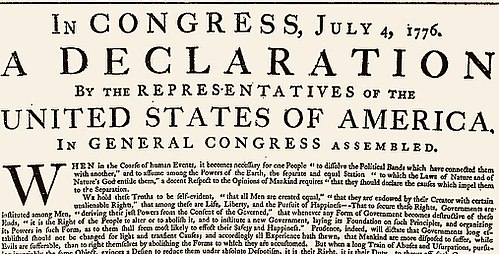
Humans imagine that they have rights and obligations and belong to social classes. This is what is meant with social order. There has been a variety of rights and obligations and social classes throughout history.1 Societies usually have a ruling class who invents the social order and benefits the most from it. A social order needs some kind justification to convince everyone to accept the rules that come with it. That is where religion comes in. You can compare the Code of Hammurabi, a Babylonian law from 1750 BC, with the United States Declaration of Independence from 1776 AD.
The Code of Hammurabi declares that the Babylonian social order is based on universal and eternal principles of justice dictated by the gods. It divides people into three classes, nobility, ordinary people and slaves. The code then sets out all kinds of laws and punishments for transgressions. The United States Declaration of Independence begins with the following words:
“We hold these truths to be self-evident, that all men are created equal, that they are endowed by their Creator with certain unalienable rights, that among these are life, liberty, and the pursuit of happiness.”
On closer inspection 3,500 years didn’t make a lot of difference. The eternal principles are replaced by self-evident truths but the order still needed divine support. There is no mentioning of classes. All men are created equal. But the devil is in the detail. Women and slaves did not have these unalienable rights when the constitution was written. Only nobility was done away with as businesspeople were the new ruling class. In the 200 years that followed slavery was abolished and women received equal rights before the law, but businesspeople are still the ruling class.
Saying that people are equal and have equal rights is problematic. People are not equal in their abilities as well as their opportunities. For example, we can imagine the right to live but we all die. Some people die young while others live very long. Many people are poor and have no access to good education. Some are rich and can go to the best universities. Still, we imagine that people have equal rights, just like the Babylonians imagined that people are divided into classes.
Social orders are the result of history, economics, and politics. Ideas are at the basis of them. Equality is a revolutionary and modern idea that has gained ground during the last centuries. It has affected political orders on every corner of the globe. Even the worst dictators now say in public that all people are equal.
A social order is also a collective imagination. A social order doesn’t exist in reality as such, but only in the minds of people. If people agree on a social order, whether it is a division into classes or the notion that everyone is created equal, it can be stable. Social orders bring peace and stability and that is the most compelling reason to have them. If people agree on a social order they can cooperate more easily as the order settles many matters that would have to be negotiated otherwise. A reason why certain social orders prevail over others is because they create more powerful societies.
Featured image: United States Declaration of Indepence
1. Sapiens: A Brief History Of Humankind. Yuval Noah Harari (2014). Harvil Secker.
In philosophy, the state of nature is about human nature and our natural way of life. We are social animals who operate in groups. What makes us unique is that we can collaborate flexibly on any scale. We employ language and shared imaginations like corporations, nation-states, money and religions. They help us collaborate. In this way, we created an imaginary world, civilisation. We can program ourselves to a significant degree and have different cultures. So, what is our natural way of living? That is hard to tell, but we can say a few things.
We help our family and friends but can also cooperate with strangers. It is not something we learn. It is natural human behaviour. Other social animals also do it, including chimpanzees, our closest relatives. Chimpanzees live in small troops of a few dozen individuals. Like us, they have close friendships, work together with reliable congeners and avoid unreliable ones. They have social rules, may cheat and probably can feel guilty. Like human males, chimpanzee males can be violent and kill each other.
Like human leaders, chimpanzee alpha males acquire their status by building coalitions and gaining support. Others show their submission to the alpha male. He strives to maintain social harmony within his troop, like a king maintaining peaceful relations between his subjects. He takes coveted pieces of food like the government takes taxes. Alpha males gain their position by building a coalition of supporters. Usually, a chimpanzee band has several alliances.
Coalition members in a chimpanzee band build and maintain their ties through intimate daily contact. They hug, touch, kiss, groom and take fleas from each other’s furs. Like humans, they do each other mutual favours. The coalitions in a chimpanzee band have good relations to protect themselves against outside enemies. Within the group, there are friendships and more distant, colder relationships.
There is a limit to the size of a group of chimpanzees. To function as a chimpanzee band, all members must know each other intimately. They must remember how others acted in the past to guess what they will do. Unlike humans, they have no language to share social information. Humans gossip to share information about others. Thus, we can learn someone is unreliable without being cheated upon ourselves. That allows us to collaborate in more sophisticated ways in larger groups.
Chimpanzee groups with more than a few dozen individuals are unstable. Its members do not know each other well enough to establish a hierarchy. Separate groups of chimpanzees seldom cooperate and compete for territory and food. There have been cases of prolonged warfare between groups of chimpanzees, including a few instances of genocide. Early humans lived similar lives but could live in larger and more stable bands of up to 150 individuals. The size of a group with which we can closely cooperate is one of our natural limits. We have overcome that limit with shared imaginations, which might be unnatural and a source of many troubles we have today.
Shared imaginations
We think in terms of cause and effect. We believe clouds cause rainfall. Our imagination also allows us to attribute causes to imaginary things. If the harvest fails, we can think the gods are angry. To deal with that, we can start a ritual like sacrificing a goat in the planting season to please the gods. Rituals also have another role. They bond a community and can outlive the beliefs that created them and lose their meaning. Many atheists still celebrate Christmas and think of eating turkey rather than the birth of Jesus.
Large groups face difficulties acting as a collective. Distinguishing between the contributions of individual members becomes challenging, so cheating and opportunistic behaviour are more common. Money, states, and belief systems like religions and ideologies help us deal with that. Money can keep track of our contributions and usages. States enforce cooperation. Religions and ideologies help us collaborate, for instance, by promising rewards in the afterlife or telling inspiring tales of worker solidarity.
For that, we share our imaginations. We imagine laws, money, property, corporations and nation-states. We think a euro banknote has value, even though it is just a piece of paper. And that is why we can use it for payment. If we believe the banknote is worthless, we cannot accept it or use it for payment. We imagine a law exists and, therefore, it works. Without these shared imaginations, our societies would stop functioning. Our cooperation also requires an inspiring story like a myth about the founders, a religion or an ideology.
Stories are the basis of our large-scale cooperation. We change how we cooperate and build societies by changing the stories. In 1789, the French population switched from the story of the divine right of kings to the sovereignty of the people. That changed the organisation of French society from feudal to modern, an advantage that Napoleon could subsequently exploit on the battlefield. Intelligent animals like monkeys can learn new behaviour but cannot change their organisation because they lack the stories to do so.
Norms and values
We invent rules and follow them. That is also in our nature. The rules differ per group, but all groups have rules. Norms are shared rules and expectations about the behaviour in a group or society. They maintain the social order, define cultural values, and shape social interactions. Norms can be laws, folkways, mores, taboos. Values are beliefs about what is important to us and society. Values can be honesty, respect, fairness and kindness. Norms and values thus reflect our rules.
Our rule-following behaviour is ingrained in our nature and comes with emotions like anger, shame and pride. If we have rules, we can spend less time negotiating about who does what and who gets what. It allows us to cooperate more efficiently and effectively. It also limits our freedom. We cling to our norms and values. Rules make societies stable. But they cause trouble if they have outlived their usefulness and block much-needed change.
Most of our communication is gossip. We need the group to survive. To survive, we must understand what is happening in our group. We talk about other people in our group, for instance, who is cheating or breaking agreements and what we should do about it. Groups enforce their rules by pressuring or ostracising those who do not conform to them. Being evicted from your group is particularly traumatic as it can lead to death.
Our inclination to attach value to mental models and theories promotes social stability. It also makes societies conservative regarding ideas and rules. Rules and institutions emerged to meet a specific challenge and become a burden once they have outlived their usefulness. Social change is often not a process of small steps but of long periods of standstill alternated with sudden dramatic changes.
Violence is often crucial for change. The fear of violent death can motivate us to do things we would not do out of self-interest alone. Those who benefit from the current arrangement hold off changes, so violence or the threat of violence can end the stalemate. That happened in the French Revolution. The human desire for recognition means politics is seldom about mere self-interest. We also judge leaders and the rules in society with our norms and values.
The struggle for recognition
Societies require individual members to play particular roles. Each role has a status and norms based on the values and beliefs of the culture of that society. Socialisation is learning your role in society and the norms and values that come with it. Groups of humans, including societies, have social hierarchies with statuses attached to the roles people play. In organised societies, status differences are more pronounced than in small groups. That is called stratification.
An individual or a group can recognise another person’s or group’s status, including this person’s or group’s beliefs and customs. The struggle for recognition differs from the struggle for material goods. All parties can gain from an economic transaction. You can exchange your fish for bread if you want bread more if someone else has bread and desires fish. But humans imagine social hierarchies. The recognition of one person, group or nation thus comes at the expense of others.
We aspire to social status, and some compete for leadership. Chimpanzee males compete for the status of the alpha male but also cooperate to defeat an enemy. We not only desire recognition for ourselves. We also seek respect for our beliefs and the groups we belong to. Much of our struggle concerns respect for groups such as women, ethnic minorities and homosexuals. There is an economic aspect, such as equal pay for women, but it is primarily about recognition. Pay is also a token of respect.
You cannot enforce recognition. Others must feel you deserve it. Leadership comes from a group acknowledging that a specific person has exceptional courage or wisdom or is impartial in conflicts and a desire from a community to have a leader. Once a society develops, we transfer our recognition to political institutions like parliaments and courts rather than individual leaders. In both cases, the political order requires legitimacy to make people accept the order and adhere to the rules.
Changing our environment
We change our environment. So, if we have a natural environment, we can make it unnatural. The first humans lived as hunter-gatherers in small groups of a few dozen individuals. Everyone in the group knew each other. If that is our natural way of living, city life would be unnatural. Our mental makeup emerged from evolution, so living in large cities could produce psychological problems like stress and alienation. The biblical vision of the state of nature is Eden, where people lived in harmony with nature.
But what does that mean? In the last 400,000 years, humans have become the top predators. That had enormous consequences for what we can eat and do. And it had psychological and social effects. Humans did not evolve but suddenly rose to their new position. Many historical calamities and things about how humans behave towards others and the environment, from the deadly wars to how people treat the ecosystem around them, result from this fast change that our evolution could not match.
Humans like Neanderthals, and later the modern humans, Homo Sapiens, began using fire. It gave them light, warmth, and an effective weapon against dangerous animals like lions and bears. That changed the balance of power between the animal species. The humans came out on top. Humans also used fire to change their environment. They started burning down forests and collected dead animals cooked in the fire to eat them. And cooking allowed them to eat more sorts of food.
The Agricultural Revolution was another dramatic change in human lifestyle. To feed more people, humans began to grow crops and herd animals. With agriculture, more people could survive, but it created new problems. Hunter-gatherers could move on in the case of conflict, but farmers had to protect their land and cattle against thieves and invaders. And so there were more intense conflicts, and people began to organise themselves for larger-scale wars in tribes and states.
Latest revision: 23 December 2023
Featured image: cover of The Origins of Political Order
From: The Origins of Political Order: From Prehuman Times to the French Revolution of Francis Fukuyama.




 The Plan For The Future