Jesus and Minas Coptic icon dating from 6th or 7th century

From Jesus to Christianity

Did Jesus exist at all?

The Gospel of John tells us that Jesus believed he had eternal life and a bond with God from the beginning of Creation until the end of time. Christians and Muslims expect him to return. Even though Muslims don’t believe Jesus is the Son of God, they also think he has eternal life and that his mother was a virgin. Remarkably, Muhammad and the Jewish prophets didn’t view themselves as the eternally living Son of God. In other words, Jesus is perhaps the most enigmatic individual in the history of humankind. Some people claim that there is no evidence that Jesus was a real person and that he is a fantasy figure like Spike and Suzy. So, let’s first address the argument that Jesus is a fictional person.

Sources from his era don’t mention him. There is hardly any evidence of Jesus outside the Bible. Jesus was the leader of a small sect, so that is not particularly surprising. The problem with the idea that there never was a Jesus is that it leaves us without a compelling explanation for the existence of Christianity, so that we must seek refuge in more bizarre explanations, like Christianity being a Roman conspiracy to replace Judaism with the Roman emperor cult. The supposed proof is that Jesus Christ shares the initials JC with Julius Caesar, and that both died due to a betrayal. That can’t be a coincidence, so the Christ story is just a refurbished Caesar story, the proponents of this ‘theory’ argue.

They are right that it isn’t a coincidence. However, as an explanation for Christianity, it is pretty imaginative. And it fails to explain nearly everything we can read about Jesus in the Gospels. And so, Jesus did live. But what made him unique? Jesus started a religion that has over two billion followers today. Apart from a historical account, an explanation of his beliefs may help us understand him. That includes his relationship with God, the supposed guy in the sky who is far more powerful than Superman, can do more tricks, and is allegedly all-knowing. But Jesus changed world history more than anyone else, so did that sky dude have a hand in that? It would be strange not to ask that question.

What can we know?

Historians and biblical scholars try to reconstruct what Jesus taught and did. They use historical sources such as the Gospels, but never ask the question that would be strange not to ask. And so, they fail to clarify Jesus’ supposed close relationship with God or why God was his Father. Decades after Jesus allegedly went missing, a few anonymous authors wrote the Gospels. Mark, Matthew and John haven’t written the Gospels attributed to them. The Gospels provide no clue as to who wrote them. Mark, Matthew and John were peasants who spoke Aramaic, while the authors of the Gospels were educated and spoke Greek. Some scholars argue that Christians initially relied on oral traditions and utilised writings that are no longer extant. Oral recounting is notoriously inaccurate. Stories change when retold. Details get lost, and new details get added. They had good reason to think so. Luke begins, stating precisely that (Luke 1:1-4),

Many have undertaken to draw up an account of the things that have been fulfilled among us, just as they were handed down to us by those who from the first were eyewitnesses and servants of the word. With this in mind, since I myself have carefully investigated everything from the beginning, I too decided to write an orderly account for you, most excellent Theophilus, so that you may know the certainty of the things you have been taught.

Luke was not one of the original Apostles, but a companion of Paul (Philemon 24), who was a physician (Colossians 4:14). And so, he could have written the Gospel attributed to him. But we don’t know. Church tradition also holds that the author of Mark wrote down a testimony of Peter. Peter died years before the author of Mark penned the text, but there are reasons to believe that a testimony of Peter was a source the author used, most notably because Peter has a prominent role in the text. Much of this Gospel is plausible given the time and place in which Jesus lived. Mark also discloses things about Jesus that Christians wouldn’t make up because it is embarrassing, such as Jesus’ family claiming he was insane (Mark 3:21). Mark seems to have had access to a reliable source.

There is also evidence of redactions in the New Testament. What to think of Jesus being the bridegroom and the Bride having gone missing? Jesus was married, but we are not supposed to know that. As a result of the confusion, scholars agree on very little about Jesus of Nazareth, except that he lived and preached shortly after 26 AD. His ministry started after John the Baptist had baptised him. Then there was a lot of action, with mystical and sensational statements, including miracles such as healing the sick and multiplying bread and fish, followed by a betrayal, crucifixion, and resurrection from the dead, and finally, his disappearance. The Gospels agree on a few things:

  • Jesus performed miracles, such as walking over water, healing the sick, multiplying bread and fish, and raising the dead.
  • Jesus made controversial statements that baffled the Pharisees, so they schemed against him, which eventually led to his crucifixion.
  • Jesus did not take Jewish religious law as seriously as other religious zealots. He had a different message of forgiveness of sins.
  • Jesus did not like hypocrites, for who is without sin? He forgave sinners who repented. Still, he claimed there would be judgment.
  • Jesus was respectful of women. And he held unconventional views on marriage. Few men were up to that task. That goes unexplained.
  • Oh yes, and he called God his Father, and he was God’s son. It was a close and loving relationship. Other prophets weren’t like that.

Who was Jesus, what did he do, and what were his teachings? Scholars and historians seek to reconstruct what happened and the beliefs of the earliest Christians by examining the oldest texts and earliest controversies. They have analysed the scriptures for centuries and concluded that you can’t establish much with certainty about Jesus except that he lived and preached. Some things are more plausible than others. And some things are nearly certain. The virgin birth didn’t happen, while the crucifixion did. Some of Jesus’ disciples likely saw him after he died, perhaps in a psychosis. Otherwise, you lack a compelling explanation for the origins of Christianity. Thoughts that scholars dared not entertain were that some of the miracles did happen, or that Jesus did have the gift of prophecy. If you have witnessed paranormal events, which scientists seem to call metanormal events, or know people who have, you may have second thoughts about the scholarly consensus on miracles. The scholar Dale Allison wrote in his book Interpreting Jesus,

What if a historian of the early Jesus movement decides, on empirical, not theological grounds, that sometimes people see the future, that clairvoyance is not uncommon, that additional metanormal claims should be seriously entertained, and even that enigmatic capacities sometimes congregate in exceptional or charismatically gifted individuals, in what Max Weber termed ‘religious virtuosi’?

Allison produces a long list of examples in the Gospels and concludes that his fellow scholars who reject the historicity of Jesus’ clairvoyance suffer from dogmatic incredulity. In other words, the Gospels could be more historically accurate than most scholars claim because their assumptions about the possibility of miracles and clairvoyance are incorrect. Hence, the confidence they have in their claims is unjustified. And the original written sources are older than the Gospels, so oral recounting probably hasn’t affected them. Earlier written records have existed, scholars argue, and they give these supposed writings mysterious names, such as Q and ‘The Signs Gospel’. Mark, Matthew, and Luke are very similar and primarily draw on the same sources. The Gospel of John stands apart. The Gospel of John notes that an eyewitness, the Beloved Disciple, wrote it. And so, an eyewitness account by a disciple could be the basis for this text. Now, John 5:1-3 reads,

Some time later, Jesus went up to Jerusalem for one of the Jewish festivals. Now there is in Jerusalem near the Sheep Gate a pool, which in Aramaic is called Bethesda and which is surrounded by five covered colonnades. Here, a great number of disabled people used to lie — the blind, the lame, the paralysed.

The use of the word ‘is’ implies that the text dates from before the destruction of Jerusalem in 70 AD, thus from before the writing of the Gospel of Mark. The Sheep Gate was still there at the time of writing, the wording suggests. Now it gets more interesting. Peter was Jesus’ favourite disciple, and John may contain his testimony. There is little doubt that the Gospels contain historical evidence, but they also claim that miracles and the resurrection have happened. And so, you have some additional explaining to do, as these events defy the laws of nature, which is impossible had this world been real.

This universe is a virtual reality, so these miracles are possible. On the Holodeck, I can slay platoons of ferocious Klingon warriors alone with my bare hands and some magical powers. At the same time, in real life, elderly ladies overtake me in the swimming pool even when I am giving my best. Conjuring fish out of thin air, reviving the dead, walking on water, and turning water into wine should also be no problem. The same goes for a virgin birth. Whatever you imagine can become true. But it is not proof that it happened because Christians may have invented stories. For the virgin birth at least, that applies.

Explaining the differences

Mark and John are so different because they come from two very different traditions. Jesus had Jewish and Gentile followers. In the Jewish tradition, he was a prophet, and ‘Son of God’ meant ‘King of the Jews.’ To Gentiles, the Son of God had a literal meaning as God’s firstborn child. The Jewish Jesus was a human prophet and perhaps a resistance leader, while the Gentile Jesus was an eternal godlike being, the Firstborn of Creation. Most of the confusion stems from these differences, which reveal a controversy in the early Church that Paul successfully resolved. Mark and John are the best historical sources about Jesus’ life, but they have different perspectives. And the final version of the Gospel of John has undergone several revisions.

Writing a Gospel was an intellectual challenge for talented writers who could combine scraps of information, symbols and signs to compose high-level literature. Without social media, scribes could dedicate their entire lives to such a project. And others could dedicate lifetimes to finding out what those writers meant, so, if we wish to do so, we can read countless commentaries by experts. The Jews and the Muslims also have them. Jesus also contributed to the confusion. Well-known are the parables, stories that Jesus told to convey an underlying message. By saying something and meaning something else, Jesus often left his audience confused, including his disciples. Even today, the central question is: Was Jesus merely human or was he godlike? In either case, he is enigmatic.

Jesus’ deeds had religious significance, which is why we read that he had twelve disciples. Twelve stands for perfection or authority in government. Jacob had twelve sons who represented the twelve tribes of Israel. Jesus likely didn’t have twelve disciples. And Jesus supposedly spent forty days in the desert. The number forty signifies new life, growth and transformation. The rain of the Great Flood lasted forty days and nights. If Jesus went to the desert, then it was probably not for forty days. According to the Bible, God created the world in six days and rested on the seventh. The number seven also signifies completion and perfection. And Jesus said ‘I am’ seven times in the Gospel of John, supposedly implying he was godlike. If he said it, then he probably didn’t say it seven times. And the scripture tells us that Jesus rose from the dead after three days. This number represents divine wholeness, completeness and perfection. If Jesus had returned from the dead, it would probably not have been after three days.

The biblical authors tweaked and rearranged the facts to fit the religiously significant numbers. Eight disciples would have made a dud. What prophet has eight disciples? You can’t take such a prophet seriously. Paul claimed that Jesus appeared to ‘The Twelve’ (1 Corinthians 15:5) after Judas had already died. That is fishy. Mark, Matthew, and Luke list the names of ‘The Twelve,’ but John does not. He only calls them ‘The Twelve’ like Paul did. That is telling. Are they all taking Paul’s word for it? Talking about fishy, the experts are still baffled about those 153 fish Simon Peter dragged ashore without tearing his net (John 21:11). What does that number signify? Experts agree that it is not merely a fact. They have written voluminous tracts on the matter. A Wikipedia page deals with this question. There, you find links to the relevant literature. But we still await the book title ‘The Ultimate Guide on the 153 Fishes’ that explains it all. The experts don’t mention that 153 = (12 * 12) + (3 * 3). Both three and twelve have special meanings. It can’t be that simple. Or can it?

As time passed by

There are facts, early beliefs, and later beliefs. What Christians believed changed over time due to circumstances, so early beliefs are likely closer to Jesus’ teachings than later ones. Earlier sources might have fewer distortions and are thus closer to the facts than later ones. To understand Jesus, you must also become familiar with the time and place in which he lived. The Jews were a small nation crushed by major powers and could only hope for God to come to their rescue. At the time of Jesus, many believed the end was near and that God would send a Messiah to kick out the wicked Roman oppressors and restore Israel to its former glory, which it supposedly had when David was king.

Religious zealots prayed, committed terrorist acts, and revolted. Nowadays, the Palestinians follow the same recipe only to get their butts kicked time after time. And they never seem to learn. Back then, the Jews were like the Palestinians today. They were a pain for the Romans. Nowadays, the Jews run the empire in Washington, DC, and let it protect their pet project in the Holy Land. The stage was already set 2,000 years ago. The end times, the arrival of a Messiah, and a final reckoning still define Jewish, Christian, and Islamic thinking. In Jesus’ time, numerous end-time preachers proclaimed that the end was near. Jesus was one of them. He said things like (Mark 13:12-13),

Brother will betray brother to death, and a father his child. Children will rebel against their parents and have them put to death. Everyone will hate you because of me, but the one who stands firm to the end will be saved.

That is pretty scary already. Jesus continues (Mark 13:14-17),

When you see the abomination that causes desolation standing where it does not belong, then let those who are in Judea flee to the mountains. Let no one on the housetop go down or enter the house to take anything out. Let no one in the field go back to get their cloak. How dreadful it will be in those days for pregnant women and nursing mothers!

Now comes his prediction, which the faithful still await to come true (Mark 13:23-27),

So be on your guard. I have told you everything ahead of time. But in those days, following that distress, the sun will be darkened, and the moon will not give its light. The stars will fall from the sky, and the heavenly bodies will be shaken. At that time, people will see the Son of Man coming in clouds with great power and glory. And he will send his angels and gather his elect from the four winds, from the ends of the earth to the ends of the heavens.

Jesus may have seen himself as a Jewish Messiah and didn’t plan to start a world religion. When a non-Jewish woman begged Jesus to drive a demon out of her daughter, he replied, ‘First let the children eat all they want, for it is not right to take the children’s bread and toss it to the dogs.’ He was there for the Jews, and Gentiles were on par with dogs. Only after she replied, ‘Lord, even the dogs under the table eat the children’s crumbs,’ was Jesus willing to grant her request (Mark 7:24-30, Matthew 15:21-28). It is at odds with the Parable of the Good Samaritan (Luke 10:25-37) and the story of the Samaritan woman, in which Jesus asked this woman to give him some water she had drawn from the well, and in which everyone can get salvation (John 4:1-26). John also notes the woman’s surprise as Jews didn’t associate with Gentiles. It was also a point of contention between Peter and Paul (Galatians 2:11-21).

Scholars explain the contradiction by assuming each of the Gospels had an intended audience. Matthew wrote for the Jews and aimed to prove that Jesus was the Jewish Messiah. Gentiles were Luke’s intended audience. John was the product of a community separate from mainstream Pauline Christianity with an anti-Jewish bias. And so, we can’t be sure whether Jesus really compared Gentiles to dogs or whether it merely reflected a widespread Jewish sentiment about Gentiles. Still, all the Gospels agree that Jesus accepted the faith of Gentiles, halfheartedly or not.

Jesus probably saw himself as the eternally living Son of God. Unlike John, Mark doesn’t say it plainly, but notes that he did see himself coming in clouds with great power and glory. Initially, Jesus’ followers expected him to return soon. Jesus may have believed that himself. However, Jesus also said that no one knows the day or hour, not even he, only God (Mark 13:32). It could be a later addition, but there is no evidence to suggest that it is. His disciples probably thought they would live to see it happen. Scholars think Paul believed it also. When things didn’t go according to plan, the Christians had to adapt to this new reality and become less specific about the date of Jesus’ return.

Jesus’ Jewish followers had hoped that he would throw out the Romans. After the Romans levelled the Jewish Temple around 70 AD, that hope crumbled to dust together with the Temple. In the end, with no return of Jesus in sight, Christians turned him into a heavenly ruler who gives you access to eternal life if you follow him. That is how the Gospel of John depicts Jesus. It was the last Gospel written around 95 AD. To understand what happened, it is crucial to view the development of early Christianity as a historical process with actors, where there was a development over time as these actors attempted to address various issues. One actor in particular is of interest, namely Paul. He, rather than Jesus, invented Christianity. The historical order of the New Testament is with approximate dates:

  • Paul’s Epistles (the genuine ones), 55 AD,
  • Gospel of Mark, 70 AD,
  • Gospel of Matthew, 75 AD,
  • Gospel of Luke, 85 AD,
  • Gospel of John, 95 AD.

No one knows who wrote the Gospels. Attributing them to the Apostles was a ploy by the Church to lend them authority. The New Testament also contains epistles signed by Paul and Peter. Nobody knows who wrote them. Now, that does not need to be forgery. The writing process in Paul’s time involved co-authors. 1 Thessalonians starts with (1 Thessalonians 1:1-2),

Paul, Silas and Timothy, To the church of the Thessalonians in God the Father and the Lord Jesus Christ: Grace and peace to you. We always thank God for all of you, mentioning you in our prayers.

The Paul who wrote these letters was not always the individual Paul, but often a team of authors. After Paul’s death, the other team members might still have written letters in his name. They wouldn’t have thought of it as a forgery. Individualism as we know it today didn’t exist at the time, so if you were part of Team Paul, you could still write a letter and sign it in Paul’s name after his death.

The Gospel of John is the latest, so scholars have long considered it the least reliable of the four Gospels. They long held the view that Christians gradually deified Jesus, which could then explain why it is so different. However, Paul already viewed Jesus as God in nature (Philippians 2:6), and that at the name of Jesus, every knee should bow, in heaven, on earth, and under the earth (Philippians 2:10). The latter phrase originally referred to God. Paul applied it to Jesus, viewing him as godlike but not equal to God.

The mystery remains

And so, the opinion among scholars has shifted, and most now believe that the Gospel of John comes from a separate tradition. To Greeks and others, a human could more easily become godlike than to Jews. The Bible also testifies to this. After Paul healed a lame man in Lystra, the locals concluded that Paul and Barnabas were gods in human form (Acts 14:11). The first three Gospels emerged within Jewish Christianity. In contrast, the Gospel of John originated from a Gentile Christian community. And gradually, the scholars came to the conclusion that John could be more historically accurate than previously thought.

Hence, John may reveal things that other Gospels fail to mention. There were disputes about the nature of Jesus and his relationship with God. Was he human or godlike? The compromise ultimately became that he was both. Paul never wrote about what transpired during Jesus’ life. Mark is the oldest Gospel that tells the story of Jesus’ life. It is brief and presents an enigmatic Jesus. Mark 1:27-28 reads,

The people were all so amazed that they asked each other, ‘What is this? A new teaching, and with authority! He even gives orders to impure spirits and they obey him.’ News about him spread quickly over the whole region of Galilee.

The Gospel of Mark initially ends after Mary Magdalene and a few other women discover that Jesus’ tomb is empty, and an angel tells them that Jesus has risen. The remainder is a later addition. Because of that, some scholars doubt the resurrection. Other scholars have suggested that it was an intentional open ending, ‘because everyone knew what happened next.’ That is a bit of a stretch, as it attributes Hitchcock-like motives to an author who seemed keen on giving a testimony. Jesus probably appeared to at least some of his followers after his death. Otherwise, there would be no Christianity. And so, the premature ending of Mark raises questions.

That could be as reliable as it can get. Conviction, no matter how strong, is not a fact, but we have no unquestionable, accurate accounts of what had transpired. The Gospels diverge from what Paul writes, so we can’t construct a more precise picture of the events unless we can establish which accounts are the most reliable and what the falsifications are. And so, we can’t get closer to the truth unless we learn more about the relationship between God, the supposed guy in the sky, and Jesus, His alleged son.

Latest revision: 8 November 2025

Featured image: Jesus and Minas Coptic icon dating from the 6th or 7th century. Clio20 (Anonymous). Wikimedia Commons.

1. At what point were there doubts about Mark’s longer ending? r/AcademicBiblical (2025). [link]
2. Did Mark’s gospel really end on a cliffhanger, or is it unfinished? r/AcademicBiblical (2025). [link]
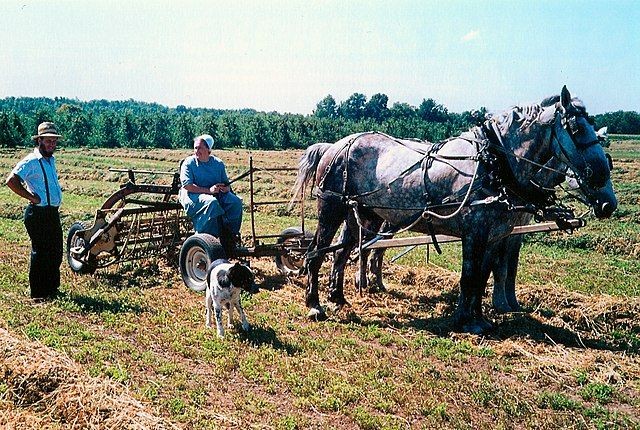
Amish family, Lyndenville, New York. Public domain.

Towards a spirit of connectedness

A world without hope?

The future prospects for humanity appear grim. At best we manage to avoid a planetary ecological disaster. And that already may be too high an aim. So what will our future look like? Which direction should we take? Can we build a sustainable and humane world society? And what is wrong with our current way of living? Perhaps the answer can be found in a speech the native American Chief Seattle allegedly gave in 1854 when the United States government wanted to buy the land of his tribe. Here are his first words:

How can you buy or sell the sky, the warmth of the land? The idea is strange to us. If we do not own the freshness of the air and the sparkle of the water, how can you buy them?

Every part of the Earth is sacred to my people. Every shining pine needle, every sandy shore, every mist in the dark woods, every clear and humming insect is holy in the memory and experience of my people.

Only, Seattle never said this. It is fake history. It has been made up by a screenwriter in 1971. Still, the speech strikes at the heart of the matter. Nothing is sacred anymore. The pursuit of money destroys our values and our planet. For instance, it is argued that if we don’t allow the airport to expand, money and jobs will be lost. This is killing us. The speech contains some more interesting words:

This we know – the Earth does not belong to man – man belongs to the Earth. This we know. All things are connected like the blood which unites one family. All things are connected.

Whatever befalls the Earth – befalls the sons of the Earth. Man did not weave the web of life – he is merely a strand in it. Whatever he does to the web, he does to himself.

We know this deep down in our hearts but it is hard to deal with it. What can we do? The people from the environmentalist group Strohalm worked for decades on an outline for the society of the future. They were not hindered by established interests nor did a lack of perspective deter them from continuing their search. They tried to learn their lessons from history and were part of a small group of people that kept on caring and never gave up. Here is another take-away from the speech:

Even the white man, whose God walks and talks with him as friend to friend, cannot be exempt from the common destiny. We may be brothers after all. We shall see. One thing we know, which the white man may one day discover – Our God is the same God. You may think now that you own Him as you wish to own our land, but you cannot.

In 1991 Strohalm issued a booklet named Towards a Philosophy of Connectedness. It lays out their vision for a future society that is both sustainable and humane. It gives possible steering mechanisms that can help to achieve such a society. It is a vision that long seemed unattainable, not because it is impossible to do, but because vested interests stood in the way. Seattle also never said:

That destiny is a mystery to us, for we do not understand when the buffalo are slaughtered, the wild horses tamed, the secret corners of the forest heavy with scent of many men, and the view of the ripe hills blotted by talking wires. Where is the thicket? Gone. Where is the eagle? Gone. The end of living and the beginning of survival.

In 1994 I was an active member of the environmentalist movement. In this way I became familiar with Strohalm. For a long time I believed them to be naive dreamers. Most people I know do not like environmentalists. And indeed, they weren’t always realistic and sometimes decades ahead of their time. I kept on supporting their work because there is no alternative. You can’t allow realism to stand in the way of what needs to be done. And so this vision is here because of the hard work of environmentalist groups like Friends of the Earth and the Strohalm Foundation.

A new perspective

We need a new starting point, a new foundation for our culture, our beliefs and thinking and our place in the universe. There is no other choice. Small steps can’t save us anymore. We need to fundamentally change ourselves and the way we live. The planet we live on is given to us on loan to live off and not ours to destroy. Sadly, the fate of our planet does not compel us to do the right thing so God may be needed to make it happen.

As long as we do not completely change our approach to the major issues of our time, our societies will not become more humane and respectful of our planet. As long as production and consumption increase, new problems emerge faster than old problems can be solved with laws, technology, targets and other solutions.1

We are not confronted with an array of regrettable separate incidents, but with a culture that is on the loose. It is a throw-away culture in which not only materials and energy are wasted. Human relationships and values end up on the waste dump too.1

You probably know that but you may find it difficult to admit. It can make you feel hopeless. And so you may be inclined to ignore this, to focus on smaller and more concrete problems, or to withdraw yourself1 by fleeing into cynicism, new age spiritualism or conspiracy theories.

Most of us believe that massive structural changes are impossible and that we can’t influence the course of history in a meaningful way. And I can’t blame you for having what I for a long time believed to be a realistic view on this matter. And so we choose to manage existing developments with smaller measures. That is not going to help us in the end.

There is another way of looking at the situation. Acknowledging a problem is already solving it half. Our belief that nothing will help can become a self-fulfilling prophecy. As soon as there is a realistic perspective for change, many of us will let go of their cynicism and help to make it happen1 and then it can happen fast. Twenty years may be all we have left. And twenty years may be all we need.

Natural World Order

You do your job and perhaps you achieve something. Your activities do not only have the intended consequences but many others as well. If you succeed and get a promotion, a colleague might get jealous. If you go to your job by car, the exhaust gases can make other people sick.1 The unintended consequences of your actions hardly play a role in your decisions but they change our reality in unexpected ways.

The world is complex so the models we use can’t get a proper hold on what is going on. And so it appears that we can’t change our future in a meaningful way, and that at best we can anticipate what is going to happen. The failure of communism demonstrated that centralised planning does not create a happy society. That left us with capitalism and markets. They brought us prosperity while our living conditions are being destroyed.

Perhaps nature can show us the way. Organisms start relationships with each other. These relationships can become permanent if one organism makes something another organism needs and the other way around so that both benefit. For instance, plants and animals have such a relationship. Plants produce oxygen that animals need while animals produce carbon dioxide that plants need.1

Plants and animals are part of a self-sustaining cycle. They are connected. They are parts of a whole. If plants die then animals including humans die too. There are many of such relationships in nature. Such a natural order emerges spontaneously but it takes a long time. It starts with individual organisms starting relationships. These relationships can grow to a global scale as long as the external conditions allow for it.1

External conditions are like a dictate. If there were no fossil fuels then we can’t burn them. If there was no technology to build cars, we can’t drive them. External conditions are usually taken for granted but when they suddenly change then we must adapt and that can be brutal. For instance, the spread of the corona virus brought long-distance travel to a standstill. And climate change can become far worse than that.

Make no mistake. Running into the limits of our planet will be more brutal than anything that ever happened before in the course of human history. That leaves us with no other choice than setting global limits on human activities before the planet does it for us. But the sudden stop of air travel also teaches us that we don’t really need it. And there are many more things we do not need.

People, businesses and governments must deal with these limits. Once they are in place, communities, governments and businesses all over the world can reorganise themselves via communities, so that the Natural World Order will arise more or less spontaneously. Humans can make this happen fast because they can quickly change the ways they cooperate by changing their cultures. That doesn’t require planning every detail but it does require altering the steering mechanisms of our societies and economies.

One of the most important things we must change is the way we look at wealth and conspicuous consumption. Wealthy people are seen as great examples and their consumption is seen as good for the economy. If conspicuous consumption is frowned upon, there is less fun in being extremely rich, and a lot of crime becomes pointless. For example, what’s the point of risking your life by being drug dealer if you can’t drive around in your expensive cars any more? This way looking at wealth and consumption is essential to make the Natural World Order come to pass.

Steering mechanisms

Money is now the most important steering mechanism in society. Realising goals of any kind usually requires the cooperation of others and therefore money. That is understandable. Everyone needs money but it may be better that we are motivated more by our job or our contribution to society and less by money. Economic decisions are affected by interest as well. Interest is a steering mechanism. High interest rates promote short-term decisions while low interest rates promote long-term decisions. So how does that work?

If the interest rate is 5% then € 1,00 next year is worth € 0,95 now. That makes you prefer to get € 1,00 now rather than next year, even when you need the money next year simply because you can receive interest and will have € 1,05 next year. Interest reduces the value of future income and therefore the future itself. Interest makes people and businesses prefer the present to the future and short-term gains at the expense future generations.

This is why a sustainable economy requires low or even negative interest rates. Ending growth also requires negative interest rates otherwise the interest on debts can’t be paid. Interest is any return on capital so interest doesn’t depend on money but on capital. As the wealthy own most capital, interest is a flow from everyone else to the wealthiest. A humane society may therefore need to end positive interest rates. Central banks do not determine interest rates in the end. The supply and demand for money and capital do. But ending interest may soon be possible.

In markets competition is a steering mechanism. Competition promotes efficiency and progress but it also causes problems. Competition affects economic decisions.1 It can force corporations to produce as cheaply as possible or to produce stuff that no-one really needs because it can be sold at a profit. Some corporations faced with intense competion see little room to treat their employees well or to care for the environment.

If you desire that latest model, the best service, the lowest price, and want more money to buy even more stuff, you are part of the problem like many others, and that includes me. It may be strange to realise that you have enough, or even have far more than enough, and that you can do with less, older models, poorer service and higher prices, so that local businesses may survive.

Another important steering mechanism is the distribution of cost. Short-term gains are for corporations while societies deal with the long-term cost like pollution and unemployment. Education and health care are public costs that corporations often do not pay for. Taxing systems do not take into account the limits of the planet. They need to be changed in order to attribute the true cost to the products and services people buy.

Shifting taxes from labour to raw materials and energy can help. This measure can induce people to use items longer and promote repair and recycling. Corporations must be responsible for the entire life-cycle of the products they produce. Non-essential products that are harmful can be banned completely. The advertisement industry can be regulated to stop people from buying items they do no need.

Laws are a steering mechanism too. What is legal isn’t always fair. Unethical behaviour is often not punished by the law. A greater role for ethics in law is needed, most notably in matters of business. Savvy people and corporations use loopholes to their advantage or bribe politicians into changing the law into their favour. Exploiting people, misusing public funds, and harming the planet should be sufficient ground for persecution and conviction, even if the specific activity is not declared illegal.

Most people take the existing steering mechanisms for granted. A few people like the anti-globalists and religious extremists think of an alternative. Only most people would not like a reign of terror. And so we limit ourselves to taking small measures in order to reduce the fall-out. It is hard to believe that the steering mechanisms themselves can be changed. Perhaps technology will save us, we hope. That may not be the case.

The throw-away culture

Science, technology, society and culture are closely interconnected. It is fair to say that we live in a technological society and a throw-away culture. If we have a problem then we look at scientists and engineers to solve it. Even our emotional problems we address with therapy sessions and pills. This is also true for environmental problems.

A good example is perhaps a report of the Dutch research agency TNO in the 1980s about replacing milk bottles by milk cartons. Milk bottles were used many times while cartons are thrown away. The discussion that followed was about the number of times a bottle was reused, which determines whether or not the bottle is better for the environment. That depended, amongst others, on the number of times a bottles was reused.

These discussions can be useful. What was not discussed however, was the throw-away culture. Milk bottles were part of a culture of reuse that was disappearing. The cartons are part of the new throw-away culture. Discussions are about quantity, objectivity and efficiency, but not about fundamental questions about the way we live.

The things we use deserve more respect. Valuable resources and energy have been used to make them. We should not depart from them until they are worn out completely. If they are broken we should fix them until they can’t be fixed any more. And why should we buy frivolous items or make long distance trips for recreational reasons?

The fourth way

The damage done to our planet is escalating. There is a lot of excess. Nowadays there are more obese people than hungry ones. The end of our way of living is here. Communism and state planning have failed. Capitalism and free markets have failed too, but most people have yet to find out. Many countries have combined state planning with market economies and called it a third way. That didn’t change much either. Many people have become cynical. But there is no need for poverty.

It is not surprising that people distrust stories that have a claim to the truth like religions, ideologies and science. But it is the absence of great stories we can believe in that makes our societies directionless. Individuals and their desires are now at the centre stage. So is there anything left that binds us together? Sure there is. A soon as a crisis emerges people join and help each other. The future is not without hope.

There is a fourth way. It can be called the Natural World Order. It is setting limits on a planetary level and letting people deal with them via communities, governments and markets. It is not clear from the outset what will happen because this can’t be planned from the top. Developments can take different turns. For instance, if energy is to become expensive, international trade would diminish and local products would be favoured. If most people do what needs to be done then it can be done.

This is the time to act. The current order can’t be sustained. The limits of our planet should be respected. Administrating these limits would require a global government and the same laws everywhere around the planet. It can only work if people, communities and businesses help to make it become reality. It can work when we want to make it work whatever it takes. It all begins with admitting that enough is enough.

We want more stuff because the advertisement industry tells us that we need this or that product or that buying it will make us happier. Our current economic system needs growth. We must buy more to keep the economy from collapsing. That is why fundamental change freaks us out. There can be enough for everyone. Eve and Adam had everything they needed. And so we may enter the Final Gardens of Paradise that await for us at the End of History. The change is not going to be easy but there may be no alternative.

Featured image: the only known photograph of Chief Seattle taken in 1864

1. Naar een filosofie van verbondenheid. Guus Peterse, Henk van Arkel, Hans Radder, Seattle, Pieter Schroever and Margrit Kennedy (1990). Aktie Strohalm.

2017 Jeep Grand Cherokee in Makarska, Croatia. Elishur19.

The law of diminishing marginal utility

Imagine you are fond of pizza and very hungry. If I offer you a pizza, you will be very grateful. If, after you have finished, I present you a second, you will not decline, but you will be a bit less grateful. If I offer you a third, you might still eat it, perhaps not to offend me. The fourth pizza you would decline. You might give a lame excuse like nausea to explain your peculiar behaviour. Before the fifth pizza is offered, you may already have sneaked out of my home.

Welcome to the law of diminishing marginal utility. It is a law in economics. It states that the more you have of something, the less use an extra unit has.

It is possible to express the law in terms of money. Suppose you are at a pizza restaurant, hungry, and willing to pay € 12 for a pizza. After eating it, you are not hungry and unwilling to pay € 12 for a second pizza. But if the restaurant owner offers you a discount of € 6, you might accept the offer. A third pizza you may only eat if it is on the house. A fourth pizza you will not eat unless the restaurant owner offers you € 6 to eat it. Eating a fifth pizza might cost the restaurant owner € 12.

number of pizzas eatenvalue of the next pizza in €
0€ 12
1€ 6
2€ 0
3– € 6
4– € 12

What might strike you is that the fourth and fifth pizzas have negative value to you. You are not willing to eat them unless the restaurant owner pays you for it.

Most people have other desires than pizza alone. If you also desire soda, there is a limit to that, too, and at some point, drinking more soda also has a negative value to you. Perhaps you desire a hundred other things, for instance, a refrigerator, and you may even have room for a second, but more refrigerators have no use to you, nor do they fit in your house. And so, the more you have, the less something extra is worth to you, and you might start to think about the future.

Perhaps you have plenty of pizza and soda now, but what about tomorrow and next year, so you might start saving. As we get wealthier, getting more stuff becomes less important to most of us, while certainty about the future becomes more important. At some point, we do not want more stuff, and the law of diminishing marginal utility becomes an obstacle to economic growth.

If you are happy with what you have and care about the future, you may save too much for the economy to grow and capitalists won’t make enough money because they must at least make the interest rate. The law of diminishing marginal utility is, therefore, a grave threat to capitalism. And so is interest. This is where the advertising industry comes in. The trick of advertising is to make us unhappy with what we have and to make us desire more. Buying this or that will make us happier, advertisements promise us.

Fashionable items with a limited lifespan are part of the solution too. It is not always possible to make us desire more stuff, but it is still possible to make us desire new stuff. The dress you bought last year is out of fashion now. In order not to look stupid you have to buy a new one. And then there is technological development. Next year there will be a newer model, and by the way, the software on the old model won’t be supported any more. And of course, luxury items do their bit. Why go for a Volkswagen Polo if you can afford a car with a low marginal sports utility value like the Jeep Grand Cherokee?

Yes, the Jeep Grand Cherokee is an ugly monster, but it is bigger than the Volkswagen Polo and if you can afford to drive it, why not? There is a reason why not.

We, humans, use far more resources than our planet can offer. That’s why capitalism is a grave threat to humanity. Capitalism nowadays is like making us eat the fifth pizza and pay extra for it even though that creates a health hazard while many people are hungry. And there may be no food tomorrow because we have eaten too much today. The Jeep Grand Cherokee is like the fifth pizza. We work hard to buy stuff we do not need. This is how humanity is committing suicide. This can’t go on. There is one obstacle. Businesses must make at least the interest rate, and interest rates below zero are still unthinkable.

In other words, we must learn to care about the future and interest rates may need to go below zero. We must learn to be happy with what we have and settle for less when possible. This may be a grave threat to capitalism for what will happen if we stop spending on excesses? Economists fear that the economy will collapse and that we will be without jobs when business profits decline and interest on debts can’t be paid. That doesn’t have to happen when interest rates are negative. In that case, debts don’t have to be repaid and businesses with little or no profits can survive.

That may seem strange but it is already happening. The law of diminishing marginal utility is kicking in, and it is kicking in big time.

This law affects capital too. If there is only one pizza factory that can supply every pizza addict with one pizza per day, it would almost certainly make a profit. A second factory might make a profit but it might not. And what is more, if the second factory comes into operation, the supply of pizza increases, and according to the law of supply and demand, the price of pizza would drop. That would also cut into the profits of the first factory.

A third factory is even more likely to be loss-making and it could make the other factories loss-making too. At some point, there is little use for capital. That causes the demand for capital to drop and interest rates to go negative. Traditional economics would consider this unhealthy or temporary.

That doesn’t need to be and it can be desirable. Three pizza factories fiercely competing and without profits might be better for consumers than one that is profitable if we assume that pizza is a necessity. Everyone must eat something. There could be an ample supply of investment capital at negative interest rates so profits may not be needed for pizza factories to stay in business.

A problem is that excess investment capital can go to businesses that suicide humanity by using scarce resources to produce the stuff we do not need. Negative interest rates can help to make the economy sustainable but only if the excesses do not happen. This would require governments to ban or tax excesses or to regulate their production so that these products don’t have a harmful impact. That would make them a lot more expensive.

But the fun of driving a Jeep Grand Cherokee, apart from giving environmentalists the middle finger, comes from the fact that you can afford to drive it, so the fun may be even greater when it is three times as expensive.

When people start saving more and businesses hardly make profits then where does the money go? It can be used to make the economy sustainable. It can go to people in need who still have use for money. The money can help to reduce poverty and it can be used to address pressing needs in society. And we could have far more leisure time. What’s the point of working so hard for things we do not need? We may only have to work for twenty hours per week and still have a good life. It seems possible that humanity will survive capitalism and that capitalism will be transformed into an economic model that can endure for the foreseeable future.

Featured image: 2017 Jeep Grand Cherokee in Makarska, Croatia. Elishur19. CC BY 4.0. Wikimedia Commons.

Amazon Blue Front Economist

Currency

Political Economy and Currency

A dictionary defines currency as the system of money used in a particular country. You find both the words ‘general’ and ‘particular’ in this general definition of this particular term. A currency belongs to a specific country. Financial transactions within that country are in that currency. If you go to Sweden to do some shopping, be sure you have some Swedish crowns on you. The economist’s definition is government money. It includes coins, banknotes, and central bank deposits, but not commercial bank deposits.

Under the gold standard, each currency represented a fixed amount of gold, and national central banks held gold in their vaults to back that promise. You could exchange banknotes for the amount of gold the currency represented. That was the basis of the currency’s value. And so, the underlying currency was not the national currency, but the international currency, gold. Under the gold standard, the world had a single currency, gold. You could exchange bank deposits for currency, thus gold.

Today, we have national fiat currencies, and bank deposits are also money. But what gives fiat currencies their value? It is the national economies backing them, because of the equation known as the Quantity Theory of Money, which says that Money Stock (M) * Velocity (V) = Price (P) * Quantity (Q), so Money Stock (M) depends on Velocity (V), Price (P) and Quantity (Q), and the value of a single unit such as the Swedish crown, is M / units in circulation. The money stock includes bank deposits.

Honest money

Proponents of the gold standard argue that gold is honest money and that fiat money is a fraud. However, the scam is usury, and charging interest on gold is a fraud. There isn’t enough gold to repay all debts, and interest compounds that problem. In that sense, fiat is honest money because it merely promises to pay in fiat, which a government can make good on. Everyone knows that this money will be worth less in the future, and no one knows by how much, which everyone knows. Usury turns money into a Ponzi scheme. And so, only usury-free fiat money is honest money.

Usury may seem victimless, but it corrupts everything, bringing down nations and civilisations. It is the gravest crime against humanity. As a result, honest people become increasingly rare. A society or a civilisation collapses due to scams and greed. Crimes seem victimless when you are unaware of the consequences, don’t care about them, or even deny them. But everything you do affects people, animals, plants, and future generations. Today’s economy is an orgy of planetary destruction, transforming energy and resources into waste and pollution, driven by the pursuit of profit.

Interest is the price of distrust, not only in the currency, but also in debtors. Usury-free money requires honest debtors. Planning not to repay your debts, or hiding the risk that you might not be able to, is a most serious offence, as harmful as demanding interest. Many financial frauds are comparable to usury. These crimes often seem victimless, but they cause distrust. They are worse than murder, because distrust causes interest rates to rise, and usury is a destroyer of civilisations.

A usury-free financial system requires a political economy with high ethical standards. The moral foundation of our civilisation is the ethics of the merchant, which is no ethics at all. And as long as there is no permanent world peace, nation-states will do anything to finance their war effort, such as offering interest on loans. Humans are a self-destructive species that may only do the right thing when inspired by fairy tales. And so, an honest political economy and permanent world peace remain unthinkable unless an inconceivable event, such as the emergence of a new world religion, were to occur.

Import and export

International trade also affects a currency’s value. When a country exports more than it imports, demand for its currency exceeds supply, driving its currency higher against other currencies. That makes foreign products more affordable than domestic products, allowing exports and imports to balance. Conversely, the opposite happens if a country imports more than it exports. After World War II, the German mark became a strong currency because Germany was exporting more than it imported.

That isn’t always the case. Countries lend and borrow in international markets. The central bank of Japan printed yen to buy US dollars, thereby increasing the supply of yen and decreasing the supply of US dollars by lending those yen to traders. As a result, Japan continued to export more than it imported for decades. The Japanese central bank set interest rates at a low level. Traders borrowed yen to buy US Treasuries with higher interest rates, pocketing the difference, subsidised by Japan’s willingness to depress the value of their currency. Without usury, that would have been impossible.

Likewise, countries that import more than they export can borrow foreign currency to cover their import costs. These countries can run into trouble as they borrow a currency they can’t print. They can borrow because, in a usury-based financial system with national currencies, interest is a reward for the risk of default. Had borrowing at interest been impossible, deficit nations would have to balance imports and exports. Instead, they go into debt and export more than they import to pay the interest on their debts.

The primary reasons for these persistent imbalances are usury and the existence of independent nations with national currencies and economic policies. The alternative would be to let these imbalances correct themselves, which would require the free movement of people around the world so they can settle where the opportunities are, or government policies to support weaker regions, such as ordering corporations to employ people in these areas. That becomes possible with a single world government and currency.

Reserve currency

Reserve currencies facilitate international trade. Since World War II, the US dollar has been the most widely used reserve currency. The arrangement allowed the United States to enjoy a higher standard of living and have a large military paid for by foreign nations. In the 1960s, the French Minister of Finance, Valéry Giscard d’Estaing, referred to it as the US’s ‘exorbitant privilege’. The US dollar and Wall Street have been the pillars upon which the US financial empire rested. Previously, Great Britain had a similar privilege.

The arrangement also gave exporting industries in foreign nations a competitive advantage. By buying US dollars for their currency reserves, competitors of the United States were able to suppress the value of their own currencies and sell their products at a lower price, leading to the deindustrialisation of the US. If you own a money printing press, printing money is also an easy way out. The US dollar reserve status harmed US exports and allowed other countries, such as China and Japan, to build their industries.

The US Dollar’s reserve status also made the FED responsible for the international financial system. The FED had to rescue foreign banks during the 2008 financial crisis. Americans felt they ended up paying to prop up foreign banks. That is incorrect, as the holders of US dollar-denominated debts paid for it, not indebted Americans. And had the Fed not acted, and the global economy had collapsed, they would have discovered that the rest of the world had been funding the United States.

Due to usury, debtor nations face a shortage of US dollars, making them hostages to the US dollar-based usury financial system. Meanwhile, creditor nations, lured by interest payments, store their wealth in US dollar-denominated debt. That has been the basis of the US empire. It was a deliberate choice by US policy makers to financialise the US economy under the guise of Reaganomics and neoliberalism, and to generate financial profits in the bullshit economy to attract investment capital.

Belief in the US dollar’s value and the promise of financial profits fueled the neoliberal economic boom. The imbalances in the system accelerated the conversion of energy and resources into waste and pollution, a process that economists refer to as wealth creation. The US dollar reserve status meant that Americans have lived beyond their means, paid for by austerity in the rest of the world. In other words, Americans could spend their way into prosperity while other countries had to export their way into it.

Government debt and liquidity

A government doesn’t need to borrow if it can print currency. Such a scheme doesn’t instil confidence in currencies. For that reason, central banks became independent of governments to promote trust in their currencies, as creditors don’t trust politicians. Instead of printing currency outright, the usurers made governments borrow and pay interest. Still, when a government borrows in its own currency, it can always repay the loan with interest, if needed, by printing currency. That makes government debt as safe as the currency itself, so banks could use it as a liquidity reserve in the financial system.

It has become unthinkable that a sovereign government would go bankrupt, so banks use government debt as an investment or collateral, thereby promoting liquidity in the financial system and generating profits for the usurers who operate the system. When a bank lacks cash, it can sell government bonds or pledge them as collateral for a loan from another bank. Government debt is a central pillar upon which trust in the financial system rests. US banks hold more in government debt than in commercial loans. Therefore, when the government goes bankrupt, the financial system collapses with it.

With fiat currencies, the currency is as good as the political economy backing it. Ideally, a stable society, industrious people, and a prudent, honest government help a fiat currency maintain its value. In reality, tax evasion also plays a role. High-net-worth individuals take their wealth from the societies that helped them generate it, because they don’t want to pay for the public education and infrastructure that made their wealth possible, and transfer it to tax havens that parasitise on productive economies. A single tax regime for the entire world can remedy that issue.

Under a gold standard, there was no guarantee that a government could repay its debts in gold. And so, only gold itself was a safe reserve, which constrained liquidity in the financial system. Fiat currencies in the usury financial system are not a store of value, but they usually suffice as a medium of exchange. With inflation rates of 10%, lending and borrowing can continue at higher interest rates. Therefore, under normal circumstances, interest-bearing investments in a fiat currency can retain their value.

Gold money requires interest, as you can store it without loss. Therefore, gold can’t be money in a usury-free financial system. Other forms of backing, such as food reserves, are also problematic as they generate a monetary demand for these items, which can make them more expensive. By owning gold, you can protect yourself against the failures of the political economies backing the world’s fiat currencies. Precious metals, however, offer little protection against societal collapse or revolution. Gangs or revolutionaries may take your possessions and murder you, so you are as safe as the society you live in.

Single currency

The member states of the eurozone have embarked on a monetary experiment. What is novel about the single currency is that the member states are sovereign, yet they share a single fiat currency. Eurozone member states can still issue debt, despite having agreed to limit their debt and deficits under the Stability and Growth Pact. The problems that arose demonstrate the relationship between sovereign governments and the currencies they issue. In a broader historical context, the euro is a prelude to a single world currency, and the euro experiment highlights the problems that come with it:

  • Under the gold standard, there was a single currency, gold.
  • After the gold standard had ended, states began issuing fiat currencies.
  • Under the euro standard, the Eurozone has a single fiat currency, the euro.

A state’s prerogative to issue currency hands it a degree of independence in making political choices that impact the economy. If France still had the franc, and the country decided to lower the retirement age, it could finance the entitlements by printing francs. The franc would have lost value, and prices in France would have increased, with the French ultimately paying the cost. The Quantity Theory of Money makes it clear. The money printing makes M rise, and the lowering of the retirement age makes Q fall, so that P increases, and to compensate for the loss in purchasing power, lenders will demand higher interest rates.

The French socialists would then blame the higher prices on price-gouging corporations and the higher interest rates on usurious bankers, and the French would go on strike to demand lower prices and lower interest rates. However, now that France has entered the Eurozone, the consequences of its political and economic choices are felt across the entire Eurozone, and going into debt or printing currency to lower the retirement age has become a scam at the expense of other Eurozone member states.

In a fiat currency regime, government debt is ‘safe’, meaning that the government borrows in its own currency and promises to repay both the principal and interest in that same currency. In the past, France could borrow French francs in the market and repay them with interest, as it could print francs if needed. And so, France could always repay its debts in French francs. In today’s world, banks hold government debt as a liquidity reserve based on its presumed safety. Government debt is a pillar upon which trust in the financial system rests. So, to make the eurozone work, its member states must underwrite each other’s debts.

The underwriting was not part of the initial eurozone setup. That problem came to light during the eurozone crisis that escalated in 2012. ECB President Mario Draghi decided to do ‘whatever it takes’ to save the euro. Investors were losing trust in the debts of several eurozone countries. The recession following the 2008 financial crisis had deteriorated their finances. Due to the higher interest rates they had to pay on their debts, these countries were heading toward default, which would bring down the euro. It forced the ECB to underwrite these debts by buying them until their interest rates dropped.

The underlying cause of the crisis is usury. High interest rates pushed these countries toward default, while lower interest rates made their debts safe again. The fiscal irresponsibility, insofar as there was one, also relates to usury. Had these governments not been allowed to borrow at interest rates above zero, their finances would have been in excellent shape. And finally, the crisis began with subprime lending in the United States, which wouldn’t have occurred without usury, as there would be no reward for the risk of default. And so, a global fiat currency can only work when it is usury-free.

International Currency Unit

The euro experiment has shown that a single world currency, or International Currency Unit (ICU), doesn’t require a one-world government if all the world’s governments yield their prerogative to issue the currency, as the Eurozone members have done, and accept that they can’t issue debt if no lenders are willing to lend at a negative interest rate. In a Natural Money usury-free financial system based on a currency with a holding fee, the ICU becomes a unit of account only, as no one wants to pay the 10-12% holding fee. Government debt, rather than currency, will be the liquidity in the financial system.

All the world’s governments can issue their debt in the ICU, provided lenders are willing to lend them at interest-free rates. Hence, a global usury-free financial system founded on the International Currency Unit (ICU) can be politically neutral. It doesn’t require reserve currencies that can benefit specific nations. The ban on usury ensures the system’s integrity, as there is no reward for taking on risk, while debt issuance depends on a lender’s willingness to lend without interest. That includes government debt. Enforcement still requires a higher authority to oversee nation-states.

Governments can only issue debt to the extent that lenders are willing to lend them funds at a negative or zero rate of interest. When a government can’t borrow, it must either raise taxes or reduce spending. With Natural Money, government debt becomes a separate currency that also backs banknotes and coins. If nation-states continue to exist, these will be the national currencies. The same applies to a world government. The world government needs a tax base and may issue ICU-denominated debt that may become the Global Reserve Currency (GRC).

Private vouchers and crypto vouchers

Private vouchers and crypto vouchers, touted as currencies by their sales teams, are not currencies because no government has issued them, and there is no law requiring us to accept them for payment. They are comparable to supermarket chains’ value stamps and value tokens in computer games. If your employer proposes to pay you in Dogecoin, you can refuse and request payment in the national currency. It is your prerogative by law. But you can’t refuse the national currency. The government doesn’t accept crypto vouchers for tax payments unless it can’t issue a credible currency.

The proponents of crypto vouchers promise that they provide an alternative payment system independent of governments and banks. For criminals, they may do so. You can also legally invest in crypto. Those who hold crypto vouchers see them as a hedge against state-issued currencies. In that sense, crypto vouchers have a role similar to that of precious metals, as they are also eternal. As a result, a few crypto vouchers have seen spectacular value increases. Crypto vouchers don’t offer as much protection as gold, as they depend on a technological infrastructure that may fail.

National currencies hand nation-states a degree of political and economic autonomy. Governments have usurped the prerogative to issue currency and, through legal tender laws, to determine what is money. A contentious issue is that governments permit private banks to exploit their national money systems for private gain through usury, thereby undermining the currency. The crypto vouchers don’t have that issue, as lending and borrowing can’t increase their supply, so their sales teams market them as a store of value. But they aren’t gold, so the question is: who will end up empty-handed?

Latest revision: 13 December 2025

Featured image: Amazon Blue Front Parrot. Beverly Lussier (2004). Wikimedia Commons. Public Domain.

Confucius. Gouache on paper (ca 1770)

Morality Clause

Legal is not always fair

Legal is not always fair. The role of morality in law may be too small. People have different views about right and wrong, so the prevailing view in many Western societies is that people should be free to do as they please unless their actions harm others. Even that view can justify an increased role of ethics in judicial matters. And if moral viewpoints converge, this becomes easier. That begins with setting priorities.

We can get trapped in contentious issues. People reason according to their beliefs and political views. Debates are often framed to make the opposing view look evil:

  • Leftists might be concerned with the rights of criminals in jail but not with the rights of unborn children who are innocent of any crime.
  • Conservatives might be concerned with the fate of unborn children but as soon as they are born in misery their compassion suddenly vanishes.

Science indicates that the degree to which a fetus is a baby gradually increases during the pregnancy. If you are religious and presume that an unborn child has a soul, it becomes a discrete process. When the soul enters the fetus, it instantly becomes a baby. These are two fundamentally different views. If you have one of those particular views, it may be hard to stay moderate. If there is a soul then abortion is killing an unborn child. If there is no soul, and a fetus has an awareness similar to a mouse, it is about the right of women to decide about what happens inside their bodies.

Moral issues are often complicated. Euthanasia can be an act of compassion but it can become a way of getting rid of undesired people. Perhaps criminals have mental issues, but making them suffer can give victims a sense of justice. In business, morality long took the back seat. In other words, in business, you can do as you please as long as it is legal, and making money is a virtue.

In some areas, ethics are needed urgently. Research has shown that CEO is the job with the highest rate of psychopaths while lawyer comes in second,1 possibly because traders in financial markets were not included in the survey. Media came in third because it was a British research. Salespeople make a rather unsurprising fourth position.

Vulture capitalism

Rural areas in the United States are turning into an economic wasteland. Closed-down factories and empty malls dominate the landscape. Communities are ravaged and drug abuse is on the rise. One reason for this to happen is that jobs are shipped overseas. Several factors contributed to this situation, but a major cause is CEOs not caring for people and communities. In many cases other solutions were possible.

Paul Singer is wealthy hedge fund owner. He made a fortune by buying up sovereign debt of countries in trouble such as Argentina and Peru at bargain prices and starting lawsuits and public relation campaigns against those countries to make a profit on these debts at the expense of the taxpayers of these countries.2

In the United States Singer bought up stakes of corporations in distress. He then fired workers so that the price of his shares rose. In the case of Delphi Automotive he and other hedge fund managers took out government bailouts, moved jobs overseas, and cut the retirement packages of employees so they could make a huge profit.2

Vulture capitalists prey on patients too. They buy patents on old drugs that are the standard treatment for rare life-threatening diseases, then raise the price because there is no alternative. Martin Shkreli was responsible for a 6,250% price hike for the anti-retroviral drug Daraprim. Many people died because of his actions.3 Perhaps he should be in jail for being a mass murderer but he is not because what he did is legal.

Profiteering at the expense of the public

In the years preceding the financial crisis of 2008 there was a widespread mortgage fraud going on in the United States. Few people have gone to jail because much of what happened was morally reprehensible but legal. Financial executives and quite a few academics share this view.4 And so nothing was done. Perhaps fraud can be proven some day but that may take years if it ever succeeds.

Healthcare is another domain for fraudsters and unscrupulous corporations. Patients are often not in a position to bargain. Perhaps that is why privatised healthcare performs poorly compared to government organised healthcare. In 2015 the Dutch government introduced the Social Support Act, making municipalities responsible for assisting people who are unable to arrange the care and support they need themselves.5

The municipalities were ill-prepared so fraudsters took advantage of the situation. Most businesses are legitimate but several private contractors enrich themselves at the expense of taxpayers and people in need. The Dutch prosecution is overwhelmed by fraud cases and it is not always possible to get a conviction because of loopholes in the law. Until these loopholes are fixed, several schemes remain legal.6

In the United States hospital bills are feared. A routine doctor visit for a sore throat can result in a $ 28,000 medical bill.7 And so many people in the US go without healthcare because they can’t afford it. Efforts to reform healthcare in the US haven’t succeeded, perhaps because those who send $ 28,000 bills for sore throats have plenty of money to bribe politicians into keeping the US healthcare system as it is.

Attributes of the law

First we have to recognise why it is so hard to prevent these things from happening. On the political front it is because once politicians are elected, they can do as they please until the next election. Lobbyists prey on them. Citizens have few means of correcting politicians, except in Switzerland. The Swiss have direct democracy. Swiss citizens can intervene in the political process when they see fit and fix laws if they think that is needed. Direct democracy might help to fix many of these issues.

Laws are often made with the best intentions but it is not possible to test them in a simulation to see how they will work out in practice. So once laws are enacted, unexpected problems pop up. The process of law-making is slow and it can take years before issues are fixed, at least if they are fixed at all because law-making is often political process, and that can make it rather complicated.

Even more importantly, the underlying principles of law benefit the savvy. The system of law is the way it is for good reasons. No one should be above the law and people as well as businesses should not be subject to arbitrariness. The rule of law implies that every person is subject to the law, including lawmakers, law enforcement officials, and judges. It is agreed that the law must be prospective, well-known, and general, treat everyone equally, and provide certainty. Only, in reality, not everyone is treated equally.

Laws being prospective means that you can only be convicted for violation of laws in force at the time the act was committed. Legal certainty means that the law must provide you with the ability to behave properly. The law must be precise enough to allow you to foresee the possible consequences of an action. Businesses prefer laws to stable and clear. Corporations invest for longer periods of time. If laws change they may face losses. If laws are not clear, investments won’t be made, and a country may end up poorer.

With the rise of neo-liberalism came the era of shareholder capitalism. Making profits became a goal in itself. Greed was considered good. Wall Street traders and CEOs were seen as heroes even when they were just psychopaths outsourcing jobs for profit. There was little consideration for the planet, people and communities. Consumers preferred the best service at the lowest price so businesses were pressed into cutting costs and moving jobs to low-wage countries. Ethics in business were a marginal issue at best.

A bigger role for ethics

More and more people believe that ethics should play a bigger role in business. Activists pressure corporations. That may not be enough. Corporations must be competitive and can’t make real changes if that increases their costs. Levelling the playing field with regulations is an option but that may not be sufficient. The law needs a morality clause, making unethical behaviour unlawful, even though the action itself is not explicitly stated as forbidden in the law. That increases the cost of unethical behaviour.

A randomly selected jury of laypeople could make verdicts on these issues. Perhaps the legal profession should stay out of these matters because it is not a legal matter in the first place. There are a few issues that come with a morality clause. Ethics in business can be a political issue. People may differ on what kind of behaviour is ethical and people may differ on what kind of unethical behaviour should be punished.

Introducing a morality clause to enforce ethical behaviour in business affects legal certainty. It will be harder for businesses to predict whether or not a specific action is legal. Business owners may incorrectly guess moral sentiment and believe they did nothing wrong. The uncertainty that comes from that might reduce the available investment capital for questionable activities. But that may not be so bad. And if immoral profits and bonuses from the past are to be confiscated, it affects the prospectiveness of the law.

International treaties like the Transatlantic Trade and Investment Partnership (TTIP) have been set up to accommodate the unethical practices of corporations and to protect those corporations from making those unethical practices unlawful. That is often what reducing the regulatory barriers to trade like food safety laws, environmental legislations and banking regulations often amounts to in practice.

In most cases, it can be known beforehand what actions are unethical. For instance, investors in corporations that extract fossil fuels should know that burning fossil fuels causes climate change. They are gambling on the future of humanity. So if some countries decide to outlaw the use of fossil fuels then these investors should not be compensated.

Perhaps you have serious doubts about this proposal as it upsets the very foundations of the current system of law. And I can imagine that you think: “Where does this end?” But there is something very wrong with the current system of law. Business interests often take precedence. So do you want the law to protect the psychopaths who maximise their profits at the expense of people and the planet? And do you really think that the law can be made without failures so that corporations and savvy people can’t exploit them?

Featured image: Confucius. Gouache on paper (ca 1770).

1. The Wisdom of Psychopaths: What Saints, Spies, and Serial Killers Can Teach Us About Success. Kevin Dutton (2012).
2. The death of Sidney, Nebraska: How a hedge fund destroyed ‘a good American town’. Charles Couger, Alex Pfeiffer (3 December 2019). Fox News. [link]
3. Vulture capitalists prey on patients. The Sacramento Bee (22 September 2015). [link]
4. How Mortgage Fraud Made the Financial Crisis Worse. Binyamin Appelbaum (12 February 2015). New York Times. [link]
5. Social Support Act (Wmo 2015). Government of the Netherlands. [link]
6. Gemeenten starten onderzoek naar Albero Zorggroep. Eelke van Ark (31 October 2019). Follow The Money. [link]
7. How a routine doctor visit for a sore throat resulted in a $28,000 medical bill. CBS News (31 December 2019) [link]