Amazon Blue Front Economist

Currency

Political Economy and Currency

A dictionary defines currency as the system of money used in a particular country. You find both the words ‘general’ and ‘particular’ in this general definition of this particular term. A currency belongs to a specific country. Financial transactions within that country are in that currency. If you go to Sweden to do some shopping, be sure you have some Swedish crowns on you. The economist’s definition is government money. It includes coins, banknotes, and central bank deposits, but not commercial bank deposits.

Under the gold standard, each currency represented a fixed amount of gold, and national central banks held gold in their vaults to back that promise. You could exchange banknotes for the amount of gold the currency represented. That was the basis of the currency’s value. And so, the underlying currency was not the national currency, but the international currency, gold. Under the gold standard, the world had a single currency, gold. You could exchange bank deposits for currency, thus gold.

Today, we have national fiat currencies, and bank deposits are also money. But what gives fiat currencies their value? It is the national economies backing them, because of the equation known as the Quantity Theory of Money, which says that Money Stock (M) * Velocity (V) = Price (P) * Quantity (Q), so Money Stock (M) depends on Velocity (V), Price (P) and Quantity (Q), and the value of a single unit such as the Swedish crown, is M / units in circulation. The money stock includes bank deposits.

Honest money

Proponents of the gold standard argue that gold is honest money and that fiat money is a fraud. However, the scam is usury, and charging interest on gold is a fraud. There isn’t enough gold to repay all debts, and interest compounds that problem. In that sense, fiat is honest money because it merely promises to pay in fiat, which a government can make good on. Everyone knows that this money will be worth less in the future, and no one knows by how much, which everyone knows. Usury turns money into a Ponzi scheme. And so, only usury-free fiat money is honest money.

Usury may seem victimless, but it corrupts everything, bringing down nations and civilisations. It is the gravest crime against humanity. As a result, honest people become increasingly rare. A society or a civilisation collapses due to scams and greed. Crimes seem victimless when you are unaware of the consequences, don’t care about them, or even deny them. But everything you do affects people, animals, plants, and future generations. Today’s economy is an orgy of planetary destruction, transforming energy and resources into waste and pollution, driven by the pursuit of profit.

Interest is the price of distrust, not only in the currency, but also in debtors. Usury-free money requires honest debtors. Planning not to repay your debts, or hiding the risk that you might not be able to, is a most serious offence, as harmful as demanding interest. Many financial frauds are comparable to usury. These crimes often seem victimless, but they cause distrust. They are worse than murder, because distrust causes interest rates to rise, and usury is a destroyer of civilisations.

A usury-free financial system requires a political economy with high ethical standards. The moral foundation of our civilisation is the ethics of the merchant, which is no ethics at all. And as long as there is no permanent world peace, nation-states will do anything to finance their war effort, such as offering interest on loans. Humans are a self-destructive species that may only do the right thing when inspired by fairy tales. And so, an honest political economy and permanent world peace remain unthinkable unless an inconceivable event, such as the emergence of a new world religion, were to occur.

Import and export

International trade also affects a currency’s value. When a country exports more than it imports, demand for its currency exceeds supply, driving its currency higher against other currencies. That makes foreign products more affordable than domestic products, allowing exports and imports to balance. Conversely, the opposite happens if a country imports more than it exports. After World War II, the German mark became a strong currency because Germany was exporting more than it imported.

That isn’t always the case. Countries lend and borrow in international markets. The central bank of Japan printed yen to buy US dollars, thereby increasing the supply of yen and decreasing the supply of US dollars by lending those yen to traders. As a result, Japan continued to export more than it imported for decades. The Japanese central bank set interest rates at a low level. Traders borrowed yen to buy US Treasuries with higher interest rates, pocketing the difference, subsidised by Japan’s willingness to depress the value of their currency. Without usury, that would have been impossible.

Likewise, countries that import more than they export can borrow foreign currency to cover their import costs. These countries can run into trouble as they borrow a currency they can’t print. They can borrow because, in a usury-based financial system with national currencies, interest is a reward for the risk of default. Had borrowing at interest been impossible, deficit nations would have to balance imports and exports. Instead, they go into debt and export more than they import to pay the interest on their debts.

The primary reasons for these persistent imbalances are usury and the existence of independent nations with national currencies and economic policies. The alternative would be to let these imbalances correct themselves, which would require the free movement of people around the world so they can settle where the opportunities are, or government policies to support weaker regions, such as ordering corporations to employ people in these areas. That becomes possible with a single world government and currency.

Reserve currency

Reserve currencies facilitate international trade. Since World War II, the US dollar has been the most widely used reserve currency. The arrangement allowed the United States to enjoy a higher standard of living and have a large military paid for by foreign nations. In the 1960s, the French Minister of Finance, Valéry Giscard d’Estaing, referred to it as the US’s ‘exorbitant privilege’. The US dollar and Wall Street have been the pillars upon which the US financial empire rested. Previously, Great Britain had a similar privilege.

The arrangement also gave exporting industries in foreign nations a competitive advantage. By buying US dollars for their currency reserves, competitors of the United States were able to suppress the value of their own currencies and sell their products at a lower price, leading to the deindustrialisation of the US. If you own a money printing press, printing money is also an easy way out. The US dollar reserve status harmed US exports and allowed other countries, such as China and Japan, to build their industries.

The US Dollar’s reserve status also made the FED responsible for the international financial system. The FED had to rescue foreign banks during the 2008 financial crisis. Americans felt they ended up paying to prop up foreign banks. That is incorrect, as the holders of US dollar-denominated debts paid for it, not indebted Americans. And had the Fed not acted, and the global economy had collapsed, they would have discovered that the rest of the world had been funding the United States.

Due to usury, debtor nations face a shortage of US dollars, making them hostages to the US dollar-based usury financial system. Meanwhile, creditor nations, lured by interest payments, store their wealth in US dollar-denominated debt. That has been the basis of the US empire. It was a deliberate choice by US policy makers to financialise the US economy under the guise of Reaganomics and neoliberalism, and to generate financial profits in the bullshit economy to attract investment capital.

Belief in the US dollar’s value and the promise of financial profits fueled the neoliberal economic boom. The imbalances in the system accelerated the conversion of energy and resources into waste and pollution, a process that economists refer to as wealth creation. The US dollar reserve status meant that Americans have lived beyond their means, paid for by austerity in the rest of the world. In other words, Americans could spend their way into prosperity while other countries had to export their way into it.

Government debt and liquidity

A government doesn’t need to borrow if it can print currency. Such a scheme doesn’t instil confidence in currencies. For that reason, central banks became independent of governments to promote trust in their currencies, as creditors don’t trust politicians. Instead of printing currency outright, the usurers made governments borrow and pay interest. Still, when a government borrows in its own currency, it can always repay the loan with interest, if needed, by printing currency. That makes government debt as safe as the currency itself, so banks could use it as a liquidity reserve in the financial system.

It has become unthinkable that a sovereign government would go bankrupt, so banks use government debt as an investment or collateral, thereby promoting liquidity in the financial system and generating profits for the usurers who operate the system. When a bank lacks cash, it can sell government bonds or pledge them as collateral for a loan from another bank. Government debt is a central pillar upon which trust in the financial system rests. US banks hold more in government debt than in commercial loans. Therefore, when the government goes bankrupt, the financial system collapses with it.

With fiat currencies, the currency is as good as the political economy backing it. Ideally, a stable society, industrious people, and a prudent, honest government help a fiat currency maintain its value. In reality, tax evasion also plays a role. High-net-worth individuals take their wealth from the societies that helped them generate it, because they don’t want to pay for the public education and infrastructure that made their wealth possible, and transfer it to tax havens that parasitise on productive economies. A single tax regime for the entire world can remedy that issue.

Under a gold standard, there was no guarantee that a government could repay its debts in gold. And so, only gold itself was a safe reserve, which constrained liquidity in the financial system. Fiat currencies in the usury financial system are not a store of value, but they usually suffice as a medium of exchange. With inflation rates of 10%, lending and borrowing can continue at higher interest rates. Therefore, under normal circumstances, interest-bearing investments in a fiat currency can retain their value.

Gold money requires interest, as you can store it without loss. Therefore, gold can’t be money in a usury-free financial system. Other forms of backing, such as food reserves, are also problematic as they generate a monetary demand for these items, which can make them more expensive. By owning gold, you can protect yourself against the failures of the political economies backing the world’s fiat currencies. Precious metals, however, offer little protection against societal collapse or revolution. Gangs or revolutionaries may take your possessions and murder you, so you are as safe as the society you live in.

Single currency

The member states of the eurozone have embarked on a monetary experiment. What is novel about the single currency is that the member states are sovereign, yet they share a single fiat currency. Eurozone member states can still issue debt, despite having agreed to limit their debt and deficits under the Stability and Growth Pact. The problems that arose demonstrate the relationship between sovereign governments and the currencies they issue. In a broader historical context, the euro is a prelude to a single world currency, and the euro experiment highlights the problems that come with it:

  • Under the gold standard, there was a single currency, gold.
  • After the gold standard had ended, states began issuing fiat currencies.
  • Under the euro standard, the Eurozone has a single fiat currency, the euro.

A state’s prerogative to issue currency hands it a degree of independence in making political choices that impact the economy. If France still had the franc, and the country decided to lower the retirement age, it could finance the entitlements by printing francs. The franc would have lost value, and prices in France would have increased, with the French ultimately paying the cost. The Quantity Theory of Money makes it clear. The money printing makes M rise, and the lowering of the retirement age makes Q fall, so that P increases, and to compensate for the loss in purchasing power, lenders will demand higher interest rates.

The French socialists would then blame the higher prices on price-gouging corporations and the higher interest rates on usurious bankers, and the French would go on strike to demand lower prices and lower interest rates. However, now that France has entered the Eurozone, the consequences of its political and economic choices are felt across the entire Eurozone, and going into debt or printing currency to lower the retirement age has become a scam at the expense of other Eurozone member states.

In a fiat currency regime, government debt is ‘safe’, meaning that the government borrows in its own currency and promises to repay both the principal and interest in that same currency. In the past, France could borrow French francs in the market and repay them with interest, as it could print francs if needed. And so, France could always repay its debts in French francs. In today’s world, banks hold government debt as a liquidity reserve based on its presumed safety. Government debt is a pillar upon which trust in the financial system rests. So, to make the eurozone work, its member states must underwrite each other’s debts.

The underwriting was not part of the initial eurozone setup. That problem came to light during the eurozone crisis that escalated in 2012. ECB President Mario Draghi decided to do ‘whatever it takes’ to save the euro. Investors were losing trust in the debts of several eurozone countries. The recession following the 2008 financial crisis had deteriorated their finances. Due to the higher interest rates they had to pay on their debts, these countries were heading toward default, which would bring down the euro. It forced the ECB to underwrite these debts by buying them until their interest rates dropped.

The underlying cause of the crisis is usury. High interest rates pushed these countries toward default, while lower interest rates made their debts safe again. The fiscal irresponsibility, insofar as there was one, also relates to usury. Had these governments not been allowed to borrow at interest rates above zero, their finances would have been in excellent shape. And finally, the crisis began with subprime lending in the United States, which wouldn’t have occurred without usury, as there would be no reward for the risk of default. And so, a global fiat currency can only work when it is usury-free.

International Currency Unit

The euro experiment has shown that a single world currency, or International Currency Unit (ICU), doesn’t require a one-world government if all the world’s governments yield their prerogative to issue the currency, as the Eurozone members have done, and accept that they can’t issue debt if no lenders are willing to lend at a negative interest rate. In a Natural Money usury-free financial system based on a currency with a holding fee, the ICU serves only as a unit of account, as no one wants to pay the 10-12% holding fee. Government debt, rather than currency, will be the liquidity in the financial system.

All the world’s governments can issue their debt in the ICU, provided lenders are willing to lend them at interest-free rates. Hence, a global usury-free financial system founded on the International Currency Unit (ICU) can be politically neutral. It doesn’t require reserve currencies that can benefit specific nations. The ban on usury ensures the system’s integrity, as there is no reward for taking on risk, while debt issuance depends on a lender’s willingness to lend without interest. That includes government debt. Enforcement still requires a higher authority to oversee nation-states.

Governments can issue debt only to the extent that lenders are willing to lend them funds at a negative or zero interest rate. When a government can’t borrow, it must either raise taxes or reduce spending. With Natural Money, government debt becomes a separate currency that also backs banknotes and coins. If nation-states continue to exist, these will be the national currencies. The same applies to a world government. The world government needs a tax base and may issue ICU-denominated debt that may become the Global Reserve Currency (GRC).

Private vouchers and crypto vouchers

Private vouchers and crypto vouchers, touted as currencies by their sales teams, are not currencies because no government has issued them, and there is no law requiring us to accept them for payment. They are comparable to supermarket chains’ value stamps and value tokens in computer games. If your employer proposes to pay you in Dogecoin, you can refuse and request payment in the national currency. It is your prerogative by law. But you can’t refuse the national currency. The government doesn’t accept crypto vouchers for tax payments. The proponents of crypto vouchers promise that they provide an alternative payment system independent of governments and banks. For criminals, crypto vouchers are indeed a boon. Most cryptocurrencies are scams.

Proponents of free markets believe that the private sector does a much better job of scamming the public with currencies than the government. They enrich themselves at other people’s expense. You can legally invest in crypto like you can in stock market scams. Those who hold crypto vouchers see them as a hedge against state-issued currencies, as criminals will still be there long after governments have collapsed. In that sense, they play a role similar to that of precious metals. As a result, a few crypto vouchers have seen spectacular value increases. Crypto vouchers don’t offer as much protection as gold, since they depend on a technological infrastructure that may fail. Gold is not a scam, even though it is a very problematic type of money, as it makes usury inevitable.

National currencies hand nation-states a degree of political and economic autonomy. Governments have usurped the prerogative to issue currency and, through legal tender laws, to determine what is money. A contentious issue is that governments permit private banks to exploit their national money systems for private gain through usury, thereby undermining the currency. The crypto vouchers don’t have that issue, as lending and borrowing can’t increase their supply, so their sales teams market them as a store of value. But they aren’t gold, so the question is: who will end up empty-handed?

Latest revision: 13 December 2025

Featured image: Amazon Blue Front Parrot. Beverly Lussier (2004). Wikimedia Commons. Public Domain.

Confucius. Gouache on paper (ca 1770)

Morality Clause

Legal is not always fair

Legal is not always fair. The role of morality in law may be too small. People have different views about right and wrong, so the prevailing view in many Western societies is that people should be free to do as they please unless their actions harm others. Even that view can justify an increased role of ethics in judicial matters. And if moral viewpoints converge, this becomes easier. That begins with setting priorities.

We can get trapped in contentious issues. People reason according to their beliefs and political views. Debates are often framed to make the opposing view look evil:

  • Leftists might be concerned with the rights of criminals in jail but not with the rights of unborn children who are innocent of any crime.
  • Conservatives might be concerned with the fate of unborn children but as soon as they are born in misery their compassion suddenly vanishes.

Science indicates that the degree to which a fetus is a baby gradually increases during the pregnancy. If you are religious and presume that an unborn child has a soul, it becomes a discrete process. When the soul enters the fetus, it instantly becomes a baby. These are two fundamentally different views. If you have one of those particular views, it may be hard to stay moderate. If there is a soul then abortion is killing an unborn child. If there is no soul, and a fetus has an awareness similar to a mouse, it is about the right of women to decide about what happens inside their bodies.

Moral issues are often complicated. Euthanasia can be an act of compassion but it can become a way of getting rid of undesired people. Perhaps criminals have mental issues, but making them suffer can give victims a sense of justice. In business, morality long took the back seat. In other words, in business, you can do as you please as long as it is legal, and making money is a virtue.

In some areas, ethics are needed urgently. Research has shown that CEO is the job with the highest rate of psychopaths while lawyer comes in second,1 possibly because traders in financial markets were not included in the survey. Media came in third because it was a British research. Salespeople make a rather unsurprising fourth position.

Vulture capitalism

Rural areas in the United States are turning into an economic wasteland. Closed-down factories and empty malls dominate the landscape. Communities are ravaged and drug abuse is on the rise. One reason for this to happen is that jobs are shipped overseas. Several factors contributed to this situation, but a major cause is CEOs not caring for people and communities. In many cases other solutions were possible.

Paul Singer is wealthy hedge fund owner. He made a fortune by buying up sovereign debt of countries in trouble such as Argentina and Peru at bargain prices and starting lawsuits and public relation campaigns against those countries to make a profit on these debts at the expense of the taxpayers of these countries.2

In the United States Singer bought up stakes of corporations in distress. He then fired workers so that the price of his shares rose. In the case of Delphi Automotive he and other hedge fund managers took out government bailouts, moved jobs overseas, and cut the retirement packages of employees so they could make a huge profit.2

Vulture capitalists prey on patients too. They buy patents on old drugs that are the standard treatment for rare life-threatening diseases, then raise the price because there is no alternative. Martin Shkreli was responsible for a 6,250% price hike for the anti-retroviral drug Daraprim. Many people died because of his actions.3 Perhaps he should be in jail for being a mass murderer but he is not because what he did is legal.

Profiteering at the expense of the public

In the years preceding the financial crisis of 2008 there was a widespread mortgage fraud going on in the United States. Few people have gone to jail because much of what happened was morally reprehensible but legal. Financial executives and quite a few academics share this view.4 And so nothing was done. Perhaps fraud can be proven some day but that may take years if it ever succeeds.

Healthcare is another domain for fraudsters and unscrupulous corporations. Patients are often not in a position to bargain. Perhaps that is why privatised healthcare performs poorly compared to government organised healthcare. In 2015 the Dutch government introduced the Social Support Act, making municipalities responsible for assisting people who are unable to arrange the care and support they need themselves.5

The municipalities were ill-prepared so fraudsters took advantage of the situation. Most businesses are legitimate but several private contractors enrich themselves at the expense of taxpayers and people in need. The Dutch prosecution is overwhelmed by fraud cases and it is not always possible to get a conviction because of loopholes in the law. Until these loopholes are fixed, several schemes remain legal.6

In the United States hospital bills are feared. A routine doctor visit for a sore throat can result in a $ 28,000 medical bill.7 And so many people in the US go without healthcare because they can’t afford it. Efforts to reform healthcare in the US haven’t succeeded, perhaps because those who send $ 28,000 bills for sore throats have plenty of money to bribe politicians into keeping the US healthcare system as it is.

Attributes of the law

First we have to recognise why it is so hard to prevent these things from happening. On the political front it is because once politicians are elected, they can do as they please until the next election. Lobbyists prey on them. Citizens have few means of correcting politicians, except in Switzerland. The Swiss have direct democracy. Swiss citizens can intervene in the political process when they see fit and fix laws if they think that is needed. Direct democracy might help to fix many of these issues.

Laws are often made with the best intentions but it is not possible to test them in a simulation to see how they will work out in practice. So once laws are enacted, unexpected problems pop up. The process of law-making is slow and it can take years before issues are fixed, at least if they are fixed at all because law-making is often political process, and that can make it rather complicated.

Even more importantly, the underlying principles of law benefit the savvy. The system of law is the way it is for good reasons. No one should be above the law and people as well as businesses should not be subject to arbitrariness. The rule of law implies that every person is subject to the law, including lawmakers, law enforcement officials, and judges. It is agreed that the law must be prospective, well-known, and general, treat everyone equally, and provide certainty. Only, in reality, not everyone is treated equally.

Laws being prospective means that you can only be convicted for violation of laws in force at the time the act was committed. Legal certainty means that the law must provide you with the ability to behave properly. The law must be precise enough to allow you to foresee the possible consequences of an action. Businesses prefer laws to stable and clear. Corporations invest for longer periods of time. If laws change they may face losses. If laws are not clear, investments won’t be made, and a country may end up poorer.

With the rise of neo-liberalism came the era of shareholder capitalism. Making profits became a goal in itself. Greed was considered good. Wall Street traders and CEOs were seen as heroes even when they were just psychopaths outsourcing jobs for profit. There was little consideration for the planet, people and communities. Consumers preferred the best service at the lowest price so businesses were pressed into cutting costs and moving jobs to low-wage countries. Ethics in business were a marginal issue at best.

A bigger role for ethics

More and more people believe that ethics should play a bigger role in business. Activists pressure corporations. That may not be enough. Corporations must be competitive and can’t make real changes if that increases their costs. Levelling the playing field with regulations is an option but that may not be sufficient. The law needs a morality clause, making unethical behaviour unlawful, even though the action itself is not explicitly stated as forbidden in the law. That increases the cost of unethical behaviour.

A randomly selected jury of laypeople could make verdicts on these issues. Perhaps the legal profession should stay out of these matters because it is not a legal matter in the first place. There are a few issues that come with a morality clause. Ethics in business can be a political issue. People may differ on what kind of behaviour is ethical and people may differ on what kind of unethical behaviour should be punished.

Introducing a morality clause to enforce ethical behaviour in business affects legal certainty. It will be harder for businesses to predict whether or not a specific action is legal. Business owners may incorrectly guess moral sentiment and believe they did nothing wrong. The uncertainty that comes from that might reduce the available investment capital for questionable activities. But that may not be so bad. And if immoral profits and bonuses from the past are to be confiscated, it affects the prospectiveness of the law.

International treaties like the Transatlantic Trade and Investment Partnership (TTIP) have been set up to accommodate the unethical practices of corporations and to protect those corporations from making those unethical practices unlawful. That is often what reducing the regulatory barriers to trade like food safety laws, environmental legislations and banking regulations often amounts to in practice.

In most cases, it can be known beforehand what actions are unethical. For instance, investors in corporations that extract fossil fuels should know that burning fossil fuels causes climate change. They are gambling on the future of humanity. So if some countries decide to outlaw the use of fossil fuels then these investors should not be compensated.

Perhaps you have serious doubts about this proposal as it upsets the very foundations of the current system of law. And I can imagine that you think: “Where does this end?” But there is something very wrong with the current system of law. Business interests often take precedence. So do you want the law to protect the psychopaths who maximise their profits at the expense of people and the planet? And do you really think that the law can be made without failures so that corporations and savvy people can’t exploit them?

Featured image: Confucius. Gouache on paper (ca 1770).

1. The Wisdom of Psychopaths: What Saints, Spies, and Serial Killers Can Teach Us About Success. Kevin Dutton (2012).
2. The death of Sidney, Nebraska: How a hedge fund destroyed ‘a good American town’. Charles Couger, Alex Pfeiffer (3 December 2019). Fox News. [link]
3. Vulture capitalists prey on patients. The Sacramento Bee (22 September 2015). [link]
4. How Mortgage Fraud Made the Financial Crisis Worse. Binyamin Appelbaum (12 February 2015). New York Times. [link]
5. Social Support Act (Wmo 2015). Government of the Netherlands. [link]
6. Gemeenten starten onderzoek naar Albero Zorggroep. Eelke van Ark (31 October 2019). Follow The Money. [link]
7. How a routine doctor visit for a sore throat resulted in a $28,000 medical bill. CBS News (31 December 2019) [link]

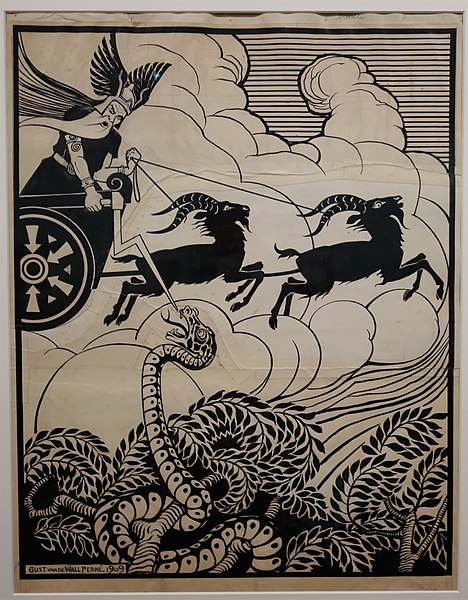
Donar by Gustaaf van de Wall Perné (1911)

Imagined Gods Versus One True Faith

Throughout history, humans have imagined thousands of gods and goddesses. Among them were Zeus of the Greeks, Venus of the Romans, and Thor of the Vikings. And there were countless others. Originally, God was one of the gods from Canaan, so Israel and Palestine, one of the sons of the deities El and Asherah, named Yahweh, thus a minor figure barely above the level of an angry spirit. Apart from Yahweh, the Canaanites worshipped several other local deities. Yet, due to some remarkable course of events, billions of people now believe that this former local nuisance is the all-powerful owner of the universe. And by some other remarkable incident, the Levant, thus Canaan and the surrounding area, is the cradle of civilisation, the birthplace of the Agricultural Revolution. Jericho is thousands of years older than the pyramids and the Sumerian civilisation. So, forget about Mesopotamia, Egypt and China. Our story begins there.

Humans are religious creatures. We are social animals who cooperate in groups. Sharing beliefs helps us do that. If we all believe in the magical powers of the forest spirit, we can establish rituals, such as special dances, to bond the group members. And when we expect the protection of the forest spirit when we go to war, we fight more confidently and have a better chance of winning. If you believe the forest spirit doesn’t protect you, you can easily panic and flee. However, if your belief is strong enough, you may be able to overcome adversity and persevere. Whether there is a forest spirit or not doesn’t matter. If the belief in it helps the faithful survive, it is beneficial in the struggle for survival. It is survival of the fittest rather than survival of the most accurate. The religions we have now have been the fittest in the past.

There is, however, a piece of historical evidence that atheists prefer to ignore, perhaps because they consider it irrelevant even though it is not. Somehow, the worship of the Jewish deity in all its forms survived and grew, so by now, nearly half the people believe that Yahweh, also known as The Father or Allah, is the only true God who rules our world. No one worships Thor anymore, except a few eccentrics who think that choosing a religion is like going to a supermarket and picking a faith you like. You almost hear them think, ‘Look how special I am. I worship Thor.’ A coward like Blaise Pascal, the world-famous guy who invented Pascal’s Wager, would never take up that bet. It is unlikely that Thor exists. And if he does, he must be weaker than the Christian God.

Otherwise, Thor could have prevented the Christian God from taking over his turf. Or better yet, Thor could have expanded his franchise into new regions by sending priests to convert the infidels. Pascal’s Wager is that the risk of not believing in God is eternal damnation instead of eternal bliss, while the risk of believing in God is merely wasting time in church and having no spectacular sex life, without getting a reward for that discomfort. It is thus rational to believe in God and act accordingly because the sacrifice is small compared to the possible gain. That makes Satan worshippers appear stupid. You almost hear them think, ‘Look how naughty I am. I risk eternal damnation by worshipping Satan.’

But then again, I gradually came to think there is no evidence for the existence of God and that the morality of religious people is not better or worse than that of non-believers. Even worse, people betting on God by believing something that makes no sense, only to get a reward, are morally corrupt. And if insincerity would get you in heaven, I preferred to burn in hell with the sincere. That was indeed a careless thought. I didn’t believe God existed, but if He did, He would not appreciate those grovelling worms who merely hoped to cash in their reward. At the time, I still thought of God as a He. Things took an unexpected turn later on, so the latter part of my thought might be correct. In hindsight, I had severely underestimated the risks associated with inverting Pascal’s Wager. Like Blaise Pascal, I am not a hero. If I had thought that believing something nonsensical could protect me from harm, I would have had faith.

To appreciate the long-term historical trend, you can go back 2,500 years, when the insignificant nation of Israel began to develop visions of grandeur and imagined that all the nations would receive blessings through Israel and its special relationship with that local nuisance called Yahweh. Nothing of that kind appeared to be in the making for over 500 years. But then came Paul, who turned the teachings of Jesus of Nazareth, who might otherwise have remained an obscure prophet claiming to be the Son of God, into a religion with universal appeal. Everyone could join and receive salvation, and who doesn’t want that? A suspicious mind might wonder why this unusual religion sprouted from Judaism and has gained over two billion followers 2,000 years later. But then again, God has advised us not to ask too many questions, while Christians think they already know the answer. And thanks to Muhammad, the worship of Israel’s God spread even further.

That wrathful cloud that allegedly led the Israelites out of Egypt, which then went into hiding for over 500 years to supposedly father Jesus, then 600 years later sent an angel to whisper messages in Muhammad’s ear, then waited for another 900 years to give us Martin Luther and even more confusion, and then left us in suspense for another 500 years so we could develop computers and invent the simulation argument to find out that we live inside a virtual reality and merely exist as amusement, has been the veil behind which the owner of this universe is hiding. Perhaps you are unconvinced, but even if you believe in the theory of evolution and the survival of the fittest, you must admit that of all those imagined deities, this one has won the competition by a wide margin. Who knows what the future brings, but if we look at the past, there can be only One, or perhaps none. There are a few atheists who think they are so smart, so when someone says ‘God’, they ask, ‘Which one?’ That is a silly question.

Looking at the trail of confusion, you could also have realised your beliefs were incorrect. Christianity has 45,000 branches, all claiming to be the one true faith. Only they will go to heaven. You might call it Pascal’s Nightmare. You are fuel for Satan’s furnaces forever unless one of those 45,000 is correct, and you happen to have that belief. Place your bets, ladies and gentlemen. Rien ne va plus! Islam is a bit more inclusive and promises that faithful Jews and Christians can join the party in heaven. And the Jews believe they are the chosen people. Israel’s history was one of setbacks, but Israel survived while nearly all the other nations disappeared. Israel had little military power, so the Israelites clung to hope. One day, a Messiah will come, liberate Israel, destroy its enemies, and restore its glory, which it is said it once had when David and Solomon were kings. Jesus was not good enough. He didn’t rout the Romans. And so, they kept on waiting.

Judaism, Christianity, and Islam share an apocalyptic worldview featuring a final battle between good and evil in the Holy Land. Many Christians, adherents of the Religion of Love, support Zionism to make that happen, including the murder and displacement of Palestinians. That infuriates Muslims, followers of the Religion of Peace. They hardly care how many Muslims are slain by other Muslims. To them, the suffering of the Palestinian people at the hands of the Jews is worse than any atrocity in the history of humankind, including the Crusades.

The Book of Revelation raves about 144,000 Jews protected from divine judgment who would convert the other Jews to Christianity and save them. It all has to happen in the Holy Land in the End Times, the Christian Zionists think, so the Jews must move back to Israel and kick out the Palestinians. Some religious Jews would like to blow up the mosque on the Temple Mount and replace it with a proper house of prayer. Perhaps that will kick off the End Times.

So what about that final battle between good and evil? John’s utterings reveal a precise location and suggest it will materialise at a place named Armageddon near the border between Israel and the West Bank, where the armies of the world will gather. Depending on which side you are on and the mushrooms you have consumed, you may see those forces gathering. There have been wars since time immemorial in the area, but since the inception of the state of Israel, the number and intensity of wars in the Holy Land have significantly increased. But why would it be now? If you are neutral, sober or not religious, you may see a bunch of religious crazies fighting for a small patch of land that is not particularly worthwhile. Is this the End Time? Only God knows.

Latest revision: 6 September 2025

Featured image: Donar by Gustaaf van de Wall Perné (1911). Public Domain.

What Are The Odds?

The law of large numbers

On 11 November 2017 (11-11), I went to Groningen with my wife and son by car. While driving, I noticed the date and time displayed on the car’s clock. The date was 11-11, and the time was 10:35. It made me think, ‘Wouldn’t it be nice to look at the clock at exactly 11:11 today because it is 11 November (11-11).’ Within a second, I noticed the distance recorder standing at 111.1. It had been 111.1 kilometres since I last filled up. Peculiar coincidences can occur by chance. With eight billion people on this planet and so many things transpiring, these things happen.

An example illustrates this. Imagine you have five dice and make a throw. A remarkable incident is throwing five sixes. If you roll the five dice only once, it probably doesn’t happen. On average, it only occurs once every 7,776 times. But if you throw the dice a million times, it happens 128 times on average.

If a reset of the distance recorder occurs every 500 kilometres, the chance of 111.1 kilometres appearing on it is one in 5,000. The distance recorder was not far from the clock, so I would probably have noticed a peculiar number on it after seeing the date. The probability of the distance recorder being on 111.1 might have been 0.02%. The likelihood of the thought about 11:11 popping up on 11 November is difficult to establish, but in my case, it was not low.

The birthday problem demonstrates strange coincidences happen more often than we might think. If you share a birthday with another person in a small group, it might strike you as odd, but the chance of someone sharing a birthday with another person is already 50% in a group of 23. However, two people sharing a birthday is not a mind-blowing coincidence. It is not as remarkable as the incident with the distance recorder.

When you are a member of this group, the probability of you being one of the persons sharing a birthday is much smaller, namely 6%. Meaningful coincidences are likely to happen, but less likely to you. So, if many people experience the same and think it is merely a coincidence because coincidences occur more often than you might think, they suffer from what you might call a collective delusion. Imagine a group of 24 all sharing a birthday with one other group member, so they share 12 birthdays, and they all think, ‘Nothing exiting to see here. The odds of me sharing a birthday with another person in this group are over 50%.’

Taking a smaller sample reduces the likelihood of meaningful coincidences. If you randomly pick two people, the chance of them having the same birthday is only 0.3%. So, if you run into someone else who happens to share your birthday, and it happens again with the next person, it is noteworthy. If it happens another time with the following individual, you might wonder whether there is more to this universe than mere chance. The more elaborate a scheme, the less likely it is to transpire. The probability of three people sharing a birthday in a group of 23 is 1.3%, and for five, it is only 0.0002%. If your life is riddled with elaborate, meaningful coincidences, you might start to believe that you have a critical role in the universe.

Possible avenues to circumvent the law of large numbers

There may be a way to find out there is no such thing as coincidence. If some of the most significant historical events come with peculiar coincidences, that might be more telling for two reasons. First, there are only a few, so the law of large numbers doesn’t apply. After all, it is a small sample. Suppose no intelligence is coordinating events in this universe. In that case, it is less likely that meaningful coincidences will turn up in this sample, and elaborate schemes will be unlikely to emerge. Second, if the most significant historical events come with peculiar coincidences, it becomes more likely that history is scripted than when peculiar incidents transpire in someone’s personal life.

To make the argument, you need to answer questions like, what are the most important historical events, and what are peculiar coincidences? Events such as the sinking of the Titanic or the Kennedy assassination might not qualify, even though the coincidences surrounding them form a strange and elaborate scheme. The extent of these schemes might compensate for that, but it is hard to tell. The beginning and the end of World War I meet the requirements. D-Day, the fall of the Berlin Wall, and the terrorist attacks of 11 September 2001 are among the most important historical events.

And what should I think of the number of meaningful coincidences in my life? It is not possible to establish the likelihood of that happening. You can make assumptions to arrive at an idea. A highly unusual coincidence, such as the do-it-yourself store incident, could be likened to throwing five sixes with five dice. The chance of such an event happening in any year in any life could be one in 7,776. If something similar transpires again that year, it is like throwing five sixes twice in a row. The chance of that would be one in 60,000,000. On average, 120 people would experience something similar each year. But what if more similar incidents occur in one life? Or if 100,000 people have this instead of 120?

I have shared a few of my coincidence stories on the Reddit/SimulationTheory message board. Others also experience similar situations. Only the people on that message board are not a random group, but a select group of individuals who believe we live in a simulation, often because they have witnessed similar phenomena. Some of these stories are as remarkable as mine. I can’t verify these tales, but I believe most aren’t frauds because similar things happened to me. The question remains whether they have seen strange incidents occurring in the numbers I have seen.

There is a point where you must admit that these things are not merely coincidental. We can’t establish that point objectively. The number of possible unusual events is infinite, so the chance of something strange happening, such as the do-it-yourself store incident, could be higher than we intuitively think. It seems impossible to accurately estimate the odds. Still, without intelligence coordinating events in this universe, we should expect these incidents to be distributed more or less evenly across all people and time frames.

Even then, significant deviations from the average are possible. Lightning strikes only a few people. It happens to some people twice, which might seem odd, but there is nothing suspicious about that. If lightning strikes one in 10,000 people once, then one in 100,000,000 gets hit twice. But how would you explain if one person ran into lightning ten times, and this individual did nothing unusual? Statistically, it can happen. More likely, there is a cause, such as living in a dangerous spot. There is a point where we must assume these stories are evidence of us living in a simulation. We can’t establish that point precisely, but whether we live inside a simulation or not doesn’t depend on our assessment. We are, however, inclined to see causes behind remarkable situations or events, but they may be accidental.

The limits of our minds

We are good at attributing causes, but we do poorly at estimating the likelihood of an event. The psychologist Daniel Kahneman provided an example. It is a study of the incidence of kidney cancer in the counties of the United States. The research revealed a remarkable pattern. The incidence of kidney cancer was the lowest in rural, sparsely populated counties in traditionally Republican states in the Midwest, the South, and the West.1 So what do you make of that?

You probably came up with reasons why kidney cancer is less likely to occur in these counties, such as a healthy rural lifestyle or low pollution levels. You probably did not think of randomness. Consider then the counties in which the incidence of kidney cancer is the highest. These counties were also rural, sparsely populated, and in traditionally Republican states in the Midwest, the South, and the West.1

How can that be? Those counties all had small populations. And with smaller samples come more sizeable deviations from the average. Our intuition makes connections of causality, but our reason does not verify whether it could just be randomness. We like to think some cause makes unusual things happen, while they might be random accidents.

When we consider the most significant historical events, we run into problems if we use this small sample to establish that someone is ‘writing history’. On the other hand, comparing this sample to a sparsely populated rural county may not be apt. It is more fitting to compare this sample to the royal family, as it encompasses the most significant events in history. If a high incidence of kidney cancer were to turn up in the royal family, an experienced physician would tell you it is probably not a random issue.

I am a single individual, the smallest possible sample. Some people get struck by lightning twice. It could even happen three or four times, but the chance of it happening ten times is so insignificant that no one will ever experience that unless they live in a hazardous spot. Is the number of meaningful coincidences in my life enough to rule out chance? That number is extraordinarily high. It is not chance. The question arises: Am I just a random individual, or do I live in a dangerous location, or has destiny given me a unique role, such as proving that we live in a simulation? Others have this, too. And so, a lengthy series of peculiar incidents doesn’t suffice to believe the latter.

The things that could have happened but did not

In 1913, the ball fell on a black number twenty-six times in a row at the roulette wheel at the Casino de Monte-Carlo. Some people lost a fortune by betting the ball would fall on red the next time. They did not realise the chance of the ball choosing a red number never changed. The ball does not remember where it went the previous times. If we represent black with a B and red with an R and assume, for simplicity’s sake, there is no zero, we can write down falling twenty-six times on black like so:

B B B B B B B B B B B B B B B B B B B B B B B B B B

The probability of the ball falling on black twenty-six times in a row is one in 67,108,864. That is a long shot. What might surprise you is that the following combination of black and red numbers is precisely as likely to occur:

R B B R B R R B R B B R R B R R B R B B R R B B R B

You wouldn’t be thrilled if that happened unless you became a millionaire by betting on this particular series of twenty-six. And even then, you wouldn’t think of the 67,108,863 sequences that did not materialise. We tend to consider only the things that did happen, but we rarely think of all the things that could have transpired but didn’t. Events such as the ball falling on black twenty-six times in a row impress us. And I am even more impressed because twenty-six happens to be my lucky number.

This argument applies to meaningful coincidences but not to a prediction materialising, as such a feat may imply that all the other things couldn’t have happened. If I say with firm conviction that the coming sequence of black and red would be R B B R B R R B R B B R R B R R B R B B R R B B R B and it happens as I predicted, I may have the gift of prophecy. The chance of me being accidentally right was one in 67,108,864.

Imagine the probability of you sitting here reading this page on a tablet or a mobile phone, but as a prediction from 3,600 years ago. Imagine Joseph telling the Pharaoh: ‘I see (your name comes here) reading a pile of papyrus pages, not real papyrus pages, but papyrus pages appearing on something that looks like a clay tablet. Do not be afraid, dear Pharaoh, for it will happen 3,600 years from now. But if we do not set up this grain storage, it will not happen, so we must do it. And by the way, Egypt will starve otherwise.’

The chance of this prediction coming true was not one in 67,108,864, nor was it one in 1,000,000,000,000,000,000,000. Adding more zeroes doesn’t help. The chance is far smaller than any number you can ever write down. It is so close to zero that no one can tell the difference. Nevertheless, you sit here reading this text, perhaps even on a tablet. How could this happen? The answer to this mystery is that many things could have occurred but did not; however, something had to happen, and that is what transpired. In any case, Joseph couldn’t have made such a prediction by accident.

The licence plate number

What about the reference to the end date of World War I on the licence plate of Franz Ferdinand’s car? Few historical events are as significant as the start and end of World War I. And so, the law of large numbers doesn’t apply here. It is one of the most important historical events, thus part of a sample comparable to the royal family. A mere accident seems unlikely. The assassination could have gone wrong; cooler heads might have prevailed, or the war could have proceeded differently, ending on a different date.

It might have been possible to guess the end date of World War I once it had started. If you presumed that the war would not take more than twenty years, a random guess of the end date could be correct one in every 7,305 times. But something doesn’t add up here. Hardly anyone expected the war to last longer than a few months. The licence plate originates before the war. The assassination succeeded after a series of mishaps. If the licence plate number contained a prediction, that prediction included the assassination succeeding, Franz Ferdinand dying in this particular car, and this event being the trigger for the war.

That is hard to do. And so Mike Dash in the Smithsonian noted, ‘This coincidence is so incredible that I initially suspected that it might be a hoax.’2 Only, it is not a hoax, so investigative minds could have probed other options, but they did not. Conspiracy theorists also ignored it, even though this incident agrees with their beliefs of a secretive plan being behind history.

In the conspiracy scene, a story circulates about a Freemason named Alfred Pike, who allegedly disclosed a secretive plan of the Freemasons to bring about the New World Order. Pike supposedly predicted both world wars with uncanny precision in 1871. Nobody had ever heard of this plan before 1959, when an ‘investigator’ ‘uncovered’ it. Contrary to the licence plate number, the story has no substance. It is a hoax. In the Netherlands, they would call it a monkey sandwich story.

Seeing meaning

Authors use symbolism, hidden meanings, themes, and stylistic figures. Events in their lives, as well as the writings of other authors, influence their writings. Literary critics look for those meanings. You can check out what experts wrote about the poem The Waste Land by T. S. Eliot. You will be surprised. Some authors marvel at what literature critics discover in their works. Apart from intention, there can be an unconscious influence. And so, seeing meaning is more like an art than a science. A scientist would argue there is no proof and that it is baseless speculation because science isn’t about meaning.

He spent a number of years at this project
And now he knows how an electron behaves

The Nits, Mountain Jan

You can’t understand intentions and meaning from investigating the conduct of electrons. Meaning in literature is often intentional. If someone wrote the script running the events in this world, the author might do what other authors do. And so, the licence plate number on Franz Ferdinand’s car could signal foreknowledge of future events or even control over them. The sceptics argue from a scientific perspective, while those who see meaning act like literary critics. Who is right about the meaning of AIII 118 depends on whether there is a script and, therefore, an author.

Sceptics might claim that AIII 118 is a random sequence of characters, but we see a reference to the end date of World War I. That is how our minds work. The argument is odd. If you take it to the extreme, this text is also a random array of characters, as is any book or report. And still, you read words and sentences that have meaning to you. Indeed, the licence plate number would have remained unnoticed if the war had not ended on 11 November 1918.

However, the war ended on 11 November 1918. AIII 118 is the car’s licence plate number that drove Franz Ferdinand to his appointment with his destiny. And destiny is the message the licence plate number radiates. It suggests premeditation concerning the assassination, the start of the war and its end on 11 November 1918. That is a meaning we can see without too much imagination. There are plenty of instances and locations where this sequence of characters could have turned up, so their presence in this particular spot is noteworthy. AIII 118 on a fish barrel in Vienna wouldn’t have attracted attention. Ditto for the licence plate number ABII 117 on that particular car.

Sceptics can also be fanciful. Austrians speak German. Armistice in German is Waffenstillstand. So why does it not read WIII 118? Or even better, W1111 1918? If someone sends you a message, you don’t quibble about such details. If I said ‘hello’ to you, you wouldn’t ask me why I didn’t utter the word ‘hi’ instead. That is, unless you are a philosopher with a lot of idle time and have a hobby of questioning everything. Great Britain, the United States and France were all major participants in the war. These countries all use the term armistice. And if the sceptics come with outlandish arguments, you have won the argument. Only, they disagree. Not seeing meaning is the art of being a moron. Communication with morons is, therefore, problematic.

Asking yourself which licence plate numbers were available in the Austrian-Hungarian Empire may be a better idea. You could check which combinations fit the purpose. There aren’t that many options. Perhaps, you end up with just one match: AIII 118. That makes it harder to believe that this sequence of characters is meaningless. This scheme became even more inconceivable because the war ended on 11 November (11-11), the most peculiar date of the year.

Only a few historical events are as important as the assassination of Archduke Franz Ferdinand and the Armistice of 11 November 1918. You can think of D-Day, the fall of the Berlin Wall, and 9/11. The coincidence scheme surrounding D-Day is extensive, and the recurrence of dates is intriguing. The involvement of Hans van Mierlo is also mind-boggling. It also relates to the Curse of the Omen, a film released on the anniversary of D-Day, as well as the untimely passing of Senator Robert Kennedy on 6 June (6/6) and Martin Luther King on 4 April (4/4) 1968. A historian correctly predicted the fall of the Berlin Wall in 1989, while the coincidences surrounding the terrorist attacks of 11 September 2001 are dumbfounding. In other words, this incident doesn’t stand alone.

A final argument may be that such extensive or peculiar coincidence schemes don’t appear in other historical events that are equally significant, such as the American, French, Chinese, and Russian revolutions. These events are marked by a few peculiar coincidences, such as Thomas Jefferson and John Adams having their appointments with the Grim Reaper on the same day, which happens to be 4 July, thus Independence Day. That is noteworthy, but perhaps not sensational. The parallels between Napoleon Bonaparte and Adolf Hitler might also raise some questions. Somehow, the licence plate number of Franz Ferdinand’s car is more exceptional, most notably because of it being so precisely predictive.

The Chinese Revolution of 1911 began on 10 October 1911. It marked the end of 2,000 years of imperial rule in China. The date, 10 October (10/10), is not as remarkable as 11 November (11/11), even more so because there are no related coincidences. The Russian Revolution led to the establishment of a communist empire that lasted for seven decades. A bad omen marked the coronation of the last Czar of Russia, Nicholas II. The communists later murdered him and his family. You can ask why these events don’t seem part of a coincidence scheme. It is like asking why several members of the Royal Family don’t have kidney cancer. Well, they haven’t. That’s all there is to it. Perhaps, it is not satisfactory to philosophers with a lot of time on their hands, but it will have to do.

Hindsight bias

And then there is the benefit of hindsight. Countless strange incidents could have occurred, but they didn’t. We notice only things that did happen and don’t think of those that didn’t. That is hindsight bias. The sample of the most significant historical events comes with the benefit of hindsight. There is a danger to that approach, and it is unacceptable in science. It is like selecting only the data that confirms your theory. You might have a theory about gravity, saying that all objects will fall to the ground. And you prove your theory by ignoring the heavenly objects and the birds in the sky, so everything you investigate falls to the ground. It later turned out that gravity works that way, and ignoring the heavenly objects and the birds in the sky put you on the right track.

With hindsight, you know things you can’t learn in advance. Hindsight knowledge is also a favourite tool of critics when something goes wrong. However, when you use hindsight to find evidence, your critics argue you can’t. That’s how the critics play their game. They might clip a bird’s wing feathers and then ask the bird to prove it is a bird by flying. But if you use clipped birds to prove your theory of gravity, they might criticise you for that as well. You can’t beat your critics in their game. No evidence will ever convince them. So I won’t try. This wasn’t science in the first place, but metaphysical speculation.

Using hindsight, thus, is the only way to conduct this investigation, as we can’t predict the occurrence of meaningful coincidences. If this universe is genuine, we can’t establish that it is authentic. However, if it is a simulation, we may discover it is a simulation. So, if there is meaning, we must look for it to find it. We should be careful, as we are inclined to see intent when it could have happened accidentally. With that in mind, it is still fair to say that meaningful coincidences related to the most important historical events are likely not mere coincidences. Combined with the other evidence, we can establish that we live inside virtual reality, probably a simulation created by an advanced post-human civilisation.

Latest revision: 24 July 2025

1. Thinking, Fast and Slow. Daniel Kahneman (2011). Penguin Books.
2. Curses! Archduke Franz Ferdinand and His Astounding Death Car. Mike Dash (2013). Smithsonian. [link]

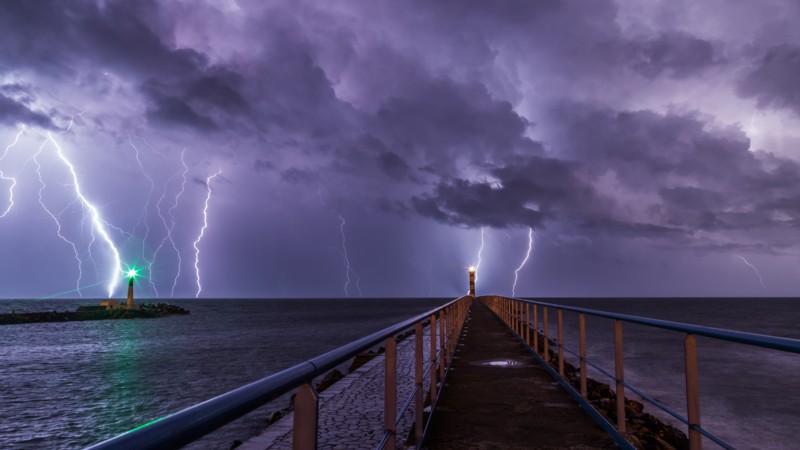
Port and lighthouse overnight storm with lightning in Port-la-Nouvelle in the Aude department in southern France. Maxime Raynal.

The Curse of The Omen

Rumours go that some films, such as The Poltergeist, Superman, and Rosemary’s Baby, have been cursed. Numerous accidents have occurred, causing people to believe that these films have a jinx.1 Not all of these arguments are particularly convincing, as accidents happen. They usually have no relation to a movie, even when several actors of the same cast have had bad luck. However, there is one noteworthy exception, the infamous curse of The Omen, the curse of curses in the film scene.

Danny Harkins wrote on Cracked.com: ‘No film in history has had worse luck than The Omen. Hell, nothing in history has had worse luck than The Omen.’2 The Omen came with billboards featuring a 666 logo inside the title and the uplifting slogan, ‘You have been warned. If something frightening happens to you today, think about it. It may be The Omen.’ And the cheery notice, ‘Good morning, you are one day closer to the end of the world,’ and a conclusion stating, ‘Remember, you have been warned.’

In the script of The Omen, the wife of the American ambassador to Italy gave birth to a son. The child died almost immediately. A priest then convinced him to switch his son with an orphan without telling his wife. Mysterious events soon started to haunt them. The child turned out to be the Antichrist. The Omen was first released on 6 June 1976 (6/6), also the anniversary of D-Day. The date refers to the number 666, as the last digit of 1976 is also a 6. The film’s length is 111 minutes, thus a triple-digit number like 666.

These ominous ingredients made The Omen an ideal candidate for a hefty curse. Two months before the filming started, the son of lead actor Gregory Peck committed suicide. In the film, he is the father of the child who died. When Peck went to the film set of The Omen, lightning struck his plane. A few weeks later, lightning struck executive producer Mace Neufeld’s flight. A lightning bolt in Rome just missed producer Harvey Bernhard, which you might call unbelievable luck, but the number of lightning bolts involved was also incredible. Later, the IRA bombed the hotel in which Neufeld was staying.1 He also survived that.

A plane hired by the studio to take aerial shots was switched at the last moment by the airline. The people who took the original aeroplane were all killed when it crashed on take-off. That is, again, incredible luck, but if you think there is a curse in operation, it is eerie nonetheless. An animal handler who worked on the film set died two weeks after working on the film when he was eaten alive by a large feline, possibly a tiger.1

And then there is the non-fatal accident of Stuntman Alf Joint that seriously injured and hospitalised him when a stunt went wrong on the set of A Bridge Too Far in Arnhem in the Netherlands, less than a year after the production of The Omen. He jumped off a building and missed the inflatable safety bags. It nearly killed him. Joint said he felt a push even though nobody was near him.1 These accidents weren’t exceptional. These things happen. Their number might be noteworthy, but so far, they are not evidence of the infamous Curse of the Omen.

However, the following should make you wonder. On Friday, 13 August 1976, special effects consultant John Richardson drove through the Netherlands with Liz Moore. Both were working on A Bridge Too Far. They became involved in a car accident that killed Moore. The gruesome accident is said to have been eerily similar to a scene Richardson had designed for The Omen. The story goes that the accident happened near a road sign stating a distance of 66.6 kilometres to the town of Ommen, a name very similar to Omen. And it happened on Friday the thirteenth.1 Now, that begins to look like a curse.

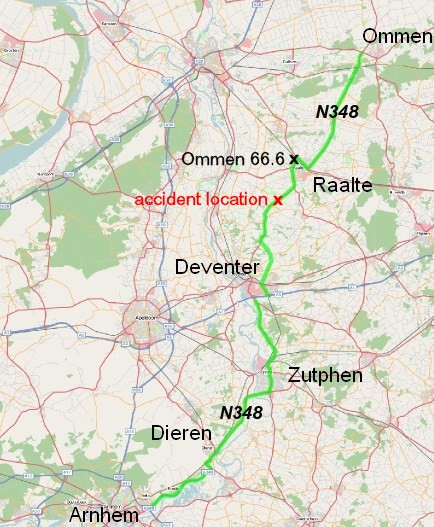
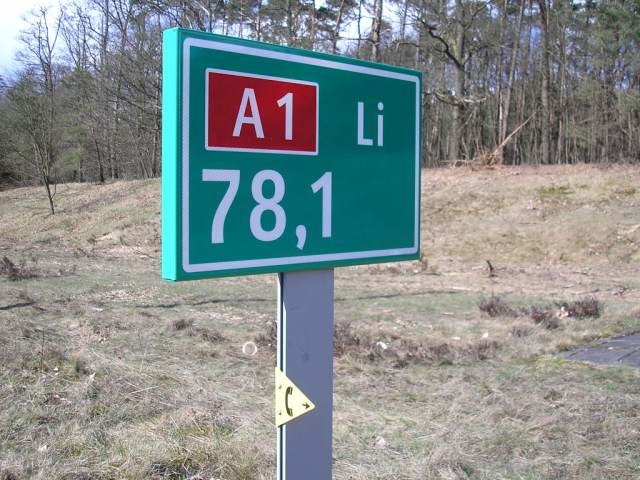
That caught my attention. Road signs in the Netherlands don’t give distances in fractions of kilometres. Only kilometre markers come with fractions. Near Raalte is a junction where Route N348 to Ommen meets Route N35, connecting to Enschede via Nijverdal. This location corresponds with kilometre marker 66.6 on Route N348. I am familiar with the area because I lived nearby, in Nijverdal, as a child. Road signs indicating the direction to Ommen are near this Anti-Christ marker, which I first noticed after returning from a funeral. It appeared to me that this junction should be the site of the crash.

Route N348 from Arnhem to Ommen

And so I came to investigate the curse. In 2015, I started an inquiry. A journalist from the local newspaper, De Stentor, helped me. He delved into the issue and emailed me on 14 April. He had managed to find a former police officer from the area. According to the police officer, the accident indeed occurred near Raalte on Route N348, but not at the intersection near marker 66.6, but between Raalte and Deventer, near Heeten, where Route N348 intersects with the Overmeenweg. This location corresponds with the kilometre marker 60.0. The police officer told the journalist he remembered the car crash very well.3

According to the police officer, the accident happened when he was on duty. A man and a woman had parked their car in a parking lot alongside Route N348. When they drove away in the direction of Deventer, they entered the wrong lane and collided head-on with an oncoming vehicle driven by a resident of Nijverdal. The view was somewhat limited because of two gentle curves in the road. He added that there was no road sign with ‘Ommen’ near the crash site.3

The woman died on the spot. The car was destroyed and disposed of at a fire station. It turned out that the couple were foreigners involved in the production of A Bridge Too Far, the police officer told the journalist. He suspected that Richardson, accustomed to driving on the left side of the road, was not paying attention to the traffic.3

On television, Richardson said, ‘It was certainly very odd because it happened on Friday the thirteenth.’ He added, ‘Right opposite the point where the accident happened, was an old mile-post with nothing but sixes on it.’ He also noted, ‘What spooked me even more was when I discovered it was on a road to a place called Ommen.’ It appears that Richardson has misread kilometre marker 60.0 and has taken the zeroes for sixes. The numbers might have been worn out if it were an old post, like Richardson said.

Kilometre marker at the A1 at km 78.1. Public Domain.

Producer Alan Tyler, who made a documentary about the curse of The Omen, noticed odd things while working on it. The strangest thing was that he had two different camera crews filming in separate locations, but all the footage showed the same fault. It did not seem satanic to him, but it made him wonder. It is at least remarkable that kilometre marker 66.6 is near a road sign stating the direction to Ommen on the same road where the car crash occurred, so I came to investigate the curse, most notably because of what happened next.

When I compiled my findings after receiving the email from the journalist, a few curious events occurred. After reading the email, I took a glance at my stock portfolio. Apart from a few mutual funds, I owned stocks in three corporations. One of them was Heymans, a constructor. It came with a quote of € 13.13. Another position was Macintosh, a retail company. I owned 500 of these, and the price was € 2.626. Hence, the total value was € 1,313. It was peculiar because the car crash happened on Friday the thirteenth. Meanwhile, Macintosh is bankrupt. Heymans’ stock dropped 60% after the company ran into trouble.

That seems a bit of a curse already, and it suggests poor stock-picking skills on my part. But there was more to come. That evening, I had an appointment with a contractor who came to make a tender for renovating my bathroom. He came from Almelo while I lived in Sneek. He cancelled because his van had broken down earlier that day. He could take two routes from Almelo to Sneek: via Nijverdal, crossing Route N348 near kilometre marker 66.6, or the alternative route via Ommen.

My Google search for ‘Ommen 666’ was linked to the Hondentrainingsneek.nl website. At first glance, it appeared to be a site for dog training in Sneek, but it seemed a bit fishy. Somehow, ‘Ommen 666’ had been inserted into topic titles such as ‘Dog Training Terry Ommen 66.6km.’5 The texts on the website were incoherent, with a few references to Ommen 66.6. It is noteworthy that I currently live in Sneek and previously lived in Nijverdal, as my enquiry revealed that Richardson crashed into the car of a resident of Nijverdal.

A final, and also highly peculiar, titbit is that my wife has a heart condition that caused her to visit the St. Antonius hospital in Sneek around the same time I began investigating the curse. Her doctor’s name was Oomen, which sounds like the word ‘omen.’ She visited Dr. Oomen several times over a few years and underwent an operation in 2018 at the St. Antonius hospital in Nieuwegein. Nieuwegein translates to ‘New Joke.’ There are two St. Antonius hospitals in the Netherlands: the one in Sneek and the group to which the hospital in Nieuwegein belongs. There is something odd about The Omen, or perhaps this universe, where strange incidents occur.

If you like this post, then you might also like:

History’s oddities

US Presidents Thomas Jefferson and John Adams were both involved in drafting the US Declaration of Independence that was signed on 4 July 1776. Both died on 4 July 1826, fifty years after the Declaration of Independence. There are more of such oddities in history.

Read More

11 September coincidences

What may strike you about the coincidences surrounding 11 September 2001 is that many of them could have happened accidentally but that the combination of these incidents might be too improbable to be just coincidence.

Read More

Featured image: Port and lighthouse overnight storm with lightning in Port-la-Nouvelle in the Aude department in southern France. Maxime Raynal from France. CC BY 2.0. Wikimedia Commons.

Other image: Route N348 from Arnhem to Ommen. User Michiel1972 (2007). Wikimedia Commons.

1. Curse of The Omen and other Hollywood hexes. Barry Didcock (2012). Scotland Herald. [link]
2. The Insane True Stories Behind 6 Cursed Movies. Danny Harkins (2008). Cracked.com. [link]
3. Email exchange with De Stentor. Theplanforthefuture.org. [link]
4. Curse or coincidence?… ‘Conspiro Media’ re-examines the grisly chain of events connected to those involved in the ’70s horror flick, ‘The Omen’… Matt Sergiou (2014).
conspiromedia.wordpress.com. [link]
5. Dog training Terry Ommen 66.6km. Theplanforthefuture.org. [link]