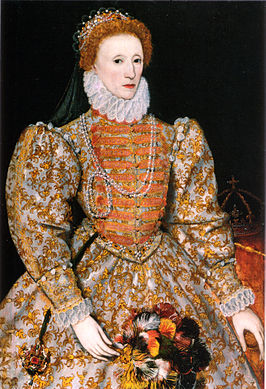
The "Darnley Portrait" of Elizabeth I

History is Her Story, Part 2

God can become an ordinary person to play a role in Her story. Several well-known women in history may have been avatars of God. This is the second episode. The first episode can be found via the following link: History is Her story part 1.
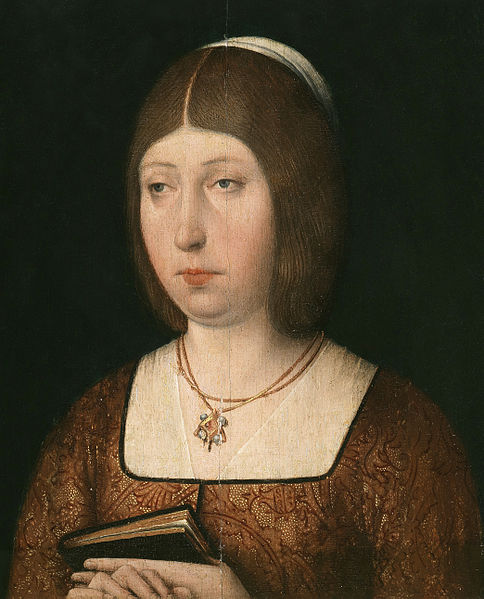
Isabella I Of Castile
Isabella I Of Castile.

Isabella I of Castile

We learned who discovered America, but not the person behind the scenes who financed his mission and made it happen. And by the way, the same person who sent Columbus on his journey also created Spain. Queen Isabella I (1451-1504) was Queen of Castile and one of the most influential historical figures. She was the second child of King John II of Castile. At the time, two countries, Castile and Aragon, dominated the area. Isabella’s half-brother, Henry, was the heir to the throne.

Isabella became a pawn in Henry’s political ambitions. He forced Isabella into several betrothals and attempted to marry Her to King Alfonso V of Portugal. Later, as part of an agreement to restore peace after a rebellion, Isabella was to be betrothed to Pedro Giron, Master of the Military Order of Calatrava. Isabella prayed that the marriage would not take place. Don Pedro suddenly fell ill and died on his way to meet Isabella. That prayer worked better than voodoo.

Henry didn’t have a male heir. Isabella made Henry sign an agreement, making Her his successor to the throne. Henry made another effort to arrange a marriage, but Isabella refused and secretly arranged a wedding with Ferdinand of Aragon. In doing so, Isabella created Spain by uniting both kingdoms. After Isabella secured the throne, She initiated several successful reforms in government, finance, legal code, and policing.

Isabella’s actions had a lasting impact on world history. Her political manoeuvring in dynastic politics created Spain. Isabella sponsored Christopher Columbus’s mission to reach the Indies by sailing west. On his way, Columbus bumped into America. A film about this event is titled 1492: Conquest of Paradise. That is noteworthy for two reasons. First, there is the word Paradise. And second, the number 1492 refers to the initials and possibly the birthday of this peculiar Lady. That might be a clue.

Katharina von Bora

Katharina von Bora (1499-1552) was the wife of Martin Luther, who initiated the Protestant Reformation. Katharina had several suitors, but none of them became Her husband. She told Luther’s friend and fellow reformer, Nikolaus von Amsdorf, that She would be willing to marry only Luther or von Amsdorf. Luther was unsure whether he should marry at all. A woman who wanted him made him change his mind. As Roman Catholic priests were celibate, their marriage set a precedent for Protestant family life and clerical marriage.

Von Bora had been a nun interested in the Protestant Reformation and dissatisfied with cloistered life. Conspiring with several other sisters, Von Bora contacted Luther. They asked for his assistance. Luther sent a merchant who regularly delivered herring to the convent. The nuns escaped by hiding in his covered wagon among the fish barrels.

Von Bora bred and sold cattle and ran a brewery to provide for their family, the numerous students who boarded with them, and her husband’s visitors. During epidemics, she operated a hospital with a staff of nurses. Luther called her ‘Boss of Zulsdorf’ after the farm they owned. Based on Luther’s descriptions, his wife, whom he nicknamed ‘Herr Käthe’, exerted control over his life like a master.

After Martin Luther died in 1546, Von Bora’s fortunes turned sour. Wars destroyed Her property, and She became impoverished. She fled due to war, the Black Death, and crop failures. During Her last flight, she was thrown from her cart into a watery ditch and fell ill. She reportedly said on her deathbed, ‘I will stick to Christ as a burr to cloth.’ Does it mean, ‘See you again in the next life?’

Many Protestants and Germans consider Martin Luther a prophet. And prophets might be married to God. The book The Virtual Universe discusses the assassination of Martin Luther King on 4 April 1968 as part of an elaborate coincidence scheme that includes the Lincoln and Kennedy assassinations. King’s last name might imply that Martin Luther was a king like Jesus, thus a prophet of great importance.

The
The “Darnley Portrait” of Elizabeth I

Elizabeth I

Queen Elizabeth I of England (1533-1603) was one of the most successful monarchs in history. Her reign laid the foundation for the Anglo-Saxon world domination. She depended on trusted advisers like William Cecil. She also established the Church of England, a Protestant Church with Catholic elements, of which She became the supreme governor. Elizabeth was moderate and religiously tolerant.

Great Britain became a great power. Elizabeth was cautious in foreign politics, tried to avoid conflict, and half-heartedly committed to the wars England fought. In 1585, England could no longer avoid war with Spain because it had supported the Dutch in their fight for independence from Spanish rule. In 1588, the English defeated the Spanish Armada, and the remainder of the fleet sank in a storm, marking the end of Spanish dominance over the seas and paving the way for British supremacy.

A curious sequence of events led to Elisabeth becoming Queen of England. Upon hearing of Her accession to the throne, She reportedly quoted the twenty-third line of the 118th Psalm: ‘It is the Lord’s doing, and it is marvellous in our eyes.’ Elizabeth’s unmarried status inspired a cult of virginity. She said She was married to England like God was married to Israel. Some poetry and portraits depicted Elisabeth as a virgin goddess.

Computable article about Armada
Computable article about the Armada

During a walk in 2009, I pondered whether or not Elizabeth had been an avatar of God. When I returned home, there was a copy of the weekly magazine Computable in the letterbox. The front page featured an article about a distributed database system called Armada. That might be another hint.
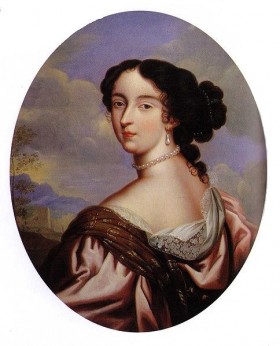
Françoise d'Aubigné, Marquise de Maintenon
Françoise d’Aubigné, Marquise de Maintenon

Françoise d’Aubigné

Françoise d’Aubigné (1635-1719) was the second wife of King Louis XIV, also known as the Sun King. He was vain and waged numerous wars. His lavish Palace of Versailles had no equal. Louis’ magnificence was over-the-top and equally unparalleled. His reign lasted over 72 years, the longest of any sovereign in recorded history. During his first marriage, he had several mistresses.

Louis was more faithful to his second wife, Françoise d’Aubigné. Françoise never became queen, but She had considerable clout in the royal court. Louis was also pious. He saw himself as the protector of the Catholic Church. He made his devotions daily regardless of where he was. Under Françoise’s influence, Louis became even more religious.

Louis XIV was the epitome of the divine right of kings. This doctrine states that the king is appointed by God and, therefore, not accountable to anyone except God. That doctrine might come in handy for the Messiah in the end times. A quote attributed to Louis is, ‘The state, that is me.’

As a teenager, I was a member of the School Council. The school bureaucrats had lengthy discussions after the Financial Commission had overstepped its bounds. One of them argued that it was a the-state-that-is-me situation. It could be a hint that Louis was God’s husband. I doubted it, and tossed a coin, and Françoise made it to the list. Another toss of a coin eliminated Catherina the Great from the list.
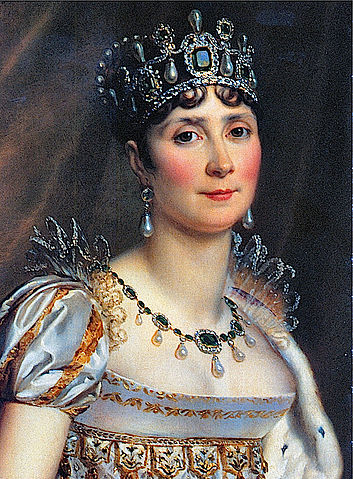
Empress Josephine in Coronation Robes
Empress Josephine in Coronation Robes. François Gérard

Joséphine de Beauharnais

Joséphine de Beauharnais (1763-1814) was the first wife of Napoleon Bonaparte. She was his greatest love. After the execution of Her first husband during the French Revolution, She had affairs with several leading political figures. Napoleon, who was six years younger, fell in love with Her and sent Her many love letters. Napoleon’s love for Joséphine cooled somewhat after discovering She had a lover on the side. He then began affairs with other women but remained in love with Joséphine and married Her.

Napoleon Bonaparte’s lasting legacies include the civil registries with first and last names, the metric system (metres, grammes, and litres), and legal reform, embodied in the Napoleonic Code. The well-structured and accessible law code was a milestone, replacing a patchwork of feudal laws. It has influenced the whole world. The Napoleonic Code is the most widely adopted legal system. About 120 countries use it, but not Great Britain, which also rejected the metric system.

Napoleon was not a favourite of the British, or perhaps it was a British conservative attachment to incoherence and feudal institutions, so they held on to their lords, laws, miles and pints. Unlike the rest of Europe, the British now drive on the wrong side of the road and have left the European Union to rid themselves of David Cameron. He later returned as Minister of Foreign Affairs, so Brexit failed. Napoleon tried to unite Europe, and that project appeared close to succeeding.

Through the children from Her first marriage, Josephine became the grandmother of Napoleon III and the great-grandmother of Swedish and Danish kings and queens. The reigning houses of Belgium, Norway and Luxembourg also descend from Josephine. She, however, didn’t give Napoleon any children. Napoleon believed he needed an heir, so they divorced. Napoleon then married Marie Louise, an Austrian archduchess. It was not love that drove him, but calculation. Marie Louise bore him a son who died at the age of 21. His family line died out, so the divorce proved pointless. Her family line lived on. Napoleon’s last words on his deathbed were, ‘France, the army, the head of the army, Josephine.’

There are some remarkable parallels between Napoleon Bonaparte and Adolf Hitler. Napoleon Bonaparte was born on the island of Corsica, which became part of France. Later, Napoleon Bonaparte became the leader of France. Adolf Hitler was born in Austria, a country that became part of Germany. And Adolf Hitler became the leader of Germany. Both men were involved in a coup on 9 November (9/11 in European notation). Both started a military campaign in Russia that led to their downfall. That emboldened the current leadership in Russia, leading them to think they are safe in Moscow.

Napoleon Bonaparte and Adolf Hitler both came to power by a coup, ending an unstable republic. They both turned Europe into a battlefield. Both ventured into Africa, and both faced defeat in Egypt. They both waged war on two fronts because they attacked Russia after failing to defeat England. These parallels are intriguing as if Hitler were Napoleon’s reincarnation. Their wives were noteworthy as well. Concerning Josephine de Beauharnais, I didn’t receive a hint, but the thought isn’t far-fetched. Informed deduction is impossible anyway, leaving me with guessing the obvious.

Lucretia Garfield
Lucretia Garfield. Library of Congress.

Lucretia Garfield

Lucretia Garfield (1832-1918) was the wife of US President James A. Garfield. A disgruntled public office seeker assassinated him in 1881, shortly after he took office. He lingered in the Twilight Zone for two and a half months before dying. Lucretia stayed at his bedside and received public sympathy, which might be ill-deserved, as it now turns out. They were both 26 when they married on 11 November 1858, referencing 11:11. During the Civil War, James Garfield had an affair as a general.

He later confessed it to his wife, who seemingly forgave him. On 12 January 2010, a previously unknown $10,000 life insurance policy on President Garfield’s life surfaced in a family scrapbook.1 Lucretia Garfield had opened it 45 days before the assassination of Her husband. It is a most notable coincidence that might indicate foreknowledge.

My son was fond of the comic character Garfield. In 2006, a mysterious parcel addressed to him was delivered to us by mail. It contained some Garfield items, including a coffee cup with the lettering ‘It is good to be king.’ The sender of the parcel was unknown. We made several enquiries, but nobody conceded to having sent it. Until today, the sender remains unknown. That might be a clue.

Eurocentrism

This list is Eurocentric. Most people on the list come from Europe. Eurocentrism emphasises European culture or Western ideas and theories without much regard for other cultures. That can offend people from different cultures and the Woke. For the last 500 years, most of the action has centred in Europe, and today’s world is so profoundly affected by European ideas and culture that you might call the world European. Those who oppose Eurocentrism propose eccentric ideas like the knowledge of indigenous peoples being on equal footing with science invented in the West. They suggest that if you have AIDS or cancer, you don’t need to take the treatments invented by science, but you might as well consult your local witch doctor.

As a cultural relativist, I don’t believe Western culture is superior. It set in motion a process that is about to end human civilisation. That is also what the tale of the Fall says. We would have been better off running naked in the jungle. If it had been up to me, the list would have been more diverse, but I don’t make the decisions. After watching the Netflix documentary about Queen Nzinga of Ndongo and Matamba and reading her life story on Wikipedia, I found her to be a worthy candidate for being an avatar of God and better suited than some of the women on the list. Nzinga could fill a gap between Queen Elizabeth I and Françoise d’Aubigné. And I tried to fill in the gaps on the list.

More than filling a hole is required to qualify. Nzinga’s life story didn’t provide clues to work with, like Queen Isabella I, who prayed that her marriage would not come to pass, and then her suitor died. Nor did a noteworthy coincidence happen, like with Queen Elizabeth I, when a magazine featured an article about a database system called Armada. Again, I tossed a coin, which was my favourite way of resolving such matters, but the outcome suggested God didn’t want me to think that Queen Nzinga had been Her avatar. Catherine the Great would also have made a proficient gap filler. She also didn’t make it to the list.

Latest revision: 15 July 2025

Featured image: The “Darnley Portrait” of Elizabeth I. Wikipedia. Public Domain.

1. https://commons.wikimedia.org/wiki/File:Garfieldlifeinsurancepolicyback.jpg

Getting Used to Strangeness

Eleven is the fool’s number in the Netherlands. 11 November (11-11) is when the Councils of Eleven are elected. It marks the beginning of the carnival season, which culminates in the celebrations of Carnival in February. In the former Roman Catholic areas of the Netherlands, forty days of fasting ended with a feast of excessive eating and drinking, in which people dressed in costumes. Nowadays, people only opt for feasting and excess. Fasting and contemplation are bad for business. In any case, in the Netherlands, eleven is associated with oddity.

Eleven is also the first double-digit number. To me, eleven symbolises a strange event. After all, it is the fool’s number. 11:11 symbolises a repetition of such an event or two related peculiar incidents. That is the nature of coincidences. Something unusual might happen. That can make you wonder, but if something similar or related happens again shortly afterwards for unexplained reasons, that could be amazing.

Several incidents in my life are noteworthy because of a repetition in an unlikely manner. One, while visiting my father in Nijverdal, I drove on a narrow road nearby. An oncoming car hit my rear-view mirror, and it broke off. A few weeks later, my father had the same type of accident in his car. To the best of my knowledge, no one I know has ever had an accident of this kind.

My son Rob had two bicycle accidents that injured him. The first was near our home, just before the home of a retired physician who could help him with his injuries. The second accident occurred during our holiday in Ameland, just before the home of a retired physician who could have helped him. That is odd, even more so because these were the only two bicycle accidents he had ever had.

In the Autumn of 2008, a strange accident occurred before our house in Sneek. A car had crashed into a lamppost. The lamppost broke off. Two men stepped out and hared away. A few years later, I realised the accident may have been a prelude to the array of unusual events that followed. That day, I bicycled towards IJlst, a village near home. Near IJlst, I found the remains of a broken-off lamppost. That was remarkable, even more so because our house is on the road to IJlst, which is the same road.

In August 2014, we were waiting for a traffic light near our home in Sneek. In the car ahead of us sat a guy who looked like my cousin. And so I told my wife. My cousin and I had been best friends for over a decade. We made a funny newspaper together. Immediately after I finished speaking, four trucks from the transport company Leemans came from the right. My cousin had once decorated a truck of Leemans. When I was eighteen, I went on holiday with him, hitchhiking through Scandinavia. A truck driver from Leemans brought us to Sweden.

I hadn’t seen a Leemans truck in my home town before. They were there because of railroad construction work. My cousin came from Haaksbergen, a village near Enschede. In June 2015, we left Nijverdal after visiting my father. Haaksbergen was in the news because of a shooting incident.1 Haaksbergen had been on the news a few times because of electricity failures,2 3, skating contests,4 and a monster truck accident.5 I told my wife, ‘Haaksbergen is often in the news.’ Just after I had finished speaking, we passed a truck of Leemans parked by the side of the road.

In 2014, a woman rang our doorbell. Her father was about to turn eighty. He had lived in our house during the 1950s. She wanted to give him a tour of his old home as a birthday present. She made an appointment to visit us the following Saturday. She showed up with her sister and father. I gave them a tour around the house. A few hours later, the doorbell rang again. My wife opened the door to an elderly lady with her daughter and son-in-law. They asked if they could see the house because she had lived there in the 1960s. Both families had taken up this idea independently and hadn’t spoken to each other. And nothing of that kind had transpired before or afterwards.

In July 2014, we went on holiday to Sweden and Norway. My son wanted to visit Hessdalen Valley in Norway. People have spotted mysterious lights there. Those lights look like orbs and are known as the Hessdalen orbs. Some people have claimed they were UFOs. When we were in Hessdalen, we went to a viewing point on a hilltop. A few Norwegian guys had been there already for hours, hoping to photograph a UFO. We did not see anything unusual. We took some pictures of the surroundings. After we had returned home, we noticed orbs in one of the photos we had taken there. Orbs on photographs are a phenomenon unrelated to the Hessdalen orbs. Still, it is remarkable.

My wife and I had one specific person with whom we couldn’t get along. What is remarkable about it is that they both have the same last name, and there is no connection between these conflicts. And their last name is not very common. In my wife’s case, the person had been a friend previously. This friend wanted the friendship to become closer, but my wife didn’t. My wife doesn’t dare to offend others, so instead of stating plainly what she wanted, she decided not to see this friend again. Now, this former friend wasn’t easy-going, and nearly all her friendships ended in conflict, so there may be more to it. She was rich, volatile, overbearing, and easily offended. She didn’t have to work for a living but could buy anything she wanted because she had inherited a fortune, making her spoiled. She sometimes drove her husband crazy, but he couldn’t leave her because she had the money, or so my wife said. And so, he lived in a golden cage. My wife had succeeded in remaining her friend for decades, which is probably an epic achievement.

I had trouble with the lawyer in the office next door. He wanted me to cut down the trees in my garden, which I did not. That displeased him. Most notably, he took offence at the pine tree in my front yard, which dispensed needles in the Autumn and also had branches that invaded his territory, or at least the air above it. I was accommodating, trying not to let the dispute escalate, so I allowed him to prune the trees, and I also pruned them. When pine needles ended up in his garden, I often removed them, which I was not obliged to do, as these legally were his needles in his garden. But that wasn’t enough. He believed he could order me. And he became angry when I didn’t do what he wanted or forgot to remove the needles from his garden. You know how lawyers are. They try to intimidate you, even when they have a weak hand. There is a Dutch television programme, De Rijdende Rechter (The Travelling Judge), where neighbours fight out their petty judicial conflicts, and a judge makes rulings, so I proposed bringing the case there.

There was no risk that we would have ended up on television. Otherwise, I would have had second thoughts before making such a proposal. Losing a petty conflict with me would make him lose face, as he was a lawyer. He came from a poor family and had long been a car salesman, but had become a lawyer. He talked with a slight elite accent, so a bit with ‘a hot potato in the mouth’ as the Dutch would say, but not much, and so close to Dutch without a local accent that it is hard to tell the difference, so that I might just be imagining it because I don’t like him. At least he gave me the impression that he saw me as a peasant he could order around. Such a man wouldn’t risk losing face. He backed off, perhaps not for that reason, but who knows? Out of frustration, he dumped the pine needles he found in his garden in my garden several times. For several years, I avoided him so the conflict would not escalate. He later turned the office into his home and became my next-door neighbour. Assuming he had had years to calm down and think it over, I contacted him again. Now, we have a reasonable understanding. I later realised that it is indeed odd that he has the same last name as my wife’s former friend.

Latest revision: 28 August 2025

Featured image: Orbs on a photograph taken at Hessdalen, Norway (2014).

1. Schietpartij Haaksbergen, politie geeft beelden vrij en toont auto schutter. RTV Oost (7 May 2015) [link]
2. Leger helpt Haaksbergen bij stroomstoring. Nu.nl (26 November 2005). [link]
3. Stroomstoring treft Haaksbergen en omgeving. De Volkskrant (29 March 2007). [link]
4. Natuurijsbaan. Wikipedia. [link]
5. Derde dode door ongeluk monstertruck Haaksbergen [link]

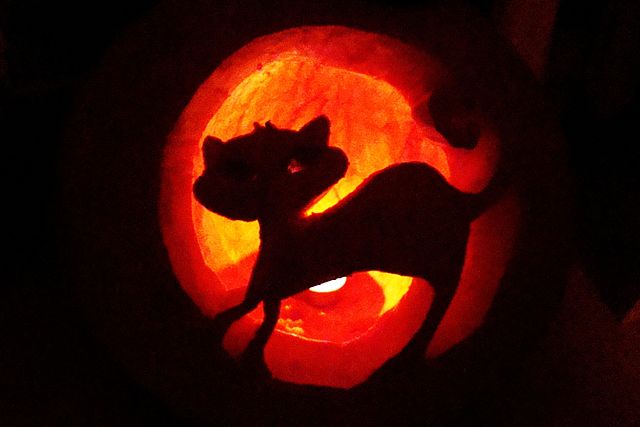
Halloween cat from Poland. User Silar.

Ghost Stories

The first thing someone told me about ghosts was that they are fake. That person was probably a schoolteacher. Before that, I hadn’t heard of spooks. Ghosts are fairy tales, the teacher said at primary school. Several years later, I went on a school trip and visited the Singraven Estate near Denekamp. The custodian told us that a spook dwelt inside the manor, upsetting things, but he added that we shouldn’t fear it. We could safely enter. It is better not to put faith in spooky stories about venues that depend on tourist income. The facts that are beyond doubt aren’t spectacular. They are lame indeed.

As a teenager, I also visited Twickel Castle in Delden, located near Denekamp, but it did not have such a spooky reputation. I recently learned that this castle also has ghostly phenomena. The castle doesn’t advertise itself as a ghostly venue, which makes the claim more believable. Only one source on the Internet mentions it. If it is true, the laws of physics went out the window, at least temporarily. The author preferred that I quote her work. She wrote,

Recently I heard a strange tale from the phlegmatic steward of Twickel Castle in Delden. An English restorer who had come to restore some antique cupboards was given permission by her to stay overnight in an attic room of the castle. After he had been there for a few days, she saw that he had put his mattress on the floor.

She asked him why he slept on the floor and not on the bedstead? He answered her unmoved that he had been pushed out of bed for three consecutive nights. To prevent it from happening again, he had decided to sleep on the floor from then on. He had not been bothered since then. The steward asked him if he didn’t find that creepy? His answer was calm and clear: ‘No, I’m from England.’1

That is what the stiff upper lip is about. You might not believe it if you haven’t witnessed similar things occurring in your own house. So that is why I am inclined to believe it. There are plenty of ghost tales that go around. Most are hearsay. On the Internet, you can find lists of ghost tales like 10 Eerie Real-Life Paranormal Encounters to Creep You Out on Listverse.com.2 The list is fact-checked, which means the stories happened unless witnesses lied and got away with it. You are about to read one story from that list. It was also on CNN. The CNN article allows paranormal investigators to share their unscientific claims about crisis apparitions. An explanation that doesn’t conflict with science is that we live inside a virtual reality. So, here is the story,

Nina De Santo was closing her New Jersey hair salon when she saw Michael, one of her customers, standing outside the shop’s window. He had become a good friend. He had been going through a tough time after his wife left him. Nina had tried to cheer him up. When she opened the door, Michael seemed happy and transformed. He smiled at her and said he wanted to thank Nina for everything she had done for him. They chatted, and each went their way. The following day, Nina received a call from one of her employees. Michael’s body had been found the previous morning, nine hours before Nina had spoken to him at the salon. He had committed suicide.2

In 2014, a couple named the Simpsons asked the regional news channel Fox43 in the United States to visit their haunted house in Hanover, York County. DeAnna Simpson, the wife, mentioned that entities were haunting the home. She and her husband had lived there for seven years. She caught ‘ghosts’ on film. They had scratched or even attacked the guests. DeAnna had invited priests, paranormal researchers, and the crew of the TV show The Dead Files into her home, who then uncovered ‘evidence’ of ‘grisly deaths’ that had occurred there.3 When the Fox43 staff came in, something invisible scratched their photographer.

In March 2018, my wife woke me up in the middle of the night. She said, ‘The bathroom door is locked, and our son is sleeping in his bed.’ You can only lock the door from the inside. The lock needs force, so this can’t happen by accident. My wife feared a burglar was hiding inside. I took a knife from the kitchen to unlock the door while she was standing behind me, holding a heavy object to smash into the head of the burglar. Only, I never believed there was a burglar. So many unusual things had happened already. And I was right. There was no burglar.

So, what to make of this? The goings-on at Twickel Castle and the Hanover house are undoubtedly peculiar. Nina De Santo’s story is mind-boggling. In my home, the laws of physics didn’t always fully apply either. It made me wonder. I have seen it happen, and so has my wife. And if there is no naturalistic explanation, is this evidence of ghosts? Not necessarily. If you believe ghosts are real, you think science is crap. And I don’t. The simulation can play into our imaginations and fears. And ghosts are as unreal as we are. There may not be more to it than that. That at least makes sense.

Latest revision: 18 July 2025

Featured image: Halloween cat from Poland. User Silar (2012). Wikimedia Commons. Public Domain.

1. Betoverd door: haunted houses. Theracoppens.nl.
2. 10 Eerie Real-Life Paranormal Encounters to Creep You Out. Listverse.com (2022).
3. A haunted Hannover home. Civilwarghosts.com. [link]
4. Why those TV ghost-hunting shows are transparently fake. Scott Craven (2019). The Republic. [link]

Aruba sunset

Predetermination Issues

Whether or not we have free will is an ancient philosophical question. Ancient Greek philosophers already reasoned, ‘This happens because of that. Everything that happens could be an endless sequence of causes and effects.’ We feel we make our own choices. If I went out to buy a garden gnome yesterday, I am inclined to think I could as well have decided not to go out shopping or to buy something more useful instead, like an inflatable Santa Claus that says ‘Ho ho ho’ when you pinch his nose. If I could go back in time, I might have done something different, or so I believe. But if I had felt an uncontrollable urge to buy that garden gnome, I would have considered myself subjected to forces beyond my control.

And some things are beyond our control. Our biology and culture limit our options. You can’t simply stop breathing or run faster than the speed of sound. Those who have tried, failed, or died. And it is hard to do things that go against the prevailing will of society or your family and friends unless you don’t care about other people’s opinions, which might be something you have no control over. But it seems you have options. Choices like buying a garden gnome don’t raise controversy, and you appear free to make them.

Recent advances in neuroscience have enabled scientists to observe brain activity associated with decision-making. And that was quite revealing. Our choices originate in our brains several milliseconds or even longer before we become aware of them.1 The evidence suggests that there is no free will in the sense we traditionally believe it to exist.

This traditional idea of the will is that it is a force of its own. Nothing else causes it. It is rooted in the belief that we have a mind, a spirit or a soul that is separable from our bodies. This idea is at odds with scientific findings that our minds are a result of chemical brain processes. Not having a will is not the same as predestination, as it doesn’t rule out the possibility that we could make different choices if we were to go back in time. Our choices could still be random, like the throw of a dice. A dice doesn’t have free will, either.

Religious people face questions like, ‘If we have a free will, how can God know what we will choose?’ Or conversely, ‘If God knows what we will choose, how can we have a free will?’ The most straightforward answer is that there are two levels, so the level of us mere mortals, who make their plans, and the level above, that of the Supreme Puppet Master, who pulls the strings and determines what we will choose. That is not free will at a higher level, but at a lower level, it is. Somehow, some people remain fascinated by this question.

At least we experience making choices. These choices might be illusions, but the feelings that accompany them aren’t. It is the experience of choice that ordinary people understand as free will. When you go through an emotional struggle before buying a garden gnome, the emotions are real, even if they are chemical processes in the body. And so, free will as experience exists. And it is pointless to argue that even if you could go back in time, you could not have done otherwise, because you can’t go back in time.

Predetermination raises several questions. One is about punishing criminals as retribution rather than to protect the public. A desire for reprisal is a human emotion. But it seems unjust to hold people responsible for actions they can’t control. Often, criminals lack a proper upbringing or have psychological issues. And punishing offenders rather than addressing the underlying causes increases the likelihood of recidivism. In our experience, moral rules and punishment matter, just as free will does, and we experience having a choice. That is the point of punishing criminals. And it can deter calculating individuals. It is good to address social problems and prevent crime whenever possible. However, not catering to feelings of justice and the desire for reprisal undermines the moral fabric of society. Rules and punishment are in our nature.

Compatibilism says we have free will, even when our choices are predetermined. It is similar to the Christian concept of having a moral choice, while God knows what you will do. It becomes logically consistent if you introduce two levels: one of daily experience and another of the underlying reality. It is a practical approach which allows us to make moral choices. Morality is more than just following rules. It is about doing the right thing. However, the entire concept of morality hinges on the assumption of freedom of choice.

The second question deals with fate. If you are going to die on a preset day, then what is the point of seeing a doctor? Alternatively, you could opt for a dangerous hobby like mountaineering, for you will live until a specific date. But you don’t know that date. So, if you go to a doctor who cures you of an illness that would otherwise have been fatal, that would be predetermined. If you choose not to go to the doctor and you die, that would also be predestination. The same applies to abandoning a hobby such as mountaineering versus the alternative of perishing on the slopes of Mount Everest.

The third deals with premonitions and accurate predictions insofar as they are not attributable to fraud or chance. Why can fortune-tellers sometimes make accurate predictions? And why are their predictions unreliable at the same time? The answer is it is impossible to know the future. If I knew I would have a car accident tomorrow, I would remain home, and the accident wouldn’t happen. Predictions can influence the future, unless they are vague or hidden. In 1914, no one could have guessed that the licence plate number on Franz Ferdinand’s car referred to the end date of the upcoming world war.

So, if I pass a sign saying, ‘You will have a car accident tomorrow,’ it can only be a sign if I laugh about it and discover it was a sign the next day. Premonitions and accurate predictions require more than predestination. If you have a suspicion that proves correct, it is not you knowing the future but the one giving you the premonition. Predetermination suggests that we are like characters in a story, much like the comic book character Spiderman. Spiderman may realise he is a comic character in a story, but only if that is the script. Spiderman can’t change the script, but the script’s author can make him believe he can. That would be a delusion on the part of Spiderman, for you can’t escape destiny.

That is also how voodoo works. The practitioner of voodoo puts needles in a doll, and the targeted subject suffers intense pains simultaneously, but there is no causal relationship. There is no magic. The underlying cause is a scripted coincidence.

Predetermination allows for accurate predictions that defy chance. Actions taken to prevent these predictions from being fulfilled must fail, which requires a lack of information on the actors involved. Oedipus fulfilled the prophecy of killing his father and marrying his mother. He didn’t know that the couple he believed to be his parents were not his true parents. Fearing the prediction, he fled, which led to a sequence of events that made the prediction come true. That is why the prophecies of ancient Greek oracles only made sense in hindsight. And so, as predictions, they were pretty worthless.

Latest revision: 23 July 2025

Featured image: Aruba sunset. English Wikipedia.

1. The clockwork universe: Is free will an illusion? Oliver Burkeman. The Guardian (2021).

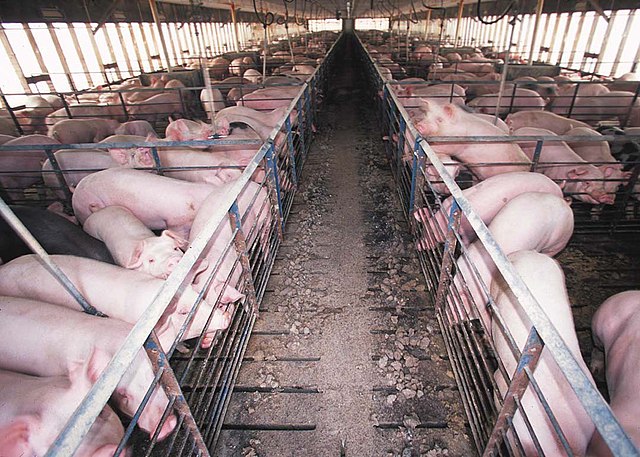
Hog barn interior. Public Domain.

Animal Rights

Evolution theory suggests we are an animal species that evolved from apelike creatures and that chimpanzees are our nearest living relatives. In other words, we are much like the other animals. Indeed, animals can experience joy and suffering like us. A central ethical rule is not to cause unnecessary pain and suffering. So, if ethical considerations apply to our fellow humans, they might as well apply to other animals. Nature does not have ethics, but ethics are part of our nature because we can place ourselves in someone else’s position and feel compassion. Compassion helped us as a species, as did aggression, but in a utopian society, ethics take precedence.

Suffering is something a conscious mind experiences, but consciousness comes in different levels. You can beat a stone, but it does not feel anything. A plant is less aware than an insect if it is aware at all. An insect has less awareness than a fish. And fish are less conscious than mammals. And we may relate more to animals that are more like us. That is why mammals elicit the most sympathy. And so, murdering a cow feels very different from killing an ant.

We care more about people we know than strangers, so we may also care more for our pets than people in faraway countries. The suffering that goes unnoticed does not affect us. Only when we see the misery, for instance, in factory farms and slaughterhouses, do we become aware of it. But once we know, we can react in different ways:

  • Not caring. You may have more urgent problems than animal welfare.
  • Accepting. You could argue that meat is a natural part of our diet.
  • Doing something. You might become a vegan.

Humans have been murdering animals since time immemorial. And our distant forebears drove several animal species to extinction. So, why stop now? Today, humans dominate the planet, and much of the remaining wildlife is under threat. Hence, it may not be a luxury to ask ourselves some questions like should there be animal rights like there are human rights? And if so, what rights should animals have? Animals themselves do not think they have rights. Respecting nature and animal suffering are reasons why we think about animal rights. But those considerations can conflict with each other. So whatever choices we make, they can raise controversy.

Even when we think animals have rights, animals transgress our moral rules, for instance, by murdering each other. After all, predators eat prey, and nature does not care. It is survival of the fittest. Should we stop them from doing that? Some species go extinct because of our actions, while others profit. Rats, cockroaches, and crows do well where humans have disrupted the balance in nature. Should we restore the balance in nature? And, if you own a cat and allow it to go outside, you contribute to a bird massacre. In the Netherlands alone, cats eliminate twenty million birds per year. Should you keep your cat inside or not keep a cat at all? And should we control pests? Probably so because pests threaten us.

And what about eating meat? Meat has been on the human menu since time immemorial. It provides us with some of the nutrients we need. There may soon be artificial meat and replacements with those same nutrients. And so, we might end the suffering of animals in the meat industry. Animals in the meat industry often live under miserable conditions, but in some areas like the European Union, there are regulations regarding the welfare of animals on farms. If animals cannot behave naturally, they experience stress and suffer, for instance, when confined to small spaces.

These European animal-welfare regulations conflict with practical economic considerations. For instance, what to do with a pig that resists stepping into the truck that brings it to the slaughterhouse and gentle prodding does not help? Transport companies and slaughterhouses must make money. Unruly beasts take time and can make the operation unprofitable. Whether animals in the wild always have a better life than those on farms remains to be seen. Wild animals must deal with predators, food shortages, and humans. Still, it is fair to say that ending factory farming promotes animal welfare. And we may need to limit meat consumption to reduce our impact on the planet.

In a caring utopian society, we should not make animals suffer unnecessarily. We can extend that to nature. For instance, if there is not enough food for the deer in a forest, is it not better to shoot the weak and eat their meat than to let them starve? Perhaps, you could introduce wolves, but that might cause even more misery. A deer suffers less from a clean shot from a rifle than a lengthy chase by a pack of wolves. And it gets worse when there are pastures with sheep nearby. Or do sheep lives not matter? Sheep, whether these are black or white, are mostly peaceful creatures who do nothing wrong.

If you prefer the wolves chasing deer, you believe the value of nature takes precedence over the rights of animals and that it justifies animal suffering. But nature itself does not suffer, nor does it care. And humans have profoundly disturbed the ecological balance, so unspoiled nature as it once was, is gone in most places. Letting wildlife coexist with humans can cause problems. For instance, bears are beautiful creatures, but it is better not to let them roam in cities as they are intelligent enough to adapt and may kill people. We can restore the original situation in areas where few people live, stop agricultural and industrial activities, and create large nature reserves. In other areas, we can better manage what remains of nature as a park.

Latest revision: 6 June 2023

Featured image: Hog barn interior. Public Domain.