Master of my own destiny?

It’s a miracle

In early 1993, I started to look for a job. My first application was for an IT traineeship at Cap Gemini. They had sixteen vacancies. Some 1,600 people applied, of which they selected 200 for a series of tests. I was one of them. Before these tests began, other applicants told stories about assessments and job interviews they had gone through. The economy fared poorly, so there weren’t a lot of jobs. Many graduates were already searching for a long time. It was discouraging, so I expected to remain unemployed for quite a while.

That was not meant to be. The tests went well, and they invited me for an interview and some more psychological tests. On my way to the appointment, a guy I knew from dormitory Witbreuksweg 389-2 came sitting on the opposite seat on the train. He asked me why I was wearing a suit. I told him about the interview. Then he started to laugh loudly. ‘Your tie is a mess,’ he said, ‘Let me fix it for you.’ He then arranged the tie correctly.

If this event, which appeared accidental at the time, hadn’t happened, they may not have hired me. The interview and the tests went well. My misfortune because of not fitting in during my student years made me investigate cultures and cultural differences. It wasn’t hard for me to translate the expectations of Cap Gemini concerning its employees into test answers. And so, the test results made it appear as if I fitted perfectly into the corporate culture of Cap Gemini. Cap Gemini stressed I was the master of my own destiny. It was one of their company slogans.

They hired me and sent me to a junior programming class to prepare for my first assignment. My self-confidence was low as I had manipulated the test. Perhaps, I didn’t fit in. And it was shortly after the encounter with Suzanne. I was afraid to turn up because I felt unfit for the job. These feelings receded once the class had started. We learned about programming. I was often joking about a programme I was planning to write. I nicknamed it DoEverything as it was supposed to do everything, which is noteworthy because we may be part of such a programme.

My classmates often discussed what car they would choose once they were on the job. I was the only one planning to use public transport. Not surprisingly, I was not a model employee. One classmate, a cheerful guy from the Eindhoven area named Ad, expressed his amazement about the fact that I passed all the tests. ‘There were 1,600 applicants. And they picked you? It’s a miracle! How could that happen?’ Ad and I had a good laugh about it. His last name referred to Burgundy. In the Netherlands, a Burgundian lifestyle denotes enjoyment of life and good food, most often found in the vicinity of Eindhoven. And Ad radiated this lifestyle. He seemed the personification of it. His first name and the region he came from make another peculiar coincidence in light of later developments.

With regard to the work that awaits us

My first assignment was on a project at the Groningen office of Cap Gemini. I became part of a team of six with a few colourful personalities. Our customer had hired us but didn’t come up with work. For months we had nothing to do, but we had a lot of fun. And I had more fun than I ever had during my student years. Our project manager was ambitious. He organised project meetings and demanded progress reports he could present to senior management even though we did nothing. One of us was a graduated linguist, so he used his skills to produce eloquently written progress reports. For instance, he wrote, ‘With regard to the work that awaits us, we can only assume a wait-and-see attitude.’

Another guy was a hippie and had been part of the squatters’ movement. He always wore the same orange sweater. Perhaps, he had two orange sweaters, but I am not sure. He was the type of guy who might wear the same sweater for months. He often made fun of the project leader and his ambitions. At the time, Windows was gradually becoming the standard operating system. It had new features like WAF files for sounds. Some team members played around with these features, so if I started my computer, it sometimes made an unexpected noise. I had so much time on my hands that I familiarised myself with database administration. After a few months, the work came in, so the project manager was busy managing our work. He constantly demanded progress updates.

We soon realised we would miss our deadline at the end of July. Before the project manager went on a holiday, he discussed the situation with our customer and arranged a new deadline date at the end of August. Once he was gone, things suddenly went smoothly, so we met the original deadline date in July, possibly because the project manager stopped managing us. When he returned, the programmes were already running at the customer’s site. His superiors praised him for delivering a month ahead of schedule. He was on his way to a great career. Perhaps he received a bonus too.

There is room for improvement

The next job was restructuring a database at a telecommunications company. I had some database knowledge. And my managers were impressed that I had familiarised myself with database administration. And so, I did get that job. The company doubted the capabilities of their database administrator, so they hired me to reorganise one of their databases. They took this delicate task out of the hands of their own database administrator and gave it to me, a novice with little experience. And so, their database administrator didn’t like me from the start. And I didn’t follow his advice because he was a bungler. After all, that was the reason they hired me. And he was showing off his expertise by using incomprehensible language, so I often had no clue what he was talking about.

It was a highly political environment. The telecommunications company had been a government operation for a long time, but the government had just privatised it and put its shares on the stock market. The board wanted to purge the old-fashioned government bureaucrats from management positions. And the department I worked for was led by a risk-averse bureaucrat fearing for his job. If something went wrong, his head might roll. And the database administrator might have felt that his position was on the line too. He often complained about me to his manager. And the manager passed on these complaints to Cap Gemini. I also had a team leader who knew the situation and gave a more accurate depiction of what I was doing to his manager and my account manager. That is why they didn’t take me off the job.

And I caused a major accident. To reorganise the database, I needed a list of the tables in the production database and their sizes. Production is the database that matters. The data in the production database is precious. For that reason, I had no access to the production database. There are also databases for development and testing. But I needed production data, so I prepared a file named tablelist.sql containing a query that delivered the necessary data. And for once, they allowed me to access the production database using a tool called SQL Plus. I could start the script by typing @tablelist and pressing enter. I started typing @t. The system didn’t respond, so I pressed enter to see if there was any response at all. And then, I saw the system respond with table dropped, table dropped, table dropped. I cancelled it, but it was already too late. Some precious data was already gone. The operators restored a backup of the previous night, so a day’s work was lost. The database administrator had left a file named t.sql in the SQL Plus directory, dropping all the tables. It was an accident waiting to happen. And even though everyone knew that, the incident reflected poorly on me. With the benefit of hindsight, it was odd. How much bad luck can you have?

Because of the fuss, Cap Gemini sent me to a course called Professional Skills. I was not politically sensitive, and that could be a handicap when you work at the site of a customer. I was aware of that as I had a way of formulating things clearly, so I considered it a good idea. And the course taught me something. For instance, positive framing can contribute to a better atmosphere. You can call it political correctness. So if it is a complete mess, you can say, ‘There is room for improvement.’ Even though it is the same mess, it sounds a lot better. After all, a consultant’s primary responsibility is not to solve problems but to make money for Cap Gemini by making the customer happy. I let it all pass by, concentrated on my task and successfully finished the database restructuring job.

My next assignment was at the real estate department of the telecommunications company. They hired me to make database queries in their financial system for management information. Usually, managers or salespeople wanted a report promptly. It was always very important and, of course, very urgent. I called them jokingly life-and-death queries. It took a few hours to write a query, check the validity of the output, and deliver the report. By then, it often wasn’t needed anymore. The availability of the data rather than necessity created a demand for these reports. In other words, the reporting usually wasn’t that important. Over time, I found patterns in their requests, so I made a set of standard queries with parameters and delivered 90% of the reports on the spot. No one had ever thought of that, so they saw me as a genius and hired me for a longer time to work on their systems.

Hit the moving target

Cap Gemini emphasised the concept of employability. You were responsible for your employment by ensuring your skills were in demand. ‘Hit the moving target,’ is what they called it, referring to the constantly changing market for skills. You must be there where the demand for skills is. During a company meeting, they once gave us toy guns to aim at moving targets on a large projection screen in the front of the room.

Times were changing, and I had been working on the obsolete systems of the real estate department for a few years. My manager and I agreed I had to catch up with the latest developments. In 1995 and 1996, two new development tools, Oracle Developer/2000 and Designer/2000, came to the market. And so, they sent me far away from home, to Zeist, where Cap Gemini had started an Oracle Developer/2000 software factory, a marketing term for a group of people working with Oracle Developer/2000. Zeist was far from home, so I stayed in a hotel nearby. The newest tool was Oracle Designer/2000, and Oracle introduced it when I worked at the software factory. It had a promising future. Designer/2000 could generate Developer/2000 programmes, so you didn’t need to write them yourself. I gained experience with Developer/2000 and also Designer/2000. After a year, I hoped for a Designer/2000 assignment near home.

My manager agreed, but there was trouble brewing once again. An account manager came up with a prospective assignment. I knew him. He was a rough guy who only cared about his bonus. People like him might have done well in the Wild West, playing poker, staring down opponents and engaging in brawls in saloons. I told him that I specifically aimed for a Designer/2000 assignment as I had invested much time and effort in Designer/2000. He said, ‘The customer is planning to switch to Designer/2000, and you can play a role in that process.’ He didn’t disclose any additional information. His vagueness put me on high alert, and I presumed he was planning to dupe me. And so, I warned him that I would decline the job if it wasn’t Designer/2000.

I contacted my manager and discussed the situation with him. I had invested much time in Developer/2000 and Designer/2000 and had been away from home for a year. I would rather stay away from home a few months more if needed to get a proper Designer/2000 assignment. Designer/2000 was just released, so work had yet to come in. If you intend to hit a moving target, you must aim just in front of it, considering the direction of the movement. It takes time for the bullet to arrive at the target. By then, the target had already moved a bit further. So, I was already there, where the target would soon be. And there was plenty of work at the software factory. And so, I asked him if I could decline the job if it wasn’t Designer/2000. He said that sales targets were important and we all must do our bit. But I was supposed to be the master of my own destiny. Knowing that my Designer/2000 skills would soon be in high demand, I said I would look for another employer if that would be his stance. He then gave in.

But the account manager pressed on, ready to make the kill. Before the interview with the customer, another department of the telecommunications company, we once more discussed the assignment. And again, he didn’t say much more than, ‘They are planning to switch to Designer/2000, and you can play a role in that process.’ Once more, I warned him in no uncertain terms. And despite his name being Warner, he didn’t appear to understand what a warning was. Still, his name was endowed with a whiff of coincidence. Then came the interview. The department manager told me they planned to use Designer/2000, but their people would do the Designer/2000 work. They needed me to maintain their obsolete systems. And my resume was perfect as I had been looking after the old programmes of their real estate department for a long time. That was the role I could play in the process. And the account manager knew that all along.

Assuming that the account manager was ready to close the deal and seal my fate, I declined and said I wasn’t informed about the nature of the assignment. And so, I humiliated the account manager in front of the customer and made Cap Gemini lose face. The account manager probably had believed he could get away with it. Indeed, I didn’t want to cause a fuss again, but I thought Designer/2000 to be crucial for my future employment. After all, life is a bitch. If you end up with obsolete skills, you end up unemployed. A few weeks later, I did get a Designer/2000 assignment in Groningen, so close to home that I could bike to work again. Later, my manager said that my actions were unprecedented and had raised several eyebrows. On closer inspection, I could have been a model employee, and more than Cap Gemini might have hoped for.

Walking out of Paradise, once again

After moving to Sneek, I looked for a job near home. There was a vacancy for a software designer at FBTO, an insurer in Leeuwarden. It later turned out that the job included being a project leader. The insurer had split the IT department into smaller teams working for a business unit. Every three weeks, we planned our tasks for the coming three weeks, and a business unit representative determined the priorities. It worked well as we had fewer political games, like business units competing for resources. The IT department was well organised compared to what I had seen elsewhere. This way of running IT departments has become commonplace two decades later.

The team knew what they were doing, so I felt redundant as a project leader. There is no point in managing people who know what to do. The atmosphere was friendly. I had grown accustomed to grim conditions, so I felt out of place. I could have gotten used to the friendliness but not the job itself. All those documents, meetings, and priorities were boring. Building information systems was much more fun. I was qualified for Oracle, but FBTO didn’t use Oracle. I decided to try my luck as a freelance Oracle Designer/2000 developer and database administrator. And so, I walked out of Paradise again, but this time out of my own will. After all, Cap Gemini had taught me that I was the master of my own destiny. But an ominous incident would soon suggest that I was not.

Latest revision: 7 January 2023

Featured image: Cap Gemini logo

The future of interest rates

There is a relationship between the amount of capital in a market economy, wealth inequality, savings, the level of debt, and interest rates. If an economic depression or a world war can be avoided, this relationship may decide the future of interest rates, and interest rates may go negative. If this makes you yawn, you have read the message already, and you can proceed with more exiting ventures like checking out what your friends are doing on Facebook or Instagram.

If instead you are thrilled by the idea of knowing more about this relationship, you may continue reading. Interest rates are the result of supply and demand for money and capital. Money and capital differ from consumer goods like coffee and services like haircuts. Money is a medium of exchange. You use money to buy and sell consumer goods and services. And capital isn’t consumer goods or services either. Capital is used to make these consumer goods and services. Hence supply and demand for money and capital need a separate explanation.

The price of money

A kilogram of coffee might cost € 7 in France and $ 8 in the United States. But what does that mean? Is coffee more expensive in the United States than in France? That entirely depends on the price of the dollar and the euro. If one dollar is worth € 0.80 then $ 8 is € 6.40, which is less than € 7. The price of the euro and the dollar change every day because of changes in supply and demand in the market for euros and dollars. But the price of euros and dollars is not the price of money, at least according to economists.

When economists talk about the price of money, they do not mean the price of dollars and euros. They talk about the interest rate. The supply and demand for money and capital determine the interest rate, hence the interest rate is the price of money. This price has a relation with the returns on capital because investments in capital are an alternative to lending. Money isn’t produced and consumed like coffee. If you borrow money, you may have to return it with interest. Borrowers may pay for the use of money, not for the money itself.

There are people and corporations that have savings as well as people and corporations that need money for consumption or investment. So there is supply and demand for money. But what determines the supply and demand for money and therefore the interest rate? It begins with the choice people have when spending their income. They can choose between consumption and saving. Savings can be used for investments in corporations to make products and services in the future.

Consumption versus investment

Economists sometimes use a simple model consisting of only households and businesses to explain things like consuming and saving. Households consume the stuff businesses make. In order to make that stuff, businesses need investment capital provided by households from their savings. It is important to notice that some households borrow and some businesses save, but on balance households save while businesses borrow to invest.

Households can do two things with their income. They can either use it for buying stuff, which is consumption, or save so that businesses can invest. For example, if you are a plumber and need to buy a new van for your business, which is an investment, you may have to forego a new car for your family, which is consumption, to save money for the van. You could also borrow the money for the van so that you can buy the family car too, but in that case someone else has to save so that you can borrow.

If people spend a lot of money on consumption, businesses sell a lot of stuff and make great profits. Businesses may be willing to invest so that they can sell even more and make even more profits. But if there are only a few savings because people spend a lot of money on consumption, so businesses might fear they can’t borrow and may be willing to pay higher interest rates, so that interest rates go up.

When interest rates go up, some businesses may abort their investment plans as they don’t expect to make enough money to pay for the interest. At the same time, more households may be willing to save. So when interest rates go up, the demand for money goes down and the supply of money goes up.

On the other hand, if households save a lot of money and do not consume, there are a lot of savings, but businesses are not willing to invest because they have trouble selling stuff and making profits. In that case households fearing that they don’t receive interest on their savings are willing to lend at lower interest rates, and interest rates go down. But how do households choose between consuming and saving?

Time preference

Economists believe that your choice between saving and borrowing depends on your time preference as well as the interest rate. Time preference is your willingness to forego your needs or desires in the present in order to fulfil your needs or desires in the future. An example can illustrate this. Assume that you want to buy a new car. You want that new car now but you don’t have the money. You can either wait and save to buy the car later or you can borrow to buy the car now.

Assume the car costs € 10,000. If the interest rate is 10%, you may realise that borrowing money to buy the car will cost you dearly. If you pay back € 1,000 each year, you repay the loan in 10 years. Over that period you pay € 5,500 in interest so the car will cost you € 15,500 instead of € 10,000. The alternative is to wait and save money to buy the car.

If you can manage saving € 1,500 per year and the interest rate on savings is also 10%, you could buy the car after less than six years. But then the car only costs you € 8,250 because you receive € 1,750 in interest. At an interest rate of 10% borrowing money to buy this car costs nearly twice as much as saving.

That may convince you to save and drive your old car for six more years. If the interest rate is lower, you may find borrowing more attractive than saving because you would rather have the new car now. Your time preference tells how strong your desire is to have the car now rather than later. It determines the interest rate you are willing to pay. Not surprisingly, different people have different time preferences.

Time preferences affect interest rates. Suppose that you want to borrow money for a new car. Suppose that you can only borrow the money from John. John has € 10,000 but he wants to buy a car too. Time preferences are going to decide whether or not John is going to lend you this money. If your time preference is 7% and John’s time preference is 5%, he will keep his old car for a while and lend the money to you. He may do this because he expects to buy a bigger car once you have repaid your loan with interest.

The interest rate could be anywhere between 5% and 7% depending on your and John’s negotiating skills. You won’t borrow at interest rates above 7% and John won’t lend at interest rates below 5% but any interest rate between 5% and 7% is acceptable to both you and John. In this way time preferences affect interest rates.

When interest rates go down, more people may borrow and fewer people may save because of their time preferences. If the interest rate is 4%, John may buy that bigger car now and borrow the money to buy it. If the interest rate is 8%, you would save to buy the car. When interest rates rise, more people may opt for saving instead of borrowing. The interest rate may move to where supply equals demand, which depends on the time preferences of lenders and borrowers but also on the demand for investment capital.

Capitalist spirit

Time preference only works for ordinary people. There are other people too. They are called capitalists. You probably have heard about them. Capitalists think differently. They suffer from a condition called capitalist spirit, which is having little or no time preference. Capitalists think that money spent on a frivolous item is money wasted, because when you invest your money, you end up with more money that you can invest again.

Capitalists save regardless of the interest rate. They rather invest in the distant future when they are dead than spoil their money on frivolous items during their lifetimes. Consequently capitalists end up with a lot of money when they die. What’s the point of that? Capitalists invest in businesses that make the frivolous items ordinary people enjoy. Ordinary people wouldn’t have invested their money, but spent it on frivolous items instead so that these items wouldn’t have been produced in the first place.

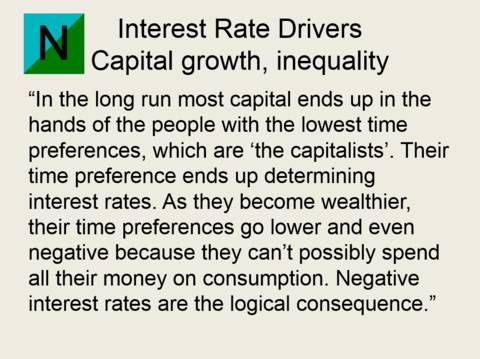
Perhaps you think that all capitalists are wealthy. But that isn’t true. Anyone who saves as much as he or she can regardless of the interest rate can be called a capitalist. What is important here, is that the capitalists as a group own most capital, and because capitalists own so much money and capital, and keep on saving and investing, there is a surplus of savings. And if there is a surplus of savings at an interest rate of zero, the interest rate should be negative according to the law of supply and demand.

Convenience

When you lend money to someone else you can’t use it yourself. There may be a new mobile phone you want to buy, but alas, you have lent out your money. This is not convenient. But then you remember with a smile on your face that you will be able to buy the phone but also an additional hip phone cover next year because you receive interest on that loan. So, if you don’t receive interest on your money, you may not bother lending it out because you may suddenly need it. Interest rates on long-term loans are higher than interest rates on short-term loans because the longer you can’t use your money, the less convenient it is.

When you deposit money at a bank, you lend it to the bank but you can still use it any time. That is possible because when you make payment, for example for legal advice, this money ends up the account of the lawyer. The bank will then be borrowing this money from the lawyer instead until she uses it to pay someone else. This is convenient so you are willing to lend money to a bank. For that reason interest rates on current accounts and checking accounts are low. Having money in a bank account is more convenient than cash so the bank may even charge you for having an account.

Risk

Lending out money can be risky. There are two types of risk. First the borrower may not pay back the loan. That could make you reluctant to lend. So if someone of questionable integrity wants to borrow money from you, and you fear that she may not pay back, she could offer you a very high interest rate so that you might think, ‘Well, she may not pay back, but the interest rate is very attractive, so I’ll take my chances and do it anyway.’

Second, money may become worth less in the future. This is called inflation. If there’s a lot of inflation then the money that buys a mobile phone today may only buy a phone cover next year. In that case you may spend your money right away on a mobile phone before it is too late. That is unless someone wants to borrow the money from you and offers a very high interest rate, so that your can buy a better model next year.

The business of a bank is to know its customers. For that reason lending money to a bank is less risky than lending out money to an individual or a corporation. And because banks are supposed to be good at managing risk, they can borrow at lower interest rates, meaning that interest rates on bank accounts are lower than those on loans.

And because banks know their customers and lend to many different people, they can manage risk better than you can and lend at lower interest rates than you are willing to because if you lend money to a someone you don’t know, you may desire a higher interest rate because you don’t know whether he or she is going to repay the loan.

Returns on investments

If you have money, you could invest it in corporations or real estate. Corporations pay dividends and real estate pays rent. If the rents and dividends are higher than the interest rate you get by lending out your money, you may prefer investing to lending. But investing is more risky than lending. If sales are sluggish, profits may go down and dividends may be cut, but lenders still get their interest. Nevertheless investments are an alternative to lending, so if investments offer better yields, you may opt for investing.

If someone wants to borrow money from you, the interest rate must be high enough otherwise you may invest this money instead. Other people who have money are in a similar position. Borrowers need to offer attractive interest rates in order to be able to borrow. Similarly, if dividends and rents are low, people with money may prefer lending to investing, so that borrowers can negotiate lower interest rates. In this way the returns on investments affect interest rates on loans.

The type of money used

The properties of money can affect interest rates. Just imagine that apples are money and you are saving to buy a house. If someone wants to borrow 1,000 apples from you, and promises to repay those 1,000 apples after 10 years when you plan to buy your house, you would gladly accept this generous offer. You may even accept an offer of 900 apples because that is better than letting your apples rot. In this case you would settle for a negative interest rate. But you would only do so if there are no alternatives.

If you could make 10% per year in the stock market, you could exchange your apples for Apple stock because their gadgets are in great demand and outrageously expensive. In that case, it doesn’t matter that apples rot and you could demand interest on a loan. But if returns on the stock market are low or when stock prices are fluctuating so wildly that you can’t sleep at night, you may prefer the offer of 900 apples.

If the money had been gold, you would never accept such an offer, even when the stock market is doing terrible. You can always keep your gold in a safe deposit box. Similarly, you wouldn’t accept negative interest rates on euros or dollars because you can take your money from the bank and store the bank notes in a safe deposit box. The problem with this is that if you put money in a safe deposit box, other people can’t use it for buying and selling stuff. And this can cause an economic depression.

Central banks

It is often said that central banks set the interest rate. But how do they do that? Central banks can print money. If central banks believe that the interest rate is too high, they print more money so that there is additional supply and interest rates go down. On the other hand, if central banks believe that the interest rate is too low, they print less money so that interest rates go up. If the central bank says that it sets the interest rate to 3%, this means that it will print precisely enough money to keep the interest rate at 3%.

Why do central banks print money? Money isn’t produced and consumed like coffee. If you borrow money, it has to be returned with interest. Most money is debt so where does the interest come from? Capitalists let their money grow on their bank accounts so the money to pay the interest from must come out of thin air. Individual borrowers may be able to repay their debts with interest but on aggregate borrowers can’t.

More money needs to be borrowed to pay for the interest. That’s why the total amount of debt increases each year. And if people aren’t borrowing enough, the central bank may print more money to prevent a financial crisis.

Sometimes people don’t borrow enough to keep the economy going and sometimes they borrow too much so that the economy is overheating. Central banks adapt their money printing to prevent these things from happening. Central banks raise interest rates and print less money (or stop printing money or even destroy money) when they want people and businesses to borrow less and they lower interest rates and print more money when they want people and businesses to borrow more.

The future of interest rates

Interest rates went down because capitalists acquired more and more capital over the years and kept on saving and investing regardless of the interest rate. In the past returns on capital have mostly been higher than the economic growth rate while most returns were reinvested so that a growing part of total income was for capitalists. As capitalists reinvested most of their capital income, this is not sustainable in the long run.

interestvers
Capital income (red) versus total income with capital income growing faster than total income

The graph above shows how total income and capital returns (in red) develop if the economic growth rate is 2%, the return on capital is 5%, capital income starts out as 10% of total income, and all capital income is reinvested. After 25 years the economic pie has grown faster than interest income and more is available for wages. At some point interest income starts to rise faster than total income, and less becomes available for wages. And after 80 years there’s nothing left for wages.1

This graph explains a lot about what is going on in reality. When wages started lagging, people couldn’t afford to buy all the stuff corporations made. As a consequence business profits, which is capital income, went down. In the short run it was possible to prop up business profits by allowing people go into debt to buy more stuff. But at some point people couldn’t borrow more unless interest rates went down. As capital income went down, capitalists became willing to lend money at lower interest rates, allowing people to borrow more to buy stuff. As interest rates went lower, more and more people went into debt because interest rates moved below their time preferences.

Nowadays most people are borrowing from the capitalists, for instance via mortgages, car loans, and credit cards, but also via governments as governments borrow from the capitalists too. Many people and governments can’t afford to borrow more. Interest rates are already near zero and may need to go negative if the law of supply and demand is going to do its job. In that case capitalists may start handing out money to the rest of us so that we can keep on buying the stuff their corporations make.

Capitalists may only lend at negative interest rates if money is like apples and not like gold.2 When interest rates are negative, people may buy land or real estate so that the prices of these properties may rise. Property taxes are often based on the value so properties may become less attractive at higher prices. Alternatives are gold or bitcoin, but at some point gold or bitcoin may become so expensive that the risk of losing money on these investments could deter people from buying more. Nevertheless, these alternatives put a constraint on how low interest rates can go. Interest rates must remain attractive for investors.

1. The End Of Usury. Bart klein Ikink (2018). Naturalmoney.org. [link]
2. Feasibility Of Interest-free Demurrage Currency. Bart klein Ikink (2018). Naturalmoney.org. [link]

Heaths near Nijverdal

Our invisible friend

Market economy

Market economies have an invisible friend called the invisible hand. In market economies, goods are distributed without the need for a planning agency. According to Adam Smith, it is as if an invisible hand makes this miracle happen. His critics, for instance, Karl Marx, did not believe in invisible friends. Not surprisingly, Marx also did not believe in God. Smith claimed that if everyone pursues his own interest, the interest of society is often best served. The followers of Marx felt that the state should plan the production and distribution of goods and services.

I’m the invisible man
Incredible how you can
See right through me

– Queen, The Invisible Man

The following story demonstrates how the invisible hand does its magic. Whether or not it is true does not matter. The story goes that the mayor of Moscow once visited London in the 1980s. Back then, Russia did not have a market economy. The mayor received a tour around the city and noticed that no one queued up for bread as everyone did in Moscow. There was an ample supply of bread at affordable prices. Somehow bread was produced in the right quantities for the preferred tastes and supplied at the right places.

The mayor was amazed about this feat, so he said to his hosts, “Back in Moscow our finest minds work day and night on the bread supply and yet there are long queues everywhere. Who is in charge of the supply of bread in London? I want to meet him!” Of course, no one was in charge. That’s the secret of the market economy. Every baker decided how much he was planning to make and sell and at what price. A few years later, Russia switched to a market economy.

The individual decisions of bakers and the businesses in the supply chain, for instance, farmers and flour mills, make this miracle happen. They all decide for themselves. If a baker could sell more than he produced, he would miss out on profits. The same is true when he has to throw away bread. And some people are willing to pay more if the bread tastes better. Hence, each baker tries to make the right amount of bread to the tastes people desire. It is in their best interest.

In Russia, the state planned how much of each item a corporation should produce. Corporations could not decide on prices. They received compensation for their costs but could not make a profit. Employees received a fixed salary. Corporations that produced more or better products and their employees did not benefit. Corporations also could not go bankrupt when they did a terrible job. That resulted in poor-quality products, a shortage of nearly everything and even outright famine from time to time.

It doesn’t always work out well

This miracle has enchanted quite a few people. They believe that everything will turn out fine if only markets can do their job. But there are many instances where a market economy doesn’t produce the best outcome for society. Economists call them market failures. One can think of the following situations:

  • We have more desires than our planet can support. A market economy may fulfil those desires at the expense of our future.
  • Many people cannot make a living in the market economy, for instance, because they lack the skills or have little bargaining power.
  • Corporations use lobbyists and bribe politicians to pass legislation that favours them.
  • A government may be a more efficient producer of products that do not benefit from competition, for instance, roads and the power grid.
  • Corporations may abuse their power and charge higher prices, most notably if they have no competitors.
  • Products can cause harm to people or the environment, but producers may not pay these costs themselves. For example, cigarettes cause health costs.

In most countries, governments interfere with the economy to deal with these market failures. These are situations where pursuing personal interests does not bring the best outcome for society. In many democratic countries, public expenses are about 50% of national income. People in these countries probably believe that a market economy does not always work best. In some areas, markets produce extremely poor outcomes, for instance health care.

An example can demonstrate why. People in the United States live as long as people in Cuba.1 Cuba is poor and does not have a market economy. The United States spends more on health care than any other country in the world. Every possible treatment is available in the United States. Still, in more than 40 countries, people live longer than in the United States.1 Cuba does not spend a lot on health care, only 10% of what the United States spends per person. Healthcare in Cuba appears efficient compared to healthcare in the United States. How can this be?

The available treatments in Cuba are free for everyone. In the United States, you may not receive treatment when you cannot afford it because the United States has a market economy. There may be other causes, for example, differences in diets in Cuba and the United States. There is no fast food in Cuba because Cuba has no market economy. Life in Cuba may be miserable, but healthcare is one of the few things Cuba has organised well.

Successful societies have market economies and governments that organise things that the market fails to do. And a market economy still needs a government to set the rules and enforce them. Governments of successful societies aim at making the market economy work better where it is beneficial for society and constraining it where it does more harm than good.

Capital

Market economy and capitalism are so closely related that many people believe them to be the same. Capitalism is about capital. Capital consists of the buildings and the machines corporations own, but also the knowledge of how to make products and how to bring them to the market. Knowledge of how to make a film entertaining might be capital for a film company. Networks of customers and suppliers can be capital too if they contribute to the success of a business. The same applies to contracts and brands. For instance, the brand Coca-Cola has a lot of value because people are willing to pay more for cola when the logo of Coca-Cola is printed on the bottle.

Building capital can be costly but in a market economy the value of capital doesn’t depend on the cost to build it but on the future income it is expected to produce. This can lead to peculiar situations. When investors have no faith in the future of a corporation because it is expected to make losses, the buildings and the machines on their own may be worth more than the corporation as a whole as those buildings and machines could be used by other corporations for more profitable purposes.

In most cases, more capital means more wealth because capital produces the things people need or desire. Corporations tend to be more profitable if they fulfil those needs and desires better. Therefore, the value of capital in a market economy often depends on how well it can fulfil the desires of consumers. Investors are willing to invest in corporations that fulfil those needs and desires because they expect to make money by doing so.

It is sometimes argued that when investors are free to invest in the corporations of their choosing, the invisible hand channels investment capital to the most useful corporations because they are the most profitable. That’s why the value of corporations is important in a market economy. Businesses ‘create value’ for investors by making consumers happy. Still, the value of a corporation might not reflect the benefits for society as a whole. For instance, if the profitability of a corporation comes from exploiting people or harming life on the planet, a high value could be a bad sign.

And capital can be useful without being profitable, for instance in the public sector. A hospital in the public sector may have no market value because it doesn’t make a profit but it can be useful nonetheless. Capital in the public sector might even be more valuable than in a market economy. For instance, making hospitals private enterprises for profit might not benefit society as a whole. Hospital care may not improve from the competition as it is often best to have one hospital serving a particular area. And patients might receive unnecessary treatments when hospitals can make a profit. Healthcare in the United States may create a lot of value for investors but it doesn’t always benefit the patients.

As there are basically two types of people, capitalists who save and invest and ordinary people who borrow and spend, it is hardly surprising that capitalists tend to be wealthier than ordinary people. Capitalism can create wealth because it is the capitalists who finance the investments in the corporations that make the items ordinary people enjoy, but this wealth is often unevenly distributed. From a moral perspective, it is a problem that poverty still exists when there could be enough for everyone. So the question that still remains is how to make the economy work better for the benefit of all?

Featured image: Our invisible friend photographed in the moorlands near Nijverdal. Jürgen Eissink (2018). Wikimedia Commons. Public Domain.

1. Life expectancy per country 2017. World Population Review. [link]

The newspaper Pravda dated 29 May 1919

Strife

My sister Mary Anne was an ordinary kid with a social life, friends and later boyfriends, and social skills. And I was a peculiar child, a loner and a bit strange, and having a social disadvantage, which is probably Asperger’s Syndrome. My sister didn’t take life as seriously as I did. She was more pragmatic and had a more flexible arrangement with the truth. Perhaps, not surprisingly, my sister later became a fashion saleswoman and was good at her job. In sales, you shouldn’t care about the truth. ‘That looks good on you.’ That’s a lie! Nothing looks good on me. I am far too sexy for any clothing. And so, I was upset when it came out that Saint Nicholas (Santa Claus) didn’t exist. Everyone had lied to me for years. It was already hard to fathom that people could lie occasionally.

Mary Anne was two years younger and promised she would still believe in Saint Nicholas if he brought her presents. I was rigid when it came down to the truth. Most people lie if that suits them. I was different. My sister was amazed at how I kept strictly to the facts, even when it harmed my interests. ‘ An Enasniël never lies,’ she said more than once. These were her exact words. She added an article to my name and said, ‘An Enasniël.’ Perhaps that was to stress that I was a specimen of a highly peculiar species, of which she only knew one. But I wasn’t perfectly honest. I still remember an instance when I cheated. I once arranged a few letters before the beginning of a Scrabble game to pick them up, make a word, and get extra points.

Mary Anne had a way of nagging me. It began early. She followed me wherever I went as soon as she could walk and was set free from the kids’ box. Probably, she didn’t intend to annoy me at first, but when she suddenly became my constant companion, it felt intrusive. Perhaps she craved attention, and my frustrated reactions fulfilled that desire. And so, she went on and on, and Mary Anne became adept at soliciting vexed responses. It went from bad to worse and escalated into protracted strife.

Whenever there was a conflict, my mother blamed me. I was older and should be wiser. That changed once she caught on to how these conflicts started and escalated, as Mary Anne usually was the culprit. She never showed remorse and pulled out all the stops. She could become angry if she didn’t get her way. So, she did get her way. On one occasion, Mary Anne smashed a chair at me so fiercely that its leg broke on my shoulder. Was it blind anger, or did she aim for my head? That is unclear. Perhaps she had aimed for my head and not thought of the consequences. My mother later said that she had terrorised the family. She usually got what she wanted in this way. And so, home was a war zone as well. I was always plotting and scheming to get back at her.

My cousin Rob and I started a new club, The Company, a spy club. Rob’s brothers joined the club. We could get our hands on a set of walkie-talkies, and we hid in the alleys in Haaksbergen, talking to each other over the radio. We thought of ourselves as spies, so Rob and I wrote each other letters in code. My tree garden in a fallow backyard behind the shed became our headquarters. I built a hut, made a lookout post so we could survey the area, and erected a flagpole to raise our flag.

Mary Anne and her friends soon invaded this land. And they made a hut of their own. It took a long time to get them out. I had to be careful because she could become enraged, take up a shovel or a hoe and come after me, and then you had to run for your life. I wasn’t violent or mean. These silly wars weren’t worth any injuries. Mary Anne’s best friend, Dorothee, was once indignant after I had shot a cork at her legs using a sawn-off bicycle pump on this land and hit her trousers with it. I split up the tree garden, introduced a border, and retook the land after my sister lost interest in her stake.

And I found a way to get back at her. Rob and I started a funny newspaper, The Big Company Newspaper. It had a lot of fiction in which we named Mary Anne and her friends Dorothee and Ellen as ‘The Morons’. We didn’t use their names but called them Moron M, Moron D, and Moron E. We were constantly ‘fighting’ The Morons. The war against morons was our primary mission. We fought hard, for instance, by reading my sister’s secret diary and writing about it in the newspaper. Later, after some people had complained about the word morons, which wasn’t nice indeed, we renamed The Morons into The Wokkels after a particular potato crisp and named them Wokkel M, Wokkel D, and Wokkel E, respectively. Wokkel sounds like mokkel, the Dutch for bitch, and you only had to turn the W upside down to get at that word.

Occasionally, the newspaper reporting had a remote relationship to facts. I made up most of the stories while Rob took care of the drawings. Mary Anne practised horse riding and played hockey. These were elite sports for the upper class. Even though we had different political opinions, as Rob was left-wing while I was right-wing, we were both anti-posh and anti-elite. In the rag, Mary Anne spoke with a posh accent, or as the Dutch would say, with a hot potato in her mouth. To stress the nature of our newspaper, the fictitious Bureau van Lulkoek (Bullshit Agency) issued it. It was fake news, so we labelled it as fake news. People take the written word seriously, whether it is a tweet from Paris Hilton or the Bible. You can never be careful enough. You can’t have people take nonsense seriously.

We were thirteen when we began and eighteen when we stopped. The rag started childish and rude, but over time, it grew funnier, and my sister became, not entirely a side-show, but definitely of lesser importance. The paper began to feature fantasy stories about us fighting organised crime and other groups in the neighbourhood. We outwitted everyone, including the CIA, the KGB, and the mafia. We always came out victorious because of odd coincidences and the stupidity of our opponents, who usually attacked each other, so we didn’t have to do anything to win.

One of the stories we added was an account of an expedition led by Dr Livingstone, the grandson of the famous Dr Livingstone, to the so-called mountains near Nijverdal, where cannibals hid in the forests. They were German soldiers who had stayed there since World War II and were unaware that the war had ended. Not all expedition members returned whole. We also mocked advertisements. The newspaper featured Roweco, a corporation selling light bulbs and robots. And there was Geopondex, a producer of automatic spear throwers. Its advertising slogan was, ‘Otiosity is our quality,’ a catchy phrase. We sold those newspapers to pay for the materials. These were the early 1980s, so we didn’t use computers. We used a typewriter, paper, and special rub-on fonts to create newspaper headlines.

To give you a glimpse of the kind of buffoonery the funny newspaper was about, I cite one article in its entirety. To understand the story, you need to know that at age fifteen, I invented a new game, chessers, a combination of checkers and chess, but I was the only person playing it. The tale itself is entirely fictional, so it didn’t happen. So, here it goes,

The world championship chessers, which is a merger of chess and checkers, took place in the sports hall of Nijverdal. It started on Saturday, 11 May, and continued on Monday, 13 May. The current world champion, Mr. E Drogoel, had to compete against a Roweco chessers robot due to a lack of human opponents. The main prize consisted of a cash prize of f 0.05 (€ 0.02) and a challenge cup made of pure tin with a height of two millimetres. The fight was rather slow and tedious. Half of the audience, Mr. Drogoel’s father and mother, left the hall. After six moves, the robot gave up because its batteries were empty. Mr. E Drogoel then received the trophy from the director, Mr. E Drogoel, of the Dutch Chessers Promotion Committee (DCPC). After that, the public relations officer of DCPC, Mr. E Drogoel, gave a speech about the fascinating aspects of chessers. After this mediocre performance, the remaining two-person audience, namely the journalist from Nieuwsblad de Grootcompagnie and the reporter from Radio Huunt (an imaginary local radio station), started throwing rotten eggs, tomatoes, beer bottles and car parts.

My mother criticised my childish behaviour. Once, I disturbed Mary Anne’s birthday party with a smoking device. I also had hidden a microphone in her room. After all, we had a spy club. We hardly ever made recordings, and the ones we did were so poor that I couldn’t make out what she and her friends were saying. However, being able to make a recording gave me a sense of power. The newspaper reported what they supposedly said during their secret meetings in that room. I also placed devices in my room that would throw Lego blocks at her if my sister entered to plunder my piggy bank. Still, my sister and I often played together. We played games like Who Is It, chess and Stratego. Mary Anne became the chess champion at her school. She later said it was because we played so much chess together. Our mutual understanding improved once we became adults.

It still doesn’t explain the situation well enough. Copies of the newspaper reveal a great deal of hatred towards my sister. It would be better to clarify this further by referencing a few specific events. Instead of listing incidents, it might be better to mention a few similar events suggesting a pattern. When my sister went to kindergarten, we bicycled to school together because her school was next to mine, allowing my mother to stay home. Mary Anne once ran into a flat tyre on our way to school. I set her on the back seat of my bicycle and took her to school. I took her bicycle with me, expecting to bring her back home this way. When school finished, my bicycle and my sister were gone. Her bicycle with the flat tyre was still there. I had to walk home, a stretch of 1,5 kilometres.

You might think it was just an incident. After all, Mary Anne was five or six. Perhaps she didn’t know better. That was what my parents thought, so they didn’t punish her. I had received punishments for lesser offences, like a severe spanking for singing in bed around five AM. And the affair with the flat tyre was not a mere incident. I already knew that. More than a decade later, my sister had taken my bicycle to go out and had run into a flat tyre. She left it that way in the shed. I asked her repeatedly to fix the bicycle or bring it to the repair shop, but she didn’t. When my sister needed her bicycle, I took it and went out. She scolded me and came furiously after me, but I was on a bicycle, thus much faster.

When I was a teenager, I saved money for the future, but Mary Anne was short of cash, likely because she wanted to go out with friends or buy candy. To finance her expenses, she stole money from my piggy bank. I noticed money disappearing, but I needed proof before telling my mother. It was time to set up a trap. After receiving the pocket money, I told my mother in my sister’s presence so she could hear it, ‘I will bring this money to the piggy bank now.’ After doing that, I returned and said, ‘I will now go out to the tree garden in the backyard and will be away for at least an hour.’

Then, I positioned myself outside the house near the front door window to observe the entrance of my room and started lurking. And after fifteen minutes, bingo! I slipped inside, went upstairs and waited for
my sister to come out. I then asked her to empty her sacks, which she refused. A wrestle unfolded, and I cleared her pockets myself, thereby retrieving a sum of 2,25 guilders. And lo and behold, that same amount had gone missing from my piggy bank. I told my mother, but also, this time, she didn’t punish Mary Anne, perhaps out of fear of what my sister might do.

And again, you might think she was just a teenager short of cash. But that was not the whole truth. Years later, when my parents were married for twenty-five years, Mary Anne and I bought a stereo set together as a present for them. It cost 1,000 guilders, but my sister had no money, so she borrowed her share, 500 guilders, from me. She promised to pay back once she had some money herself. Time passed, and my sister did get a job. And so, I asked her nicely several times to give me my money back, which she never did. And then, when we were at my parents’ house, she proudly announced she was saving 250 guilders per month to buy a home with her fancy man, Marcel, who later became her husband. I was furious and made a scene, and finally, I did get my money back. These incidents reflect a disregard for me that was always there. My parents never took action against it, so I had to fend for myself. Many people have suffered far more, but unlike them, I must explain myself to you. I know that many people have suffered far worse than I ever did, but unlike them, I must explain myself to you.

We also had two white rabbits when we were teenagers. My sister later revealed how we got them. When my parents were on a journey, my grandfather came to look after us. She talked my grandfather into buying these rabbits and a rabbit hutch by telling him it was something her parents had agreed to, which was a lie, which she also said. She knew my parents would disapprove, and she still seemed proud of her deception, so when my parents returned, the rabbits were there and stayed. She was an animal lover, or so she proclaimed, and she reproached my father for being a hunter, calling him a murderer, but I had to clean up the hutch. My sister was a popular kid, while I was not. She could get away with things I could not. She often made my life miserable, and the funny newspaper brought it into balance.

We also had two white rabbits when we were teenagers. My sister later revealed how we got them. When my parents were on a journey, my grandfather came to look after us. She talked my grandfather into buying these rabbits and a rabbit hutch by telling him it was something her parents had agreed to, which was a lie, which she also said. She knew my parents would disapprove, and she still seemed proud of her deception, so when my parents returned, the rabbits were there and stayed. She was an animal lover, or so she proclaimed, and she reproached my father for being a hunter, calling him a murderer, but I had to clean up the hutch. My sister was a popular kid, while I was not. She could get away with things I could not. And the funny newspaper brought it into balance.

A final titbit underscores my sister’s character. She had a red-haired boyfriend, Peter, for several years until he broke up with her to date another girl. That was his mistake—never make Mary Anne angry! She schemed to have him back, luring him into a break-up with the other girl and becoming her girlfriend again so she could dump him for revenge. My sister was mean and excessively domineering.

I hate to write about it because it makes my sister look bad. There are no hard feelings. She has changed quite a lot and isn’t like that today anymore. The same is true for me. And now, my sister is in a miserable situation because she has a brain tumour, which she handles with more spirit and optimism than I would have done, so I don’t want to make her life more miserable than it already is. But my mission seems to be the kind that justifies any means and requires you to know the conditions that shaped me. At the time, my sister didn’t seem like preparation for my future.

The story depicts actual events but contains fictitious names.

Latest revision: 2 August 2025

Featured image: The newspaper Pravda (Russian for The Truth) dated 29 May 1919. RIA Novosti archive. Wikimedia Commons. Public Domain.

What’s the use of politics?

Politics is worthless many people agree. For that reason, the use of politicians may need some clarification. Humans became the dominant animal species because they cooperate in large numbers in a flexible way. This makes us unique in the animal world. Some animals such as ants and bees can cooperate in large numbers, but they are not flexible in the ways they do that. Their cooperation is based on their genetic code. Social animals like chimpanzees, elephants, wolves and dolphins can cooperate more flexibly, but not in very large numbers. Cooperation in a chimpanzee band, an elephant band or a wolf pack is based on the intimate familiarity of the band members.1

Language is a tool for human cooperation. Animals have languages too. Animals can communicate about the whereabouts of food or enemies. Only, human language is used for many more things. Most notably, humans gossip and talk about what other people are doing and thinking. This gives them better information about other people in the group so that they can develop more sophisticated ways of cooperating. Apes like chimpanzees, baboons and gorillas all show interest in social information, but they have trouble gossiping because their languages don’t allow for that.1

The truly unique feature of human language is not gossip, but its ability to transmit information about imaginary things. All forms of large-scale human cooperation, such as nation-states, churches, cities and corporations, are rooted in fictions that exist only in the collective imagination of human beings. Myths, like the existence of gods, laws, corporations and nation-states, gave humans the unprecedented ability to cooperate flexibly in very large numbers. For example, churches are based on common religious beliefs. Religious beliefs make it possible that Christians who never met before can do things together like going on a crusade or building a hospital.1

Religions and ideologies have a lot in common. You could call them myths or models of reality. Religions as well as ideologies maintain there is a superhuman order of universal laws that govern the world, which should guide human actions. For example, Buddhists believe that the law of nature was discovered by Siddhartha Gautama. Communists believe that the laws of nature were discovered by Karl Marx. Like other religions, Communism had its holy scriptures and prophetic books such as Das Kapital, which prophesied that history would soon end with the inevitable victory of the proletariat over the capitalist system.1

So what does this have to do with politics? In democracies, people can decide about what needs to be done and determine who should do what. Politics involves discussing collective imaginations such as laws, nation-states, religions and ideologies to determine what course of action should be taken as well as gossip to determine who should do what, for instance, who is going to be the leader of a political party or a nation. Many people nowadays believe that democracy is the best political system, even though democracy has disadvantages too.

Politicians may not do what they promised their voters to do. There might be an intense political struggle. And politics might result in poor decisions when voters don’t like the measures that need to be taken. In times of upheaval, people might opt for someone who promises to take drastic action, for instance when the economy has collapsed or when insurgents and criminals wreak havoc. The most notorious example in history was the rise of Adolf Hitler. The suffering of the Germans during the Great Depression and the inability of politicians to relieve their plight helped Hitler to grab power.

Even in stable and established democracies, citizens may have little faith in politicians. The politicians in parliament do not represent the makeup of the population at large. People who like to talk, like lawyers and teachers tend to be overrepresented. Engineers who know how systems work tend to be underrepresented, which may explain why laws often fail to meet the intended objectives. The same applies to poor people and people with little education, which may explain why their interests are often neglected. Perhaps giving citizens more responsibility via direct democracy can help to solve these issues.

Featured image: House Of Commons in the United Kingdom. Parliament.uk. [link]

1. A Brief History Of Humankind. Yuval Noah Harari (2014). Harvil Secker.