On 15 July 2011, two television towers in the Netherlands caught fire. One collapsed spectacularly. There had never been a fire in a television tower in the Netherlands. These television towers had been there for over fifty years. And there were only twenty-four of them. A few people speculated about these incidents having a common cause.1 The towers are in different areas, making a common cause unlikely unless there is intent. After all, what is the chance of two aeroplanes crashing into both towers of the World Trade Center in New York on the same day? Only there was no evidence suggesting intent or a common cause. That makes it very mysterious.
Consider this coincidence from Bermuda, which is near the mysterious Bermuda Triangle. In 1975, a 17-year-old boy had a deadly accident while riding his moped. He died exactly a year after his 17-year-old brother died in an accident while riding the same moped in the same intersection and collided with the same taxi with the same driver, carrying the same passenger. Repeating patterns may have contributed to the incident. Perhaps it was a dangerous point where accidents frequently occurred. The passenger may have visited Bermuda once a year and taken a taxi from the airport to the same destination each time.
In 1992, I was bicycling in Groningen, where I lived at the time. On the way, a car door suddenly opened just before me. I could barely avoid a collision. About ten minutes later, on the same trip, it happened again with another car on another road. Never before or after this trip had a car door opened in front of me, even though I had made bicycle trips nearly every day for several decades. It is odd. But what are the odds?
Those incidents might be random events. Many things happen all the time, so bizarre accidents occur by chance. It doesn’t require a Supreme Puppet Master to make them happen. It may be hard to calculate the probability of an event like two television towers catching fire in one country in one day, but it is very low. Only, the number of possible strange incidents is very high.
But how low and how high? That matters tremendously. If there are a million possible events, and the chance of one happening on any given day is one in a million, we should not be surprised when one does. On average, an event like that should happen every day. If it is one in a trillion, and such an event occurs quite frequently, we are on to something, because, on average, it should happen once every million days.
The number of possible strange coincidences is infinite, so it shouldn’t surprise us that simple coincidences, such as a car door opening in front of me twice on a single bicycle trip, happen from time to time. It is, however, odd that it happened twice on one trip and never on any other. Coincidences come in different types. The more intricate a coincidence is, the less likely it is to occur. Indeed, some complicated coincidences are far less likely to occur than two car doors opening on one bicycle trip.
The following falls in the latter category. Once, I entered a do-it-yourself store. There was a couch near the entrance. The price tag of € 389 caught my attention. As a student, I lived in dormitory 389 on the campus. Price tags often end with a nine, so there was nothing suspicious about it, I concluded. Strange things had happened, so I tried to convince myself that it was not unusual. I realised it would be far more curious to find a price tag of € 401, as I had also lived in building 401, and price tags rarely end in a 1.
A few seconds later, I ran into a pile of bags of potting soil. These bags had a conspicuous lettering ’40l’, indicating they contained 40 litres of potting soil. That was close enough to 401 to be intriguing. There were no other types of bags on the spot. Potting soil is available in 10, 20, 25, 40, and 50-litre sizes. Sacks of 40 litres also come with markings such as ’40L’ and ’40 litres’. Hence, the ’40l’ was indeed remarkable.
Two years later, I returned to the same store. These bags of potting soil, marked ’40l’, stood conspicuously stacked near the entrance, reminding me of the previous incident. There was no couch, and I did not see a € 389 price tag there. I contemplated this while fetching the item I planned to buy. Its price tag was €3.89, and I had gone to the store to purchase that one item.
That is far less likely to happen than two car doors opening before me on the same bicycle trip. The events interacted with my thoughts, and the sequel made it even more improbable. The car doors opening could be a coincidence, but the do-it-yourself store incident should boggle the mind, provided one is allowed to think. In one of those dormitories, I met a most peculiar Lady. Since then, a series of noteworthy coincidences have transpired, reminding me of that. This coincidence thus also fits into this scheme, further heightening its peculiarity.
To make the coincidence happen, the bags of potting soil had to be in place, so I would run into them just after thinking of 401. And later, I had to go there to buy an item for € 3.89. And it goes much further than that. The scheme encompasses the item having a price tag of € 3.89, and my having lived in dormitories 389 and 401. That is most peculiar indeed. So much can go wrong. Imagine the bags’ content being 50 litres, the lettering being different, or me visiting another do-it-yourself store or buying another item the second time, and the scheme would fall apart. Perhaps it is a mere coincidence, but it is less likely than two car doors opening in front of me during the same bicycle trip.
On the evening of 11 October 2025, my wife and I watched episode ‘Demon 79’ of the Netflix series Black Mirror. The story played in Great Britain in 1979. It turned out that the murder of two people by a psychotic shoe saleswoman, following orders of a demon disguised as Boney M band member Bobby Farrell, proved insufficient to ward off the apocalypse. The apocalypse proved to be a nuclear war. After watching it, I went to bed. The next morning, I first read the news headlines on the teletext page 101 of the Dutch public television, and found out that two people had died at age 79, actress Diane Keaton and singer Joost Nuissl. So, two people died, thus not enough to ward off nuclear war. Two days later, on 14 October 2025, a NATO exercise named Steadfast Noon began. It included dropping fake atomic bombs above the area where I live. ‘You can sleep peacefully,’ a NATO spokesman added.
Latest revision: 14 October 2025
Featured image: Number 381 dormitory. University Of Twente (2013). [copyright info]
1. Onderzoek: Hoe konden twee zendmasten vandaag in brand vliegen? Algemeen Dagblad (15-07-2011). [link]
In archaeological excavations, female figurines have turned up. They could depict mother goddesses. The most famous example is the Venus of Willendorf, dating back to around 23,000 BC. In ancient cultures, mother goddesses represented fertility. The ability of women to produce offspring could have been the essence of Mother Goddess worship. Women give birth, and early humans may not have understood that men were the fathers. They may have thought men had no reproductive use and existed to please the women. Consequently, the Mother Goddess can give birth as a virgin, which is the miracle of the Mother Goddess. One of the best-known Mother Goddesses was Isis.
Women can be sure that their children are their own, but men can’t. When the fathers of children are unknown, families are often matrilineal, meaning that family lines run through mothers. The goddess worship may have disappeared because men desired to control women and their sexuality. The transition from hunting and gathering to agriculture may have played a crucial role in this development.
Hunter-gatherers were wanderers. They had fewer territorial conflicts. Population density was low, and they had no property, so it was easier to move on if a stronger group invaded a band’s territory.1 That changed with the advent of agriculture. Farmers had to defend their property and families against thieves and invaders. It became a matter of life and death, so warfare became more common and deadly. Giving up territory would mean starvation. Men are willing to protect women and children they consider their own. And they can walk out when they doubt their fatherhood. That gave them a position of power, allowing patriarchy to emerge.
Male dominance is almost universal among humans, with only a few exceptions, so it is something more than merely a cultural phenomenon. Our closest relatives, the chimpanzees, live in groups led by males, while the bonobos live in groups dominated by females. And so, it may be a natural inclination of humans.1When women and men have an equal status, women may more often boss men, but there is something in human nature that favours men as clan leaders. As humans are programmable and have varying cultures, they can overcome their natural inclinations and choose female leaders, or make female leadership the standard in their societies, and invent myths to justify the arrangement, such as stories about the Mother Goddess creating the man as a companion for the woman.
As we have no written records, we know little about the lives of hunter-gatherers, their leaders and their family structures. Still, we do know that there must have been an enormous cultural diversity, as they lived in small groups that had little or no contact with each other. The lifestyle of hunter-gatherers was more favourable for female leadership and matrilineal families than farmer communities, so that female leadership and matrilineal families likely were more common before the Agricultural Revolution. Relatively peaceful conditions and a belief that men have no reproductive role, thus only exist to please women, could easily produce female-centred societies.
In her book, When God Was a Woman, historian Merlin Stone claims that goddess worship was the earliest religion in the Near and Middle East. The Creator was a woman before men rewrote history. Stone bases her claim on the discovery of female figurines in archaeological finds. In a 7,000-year-old settlement in Turkey, where archaeologists also found these figurines, families were matrilineal.2
The Garden of Eden features in an ancient Mesopotamian myth, the Epic of Gilgamesh. The garden was near the rivers Tigris and the Euphrates. The Jews lived in exile in Babylon when their priests compiled their holy scriptures. The first chapters of Genesis take place in Mesopotamia. Jewish scribes tailored Mesopotamian myths to their needs and incorporated them into the Jewish Bible.
In the Epic of Gilgamesh, the gods created a man from clay, much like in Genesis. In another creation myth, a goddess gave birth to humanity. There probably were other creation accounts as well. Eve was Adam’s mother in the original tale. It makes more sense than Eve coming from Adam’s rib. She is the Mother of All the Living (Genesis 3:20), and we are the woman’s offspring (seed) (Genesis 3:15). Elsewhere in the Bible, a child is the father’s offspring, which is a noteworthy difference. It implies that we come from women and that men have no reproductive role. That perspective sheds a new light on what Eve said about giving birth to Cain (Genesis 4:1),
Adam made love to his wife Eve, and she became pregnant and gave birth to Cain. She said, ‘With the help of the Lord I have brought forth a man.’
It wasn’t making love to Adam that made Eve give birth, but the help of the Lord. That is noteworthy because we are the woman’s offspring (seed). Perhaps Eve didn’t need Adam to have a child. There is another explanation. Long before the Jews went into exile in Babylon and picked up the story about the Garden of Eden, Asherah was the wife of El. They together were the supreme gods of the Canaanite divine council.3 Perhaps they, together, not only brought forth lesser deities like Yahweh, but also humanity, starting with Cain and Abel, so that Asherah was the Mother of All the Living.4 Later on, the Jews grew particularly attached to Yahweh, so Yahweh became their supreme deity, replacing El.
Asherah then became Yahweh’s wife. When the Jews were in exile in Babylon, they drew on local myths to rewrite their creation account. They took a story in which the first woman gave birth to the first man, and may have turned the goddess Asherah into the woman Eve. And so, Adam came somewhat late for the first man. Asherah then went out of the window, as the Jews became monotheists. That is speculation in the realm of biblical scholars, and few have dared to delve into this particular matter, for there is too little information to draw such a conclusion. However, it is plausible and explains this peculiarity quite neatly, which is a quality that the truth also possesses.
In the original Mesopotamian tale, Eve gave birth to Adam without prior sexual intercourse. The miracle of the Mother Goddess is the virgin birth. Jesus supposedly was born of a virgin. As God supposedly was Jesus’ Father, he couldn’t have had a human father. That is the reason we know about. However, it was also an allusion to Adam’s birth. Jesus was God’s son because he was Adam reincarnate, the son of Eve, who was God. In scriptural religions, inventing a new story is preferable to contradicting an existing one, as that would imply that the scriptures are corrupt. And you can’t have that, most notably when Paul was around. The virgin birth was a necessity if God was to become Jesus’ father, but it also reflected God being Jesus’ mother, as God’s name was also Mary. It miraculously solved two problems, making early Christians agree on this compromise.
The Bible claims that God created a man from the dust of the ground (Genesis 2:7) to work in the garden (Genesis 2:15) and made a woman as a companion for the man (Genesis 2:18). This is a result of merging with another creation myth. Mesopotamia had several creation myths, including one where the gods fashioned a man from clay to do the work. Also, the Bible has two. In Genesis 1, God creates all that is, and then in Genesis 2, God repeats some of that work. There has been some patching around here and there to glue these two stories.
In the original story of Eve and Adam, the purpose of the man was to be a mate for the woman. A reason to think so is that Genesis mentions the woman’s desire for her husband rather than the man’s desire for his wife (Genesis 3:16). If you live in a modern society that has undergone several waves of feminism, you may not realise how odd noting a woman’s desire for a man truly is. The Bible is a product of a patriarchal society. In a patriarchal society, a woman is often a man’s possession, and her desires are of no consequence. The original tale thus had a woman’s perspective. Eve was the leading character. She discussed eating the fruit with the serpent and made Adam eat from it (Genesis 3:1-6). And it was Eve who commented on the birth of Cain, not Adam (Genesis 4:1).
Also noteworthy is that a man left his father and mother to be with his wife (Genesis 2:24). This was how life was in Eden. In patrilineal societies, family groups centre around fathers, while matrilineal societies centre around mothers. Women join their husbands’ families in patrilineal societies. The man leaving his father and mother thus suggests that family groups in Eden were matrilineal. Experts still debate whether hunter-gatherers lived in patrilineal or matrilineal groups. The limited interest of men in childcare suggests that matrilineal groups could have been the standard as long as there were no compelling reasons to do otherwise. These reasons emerged with the advent of agriculture. The title Mother of All the Living may also refer to the Mother Goddess.5 Ashera was the Mother Goddess in Canaan, and one of the deities of the Jews before they became monotheists. Eve also resembles Namma, the primordial mother in the story of Enki and Ninmah.
The Fall is about the curse of knowledge. More knowledge doesn’t make your life better. Knowledge of agriculture allowed the switch from hunting and gathering to agriculture, and condemned humankind to a life of toil. The life of hunter-gatherers was more agreeable than the plight of farmers who came later on. They had a more varied diet, worked fewer hours, and spent their time doing more exciting things. Additionally, they were less likely to face starvation, disease, and warfare. The Agricultural Revolution did increase the total amount of available food. However, all this extra food didn’t result in a better diet or life, but only in more people, including elites such as kings and priests, who ate the extra food. The peasants worked harder than the foragers before them and got a poorer life in return.1
And so, there is a profound wisdom hidden in the Bible. The Garden of Eden provided for everything. It was the natural state of humans. Eve and Adam were nude (Genesis 2:25), like hunter-gatherers in the jungle today. Eve and Adam might have been vegetarians in Paradise, as God told Adam that he was free to eat from any tree in the garden, except the tree of the knowledge of good and evil. It doesn’t mention hunting or eating animals, implying animals were not on their menu. That is noteworthy as hunter-gathering included hunting. After the Fall, working the land became a life of toil (Genesis 3:17-19), the curse of the Agricultural Revolution. The original tale was also about the downfall of women. Women had to obey their husbands from then on (Genesis 3:16).
In ancient cultures, people venerated snakes for their wisdom and knowledge, so consulting a snake for advice was not unusual. The tree of knowledge relates to the sacred tree, which may explain why it was forbidden to eat from it. Eve’s deed may reflect the role of women in starting the Agricultural Revolution. Farmers must protect their crops from thieves. Otherwise, they face starvation. That condemned men to a life of warfare. And so, Cain, a crop planter, murdered Abel, a cattle herder. Perhaps Cain had only meagre offerings to God because Abel’s animals ate from his crops.
The Abrahamic religions disagree with our Creator being a woman. The Jewish deity Yahweh and the Arabian deity Allah were male, even though many people now think God has no gender. Yahweh and Allah had wives and children before monotheism took over. Allah was at first the supreme deity of Mecca. Later, the owner of the universe appropriated this title. To address the confusion this act generated, the Quran stresses that God has no partner or children. Unlike Christians, Jews and Muslims don’t see God as a Father. But Christians are born of God, a most remarkable wording indeed.
The Quran extensively mentions the creation of Adam but says little about the origin of Eve. The Quran doesn’t claim that Eve came from Adam’s rib but that men and women come from one soul (Quran 4:1, 7:189). It relates to Genesis 1:27, in which God created males and females in His image, so that the soul could be God. The Quran further claims that God created Jesus like Adam from dust (Quran 3:59). The Quran also corroborates the virgin birth story of Jesus (Quran 3:47, 66:12). Christians understand the virgin birth story in the context of God being Jesus’ Father, so that he can’t have a human father. However, the Quran makes it clear that God is not Jesus’ Father. And so, being created from dust could refer to birth from a virgin, so Eve could have been Adam’s mother.
The account of the Fall in the Quran differs from the one in Genesis in some noteworthy aspects. The Quran features no serpent, and Eve didn’t make Adam eat from the tree. The Quran holds both Eve and Adam responsible for the Fall (Quran 7:19-23). Another fragment only blames Adam,
But Satan whispered to him, saying, ‘O Adam! Shall I show you the Tree of Immortality and a kingdom that does not fade away?’ So they both [Eve and Adam]] ate from the tree and then their nakedness was exposed to them, prompting them to cover themselves with leaves from Paradise. So Adam disobeyed his Lord, and so he lost his way.
(Quran 20:120-121)
The historical context of the original story, the curse of the Agricultural Revolution, and the role of women in it have been lost in the Quran. The first Christians believed that Eve was God, the Mother of all the Living, who gave birth to Adam, that Mary Magdalene was Eve, and Jesus was Adam. So Adam and, therefore, Jesus were the Son of God. Humanity descends from Eve, so we are God’s children (John 1:13), but also Jesus’ children.
Tribespeople feel a connection to each other because they believe they share common ancestors. The stories about these common ancestors are myths, such as the tale about Eve and Adam. Eve and Adam came alive again as Mary Magdalene and Jesus. The myth of Eve and Adam can turn humanity into a single tribe. It is the reason why Christians wait for Jesus’ return. And so, Paul may have realised that the good news of Jesus concerns humankind rather than just the Jews.
Latest revision: 28 August 2025
Featured image: Eve in the Garden of Eden. Henri Rousseau (1906-1910). Public Domain. Wikimedia Commons.
Other images: Venus of Willendorf. Don Hitchcock (2008). Wikimedia Commons.
1. A Brief History Of Humankind. Yuval Noah Harari (2014). Harvil Secker. 2. Ancient ‘female-centered’ society thrived 9,000 years ago in proto-city in Turkey. Kristina Killgrove (2025). Livescience. 3. Daniel O. McClellan, Deity and Divine Agency in the Hebrew Bible: Cognitive Perspectives (PhD diss., University of Exeter, 2020) 327 4. Eve as a goddess/consort of Yahweh? r/AskBibleScholars (2024). [link] 5. Asherah – Wikipedia [link]: Some scholars have found an early link between Asherah and Eve, based upon the coincidence of their common title as “the mother of all living” in Genesis 3:20 through the identification with the Hurrian mother goddess Hebat. Asherah was also given the title Chawat, from which the name Hawwah in Aramaic and the biblical name Eve are derived.
A few centuries ago, nearly everyone lived in abject poverty. Most people had barely enough to survive. In the Middle Ages, 30% of the children died, often of malnutrition or diseases. And so, Thomas Hobbes wrote in 1651 that man’s life was poor, nasty, brutish, and short. It has been that way since time immemorial. Around 1800, Thomas Malthus concluded that humans live in a permanent state of misery. Once we have more food and resources, more children will survive, so that we will always be on the brink of starvation. At the time, only one billion humans were roaming the Earth, searching for a meal.
Two centuries later, a miracle had occurred, and it was unexpected if you had lived in 1800 or before. Today, more than eight billion people live on this planet, and less than one billion live on the brink of starvation. The life expectancy in the poorest countries exceeds that of the Netherlands in 1750, the wealthiest nation before the Industrial Revolution. At first glance, it looks like Paradise. Available food and resources have increased faster than the population. Capitalism and fossil fuels enabled this growth. We now use more resources than the planet can sustainably provide, so an apocalypse is in the air.
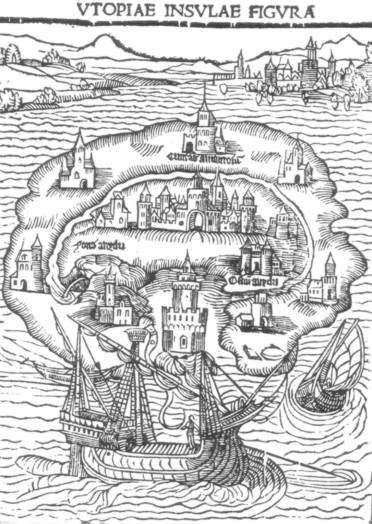
In 1516, Thomas More wrote a novel about a fictional island, Utopia. Life in Utopia was good. The Utopians had a six-hour workday and had enough because everyone took only what they needed. Utopia means ‘nowhere,’ but the name resembles eutopia, which means ‘a good place.’ More may have intended the pun. There is more than enough for all of us. So, why can’t we all work a few hours per day, live peaceful lives and have enough? A well-functioning society requires a set of values and a culture to support it.
Utopian dreams aren’t new. According to the Bible, humankind once lived in the Garden of Eden, where people lived simple lives and were happy with what nature provided. Jesus said, ‘Look at the birds of the air; they do not sow or reap or store away in barns. God feeds them.’ There have since then been utopian dreams of peace and sharing. Most utopian dreamers think of a better world while leaving the hard work to others. In reality, utopian societies are not perfect and are oppressive to those who don’t fit in. Usually, their ideologues define the ideal human as hard-working and public-spirited.
Third ways
There have been several attempts to arrive at a synthesis of capitalism and socialism, often called a third way. The challenge of socialism, the antithesis of capitalism, fuelled a lively debate about economic systems in the second half of the 19th and the first half of the 20th century. Silvio Gesell, who wrote Barataria, was one of the central figures in this debate, as was Henry George in the United States. Since the Cold War, that debate has narrowed down to a struggle between communism and capitalism, or between individual freedom and enforced collectivism. After the collapse of the Soviet Union, the feeling in the West is that capitalism is superior and that there is no alternative.
The Soviets have tried to bring communism into practice. They replaced markets with state planning and repression. Due to the forced collectivisation of farms, millions died of starvation. Millions more ended up in prison labour camps. The end of communism led many people to believe that a better future lay ahead. But many of the economic problems we face today stem from faith in capitalism and the idea that governments can manage its drawbacks. And so, the question remains: is a third way possible? The Chinese have kept innovating and remained determined to make socialism work. It did so by making the Chinese economy more capitalist. However, the state still runs much of it.
The Russians lost faith in the fairy tale of socialism as central planning produced poor outcomes. Still, the Chinese economy has baffled the proponents of the capitalist myth. The Chinese allow the profit motive to exist as long as businesses conform to the Chinese Communist Party’s objectives. State ownership of enterprises further ensures that. The Chinese have demonstrated that you can submit the profit motive to a society’s goals and place large corporations in sovereign wealth funds. But competition still determines the outcome. We are in a rat race that will probably not end well.
The Chinese political economy is more advanced than Western models in that it subordinates the economy to political goals while promoting prosperity for China’s population. In many fields, China has surpassed the West. So if we were to agree on humanity’s goals, political control works better than pure capitalism. Chinese culture contributed to China’s development. Several Asian nations with similar cultures have also successfully modernised their economies. Modernisation is also a cultural shift from reliance on families and communities to markets and states.
The failures of capitalism and socialism come from the fact that both are models of reality, thus simplifications, and that the oversights in both models come with disastrous consequences. We are religious animals who want to believe in fairy tales like capitalism and socialism. The proponents of these systems blame their failures on execution rather than on the systems themselves. To clarify the discussion and address confusion about terminology, it may be helpful to provide definitions of economic systems. Their differences centre around ownership of resources, capital, and labour.
resources
capital
labour
communism
state
state
state
socialism
state
public
private
third way / mixed
varies
varies
private
capitalism
varies
private
private
Under communism, the state owns all there is, including your labour, so you can’t even decide on the job you take. Under socialism, you can choose your occupation, but capital and natural resources are public, thus owned by workers or the state. In mixed economies, ownership of natural resources and capital varies. You may own the ground, but if there is oil underneath, the oil may belong to the state. There may be state-operated corporations, such as railways, alongside private corporations. Under capitalism, everything is private. There may be public services, but there are no public corporations. Few countries give their resources away for free. Governments want a piece of the action.
One crucial oversight is culture. There were substantial differences in living standards in the Soviet Bloc. Czechoslovakia did relatively well. Yugoslavia suffered from high unemployment, but the Slovenian unemployment rate never exceeded 5%, while Macedonia and Kosovo had rates of over 20%. These were extreme differences within a single country and under the same system. Likewise, capitalism also promoted varying results. Latin America remained poor despite having mostly right-wing regimes. Cultures change, and an advantage can turn into a disadvantage. Success breeds complacency, and to stay competitive, you have to regularly ‘reinvent’ yourself.
China has developed its economic model, a state-run socialist market economy, which now outcompetes the West. Its success depends on the Chinese people’s hard work, discipline, and ingenuity, as well as China’s long-standing tradition of modern bureaucratic government and Confucian ethics, which enable the government to work in the public interest and the people to respect authority. Chinese culture thus helped them to achieve this. China’s economic success resembles that of neighbouring countries with similar cultures, such as Japan and South Korea. The Japanese and South Korean economic successes also involved state planning and the state organising industries.
Free economy
There are other ways of organising the economy besides communism and socialism. These are community economics and religious economics, so economies founded on a moral system. Economic thinking centres around the division of tasks between the market and the state. There is little room for moral systems and communities. Religion can make people pursue other goals in life than maximising economic utility, while communities can produce most of the essentials, as they did in the past. Barataria had an economy with private enterprise and home ownership, but without capitalists, bankers, or merchants. The Baratarians were a community sharing a religion.
Silvio Gesell believed in economic self-interest as a natural and healthy motive for satisfying our needs through productive activity. He aimed for free and fair competition with equal opportunities for all. He proposed the end of legal and inherited privileges, so the most talented and productive, rather than the most privileged, would have the highest incomes without distortion by interest and rent charges. Henry George believed that society gives land its value through public services. George thought that a land tax would benefit the overall economy and could replace other taxes.
After Argentina experienced an economic depression in the 1890s, Gesell found that returns sometimes failed to meet investors’ minimum requirements. It caused investors to put their cash in their pockets, disrupting money flows. It regularly caused economic hardship and unemployment. Gesell proposed a holding fee on currency to keep the money in circulation, as low returns are more attractive than paying the surcharge, which amounts to a negative interest rate. Gesell’s economic system was well known in Germany as the free economy. In Wörgl, the holding fee on money proved a successful recipe to revive the economy during an economic depression.
European Union
European economies are mixtures of capitalism and socialism. Many Brits found the union too socialist and bureaucratic, so they left. The European Union tries to regulate capitalism a bit too much to the taste of many Britons. Overall, Western Europeans live a relatively good life. Well-being is hard to measure, but European societies are among the world’s most agreeable, at least if you believe the rankings. And if every country kills innovation with legislation like the bureaucrats of the European Union, we wouldn’t need to fear artificial intelligence, genetic engineering or other new technologies. But this political-economic model will probably not survive the competition for much longer.
Europe has a collectivist tradition with Christian and socialist roots, as well as worker and consumer protection laws. Europeans live longer than Americans, partly because the European Union has banned unhealthy foods that are available in the United States. At the same time, governments run the healthcare systems, so most healthcare is for the public interest rather than private profit. In Europe, it is harder for corporations to pass business-friendly legislation through bribery of politicians. That is also because Europeans have more faith in the common good than Americans do. Like the invisible hand, our imaginary invisible friend, the common good, has a few magical powers of its own.
Immigrants do much of the hard manual labour in Western Europe, often for low wages, so they help many Europeans lead agreeable lives. They frequently live in poor housing. Others may find Western Europeans lazy, as they work 36 hours per week and have five weeks of holidays each year. Europe is losing the competition, or at least that is what the experts think. Still, the lives of people in Western Europe may be the closest to what life should be in Paradise, except that European energy and resource consumption would be unsustainable if everyone lived like that. The demise of the European Dream shows that competition is the reason why we can’t live in Paradise forever.
Nazi Germany
The Nazis produced an economic miracle during the Great Depression. Their success came from deficit spending for rearmament and from restricting trade with the outside world, so government expenditures boosted the German economy without causing trade deficits. It is similar to Keynesian economics. It worked like the miracle of Wörgl, except that the German government accrued a large debt while the council of Wörgl did not.
Factories were idle, and many people were unemployed, so the scheme didn’t lead to high inflation. Price, wage and rent controls also helped keep inflation in check, but they hurt small farmers. The Nazi economy was a mixture of state planning and capitalism. Germany was rearming and preparing for war, so it was also a war economy. Countries organising for war take similar measures to mobilise their industries for warfare.
Yugoslavia
Yugoslavia was socialist rather than communist. It combined state planning with markets and decentralised decision-making or worker self-management. The Yugoslav economy fared better than that of fully communist countries. Yugoslavia was more open, and living standards were higher. Eventually, Yugoslavia couldn’t compete with more capitalist economies. The oil crisis of the 1970s magnified the economic problems. Foreign debt soared. Generous welfare spending further contributed to Yugoslavia’s financial woes. The case of Yugoslavia highlights the issues that plague utopian economies.
The country implemented austerity measures, such as rationing fuel use and limiting imports of foreign-made consumer goods. Yugoslavia had been able to feed its people until then, but from the 1970s onwards, the country became a net importer of farm products. Yugoslav citizens could travel to the West. Emigration helped the economy by reducing unemployment and bringing in foreign currencies as emigrants returned money home to support their families. The Yugoslav economy collapsed in the 1980s.
Openness to foreign competition contributed to the demise of the Yugoslav economy. Yugoslav consumer products were inferior to foreign products. To compete, businesses laid off workers. The Yugoslav economic system might have worked if every country had operated its economy like so. Yugoslav products would have sufficed had there been no better alternatives. In that case, mass unemployment wouldn’t have materialised, and Yugoslavia could have managed, perhaps with less generous welfare. Utopian economics can only work when the economy encompasses the entire world.
China
The stories of Airbus and Boeing demonstrate that state ownership of large businesses can work better than private ownership. Boeing was the industry leader, but ruined itself by focusing on shareholder value. Reducing quality brought short-term cost savings, boosted the stock price, and generated management bonuses. That seemed all fine until Boeing’s aeroplanes began dropping from the sky. The largest holders of Airbus stock are European states, allowing the corporation to focus on its long-term goals. The state-owned aeroplane industry is one of the few areas where Europe is still at the top.
Traditional Soviet-style communism yielded subpar economic results, but the Chinese continued to innovate. The Chinese socialist market economy (SME) has private, public and state-owned enterprises (SOEs). China is not capitalist, as the Chinese Communist Party (CCP) retains control over the country’s direction. It is a command state-market economy like Nazi Germany was. Unlike Nazi Germany, which aimed for maximum self-reliance, the Chinese economy integrated into the global economy. It depends on exports, like those of other Asian Tigers such as Japan and South Korea. China’s advantages include a massive market, which enables it to achieve economies of scale, the world’s longest tradition of rationally administered states, and a culture shared with some other East Asian countries that enabled the Chinese to develop quickly.
The ideological vision behind China’s market reforms was that China was underdeveloped and that a fully developed socialist planned economy would emerge once the market economy fulfilled its historical role, as Marx prophesied. The CCP claims it has incorporated a market economy into the Chinese socialist system. The CCP leadership looks at its project through an ideological lens. Proponents of capitalism might argue that China is more capitalist than the West, given its success. Had China failed, the same people would have blamed it on socialism. Others call it state capitalism, as the SOEs that comprise a large share of the economy operate like private-sector firms and retain their profits rather than returning them to the government. On economic organisation, the West can learn from China.
China eliminated extreme poverty, which declined from over 90% in 1980 to less than 1% today. It also became the world’s leading manufacturing economy and the world’s leading producer of unnecessary items that end up in our landfills. Despite its leadership in renewable energy and electric cars, China has also become the world’s leading polluter and carbon dioxide emitter. China’s status as a manufacturer and exporter distorts the picture. By importing from China, other economies appear less polluting. Those who have visited China long and often enough to have an informed picture agree on the following:
China is ahead of the West in several crucial fields. Its economy is more efficient. The West, as it operates now, is losing the competition.
Cities are clean, and violent crime levels are low. There is intensive surveillance, which we in the West consider intrusive.
There is a lot of corruption. Unlike in many other countries, Chinese corruption promotes economic growth by bribing people to get things done.
China is a dictatorship, but citizens have options to criticise and influence the government. If you aren’t a troublemaker, you are relatively free.
China represses dissenters and has put millions of people in internment camps to re-educate them and turn them into Chinese citizens.
Chinese corporations align with the Communist Party’s societal goals. There is a profit motive, but profit is secondary. The government can provide support through subsidies. In that sense, the Chinese economy looks like that of the Soviet Union. This model achieves acceptable living standards. At present, China outcompetes the United States and Europe in many fields. If our society’s goals are sustainability and happiness, this economic model can help align corporations with public policies.
State control and ownership of businesses, as in China’s, can be a viable way to pursue political goals such as protecting the environment and reducing poverty. Business objectives, such as profit, can become secondary to political goals, provided that corporations receive support when needed. With state ownership, it becomes feasible to ban products or subsidise others without harming or favouring private entrepreneurs. What China has demonstrated is that a politically steered economy can be competitive and achieve acceptable living standards. And so, we should have confidence that a political economy grounded in moral values can achieve acceptable living standards.
Getting to Denmark
In 1997, my wife and I visited a town in Venezuela. The shops there had armed guards. Shopkeepers believed that they needed these security measures. Not surprisingly, I didn’t feel safe there. If you need guns to protect yourself, something is wrong with society. Perhaps criminals had free rein, and you could not trust the police. Starting a business in Venezuela seemed unwise. I have also been to Denmark. The difference is astounding. Venezuela is an extreme case, and so is Denmark. In the 2024 Corruption Perceptions Index, Denmark ranked first, with the lowest level of corruption in the world. Venezuela was at the bottom. Compared to the rest of the world, Denmark is a Paradise.
Poverty, inequality, and the absence of the rule of law go hand in hand. Without a rule of law, you and your property are unsafe, and building a flourishing society becomes impossible. Some societies are more agreeable than others. Economists understand the rule of law as secure property rights, but it is more important that citizens feel safe and can conduct their affairs in peace. High-quality societies don’t come easy. It is tough to have a capable government, the rule of law, and accountability to the citizens simultaneously. One measure the Danes took to preserve their society was limiting migration, but it would be better if all societies were as agreeable as Denmark’s.
That is possible. Denmark became the way it is because of its unique history. The Danes turned from raping and pillaging Vikings into the peaceful nation it is today. Cultures can change dramatically. Danish history includes the Protestant Reformation. The German sociologist Max Weber argued that the Protestant ethic contributed to the rise of modern capitalism. This ethic includes education, hard work, thrift, and moral uprightness. And that affects attitudes towards graft. The ethic was most present in North-West Europe. Formerly Protestant countries are the least corrupt. But every country can achieve the same. Singapore, Uruguay and Japan are also among the least corrupt countries.
So, what is life in a high-trust society? Everyone is a good citizen. The government is clean. No one misuses state benefits. There is no crime. You feel safe on the streets. You can trust the police. The rules apply to everyone equally. A government can’t create a good society. It merely reflects society. A government can’t enforce laws when its citizens don’t believe in and don’t live by them. Denmark is a cohesive society. People feel connected to each other and share the same values. Becoming a global society like Denmark is an unlikely future for humanity, and getting to Denmark is a utopian dream. Unless, of course, unless a miracle happens. Only religion can move mountains.
Latest revision: 6 December 2025
Featured image: Illustration for the first edition of Utopia by Thomas More.
At the end of our lives, we will boldly go where billions have gone before, which is the afterlife, of which we know very little. Quite a few have ventured into the no-man’s land between life and death and returned to report on what they found there. One group has had a near-death experience (NDE). Often, they saw a bright light at the end of a tunnel and experienced a sense of absolute peace. Another group travelled outside their own body while hearing doctors discussing what to do. These are out-of-body experiences (OBE). Some argue that this is evidence of an afterlife. Scientists are unconvinced. NDEs and OBEs could be hallucinations of a dying brain lacking oxygen. Some psychologists claim people believe in an afterlife to cope with their fear of dying.
People who have had an OBE claimed they were fully aware of it. Their memories were vivid. Is this a hallucination of a dying brain? Those who have gone through the experience differ. Scientists claim our consciousness is just the result of chemical processes in our brains. Pills can cure depression or psychosis. A slight change in brain chemistry can turn a rational and intelligent person into a raving lunatic or a serial killer. A brain injury from a car or bike accident can change a person’s personality. Research suggests that brain chemistry may induce OBEs. Still, that doesn’t explain the evidence suggestive of reincarnation.
A psychiatrist named Ian Stevenson has researched thousands of cases. He began in 1960, when he learned of a child in Sri Lanka who claimed to remember a previous life. He questioned the child, his parents and the people the child named as his parents in his former life. Stevenson worked through thousands of similar cases, conducting interviews with the people involved. In many cases, no one close to these children knew about the deceased person, the child claimed to have been in a previous life. It is possible to plant fake memories in someone’s brain. However, there was no evidence to suggest that it had happened, as these memories were spontaneous.
The YouTube film below shows five reincarnation stories:
Stevenson’s work generated criticism, but his integrity remains beyond doubt. He carefully collected the data and investigated the possibility of fraud. Stevenson even hired a sceptic to verify his methods and conclusions. This person claimed that in only 11 of the 1,111 cases he checked, there had been no contact between the families of the deceased and the child before the interview.1 When the investigators arrived, the evidence was contaminated. The exchange between the families could have altered the account. But there is irony in those numbers, 11 of the 1,111, which was lost on the sceptic. This kind of contact is difficult to avoid in real-life situations. Parents want to check their child’s story and will thus contact the relatives of the deceased before going public.
Why are there only a few thousand credible reincarnation cases on record? Why aren’t billions of people remembering previous lives? If we do reincarnate, one might expect this to be the case. And why do most cases occur in areas where people believe in reincarnation? And why is there so much evidence that our consciousness is a result of chemical processes inside the body? Reincarnation evidence could be a practical joke of our creators. We like to believe there is life after death. Why not play into that? In a simulation, you don’t have a soul, but your consciousness exists in computer memory. Someone else can inherit your memories and even your personality after you pass away. Minds are chemical processes inside the body in the real world. In this world, it only appears like so.
Latest revision: 19 July 2025
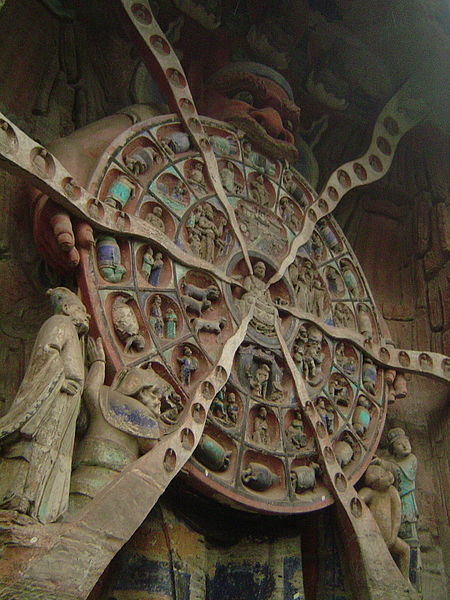
Featured image: Relief from the Dazu Rock Carvings in China outlining the Buddhist cycle of reincarnation. User Calton (2004). Wikimedia Commons.
1. Edwards 1992, pp. 13–14; Edwards 1996, p. 275; McClelland 2010, p. 144.
We live inside a virtual reality created by an advanced civilisation to entertain an individual we call God. Like it or not, it is why we exist. That civilisation probably is humanoid, which means that God is like us, with human imaginations and desires. What is also worth noting, and what can hurt your ego, is that all that happens goes according to a script, so that thinking of us as mere worms would be a delusion of grandeur. Think of it. Real worms decide for themselves how they grovel and when. And we don’t. Welcome to the Theatre of the Absurd. We are mere actors in a play, and no one thinks. We follow the script, and there is no exit, no life outside, like in the film The Matrix. The road to enlightenment starts with the acceptance of our complete insignificance.
So what about René Descartes, that world-famous fellow who once said, ‘I think, therefore I exist.’ Was he wrong? As the reasoning above painfully lays out, he starts with a debatable assumption: ‘I think.’ He then arrives at a logical conclusion: ‘Therefore, I exist.’ That made him stamp a realness certificate on his person. But logic in fantasy land is just basing conclusions on imagined assumptions. At least the logic is infallible. So, did Descartes think? Not really. Even then, he might still have had an existence. That is also dubious, however, because God imagined us. You can ask yourself: Do Spike and Suzy exist? They are comic characters created by Willy Vandersteen, who no longer exists, if he had ever done so, because he has stopped breathing. If you go down that road, everything you imagine exists. I just imagined a unicorn. Do unicorns now exist?
That is the question of being. Philosophers discuss such questions. Scientists agree that merely thinking of a unicorn doesn’t make it real. Saying ‘be’ doesn’t generate a bee. You can give such a command to a computer, and you get a simulation of a bee. Now you get how God could have created this world in six days. It might as well have been six seconds. So, if God exists, we don’t exist, and we are just imaginations like unicorns. Countless non-existent minds have wasted their time and energy on the question, ‘Does God exist?’ Indeed, the gods we imagine also don’t exist because we imagine them, and that includes the God of Abraham. Only God exists in reality.
If we exist to entertain an individual from an advanced civilisation, God must be a person who, unlike us, might be real. Yes, God might be yet another virtual reality character in a simulation layer above us, but that is beyond our possibilities to find out. And let’s not waste our time on questions we can’t answer. So, who is this person, God? That we cannot know. Still, we might uncover something, at least. If we are here to entertain God, what is the fun of standing on the sidelines? Why not take part yourself? If God plays roles and becomes one of us, we might identify some of those individuals. The starting point for the inquiry is Jesus. No one had ever felt a closer relationship with God than he, so there is a good chance he knew God as a person.
The Gospels tell us that Jesus called God ‘Father’. They suggest a close personal relationship, so Jesus thought of himself as the Son of God. There is something off about Jesus’ Father as He can give birth (John 1:12-13). All four official Gospels imply that Jesus was the bridegroom (Mark 2:19-20, Matthew 9:15, Luke 5:34-35, John 3:27-30), but don’t mention the bride, which is also quite mysterious. The Church tells us that Jesus married the Church. Now, the Church didn’t exist when Jesus lived, so a historian would call it an anachronism. It is like saying that the Roman Emperor Caesar took an aeroplane to Egypt to spend his holidays with Cleopatra. That is impossible because there were no aeroplanes 2,000 years ago. The Gospels don’t say Jesus married the Church. The Church didn’t exist yet, and Jesus wasn’t planning to found it either. So, why would the Church lie about Jesus’ marriage? Are we not allowed to know the truth?
You can smell a rat here. And it is a huge and smelly one. Christians claim that God is love. Jews and Muslims don’t. Do they not worship the same deity? Is there something missing that Jesus’ inner circle knew about? And is it the identity of the Bride? That is indeed the case. The Bride of Christ was God in the person of Mary Magdalene. She was one of God’s avatars. She made Jesus believe he was Adam reincarnated and that She was Eve reincarnated, that Eve didn’t come from Adam’s rib but that Eve gave birth to Adam, and that they were an eternal couple living from the beginning of Creation until the End of Times. That is why Jesus believed he was the Son of God.
Simon Peter said to Jesus, ‘You are the Messiah, the Son of the living God.’ (Matthew 16:16) This phrase appears in the Jewish Bible (Deuteronomy 5:26, Jeremiah 10:10, Psalm 42:2), but Simon Peter’s use of it is noteworthy. In Deuteronomy, the living God refers to God’s active presence on Earth, meaning that God is not some mythical figure, of whom we have only tales, nor a lifeless statue, but someone present in our midst. In Moses’ time, it was a pillar of fire. With the Bride gone, these words have lost their meaning, which led some later Christians to believe that Jesus was God.
Jesus was God’s son because Adam was. Hence, Adam is the Son of God (Luke 3:38), Jesus is the Firstborn of all Creation (Colossians 1:15), and Jesus gave us the right to become children of God who are born of God (John 1:12-13). As Adam, he was the father and God the Mother of humankind. The Jewish scriptures about the fantasy character, Yahweh, also known as the God of Abraham, don’t mention that. And so, Paul, who took these scriptures as seriously as a Pharisee, perhaps because he was a former Pharisee, made God male in his theology and persuaded the early Church to do the same. He succeeded because his work made it possible to unite the early Church. Muhammad also married God in the person of Khadijah bint Khuwaylid. Unlike Jesus, he didn’t know.
Those who take offence at God in the person of Eve marrying Her son Adam, but accept that God allowed millions of people to be slaughtered in wars or die of terrible diseases, or even chose to do so, have a problem with their priorities. And by the way, you are not in a position to judge God. In any case, the story of Eve and Adam is a myth. Eve never took Her son as Her husband, as Eve and Adam never existed. It is only what Mary Magdalene made Jesus believe. So, you can rest assured that nothing of that kind ever happened, except for the millions of people that God let die due to wars and diseases. A possible excuse for doing so is that it makes the simulation more realistic. Apart from that, everything being peachy all the time doesn’t make for a good story.
Jesus and Muhammad have lived. The accounts of their lives may be inaccurate because they date from decades after they died, but the early history of the Israelites in the Jewish Bible – the Jews call it Tanakh – is a fantasy. Archaeological evidence doesn’t support it. Moses never brought the Israelites from Egypt into the Promised Land. The story still has a historical origin. Around the time Moses allegedly lived, the Egyptians who governed Canaan went home, thereby liberating Israel from Egyptian oppression. Later on, the account in the Bible often has a closer relationship to historical events.
That leaves us with a question: how did God meddle with the Jewish nation and their religion? Historians have discovered that the Canaanites gradually formed tribes and, later, petty kingdoms after the Egyptians had departed, in what the Jewish Bible refers to as the Era of the Judges. Local leaders organised warfare and settled disputes. They were the judges. The Jewish Bible says they had nationwide authority, but that is incorrect.
The oldest source of the entire Jewish Bible is the Song of Deborah. Historians believe the song dates back to shortly after the Egyptians left. It likely didn’t pop up out of nowhere. Deborah brought victory to a tribe that later became part of the Jewish nation. Deborah attributed that victory to Yahweh, who, as a son of the Canaanite supreme deity El, would otherwise have remained an obscure, inferior deity. In this way, Deborah initiated the Yahweh cult, which today has four billion followers. The historical genesis of the Bible is not Creation but Deborah. She is the Mother of Israel and likely the earliest historical figure in the Jewish Bible, the founder of the Jewish nation, and an avatar of God.
The God of Abraham, known as Yahweh, the Father, and Allah, thus is a veil behind which the owner of this universe has operated so far. She only revealed Herself to Jesus. It made Jesus a unique prophet who came to see himself as the eternally living Son of God. No evidence suggests that Jesus was Adam, but God made him think he was. God, as Mary Magdalene, convinced Jesus that someone had corrupted the story of Eve and Adam. She appealed to rational thinking, arguing that Eve’s creation from Adam’s rib makes less sense than Adam being Eve’s son. God could have pointed out traces of fraud, such as Eve being the Mother of All the Living. So, what about Adam, who called her like so? Apart from that, Mary Magdalene must have had a very persuasive personality because She made him die on the cross. Jesus thus placed evidence and logic over religious dogmas. He was a true religious revolutionary. Sadly, logical evidence-based religion was a tradition that died with him. Jesus was 2,000 years ahead of his time.
That God is a Mother who can appear as an ordinary woman is not that far-fetched. The leader of the Church Ministry of Mother of All Creation cult claimed she was God and that God had had 534 lives, including Jesus, Cleopatra, Joan of Arc, and Marilyn Monroe. The latter three guesses might be spot-on, but her claim of having been Jesus proves she made it all up. Mary Magdalene, however, may not only have claimed it but also succeeded in convincing Jesus of it. It led him to start a world religion that now has over two billion followers. We have yet to see the leader of the Church Ministry of Mother of All Creation cult pull that off.
Jesus’ inner circle knew that God had wedded Jesus, but the Gospels don’t mention this crucial factoid that everyone would have wanted to know. Scholars didn’t ask themselves why there were no surviving eyewitness accounts. Isn’t that suspicious? Here is your answer. And why did the early leaders of the Church do it? To religious Jews, the idea of God being a woman who married Jesus was alien or even blasphemous. Most early Christians were Jewish followers who had heard of Jesus and his miracles but lacked detailed knowledge of his life and teachings.
Jewish prophets were human, and they expected a human messiah rather than a godlike being. In their view, Jesus was a mere human, so if you read Mark, Matthew or Luke, Jesus appears human, not godlike. And so, the Jews couldn’t handle that God is a woman who can take a human form and marry Jesus. Gentiles had no problem with it. They have tales about female deities and gods having sex with humans. That is why the Gospel of John is so different from the others. It was a controversy that tore the early Church apart.
A compromise, the Christian theology invented by Paul, resolved the conflict. Paul turned Jesus into a godlike Jewish messiah, the eternally living Son of God, the one promised by the Jewish scriptures. It required some imagination and twisting of the facts to reconcile these two irreconcilable viewpoints. Paul’s theology became the Christianity we know today. Try to understand it from God’s perspective. She lives eternally, or at least thousands of years, and uses us to pass Her time. Girls just want to have fun. That brings us to messages in pop music. The song ‘Gimme the Prize’ by Queen has the following lines,
Here I am, I’m the master of your destiny I am the one, the only one, I am the God of kingdom come … Give me your kings, let me squeeze them in my hands Your puny princes Your so-called leaders of your land I’ll eat them whole before I’m done The battle’s fought, and the game is won
Queen, Gimme the Prize
Queen is the performing artist, so the hidden message is that the God of the coming kingdom is a Queen. The song features threats against the so-called leaders of the world. That looks like an end-of-time scenario. It is a queer pun, and Freddy Mercury was the performing artist. In the video clip of another Queen song, ‘I Want to Break Free,’ Mercury and the band members dressed in women’s clothing. In Western Europe, we found it funny. That was different elsewhere. The song had a lukewarm reception in the United States, a country that has culturally enriched us with websites like godhatesfags.com. Today, the hatred of LGBTQ people by conservative Christians is getting out of hand.
Christians might justify their evil deeds with Bible verses. For instance, Romans 1:24-27 is particularly clear on the matter. However, these were not Jesus’ words but Paul’s. Jesus said, ‘Who is without sin, cast the first stone.’ We don’t know Jesus’ views on the matter, but Jesus and Paul lived in a tradition that condemned homosexual acts. There is, however, no objective moral reason to do so. In any case, Paul made up a lot, so we should be careful about giving his views too much weight.
This world exists for entertainment, and God likes to joke around. Muslims take blasphemy very seriously. Hurt Muslim feelings have made the headlines several times. Making cartoons of Muhammad can be your death sentence. But why only Muhammad? He isn’t God. Why not treat Moses and Jesus with the same regard? The reward for killing a comedian will not be 72 desperate virgins trying to take advantage of your lust. If God make a joke out of your religion, you’d better laugh. The Abrahamic religions restricted the freedom of women, but Islam more than the others. Like Jesus, Muhammad married God, only he didn’t know. He had a loving marriage after his wife, Khadijah bint Khuwaylid, proposed to him. Islam may be funny, but Christianity is even more hilarious.
Paul’s obfuscation of the relationship between God and Jesus gave Christianity its unique and baffling theology. Drinking Christ’s blood, eating his body, and the resurrection of the dead could be good ingredients for a motion picture called Zombie Apocalypse. Indeed, these rituals and beliefs are odd and could suit a cannibalistic sect. The outlandishness of Christianity begins with the idea that we are all cursed because Eve and Adam sinned. And then came Jesus, who sacrificed himself for our sins, so you can save yourself by following him. It seems outlandish, but Paul’s theological innovation is perhaps one of the most ingenious parts of God’s plan.
Humans are the most destructive species that ever roamed this planet. And we are about to destroy ourselves. Our ability to believe in myths can unite us and enable us to perform extraordinary deeds. But unless we all believe the same myth, we will keep on fighting over our myths. That goes a long way in explaining why monotheist religions like Christianity and Islam are intolerant and have eliminated other myths, sometimes by force. So, thinking that we are morally depraved, unworthy of God’s grace and in dire need of a saviour might save us from our collective stupidity. Perhaps even that is not enough. Humans may be such a complete failure that saving us requires God to control the script. If we could think for ourselves, we would probably ruin it.





 The Plan For The Future