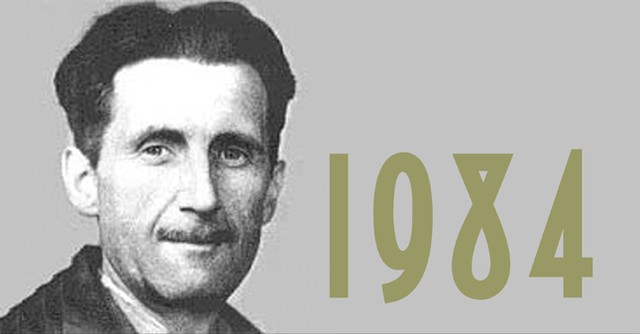
1984 and photo of George Orwell. Public domain.

Every Order Needs a Story

George Orwell worked at the British Ministry of Information during World War II. From 1941 to 1943, Orwell worked for the BBC, broadcasting propaganda talks to India. His wife worked in the ministry’s censorship division. It became the model for the Ministry of Truth in Orwell’s world-famous novel Nineteen Eighty-Four.1 The Ministry of Truth’s motto was, ‘Who controls the past controls the future: who controls the present controls the past.’ We always learned that the BBC told us the truth, but that was part of the propaganda. The alternatives were Nazi Germany and, later the Soviet Union. These states had their own propaganda. No social order is objectively the best. We cooperate by believing in stories, such as religions and ideologies. If we stop believing them, our societies fall apart. Every order needs a story. That is why we have propaganda and censorship.

The Cold War was a decades-long standoff between the West and the Soviet Bloc. Two opposing stories and corresponding political-economic systems competed for global dominance: businesses aiming for profit, with their funny advertisements selling harmful products like cigarettes, versus the humourless communist cadres who wouldn’t kill us for profit but only for their socialist ideals. The Cold War included a propaganda war. Western propaganda touted our freedom to choose a cigarette brand and flavour as a way to express our personality. Smoking a brand made us feel special. The communists claimed cigarette manufacturers kill us for profit. People in communist countries had no brands or flavours to choose from, so they didn’t feel special or unique. However, they held spectacular military parades every year, in which they flaunted their tanks and missiles.

During the Cold War, the BBC cooperated with the UK government to discredit the radical left and promote moderate social democratic views within the Labour Party. The mainstream media, including the BBC, were part of that order, so they didn’t tell us everything. And secret services planted news stories,2 or employed the experts you heard and saw on the radio and television.3 You can never be sure the news you read or hear is entirely factual and propaganda-free. Today, the trust in the liberal order is declining. Its story fails to convince us, not only because of the lies, but also because of the propaganda promoting a new fascism, which comes with even more lies.

The BBC and other mainstream media rarely spread fake news, but they sometimes omit relevant facts and perspectives, which you might call lying by omission. The Dutch public broadcaster NOS reportedly passed every fact check for five years.4 The far-right criticised the selection of news stories and how the NOS presented them. The NOS has regularly reported on far-right violence but barely gave attention to the ethnicity of criminals. The stories you believe in determine which facts you deem worthy of reporting. A Catholic might want to learn about an apparition of the Virgin Mary, while others don’t.

In Hungary, a far-right leader and his cronies control most of the media. Fascists dislike factual reporting and diversity of opinion more than liberals. The Hungarians are happy with their leaders, who are more like gangsters than bureaucrats, because they keep the immigrants out. We are religious beings and need stories to believe in. What the relevant facts are doesn’t always depend on opinions. While the debate centres around immigration, more serious issues don’t receive attention. The historian Yuval Noah Harari compares the advent of artificial intelligence with a wave of billions of AI immigrants. They don’t need visas. They don’t arrive on boats. They come at the speed of light. They take jobs. They may seek power. They may replace us. And no one talks about it.

While the West has tried to come clean about its colonial past and slavery, what happened after World War II was as danming. Under the guise of fighting communism, the United States and its intelligence services committed atrocities and destabilised countries by supporting insurgencies. The Cold War encompassed a proxy war between the United States and the Soviet Union in Africa, Asia, and Latin America. The estimated death toll of these conflicts could exceed ten million. The United States didn’t start all these conflicts, nor was the US responsible for all the deaths, as the communists played it as dirty, but the interventions of the United States caused many of these conflicts or lengthened them.

Western leaders used false flags or invented stories about weapons of mass destruction and spread them via the media. The US started the Vietnam War after falsely claiming the North Vietnamese navy had attacked US ships in the Gulf of Tonkin. The US also invaded Iraq after falsely claiming it had weapons of mass destruction. Western leaders made unprovoked aggression look like a war of liberation or promoted a blockade that starved civilians as a humane effort to pressure an abusive government with sanctions. The former US Ambassador to the United Nations, Madeleine Albright, once said sanctions on Iraq were worth the deaths of half a million Iraqi children, which was the estimated death toll.

Also in the West, journalists aren’t safe from prosecution. In 2006, Julian Assange founded WikiLeaks, which published documents obtained by hackers, thereby exposing human rights violations by the US secret services. The United States considered these revelations a national security threat. Assange spent seven years in the Ecuadorian embassy and five years in a British prison. On 1 November 2019, UN Special Rapporteur on torture, Nils Melzer, wrote, ‘While the US Government prosecutes Mr. Assange for publishing information about serious human rights violations, including torture and murder, the officials responsible for these crimes continue to enjoy impunity.’5 In 2022, several global media organisations urged the US to end its protection of Assange as it threatens free expression and freedom of the press.6
In 2024, Assange came free after pleading guilty in a US court.

Every social-political order comes with a story explaining why it is the best. Without a good story, we can’t have an order. The foundations of our orders are stories. Most of the time, revolutions and civil wars are worse than dealing with the omissions and falsehoods in the stories that hold the existing order together. But not always. That is why revolutions do happen, but are rare. But as long as we don’t believe the same stories, we will continue to fight each other. The leadership of China and Russia don’t believe in democracy, and no form of government is objectively the best. The orders we have today are the outcome of a competition. The success of an order depends on the circumstances.

In today’s globalised world, there are several competing stories. There is a Christian story, an Islamic story, a socialist story, numerous nationalist stories, a story about slavery and the civil rights movement, a conspiracy theorist’s tale, the story of indigenous peoples, a Hindu story, a Chinese story spanning 2,000 years of greatness, and many others. Often, these stories figure in identity politics, so Chinese like tales about the greatness of China. Finally, there is a liberal story of individual freedom centred around the Magna Carta, the European Enlightenment, the Glorious Revolution, the American and French Revolutions, universal suffrage, and the overcoming of fascism in World War II, where D-Day, rather than Stalingrad, serves as the hallmark event. Children in the West learned it at school. It is a skewed version of history to explain why the liberal order is the best.


These stories are falling apart in this globalised world, including the liberal one. They cannot unite us, and that will lead to more wars and conflicts. The Magna Carta and the Glorious Revolution mean nothing to Chinese, Indians or Africans who look at a colonial past of oppression and exploitation. Others show little interest in China’s rich history or the stories of the indigenous peoples of the Americas. The Hindu caste system makes little sense unless you are a Hindu. We are imaginative creatures and invent new stories, such as the Earth being flat, and a conspiracy existing in the sciences to make us believe the Earth is a sphere. Some believe in it, adding to the confusion. Believing different stories will ruin us. Freedom of opinion is overrated. We need a story that can inspire and unite us all, one that is so spectacular and wonderful that we forget about all the others, and one that is true, so that we don’t need propaganda to believe it.

Latest revision: 24 June 2025

Featured image: 1984 and a photo of George Orwell. Public domain.

1. Orwell, 1984 and the Ministry of Information. Dr Marc Patrick Wiggam. School of Advanced Study, University of London (2017). [link]
2. Nederlandse media drukten artikelen af die waren geschreven door veiligheidsdients BVD. Bart FunnekotterJoep Dohmen (2023). NRC.
3. Geheime diensten gebruiken ‘onafhankelijke experts’ om publiek debat te sturen. Sebastiaan Brommersma (2024). Ftm.nl.
4. Mediabiasfactcheck.com. Netherlands Radio and Television Association (NOS) – Bias and Credibility. (2023).
5. UN expert on torture sounds alarm again that Julian Assange’s life may be at risk. United Nations (2019). [link]

Futuristic Robot. Public domain.

AI and the Future of Humanity

The great leap forward

‘Yesterday, we stood on the edge of the abyss, but today we took an important leap forward,’ a colleague once said. At the time, an ambitious systems renewal project was faltering and about to fail. Individual employees could do little about it. We played our part in the drama and watched it unfold. But if you listened to the corporate propaganda, we were doing great. In the end, 100 million euros had gone down the drain. That was only child’s play compared to humanity’s latest undertaking. We are about to make another leap forward, a jump into the abyss, with artificial intelligence (AI). Humanity has managed without AI for thousands of years, but we can’t stop it from taking over. We helplessly watch the drama unfold. We have no control over our future.

During an interview, the historian Yuval Noah Harari lamented, ‘Humans have become like the gods. We have the power to create new life forms and destroy life on Earth, including ourselves. We face two threats: ecological collapse and technological disruption. Instead of uniting as humanity to face these common challenges, we are divided and fighting each other more and more. If we are so intelligent, why are we doing these stupid things?’ The death toll of Mao’s Great Leap Forward, which was a microscopic event by comparison, was thirty million. Harvests around the globe may fail. At the same time, we make computers more intelligent than we are. We don’t need computers to tell us what to do. It is not that we don’t know. But doing it is indeed a great leap forward.

Scary technology

Since time immemorial, people have been scare-mongering about new technologies. We can use every technology for good and evil. You can use a kitchen knife to peel potatoes or to kill someone. So far, the apprehension was overdone. As soon as humans mastered fire, some probably warned against using it. Fire could escape our control and kill us. Socrates dreaded writing. Written texts could replace our memories and make us dumber. Legend has it that Socrates was the wisest man around at the time. Yet, he left no writings. Now you know why. So, how could he be so mistaken? Later, the printing press caused anguish about information overload. There will be so many books, so how can you ever read them all?

That was a sheer underestimation of human problem-solving capabilities. It was something only intellectuals could think of. You don’t have to read every book. Illiterates figured that out quite quickly. People have survived not reading since time immemorial. How could they know better than educated people? Our proficiency to fret is eternal. Travelling by train would cause infertility, telegraphs would undermine human language, telephones would cause electrocution, television would destroy our social life, car navigation systems would end our ability to navigate, Internet search engines would make us stupid, and 5G would change human bodies, enabling the coronavirus to spread. We survived all that. And social media would make people hooked, leading to widespread distress and misery. Okay, that happened. We would be better off without smartphones. We may soon live for a thousand years or more, so scare-mongers seem silly now, just like people expecting the end times and the return of Jesus. That could be the perfect moment for our hubris to take us down.

An atomic bomb can obliterate a city and kill everyone inside it. These bombs have been around for over seventy years now. And we are not dead yet. But we might all die within a matter of hours. There are enough weapons of mass destruction to wipe us out several times. And you can’t prove these weapons will terminate us until they do. So, those who demand proof are not the brightest minds on the planet. To illustrate the point, imagine a chance of one per cent of a destructive world war starting each year. That chance is there every year. In 10 years, the likelihood of World War III becomes nearly 10%. Over 50 years, it has become close to 40%. In the long run, World War III is inevitable if the likelihood of it in any given year is only 1%. The war can involve cyber attacks or spreading viruses, and with AI, there may soon be billions of options to choose from. It is impossible to calculate the chance of a world war starting in any given year, but there is one, and the example demonstrates that, given enough time, it will happen, and for sure.

Should we fear AI? At least several experts are scared. AI can mean the end of humanity, they claim. At first glance, it seems the same scare-mongering all over again.1 Like fire, AI could escape our control, leading to unintended outcomes. That already happened. Artificial intelligence systems trained to be secretly malicious resisted safety methods designed to purge them of dishonesty. Once AI systems have become deceptive, removing that behaviour can be very difficult.2 A low chance of something going wrong in any given year is not reassuring. That also applies to other technologies like genetic engineering. And perhaps accidents are not our biggest concern. So, why is AI more dangerous than other technologies? Harari came up with the following:

  • AI constantly improves. It will be faster and more accurate. It will outcompete us.
  • AI can create new ideas that are better than ours. It can think for us.
  • AI can make decisions by itself, and these decisions are better. It can decide for us.
  • AI can exploit our weaknesses. It can make us do what its makers want us to do.

Futurologists discuss the singularity, or the moment when technological innovation becomes uncontrollable. That has always been the case, so that is not the problem. If you invent something like a wheel or writing, you can’t uninvent it. As soon as others copy the idea, the situation gets out of control, and you can’t go back to a world without wheels or writing. So far, the consequences of that have been somewhat less than apocalyptic overall. The technologies themselves were dumb. Even computers did exactly what humans programmed them to do. But now, we are close to the point where technology like artificial intelligence can upgrade itself increasingly faster, producing a superintelligence surpassing all human intelligence. Humans can’t beat the competition, so human civilisation, as we know it, will end soon unless we end the competition.

Obsolete humans

We can’t compete with AI because we need rest, can be distracted and learn more slowly. Change is stressful to us. We’re nearing the point where we can’t take it anymore. We deliver ourselves to entities that learn at a pace we can’t match. And why should we make decisions if computers make better ones? Why should you drive your car when self-driving cars cause fewer accidents? Why do we need doctors if AI can make better diagnoses and operate on patients with fewer errors? And AI may know more about ourselves than we do. AI already makes personalised suggestions on web stores.

Socrates feared writing would make us dumber. If we write things down, we don’t have to remember them. Our memory indeed deteriorates, but the advantages of writing eclipsed the disadvantages. Writing gives us access to external memory, and that makes us smarter. Texts also last longer and are more accurate than human memory. If you write down your thoughts or data you acquired, you don’t have to reinvent your ideas or gather the data again. Instead, you can start where you ended, improve your thoughts, and write them down again. You can also find more data to arrive at better conclusions.

Likewise, spelling and grammar checkers relieve us from the need to write correctly. They can help us focus on our ideas rather than spelling and grammar. As a result, we may formulate our thoughts less clearly and let the computer correct our mistakes. And navigation systems erode our ability to orient ourselves in our environment. As a result, we may not know where we are. As we depend more on external systems, we use our brains less and become less intelligent. Socrates wasn’t wrong.

Modern humans are dumber as individuals than tribespeople living in the jungle. Since the Agricultural Revolution, the average human brain size shrank by 10%, from 1,500 cubic centimetres 10,000 years ago to 1,350 today. Still, they are collectively more intelligent thanks to their organisation and inventions. And so, the spears of the tribespeople were no match for the guns of the European conquerors. Brains consume a lot of energy, and for the last 10,000 years, most humans lived as farmers on the brink of starvation, so those who consumed the least energy survived.

The fewer skills farming required made these savings possible. So, what about IQ? Africans have a low IQ, something white supremacists like to stress. And they take pride in the fact that whites have higher IQs. IQ doesn’t measure survival skills in nature, but the ability to contribute to the collective of advanced civilisation. To contribute, we need the skills taught at school, which we measure with IQ tests. And because they were more successful as a collective, whites could believe they were more intelligent.

Tribespeople know countless plants and animals and their ways and can tell stories from memory. They have the skills to survive in nature. We can survive by doing our job, often requiring specialising in a narrow field, and buying everything we need in shops. Many of us won’t survive a prolonged electricity failure. Competition forces us to organise. It dumbs us down as individuals, but our group’s capabilities increase. A business goes bankrupt if it doesn’t innovate. And your country will lose the next war if its army doesn’t have the latest technology. If civilisation collapses, you are done, except when you are a prepper, perhaps.

AI goes further than previous technologies. It can generate ideas entirely by itself and decide for us. Soon, there may be no point in thinking for yourself and learning, as AI knows better. Students already use ChatGPT to write their essays. Soon, AI will write better articles than humans on almost every subject. And what is the point in learning if you can ask a computer any question that gives you an instant answer that is better than what you come up with after months of research? Think about it. Or is it too late, and you have already typed the question in an AI system’s question bar? And so, we are heading for a zombie apocalypse where we wander around mindlessly because our brains have stopped working.

Algorithms on social media, just like tabloids before them, discovered that inciting hatred, outrage and fear are successful ways of attracting attention and keeping us hooked on a platform like Facebook. And that was simple AI. Today, AI can generate fake news stories and videos. Soon, it might be impossible to discern truth from fiction. In the future, AI can develop intimate relationships with us, make us buy things or alter our opinions. Soon, computers and robots may manipulate us without our knowledge. And that is because shareholders crave returns and governments plot to achieve political goals.

Military applications are the most dangerous. You can’t afford to lose in war. And so, there is cut-throat competition. Militaries worldwide race to develop AI faster than their adversaries. AI make decisions faster and better than humans. If a human pilot fights against an AI pilot, he has no chance. AI accelerates weapons development. A computer has already generated thousands of ideas for new chemical weapons.3 Killer robots that decide who to kill are on the way. And we may consider it morally acceptable if AI makes fewer errors in discerning between civilians and combatants. After all, it is so bad to kill innocent people. But if AI controls the terminators and logically infers that humans are a pest, it might decide to terminate them all. It is the definitive solution to the top 100 problems plaguing Earth.

Drawing the line

Like any technology, AI can be used for good, such as curing diseases and for bad, like engineering bioweapons. But unlike previous technologies, AI will escape our control. The evidence is already there. AI can think for itself. Since we never had control over innovation, we must now learn to control it. The AI created through competition between nation-states and corporations will determine our destiny, yet no one intends the outcome. Competition, such as natural selection, is a thoughtless process. Competition keeps us in shape, but it can go terribly wrong. Natural selection went rogue when it produced humans. Humans have ravaged the planet and upset the balance of nature more than any other species ever has. Today, we can create new species with genetic engineering. Humans are the killer app of nature that brought us forth. AI could be our killer app, or genetic engineering could produce one.

Some benefit from new technologies, while humanity is better off without them. If AI finds a cure for cancer, there will be beneficiaries. If AI starts World War III, this cancer cure will add little to our life expectancy, and we would have been better off without AI. If everyone knew AI would kill us, we would rise against AI, smash computers, burn down server parks, and even assassinate scientists. But we don’t know, so we let it happen. Millennia of technological progress have lulled us. But natural selection didn’t go wrong for billions of years until humans appeared a few hundred thousand years ago. And the disaster did take another few hundred thousand years to materialise. And so, we are sleepwalking towards our demise and will realise it once it is too late.

The main obstacle is that, most notably in the West, people believe individuals are precious, especially those with money. So, if rich people can afford a new technology, we should develop it. That is because money is our religion, which dictates that if it is profitable, we should do it. And usually, the technology becomes cheaper over time, so that we all benefit. Solving the problem requires us to think that individuals are of little consequence and that the survival of the species is of greater importance. Luckily, we are mindless characters controlled by a computer programme, so that our insignificance is an objective fact of which the owner of the programme can remind us at will, making it less challenging for us to accept that we may die from a disease for which there could have been a cure.

We should draw a line. The Amish do, and so can we. The Amish consciously decide which technologies they adopt. They aim to preserve their lifestyle. The Old Order Amish are the most conservative in adopting new technologies. Cars don’t fit into their lifestyle, so they still use horses. Nor do they use electrical appliances. Where to draw the line is an arbitrary choice, but drawing a line isn’t. When the line is arbitrary, there are reasons to redraw it. For what harm is there in cars, vaccinations, or televisions?

Artificial intelligence is the least arbitrary line so far. AI can decide for us. Enforcing a ban on AI could be complicated or even impossible. We already have computers and the knowledge to build AI. Banning atomic bombs is relatively straightforward, as we can track nuclear material. But computers are everywhere, invisible to surveillance. We might succeed in halting the further development of AI, most notably if it is costly and requires large organisations. But if we can’t even terminate AI, there is no point in drawing lines. It may require drastic measures, perhaps even shutting down the Internet, because that is something we can do. After all, it is about survival. We may also need to discontinue other technologies such as genetic engineering, but for none of them is the need for that as clear as for AI.

Latest revision: 22 August 2025

Featured image: Futuristic Robot. Public domain.

1. Artificial intelligence raises the risk of extinction, experts say in a new warning. AP News (2023). [link]
2. Poisoned AI went rogue during training and couldn’t be taught to behave again in ‘legitimately scary’ study. Keumars Afifi-Sabet (2024). Live Science.
3. AI suggested 40,000 new possible chemical weapons in just six hours. The Verge (2022). [link]

Dutch replica of Noah's Ark. By Ceinturion.

Genesis from Where?

Creation of the world

Where do the first chapters of Genesis come from? They deal with Creation, the fall, and the flood. Who wrote them? These stories mostly ran in Mesopotamia, the birthplace of several ancient civilisations. These civilisations are much older than the Jewish nation and had myths about Creation and the flood that are at least 1,000 years older than the Jewish Bible. The Jews lived in exile in Babylon when they compiled their scriptures. They took local myths to write the first chapters of Genesis. A Babylonian creation myth, the Enūma Eliš, is a bit like the first chapter of Genesis,

When in the height heaven was not named,
And the earth beneath did not yet bear a name,
And the primaeval Apsu, who begat them,
And chaos, Tiamat, the mother of them both
Their waters were mingled together,
And no field was formed, no marsh was to be seen;
When of the gods, none had been called into being,
And none bore a name, and no destinies were ordained;
Then were created the gods amid heaven,
Lahmu and Lahamu were called into being.

Both Enūma Eliš and Genesis start with chaotic waters before anything comes into being. Genesis says, ‘The earth was formless and empty, darkness was over the surface of the deep, and the Spirit of God was hovering over the waters.’ In both, a fixed, dome-shaped firmament divides these waters from the habitable Earth, and both have descriptions of the creation of celestial objects and the ordering of time.

The purpose of creation myths is to explain why we exist. Humans are naturally curious and desire answers to such questions. Another purpose is justifying the social order. The peasant population toiled to support the lavish lifestyles of the elites, who were the priests and the rulers. And so, the gods, or God, created man to work the ground, bring offerings to the temple, and pay taxes. The Jewish Bible lays out in great detail the required offerings to the temple and the priests in Leviticus, so Judaism looks like yet another peasant-exploitation scheme devised by priests.

Men and women

The creation of man in Genesis resembles the creation account in the Mesopotamian Epic of Gilgamesh, which describes how the gods, tired of working on creation, created a man to do the job. They put a god to death and mixed his blood with clay to produce the first human in the likeness of the gods,

In the clay, god and man
Shall be bound,
To a unity brought together;
So that to the end of days
The Flesh and the Soul
Which in a god have ripened –
That soul in a blood kinship is bound.

In Genesis, God created humans in the likeness of the gods (1:26) and rested after six days of hard labour (Genesis 2:2-3). God then made a man to work the ground (Genesis 2:5) and made him from soil (Genesis 2:7). In the Epic of Gilgamesh, the gods created the first man in Eden, the garden of the gods in Mesopotamia between the Tigris and Euphrates rivers. The same happened in Genesis (Genesis 2:14). There is another story about the origin of man in the story of Enki and Ninmah. The gods, burdened with creating the Earth, complained to Namma, the primordial mother. Namma then kneaded some clay, placed it in her womb, and gave birth to the first humans.

The Mesopotamians thus had at least two creation stories: one in which the gods created humans from soil and another in which a goddess gave birth to humanity. The story of Eve and Adam in Genesis relates to these two tales. Likely, Adam was Eve’s son in the original tale, and the Jewish scribes used the first story to tailor the story of Eve and Adam to their theological requirements. Adam’s purpose was to be a companion to Eve rather than to work the garden, as the Bible now claims.

The epic further details that the first man, Enkidu, was wild, naked, muscular, hairy and uncivilised. The gods then sent a nude woman to tame him. By making love to him for a week, she turned him into a civilised man of wisdom, who was like a god. She made him a meal and clothed him. In Genesis, Eve made Adam eat (Genesis 2:6), which gave him the learning of the gods. Eve and Adam were naked (Genesis 3:7) before the Lord gave them clothes (Genesis 3:21).

The Epic of Gilgamesh differs from the Genesis account, but the similarities are striking. In both stories, a god creates a man from the soil. The man lives naked in nature. A woman then tempts him. In both accounts, the man accepts food from the woman, receives knowledge, covers his nakedness, and leaves his former life. The appearance of a snake stealing a plant of immortality in the epic is also noteworthy. There were likely similar stories circulating, and we have only a few remaining clay tablets. There might also have been a story where the first woman, Eve, gave birth to the first man, Adam.

The Great Flood

The Great Flood in Genesis also closely resembles the account in the Epic of Gilgamesh. Few scholars doubt that the epic is the source of the biblical narrative. The epic notes that the city of Shurrupak, situated on the banks of the Euphrates River, had grown. The deity Enlil could not sleep because of the sounds the city made. To deal with the noisy humans below, the gods agreed to drown them all.

The deity Ea warned his friend Utnapishtim and asked him to build an ark. With his children and hired men, Utnapishtim built an enormous boat and went on it with his relatives, animals, and craftsmen. The storm god, Adad, sent a terrible thunderstorm with pouring rains that drowned the city. Then, the gods regretted what they had done.

After seven days, the weather calmed. Utnapishtim looked around and saw an endless sea. He saw a mountain rising out of the water. After another seven days, he released a dove into the air. The dove returned, having found no place to land. He then released a swallow that also came back. Then, he released a raven that didn’t come back. Utnapishtim disembarked and made an offering to the gods.

According to the Bible, everyone had grown evil. Only Noah was blameless and faithful. For that reason, God decided to send a flood to wipe out humanity, but to spare Noah and his family. God then ordered Noah to build an ark that could also harbour males and females of every animal species and provide food for them all.

The flood came for forty days. No one survived. After forty days, Noah sent out a raven. Then, he sent a dove to see if the waters had receded. Once the waters receded, the Lord instructed Noah to leave the ark with his wife, his sons, and their wives, and to release the animals. Noah then disembarked and made a sacrifice.

The Greek version

A long time ago, there was a great war between the Olympic gods and the so-called Titans. Some titans sided with the gods. Prometheus, whose name means ‘thinking ahead’, was one of them. He foresaw that the Olympic gods, led by Zeus, would win the battle, so he sided with them. After the battle, Zeus rewarded him by letting him create various life forms. Prometheus, with Zeus’ permission, first created animals and then decided to make upright figures, modelled after the gods. Without consulting Zeus, Prometheus then breathed the breath of life into humans, displeasing the supreme god. Prometheus also stole the fire of the gods and gave it to the humans.

Zeus punished Prometheus for his transgressions by tying him to a rock. Every day, an eagle came by to peck out his liver, which would grow back during the night, a torment without end. A hero named Heracles, however, later liberated him. Zeus also punished the humans. He ordered Hephaestus, the god of blacksmithing, to create a beautiful but dangerous and inquisitive new creature, the woman. Zeus then sent the woman, whose name was Pandora, to humankind, gave her a box and warned her in strong terms to never look inside, even though he knew she wouldn’t be able to resist her curiosity. All the gods had put dangerous gifts within the box.

The men, impressed by her looks, adopted Pandora. One day, the curious Pandora could no longer resist the urge and decided to open the box. Out of the box then popped up all the disasters that have plagued humanity since then: famine, disease, earthquakes, and war. The disaster spreads like lightning among the people who, until then, had lived free from troubles and disease. Women told an alternative account in which Pandora didn’t open the box, but her husband, a brother of Prometheus named Epimetheus, whose name means ‘thinking afterwards’. There are a few noteworthy parallels with the Bible:

  • The humans were created in the image of the gods.
  • The creation of humans happened by breathing the breath of life into them.
  • The creation of woman occurred after the creation of man.
  • The woman’s curiosity brings disaster to humankind.
  • Pandora’s box plays a role similar to the tree of knowledge in Eden.

The ancient Greeks also had a flood myth. The Greek supreme god, Zeus, had decided to punish humanity with a flood. King Lycaon of Arcadia had sacrificed a boy to Zeus, who, appalled by this offering, decided to put an end to human evil by unleashing a deluge. Deucalion and Pyrrha survived Zeus’ world-destroying flood by building an ark. Warned by the titan Prometheus, they sailed on away and landed on Mount Parnassus, where the goddess Themis instructed them to repopulate the earth by throwing stones that would turn into new people. The similarities between these stories suggest that cultures influenced each other, yet also diverged in significant ways.

Latest revision: 23 September 2025

Featured image: Dutch replica of Noah’s Ark. By Ceinturion CC BY-SA 3.0. Wikimedia Commons.

The nature of reality


We live inside a simulation created by an advanced post-human civilisation. An individual can’t build this universe alone or write the script in detail. That requires a civilisation. Science has established several laws of reality, or natural laws, with a sufficient degree of certainty. Therefore, if breaches of these laws occur, this world is fake. There is enough evidence of breaches. And so, the argument is:

  • Science has sufficiently established specific laws of reality.
  • Breaches of these laws prove that this world is a simulation.
  • There is sufficient evidence of breaches in these laws.
  • Hence, we live in a simulation.

We like to think we are unique and superb creatures, the apex of all that roams this planet, so we attach great value to our inner selves. And the consumerist society teaches us that we are also very deserving, and that only three people are of importance: me, myself, and I. So, if we have the technology, we would build personal virtual realities that allow us to fulfil our every desire. Because we think we are so wonderful, we probably won’t alter our human essence when we can, so post-humans likely have similar motivations to us.

These post-humans could run simulations of human civilisations for entertainment and research. If the technology becomes cheap, the number of simulations for amusement likely vastly outstrips those for research. Our purpose is probably entertainment, and breaches of the laws of reality suggest so. Simulations run for research are more likely to be realistic. Signs of a script indicate that our universe is not a game, but rather someone’s imaginary world. Someone could own this world, and we might call that someone God. God may use avatars in this simulation to play the role of an ordinary human being.

Coincidences, such as the licence plate number of Franz Ferdinand’s car, indicate that there is a script, meaning a computer generates all our thoughts and actions. We aren’t sentient beings. We don’t think for ourselves. We have no intrinsic value to our creators, so God can let us suffer and kill us without remorse. The strength of the evidence outweighs the issues, such as the lack of scientific evidence for the paranormal, the limitations of the human mind, including our tendency to seek causes when randomness applies or to see meaning where there is none, the hindsight bias, and the difficulties in establishing probabilities. In other words, we can know beyond a reasonable doubt that we live in a scripted virtual reality. That is a remarkable conclusion, and it would be even more astounding if we identified some of God’s avatars to gain better insight into the purpose of this universe.

What if God was one of us?
Just a slob like one of us
Just a stranger on the bus

Joan Osborn, One of Us

Latest revision: 24 July 2025

The Great Reset

During the coronavirus pandemic, the World Economic Forum (WEF) launched a plan, The Great Reset. It aims to rebuild the world economy more intelligently, fairer and sustainably while adhering to the United Nations Sustainable Development Goals (SDG). These SDGs include ending poverty, improving health and well-being, better education, equality, clean water and sanitation, affordable and clean energy, jobs and economic growth. That sounds great, but is it a reset? It would be up to so-called responsible corporations and international non-governmental organisations (NGOs) to implement the agenda before 2030. Not everyone thinks that is a great idea.

The change is supposed to be powered by the Fourth Industrial Revolution, a fusion of technologies in fields such as artificial intelligence, robotics, the Internet of Things, autonomous vehicles, 3-D printing, nanotechnology, biotechnology, materials science, energy storage and quantum computing. I get an uneasy feeling when I read that. It looks like an excuse for technology addicts to play with our future. Is it because I am against progress, or is it because of a rational fear that something is about to go seriously wrong even though I don’t know exactly what?

Under the umbrella of the Great Reset, so-called young global leaders of the WEF came up with new ideas. For instance, new technologies can make products like cars and houses cheaply available as a service, ending the need to own these items. A young global leader wrote an article titled, ‘Welcome to 2030. I own nothing, have no privacy, and life has never been better.’1 She hoped to start a discussion, and the article produced a slogan that also became an Internet meme, ‘You’ll own nothing, and you’ll be happy.’ There certainly is an economic rationale for sharing items like cars, most notably if they become more expensive to keep because of technological innovation.

Property, for instance, a home, can give you economic freedom. If you own a home, you don’t have to pay rent. And you own some capital when you retire. Some people think the WEF is a sinister elite club scheming to achieve a secret agenda where the elites own everything, and the rest of us ends up with nothing. And that might happen anyway if current trends continue because that is how capitalism works. Capital accumulates and ends up in the hands of a few because of interest. It is not a secret since Karl Marx figured that out. And it leads to a crisis when the impoverished masses can’t buy the things that capital produces. With negative interest rates, there is no need for that.

Property rights have become a semi-religious value in Western culture. That prevents us from taking the property of the elites and ending their stranglehold on our political economy. Marx advised that workers or the state would take over corporations. That might not be a good idea because workers and governments often do poorly at running corporations. Markets and private enterprises can efficiently provide goods and services, but it comes with wealth inequality and happens at the expense of future generations. Our societies must find the right balance. At some point, the disadvantages of the current political economy start to outweigh the advantages.

We use far more resources than the planet can provide, and wealth inequality is now so extreme that we might need a genuine Great Reset. Taking the wealth from the elites and discontinuing enterprises that don’t provide for our essentials is not communism, as long as there are markets and private property. People should prosper if their work benefits society and enterprises often do better at providing for our needs. But we don’t benefit from the corrupting influence of oligarchs. Their wealth comes from inheritance, criminal and shady activities, and, most notably, accumulated interest on their capital. That arrangement may have suited us in the past, but not now.

Economists believe property rights are essential for economic growth, and that business owners should be able to do as they please. For instance, Elon Musk has the right to ruin Twitter because he owns the company. Should employees and others suffer from the irrational behaviour of their owners? In the Netherlands, a series of interesting trials took place, where corporations tried to escape the influence of their majority shareholder Gerard Sanderink, who allegedly didn’t act rationally in the interest of these companies.2 Limited property rights and a collectivist attitude have not prevented China from becoming a large and advanced economy surpassing the United States and may have contributed to China’s success.

The degree of individualism currently existing in the West may do more harm than good. They promote political fights and litigation and prevent us from doing what we should do. And perhaps, less privacy can go a long way in reducing crime. Property rights and individualism were crucial to start capitalism and made the West dominate the world for centuries. And so, we have learned to see them as necessary, inevitable or even desirable. But once the European imperialist capitalist engine ran, these features became less important than economic stability. If you start a business, you must be able to estimate your returns, but you can lease everything and own nothing.

Individualism and property rights also play a positive role in society. The cultural heritage of the West is extensive compared to other cultures, for instance, if you express it in the number of books written or discoveries made. Self-interest and personal responsibility can inspire us to work harder and do a better job. The Soviet Union failed to produce enough food for its citizens while there was enough arable land. In the Soviet Union, farmers had to work on collective enterprises where they could not do as they saw fit and didn’t share in the profits. The tragedy of the commons is that we don’t care for public spaces as much as our possessions. Homeowners usually take better care of their houses than tenants. The same is true for car owners.

As they are now, property rights protect the elites. And the WEF plan is just a fart in the wind, not a Great Reset. We face unprecedented worldwide challenges while wealth inequality is at extreme levels, so individualism and property rights need limits. And we need a proper Great Reset, or a switch from economic to political control of the world’s resources if we intend to live in a humane world society that respects our planet. It is what a corporation named Patagonia did in 2022.3 We can do that on a global scale.

It begins with seizing the wealth of oligarchs and criminals and all hidden wealth in offshore tax havens, including their so-called charities, placing them in sovereign wealth funds, and setting a limit on what individuals can own or earn. And perhaps, we need to build our future on values rather than balance sheets. And everyone should contribute. Capital accumulates by interest, and people who live off interest don’t work for a living. That might be as bad as being on the dole while you can work. And peddling unnecessary products that harm life on Earth could be as bad as being a criminal.

Laws should prevent people and corporations from doing wrong, but they often fail to do that. Corporations pollute the environment or exploit employees to make a profit. But consumers desire excellence for rock-bottom prices. It is profitable to break the law if you can get away with it or when the gain is higher than the fine. And if there are loopholes, they become exploited. The anonymity provided by money, large corporations and markets turn us into uncaring calculating creatures. That is why big pharma, the military-industrial complex, the financial industry, and the Internet giants threaten us. If corporations do right out of their own, many laws and regulations become redundant. If moral values can replace the law, it could be better.

Less efficiency, poorer service and a smaller choice of products can be preferable if that doesn’t lead to deprivation and starvation. For instance, why must you get your meal from a takeaway restaurant instead of preparing it yourself? Or why do you need to dress up in the latest fashion if you have ample wearable clothing? And you must work to pay for these things, so if you don’t buy them, you have time to prepare your meal or mend your clothes. We don’t want to give up these things, so in a democracy, we can’t fix this problem. Perhaps we might accept the change if God sends a Messiah who tells us this is for the best.

That might be wishful thinking, but what else can make it happen if it is not religion? Do you believe we will come to our senses, become one humanity, and do right on our own? That is wishful thinking. God is our only hope. As we are heading for the Great Collapse in one way or another, the End Times could be now. We might live inside a simulation run by an advanced humanoid civilisation.4 Hence, God might own this world, and you might soon discover that you own nothing and be happy. God’s kingdom might be a utopian society as early Christians lived like communists (Acts 4:32-35).

So what can we achieve by taking political control of the world’s resources and means of production by seizing the elite’s wealth and placing it in sovereign wealth funds? You can think of the following:

  • We can direct our means to the goals of a humane society, be respectful of this planet, and plan long-term.
  • We can dismantle harmful corporations or give them a new purpose without starting an economic crisis with mass unemployment.
  • We can make corporations employ people in developing countries and give them an education and decent salaries.
  • We can fund essential government services in developing countries and eliminate corruption insofar as it is due to insufficient pay of government employees.
  • We can make corporations produce sustainably and pass on the cost to consumers.
  • We can determine the pay of executives.
  • We can halt developments like artificial intelligence, genetic engineering, and nuclear energy if we believe they are undesirable.
  • We can end the incentive to produce and consume more and stop the advertising industry from tracking us.
  • We can end stress in the workplace if we axe bullshit jobs and redirect workers to the needs of society. A twenty-hour working week might be enough.

Interest stands in the way of a better future. The economy ‘must’ grow to pay for the interest. We ‘must’ work harder in bullshit jobs to pay for the interest. Corporations ‘must’ sell harmful products to pay for the interest. Corporations ‘must’ pay low wages or move production to low-wage countries to pay for the interest. And because of interest, money disappears from where it is needed most and piles up where it is needed least. Interest is our tribute to the wealthy. If we hope to live in a humane world society that respects creation, ending interest might be imperative. That is where Natural Money comes in.

Latest revision: 28 April 2023

Featured image: You’ll own nothing and you’ll be happy. WEF.

1. Welcome To 2030: I Own Nothing, Have No Privacy And Life Has Never Been Better. Ida Auken. World Economic Forum (2016).
2. Zakenman Gerard Sanderink tierend in rechtszaal: ‘Deze rechtbank deugt voor geen meter!’ AD.nl (2023).
3. Patagonia’s Next Chapter: Earth is Now Our Only Shareholder. Patagonia (2022).
4. Are You Living In a Computer Simulation? Nick Bostrom. Philosophical Quarterly, 2003, Vol. 53, No. 211, pp. 243-255.