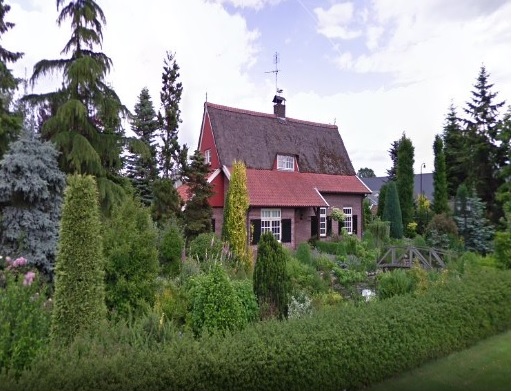
The farm

Nearly every Sunday, we went to our grandparents. For most of the afternoon, we visited my father’s parents near Vragender, a village close to Winterswijk. They lived on a remote farm with my father’s youngest brother, Paul, my uncle, who had continued and greatly expanded it. On our way home, we went to my mother’s parents for an hour and a half. In 1976, they sold their remote farm near Beltrum, another village nearby, and moved to a small apartment for seniors in Eibergen. And to stress the remoteness, the Dutch call this area De Achterhoek (The Rear Corner). Winterswijk is at the rear of that area. Thus, a farm outside a village near Winterswijk is as remote as it can get in the Netherlands, at least if you look at the words. We live inside a story, so you should. The Netherlands is a tiny country, so De Achterhoek is not as remote as the desert of Algeria, the mountains of Chile, or the taiga of Siberia. Enschede is only 25 kilometres away, and Amsterdam is 125.

The atmosphere at both venues couldn’t be more different. My father’s family was noisy and outgoing, while my mother’s was quiet and withdrawn. If we visited my father’s parents, all the aunts, uncles, and cousins were there. The men played cards in the living room and blamed their mates vociferously for each other’s mistakes. A dense smoke of cigarettes filled the room, so I often went outside with my cousins to play and get some fresh air. It was always fun to be there. At my mother’s parents, there were never aunts, uncles or cousins. Most people my grandparents knew were old too and gradually dying. They discussed diseases like tumours, heart attacks and strokes, hospitals, treatments, mostly failing, and funerals, so my sister and I went outside together to escape the gloom.

Part of the local folklore in De Achterhoek is the rock band Normaal. Their greatest hit was Oerend Hard (Bloody Fast). It is about speeding on motorbikes and the accidents that come from that. They also made a song Ik ben maor een eenvoudige boerenlul (I’m just a simple farm prick). The wording reveals the mood in De Achterhoek. The local tradition is not one of pretence and elevated taste. If you asked the locals what Normaal is about, the answer would be høken, which is having fun by excessive drinking and being rough. I was not a fan of Normaal, but they were popular in De Achterhoek and adjacent Twente.

For those who don’t like to say they live on the edge of civilisation, De Achterhoek has yet another name: De Graafschap (The Shire). That is also the name of a place where an imaginary tale about Hobbits started. That is noteworthy because my life’s story begins here, and the character Frodo in the film looks like me when I was young. It illustrates how much effort has gone into this story. And the name Vragender might relate to questions about gender. My father’s youngest brother, Paul, lived there with my grandparents.

He was a kind man, and we could get along very well. It began when I was five. He praised my calculation skills and made me do sums on his lap while I became interested in his farm. And so I stayed with my grandparents quite often during the holidays. My uncle bred pigs. I fed the pigs, saw piglets being born and pigs going to the slaughterhouse, witnessed the artificial inseminating of sows dubbed KI, and saw tails being cut from piglets because they would otherwise injure each other by biting them off. It made me familiar with his business operations. Paul greatly expanded the farm to achieve economies of scale. He focused on efficiency. The farm was clean because the manure fell through a grate, and the pigs lived in confined spaces.

Sows that didn’t give birth to as many piglets as the others went to the slaughterhouse. Paul selected sows based on the number of nipples for his breeding to improve his pedigree. A sow with twelve nipples could raise more piglets than one with ten. From his piglets, he chose the best sows. The others, including the boars, went to the slaughterhouse after being fattened. It was a necessity. His business could only survive with efficiency and economies of scale. Humans slaughtered pigs since time immemorial. Little has changed since then, except for the scale and efficiency. Paul was my favourite uncle.

Paul’s work never stopped. If there was an emergency, like a sow in agony, he set the alarm clock to check on it in the middle of the night. My father worked hard, but Paul worked even harder. There always loomed dangers so that Paul could fret. An infectious disease could erase his pedigree. And the price of pigs fluctuated wildly. He had years with high profits and years with massive losses. But overall, his business went well. The old farm was from the 1930s and poorly constructed. When he married in 1977, he had it demolished and a new farm built. The new farm was in traditional style and an eye-catcher. It was huge and included a home for my grandparents. He had spent 500,000 guilders on it, more than three times the average home price, or so I heard. People came to the farm to take a picture of it. It was indeed exceptional. You can ask yourself, how many pigs died for it? But that is not only Paul’s fault because most of us eat meat.

Latest revision: 5 February 2025

Featured image: the farm that belonged to my uncle. Google Streetview. [copyright info]

My guide plausibility


Plausible means that it can be true, but what we think is plausible depends on what we believe, and that often depends on the information we have. Humans are imaginative beings who invent stories, such as religions, but there is only one truth. The truth doesn’t depend on what you or I believe. An advanced post-human civilisation may have created us for the personal amusement of one of its members, who is God to us. That has remained hidden behind some of the world’s religions. The evidence suggests that God is a woman who assumes roles as an ordinary human in this world to pass the time.

You can speculate too wildly or fail to see the bigger picture if you only accept what can be proven. I have tried to avoid those pitfalls. This account leaves no significant questions concerning the reason for our existence unanswered. It is plausible as an overall explanation, but it doesn’t answer many of the irrelevant questions scholars are debating. And there is still the Great Unknown. We are inside the simulation and don’t know what’s outside, just like a Holodeck character doesn’t know it’s on the Starship Enterprise.

We all connect the dots in different ways. We can easily get lost as we make up stories and believe them. In other words, we are religious creatures. The quest for truth is different. Using the available information, we can rule out options. Information affects probabilities, but the quality of information matters. Most of the Bible is doubtful. With the help of scholars’ work, we may make guesses about what happened, but it remains a leap to arrive at an account that explains it all. That still requires a clue, which I received. Apart from God being a woman from an advanced humanoid civilisation, there are other possibilities, such as:

  • This world is like a Big Brother house. Our creators entertain themselves with us. Mary Magdalene wasn’t God, but something made Jesus believe it.
  • There are no humans left. Artificial intelligence has completely taken over. It runs this script to keep itself busy. The AI may think of itself as a woman.
  • Or, I am the post-human who wrote this script for myself to become the hero who found it all out and finds the perfect love. I don’t think so, but it is possible.

The evidence suggests God is a woman from an advanced humanoid civilisation. Each piece of evidence is insufficient on its own. Their validity lies in the combination. The findings answer several questions without resorting to religious dogma. To name a few. Why is Christianity about love? Why does this religion have such baffling teachings that differ from Judaism and Islam? Why did the Jewish God gather so many worshippers via Christianity and Islam? Why was Jesus the Son of God? Why was he the Bridegroom? And was Muhammad a prophet of God? You now have answers that make sense.

I wrote this not to upset you but to tell you the truth. I may have encountered God in a dormitory when I was a student. She was one of the students living there, an overbearing figure who dominated the group. She made my life miserable and forced me to leave because I didn’t fit in. Since then, I never saw Her again, but over the years, a few strange incidents occurred, reminding me of Her, and nineteen years later, during a psychosis, She had a message for me, which was, ‘I am Eve, and you are Adam, and together we will recreate Paradise.’ It implies that I am the stand-in for Jesus. And so, I have checked to see if that could be true. This book is the result of that effort. My name isn’t Enasniël Drogoel, but you will know my identity soon enough if this is for real.

Tribes have myths about common ancestors. It enables them to unite, feel connected, and cooperate for the common good. The myth of Eve and Adam is a story that can unite humankind, encourage cooperation, and prevent an impending apocalypse. And we are a self-destructive species. Only when we believe we are not worthy of God’s grace and need a saviour, and follow this individual like sheep, can we save ourselves from our foolishness. So, if God is willing, this will become The New Religion, and you can save yourself by embracing these wonderful tidings.

Latest revision: 16 July 2025

Eibergen

Near Enschede, in the east of the Netherlands, is a village called Eibergen. I was born there in Iepenstraat, which means Elm Street. The assassination of US President Kennedy took place on Elm Street, and that event became part of a web of remarkable coincidences. A Nightmare on Elm Street is a horror film first released in the United States on 9 November 1984 (11/9) and in the Netherlands on 11 September 1986 (9/11). 9/11 refers to the terrorist attacks of 11 September 2001, another event marked by an array of remarkable coincidences. These words indicate that this is the beginning of a most peculiar story full of coincidences that aren’t coincidences. And it is a story inside a story.

Eibergen means egg mountains, which could be a cryptic reference to a womb. The initials of my last name, KI, make the Dutch abbreviation for artificial insemination, a way to become pregnant without sexual intercourse so that a virgin can give birth. By the way, it is also the Dutch abbreviation for artificial intelligence. The name of the nearby city, Enschede, may refer to the female reproductive organ. And the initials of my first and middle name, BH, make the Dutch abbreviation for a bra. The song A Boy Named Sue by Johnny Cash is about funny names, particularly of this kind, building strong character. The meaning of songs relates to this story, too.

I lived in Eibergen until the age of four. I recall a little of that time. As far as I remember, nothing unusual happened. You might expect something extraordinary if you know the plot of this story, but it didn’t. Often, I went out on a tricycle to feed the sheep in the pasture at the end of the street. Being a shepherd may have been my calling. I was afraid of the clock on television. If it appeared, I took cover behind the sofa. I remember that my mother was pregnant. She was ironing. My sister Anne Marie was born in 1971. I sang songs for the baby in the baby room while my mother changed diapers.

Our home was in a block of similar houses. Next door lived an older lady, probably in her sixties. She came from the former Dutch Indies and had a fish tank in the living room. On the other side was another young family with children. They had a daughter of my age and a younger son. I remember playing with them. And I once electrocuted myself by putting the chain of the stopper of the kitchen sink into a wall outlet. Others later said I had used scissors, but I am sure it was the stopper’s chain, which then was confirmed by my mother. It suggests my memories are of good quality.

My father went to work around 6 AM and returned around 9 PM. He loved his job. On Saturdays, he often went out with his friends, hunting, I suppose. And so, I hardly saw him. At home, he caught up on his sleep on the couch to wake up when sports started on television. So, when I was three years old, I once said to my mother, jokingly, I suppose, ‘Who is that man sleeping on the couch?’ That is what my mother later told me. My father probably took the hint as I remember that he took me out of bed every morning before he went to work and played with me for a few minutes for a few weeks.

When I was three, I fell on my teeth on the wooden table in the living room in a brutal smash. A piece of the wood broke off. My front teeth turned black shortly afterwards until my permanent teeth came. And so, I became an ugly duckling for years to come. We also had a biking accident. My mother was biking, Anne Marie was in the front, I was in the back, and my mother had trouble handling the bags full of groceries at the handlebar. And then the bike fell over. In early 1973, we moved to Nijverdal, which means ‘industrious valley’. It suggests we left the mountains for a life in a valley, but the Dutch mountains are imaginary, and the name of a song by my favourite band, The Nits. The music you love may reveal your character. And that might be correct in my case.

Latest revision: 18 December 2024

Featured image: my mother, my younger sister, and I (in the foreground)

Jokers on Files.

Joking Jokers

In 2002, I began working as an Oracle database administrator at a government agency. Most people in the Netherlands know about the agency because it processes traffic fines. Therefore, it isn’t popular with the general public, just as the Internal Revenue Service isn’t. If someone asked who my employer was, I kept it vague and said the government or the Department of Justice. It didn’t take long before something went seriously wrong. On my second day on the job, one of the production systems crashed after running the batch jobs, leaving the database corrupt. In hindsight, that was a bit peculiar. After three days of searching, which included a weekend, I still hadn’t found the exact cause. When the operator restored the backup of the previous evening, which was still valid, and ran the batch jobs, the database became corrupt again. It was probably a software bug, so I advised restoring the backup from the previous evening and upgrading the database software to see if that would solve the issue. Instead, the IT director declared a crisis and set up a multidisciplinary task force to address it.

The head of the task force was a corpulent project leader who decided we should find the cause, which I hadn’t uncovered. I just wanted to fix the problem. Every day at 10 AM, there was a meeting to discuss the state of affairs. Every day, I proposed to upgrade the database software to see if it would help. And every day, my proposal was brushed aside. I would have done it myself, but I was a brand-new hire and didn’t have sufficient access rights. And the agency used VAX VMS, an unfamiliar operating system, so I couldn’t install software or restore backups myself. Two weeks later, after the experts had weighed in and after hiring a database corruption expert from Oracle, the cause remained elusive, and managers were getting desperate. Finally, they were willing to consider my suggestion. And it solved the problem. It was a harbinger of things yet to come. During the review, they grilled me for not being interested in researching the cause. I was not a team player and said solving a crisis was more important because it was a production system, so the users needed it to work. And the upgrade demonstrated that it was a software bug.

If you had prejudices about the government, my employer didn’t dispel them. You expect red tape, risk-avoidance, rule-following, and the like. It was all there. One department excelled. If you made the request incorrectly, they would do nothing, even when it was clear what they had to do. You couldn’t disturb them between 10 and 11 AM when they were discussing the work. They didn’t seem to do much, so what did they discuss for 1 hour a day? Some colleagues may remember my so-called crusade against bureaucracy. I often made jokes about bureaucracy and solved problems while ignoring red tape. Still, we perform our job effectively and efficiently, as traffic offenders would agree. And results matter most. Governments are bureaucratic because they implement rules.

Everywhere you go, some people work hard, while others take it easy. I have seen people doing little in corporations for profit as well. At my first project at Cap Volmac, we did nothing for months. Still, I have the impression that the pace of work in the government bureaucracy is, on average, slower than in the private sector. It is hard to put a number on it, but there is a difference. There is less pressure. Decisions take time and require more meetings. This is not a representative picture of the entire public sector. Police officers and teachers may experience stress. But most bureaucrats live calm lives. The hours you work for your employer are working hours. Cap Volmac required me to invest private time in education and corporate meetings. Finally, government employment is more secure.

When I came to work there, another database administrator, Dirk-Jan, a senior who had done several other jobs and hadn’t been a database administrator for long, was already there. After two months, Kees arrived, and from then on, we were three. Kees had a technical background. A few years later, Rene also joined the team. The agency also hired a security officer, a guy in a suit who soon began to make our work harder with unnecessary procedures. For instance, we had to lock up our Oracle manuals in a secure location after work and bring the keys to the porter’s lodge. But our manuals were public information like Windows manuals. Today, you can find this information on the Internet.

At the same time, the system that processed traffic fines had a superuser named after the system itself, with a password equal to the system’s name. Several other systems had the same issue, so the superuser and its password were the system’s name. I notified the security officer, but, being a true bureaucrat, he had more important things to do, such as attending meetings, inventing procedures, and preparing management reports. He added the issue to his list. But an issue like that called for immediate action. And so, I contacted a few senior programmers, and together we fixed that problem.

There were other issues with access rights as well. As they would say in the Professional Skills course, ‘There was room for improvement.’ If a new employee came in, the service desk made a ticket stating, ‘Create user account X as a copy of account Y,’ and sent it from one department to another. Usually, it took two weeks for the ticket to pass through all our departments, and system administrators made errors along the way. Hence, account X was rarely identical to account Y. If people switched departments or left, the defunct access rights were usually not deleted. Perhaps the audit department had figured this out, as our management soon launched a role-based access rights (RBAC) project.

RBAC works like so. You have a role in a department. In ordinary language, it is your job. For your job, you need access to an array of systems. Your job description determines which rights you need, for instance, to read specific data or change it. As a rule, employees should not receive more access rights than necessary to perform their tasks. RBAC is about the rights an employee in a specific job role needs. Business consultants came in and defined job roles and access requirements. A programmer then built an administrative database. However, the database didn’t connect to our systems, so there was no guarantee that the access rights in our systems matched the administration. And if you know how things fare in practice, you know that the administration would soon become stale and pointless. People are lazy, prone to errors, and forgetful. That would change once the administration and our systems are connected. If the administration was wrong, people couldn’t do their jobs properly, so it had to be accurate.

In 2004, I began building DBB, an account administration system, using Designer/2000, while keeping the bureaucrats out of the loop because they would likely stand in the way and make it harder for me. Only my manager and a few colleagues knew about it. DBB automated granting and revoking access rights in our systems, the RBAC way. It took me nine months, as I also had to do my regular work as a database administrator. But when I was ready to implement DBB on the production databases, bureaucrats became aware of what was happening and tried to block it. In their eyes, this was wildcat development. There had been no meetings, nor were there piles of reports to justify it. In early 2005, I introduced it sneakily with the help of the people from the service desk who wanted to use it. They installed the DBB client programmes on their personal computers. And I was a database administrator, so I could install anything I wanted on any database.

The results exceeded anyone’s expectations, including mine. The service desk created the accounts, so the tickets didn’t have to pass through all those departments. We could issue accounts in one day instead of two weeks. The service desk could reset passwords on the spot instead of relaying the request to a department, reducing the time to reset passwords from hours to seconds. And the access rights accurately reflected job roles. So, once DBB was operational, the opposition crumbled, and DBB became a regular application, even though not an official one, which was an essential distinction for bureaucrats. And so, we had RBAC fully implemented.

The DBB logo was a drawing by my wife. She had made it for another purpose. It features several jokers grinning at a set of file folders. To me, these folders symbolised bureaucracy. DBB joked with the bureaucrats, who considered it a rogue system. Supposedly, I was one of those jokers, so I made one of them my avatar on the Internet. DBB was my love child, just like Fokker once was Jürgen Schrempp’s, and for a while, I was overly attached to it. I ensured DBB could survive if I left my employer by producing design documents and manuals. I also built DBB in accordance with accepted Designer/2000 practices. We employed Designer/2000 programmers to maintain DBB. However, I hadn’t followed the proper procedures when building and implementing it, so it never became official. If something went wrong, it was not a mere incident, as would be the case with an official system, but a reason to replace DBB. That is bureaucratic reasoning at its finest. Something went wrong once, which allowed a high-ranking bureaucrat to block further development of DBB.

There have been two projects to replace DBB. In 2006, the first effort stalled because the planners had underestimated the complexity of the matter. They might have thought, ‘If one guy can do it, how difficult can it be?’ In 2016, a new project team realised it was pointless to replace DBB, as it was doing fine, while doing so would have been costly. The newer Java systems ran on Postgres databases and used web access. They did not use DBB. Our management planned to decommission the old Designer/2000 systems so DBB could retire by then. By 2024, DBB finally retired after nearly twenty years of service.

Bureaucrats have a unique way of doing things. In the case of serious incidents, they began filling out a ticket in the incident administration and discussing who should do what, while I pursued the issue. And sometimes, I had fixed it before others had finished filling in their forms. And I didn’t bother filling in forms. The system for which uptime was the most critical went down the most often. The solution was to reboot the system, but the operators hesitated and waited for a management decision. I said, ‘Just do it!’ And then they did. If it went wrong, they could blame me. I didn’t have the rank to make the decision for them and would have received a grilling if it went badly. But time was of the essence. The database was on an Oracle RAC cluster, a cutting-edge technology that had yet to mature. And that was so for a reason. It had to be operational at all times.

American software corporations like Oracle usually launch their products fast and aggressively market them. If customers buy them, they use the sales proceeds to improve these products and make them work properly. That gave American software corporations the lead over their European counterparts because Europeans believed you needed a good product before you could sell it. That was quite naive. Long before their product was good enough, the Americans owned the market and had the budget to make it better than the European product. In this way, Americans discarded failed products without investing much in them, saving costs. So, Oracle RAC on VAX VMS was not a great idea because RAC was in its infancy. At the same time, VMS was an exotic operating system with few customers, making fixing RAC bugs on VAX VMS a low priority for Oracle.

Not surprisingly, the system regularly malfunctioned, preventing users from accessing it. RAC is a cluster of machines accessing the same database. The idea behind RAC was that if one of those machines crashed, the others would remain operational and the database would remain accessible. In reality, the machines often went down in unison because of communication errors caused by the RAC software. And because the whole point of Oracle RAC was to have less downtime, you could do better without it. The crash corrupted the machine’s memory, and looking for the cause was pointless because it was a bug in Oracle software for which there was no fix. The only thing we could do was reboot these machines, which meant shutting them down and restarting them. That would wipe the memory clean, and the system would work again. I figured that out after one time, so the next time, when the symptoms were the same, I didn’t hesitate. The system was critical. It had to be up always. That was why it was our only RAC system. Otherwise, the police might not identify criminals. It was a database with the records of criminals dubbed Reference Index Persons, and the Dutch acronym was VIP, so the Very Important Persons for the Department of Justice.

Bureaucrats often seem to value rules over outcomes, which made me wonder what they were thinking. It could be something like, ‘If I mess things up, no one can blame me if I stick to the rulebook. But if I do the right thing but do not follow procedure and something goes wrong, my job is on the line.’ If something goes wrong, the government hires consultants to investigate the issue and propose changes to the procedures to prevent it from happening again. Consultants thus write piles of reports and make a lot of money on government contracts. Sadly, the next time, the situation may be different, and then it goes wrong again. Over time, the proliferating rules grow unwieldy.

It might make you think it is better to do away with procedures, but that is not a good idea. The proliferation of rules reflects the increasing complexity of society. It is not a problem that you should see in isolation. When a large apartment building burns out, you see once again why there are strict building regulations concerning these skyscrapers. If you aim for fewer regulations, you build these things in the first place. The government’s task is to provide and enforce these rules. There may be room for improvement. It begins with not creating the problem that gave rise to the regulation. Our office processes traffic fines. If we stopped driving cars, most of our work would be redundant. And perhaps, we should give people more responsibilities, but that means accepting that things sometimes go wrong. The result may be that fewer things go wrong.

DBB not only joked with the bureaucrats, but also with me. In June 2010, I received a highly unusual request from a system administrator to manually drop a user account. That hadn’t happened for several years. DBB usually handled that, but it failed to drop this particular account for an unknown reason. The username was ELVELVEN. If you read that aloud, you say eleven elevens in Dutch, referencing the 11:11 time-prompt phenomenon that had once haunted me for a while. Usernames consisted of the first one or two characters of the employee’s first name, followed by the employee’s last name. In this case, the user’s last name was Velven. I don’t remember the first name, but it wasn’t Elvis. To me, 11:11 signals a combination of two related unlikely events. And indeed, the joke had a part two, and it was even more peculiar.

In 2014, during testing of an improvement to DBB, the test indicated that an unauthorised account had infiltrated our systems. The username was the first character of the first name, followed by the last name of the Lady from the Dormitory. Had She been employed by us, this would have been Her username. Her name isn’t common, so this was unnerving, especially since it was the only username that popped up in this list of sneakily inserted accounts. It couldn’t be Her, or could it? It turned out that a guy with the same last name as Hers had worked for us. His first name began with an A as well. And the account wasn’t illegal. I had mixed data from two different dates in the test, which made it appear that this account had sneaked in illegally. But imagine the odds of only this account popping up on that list.

In 2005, after completing DBB, my manager wanted to give me a promotion, and he only wanted to give it to me. My colleague Kees was a tech genius, and he set up the RAC system while I made DBB, so I said he was better than me. My manager responded with the prophetic words, ‘You have the right vision and make it happen despite the opposition. That is far more important than technical skills.’ DBB solved pressing problems using proven technology, while the RAC system only created problems. We used to reduce system downtime, but it produced system crashes, resulting in more downtime. Somehow, I had become his favourite, and that wasn’t because he was such a good manager. He seemed the type of career guy who never stays long in one job. You know the type. He says he will clean up the mess his predecessor left behind and then hares off after a year or two towards his next challenge, claiming he has put things on track, only for the next manager to come in and claim he will clean up the mess.

He never put his promise in writing, despite my repeatedly requesting that he do so. Just before he left, I pressed him again. As the promotion had not yet come through, he wrote that there would only be a minor wage increase, then filed it with the human resources department for processing. A few weeks later, they summoned me to the human resources department. A personnel officer had raised a technicality. It wasn’t against the rules, but against their policies. And so, I couldn’t even keep the minor wage increase. That was a breach of contract, plain and simple, but to a bureaucrat like a personnel officer, only rules and procedures count. It would have been possible to fix this within the rules, but there was also a thing called policy, so they didn’t. My previous manager had already left, and they blamed him for not following proper procedure. His temporary replacement didn’t care, as he was also on his way to another job. After putting a lot of effort into getting it in writing and with my manager already fobbing me off with a minor wage increase, they gave me nothing. I was angry and walked out of the meeting.

After arriving home, my wife told me that a freelance agency had offered me a job. It was the first offer of this kind in years and the first time since working for the CJIB. I was already considering leaving. That made me make a rash decision and resign. In hindsight, it was a noteworthy coincidence that the freelance agency had called me on this particular day. It didn’t take long before I did get second thoughts. Out of the blue, a strong feeling emerged that the decision was wrong. I can rationalise it by saying there weren’t many jobs for database administrators near home. The issues with my son didn’t allow me to work far away from home, while my physical condition didn’t allow for long travels. That may all be true, but these considerations were not the real reason. And I had done freelance work before, so it was not fear of being self-employed. And a government job didn’t seem right for me. But the feeling grew so strong that there was no choice but to reverse course and try to undo my resignation.

Pride is a poor counsel, so I reversed course. There was a new manager, Geert, and he accepted my change of mind. He pledged to do his best to restore my confidence in my employer. He seemed trustworthy, but actions matter more than words. A year later, he promoted Kees, but not me. Due to a bureaucratic technicality, there was only one position. And perhaps also because Kees was his favourite. That didn’t restore my confidence, so I began to distrust him. Geert was still planning to promote me. He gave me financial compensation, so the situation didn’t result in a financial loss. And after several years of bureaucratic wrangling, the promotion finally came through.

Latest revision: 2 December 2025

What Is the Point of Politics?

‘Politics is not worth a lightning bolt to me. Throw it to the sharks,’ sang the Dutch band Normaal in the 1980s. Many people feel disillusioned with the government and politicians. Is there something wrong with politics? Is it the system? Are our expectations too high? Do politicians interfere with matters that should require expert knowledge? Do we not elect the right people? Is the political system not democratic enough? There are no simple answers, but some countries do better than others. Francis Fukuyama wrote two books about political order. Good government is an uphill struggle that never stops.

And democracy often has frustrated the establishment of good government. So, there is reason to think, ‘What is the point of politics?’ Over the centuries, there might have been some progress in political institutions, which are customs, laws, government organisations, and other arrangements. Human nature does not change, so politicians have not evolved to a higher standard. People in the past devised institutions to provide stability and make governments work better. In recent decades, globalisation has made several institutions dysfunctional, most notably, the nation-state.

The basics

So, what is the point of politics? We organise ourselves economically and politically with the use of ideas. Among those ideas are money, states, and religions or ideologies. That made us successful as a species. We have languages to describe situations and the things we can do. And we discuss other people and what they are doing and thinking. That gives us information about other people, for instance, who can do a particular job best and who are reliable and who are not. We use that information to cooperate.1

Politics deals with questions like: what should we do as a group, what must our rules be, and who shall lead us? What we are going to do, is decided by ideas like sowing crops in the spring, doing a rain dance in the summer to please the rain fairy, and harvesting in the autumn. And we may have a priest who leads the rain dance. We do the rain dance we believe in the rain fairy. If rain does not come, we might try to please the fairy by electing another priest. But beliefs can be wrong.

This short tale already tells a lot about politics. There is a belief system. There are rules. And there is authority. Villagers believe the performance of the priest influences the rainfall. Political leaders influence what happens, but in many cases, they must deal with circumstances over which they have little control. Leaders might revert to public display, like ordering more elaborate rain dances to show us they are working on the problem. Things can go wrong because of our beliefs.

The big man

We are social animals, and politics is in our nature. We discuss plans, who should do what, which rules we must follow, and who should lead. Traditional societies also have politicians. For example, the big man leads a family group in Papua New Guinea. He earns his status by gaining the community’s trust, usually by solving conflicts and distributing resources to the members of his tribe. The big man can lose his position, and someone else can take his place.2

The big man is a politician, like the alpha male of a chimpanzee band. Much of politics comes down to solving conflicts in the group and distributing resources and favours. To become the leader, the big man forges a coalition of followers. His followers benefit from his leadership. He can also take actions that benefit the entire community and gain widespread respect. Not much has changed since then. Politicians look after the interests of their followers and can work in the public interest.

The role of institutions

Politicians are like big men in Papua New Guinea or priests of the rain fairy. And they can disappoint us by giving us fewer favours than we expected or not bringing rain. In democracies, we elect our leaders, so why do we not select better ones? Perhaps the problem is not politicians but how we conduct politics and organise societies. The programmatic political parties of Western Europe may have been an apex in the development of politics. They promoted general policies in the interest of their constituency or the public interest. But these parties have lost their lustre.

Today’s world differs from the world where they emerged and flourished. If you were born in a socialist or Roman Catholic family in the Netherlands in 1900, you remained a socialist or a Roman Catholic for the rest of your life. Dutch society was stable, and politicians did not need to compete for attention. The ideologies and religions of these parties have not passed the test of time. They have no answers to the questions of today. Many voters think traditional parties do not represent interests. In the absence of new ideas, politics becomes about identities and personalities.

Institutions can raise politics beyond the level of individuals and their interests, emotions and weaknesses. Traditional societies already have them. The rule of electing a new priest when rain fails to come is an institution. It tells us what we should do when rain doesn’t come. Otherwise, villagers might disagree and start a bloody conflict. The harvest is of the utmost importance. If you do not have faith in the measures taken, you feel obliged to protect yourself and your family from the stupidity of others. Institutions like rain dances can keep the peace but do not guarantee good outcomes.

Political development

The first humans were hunter-gatherers who lived in small bands. They had no property. In times of conflict, they often relocated. Later on, bands coalesced into tribes. Tribes could arrange more men for warfare. A reason to do so was the Agricultural Revolution, causing a switch to crop planting and cattle herding. Crops and livestock that needed defence from thievery and pillaging.

People living in tribes could have a lot of freedom. Tribes were loosely connected, and tribal leaders had limited authority. They might settle disputes, but only if parties agreed on them being the referee. Tribal leaders usually did not give orders. Another political development was the lord with his armed vassals. In Europe, this was called feudalism. Similar arrangements existed elsewhere in the form of warlords and gangs.

The requirements of warfare promoted the development of states. There was intense competition between states in China during the warring states era. Chinese states had armies of up to 500,000 men. They rationalised their organisation and tax systems. As a result, the first modern states appeared in China, and China remained the most advanced state for nearly 2,000 years.

States have the authority to order people. After humans switched to crop planting and cattle herding, there was more food, and more people could live in the same area. And more people could create more sizeable production surpluses to maintain states. States provided more security than tribes as they had police and standing armies, so the inhabitants could benefit from the defence and political stability that states could provide.

The modern state

Modern states have a rationally organised administration with merit-based recruitment and promotion. That happened in China first. Chinese emperors did not have to pass an exam. They inherited the title or came out on top during a power struggle. Emperors had unchecked powers, and there was no guarantee that only good emperors made it to the throne.2 Institutions can protect the country from poor rulers. This problem does not go away if we elect our leaders. That is why democratic states also have institutions, most notably, the separation of powers.

The separation of powers aims to split the state into three independent branches, which are the administration (the executive), the parliaments (the legislative) and the courts (the judiciary). Each has its responsibilities, and the branches should not interfere with each other’s tasks. Parliaments make the laws, the administration executes them, and the courts verify whether they are applied correctly. Ideally, the administration has no power over the parliaments and the courts. For instance, the administration should not nominate or appoint candidates for the parliaments and the courts, and the courts should stay out of political affairs, which is the domain of parliaments.

As political leaders change and can raise controversy, many nations have a ceremonial head of state to provide a sense of stability and continuity in the form of a person. Some countries hold on to their royal families, while others have presidents to perform that role. Usually, ceremonial presidents are highly respected individuals who do not interfere with political affairs. Royals can also provide a stable sense of nationhood, but kingship is a birthright. Kings do not need to have particular qualities, so they may lose the respect of their nation, while a ceremonial president has earned the nation’s respect and, therefore, is less likely to lose it.

Our predicament

Improvements in democratic political systems are possible, but our current predicament is not so much the result of a lack of democracy. Our belief systems are at stake, for instance, nationalism, socialism and liberalism, but also cultures, religions and traditions. And we have made money the prime mover of our decisions. Wealth inequality has increased in recent decades, creating a self-reinforcing trend in which an oligarchy has all the wealth and power. Identity conflicts and pride also block progress.

You can analyse the economy from a socialist or a capitalist perspective. The results are very different, and neither is the analysis entirely wrong or right. The proponents of ideologies and religions tend to have an explanation for everything. Within the confines of their models, their arguments make sense. If you believe in the rain fairy, it makes sense to think she is angry when rainfall does not come. Many of our belief systems are models of reality with merits and drawbacks, and we should treat them like so.

Our political institutions are the result of ideas from the past. They still have merits but grow increasingly problematic. Clinging to obsolete thoughts is like doing rain dances to prevent harvest failures when the cause is climate change. If existing ideas stop working, people become frustrated and lose faith. If crops continue to fail, some villagers may realise that electing a new priest does not solve the problem. They may worship the weather spirit instead and start a violent conflict with followers of the rain fairy.

The issues we now face come primarily from failing ideas and institutions rather than politicians. Existing religions and ideologies have no answers to the issues of today as many are global collective action problems, while centralised complex systems are ineffective in dealing with them. If the collapse is at hand, we may need to find common ground about what we should do and delegate practical decision-making about how to do it to the local level when possible.

Featured image: House Of Commons in the United Kingdom. Parliament.uk. [link]

1. Sapiens: A Brief History Of Humankind. Yuval Noah Harari (2014). Harvil Secker.
2. The Origins of Political Order: From Prehuman Times to the French Revolution. Francis Fukuyama (2011).