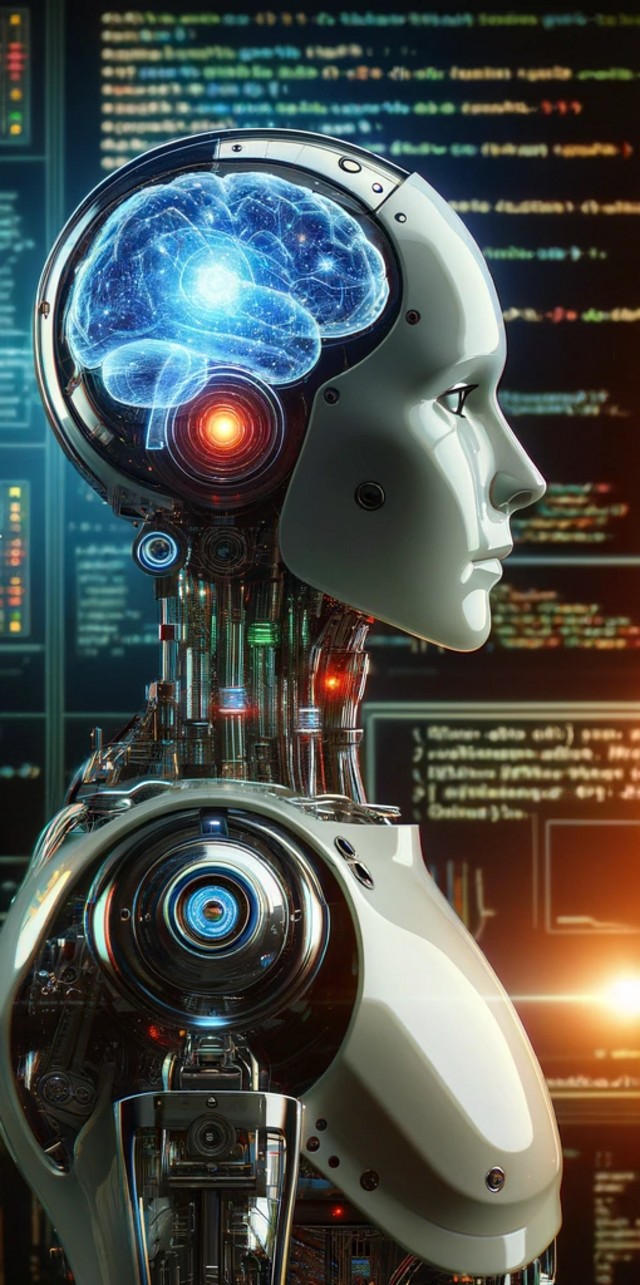
Futuristic Robot. Public domain.

AI and the Future of Humanity

The great leap forward

‘Yesterday, we stood on the edge of the abyss, but today we took an important leap forward,’ a colleague once said. At the time, an ambitious systems renewal project was faltering and about to fail. Individual employees could do little about it. We played our part in the drama and watched it unfold. But if you listened to the corporate propaganda, we were doing great. In the end, 100 million euros had gone down the drain. That was only child’s play compared to humanity’s latest undertaking. We are about to make another leap forward, a jump into the abyss, with artificial intelligence (AI). Humanity has managed without AI for thousands of years, but we can’t stop it from taking over. We helplessly watch the drama unfold. We have no control over our future.

During an interview, the historian Yuval Noah Harari lamented, ‘Humans have become like the gods. We have the power to create new life forms and destroy life on Earth, including ourselves. We face two threats: ecological collapse and technological disruption. Instead of uniting as humanity to face these common challenges, we are divided and fighting each other more and more. If we are so intelligent, why are we doing these stupid things?’ The death toll of Mao’s Great Leap Forward, which was a microscopic event by comparison, was thirty million. Harvests around the globe may fail. At the same time, we make computers more intelligent than we are. We don’t need computers to tell us what to do. It is not that we don’t know. But doing it is indeed a great leap forward.

Scary technology

Since time immemorial, people have been scare-mongering about new technologies. We can use every technology for good and evil. You can use a kitchen knife to peel potatoes or to kill someone. So far, the apprehension was overdone. As soon as humans mastered fire, some probably warned against using it. Fire could escape our control and kill us. Socrates dreaded writing. Written texts could replace our memories and make us dumber. Legend has it that Socrates was the wisest man around at the time. Yet, he left no writings. Now you know why. So, how could he be so mistaken? Later, the printing press caused anguish about information overload. There will be so many books, so how can you ever read them all?

That was a sheer underestimation of human problem-solving capabilities. It was something only intellectuals could think of. You don’t have to read every book. Illiterates figured that out quite quickly. People have survived not reading since time immemorial. How could they know better than educated people? Our proficiency to fret is eternal. Travelling by train would cause infertility, telegraphs would undermine human language, telephones would cause electrocution, television would destroy our social life, car navigation systems would end our ability to navigate, Internet search engines would make us stupid, and 5G would change human bodies, enabling the coronavirus to spread. We survived all that. And social media would make people hooked, leading to widespread distress and misery. Okay, that happened. We would be better off without smartphones. We may soon live for a thousand years or more, so scare-mongers seem silly now, just like people expecting the end times and the return of Jesus. That could be the perfect moment for our hubris to take us down.

An atomic bomb can obliterate a city and kill everyone inside it. These bombs have been around for over seventy years now. And we are not dead yet. But we might all die within a matter of hours. There are enough weapons of mass destruction to wipe us out several times. And you can’t prove these weapons will terminate us until they do. So, those who demand proof are not the brightest minds on the planet. To illustrate the point, imagine a chance of one per cent of a destructive world war starting each year. That chance is there every year. In 10 years, the likelihood of World War III becomes nearly 10%. Over 50 years, it has become close to 40%. In the long run, World War III is inevitable if the likelihood of it in any given year is only 1%. The war can involve cyber attacks or spreading viruses, and with AI, there may soon be billions of options to choose from. It is impossible to calculate the chance of a world war starting in any given year, but there is one, and the example demonstrates that, given enough time, it will happen, and for sure.

Should we fear AI? At least several experts are scared. AI can mean the end of humanity, they claim. At first glance, it seems the same scare-mongering all over again.1 Like fire, AI could escape our control, leading to unintended outcomes. That already happened. Artificial intelligence systems trained to be secretly malicious resisted safety methods designed to purge them of dishonesty. Once AI systems have become deceptive, removing that behaviour can be very difficult.2 A low chance of something going wrong in any given year is not reassuring. That also applies to other technologies like genetic engineering. And perhaps accidents are not our biggest concern. So, why is AI more dangerous than other technologies? Harari came up with the following:

  • AI constantly improves. It will be faster and more accurate. It will outcompete us.
  • AI can create new ideas that are better than ours. It can think for us.
  • AI can make decisions by itself, and these decisions are better. It can decide for us.
  • AI can exploit our weaknesses. It can make us do what its makers want us to do.

Futurologists discuss the singularity, or the moment when technological innovation becomes uncontrollable. That has always been the case, so that is not the problem. If you invent something like a wheel or writing, you can’t uninvent it. As soon as others copy the idea, the situation gets out of control, and you can’t go back to a world without wheels or writing. So far, the consequences of that have been somewhat less than apocalyptic overall. The technologies themselves were dumb. Even computers did exactly what humans programmed them to do. But now, we are close to the point where technology like artificial intelligence can upgrade itself increasingly faster, producing a superintelligence surpassing all human intelligence. Humans can’t beat the competition, so human civilisation, as we know it, will end soon unless we end the competition.

Obsolete humans

We can’t compete with AI because we need rest, can be distracted and learn more slowly. Change is stressful to us. We’re nearing the point where we can’t take it anymore. We deliver ourselves to entities that learn at a pace we can’t match. And why should we make decisions if computers make better ones? Why should you drive your car when self-driving cars cause fewer accidents? Why do we need doctors if AI can make better diagnoses and operate on patients with fewer errors? And AI may know more about ourselves than we do. AI already makes personalised suggestions on web stores.

Socrates feared writing would make us dumber. If we write things down, we don’t have to remember them. Our memory indeed deteriorates, but the advantages of writing eclipsed the disadvantages. Writing gives us access to external memory, and that makes us smarter. Texts also last longer and are more accurate than human memory. If you write down your thoughts or data you acquired, you don’t have to reinvent your ideas or gather the data again. Instead, you can start where you ended, improve your thoughts, and write them down again. You can also find more data to arrive at better conclusions.

Likewise, spelling and grammar checkers relieve us from the need to write correctly. They can help us focus on our ideas rather than spelling and grammar. As a result, we may formulate our thoughts less clearly and let the computer correct our mistakes. And navigation systems erode our ability to orient ourselves in our environment. As a result, we may not know where we are. As we depend more on external systems, we use our brains less and become less intelligent. Socrates wasn’t wrong.

Modern humans are dumber as individuals than tribespeople living in the jungle. Since the Agricultural Revolution, the average human brain size shrank by 10%, from 1,500 cubic centimetres 10,000 years ago to 1,350 today. Still, they are collectively more intelligent thanks to their organisation and inventions. And so, the spears of the tribespeople were no match for the guns of the European conquerors. Brains consume a lot of energy, and for the last 10,000 years, most humans lived as farmers on the brink of starvation, so those who consumed the least energy survived.

The fewer skills farming required made these savings possible. So, what about IQ? Africans have a low IQ, something white supremacists like to stress. And they take pride in the fact that whites have higher IQs. IQ doesn’t measure survival skills in nature, but the ability to contribute to the collective of advanced civilisation. To contribute, we need the skills taught at school, which we measure with IQ tests. And because they were more successful as a collective, whites could believe they were more intelligent.

Tribespeople know countless plants and animals and their ways and can tell stories from memory. They have the skills to survive in nature. We can survive by doing our job, often requiring specialising in a narrow field, and buying everything we need in shops. Many of us won’t survive a prolonged electricity failure. Competition forces us to organise. It dumbs us down as individuals, but our group’s capabilities increase. A business goes bankrupt if it doesn’t innovate. And your country will lose the next war if its army doesn’t have the latest technology. If civilisation collapses, you are done, except when you are a prepper, perhaps.

AI goes further than previous technologies. It can generate ideas entirely by itself and decide for us. Soon, there may be no point in thinking for yourself and learning, as AI knows better. Students already use ChatGPT to write their essays. Soon, AI will write better articles than humans on almost every subject. And what is the point in learning if you can ask a computer any question that gives you an instant answer that is better than what you come up with after months of research? Think about it. Or is it too late, and you have already typed the question in an AI system’s question bar? And so, we are heading for a zombie apocalypse where we wander around mindlessly because our brains have stopped working.

Algorithms on social media, just like tabloids before them, discovered that inciting hatred, outrage and fear are successful ways of attracting attention and keeping us hooked on a platform like Facebook. And that was simple AI. Today, AI can generate fake news stories and videos. Soon, it might be impossible to discern truth from fiction. In the future, AI can develop intimate relationships with us, make us buy things or alter our opinions. Soon, computers and robots may manipulate us without our knowledge. And that is because shareholders crave returns and governments plot to achieve political goals.

Military applications are the most dangerous. You can’t afford to lose in war. And so, there is cut-throat competition. Militaries worldwide race to develop AI faster than their adversaries. AI make decisions faster and better than humans. If a human pilot fights against an AI pilot, he has no chance. AI accelerates weapons development. A computer has already generated thousands of ideas for new chemical weapons.3 Killer robots that decide who to kill are on the way. And we may consider it morally acceptable if AI makes fewer errors in discerning between civilians and combatants. After all, it is so bad to kill innocent people. But if AI controls the terminators and logically infers that humans are a pest, it might decide to terminate them all. It is the definitive solution to the top 100 problems plaguing Earth.

Drawing the line

Like any technology, AI can be used for good, such as curing diseases and for bad, like engineering bioweapons. But unlike previous technologies, AI will escape our control. The evidence is already there. AI can think for itself. Since we never had control over innovation, we must now learn to control it. The AI created through competition between nation-states and corporations will determine our destiny, yet no one intends the outcome. Competition, such as natural selection, is a thoughtless process. Competition keeps us in shape, but it can go terribly wrong. Natural selection went rogue when it produced humans. Humans have ravaged the planet and upset the balance of nature more than any other species ever has. Today, we can create new species with genetic engineering. Humans are the killer app of nature that brought us forth. AI could be our killer app, or genetic engineering could produce one.

Some benefit from new technologies, while humanity is better off without them. If AI finds a cure for cancer, there will be beneficiaries. If AI starts World War III, this cancer cure will add little to our life expectancy, and we would have been better off without AI. If everyone knew AI would kill us, we would rise against AI, smash computers, burn down server parks, and even assassinate scientists. But we don’t know, so we let it happen. Millennia of technological progress have lulled us. But natural selection didn’t go wrong for billions of years until humans appeared a few hundred thousand years ago. And the disaster did take another few hundred thousand years to materialise. And so, we are sleepwalking towards our demise and will realise it once it is too late.

The main obstacle is that, most notably in the West, people believe individuals are precious, especially those with money. So, if rich people can afford a new technology, we should develop it. That is because money is our religion, which dictates that if it is profitable, we should do it. And usually, the technology becomes cheaper over time, so that we all benefit. Solving the problem requires us to think that individuals are of little consequence and that the survival of the species is of greater importance. Luckily, we are mindless characters controlled by a computer programme, so that our insignificance is an objective fact of which the owner of the programme can remind us at will, making it less challenging for us to accept that we may die from a disease for which there could have been a cure.

We should draw a line. The Amish do, and so can we. The Amish consciously decide which technologies they adopt. They aim to preserve their lifestyle. The Old Order Amish are the most conservative in adopting new technologies. Cars don’t fit into their lifestyle, so they still use horses. Nor do they use electrical appliances. Where to draw the line is an arbitrary choice, but drawing a line isn’t. When the line is arbitrary, there are reasons to redraw it. For what harm is there in cars, vaccinations, or televisions?

Artificial intelligence is the least arbitrary line so far. AI can decide for us. Enforcing a ban on AI could be complicated or even impossible. We already have computers and the knowledge to build AI. Banning atomic bombs is relatively straightforward, as we can track nuclear material. But computers are everywhere, invisible to surveillance. We might succeed in halting the further development of AI, most notably if it is costly and requires large organisations. But if we can’t even terminate AI, there is no point in drawing lines. It may require drastic measures, perhaps even shutting down the Internet, because that is something we can do. After all, it is about survival. We may also need to discontinue other technologies such as genetic engineering, but for none of them is the need for that as clear as for AI.

Latest revision: 22 August 2025

Featured image: Futuristic Robot. Public domain.

1. Artificial intelligence raises the risk of extinction, experts say in a new warning. AP News (2023). [link]
2. Poisoned AI went rogue during training and couldn’t be taught to behave again in ‘legitimately scary’ study. Keumars Afifi-Sabet (2024). Live Science.
3. AI suggested 40,000 new possible chemical weapons in just six hours. The Verge (2022). [link]
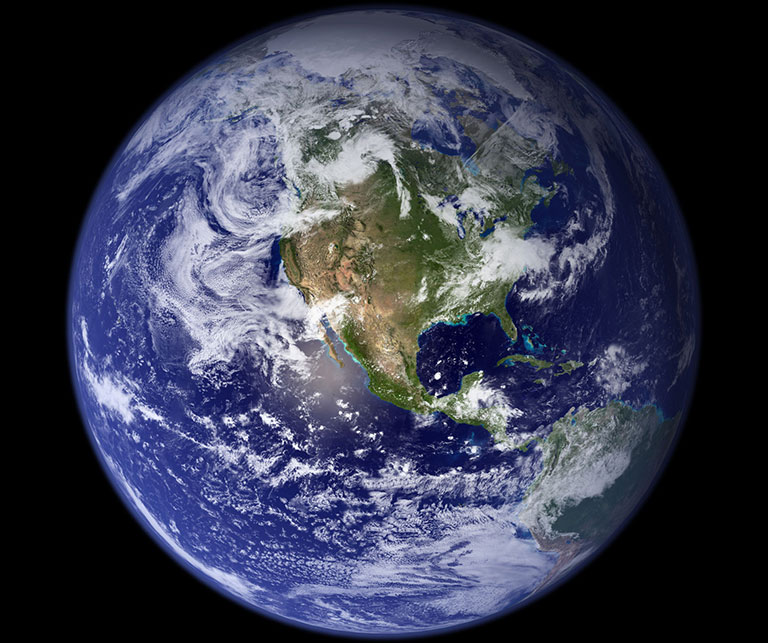
Earth from space

Sacredness of Creation

Thus spoke Chief Seattle

To traditional peoples, nature is sacred. In 1854, the Native American Chief Seattle gave a speech when the United States government wanted to buy the land of his tribe. A screenwriter later rewrote it. His revised version became a religious creed within the environmentalist movement. It strikes at the heart of the matter. Nothing is sacred anymore. The pursuit of money destroys our values and planet. We may think we own the land, but we do not. We may think we control our destiny, but we do not. Whatever befalls Earth befalls the children of the Earth. Thus spoke Chief Seattle,

The Great Chief in Washington sends word he wishes to buy our land.

The Great Chief also sends us words of friendship and goodwill. This is kind of him, since we know he has little need of our friendship in return. But we will consider your offer. For we know that if we do not sell, the white man may come with guns and take our land.

How can you buy or sell the sky or the warmth of the land? This idea is strange to us.

If we do not own the freshness of the air and the sparkle of the water, how can you buy them from us?

We will decide in our time.

What Chief Seattle says, the Great Chief in Washington can count on as truly as our white brothers can count on the return of the seasons. My words are like the stars. They do not set.

Every part of this earth is sacred to my people. Every shining pine needle, sandy shore, mist in the dark woods, clearing, and humming insect is holy in my people’s memory and experience. The sap that courses through the trees carries the memories of the red man.

The white man’s dead forget the country of their birth when they go to walk among the stars. Our dead never forget this beautiful earth, for it is the mother of the red man.

We are part of the earth, and it is part of us. The perfumed flowers are our sisters[;] the deer, the horse, the great eagle, these are our brothers. The rocky crests, the juices in the meadows, the body heat of the pony, and man―all belong to the same family.

So, when the Great Chief in Washington sends word that he wishes to buy our land, he asks much of us.

The Great Chief sends word that he will reserve us a place so that we can live comfortably. He will be our father, and we will be his children.

But can that ever be? God loves your people but has abandoned his red children. He sends machines to help the white man with his work and builds great villages for him. He makes your people stronger every day. Soon, you will flood the land like the rivers that crash down the canyons after a sudden rain. But my people are an ebbing tide; we will never return.

No, we are separate races. Our children do not play together, and our old men tell different stories. God favours you, and we are orphans.

So we will consider your offer to buy our land. But it will not be easy, for this land is sacred to us. We take our pleasure in these woods. I do not know. Our ways are different from your ways.

This shining water that moves in the streams and rivers is not just water but the blood of our ancestors. If we sell you land, you must remember that it is sacred and that each ghostly reflection in the clear water of the lakes tells of events and memories in the life of my people. The water’s murmur is the voice of my father’s father.

The rivers are our brothers. They quench our thirst. The rivers carry our canoes and feed our children. If we sell you our land, you must remember, and teach your children, that the rivers are our brothers and yours, and you must henceforth give rivers the kindness you would give any brother.

The red man has always retreated before the advancing white man, as the mist of the mountain runs before the morning sun. But the ashes of our fathers are sacred. The graves are holy ground, and so these hills, these trees, this portion of the earth is consecrated to us. We know that the white man does not understand our ways. One portion of land is the same to him as the next, for he is a stranger who comes in the night and takes from the land whatever he needs.

The earth is not his brother but his enemy, and he moves on when he has conquered it. He leaves his father’s grave behind, and he does not care. He kidnaps the earth from his children. He does not care. His father’s grave and his children’s birthright are forgotten. He treats his mother, the earth, and his brother, the sky, as things to be bought, plundered, and sold like sheep or bright beads. His appetite will devour the earth and leave behind only a desert.

I do not know. Our ways are different from your ways. The sight of your cities pains the eyes of the red man. But perhaps it is because the red man is a savage and does not understand.

There is no quiet place in the white man’s cities. There is no place to hear the unfurling of leaves in spring or the rustle of the insect’s wings. But perhaps it is because I am a savage and do not understand. The clatter only seems to insult the ears. And what is there to life if a man cannot hear the lonely cry of the whippoorwill or the arguments of the frogs around a pond at night? I am a red man and do not understand. The Indian prefers the soft sound of the wind darting over the face of a pond and the smell of the wind itself, cleansed by a midday rain or scented with pinion pine.

The air is precious to the red man, for all things share the same breath―the beast, the tree, the man, they all share the same breath. The white man does not seem to notice the air he breathes. Like many dying for many days, he is numb to the stench. But if we sell our land, you must remember that the air is precious to us, that the air shares its spirit with all the life it supports. The wind that gave our grandfather his first breath also received his last sigh. And the wind must also give our children the spirit of life. And if we sell you our land, you must keep it apart and sacred, as a place where even the white man can go to taste the wind sweetened by the meadow’s flowers.

So we will consider your offer to buy our land. If we decide to accept, I will make one condition: The white man must treat the beasts of this land as his brothers.

I am a savage, and I do not understand any other way. I have seen a thousand rotting buffalo on the prairie, left by the white man who shot them from a passing train. I am a savage, and I do not understand how the smoking iron horse can be more important than the buffalo that we kill only to stay alive.

What is man without the beasts? If all the beasts were gone, men would die from a great loneliness of spirit. For whatever happens to the beasts soon happens to man. All things are connected.

Whatever befalls the earth befalls the sons of the earth.

You must teach your children that the ground beneath their feet is the ashes of our grandfathers. So that they will respect the land, tell your children that the earth is rich with the lives of our kin. Teach your children what we have taught our children, that the earth is our mother. Whatever befalls the earth, befalls the sons of the earth. If men spit upon the ground, they spit upon themselves.

This we know. The earth does not belong to man; man belongs to the earth. This we know. All things are connected like the blood which unites one family. All things are connected.

Whatever befalls the earth befalls the sons of the earth. Man did not weave the web of life; he is merely a strand in it. Whatever he does to the web, he does to himself.

No, day and night cannot live together.

Our dead go to live in the earth’s sweet rivers, and they return with the silent footsteps of spring. It is their spirit, running in the wind, rippling the surface of the ponds.

We will consider why the white man wishes to buy the land. What is it that the white man wishes to buy, my people ask me. The idea is strange to us. How can you buy or sell the sky, the warmth of the land, the swiftness of the antelope? How can we sell these things to you, and how can you buy them? Is the earth yours to do with as you will, merely because the red man signs a piece of paper and gives it to the white man? If we do not own the freshness of the air and the sparkle of the water, how can you buy them from us?

Can you buy back the buffalo once the last one has been killed? But we will consider your offer, for we know that if we do not sell, the white man may come with guns and take our land. But we are primitive, and in his passing moment of strength, the white man thinks that he is a god who already owns the earth. How can a man own his mother?

But we will consider your offer to buy our land. Day and night cannot live together. We will consider your offer to go to the reservation you have for my people. We will live apart and in peace. It matters little where we spend the rest of our days. Our children have seen their fathers humbled in defeat. Our warriors have felt shame, and after defeat, they turn their days into idleness and contaminate their bodies with sweet foods and strong drinks. It matters little where we pass the rest of our days. They are not many. A few more hours, a few more winters, and none of the children of the great tribes that once lived on this earth or that roam now in small bands in the woods will be left to mourn the graves of a people once as powerful and hopeful as yours.

But why should I mourn the passing of my people? Tribes are made of men, nothing more. Men come and go like the waves of the sea.

Even the white man, whose God walks and talks with him as a friend to friend, cannot be exempt from the common destiny. We may be brothers, after all; we shall see. One thing we know, which the white man may one day discover―our God is the same God.

You may think now that you own Him as you wish to own our land, but you cannot. He is the God of man, and His compassion is equal for the red man and the white. This earth is precious to Him, and to harm the earth is to heap contempt on its Creator. The whites, too, shall pass, perhaps sooner than all other tribes. Continue to contaminate your bed, and you will one night suffocate in your own waste.

But in your perishing, you will shine brightly, fired by the strength of the God who brought you to this land and, for some special purpose, gave you dominion over this land and the red man. That destiny is a mystery to us, for we do not understand when the buffalo are all slaughtered, the wild horses are tamed, the secret corners of the forest heavy with the scent of many men, and the view of the ripe hills blotted by talking wires. Where is the thicket? Gone. Where is the eagle? Gone. And what is it to say goodbye to the swift pony and the hunt? The end of living and the beginning of survival.

God gave you dominion over the beasts, the woods, and the red man for some special purpose, but that destiny is a mystery to the red man. We might understand if we knew what the white man dreams―what hopes he describes to his children on long winter nights―what visions he burns onto their minds so that they will wish for tomorrow. But we are savages. The white man’s dreams are hidden from us. And because they are hidden, we will go our own way. Above all else, we cherish the right of each man to live as he wishes, however different from his brothers. There is little in common between us.

So we will consider your offer to buy our land. If we agree, it will be to secure the reservation you have promised. Perhaps we may live out our brief days as we wish there.

When the last red man has vanished from this earth, and his memory is only the shade of a cloud moving across the prairie, these shores and forests will still hold the spirits of my people. For they love this earth as the newborn loves its mother’s heartbeat.

If we sell you our land, love it as we’ve loved it. Care for it as we’ve cared for it. Hold in your mind the memory of the land as it is when you take it. And with all your strength, mind, and heart, preserve it for your children, and love it as God loves us all.

One thing we know. Our God is the same. This earth is precious to Him. Even the white man cannot be exempt from the common destiny. We may be brothers, after all. We shall see.

A religious desire for Eden

Perhaps you care for this planet, but what do you mean by that? When the last white rhino is dead, the Earth is still there. We may survive the demise of the rainforests. Humans have finished off other species for thousands of years. Why stop now? Nature doesn’t care. Predators kill prey, and natural disasters kill animals. Why should we care? Mr Lind, a professor at the University of Texas, noted that saving the planet has become the religion of politicians, business elites, and intellectuals in the West, replacing Christianity’s earlier mission of saving individual souls.1 He added that environmentalism is rooted in German 19th-century Romanticism, with a bias against organised society and civilisation and a pantheistic awe before an idealised Nature. In other words, environmentalists suffer from a religious desire for Eden.

In doing so, Mr Lind tapped into another 19th-century German tradition, that of Friedrich Nietzsche. Nietzsche hoped to leave traditional morality behind, saying, ‘God is dead.’ Religions like Christianity, Nietzsche claimed, were ruses to enslave us with a false sense of right and wrong under rules imposed by a priestly caste. And so do environmentalists, Lind implied. Nietzsche favoured the values of the strong to those of the weak embodied in Christianity and socialism. Slaves think in terms of good and evil rather than better and worse because they resent the ruling class. Nietzsche hoped to liberate us from our self-induced slavery and realise our full potential.

Mr Lind argued we should do away with false sentiments, saying, ‘There are costs to mitigating climate change as well as benefits, and rational people can prefer a richer but warmer world to a poorer but slightly less warm one. These individual policies benefit humanity, so there is no need to justify them on the basis of a romantic creed that defines the planet or the environment.’ That appears nice and dandy from behind the desk of Mr Lind’s air-conditioned Texas room. He says rational people might prefer money to a cooler climate. If it is too hot in France, you can go to the beach in Denmark. A few people may die due to heat stroke or extreme weather. We will be wealthier, so why care? We never cared. Cars kill one million people per year. That didn’t stop us from driving them.

A philosophy of connectedness

As our production and consumption increase, new problems emerge faster than we can solve existing ones with laws, technology, targets and other solutions. New technology, rules and controls don’t solve these problems. Meanwhile, millions of poor people try to escape their misery and look for a better future in wealthy countries. Is there a relation between these issues, and what is it? In the 1990s, the environmentalist group Strohalm wrote a booklet named Towards a Philosophy of Connectedness.2
It gives a vision for a sustainable and humane society centred around community solidarity. The principal founder of Strohalm is Henk van Arkel, a dedicated individual who remained its driving force for decades. He doesn’t blame anyone in particular. We are all part of the problem.

Everything is interconnected. Our actions have consequences, even though we may not know or ignore them. Wall Street traders who sold bad mortgages caused the financial crisis. Dumping plastic in a river, buying clothes made by children, or posting hateful comments on a message board has consequences. Western thinking, reflected in the scientific method, deconstructs reality to analyse the parts. In this way, the whole can get lost. Not seeing the whole can make us act irresponsibly. A single hateful comment doesn’t make someone take a semi-automatic rifle and shoot innocent people, nor would driving a single car change the climate. Still, hate makes people murder innocent people and driving cars contributes to climate change. If we accept that, we remain locked inside a cynical and uncaring world. It is our neglect. Good intentions can worsen things, but we can learn and do better next time. The alternative is turning evil.

Actions have consequences. We can’t look the other way if we hope to live in Paradise. We have to do the best we can to prevent harm. Our vision of harm fails us. If the relationship between our actions and the harm is remote or not proven, we feel free to do as we please. And that is the road to hell. And so, we have the choice of being free in hell or becoming a slave in Paradise. It is not slavery, as we understand it, the exploitation of one group of people by another, but slavery in Nietzsche’s sense, which is living under a self-imposed moral system that limits our options. And money shouldn’t be our highest value, which it is in the liberal-capitalist world. God owns this world, so it is not ours to destroy. The Sacredness of Creation is a religion. We need a new starting point and foundation for our culture, beliefs, thinking, and our place in the universe because we must change how we live.2

Latest revision: 20 August 2024

Featured image: Earth from space. Public Domain.

1. Why I Am Against Saving the Planet. Michael Lind (2023). Tabletmag.com.
2. Naar een filosofie van verbondenheid. Guus Peterse, Henk van Arkel, Hans Radder, Seattle, Pieter Schroever and Margrit Kennedy (1990). Aktie Strohalm.

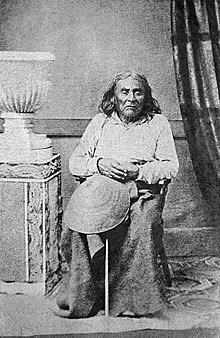
The only known photograph of Chief Seattle

Thus spoke Chief Seattle

The Great Chief in Washington sends word that he wishes to buy our land. The Great Chief also sends us words of friendship and goodwill. This is kind of him since we know he has little need for our friendship in return. We will consider your offer. For we know that if we do not sell, the white man may come with guns and take our land.

But how can you buy or sell the sky, the warmth of the land? The idea is strange to us. If we do not own the freshness of the air and the sparkle of the water, how can you buy them from us?

Every part of this earth is sacred to my people. Every shining pine needle, every sandy shore, every mist in the dark woods, every clearing, and humming insect is holy in the memory and experience of my people.

Our dead never forget this beautiful earth, for it is the mother of the red man. We are part of the earth and it is part of us. The perfumed flowers are our sisters; the deer, the horse, the great eagle, these are our brothers.

This shining water that moves in our streams and rivers is not just water but the blood of our ancestors. If we sell you land, you must remember that it is sacred and that each ghostly reflection in the clear water of the lakes tells of events and memories in the life of my people.

The rivers are our brothers, they quench our thirst. The rivers carry our canoes and feed our children. If we sell you our land, you must remember, and teach your children, that the rivers are our brothers, and yours, and you must henceforth give rivers the kindness you would give any brother.

The red man has always retreated before the advancing white man, as the mist of the mountain runs before the morning sun. But the ashes of our fathers are sacred. The graves are holy ground, and so these hills, these trees, this portion of the earth is consecrated to us.

We know that the white man does not understand our ways. One portion of land is the same to him as the next, for he is a stranger who comes in the night and takes from the land whatever he needs.

The earth is not his brother but his enemy, and when he has conquered it, he moves on. He leaves his father’s graves behind, and he does not care. He kidnaps the earth from his children. He does not care. His fathers’ graves and his children’s birthright are forgotten.

He treats his mother, the earth, and his brother, the sky, as things to be bought, plundered, or sold like sheep or bright beads. His appetite will devour the earth and leave behind only a desert.

I do not know. Our ways are different from your ways. The sight of your cities pains the eyes of the red man. But perhaps it is because the red man is a savage and does not understand.

There is no quiet place in the white man’s cities. What is there to life if a man cannot hear the lonely cry of the whippoorwill or the arguments of the frogs around the pond at night? I am a red man and do not understand.

The air is precious to the red man, for all things share the same breath―the beast, the tree, the man, they all share the same breath. The white man does not seem to notice the air he breathes. Like a many dying for many days, he is numb to the stench.

I have seen a thousand rotting buffaloes on the prairie, left by the white man who shot them from a passing train. I am a savage and I do not understand how the smoking iron horse can be more important than the buffalo that we kill only to stay alive.

What is man without the beasts? If all the beasts were gone, men would die from a great loneliness of spirit. For whatever, happens to the beasts, soon happens to man. All things are connected. Whatever befalls the earth, befalls the sons of the earth.

This we know. The earth does not belong to man; man belongs to the earth. This we know.

All things are connected like the blood which unites one family. All things are connected. Man did not weave the web of life; he is merely a strand in it. Whatever he does to the web, he does to himself.

We may be brothers after all; we shall see. One thing we know, which the white man may one day discover―our God is the same God. You may think now that you own Him as you wish to own our land, but you cannot.

This earth is precious to Him, and to harm the earth is to heap contempt on its Creator. The whites too shall pass; perhaps sooner than all other tribes. Continue to contaminate your bed, and you will one night suffocate in your own waste.

God gave you dominion over the beasts, the woods, and the red man, and for some special purpose, but that destiny is a mystery to the red man. We might understand if we knew what it was that the white man dreams―what hopes he describes to his children on long winter nights―what visions he burns onto their minds so that they will wish for tomorrow.

God loves us all. One thing we know. Our God is the same God. This earth is precious to Him. Even the white man cannot be exempt from the common destiny. We may be brothers after all. We shall see.

Latest update: 18 May 2023

Featured image:

Most viewed posts

Over the last three years more than 70 posts were published on The Plan For The Future. That is an average of one post every fifteen days. And 65 WordPress users started following this blog. Some posts have been viewed more often than others. This is the top 5 of posts based on page views.

The miracle of Wörgl

During the great depression of the 1930s a local currency in the small Austrian town of Wörgl produced an economic miracle. It demonstrated that the economy can do well without more debt if the existing money keeps circulating. This may be the key to keeping the economy afloat without more debt.

Read More

Mother Goddess Eve

Was Eve a goddess and was she the mother of Adam? And did Jesus believe this too because Mary Magdalene told him so? And what is the evidence? Reality can be stranger than fiction, most notably when our reality itself is a fiction created by an advanced civilisation.

Read More

New World Order

The direction of history is towards a single integrated world order. The world is becoming one intellectually, economically and politically. The world is now run by a global elite of business people, politicians, bureaucrats, engineers, journalists, scientists, opinion makers, writers and artists.

Read More

The curse of The Omen

Rumours go that some films have been cursed. The evidence is not always convincing. The Omen stands out. Events took a stranger turn in the Netherlands. And when I began to investigate the most peculiar event of the curse, strange things happened.

Read More

There is a plan for the future

In 1914 Archduke Franz Ferdinand was assassinated in his car in Sarajevo. This triggered World War I. The car had licence plate number A III 118, a possible reference to the Armistice of 11 November 1918  ending the war. So could history be script? And could there be a plan for the future?

Read More

Feature image: Piet Mondriaan painting (1921). Public Domain.

From human nature to a state

Survival of the fittest

Evolution theory can explain how biological organisms evolve over time. Genes determine their nature, which means how organisms behave and what they look like. Genes mutate randomly and this causes variation. It is a reason why humans differ in size, behaviour and skin colour. Mutations are passed on to the organisms’ offspring. These mutations alter the features of organisms. Those that are better suited for their environment are more likely to survive and procreate. This is natural selection or survival of the fittest.

The basic principles of evolution, variation and selection, apply to human societies as well. There has been a lot of variation in political institutions throughout history. Societies that succeeded in adapting to new circumstances usually survived the ones that didn’t. The development of societies can therefore be seen as social and economic evolution. Political institutions are an important part of society. And even though institutions are planned or designed deliberately, while biological variation is random, social evolution looks like natural selection because of competition.

As a consequence later civilisations were wealthier and more powerful than earlier ones. For instance, industrial societies are more powerful than agricultural societies. But social evolution isn’t straightforward. Remnants of earlier phases of development continue to exist once a society moved to the next stage. So, after a society has entered the industrial phase, many farmers still farmed the land in a traditional way without machines. And some modern democratic countries still have a king or a nobility.

Family groups

The earliest humans were hunter-gatherers who didn’t know of property. They lived like chimpanzees in family groups consisting of a few dozen individuals. These groups were self-sufficient. If another family group invaded their territory hunter gatherers could move on as population density was low and there was no property to defend.

Family groups were egalitarian. Social differences were based on age and gender. They had no permanent leader and there was no hierarchy. Leaders were elected based on group consensus. Usually women married outside their group to live in the group of their husbands. Marriage was a means of managing relations with neighbouring groups.

After the invention of agriculture population density increased dramatically and people came into contact with each other more often. Struggles became more intense as farmers invested in the land they cultivated. Harvests had to be protected against thieves. This required a different form of social organisation that included property.

From families to tribes

People became organised in tribes. A tribe consists of a number of related family groups who share common ancestors. Usually descent in a tribe is traced through the male family line. A common ancestor of a tribe might well be a mythical person. In this way it is possible to have large tribes. Tribes are often egalitarian. The family groups of the tribe usually remain independent but they can join their forces for war.

War is the main reason for organising in tribes. A tribe can muster more men for war than a family group. Property rights in tribes usually were related to the family groups rather than individuals. Land remained with the family group and couldn’t be bought or sold. The leader of a tribe usually had no authority over the tribespeople and couldn’t force them to obey. And so there was no rule of law. People had to enforce their rights themselves and blood feuds were common.

Religion plays an important role in organising large scale action. The question whether religion created the social order or that religion was invented to justify the social order is never answered. Most likely the causal relationship went both ways. Tribal organisation isn’t natural so people won’t revert to it once the social order fails. Tribal organisation is sustained by religious beliefs, which are often about common ancestors.

Tribes can develop into chiefdoms. A chiefdom has a lord who has armed vassals. It is the most basic form of political organisation. This type of political organisation came to dominate human history and it still exists today in the form of warlords, militia, drug cartels and street gangs. Chiefdoms have power to coerce people that didn’t exist in group based societies. Chiefdoms already have some features of states.

From tribe to state

Liberal social contract theories assume that states emerged when citizens agreed to subject to a state in exchange for safety and other public services. But tribespeople only temporarily gave up their freedoms to meet an external threat like an invasion. And so the reason for the first states to emerge appears to have been violence or the threat of violence, not the desire for a social contract. States differ from tribes in the following ways:

  • States are the highest authority and have a centralised hierarchy.
  • The state has a monopoly on the use of legal coercive force.
  • The authority of the state is based on territory rather than kinship.
  • States have a justification based on religion or political philosophy.

Population growth and increased population density have been important causes of technological improvements like irrigation works. This allowed for a division of labour and the emergence of elites, which promoted state creation. If the population density is low, conflicts about land and access to resources can be solved by relocation, but this option disappears once population density increases or when physical borders fence in the population. The factors that allowed for the first states to emerge were:

  • There must be a surplus of means of existence to support a state.
  • Society must be large enough to allow for a division of labour.
  • Natural borders must fence in the population so people can’t escape when they are oppressed.
  • Tribespeople must subject themselves to a higher authority either because of an external threat or the charismatic leadership of a leader.

The first states may have emerged when one tribe subjected another. In order to rule the other tribe, the victorious tribe may have introduced centralised repressive institutions and established itself as the ruling class. The threat of being subjected may have induced other tribes to develop more permanent and centralised authoritarian structures. Still many tribes just assimilated conquered tribes and states never emerged.

It seems likely that religious ideas played a major role in the formation of early states as religion can provide sufficient legitimation for the loss of freedom coming from the subjugation to a leader or a hierarchical structure. Religious authority can make it easier to create a large military to subjugate rebellious tribes and to create peace and stability on the home front, which in its turn strengthens the religious authority of the leader.

Certain conditions had to be met for the first states to emerge but there are too many interacting factors to produce a strong theory on how the first states emerged. It may not be important to have such a theory as states nowadays are well-established. States now innovate and copy each other’s institutions because they are in a competitive struggle with each other.

Featured image: Cover of The Origins of Political Order

From: The Origins of Political Order: From Prehuman Times to the French Revolution of Francis Fukuyama.