Heaths near Nijverdal

Our invisible friend

Market economy

Market economies have an invisible friend called the invisible hand. In market economies, goods are distributed without the need for a planning agency. According to Adam Smith, it is as if an invisible hand makes this miracle happen. His critics, for instance, Karl Marx, did not believe in invisible friends. Not surprisingly, Marx also did not believe in God. Smith claimed that if everyone pursues his own interest, the interest of society is often best served. The followers of Marx felt that the state should plan the production and distribution of goods and services.

I’m the invisible man
Incredible how you can
See right through me

– Queen, The Invisible Man

The following story demonstrates how the invisible hand does its magic. Whether or not it is true does not matter. The story goes that the mayor of Moscow once visited London in the 1980s. Back then, Russia did not have a market economy. The mayor received a tour around the city and noticed that no one queued up for bread as everyone did in Moscow. There was an ample supply of bread at affordable prices. Somehow bread was produced in the right quantities for the preferred tastes and supplied at the right places.

The mayor was amazed about this feat, so he said to his hosts, “Back in Moscow our finest minds work day and night on the bread supply and yet there are long queues everywhere. Who is in charge of the supply of bread in London? I want to meet him!” Of course, no one was in charge. That’s the secret of the market economy. Every baker decided how much he was planning to make and sell and at what price. A few years later, Russia switched to a market economy.

The individual decisions of bakers and the businesses in the supply chain, for instance, farmers and flour mills, make this miracle happen. They all decide for themselves. If a baker could sell more than he produced, he would miss out on profits. The same is true when he has to throw away bread. And some people are willing to pay more if the bread tastes better. Hence, each baker tries to make the right amount of bread to the tastes people desire. It is in their best interest.

In Russia, the state planned how much of each item a corporation should produce. Corporations could not decide on prices. They received compensation for their costs but could not make a profit. Employees received a fixed salary. Corporations that produced more or better products and their employees did not benefit. Corporations also could not go bankrupt when they did a terrible job. That resulted in poor-quality products, a shortage of nearly everything and even outright famine from time to time.

It doesn’t always work out well

This miracle has enchanted quite a few people. They believe that everything will turn out fine if only markets can do their job. But there are many instances where a market economy doesn’t produce the best outcome for society. Economists call them market failures. One can think of the following situations:

  • We have more desires than our planet can support. A market economy may fulfil those desires at the expense of our future.
  • Many people cannot make a living in the market economy, for instance, because they lack the skills or have little bargaining power.
  • Corporations use lobbyists and bribe politicians to pass legislation that favours them.
  • A government may be a more efficient producer of products that do not benefit from competition, for instance, roads and the power grid.
  • Corporations may abuse their power and charge higher prices, most notably if they have no competitors.
  • Products can cause harm to people or the environment, but producers may not pay these costs themselves. For example, cigarettes cause health costs.

In most countries, governments interfere with the economy to deal with these market failures. These are situations where pursuing personal interests does not bring the best outcome for society. In many democratic countries, public expenses are about 50% of national income. People in these countries probably believe that a market economy does not always work best. In some areas, markets produce extremely poor outcomes, for instance health care.

An example can demonstrate why. People in the United States live as long as people in Cuba.1 Cuba is poor and does not have a market economy. The United States spends more on health care than any other country in the world. Every possible treatment is available in the United States. Still, in more than 40 countries, people live longer than in the United States.1 Cuba does not spend a lot on health care, only 10% of what the United States spends per person. Healthcare in Cuba appears efficient compared to healthcare in the United States. How can this be?

The available treatments in Cuba are free for everyone. In the United States, you may not receive treatment when you cannot afford it because the United States has a market economy. There may be other causes, for example, differences in diets in Cuba and the United States. There is no fast food in Cuba because Cuba has no market economy. Life in Cuba may be miserable, but healthcare is one of the few things Cuba has organised well.

Successful societies have market economies and governments that organise things that the market fails to do. And a market economy still needs a government to set the rules and enforce them. Governments of successful societies aim at making the market economy work better where it is beneficial for society and constraining it where it does more harm than good.

Capital

Market economy and capitalism are so closely related that many people believe them to be the same. Capitalism is about capital. Capital consists of the buildings and the machines corporations own, but also the knowledge of how to make products and how to bring them to the market. Knowledge of how to make a film entertaining might be capital for a film company. Networks of customers and suppliers can be capital too if they contribute to the success of a business. The same applies to contracts and brands. For instance, the brand Coca-Cola has a lot of value because people are willing to pay more for cola when the logo of Coca-Cola is printed on the bottle.

Building capital can be costly but in a market economy the value of capital doesn’t depend on the cost to build it but on the future income it is expected to produce. This can lead to peculiar situations. When investors have no faith in the future of a corporation because it is expected to make losses, the buildings and the machines on their own may be worth more than the corporation as a whole as those buildings and machines could be used by other corporations for more profitable purposes.

In most cases, more capital means more wealth because capital produces the things people need or desire. Corporations tend to be more profitable if they fulfil those needs and desires better. Therefore, the value of capital in a market economy often depends on how well it can fulfil the desires of consumers. Investors are willing to invest in corporations that fulfil those needs and desires because they expect to make money by doing so.

It is sometimes argued that when investors are free to invest in the corporations of their choosing, the invisible hand channels investment capital to the most useful corporations because they are the most profitable. That’s why the value of corporations is important in a market economy. Businesses ‘create value’ for investors by making consumers happy. Still, the value of a corporation might not reflect the benefits for society as a whole. For instance, if the profitability of a corporation comes from exploiting people or harming life on the planet, a high value could be a bad sign.

And capital can be useful without being profitable, for instance in the public sector. A hospital in the public sector may have no market value because it doesn’t make a profit but it can be useful nonetheless. Capital in the public sector might even be more valuable than in a market economy. For instance, making hospitals private enterprises for profit might not benefit society as a whole. Hospital care may not improve from the competition as it is often best to have one hospital serving a particular area. And patients might receive unnecessary treatments when hospitals can make a profit. Healthcare in the United States may create a lot of value for investors but it doesn’t always benefit the patients.

As there are basically two types of people, capitalists who save and invest and ordinary people who borrow and spend, it is hardly surprising that capitalists tend to be wealthier than ordinary people. Capitalism can create wealth because it is the capitalists who finance the investments in the corporations that make the items ordinary people enjoy, but this wealth is often unevenly distributed. From a moral perspective, it is a problem that poverty still exists when there could be enough for everyone. So the question that still remains is how to make the economy work better for the benefit of all?

Featured image: Our invisible friend photographed in the moorlands near Nijverdal. Jürgen Eissink (2018). Wikimedia Commons. Public Domain.

1. Life expectancy per country 2017. World Population Review. [link]
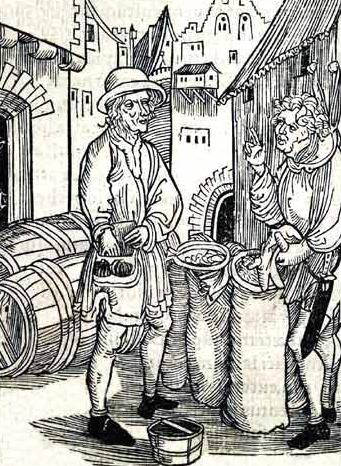
Of Usury, from Brant's Stultifera Navis (the Ship of Fools)

The Problem Of Interest

Compounding

Imagine that Jesus’ mother had put a small gold coin weighing 3 grammes in Jesus’ retirement account at 4% interest just after he was born in the year 1 AD. Jesus never retired but he promised to return. Suppose now that the account was kept for this eventuality. Imagine now that the end is near, and that Jesus is about to return. How much gold would there be in the account in 2018?

It is an amount of gold weighing 11 million times the mass of the Earth. The yearly interest would be a gold nugget weighing 440,000 times the mass of the Earth. There is a small problem, a fly in the ointment so to say. It would be impossible to pay out Jesus because there simply isn’t enough gold.

It might seem that the bank had to close long ago because of a lack of gold, but that isn’t true. As long as Jesus doesn’t show up it can remain open, at least if the borrowers are allowed to borrow more to pay for the interest. If the economy grows 4% it may not be such a big deal. The interest can be created out of thin air by making new loans that allow borrowers to pay for the interest. And if Jesus doesn’t claim his gold when he returns and accepts bank credit, everything will be fine.

There is a limited amount of gold while compound interest is infinite. As long as bankers can create money out of thin air to pay for the interest and people accept bank deposits for payment, everything is fine. Problems only arise when people demand real gold. A bank can go bankrupt when depositors want to take out their deposits in gold.

Central banks

Perhaps Jesus’ retirement account isn’t such a big problem after all. Our money isn’t gold but currencies central banks can print. Assume now that Jesus’ mother had put one euro in the account instead. One euro at 4% interest makes 22,000,000,000,000,000,000,000,000,000,000,000 euro after 2017 years. That may seem an intimidating figure, but the European Central Bank can take 22 pieces of paper and print 1,000,000,000,000,000,000,000,000,000,000,000 euro on each of them. And there you are. Something like this happened during the financial crisis of 2008. This is called quantitative easing. You may have heard that word before.

Central banks can print new dollars and euros to cope with a shortfall. In fact, this is what central banks often do. There is always a shortfall because of interest because most money is debt and interest on this debt needs to be paid. To make up for the shortfall, there are two options. First, people can borrow more. Second, central banks can print new currency. Both things can happen at the same time. Central bank decisions about interest rates are also about dealing with the shortfall caused by interest charges.

When central banks lower interest rates, people can borrow more because interest rates are lower. Central banks lower interest rates when people are borrowing less than is needed to cope with the shortfall. If central banks raise interest rates, people can borrow less because interest rates are higher. Central banks raise interest rates when people are borrowing more than is needed to cope with the shortfall and the extra money makes people want to buy more stuff than can be made. And if people don’t borrow at all, this is a crisis, and central banks may print more currency to cope with the shortfall.

Interest on capital versus economic growth

There is a problem central banks can’t fix by printing more currency. Interest is more than just interest on money. Interest is any return on investment. Throughout history returns on investments were mostly higher than the rate of economic growth. Most of these returns have been reinvested so a growing share of total income was for investors. This can’t go on forever because who is going to buy the stuff corporations make in order to keep these investments profitable? A simple example can illuminate that.

interestvers
Interest income (red) versus total income with interest income growing faster than total income

The graph above shows how total income and interest income (in red) develop with an economic growth rate of 2% and an interest rate of 5% when interest income starts out as 10% of total income and all interest income is reinvested. After 25 years the economic pie has grown faster than interest income and wages have risen. At some point interest income starts to rise faster than total income, and wages go down. After 80 years there’s nothing left for wages. This graph explains a lot about what is going on in reality.

In the short run it was possible to prop up business profits and interest rates by letting people go further into debt to buy more stuff. In the long run, the growth rate of capital income cannot exceed the rate of economic growth. Interest rates depend on the returns on capital so this can explain why interest rates went down in recent years. In the past interest rates below zero weren’t possible but from time to time there were economic crises and wars that destroyed a lot of capital. This created new room for growth.

Wealth inequality and income inequality

When interest rates go down, the value of investments tend to rise. If savings yield little this benefits the wealthy as most people have their money in savings while the wealthy own most investments. But it is important to know the cause otherwise you might think that interest rates should rise. The graph above shows that wealth inequality causes interest rates to go lower, hence redistributing income, for example via higher wages or taxes on the wealthy, can bring higher interest rates.

There is a difference between wealth inequality and income inequality. Your labour income and the returns on your investments are your income. If you are rich but make no money on your investments, your wealth doesn’t contribute to your income. In reality wealthy people make better returns on their investments than others because they have better information and can take more risk. Still, the graph shows that income and wealth inequality can’t increase indefinitely, and that returns on investments can’t exceed the reate of economic growth in the long run, hence interest rates need to go lower.

Most people pay more interest than they receive. The interest paid on mortgages and loans is the proverbial tip of the iceberg. Interest is hidden in rents, in taxes because governments pay interest on their debts, and the price of every product and service because investments have to be made to make these products and services. German research has shown that 80% of the people pay more in interest than they receive, while only the top 10% of richest people receive more in interest than they pay. Lower interest rates benefit most people despite some side-effects that work in the opposite direction.

Economic cycles

Humans are herd animals. They buy stuff and even go into debt to buy stuff when others are going into debt to buy stuff too. Suddenly they may realise that they have bought too much or have gone too deeply into debt, and all at the same time. One day they may be borrowing money, queueing up before the shops, and bidding up prices. The next day, they may decide to pay off their debts, leaving the shop owners with unsold inventories they have to get rid of at fire sale prices. So prices may go up when people are in a buying frenzy and may go down when sales dry up.

When there is a buying frenzy business owners are optimistic and do a lot of investments, and often they go into debt to make those investments. But if suddenly customers disappear, they may be stuck with unsold inventory and debts they cannot repay. Businesses may then have to fire people. Those people are then left without income, and cannot repay their debts too, so sales will go down further. If their debts are not repaid, banks could get into trouble. In most cases the economy will recover. In the worst case banks go bankrupt, money disappears, the economy collapses, and an economic depression takes off.

Interest can make things worse. Assume that you have a business and expect to make a return of 8%. You have € 100,000 yourself and you borrow € 200,000 at 6%. You expect to make 8% so borrowing money at 6% seems a good idea. If you only invest your own € 100,000 you can make € 8,000, but if you borrow an additional € 200,000 you can make € 12,000 (8% of € 300,000 minus 6% of € 200,000, which is € 24,000 minus € 12,000). The balance sheet of your business might look like this:

debit
credit
inventory
€ 250,000
loan 6%
€ 200,000
cash, bank deposits
€ 50,000
owner’s equity
€ 100,000
total
€ 300,000
total
€ 300,000

If sales disappoint and you only make a return of 2% on your invested capital of € 300,000, which is € 6,000, you make a loss because you pay € 12,000 in interest charges. You may have to fire workers. Businesses can go bankrupt because they have borrowed too much and have to pay interest, even when they are profitable overall. Sales often disappoint when the economy fares poorly. This means that more businesses face the same difficulties and make losses because of interest payments. They may have to fire workers and these workers lose their income. This can worsen the slump.

Interest, economic depressions and war

Silvio Gesell discovered that interest rates can’t go below a certain minimum because lending would then stop. Money would go on strike as he put it. Why is that? Low yields make investing and lending money unattractive because of the risks involved. Debtors may not repay and banks may go bankrupt. Depositors then prefer to take their money out of the bank and keep it with themselves.

This can cause economic crises and depressions. Silvio Gesell lived around 1900. Interest rates below zero weren’t possible because of the gold standard. Depositors could go to the bank and withdraw their deposits in gold so that they didn’t have to accept negative interest rates. From time to time there were bank runs, economic crises and wars that destroyed a lot of capital. And this created new room for growth.

There may be a relationship between interest, economic depressions and war. In 1910 the amount of capital income (the red circle in the graph) relative to total income (the two circles together) was close to what it was in 2010. This could have led to an economic depression but then came World War I. The war destroyed a lot of capital so that there was new room for capital growth and interest rates could remain positive.

A few decades later the Great Depression arrived. If interest rates could have gone below zero in the 1930s, the Great Depression might not have happened, Adolf Hitler would not have risen to power and World War II would not have occurred. The currency of Wörgl demonstrates that negative interest rates could have ended the depression. After World War II interest rates never came near zero again. Governments and central banks printed more money. This caused inflation, which eroded trust in money.

People feared that inflation would make their money worth less so interest rates rose. In the 1970s the link between money and gold was abandoned because there was a lot more money than there was gold to back it. In the 1980s governments and central banks started policies to bring down inflation and to promote trust in money. As of 1983 interest rates went down gradually as a consequence of a renewed trust in money and central banks. Debt levels rose and interest rates went near zero.

Promoting inflation might not be a good idea. The end result is unpredictable. The best one can hope for is a poor performing economy and a lot of inflation like in the 1970s. But if interest rates rise because lenders lose their trust in money and debts, people may not be able to repay their debts, and the financial system might get into serious trouble. This can cause another great depression or another great war. But if the alternative is negative interest rates, stability and prosperity, then why not opt for that?
eou_31_questions

Featured image: Of Usury, from Brant’s Stultifera Navis (the Ship of Fools). Albrecht Dürer (1494). Public domain.

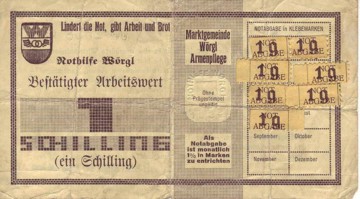
Wörgl bank note with stamps. Public Domain.

Miracle of Wörgl

In the middle of the Great Depression, the Austrian town of Wörgl was in deep trouble and prepared to try anything. Of its population of 4,500, 1,500 people were without a job, and 200 families were penniless. Mayor Michael Unterguggenberger had a list of projects he wanted to accomplish, but there was not enough money to carry them out. These projects included paving roads, erecting streetlights, extending water distribution across the whole town, and planting trees along the streets.1 2

Rather than spending the remaining 32,000 Austrian Schilling in the town’s coffers to start these projects, he deposited them in a local savings bank as a guarantee to back the issue of a currency known as stamp scrip. A crucial feature of this money was the holding fee. The Wörgl money required a monthly stamp on the circulating notes to keep them valid, amounting to 1% of the note’s value.1 2 An Argentine businessman named Silvio Gesell had come up with this idea in his book The Natural Economic Order.

Nobody wanted to pay for the monthly stamps, so everyone spent the notes they received. The 32,000 schilling deposit allowed anyone to exchange scrip for 98 per cent of its value in schillings. Hardly anyone did this because the scrip was worth one Austrian schilling after buying a new stamp. But people did not keep more scrip than they needed. Only 5,000 schillings circulated. The stamp fees financed a soup kitchen that fed 220 families.1 2

The municipality carried out the intended works, including new houses, a reservoir, a ski jump and a bridge. The key to this success was the fast circulation of the scrip money within the local economy, fourteen times higher than the schilling. It increased trade and employment. Unemployment in Wörgl dropped 25% while it rose in the rest of Austria. Six neighbouring villages copied the idea successfully. The French Prime Minister, Édouard Daladier, visited the town to witness the ‘miracle of Wörgl’ himself.1 2

In January 1933, the neighbouring city of Kitzbühel copied the idea. In June 1933, Mayor Unterguggenberger addressed a meeting with representatives from 170 Austrian towns and villages. Two hundred Austrian townships were interested in introducing scrip money. At this point, the central bank decided to ban scrip money.1 2

Since then, several communities have issued local scrip currencies. None of them was as successful as the currency of Wörgl. The reasons probably are:

  • There was no economic depression, and the economy could support interest, so introducing scrip money had little effect.
  • If scrip money is not widely accepted, people will exchange it for regular currency if they can’t use it.

In Wörgl, the payment of taxes in arrears generated additional revenues for the town council, which the town council spent on public projects. Once the townspeople had paid their taxes, they would have run out of spending options and might have exchanged their scrip for schillings to avoid paying for the stamps. That never happened because the central bank halted the project.

There are, however, a few issues to consider. The economy of Wörgl did well without issuing debt because the money kept circulating. A negative interest rate induces people to spend the money they have, so no new money has to be borrowed into existence to stimulate the economy. A holding fee makes negative interest rates possible as you do not have to pay it when lending money. For instance, lending out money at an interest rate of -2% is more attractive than paying 12% for the stamps. If we can uncover the conditions for it to work, remove its flaws, and plan for the consequences, we can have a usury-free financial system.

Natural Money

Introducing negative interest rates in the global financial system may have great benefits. The website Naturalmoney.org features an in-depth research of the feasibility and consequences of negative interest rates.

Read More

If you like this post, then you might also like:

Joseph in Egypt

Ancient Egypt had a similar type of money for more than 1,000 years. There is an account in the Bible that may explain how this money came into existence.

Read More

The future of interest rates

In the long run most capital ends up in the hands of the capitalists. Negative interest rates are the logical consequence.

Read More

Latest revision: 6 April 2024.

Featured image: Wörgl bank note with stamps. Public Domain.

1. The Future Of Money. Bernard Lietaer (2002). Cornerstone / Cornerstone Ras.
2. A Strategy for a Convertible Currency. Bernard A. Lietaer, ICIS Forum, Vol. 20, No.3, 1990. [link]