Book: The Virtual Universe

Several religions claim that a god or gods have created this universe. The simulation hypothesis explains how this might have happened. We could all live inside a computer simulation run by an advanced post-human civilisation. But can we establish that this is indeed the case?

The evidence suggests that we live inside a simulation. It even allows us to infer the purpose of our existence. This book does not promote a specific religion. It follows science, but science has its limits. It can’t tell whether the world we live in is real.

Still, the sciences can support the argument that this world is a simulation, as they have established the natural laws that guide reality. If breaches of these laws occur, such as paranormal incidents with credible witnesses, we have evidence indicating that this world is not real.

We have just invented virtual reality. We can utilise virtual reality for both research and entertainment purposes. If the technology to create virtual worlds becomes affordable, most worlds will exist for entertainment, such as games or inventing stories where we can make our dreams come true.

The latter requires control over everything that happens, which is the situation we appear to be in. With our current knowledge, the world makes the most sense as a simulation created by an advanced post-human civilisation to entertain someone we can call God.

In this book, you can find answers to the following questions:

  • Is there something more than science can explain?
  • Is there a plan behind all that happens?
  • What are virtual worlds?
  • How can we know things and determine whether we live in a virtual world?
  • How can we explain things science can’t explain?
  • What are the simulation hypothesis and simulation argument about?
  • Can we improve the simulation argument to establish whether we are living in a simulation?
  • Why does our existence not need to be a miracle?
  • What reasons might post-humans have to create virtual worlds?
  • Can we infer from the properties of our universe that we live in a simulation?
  • What can we say about the evidence of spooks?
  • What is real about UFOs?
  • Do curses exist?
  • Do meaningful coincidences indicate that there is a script?
  • Is there some point to numeric coincidences like 11:11?
  • What happens after we die?
  • How can mediums sometimes be uncannily accurate?
  • Are there strange coincidences in history?
  • Are there an excessive number of strange coincidences surrounding the 11 September 2001 terrorist attacks?
  • What are the consequences of predetermination, and how does it affect our lives?
  • Is it possible to establish that we live in a story by using meaningful coincidences as evidence?
  • So, can we establish beyond a reasonable doubt that we live inside a simulation?
  • And can we establish the purpose of our existence?

After reading this book, you know you live inside a simulation.

The book is freely available under the CC BY-SA 4.0 licence.

You can download your free EPUB here:

https://drive.proton.me/urls/A32TV9FZFM#VK1pUJozUJy5

You can download your free PDF here:

https://drive.proton.me/urls/KNS1R6XKNG#6nawGfcicKuv

Or from here:

The book is freely available as an e-book on Kobe:

https://www.kobo.com/ebook/the-virtual-universe

The book is also available as a Kindle on Amazon. Amazon requires a minimum price, so it is available at that price:

Latest revision: 6 September 2025

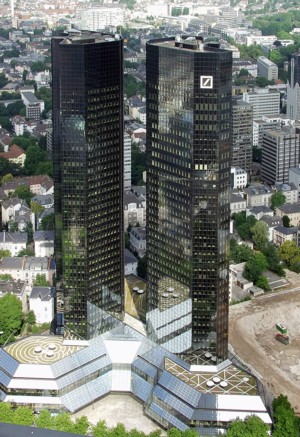
Deutsche Bank Towers in Frankfurt am Main

What Is the Use of banks?

Turning debt into money

The previous episode about money discussed some imaginary trades between you, a hatter, a lawyer, a barber and a fisherman. It is shown that if people promise to pay this might suffice for payment. So if the fisherman promises you to pay next week for the hat you just made, you could say to the lawyer that you expect the fisherman to pay in a week, and ask her if you can pay in a week too. The lawyer could then ask the same of the barber and the barber could ask the same of the fisherman. If all these debts cancel out then no cash is needed.

In most cases, debts cannot be cancelled out so easily. A hat may cost € 50, legal advice € 60, a hairdo € 30, and the fish € 20. If you are the hatter, you could lend € 10 to the barber and the lawyer could lend € 20 to the fisherman. Perhaps the lawyer doesn’t trust the fisherman because he smells fishy. But if the lawyer trusts the barber and the barber trusts the fisherman then the lawyer could lend € 20 to the barber and the barber could lend € 20 to the fisherman.

That could become complicated quite easily. And this is where banks come in. Banks can lend money because they know the financial situation of their customers. The fisherman can borrow money from his bank to make payments because the bank knows that he has an unstable but good income and a vessel that can be sold for cash if needed.

If the fisherman borrows money to pay for the hat you made, this money ends up in your account. You can use it to pay the lawyer. And so the fisherman’s debt becomes the lawyer’s money until she uses it to pay the barber. People that have a deposit lend money to the bank and the bank is lending this money to those who have a loan, in this case, the fisherman. Depositors trust the bank even though they do not know the people the bank is lending money to.

Most people think of money as coins and banknotes but more than 90% of the money just exists as bookkeeping entries in banks. When a fisherman borrows money from his bank, he can spend it on a hat. This means that the bank creates money and that this money is debt. Most of our money is debt so the value of money depends on the belief that debtors pay back their debts. This seems scary and it keeps quite a few people awake at night.

Some people argue that debts and banking are frauds because they are based on a belief. But banks and debts help to boost trade and production by creating money that doesn’t exist to start businesses that don’t yet exist to make products which will be bought by the people those businesses will hire with this newly created money. Banking and debts are the basis of the capitalist economy.

Banking as bookkeeping

Banking is more or less just bookkeeping and balance sheets. Balance sheets can be used to explain the magic trick banks do, which is creating money. Balance sheets are simple. There are no intimidating formulas, only additions and subtractions. The important thing to remember with balance sheets is that the total of the amounts on the left side must always equal those on the right side.

On the left is the value of your stuff and your money. On the right side is the value of your debts. Your net worth is what remains when you sell all your stuff and pay off your debts. It is on the right side too in order to make it equal to the left side. Your net worth can be a negative value. If that is the case, you might be bankrupt because you can’t repay your debts by selling your assets. The left side is named debit and the right side is called credit. Your balance sheet might look like this:

debit
 
credit
 
house
€ 100,000
mortgage
€ 80,000
other stuff
€ 50,000
other loans
€ 30,000
cash, bank deposits
€ 20,000
your net worth
€ 60,000
total
€ 170,000
total
€ 170,000

When you buy a car, you own more stuff, but also another loan or fewer bank deposits as you have to pay for the car. This is because debit always equals credit. When you drive the car, it goes down in value, as does your net worth, because debit always equals credit. If your salary comes in, your bank deposits as well as your net worth rise because debit always equals credit. If you pay down a loan, the amount in your bank account, as well as the amount of your loan, goes down because debit always equals credit. If debit doesn’t equal credit then you have made a calculation error.

Also for a bank, the total of the amounts on the left side must always equal those on the right side, so that debit always equals credit. Your debt is on the debit side of the bank’s balance sheet. You have borrowed this money from your bank. The bank owns this loan. Your bank deposits are on the credit side of the bank’s balance sheet. The loans of the bank are paid for by deposits. Banks lend money to each other. This may happen when you make a payment to someone who has a bank account at another bank. Your bank may borrow this money from the other bank until another payment comes the other way. The balance sheet of a bank may look like this:

debit
 
credit
 
mortgages and loans
€ 70,000,000
deposits
€ 60,000,000
loans to other banks
€ 10,000,000
deposits from other banks
€ 20,000,000
cash, central bank deposits
€ 10,000,000
the bank’s net worth
€ 10,000,000
total
€ 90,000,000
total
€ 90,000,000

How banks create money

Banks create money. How do they do that? It is easy if you understand balance sheets. Assume that you, the hatter, the lawyer, the barber, and the fisherman all have € 10 in cash. Together you decide to start a bank. You all bring in the € 10 you own so that you all have a deposit of € 10 and the bank has € 40 in cash. The bank allows everyone to withdraw deposits in cash. This is no problem as long as the total of deposits equals the total amount of cash. After everyone has put in the deposit, the bank’s balance sheet looks as follows:

debit
 
credit
 
cash
€ 40
your deposit
€ 10
  
deposit lawyer
€ 10
  
deposit barber
€ 10
  
deposit fisherman
€ 10
total
€ 40
total
€ 40

First, there was only € 40 in cash. Now there are € 40 in bank deposits too. You might think that the bank created money. Only, that isn’t true because the depositors can’t spend the cash unless they take out their deposits. In other words, the depositors don’t have more money at their disposal than before. If you look at the total, there is still € 40. This is bookkeeping. You have to write down the total twice as debit must equal credit.

But now things are going to get a bit wild. The fisherman comes to you and he wants to buy a hat. The hat costs € 50 but the fisherman has only € 10 in his account. To make the sale possible, the bank is going to do its magic. The fisherman calls the bank and asks if he can borrow some money. The bank grants him a loan of € 40 and puts the money in his deposit account so that he can spend it. And look:

debit
 
credit
 
cash
€ 40
your deposit
€ 10
loan fisherman
€ 40
deposit lawyer
€ 10
  
deposit barber
€ 10
  
deposit fisherman
€ 50
total
€ 80
total
€ 80

Who says that miracles can’t happen? The deposits miraculously increased from € 40 to € 80 so € 40 is created from thin air. There is still only € 40 in cash but the fisherman’s debt created new money. This is how banks create money. And that is only because bank deposits are money. This is all there is to it. So much for the mystery. The fisherman then pays € 50 for the hat. And so it becomes your money:

debit
 
credit
 
cash
€ 40
your deposit
€ 60
loan fisherman
€ 40
deposit lawyer
€ 10
  
deposit barber
€ 10
  
deposit fisherman
€ 0
total
€ 80
total
€ 80

And now comes the dreadful part that keeps some people fretting. Everyone can take out his or her deposits in cash. There are € 80 in deposits and only € 40 in cash. If you go to the bank and demand your € 60 in cash, the bank would go bankrupt, even when the fisherman pays off his loan the next day. You could bankrupt the bank by buying € 50 in fish with cash. If you go to the bank to get € 50 in cash it would not be there so the bank would go bankrupt before the fisherman can pay off his loan with the same cash.

A bank could get into trouble in this way even when debtors repay their debts. Clever minds already figured out a solution. Central banks can print money too. If the European Central Bank (ECB) prints € 20 on a piece of paper and lends this money to the bank, there would be enough cash to pay out your deposit. Banning the use of cash and only using bank deposits for payments would be another option. So, after the ECB deposited € 20 in cash, the bank’s balance sheet might look like this:

debit
 
credit
 
cash
€ 60
your deposit
€ 60
loan fisherman
€ 40
deposit lawyer
€ 10
  
deposit barber
€ 10
  
deposit fisherman
€ 0
  
deposit ECB
€ 20
total
€ 100
total
€ 100

After you pay the fisherman, he can pay off his loan, and the bank will have enough cash to pay out all deposits. The bank can repay the central bank and everything is fine and dandy again. In this case the bank could not meet the demand for cash but the value of cash and loans wasn’t smaller than the deposits (the bank’s debt). After the fisherman pays back his loan and the bank pays back the ECB, the bank’s balance sheet might look like this:

debit
 
credit
 
cash
€ 40
your deposit
€ 10
loan fisherman
€ 0
deposit lawyer
€ 10
  
deposit barber
€ 10
  
deposit fisherman
€ 10
  
deposit ECB
€ 0
total
€ 40
total
€ 40

If banks can’t create money, trade would be difficult. If the hat is € 50, the legal advice € 60, the hairdo € 30, and the fish € 20, and you, the lawyer, the barber and the fisherman all have only € 10, nothing can be bought or sold. If the bank lends € 40 to the fisherman, he can buy a hat from you, you can buy legal advice from the lawyer, the lawyer can buy a hairdo and the barber can buy fish. Debt is the basis of the capitalist economy. Nearly all money is debt, and without debt, the economy would come to a standstill.

How much money can banks create?

The amount of money a bank can create is limited by the bank’s capital, which is the bank’s net worth. Regulations stipulate that banks should have a minimum amount of capital. This is the capital requirement. If the capital requirement is 10%, and the bank’s capital is € 10,000,000, it can lend € 100,000,000, provided that there are enough deposits. If the bank makes a loan, a new deposit is created. If the deposit leaves the bank, the bank must borrow it back from another bank or cut back its lending. That is because debit must always equal credit.

debit
 
credit
 
mortgages and loans
€ 70,000,000
deposits
€ 60,000,000
loans to other banks
€ 10,000,000
deposits from other banks
€ 20,000,000
cash, central bank deposits
€ 10,000,000
the bank’s net worth
€ 10,000,000
total
€ 90,000,000
total
€ 90,000,000

When a deposit leaves the bank, it ends up at another bank. The other bank can use it for lending, provided that it has sufficient capital. There may be a reserve requirement, which is a minimum of cash and central bank deposits the bank must hold. If the reserve requirement is 10%, the bank can lend out as much as ten times the amount of cash and central bank reserves it has available. In the past, reserve requirements were important as people often used cash and could go to the bank to demand their deposits in cash. For that reason banks needed to hold a certain amount of cash.

Featured image: Deutsche Bank building CC BY-SA 4.0. Raimond Spekking. Wikimedia Commons. Public Domain.

Coin hoard

What is money?

Why do we have money?

Money was invented because trade would be difficult without it. For example, if you are a hatter in need of legal advice, then without money, you have to find a lawyer who craves a hat. That is unlikely to happen. Maybe there is a fisherman dreaming of a hat, but he can’t give you legal advice. Maybe there is a lawyer in need of a hairdo instead of a hat. With money, all these problems disappear like magic. You can buy the services of the lawyer so that she can go to the barber. After that, the barber can buy some fish so that the fisherman can buy a hat from you.

Despite these mind-blowing advantages humans didn’t need money for a long time because they lived in small bands and villages where everyone depended on each other and everyone helped each other. This meant, for example, that when a fisherman needed a hat, you would make a hat for him, and if you needed anything, someone else would provide it to you. You did someone a favour so that he or she was obliged to do something back. Villagers produced most of what they needed themselves. Trade with the outside world was limited and was done with barter.

Uses of money

Later cities, kingdoms and empires emerged. People living in cities, kingdoms and empires didn’t know each other so it became difficult to track whether or not everyone was contributing. Favours and obligations didn’t suffice. They were replaced by a formal system for making payments and tracking contributions and obligations. Commerce and tax collection needed a means of payment as well as administration. It is therefore not a coincidence that writing and money were invented around the same time in the same area. The earliest writings were bookkeeping entries. Money has the following uses:

  • buying and selling stuff (payment) so money is a medium of exchange
  • saying how much something is worth, so money is a unit of account
  • keeping track of contributions and obligations (saving and borrowing) so money is a store of value.
catdog
Nickelodeon character CatDog

Money being a medium of exchange as well as a store of value is like your pet being a cat as well as a dog. The result is not really a success. The parts of the pet may often quarrel, for example, because the dog part wants to play while the cat part wants to sleep. If someone keeps some money for a rainy day and does not spend it, others cannot use this money for buying stuff. And this can be a problem. A simple example can explain this.

Imagine that everyone decides to save all his or her money. Nothing would be bought or sold anymore. All businesses would go bankrupt and everybody would be unemployed. All the money that has been saved would buy nothing because there isn’t anything to buy anymore. This is a total economic collapse.

In reality, it doesn’t get that bad as people always spend on basic necessities like tablets and mobile phones, and perhaps food. When people only spend money on necessities there is an economic depression, which is not as bad as a total economic collapse but still very bad. Saving can make you poorer, but only when there are too many savings already. Savings are used to invest in businesses and hire workers to make products and services. Only if there are more savings than investments, does money remain unused.

The value of money

Money has no value when there isn’t any stuff to buy or when there aren’t any other people to trade with. Imagine that you get the offer to be dropped alone on a remote and uninhabited island in the Pacific with 10 million euros. Probably you would decline the deal, even if you can keep your mobile phone. It is other people and stuff that give money its value. But how? The answer is remarkably simple. The value of money is just a belief.

People are willing to work for money and sell their stuff for money. And because others do this, you do the same. For example, you may think that euro notes have an appalling design as well as an unpleasant odour, but nevertheless, you desire to own them because other people want them too. The euro’s value is based on the belief that other people accept euros for payment.

This is just a belief as the following example demonstrates. Suppose that you wake up one day to hear on the news that the European Union has been dissolved overnight. Suddenly you may have second thoughts about your precious stockpile of foul-smelling unstylishly decorated euro banknotes.

You may ask yourself in distress whether or not your precious bank notes still have any value. What is the value of the euro without the European Union? You may find yourself hurrying to the nearest phone shop in an effort to exchange this pile of banknotes for the latest model mobile phone.

And to prove this point even further, suppose that the phone shop gladly accepts your euros. Suddenly they become desirable again and you may start to have second thoughts about that latest model you are about to buy. It may not remain hip for much longer, so you may change your mind again and prefer to keep your precious euros because there may be a newer model next month. So, because the shop wants your euros, you wants them too.

Types of money

At first, money was an item that people needed or desired. Grain was one of the earliest forms of money. Everybody needed food so it was easy to make people believe that others accept grain for payment. In prison camps during World War II cigarettes became money because they were in high demand. Even non-smokers accepted them because they knew that other people desired them very badly. For that reason, cocaine can be money too.

Wares like grain, cigarettes and cocaine have disadvantages. They degrade over time so they aren’t a very good store of value. This makes them a great medium of exchange because people won’t save them. An example can demonstrate this. Imagine that apples are money and you want to buy a house. A house costs 120,000 apples but your monthly salary is just 2,500 apples of which you can save 1,000. It takes 10 years of saving to buy a house. Soon you will discover that apples rot and that you will never be able to buy a house. Then you will spend all your apples right away.

Saving is difficult with apples. This is where gold and silver come in. Gold and silver do have not much use, but humans were always attracted to shiny stuff. Gold is rare so a small amount of gold can have a lot of value because some people feel a strong desire for shiny stuff. Gold and silver coins can be made of different sizes and purity so that they are suitable for payment and can be used as a unit of account.

More importantly, gold and silver do not deteriorate in quality like apples, grain or cigarettes. They do not even rust after 1,000 years. This makes gold and silver an excellent store of value. But this should make us suspicious. A perfect cat makes a lousy dog so a perfect store of value can fail the test for being a good medium of exchange. People can store gold and silver so that there is less money available for buying and selling stuff. And this can cause an economic depression as we have seen.

Governments create money too, for example by printing “10 euro” on a piece of paper. Governments require by law that this money should be used for payments and taxes. This makes people believe that others accept this money too. Government money is called fiat currency or simply currency. The authority of a government is limited to the area it controls so in the past government currencies had little value outside the country itself unless this money consisted of coins containing gold or silver.

In fact, another reason why gold and silver are attractive as money is that the value of gold and silver does not depend on the authority of a government. This made gold and silver internationally accepted as money. In the 19th century, most government currencies could be exchanged for a fixed amount of gold. This is the gold standard. The gold standard boosted trade because gold was internationally accepted as money.

Most money is debt

Debts can have value and so debts can be money too. This may seem strange or even outrageous, but money is just a belief. For example, money is the belief that you can exchange a hat for money and then exchange this money for legal advice. Hence, if you believe that the debtor is going to pay, you can accept his or her promise to pay as payment. And if others believe this too, you can use this promise to pay someone else.

So if the fisherman promises you to pay next week for the hat you just made, you could say to the lawyer that you expect the fisherman to pay in a week, and ask her if you can pay in a week too. The lawyer could then ask the same of the barber and the barber could ask the same of the fisherman. If all debts cancel out then there is no need for cash. Most of the money we currently use is debt. In most cases, debts don’t cancel out and there are many more people involved so it would be complicated to keep track of all debts and savings. That is where banks come in.

Featured image: Close up of coin hoard CC BY-SA 2.0. Portable Antiquities Scheme from London, England (2010). Wikimedia Commons.

Other images: Nickelodeon character CatDog, Sméagol character from The Lord of the Rings [copyright info]

Joseph interpreting the Pharaoh's dream

Joseph in Egypt

Money with a holding fee existed in ancient Egypt for over 1,500 years. Egypt had storehouses of grain run by the state. Grain was the primary food source for the Egyptians. When farmers came with their harvest, they would get a receipt telling how much they brought in and on what date. A baker could return the receipt and exchange it for grain after paying for the storage cost and loss due to degradation.

The origins of the grain storage remain unclear. The government collected taxes in kind, thus a portion of the harvest, and had to store it. The government storage probably proved convenient for farmers as they didn’t have to keep and sell their grain, which was a significant convenience. And it made sense to have a public grain reserve in case the harvests failed.

The Egyptians used these receipts as money, as grain was a commodity everyone needed. Because of the storage costs, the receipts gradually lost value. With this kind of money, you might have interest-free loans. Someone in possession of this money who likes to save it will lose by storing it and can keep his capital intact by lending it without interest. There is no evidence that this happened.

The grain storage relates to a story in the Bible. It is fiction but might tie money with a holding fee to the Abrahamic religions. As the story goes, the Pharaoh had dreams his advisers couldn’t explain. He dreamt about seven lean cows eating seven fat cows and seven thin and blasted ears of grain devouring seven full ears of grain.

Joseph explained those dreams to the Pharaoh. He told the Pharaoh that seven years with good harvests would come, followed by seven years with crop failures. He advised the Egyptians to store food. They followed his advice and built storehouses for grain. In this way, Egypt survived the seven years of scarcity (Genesis 41):

When two full years had passed, Pharaoh had a dream: He was standing by the Nile when out of the river, there came up seven cows, sleek and fat, and they grazed among the reeds. After them, seven other cows, ugly and gaunt, came up out of the Nile and stood beside those on the riverbank. And the cows that were ugly and gaunt ate up the seven sleek, fat cows. Then Pharaoh woke up.

He fell asleep again and had a second dream: Seven heads of grain, healthy and good, were growing on a single stalk. After them, seven other heads of grain sprouted–thin and scorched by the east wind. The thin heads of grain swallowed up the seven healthy, full heads. Then Pharaoh woke up; it had been a dream.

In the morning, his mind was troubled, so he sent for all the magicians and wise men of Egypt. Pharaoh told them his dreams, but no one could interpret them for him. Then, the chief cupbearer said to Pharaoh, ‘Today I am reminded of my shortcomings. Pharaoh was once angry with his servants, and he imprisoned me and the chief baker in the house of the captain of the guard.

Each of us had a dream the same night, and each dream had a meaning of its own. Now, a young Hebrew was there with us, a servant of the captain of the guard. We told him our dreams, and he interpreted them for us, giving each man the interpretation of his dream. And things turned out exactly as he interpreted them to us: I was restored to my position, and the other man was hanged.’

So Pharaoh sent for Joseph, and he was quickly brought from the dungeon. When he had shaved and changed his clothes, he came before Pharaoh. Pharaoh told Joseph, ‘I had a dream, and no one can interpret it. But I have heard it said of you that when you hear a dream you can interpret it.’ ‘I cannot do it,’ Joseph replied to Pharaoh, ‘but God will give Pharaoh the answer he desires.’

Then Pharaoh said to Joseph, ‘In my dream, I was standing on the bank of the Nile, when out of the river there came up seven cows, fat and sleek, and they grazed among the reeds. After them, seven other cows came up–scrawny and very ugly and lean. I had never seen such ugly cows in all the land of Egypt. The lean, ugly cows ate up the seven fat cows that came up first. But even after they ate them, no one could tell they had done so; they looked just as ugly as before. Then I woke up.

‘In my dreams I also saw seven heads of grain, full and good, growing on a single stalk. After them, seven other heads sprouted–withered and thin and scorched by the east wind. The thin heads of grain swallowed up the seven good heads. I told this to the magicians, but none could explain it to me.’

Then Joseph said to Pharaoh, ‘The dreams of Pharaoh are one and the same. God has revealed to Pharaoh what he is about to do. The seven good cows are seven years old, and the seven good heads of grain are seven years old; it is one and the same dream. The seven lean, ugly cows that came up afterwards are seven years old, and so are the seven worthless heads of grain scorched by the east wind: They are seven years of famine.

‘It is just as I said to Pharaoh: God has shown Pharaoh what he is about to do. Seven years of great abundance are coming throughout Egypt, but seven years of famine will follow them. Then, all the abundance in Egypt will be forgotten, and the famine will ravage the land. The abundance in the land will not be remembered, because the famine that follows it will be so severe.

The reason the dream was given to Pharaoh in two forms is that the matter has been firmly decided by God, and God will do it soon. ‘And now let Pharaoh look for a discerning and wise man and put him in charge of the land of Egypt.

Let Pharaoh appoint commissioners over the land to take a fifth of the harvest of Egypt during the seven years of abundance. They should collect all the food of these good years that are coming and store up the grain under the authority of Pharaoh to be kept in the cities for food. This food should be held in reserve for the country, to be used during the seven years of famine that will come upon Egypt, so that the country may not be ruined by the famine.’

The plan seemed good to Pharaoh and to all his officials. So Pharaoh asked them, ‘Can we find anyone like this man, one in whom is the spirit of God?’ Then Pharaoh said to Joseph, ‘Since God has made all this known to you, there is no one so discerning and wise as you. You shall be in charge of my palace, and all my people are to submit to your orders. Only with respect to the throne will I be greater than you.’ So Pharaoh said to Joseph, ‘I hereby put you in charge of the whole land of Egypt.’

During the seven years of abundance, the land produced plentifully. Joseph collected all the food produced in those seven years of abundance in Egypt and stored it in the cities. In each city, he put the food grown in the fields surrounding it. Joseph stored up huge quantities of grain, like the sand of the sea; it was so much that he stopped keeping records because it was beyond measure.

The seven years of abundance in Egypt came to an end, and the seven years of famine began, just as Joseph had said. There was a famine in all the other lands, but in the whole land of Egypt, there was food. When all of Egypt began to feel the famine, the people cried to Pharaoh for food. Then Pharaoh told all the Egyptians, ‘Go to Joseph and do what he tells you.’

When the famine had spread over the whole country, Joseph opened these storehouses and sold grain to the Egyptians, for the famine was severe throughout Egypt. All the countries came to Egypt to buy grain from Joseph because the famine was severe in the whole world.

The story further tells how the Egyptians became the serfs of the Pharaoh (Genesis 47):

There was no food in the whole region because the famine was severe. Both Egypt and Canaan wasted away because of the famine. Joseph collected all the money found in Egypt and Canaan as payment for the grain they were buying and brought it to Pharaoh’s palace.

When the money of the people of Egypt and Canaan was gone, all of Egypt came to Joseph and said, ‘Give us food. Why should we die before your eyes? Our money is used up.’ ‘Then bring your livestock,’ said Joseph. ‘I will sell you food in exchange for your livestock since your money is gone.’

So they brought their livestock to Joseph, and he gave them food in exchange for their horses, their sheep and goats, their cattle and donkeys. And he helped them through that year with food in exchange for all their livestock.

When that year was over, they came to him the following year and said, ‘We cannot hide from our lord that since our money is gone and our livestock belongs to you, there is nothing left for our lord except our bodies and our land.

Why should we perish before your eyes–we and our land as well? Buy us and our land in exchange for food, and we, with our land, will be in bondage to Pharaoh. Give us seed so we may live and not die, and the land may not become desolate.’

So Joseph bought all the land in Egypt for Pharaoh. The Egyptians, one and all, sold their fields because the famine was too severe for them. The land became Pharaoh’s, and Joseph reduced the people to servitude from one end of Egypt to the other.

Joseph told the people, ‘Now that I have bought you and your land today for Pharaoh, here is seed for you so you can plant the ground. But when the crop comes in, give a fifth of it to Pharaoh. The other four-fifths you may keep as seed for the fields and as food for yourselves and your households and your children.’

‘You have saved our lives,’ they said. ‘May we find favor in the eyes of our lord; we will be in bondage to Pharaoh.’ So Joseph established it as a law concerning land in Egypt -still in force today- that a fifth of the produce belongs to Pharaoh.

A settlement of storage costs took place when someone brought in the receipts. The receipts gradually lost value over time to cover the storage cost. It was similar to buying stamps to keep the money valid, like in Wörgl. The grain money remained in circulation after the introduction of coins around 400 BC until the Romans conquered Egypt around 40 BC. The grain money survived for over 1,500 years. It was not a financial crisis that ended it, but the Roman conquest. It suggests a holding fee on money or negative interest rates can be the basis of a stable financial system that lasts for eternity.

Finally, there is a wisdom that we can easily overlook. Storing food makes more sense than saving money, even when you make losses on the storage. Today, the weather grows increasingly unpredictable due to global warming, so massive harvest failures become increasingly likely. Storing food makes more sense than ever in a time when people cling to money more than ever, and there is only enough food in storage to feed humanity for a few months. It doesn’t require a rocket scientist to figure that Joseph’s advice to the Pharaoh to store food for meagre times makes more sense than ever.

Latest revision: 13 January 2024

Featured image: Joseph interpreting the Pharaoh’s dream. Illustrations for La Grande Bible de Tours. Gustave Doré (1866). Public Domain.

Earth from space

Sacredness of Creation

Thus spoke Chief Seattle

To traditional peoples, nature is sacred. In 1854, the Native American Chief Seattle gave a speech when the United States government wanted to buy the land of his tribe. A screenwriter later rewrote it. His revised version became a religious creed within the environmentalist movement. It strikes at the heart of the matter. Nothing is sacred anymore. The pursuit of money destroys our values and planet. We may think we own the land, but we do not. We may think we control our destiny, but we do not. Whatever befalls Earth befalls the children of the Earth. Thus spoke Chief Seattle,

The Great Chief in Washington sends word he wishes to buy our land.

The Great Chief also sends us words of friendship and goodwill. This is kind of him, since we know he has little need of our friendship in return. But we will consider your offer. For we know that if we do not sell, the white man may come with guns and take our land.

How can you buy or sell the sky or the warmth of the land? This idea is strange to us.

If we do not own the freshness of the air and the sparkle of the water, how can you buy them from us?

We will decide in our time.

What Chief Seattle says, the Great Chief in Washington can count on as truly as our white brothers can count on the return of the seasons. My words are like the stars. They do not set.

Every part of this earth is sacred to my people. Every shining pine needle, sandy shore, mist in the dark woods, clearing, and humming insect is holy in my people’s memory and experience. The sap that courses through the trees carries the memories of the red man.

The white man’s dead forget the country of their birth when they go to walk among the stars. Our dead never forget this beautiful earth, for it is the mother of the red man.

We are part of the earth, and it is part of us. The perfumed flowers are our sisters[;] the deer, the horse, the great eagle, these are our brothers. The rocky crests, the juices in the meadows, the body heat of the pony, and man―all belong to the same family.

So, when the Great Chief in Washington sends word that he wishes to buy our land, he asks much of us.

The Great Chief sends word that he will reserve us a place so that we can live comfortably. He will be our father, and we will be his children.

But can that ever be? God loves your people but has abandoned his red children. He sends machines to help the white man with his work and builds great villages for him. He makes your people stronger every day. Soon, you will flood the land like the rivers that crash down the canyons after a sudden rain. But my people are an ebbing tide; we will never return.

No, we are separate races. Our children do not play together, and our old men tell different stories. God favours you, and we are orphans.

So we will consider your offer to buy our land. But it will not be easy, for this land is sacred to us. We take our pleasure in these woods. I do not know. Our ways are different from your ways.

This shining water that moves in the streams and rivers is not just water but the blood of our ancestors. If we sell you land, you must remember that it is sacred and that each ghostly reflection in the clear water of the lakes tells of events and memories in the life of my people. The water’s murmur is the voice of my father’s father.

The rivers are our brothers. They quench our thirst. The rivers carry our canoes and feed our children. If we sell you our land, you must remember, and teach your children, that the rivers are our brothers and yours, and you must henceforth give rivers the kindness you would give any brother.

The red man has always retreated before the advancing white man, as the mist of the mountain runs before the morning sun. But the ashes of our fathers are sacred. The graves are holy ground, and so these hills, these trees, this portion of the earth is consecrated to us. We know that the white man does not understand our ways. One portion of land is the same to him as the next, for he is a stranger who comes in the night and takes from the land whatever he needs.

The earth is not his brother but his enemy, and he moves on when he has conquered it. He leaves his father’s grave behind, and he does not care. He kidnaps the earth from his children. He does not care. His father’s grave and his children’s birthright are forgotten. He treats his mother, the earth, and his brother, the sky, as things to be bought, plundered, and sold like sheep or bright beads. His appetite will devour the earth and leave behind only a desert.

I do not know. Our ways are different from your ways. The sight of your cities pains the eyes of the red man. But perhaps it is because the red man is a savage and does not understand.

There is no quiet place in the white man’s cities. There is no place to hear the unfurling of leaves in spring or the rustle of the insect’s wings. But perhaps it is because I am a savage and do not understand. The clatter only seems to insult the ears. And what is there to life if a man cannot hear the lonely cry of the whippoorwill or the arguments of the frogs around a pond at night? I am a red man and do not understand. The Indian prefers the soft sound of the wind darting over the face of a pond and the smell of the wind itself, cleansed by a midday rain or scented with pinion pine.

The air is precious to the red man, for all things share the same breath―the beast, the tree, the man, they all share the same breath. The white man does not seem to notice the air he breathes. Like many dying for many days, he is numb to the stench. But if we sell our land, you must remember that the air is precious to us, that the air shares its spirit with all the life it supports. The wind that gave our grandfather his first breath also received his last sigh. And the wind must also give our children the spirit of life. And if we sell you our land, you must keep it apart and sacred, as a place where even the white man can go to taste the wind sweetened by the meadow’s flowers.

So we will consider your offer to buy our land. If we decide to accept, I will make one condition: The white man must treat the beasts of this land as his brothers.

I am a savage, and I do not understand any other way. I have seen a thousand rotting buffalo on the prairie, left by the white man who shot them from a passing train. I am a savage, and I do not understand how the smoking iron horse can be more important than the buffalo that we kill only to stay alive.

What is man without the beasts? If all the beasts were gone, men would die from a great loneliness of spirit. For whatever happens to the beasts soon happens to man. All things are connected.

Whatever befalls the earth befalls the sons of the earth.

You must teach your children that the ground beneath their feet is the ashes of our grandfathers. So that they will respect the land, tell your children that the earth is rich with the lives of our kin. Teach your children what we have taught our children, that the earth is our mother. Whatever befalls the earth, befalls the sons of the earth. If men spit upon the ground, they spit upon themselves.

This we know. The earth does not belong to man; man belongs to the earth. This we know. All things are connected like the blood which unites one family. All things are connected.

Whatever befalls the earth befalls the sons of the earth. Man did not weave the web of life; he is merely a strand in it. Whatever he does to the web, he does to himself.

No, day and night cannot live together.

Our dead go to live in the earth’s sweet rivers, and they return with the silent footsteps of spring. It is their spirit, running in the wind, rippling the surface of the ponds.

We will consider why the white man wishes to buy the land. What is it that the white man wishes to buy, my people ask me. The idea is strange to us. How can you buy or sell the sky, the warmth of the land, the swiftness of the antelope? How can we sell these things to you, and how can you buy them? Is the earth yours to do with as you will, merely because the red man signs a piece of paper and gives it to the white man? If we do not own the freshness of the air and the sparkle of the water, how can you buy them from us?

Can you buy back the buffalo once the last one has been killed? But we will consider your offer, for we know that if we do not sell, the white man may come with guns and take our land. But we are primitive, and in his passing moment of strength, the white man thinks that he is a god who already owns the earth. How can a man own his mother?

But we will consider your offer to buy our land. Day and night cannot live together. We will consider your offer to go to the reservation you have for my people. We will live apart and in peace. It matters little where we spend the rest of our days. Our children have seen their fathers humbled in defeat. Our warriors have felt shame, and after defeat, they turn their days into idleness and contaminate their bodies with sweet foods and strong drinks. It matters little where we pass the rest of our days. They are not many. A few more hours, a few more winters, and none of the children of the great tribes that once lived on this earth or that roam now in small bands in the woods will be left to mourn the graves of a people once as powerful and hopeful as yours.

But why should I mourn the passing of my people? Tribes are made of men, nothing more. Men come and go like the waves of the sea.

Even the white man, whose God walks and talks with him as a friend to friend, cannot be exempt from the common destiny. We may be brothers, after all; we shall see. One thing we know, which the white man may one day discover―our God is the same God.

You may think now that you own Him as you wish to own our land, but you cannot. He is the God of man, and His compassion is equal for the red man and the white. This earth is precious to Him, and to harm the earth is to heap contempt on its Creator. The whites, too, shall pass, perhaps sooner than all other tribes. Continue to contaminate your bed, and you will one night suffocate in your own waste.

But in your perishing, you will shine brightly, fired by the strength of the God who brought you to this land and, for some special purpose, gave you dominion over this land and the red man. That destiny is a mystery to us, for we do not understand when the buffalo are all slaughtered, the wild horses are tamed, the secret corners of the forest heavy with the scent of many men, and the view of the ripe hills blotted by talking wires. Where is the thicket? Gone. Where is the eagle? Gone. And what is it to say goodbye to the swift pony and the hunt? The end of living and the beginning of survival.

God gave you dominion over the beasts, the woods, and the red man for some special purpose, but that destiny is a mystery to the red man. We might understand if we knew what the white man dreams―what hopes he describes to his children on long winter nights―what visions he burns onto their minds so that they will wish for tomorrow. But we are savages. The white man’s dreams are hidden from us. And because they are hidden, we will go our own way. Above all else, we cherish the right of each man to live as he wishes, however different from his brothers. There is little in common between us.

So we will consider your offer to buy our land. If we agree, it will be to secure the reservation you have promised. Perhaps we may live out our brief days as we wish there.

When the last red man has vanished from this earth, and his memory is only the shade of a cloud moving across the prairie, these shores and forests will still hold the spirits of my people. For they love this earth as the newborn loves its mother’s heartbeat.

If we sell you our land, love it as we’ve loved it. Care for it as we’ve cared for it. Hold in your mind the memory of the land as it is when you take it. And with all your strength, mind, and heart, preserve it for your children, and love it as God loves us all.

One thing we know. Our God is the same. This earth is precious to Him. Even the white man cannot be exempt from the common destiny. We may be brothers, after all. We shall see.

A religious desire for Eden

Perhaps you care for this planet, but what do you mean by that? When the last white rhino is dead, the Earth is still there. We may survive the demise of the rainforests. Humans have finished off other species for thousands of years. Why stop now? Nature doesn’t care. Predators kill prey, and natural disasters kill animals. Why should we care? Mr Lind, a professor at the University of Texas, noted that saving the planet has become the religion of politicians, business elites, and intellectuals in the West, replacing Christianity’s earlier mission of saving individual souls.1 He added that environmentalism is rooted in German 19th-century Romanticism, with a bias against organised society and civilisation and a pantheistic awe before an idealised Nature. In other words, environmentalists suffer from a religious desire for Eden.

In doing so, Mr Lind tapped into another 19th-century German tradition, that of Friedrich Nietzsche. Nietzsche hoped to leave traditional morality behind, saying, ‘God is dead.’ Religions like Christianity, Nietzsche claimed, were ruses to enslave us with a false sense of right and wrong under rules imposed by a priestly caste. And so do environmentalists, Lind implied. Nietzsche favoured the values of the strong to those of the weak embodied in Christianity and socialism. Slaves think in terms of good and evil rather than better and worse because they resent the ruling class. Nietzsche hoped to liberate us from our self-induced slavery and realise our full potential.

Mr Lind argued we should do away with false sentiments, saying, ‘There are costs to mitigating climate change as well as benefits, and rational people can prefer a richer but warmer world to a poorer but slightly less warm one. These individual policies benefit humanity, so there is no need to justify them on the basis of a romantic creed that defines the planet or the environment.’ That appears nice and dandy from behind the desk of Mr Lind’s air-conditioned Texas room. He says rational people might prefer money to a cooler climate. If it is too hot in France, you can go to the beach in Denmark. A few people may die due to heat stroke or extreme weather. We will be wealthier, so why care? We never cared. Cars kill one million people per year. That didn’t stop us from driving them.

A philosophy of connectedness

As our production and consumption increase, new problems emerge faster than we can solve existing ones with laws, technology, targets and other solutions. New technology, rules and controls don’t solve these problems. Meanwhile, millions of poor people try to escape their misery and look for a better future in wealthy countries. Is there a relation between these issues, and what is it? In the 1990s, the environmentalist group Strohalm wrote a booklet named Towards a Philosophy of Connectedness.2
It gives a vision for a sustainable and humane society centred around community solidarity. The principal founder of Strohalm is Henk van Arkel, a dedicated individual who remained its driving force for decades. He doesn’t blame anyone in particular. We are all part of the problem.

Everything is interconnected. Our actions have consequences, even though we may not know or ignore them. Wall Street traders who sold bad mortgages caused the financial crisis. Dumping plastic in a river, buying clothes made by children, or posting hateful comments on a message board has consequences. Western thinking, reflected in the scientific method, deconstructs reality to analyse the parts. In this way, the whole can get lost. Not seeing the whole can make us act irresponsibly. A single hateful comment doesn’t make someone take a semi-automatic rifle and shoot innocent people, nor would driving a single car change the climate. Still, hate makes people murder innocent people and driving cars contributes to climate change. If we accept that, we remain locked inside a cynical and uncaring world. It is our neglect. Good intentions can worsen things, but we can learn and do better next time. The alternative is turning evil.

Actions have consequences. We can’t look the other way if we hope to live in Paradise. We have to do the best we can to prevent harm. Our vision of harm fails us. If the relationship between our actions and the harm is remote or not proven, we feel free to do as we please. And that is the road to hell. And so, we have the choice of being free in hell or becoming a slave in Paradise. It is not slavery, as we understand it, the exploitation of one group of people by another, but slavery in Nietzsche’s sense, which is living under a self-imposed moral system that limits our options. And money shouldn’t be our highest value, which it is in the liberal-capitalist world. God owns this world, so it is not ours to destroy. The Sacredness of Creation is a religion. We need a new starting point and foundation for our culture, beliefs, thinking, and our place in the universe because we must change how we live.2

Latest revision: 20 August 2024

Featured image: Earth from space. Public Domain.

1. Why I Am Against Saving the Planet. Michael Lind (2023). Tabletmag.com.
2. Naar een filosofie van verbondenheid. Guus Peterse, Henk van Arkel, Hans Radder, Seattle, Pieter Schroever and Margrit Kennedy (1990). Aktie Strohalm.