We live in a virtual world, a computer-simulated environment. Virtual worlds, such as computer games, can have numerous users who create personalised avatars, engage in activities, and interact with others. If you are familiar with computer games, you know what an avatar is. Once you enter a game, you become a character inside that game, your avatar, and you have an existence apart from your regular life. Inside the game, you are your avatar, not yourself. Alternatively, you could start a virtual world where you are God and make your dreams come true. In this world, you can also become someone else, a character in your story.
Virtual worlds have rules that may draw from reality or fantasy. These rules may concern gravity, methods of procreation, and types of communication. In virtual reality, you can make them up. You can do away with planets and stars and create a flat surface. Or there is no surface at all, where you can eliminate gravity and let everyone float. You can do away with procreation and let individuals emerge from thin air. You can have species communicate via light signals, or have no species, only individuals with random features. Yet, of all the possible worlds, the odds favour this world being like the original.
That is because our experiences shape our imagination and the options we consider. If we write stories and produce films, most are about humans and their feelings and actions. Only a few are about animals. And the animals we imagine in our tales are like humans. Ed, the talking horse, is more human than a horse. Tales and motion pictures about imaginary beings, such as The Lord of the Rings or the Star Trek series, are rare compared to series about humans. And the fictional beings in our stories, such as those in Star Trek, look and act like humans. They usually have two legs and two arms and walk upright. Extraterrestrials in Star Trek feature males and females.
The Holodeck is a virtual reality room available in the Starship Enterprise in Star Trek. Using holograms, it creates a realistic, interactive simulation of the physical world. On the Holodeck, you can make a personalised environment with objects and people, interact with them, or write a story and play a role in it. With the help of artificial intelligence, we might soon create simulations of humans and the world. If the technology becomes cheap enough, we could create billions of virtual universes. If we do that, it likely happened, and we live inside a virtual world ourselves.1
We are not far from doing so, so this world is probably a simulation. But can we find out? Most philosophers and scientists think we can’t. They have overlooked the obvious. There is an elephant in the room: the things science can’t clarify. It begins with establishing that these phenomena aren’t subjective. There must be multiple credible witnesses or other verifiable evidence. Then, you need to certify that it is not due to randomness or a natural phenomenon. To say that the simulation causes these phenomena upends the knowledge we currently believe we have. And so, we must be thorough. Answering the question begins with investigating what we can or cannot know. That is the domain of knowledge theory or epistemology, a branch of philosophy which deals with the nature of knowledge.
Latest revision: 10 October 2026
1. Are You Living In a Computer Simulation? Nick Bostrom (2003). Philosophical Quarterly (2003) Vol. 53, No. 211, pp. 243-255.
In the 2000s, it struck me that nearly all the empty cigarette packages littering the streets were Marlboro Reds. There were one or two Camels and a few others, but for some reason almost all were Marlboro Red. Marlboro Red is the most popular brand in the Netherlands with a market share of nearly 30%. The second-largest brand has a market share of under 10%. Yet if I had to guess from discarded empty packages, I would have thought Marlboro Red had a 95% market share. We didn’t make tallies, but it was like that. We made jokes about it. So, if you’re looking for a jerk, check who’s smoking Marlboro Reds. That would greatly increase your chance of success. And the finding led me to have prejudices about Marlboro Red smokers being jerks.
Littering isn’t that bad compared to warfare, chemical dumping, abuses in the meat and dairy industries, and the cutting down of rainforests. Still, disrespect begins with littering. It is a matter of upbringing, hence culture. Some countries are clean, while others are a mess because people dispose of their garbage wherever they see fit. Those who litter don’t care about the world they live in. They disrespect the Creator. They shit on God’s work. There are worse offences, but it starts with littering. Next comes graffiti, which only those who make it consider art. Art is personal expression, so do it inside your home where no one else can see it. Then comes destroying property. If you want to cause even more harm, you might consider buying the latest fashion or going on holiday by aeroplane.
If 30% of the people dump 95% of the garbage, the remaining 70% is responsible for only 5% of the mess. You can calculate that Marlboro Red smokers were 44 times as likely to dump their trash on the street as other smokers ((95/30) / (5/70) = 44), a striking finding. The sample was large enough to make the finding statistically significant. The sample may have issues, but these issues can’t fully explain the difference. Today, there are still cigarette packages on the street. Still, it is hard to identify the brand name among the scary pictures of cancers and other horrible diseases you get from smoking. Marlboro Red smokers differ from other cigarette smokers. You can call it culture. Culture explains the deviant behaviour of groups of people who share characteristics.
The Marlboro Man embodies careless living in a consumerist society. Our brand choices reveal a great deal about our personalities, so marketers have done their jobs very well indeed. A politically correct person would say I am stigmatising Marlboro Red users. There could be something wrong with my sample. I live near a train station where young people gather, but I have also noticed this elsewhere. It can’t merely be an error in the sample. But even if the sample correctly reflects reality, perhaps only 0.1% of smokers discard their cigarette packages on the street, so only a tiny minority of 4.4% of Marlboro Red smokers might do so. Perhaps that is correct, or perhaps not, but 44 times as much is an eye-popping difference. It points to a rule, which is:
It is usually one of them doing it. Yet, most of them aren’t like that. The culture within their group makes the conduct more likely.
Jerks may smoke Camel, but they are more likely to smoke Marlboro Red, or there is a Camel culture of not littering that prevents Camel-smoking jerks from littering. In any case, it is an issue within the Marlboro Red smoker community. It is of crucial importance, for culture is so ubiquitous, that so far nearly everyone vastly underestimates that importance. We are a programmable species. Our bodies and brains are the hardware, and our cultures are the software. Different software can make computers behave entirely differently, albeit within the limits of the hardware.
We could solve 95% of the littering problem by locking up all those who smoke Marlboro Red. Yet, 95% of the Marlboro Red smokers might not be part of that problem, so 95% of the people you would round up and imprison would be innocent. The latter is similar to what some fascists propose to do with immigrants to solve the problem of higher crime levels among immigrants. And to solve the problem of criminal immigrants, fascists propose to let fascist criminals run the government and deport the immigrants. The experiments with this idea in the United States have been enlightening.
Patterns give rise to prejudices. Yet, reality regularly surprises me. Individuals often don’t conform to my prejudices about the groups they belong to. Groups consist of individuals. Although these groups differ on aggregate, everyone is different. Behaviours such as littering occur more often in certain groups than in others. Our prejudices about groups tend to have a basis in reality, but they aren’t reality. When there are only Marlboro Red packages on the ground, you might assume that all Marlboro Red smokers are littering jerks, but it could be a small minority. Still, Marlboro Red smokers, on average, litter more often than smokers of other brands. If this littering is a cultural problem. Cultures are usually the product of circumstances and how a group responded to them.
Can I trust my dentist?
How do cultures emerge and develop? Circumstances and how a group respond go a long way in explaining that. I trust my general practitioner but not my dentist. It is the result of my own experiences and those of others. General practitioners and dentists are similar medical professions. In the Netherlands, a general practitioner doesn’t benefit from the advised treatments, while a dentist does. You have to trust medical professionals because your health depends on them, but you can’t trust them in a ‘free’ market. A market is never fully free because some people have more information or leverage than others. In healthcare, that is particularly damaging, as your health is most precious and you depend on expert assessment. Scammers prey on desperate people and sell treatments for which there is no scientific proof. If people buy it, they sell it.
Dental care is an area where dubious practices proliferate. To prevent dental professionals from taking advantage of me too much, I see the dentist once a year rather than twice. So what made me so distrustful? As a child, I had the same dentist for over fifteen years, an old-fashioned one for peasants like me. He didn’t propose treatments unless they were necessary. He once told me that I could wear braces, but added that it wasn’t necessary for my teeth’s health. Not caring about looking perfect, I still live with the consequences that have never bothered me.
After leaving my parental home and moving to Groningen, I selected a new dentist. The first thing he did was take X-ray pictures. Then he said that a cavity was developing underneath one of the fillings. Well, what a coincidence. The other dentist had never seen it. He showed me the picture and pointed at a dark spot. There was another filling with a dark area beneath it, and I said, ‘You can see a similar blot here.’ He replied, ‘That is something different.’ I am unqualified to evaluate these X-rays, but both areas were similar, so the dentist lied. Had he not shown me the photograph, I would have believed him. It made me suspicious and very critical of what dentists were doing.
Before he could treat my tooth for the supposed cavity, I came up with a lame excuse and selected another dentist. Several years later, I had a colleague who had married a dentist. She had previously lived in the same neighbourhood. Her husband was in training at the time, so she had been seeing another dentist, who happened to be that one. She told me she had had a row with him. I wasn’t the only one who had smelled a rat there. Her husband was a dentist-in-training, so she likely had valid reasons for quarrelling.
That was a noteworthy coincidence indeed. What are the odds that she had the same dentist, that they had an altercation over malpractice, and that her husband was a dentist-in-training, which would provide me with evidence to support my suspicions? Thirty years later, the tooth and the filling were still in place. Later, I moved to Sneek and found an old-fashioned dentist. He was like my first dentist, so I trusted him. He often performed dental cleaning. That usually took 10 minutes and cost €21. After ten years, he joined a practice with some other dentists. Shortly after that, he retired.
My next dentist didn’t perform the dental cleaning. Instead, he sent me to a dental hygienist. That treatment lasted 25 minutes and was much more expensive. Instead of €21, I paid €62. Standards do change, but I doubted the sudden need for 150% more cleaning. But if my dentist advises the treatment, who am I to disagree? After all, he is the expert. It is best to accept the assessment of medical professionals unless you have proof they are wrong. Otherwise, you endanger your health.
I have worked harder on brushing and cleaning my teeth, but dental cleaning always took 25 minutes. After eight years, my dentist said my teeth were in good shape and clean. There was only a tiny bit of tartar, negligible even, the dentist said, so he advised me to see the dental hygienist anyway. In hindsight, dental cleaning was probably not required at all. And so, the dental hygienist could have stopped after 10 minutes, but she went on until 25, so she could bill me for that. The treatment was always 25 minutes, regardless of the condition of the teeth. I found it to be a scam and looked for another dentist.
It would only get worse, even though not at the beginning. A new guideline stated that dental hygienists could perform periodic dental check-ups. The following year, the dental hygienist combined the check-up with dental cleaning, making the most of the allotted time financially. I was there for thirty minutes. She billed me for thirty minutes of dental cleaning and also charged me for the check-up. A decent check-up lasts ten minutes, so you might expect a check-up and twenty minutes of dental cleaning if you are there for thirty minutes. I was surprised and wasn’t sure. Had I checked the clock correctly?
The following year, she did it again. Additionally, she charged me for taking X-rays and evaluating them. How can you do all that in thirty minutes if you already spend thirty minutes on dental cleaning? It doesn’t add up. The dentists had decided to take pictures every 3 years instead of every 5, which means even more money for them. And she was double-charging me. Dental cleaning was €160 per hour at the time (yet their prices keep rising faster than wages), which was nearly what I brought home after a day of work and paying taxes. Many people work longer for that money. To charge that per hour wasn’t enough for her. That made it particularly nefarious.
After returning home, I emailed her to request clarification. She didn’t respond, so I filed a complaint with the Dutch Association of Dentists and looked for another dentist. In the complaint letter, I protested the double-charging and noted that questionable ethics have become the norm in dental care. A few decades ago, there were no dental hygienists. My wife once said, ‘The dental hygienist is a new profession created out of thin air.’ She had left a dentist because he required her to see the dental hygienist before he would examine her teeth to determine whether that was necessary. She went to another, who also began maximising profits at the expense of clients, so she left again. I have heard several stories from others of dentists overcharging or doing unnecessary treatments.
My next dentist also advised dental cleaning. And this time, I was with the dental hygienist for 40 minutes, and she billed me €119. Over the past fifteen years, the time spent on dental cleaning has increased by 300%, and the cost has risen by 467%. I take much better care of my teeth than I did twenty years ago, and I began using toothpicks, but it doesn’t show up in the cost of the dental cleaning. It can’t be that all these dentists and dental hygienists are lying. My teeth accumulate tartar no matter how well I clean them, so cleaning is necessary, but the extent of it remains questionable, to say the least.
I suspect that 10 minutes would suffice. Think of the 80/20 rule. Generally, 80% of the outcome requires 20% of the time. Polishing and other add-ons only increase the bill. I put up the ante once again by brushing my teeth three times a day, and it finally showed in a somewhat reduced dental-cleaning time in the years that followed. The parabolic rise in dentist costs is partly due to changing standards. Dental cleaning improves dental health. At some point, the benefits of increased cleaning and more photographs become minimal while the costs escalate. The precise border between higher and scamming will always be elusive, and you can’t prove it from individual cases like mine.
Still, we have, without any doubt, entered scamming territory, but no one puts a halt to it. In 2026, a Tubantia newspaper headline said, ‘Eight minutes in the chair, pay 200 euros: more and more patients feel like cash cows at the dentist.’ And the article goes on to say, ‘Three minutes of polishing for €480 per hour. Half-cent cotton rolls billed for €10. A €1,600 treatment plan that disappears after a second opinion. Hundreds of readers contact us after reading articles about dental care fraud. And research by Zilveren Kruis shows that in six out of ten cases investigated, there was indeed overbilling.1 Many people take out insurance and don’t care, allowing dentists to exploit the situation.
Again, I have to be politically correct and say that the number of complaints about treatments is less than 1% of all treatments. People only complain if they think something is wrong, so that 60% of complaints being justified doesn’t mean that 60% of dentists are overbilling. Still, much goes unnoticed. My wife has switched twice after being scammed, and never filed a complaint. I switched three times and complained only once. Two of those switches were due to scams, and the third to dubious practices. And so the percentage of fraudulent dentists is higher than 1%, but it could be a minority. And there is a grey area between changing standards and overtreatment. Still, more and more people can’t afford dental care, and their dental health suffers. So, as the number of treatments increases, the quality of dental healthcare in the Netherlands declines, which seems to be a systemic problem in for-profit healthcare. General practitioners don’t benefit from the treatments they recommend, leading to better care at lower cost.
The same trend is visible in veterinary practices. Douwe, our late cat, suffered from kidney failure. We had spent hundreds of euros on tests, but the vets found nothing. And we had seen several vets, because we suspected that the other vet was scamming us, but they all did it. We spent hundreds of euros more on special diets sold by these vets, but Douwe’s condition only deteriorated. We finally visited an old-fashioned vet. He examined Douwe by feeling with his hand. He found the kidney failure and euthanised Douwe. That cost us only €30. Modern veterinarians often don’t physically inspect the animals but perform tests, charging over 1000% more. Physical examinations are bad for business.
My father has spent over €5,000 on surgery for the leg of his dog. An old-fashioned vet would have amputated the leg, as the animal could still walk on three legs. But that is, of course, much cheaper and generates far fewer profits. The surgery failed, so the poor animal had to undergo a second surgery. After that, the ailment returned, so a third surgery followed. And if the treatment fails, you don’t get the next one for free. Not even a discount, unless you are, like my father, insistent on a discount and act somewhat unpleasantly. The dog didn’t recover. My father had his dog euthanised because it was in pain.
The market works such that unnecessary treatments proliferate because the rich desire them. They would rather spend €10,000 on unnecessary treatments for their dogs than spend €1,000 on feeding children in Africa. We are all like that. I don’t give all my money to charities either, so it is a most serious issue that we can only fix with unthinkably brutal measures like taxing the rich. These treatments have become the norm, so the vets sell them to the poor as well, telling them every pet deserves these treatments, even when their owners can’t afford them.
You can’t blame only the vets and dentists for the cost explosion. We view our pets as family members and want the best for them, just as we do for our children. Modern veterinary outfits look like hospitals and make investments that need to bring in a return. And we want perfect teeth, not just healthy ones. Not everyone can afford them, and healthy teeth are more important than perfect teeth. Vets make tons of money. They now retire early, purchase luxury mansions and travel around the world. It has become so lucrative that vulture capitalists are buying up veterinary practices, and scams will proliferate like cancer until the entire sector has become a scam.
Group culture is a problem. Most veterinary and dental care professionals think they are doing a good job, even though they have become a bunch of scammers. Dutch politicians are catching up and proposing a law to ban profit maximisation at the expense of pet owners, but, as usual, nothing will change. It reflects the societal mood, where we see greed as good, so dental care professionals and vets may be unaware of the damage their culture and values cause. That is precisely the problem with many cultures, whether they are professional or ethnic. So, there we are, at the greatest obstacle to the peaceful unification of humankind.
The politically incorrect
It is okay to say that something is wrong with dentists and vets, but once you do the same with an ethnic group, you’ve long stepped into a minefield. Today, you can say anything, but there was once a time of political correctness. Let’s begin with kicking in an open door. White Europeans have caused the most trouble by spreading a suicidal money-worshipping culture that is the greatest cultural problem of all. And in the elite of that culture, which places money above moral values, you find Jews more often than their share of the population would suggest. There is no point in denying that, but we should move on and fix these issues before the savages burn down civilisation. Blaming people for having grown up in a particular culture won’t solve anything. It is better to focus on what the future requires of us. And so, we have to address the harm caused by cultural differences. That is going to be harsh on everyone, as is the required change.
Stereotypes are often rooted in reality. The man on a scooter with tan skin has become a household name in the Netherlands, and the Dutch associate him with street crimes like mugging and improper behaviour towards women. If you see one, you may think of the stereotype, even when he is delivering a pizza. When a black youngster on a fatbike nearly ran me over in a park near my home, that confirmed existing prejudices. But then he excused himself like a gentleman. Not all youngsters would do that. The level of variation is usually larger than the difference between the averages.
It is hard to avoid having prejudices and acting on them because there are often underlying patterns. We are wired to fear the unknown and to react to perceived patterns. That is why we discriminate. Discrimination is undesirable, but you also can’t force people to befriend people they don’t like. If you think that Marlboro Red smokers are no good, you probably would ignore signs to the contrary, unless you know a few people belonging to the group. If you look on the street, you may see only Marlboro Red casings and fail to notice others, so you may think it is always Marlboro Red smokers doing this, even though they may be a small minority in that group.
A minority can nonetheless be quite large or cause serious trouble. Ethnic minorities may distrust the police and not rat each other out. Still, the image you get from the evidence you see is not reality itself. Yet, seemingly small differences can have a significant impact on society. If the percentage of criminals in the population rises from 2% to 4% due to the arrival of poorly adapted immigrants, you have twice as many crimes and need twice as many police, courts and prisons. As a result, a group can be a problem to society, even when a small minority within it causes the problem.
Why do mass shootings occur more often in the United States than elsewhere? The gun lobby would argue that only a tiny fraction of Americans go on a shooting spree. The image you get is not reality itself. If there are mass shootings in the United States nearly every day, you might think that Americans are gun-obsessed nutters. Only a negligible percentage of Americans go on a murder spree. Nevertheless, the number of mass shootings sets the United States apart from other countries. Conservatives don’t see it as a problem. Liberals think that stricter gun laws will solve the issue. However, the underlying causes may be gun culture, American views on the use of lethal violence, and the dog-eat-dog nature of American society, not gun ownership itself. Finland and Sweden also have widespread gun ownership without that many mass shootings.
Groups that share characteristics often share cultures. We picture Americans, Chinese, Germans, Jews and Arabs like we picture lawyers, students and construction workers. Our prejudices may identify characteristics that distinguish the group, but they will often fail us in individual cases. We may base our prejudices on experience and facts, but the facts do not base themselves on our prejudices. And the biggest problem may not be conduct, but loyalty and belief systems. We are loyal to family, friends, tribe, and nation, so if your loyalties differ, we head towards conflict. Culture is a major issue, even though it can be hard to measure. All existing cultures are problematic because different behaviours and expectations are a source of trouble. A resolution requires, on the behavioural side, ending harmful conduct and aligning behaviour where differences cause harm, and, on the expectation side, greater tolerance for differences that do not cause harm.
Is the trend your friend?
In multicultural societies, people from particular ethnic groups face greater difficulties and, as a result, cause more trouble than others. If you follow social media feeds in the Netherlands in 2026, you will remain informed about violent incidents caused by asylum seekers and particular ethnic groups, giving you the impression that they generate a massive violent crime wave that is overwhelming the Netherlands. Yet, in the statistics, you don’t see that, and violent crime numbers have gone down in recent decades. Murders are at an all-time low. Statistics can be manipulated for political or bureaucratic ends, but surveys show that the Dutch feel safer than 25 years ago and trust the police more.2 And murder statistics are hard to meddle with. Yet, drug deals and frauds don’t contribute to feelings of unsafety, nor do they show up in the statistics if no one reports them. And some criminals have switched to fraud as it’s easy money with little risk.
Also, in fraud cases, particular ethnic groups are overrepresented. The relationship between ethnicity and crime is a reason why fascism is on the rise. Policymakers have long hoped that maintaining a friendly atmosphere and supporting disadvantaged groups will reduce these problems over time. That is indeed the case, but with new immigrants arriving, new troubles arise. And differences in crime levels can have a profound impact on society. Within some groups, the sentiment is that society is not theirs. Blacks may think they live in a white man’s world. Muslims have trouble accepting the values of liberal Western societies. Whatever the reasons, and often they are just excuses because criminals don’t like to toil and prefer easy money, we are running out of excuses.
Criminals are a minority in every group, but the differences between groups are significant. People of Antillian, Moroccan, Surinamese and Turkish descent are, on average, four times more likely (2.5%) to be crime suspects than native Dutch (0.6%). The same is true for several other groups. About 70% of the prison population in the Netherlands consists of people of non-Dutch descent, while they make up 28% of the population. The relationship between ethnicity and crime can be misleading, as crime also relates to income. People from minority groups often have low incomes. A good question is why that is so. Circumstances play a role here, like growing up in a particular neighbourhood, and also culture. Culture, despite being hard to measure, is a factor with great explanatory power. The great thing is about culture is that it is programming, so it can change.
Ethnic profiling
Ethnic profiling is controversial. It has undesirable consequences, as the following example demonstrates. Suppose a country consists of two ethnic groups: Group A (2/3 of the population) and Group B (1/3). Assume further that people in Groups A and B are each responsible for 50% of Fraud X. Hence, people in Group B are twice as likely to commit Fraud X as people in Group A. To combat fraud effectively, you can only check on individuals from Group B to achieve the maximum result. You could apprehend twice as many fraudsters with the same effort. But now comes the catch. You don’t check on people from Group A, so only people from Group B end up in prison. While responsible for 50% of the fraud, Group B receives 100% of the punishment. That is the problem with ethnic profiling in a nutshell. But then again, people in Group B are doing it more often, so there is also a reason to engage in ethnic profiling.
Some call it racist, but the reason for ethnic profiling can be a risk assessment related to cultural characteristics, not ethnicity. In this hypothetical case, it is the likelihood of committing Fraud X. Also, in that case, ethnic profiling can be racist. People from Group A might dislike those from Group B and elect a leader who allows authorities to investigate Group B’s crimes while disregarding Group A’s. You can end up with a situation where the authorities prosecute Fraud X and only check on people in Group B, supposedly because they commit it more frequently, while doing nothing about Fraud Y, which members of Group A commit twice as often as those in Group B.
If your job is combating Fraud X, and you dedicate only 50% of your resources to Group B, that seems reasonable because people from Group B are responsible for 50% of Fraud X. In that case, people from Group B are still twice as likely to get punished because Group B is half the size of Group A, but receives the same amount of checking. And because people in Group B are twice as likely to commit Fraud X, people from Group B end up in prison four times as likely as those from Group A. While responsible for 50% of the fraud, Group B accounts for 67% of the prison population. So, if people from Group B claim that the authorities discriminate against them and punish them more, they are right.
People from ethnic minorities often get harsher punishment for the same crimes. A Dutch study showed that people from other ethnic groups are up to 30% more likely to receive a prison sentence for the same crime than native Dutch. The cause is likely not willful discrimination, but cultural differences, the investigators concluded. If you share the judge’s culture, you know what to say to sway the judge’s opinion. And showing remorse greatly helps your case. People from some ethnic groups have difficulty showing remorse, which might make a judge think the person is a jerk. Repenting is a Christian concept that affects Western culture, where pride is a sin, so Muslims and some other groups may show no remorse, perhaps out of pride, or they keep denying despite the evidence against them, leading to a longer prison sentence.
Because of the undesirable consequences of unequal punishment, ethnic profiling should be used with great care. It can be justified to check on people if the problem is serious and the profiling is based on evidence. If you intend to administer a multicultural society, you must take cultural differences and their consequences into account. Otherwise, it is hard to get a grip on cultural issues plaguing society. In the case of fraud detection, one could randomly check people. If it turns out that fraudsters often share characteristics, it is legitimate to use these characteristics to check people from certain groups more often.
Officially, there is no ethnic profiling in the Netherlands, but it happens nonetheless. The Dutch government conducts an offensive against ‘undermining crime’ in selected poor neighbourhoods. In Zaandam East, it led to the surveillance of suspicious individuals, sometimes based on hunches rather than evidence. The area is known for the window-cleaning gangs that divide up territories and use violence against the competition. It has been hard to crack down on these gangs, and Dutch authorities fear that they are undermining society. Zaandam East is one of the twenty areas targeted by the National Programme for Liveability and Safety, an approach to ‘clean up’ city districts. The window-cleaning ‘gangsters’ are often Bulgarians and Turks.1 Critics ask whether frauds and crimes committed by native Dutch receive similar scrutiny.
Diversity politics
If we allow ethnic profiling, which is negative discrimination, we should also allow diversity policies, which are positive discrimination. These policies can benefit not only the group itself but also society. For businesses, it can help to have a workforce that represents the surrounding community. It can attract more customers, and if the money flows back into the community, the business will benefit from the increased purchasing power of local residents. Yet, diversity shouldn’t come at the expense of quality. Still, in situations where multiple candidates qualify, it can be good to aim for diversity in hiring. And perhaps, we shouldn’t overstate the quality issues. In the United States, white men are still dropping out of the workforce, despite the end of diversity politics.
Many Dutch advertisements feature people from ethnic minorities. Ethnic minorities also buy products, so they are a part of the market, which is a valid reason to feature minority groups in advertisements. These diversity politics have crept into other issues as well. If you wish to get your story published in the subsidised artistic sector, be sure to add someone wearing a headscarf. It can also be helpful for police forces. If the police patrol a neighbourhood, it helps when they understand the people living there, so being a member of a particular minority group can make you better suited to the job. Yet, police officers of ethnic minorities often face discrimination. Another issue is that police officers from ethnic minorities are more often found to be corrupt.
Discrimination everywhere
Municipal officials from ethnic minorities say they experience discrimination by colleagues, a 2023 survey in the Netherlands revealed. Civil servants participating in the survey reported experiencing discrimination, such as criticism when another member of their ethnic group misbehaved. Those who spoke out faced bullying and exclusion. Municipal officials from ethnic minorities left their jobs due to these issues, and because they had fewer chances of promotion, the report further said. Discrimination is not a trivial issue, but there are two sides to the issue. Some might have displayed deviant behaviour or taken offence at issues a Dutch person wouldn’t. Whether the complainers are overly sensitive or discriminated against isn’t always clear. Bullying and exclusion can cause long-lasting trauma, and in the most extreme cases, psychosis after nearly two decades. Whatever the problem is, it is serious but not straightforward.
It has to do with how humans behave in groups. You either fit in, or you don’t. That is where it all boils down to. In several workplaces, a pecking order exists, with leaders, followers, and outcasts. Humans desire to establish social hierarchies. Some want to be the boss. To be a leader, you must demonstrate strength and confidence. A low-risk approach is attacking the weak or those who are different. There is a group culture that defines not precisely how you should behave, but the norms of acceptable conduct. Causing problems for the group and not fitting in are reasons for bullying and exclusion. These issues may relate to skin colour, sexual preference, or political views, and often involve divergent behaviour. Vexed responses demonstrate your weakness, and reporting incidents makes you a rat.
Workplaces should be safe, but that is not always the case. In a properly functioning group, everyone contributes to its success, members respect each other, don’t exploit each other’s weaknesses, and resolve their differences. Yet people can’t always get along, and external factors, such as overly ambitious targets or failing management, can also cause conflicts. When things go wrong, we seek scapegoats. Even if the work environment is safe, job performance can still cause trouble within teams. I have worked in a Java team for over a decade. Given the nature of our operations, failures could have devastating consequences, so we couldn’t afford to have underperforming team members. Over the course of that decade, three people had to leave. These were unpleasant situations.
That makes it difficult to pinpoint why people encounter difficulties at work. Humans make up stories, and in these stories they are never to blame. They may call it discrimination, or white men may blame diversity politics, but the underlying cause may be something else. It can be poor performance or deviant conduct. What makes you different is the attack point of bullies. If you are from a minority, they use it against you. Cultural differences cause misunderstanding, and as a result, conflicts. It is a vastly underestimated issue. It is why employers seek to select individuals who fit in with the team. They are in business to make money, not to settle disputes. In critical situations, you depend on each other, so everyone must be on the same page, and understanding reduces the need for rules.
We all discriminate, either on purpose or unconsciously. The reason why there has been a focus on white discrimination is because of a power structure in which whites held the power. This power structure still exists, but as societies grow increasingly multicultural, discrimination by others becomes increasingly problematic. As the West has long been dominant, there has been ample room for introspection, since self-criticism has long not endangered its leading position. As that changes, the call to cast away doubt and focus on pride grows stronger. It is a fatal mistake leading to hilarious clown shows like MAGA, which speed up the collapse of Western civilisation.
If people from an ethnic minority discriminate, it may seem less damaging than when the majority does it, as minorities usually have fewer favours to dispense. The Jews are an exception. They have amassed so much wealth and power that their favouring of fellow Jews has become a dire threat to global economic and political stability. Discrimination by minorities undermines society as much as discrimination by the majority. When I was on holiday in the United States, I once attempted to book a hotel room in a black neighbourhood in Miami. The lady behind the reception was kind enough to talk me out of it. Yet if there is no guest room available for a white man in a black neighbourhood, how can blacks expect whites to stop discriminating against them? Ideally, everyone should stop discriminating. But how do you achieve that?
What is the matter with me?
Once, I asked myself the following question. Suppose I had a room to let, and two men applied, one a white man from Bulgaria and the other a black man from Suriname. Both had similar jobs, and both gave a favourable impression. Who would get the room? Probably, I would choose the man from Suriname. Suriname has been a Dutch colony, and most people from Suriname living in the Netherlands are nearly as Dutch as the Dutch themselves. I have a prejudice that Surinamese are relaxed people who seldom cause trouble. About Bulgarians, I know far less, and I have never spoken to one. Yet, if it had been an option, I would have chosen a Dutchman if he had made a similar impression.
So, where did I get the idea from that Surinamese are okay? The people I have met? Television? It is unclear. Knowing I am biased, I would still choose the man from Suriname. Surinamese are culturally closer to the Dutch than Bulgarians, and I know more about them. And here we arrive at the heart of the matter, something overlooked in debates about racism and discrimination. I know very little about Bulgarians. And Bulgarians differ more from native Dutch speakers than Surinamese do. I don’t want trouble. Judging native Dutch is hard enough already, let alone people from other cultures.
Like most people, I discriminate and have prejudices. Otherwise, I wouldn’t have opinions about liberals, conservatives, Muslims, Chinese, Germans, dentists and Marlboro Red smokers. I may not always be aware of my biases, but I am not a racist. Otherwise, I would have selected the white guy in the hypothetical case. The diagnosis is xenophobia. I know more about Suriname and Surinamese. That is not to say there is no racism or that it is not widespread, but the underlying issues are often unfamiliarity and cultural differences. Identifying the issue as racism only scratches the surface. If you intend to solve the problem, that kind of simplicity doesn’t get you very far.
People who are different face exclusion and violence. I know what it means when others pick you out for special treatment for no reason other than being different. It makes you doubt yourself and ask, ‘What’s wrong with me?’ By the time I had become a student, I was an emotional wreck, mired in self-doubt. It is how groups of humans deal with deviant behaviour and press for conformity. Even people who think they are open-minded and cherish diversity don’t tolerate those who disagree. That is what Woke people do by cancelling people with deviant opinions. Cooperating in groups requires conformism. Cultural differences and unfamiliarity cause trouble and uncertainty, and lead to the failure of the cooperation.
It begins with basic things, such as appointments. Keeping agreements is critical in doing business. It made the Surinamese employer not hire his fellow Surinamese. I had a friend who was always late. He didn’t do that at work, but in private appointments, he was never on time. He married a lady from Africa. Their shared relaxed view of schedules helped make their marriage work. It wouldn’t have worked with me. It might seem like a minor issue, but maintaining schedules is a foundation of modern civilisation. Europe had that same relaxed view on schedules in the Middle Ages. It changed with the Industrial Revolution, the start of the rat race to our destruction, for which Africans are not to blame. Let’s go back in history to Martin Luther King, who once said,
I have a dream that my four little children will one day live in a nation where they will not be judged by the colour of their skin but by the content of their character.
The problem is that, through culture, the colour of your skin says something about the content of your character. How you are brought up, the circumstances you have lived in, the people you have met, and how others have treated you greatly affect who you become, which is why the world is still not a wonderful, multicultural society where life is good. But think of the great future that lies ahead if that becomes reality.
Latest revision: 10 October 2026
1. Acht minuten in de stoel, 200 euro afrekenen: steeds meer patiënten voelen zich ‘melkkoe’ bij tandarts. Peter Ullenbroeck (2026). Tubantia.nl. 2. Factcheck: de vier dubieuze claims waarmee de politie telkens honderden miljoenen lospeutert. Tim Verlaan (2026) FTM.nl.
Featured image: Black-and-white sheep. Jesús Solana (2008). Wikimedia Commons.
Solar is the cheapest source of energy, but only when it is available. When the Sun doesn’t shine, there is no solar energy. And there can be too much. The cost of solar power and electricity storage is dropping, so renewable energy may, at some point, overtake fossil fuels as an energy source. But is it economically feasible? Electricity prices in the Netherlands fall below zero for most of the day on sunny, windy summer weekends. In 2023, electricity prices reached a negative €0.40 per kilowatt-hour on a few occasions. Taxes and delivery costs were €0,15, so you could make money using electricity in those instances. As one energy expert put it, ‘This is nuts.’1 Since then, shutting down solar and wind farms during peak hours has helped keep prices in check.
The Netherlands has invested in solar and wind energy. Changing weather and limited battery storage cause fluctuations in the power supply, and, combined with rising electricity consumption, they strain the power grid. In 2022, 40% of the Netherlands’ electricity and 15% of its total energy consumption came from renewable sources. Plans are in place for additional wind and solar farms. To manage all that, you need large batteries to store electrical energy, as well as nuclear or fossil-fuel plants to bridge periods with little sun and wind. It is costly, so investors are starting to have second thoughts, putting the plans for new wind farms in jeopardy. The Dutch might be better off by curbing energy use. What are all those new businesses that need more power going to do? Apparently, it is nothing we need, as they are not yet in business. Only no one dares to say that.
In the drive to reduce carbon emissions, households are increasingly electrifying their energy use, adopting electric heating and electric cars, which is resulting in higher winter electricity demand and further strain on the grid. There is only so much shifting of energy demand that flexible pricing can achieve. Businesses can’t start or expand due to a shortage of grid capacity. That is also because the Netherlands has become an international hub for data centres. Power outages during peak hours, once unthinkable, become possible. Further down the road, the Dutch might end up shutting down energy-intensive industries during periods of renewable energy shortage.
The costs of halting climate change will be staggering, so some say renewable energy is a religion. Critics had a field day in 2023 when the Dutch Climate Minister said that the proposed measures to combat climate change would cost €28 billion over seven years, or €222 per person per year, and reduce global temperatures by only 0.00036°C. ‘This is nuts,’ they said. New estimates indicate that the combined national plans, if executed, will reduce the increase in global temperatures from 4.0°C to 2.5°C this century, which is not enough. The first part was the easiest. The second part could run into a cost wall, even if the price of solar energy itself nears zero. Something has to give. The climate is warming, but the costs are becoming prohibitive. We believe economic growth should fund the switch, which is thinking that the problem, growth, is the solution.
Sri Lanka’s organic farming disaster
In the spring of 2021, Sri Lankan farmers went organic overnight. It was not their choice. The government had banned synthetic fertilisers and pesticides, a move intended to save Sri Lanka $ 400 million a year and protect Sri Lankans from the adverse health and environmental impacts of these substances. It led to a 20% fall in rice and tea production. The price of rice rose by 30%, and the prices of vegetables like tomatoes and carrots rose by 400%. It was another blow to a tourism-dependent economy already devastated by the coronavirus pandemic. After five months, the government made a U-turn and reduced the restrictions. By mid-2022, the economy had gone into free fall. Inflation was above 50%, with 90% of Sri Lankans missing at least one meal per day.2 Some say organic farming is a religion. Current farming methods are highly dependent on synthetic fertilisers and pesticides.
The recent explosion in human population is made possible by these recent innovations. Synthetic fertilisers make crops grow faster. Around 1910, two German scientists developed the Haber-Bosch Process, which produces ammonia from atmospheric nitrogen. This powerful fertiliser became critical for wheat, corn and rice varieties. Their adoption since the 1960s, advertised as the Green Revolution, which also included mechanisation and seed-breeding, has helped lift countries like Sri Lanka out of poverty. In Sri Lanka, rice yields tripled. Synthetic fertilisers and pesticides ruin our health and the environment. Soil degradation endangers our food supplies. Yet, a sudden discontinuation of fertiliser and pesticide use will lead to famine.
There is also the issue of agricultural subsidies. In developed countries, governments subsidise farmers to purchase fertilisers and fuel their tractors. Of the total energy used to produce maize in high-input agriculture, about 70% comes from fossil fuels. The manufacture of chemical fertilisers takes more than 30% of this energy. Cleaning the groundwater from excess fertiliser nitrates may be so costly that it will be impossible.3 When these subsidies disappear, less intensive farming methods become more economical. Yet, that will reduce the food supply and make food more expensive, and poor people can barely afford it already.
Organic farming requires twice as much land for the same output. There could be ten billion people by 2050, so the world’s farmers may need to increase their production even further. That is, unless we stop breeding and change our diets. Livestock use nearly 80% of global agricultural land, while producing less than 20% of our calories.4 Holy cow! Meat and dairy are also a religion. By reducing our meat and dairy consumption, we may feed the world through sustainable, or even organic, farming methods.
Replacement
It is sometimes hard to tell which country I live in by looking at the people walking on the street before my home. And I don’t live in Amsterdam, Rotterdam or The Hague, but in a minor regional centre. It was not like that in 1997 when I moved here. What fascists call the replacement is happening over here. It is not a conspiracy. As a result of demographic trends such as immigration and higher birth rates among immigrants, the newcomers and their descendants gradually replace the natives and their descendants. Now, I never felt unsafe here, nor did my wife, nor did I witness violent incidents. When I could overhear them, so when they spoke Dutch, those who looked like newcomers often showed good manners, including the youngsters. Yet, it is not all good. A few times, I have seen suspicious things, possibly drug-related. At the swimming pool, I overheard a man of my age say,
My children are 28 and 25. Both still live with us. They can’t find a home. Homes are too expensive. That is partly the government’s doing. If you walk around in this town, it looks like the Middle East. And those Syrians. They say many of them are physicians and surgeons. Well, they are. They bring their knives with them.
He said that the town looks like the Middle East, but he might as well have said that it looks like Africa. As for his remark about Syrians, when the Syrians came, the mainstream media told us that there were many qualified people, including doctors and surgeons, among them. Yet, on social media you learn about knife violence. Some of the Syrians are traumatised, as they have lived under a brutal regime. This man’s words reflect the mood among many Dutch. There are youths on fat bikes causing trouble, and these youths are often descendants of immigrants. About one-third of the Dutch would now vote for a fascist, nationalist or anti-immigration party. Most don’t hate immigrants, but believe that it can’t go on like that. Yet, resistance to immigrants is increasing, which includes violence.
The statistics indicate that crime has declined in recent decades. It might be due to a lower willingness to report crime, since the police do little about minor offences like bicycle theft and vandalism. As for the housing shortage, migration accounted for 60% of new-home demand in the Netherlands between 2015 and 2024, with half of that attributable to asylum seekers. 11% of the Dutch aged 25-34 live with their parents, below the European average of 30%, but above the Scandinavian countries, where it is between 4% and 8%. And the Dutch have among the most living space per person. Home prices and rents have exploded. If you depend on social housing, you may wait 10 years or more to get a home.
That it has worked so far without too much trouble looks like a miracle. Most newcomers find a place thanks to the efforts of volunteers who help them integrate. In my town, blacks seem to mingle more with the natives than the Muslims. The Netherlands is an agreeable country. A 2026 survey claims it is the best place to live in. That is a subjective measure, as the outcome depends on the variables you consider and how you weigh them. Still, it says something. People move where they can find a better life. That cultures do change over time, also due to immigration, is a fact of life. Yet if newcomers don’t adapt to and integrate into the culture that has made the Netherlands the best place in the world to live, conditions will likely deteriorate, and things will be less agreeable in the future. Modernisation and the ensuing demise of traditional village life were equally profound. The difference is as great as that between Western, Islamic, and African cultures. Our traditional cultures are already dead.
If there is to be a future world society, it will be a multicultural one, but if there is not enough that unites us, a society will fall apart. And if the Netherlands is an agreeable country that many wish to live in, the rest of the world should become more like the Netherlands. Excessive consumption in wealthy countries should stop. That would be the end of the main reasons for migrants to move. The fascists are worried and call immigration an invasion. Since World War II, the ethnic makeup of several Western countries has undergone profound changes. Those who came to the Netherlands since 1960, along with their descendants, now comprise over 25% of the population.
We don’t know the future, so our choices are a matter of faith, also on the issue of the multicultural society. Science can’t even predict tomorrow’s headlines, let alone what happens a few decades from now. So, can you call the mass migration an invasion? Can the fascists be right? What seems rational depends on the future you expect. And so, some say that the multicultural society is a religion.
Had the Native North American tribes in 1650 rallied around a fascist leader who claimed whites were an evil race with nefarious inclinations, not humans, but subhuman trolls from a dark place where the Sun never shines who were planning to take their land, and united to eliminate these pale abominations, they might have fared better. And see how these pale faces have culturally enriched the land by replacing the forests with strips of tarmac surrounded by concrete constructs with neon lights. So, if you see people giving the Hitler salute, think of that. Hitler led Germany to destruction. The Native Americans who violently opposed white immigration into their lands also perished. But had the natives succeeded in exterminating the whites and prospered, critics might later have argued that it had been unnecessarily cruel to genocide these pale-faced ones.
The rear-view mirror pundits are a particularly annoying species. They can predict the past with uncanny precision, and claim they knew it all along. We can’t foresee the long-term consequences of migration. It can lead to civil war, but so can divisive politics. In Bosnia, three faiths have lived relatively peacefully alongside each other for five centuries until the 1990s, when they fought a bloody civil war. The Bosnians shared the same ethnicity, culture, and language, differing only in their religion. Nationalist and religious politics plunged them into a civil war.
The multicultural fairy tale is that people of different races, ethnicities, and nationalities live together in the same community, where individuals retain, pass down, celebrate, and share their unique cultural ways of life, languages, art, traditions, and behaviours. It is not a reality in many cases. Ethnic groups frequently reside in separate quarters. Cultural differences cause tensions. Chicago has separate neighbourhoods for whites, Mexicans, blacks, Poles, Koreans, Jews, Indians, Italians, Greeks, and they all have their neighbourhood grocery stores. The purpose of the multicultural fairy tale is to provide a story that maintains the peace long enough for us to work out our differences. That requires us to share a belief in a common destiny.
Goodbye, fossil fuels?
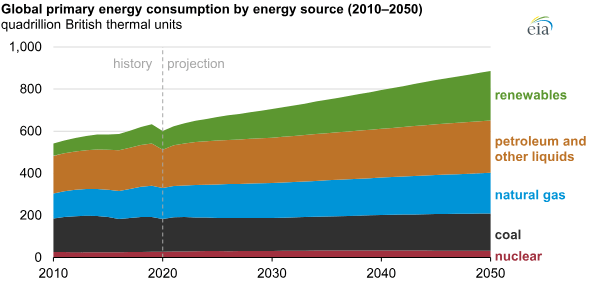
Fossil fuels provide 80% of humanity’s energy consumption. Perhaps you have heard tales about phasing out fossil fuels, that solar is the cheapest source of energy, and that it will all be nice and dandy with solar and wind. A 2021 International Energy Agency (IEA) projection of future energy use tells a different story. The IEA expected a 30% increase in world energy use between 2020 and 2050. Renewable energy will not even fully cover that increase.5 It is the reason Big Oil keeps drilling. And so, saying goodbye to fossil fuels and switching to renewable energy begins with reducing global energy consumption by 50%, and that will require drastic lifestyle changes.
The IEA concludes that the pledges by governments to date—even if fully achieved—fall well short of what is required to bring global energy-related carbon dioxide emissions to net zero by 2050 and give the world a 50% chance of limiting the global temperature rise to 1.5 °C.6 The IEA presented a plan to achieve net-zero carbon emissions by 2050. It bets on cheaper solar energy and technology to store it. Achieving 50% renewable energy use may be feasible, but beyond that, the costs may become prohibitive if the bet-on technologies don’t arrive on time. We are about to find out.
A global power grid could make switching to renewable energy feasible, as it would require less spare capacity and batteries. Long-distance electricity transport incurs limited losses (26% per 10,000 kilometres). It might be profitable to transport electricity over thousands of kilometres from locations with predictable solar availability to other locations. It is mainly a political problem as nation-states have conflicting political objectives, so it requires a global government. We may have already surpassed the 1.5°C global average temperature rise, at which point things supposedly become critical. Due to the measures already taken and planned measures, the expected temperature rise may be limited to 2.6°C by 2100 AD, significantly less than the worst-case scenario of a 4°C rise.
What is our religion?
Once we accept a story as the truth, it becomes a matter of faith, whether it is renewable energy, organic farming or a multicultural society. The bottom line is often that we may disagree on whether we need to do it and whether it is possible. Yet our belief about whether we need to do it may depend on our belief about whether it is possible. Underneath lies the problem that we may have to do it, but that it may be impossible. Maybe we should do something about climate change, but it is not going to happen, so why ruin our industries with energy shortages? And if other countries aren’t switching to organic agriculture, why bankrupt our farmers? And why should we have an open multicultural society, and go through the trouble of accommodating various cultures, when others do not? And should the migrants not adapt in the first place?
Then there are the unforeseen consequences. When the Dutch began electrifying their energy consumption, few foresaw that they might end up with power shortages requiring businesses and consumers to adapt their demand to electricity availability. And there are extremes, like no Sun and no wind during winter, when energy demand is at its peak. The waiting list for grid connections is growing. The Sri Lankans suffered much more from their sudden switch to organic farming. We accept the consequences of our choices if we believe that they are right. Our future and our children’s are on the line. Only, we don’t know the future, so our choices on these matters are a matter of faith.
In the Middle Ages, most Europeans were dirt poor. Their houses were mere sheds. They often barely had enough to eat. Still, medieval Europeans built magnificent cathedrals. God was more important to them. Were they right, or were they wrong? Today, money is our religion, and we are committing suicide by subjecting ourselves to the rule of money. Renewable energy, organic agriculture and the multicultural society are choices of faith with uncertain outcomes. They can go wrong, but so can the alternatives. We often don’t know what the right choices are. Something unforeseen can happen any time, making what seems sensible today appear ill-conceived tomorrow. Yet, the doom that the pursuit of profit will cause is certain, and few see it coming.
Latest revision: 12 August 2026
Featured image: The Lady Chapel of Exeter Cathedral. User Diliff. Wikimedia Commons.
1. ‘This is nuts:’ European power prices go negative as springtime renewables soar. Joshua S Hill (2023). Renew Economy. [link] 2. Sri Lanka’s organic farming disaster, explained. Kenny Torrella (2022). VOX. [link] 3. Can conventional agriculture feed the world? Pablo Tittonell. Wageningen University. 5. How much of the world’s land would we need in order to feed the global population with the average diet of a given country? Hannah Ritchie (2017). Our World In Data. [link] 5. EIA projects nearly 50% increase in world energy use by 2050, led by growth in renewables. EIA (2021). [link] 6. Net Zero by 2050: A Roadmap for the Global Energy Sector. IEA (2021). [link]
A whiff of coincidence was in the air. Perhaps it was more than that. And I took notice. In the Autumn of 2008, the time-prompt phenomenon haunted me for weeks. On the Internet, people wrote about similar experiences. As a result, I became preoccupied with numbers for a while, most notably double-digit numbers and multiples of eleven. For instance, in December 2008, we passed a gas station in Sneek. There was a billboard indicating prices. One number was flashing, indicating a price of 1.199. 11 and 99 were both multiples of 11. And I noticed it because of my preoccupation. And so, eleven and some other numbers, for instance, the emergency services telephone numbers 112 and 911, play a significant role in the following report. Some of these stories might be lame, while others could make you wonder.
Also in December 2008, I predicted that a superstorm would strike the Netherlands on 9 February 2009, the birthday of the Lady from the dormitory. The storm came, but it was less severe and hit Northern France rather than the Netherlands. Charles de Gaulle International Airport of Paris had to be closed that day. You can read more about that here:
Psychics, mediums, and premonition
Like psychics and mediums, we can sometimes have accurate premonitions. My personal experience may tell a lot about why that is so.
The superstorm prediction story came with a peculiar sequel. On 1 June 2009, Air France flight 447 disappeared above the Atlantic Ocean. The incident involved an Airbus 330 with manufacturer serial number 660.1 Both are multiples of 11, referring to 11:11. Flight AF447 and the 9 February 2009 superstorm relate to the Charles de Gaulle International Airport in Paris. It happened 112 days after 9 February 2009, while 112 is the European emergency services telephone number.
At first, I did not consider a relationship between the Air France AF447 flight disappearance and the superstorm. The next day, a helicopter crashed on Ameland.2 We were about to spend our holidays there, and there already had been a few coincidences related to Ameland. That attracted my attention, but I did not think much of it. The next day, my son Rob was watching the news. Suddenly he came to me yelling: ‘Guess what, the plane that crashed was due to arrive at 11:11 AM in Paris.’ That was incorrect. The plane was due to arrive at 11:10 AM. But Rob’s remark made me investigate the incident.
On 30 June 2009, Flight IY626 crashed in the Indian Ocean near Comoros,3 29 days after Flight AF447 disappeared above the Atlantic Ocean. AF447 was destined for the Charles de Gaulle International Airport in Paris. IY626 had departed from this airport. There are 29 days between 1 June 2009, the day flight AF447 disappeared and 30 June 2009, the day flight IY626 crashed, while 2/9 refers to 9 February (American notation).
The church tower in the pond at the university campus of Enschede played a central role in the circumstances that made me make the superstorm prediction. And university campus of Enschede was where I met the Lady. The artwork refers to flooded land. Enschede has area code 53. The last major flooding disaster in the Netherlands happened in 1953. This event is known as the February Storm of 53. The Dutch film De Storm about the 1953 flooding disaster came out in 2009.4
The premiere of the film, which lasts 110 minutes, was on 11 September 2009 (9/11, while 9+1+1=11 and 2+0+0+9 =11, making a reference to 11:11) at the 11th Festival Film by the Sea in Vlissingen.4 Vlissingen was the destination of our summer holidays in the four previous years. Enschede turns up in several spooky coincidences, so it is noteworthy that Enschede has a sorority named Spooky.5
Exactly three years after a blogger from Sargasso.nl posted the story about the fictional superstorm with a flooding disaster hitting the Netherlands on 9 February 2009, the presentation of the World Risk Index of the United Nations University was held on 2 September 2011. The Netherlands had the highest risk of flooding disasters in the European Union. The Netherlands is ranked number 69 worldwide,6 a peculiar ‘position’.
FC Twente becoming Dutch soccer champion
In 2010, FC Twente from Enschede became champion of the Dutch soccer Premier League for the first time ever. In 2009, AZ from Alkmaar had been champion. A is the first letter of the alphabet, while Z is the last. In Greek, that is Alpha Omega. On 21 December 2012, the day the Mayan calendar supposedly ended, there was one match in the Dutch soccer Premier League: AZ – FC Twente. In the years before 2009, PSV Eindhoven was the champion. Eindhoven means Final Gardens, a reference to Paradise. It is where the Lady from the dormitory currently lives.
On 2 May 2010, we went with my parents, my sister and brother-in-law and their children to an indoor playground in Almelo to celebrate my mother’s 65th birthday. It was the day FC Twente became champion. A screen played Disney XD channel for children. I was watching it. Three American football players appeared. One of them had shirt number 19, and another had 53. Then, the football players with numbers 19 and 53 stood side by side and began jumping, making the number 1953 noticed. It was the year of the flooding disaster, and it linked to Enschede because of the area code 53 and the church tower in the pond, and it happened on the day FC Twente from Enschede became champion.
In the years that followed, Ajax Amsterdam became champion. The Ajax team is nicknamed Sons of God, and Amsterdam is often abbreviated to Adam. Adam is the Son of God (Luke 3:38). Johan Cruijff, the most famous Ajax football player in history, has the initials JC like Jesus Christ. His nicknames were Number 14, The Skinny One and The Oracle. Number 14 was his shirt number. And that number refers to the initials of the Lady. I was a skinny person employed as an Oracle developer and database administrator. Cruijff also became the trainer for FC Barcelona in Spain. According to persistent rumours in the Dutch press, people in Barcelona called him The Saviour.
2 September 2011 is a curious date (2/9/11 or 2/9/2011 while 20=9+11), making multiple combinations of elevens. That day, the Dutch national soccer team, nicknamed the Dutch Eleven, won their Euro 2012 qualifying match against San Marino in Eindhoven. The score was 11-0, surpassing their previous 9-0 record score.7 This is a 9:11 reference. Soccer is played by two teams of 11 players, and 11:11-reference.
And on 2 September 2011 was the farewell party of star soccer player Ruiz of FC Twente, who played a crucial role in the championship of FC Twente in 2010.8 In his new team Fulham, Ruiz had number 11. His first match for his new team was on 11 September 2011. Remarkably, FC Twente played its next contest in group K of the Europa League on 15 September 2011 against Fulham, Ruiz’s new team. K is the eleventh letter of the alphabet, while the match result was 1-1. The return match was on 1 December 2011. 1 December is 1/12 (European notation), while 112 is the European emergency telephone number.
A peculiar set of plane crashes
On 15 September 2012, a small plane crashed in a field near Den Helder in the Netherlands. At the same time, there was an air show in Den Helder, but the accident was not related to the air show.9 That evening, another small plane crashed in the Netherlands in a field in Valkenswaard near Eindhoven. This plane had taken part in the Den Helder airshow earlier that day.10
On the same date, a small plane flying for the Dutch KLM Flight Academy was found crashed in a canyon in the mountains east of Phoenix, Arizona. Three people died on the crash site.11 Three weeks later, on 6 October 2012, another small aircraft flying for the KLM Flight Academy crashed into another small plane. Both managed to make an emergency landing, and nobody was injured.12 There had never been any accidents involving the KLM Flight Academy before.
The following related incident pairs can be identified: two planes crashing on the same day in the Netherlands and two aircraft of the KLM Flight Academy crashing, linked by the Netherlands and the date 15 September 2012. The number three occurred three times. Three planes were in the news on 15 September 2012, and three people were killed. And there were three weeks between the accidents.
And so, I pondered on 10 October 2012 whether or not the number three was part of this scheme. A few hours later, the news reported that three people had killed themselves in a rare triple suicide in Utrecht. Among the dead were two twin brothers aged 33.13 That made it even more bizarre. According to the report, police entered the apartment after the family had received farewell letters.
On 17 July 2014, Malaysia Airlines Flight 17 (MH17) was shot down in Ukrainian airspace. The plane was a Boeing 777-200. The incident happened four months after Malaysia Airlines Flight 370 (MH370) went missing on 8 March 2014. The aircraft is still missing, which makes its disappearance particularly mysterious. That plane also was a Boeing 777-200, and the 404th plane of that type produced while 404 is the number associated with missing (not found) web pages.
The Flight 17 plane first flew on 17 July 1997, exactly 17 years before the accident.14 That was exactly one year after the crash of Trans World Airlines Flight 800 on 17 July 1996.15 It crashed 777 days before Swissair Flight 111.16 That is peculiar because of the numbers 777 and 111. Exactly 7 years, 7 months, and 7 days after Malaysia Airlines Flight 17 (MH17) was shot down in Ukrainian airspace, Putin started the Ukraine war. Did he count the days? Probably not.
Looking at the numbers
Again in December 2008, we took a trip to Amsterdam by train. Rob and I had been noticing 11 related coincidences all day. In the evening, we were on the train destined for Sneek and sat down. Rob then said: ‘The number of this train unit has nothing to do with eleven.’ He was mistaken. The number was 242 or 2 * 11 * 11. And I took notice.
In January 2009 after work, I sat down in train unit 306. I realised that 306 is not a multiple of 11. My calculation was 330 – 306 = 14. It demonstrated that 306 was not divisible by 11. So this was not spooky. Then I looked to the left. On the track next to me was train unit 234. This number was not a multiple of 11 either as 234 – 220 = 14 also. Then I found myself contemplating whether or not the number 14 turning up was a coincidence. I looked to the right just when bus 14 was entering the bus station. 14 translated into letters is AD, the initials of the Lady. If you turn that number upside down, you get ‘hi’.
My lucky number was 26 because I was born on 26 November. As I remember it, the Lady was born on 9 February (9/2 European notation). That links the number 92 to Her. Now it happens to be that 92 is 26 upside down. And probably we were both born in 1968. We crossed each other’s path in 1989, while 89 is 68 upside down. That makes it a pair of related coincidences like 11:11. Also, 1968 and 1989 were revolutionary years. If this is not a mere coincidence, then some thinking has gone into this.
Numbers do not have any meaning except their value, and coincidences can happen by chance. Thinking of myself as rational, I once tried to debunk these suggestions as irrational. When commuting home from work on the train, I tried to convince myself that number coincidences are selective remembrance. If you focus on something, for instance, a specific number, you notice it more often. Upon nearing train station Sneek North, I told myself, ‘Let’s focus on 86, a number that has no meaning to me, and I will start to see it.’ And indeed, the following number I saw was 86 on the licence plate of a car parked at the station. Did that prove my point, or was Someone poking fun at me?
At the time, most Dutch licence plates had the following formats: AA-AA-99, 99-AA-AA, and 99-AAA-9 (A is a letter, and 9 is a number). The chance of a two-digit number like 86 on the first licence plate was close to one per cent. One year later, this incident came to my mind again. When parking my bike at work, I thought of it for no apparent reason. Then I walked down the parking lot and noticed the licence plates. Among the eight licence plates I saw, three had an 86, one had a 68, two had an 11, which might refer to 11:11, and two were unrelated to the incident, a pretty impressive score.
On 17 March 2012, the number 26 popped up conspicuously often. It never happened like that. As it is my lucky number, I would have noticed that. That afternoon Ingrid, Rob, and I were biking. The number 26 kept coming up, for instance, on licence plates. I began wondering what kind of luck was waiting for us. Rob wanted to go to the restaurant named Het Paviljoen near the lake. It was closed in March, so I warned him it would be closed. Rob wanted to go there anyway. The restaurant turned out to be open unofficially. The owner was waiting for a supply truck. It was late, and it arrived when we were there. After we left, the restaurant closed.
I also noticed the number 92. For a while, it appeared that when I left a building, the first car to pass often had the number 92 on its licence plate, perhaps, about one in three to five times, while once in a hundred was to be expected. Once, I tried to cross a road. The first car passing had a licence plate number with a 92. The second car also had 92 in its licence plate number. And so did the third. Only these three cars passed before I could cross. It was a temporary phase, and selective remembrance played a role, but it did not seem entirely coincidental.
A small white car with licence plate number 9-GXD-2 was parked in Leeuwarden on a parking lot near the train station nearly every morning for years. The letter O is not on Dutch car licence plates, so I imagined the X could represent an O linking God to 9 February (9-GOD-2). I also found this car parked 100 metres from my home in Sneek a few times. That may seem insignificant, but a related incident makes it noteworthy.
I own a green Opel Astra with licence plate TZ-GT-18. Once when we were on holiday in Zeeland, I noticed another green Opel Astra with licence plate TZ-GT-54. That attracted my attention. Later, I found it parked in Sneek near my home several times. It was in the same parking place where the car with licence plate 09-GXD-2 had also been. The distance between Zeeland and Sneek is 300 kilometres. That combination of peculiar events is like seeing 11:11.
Featured image: Poster for the film The Storm. Universal Studios (2009). [copyright info]
1. Air France Flight 447. Wikipedia. [link] 2. Helikopter stort neer boven Ameland. Volkskrant (2 June 2009). [link] 3. Yemenia Flight 626. Wikipedia. [link] 4. Stormachtige start voor 11e Film by the Sea. Trouw (9 September 2009). [link] 5. Lesleden dispuut Spooky doen graag uit de doeken wie ze zijn. Huis Aan Huis Enschede (4 May 2018). [link] 6. Nederland heeft grootste kans op natuurramp in Europa. Nu.nl (2 September 2011). [link] 7. San Marino on the end of record Netherlands win. UEFA (2 September 2011). 8. Verdrietige Ruiz verlaat Twente met pijn in het hart. Trouw (2 September 2011). [link] 9. Een gewonde bij vliegtuigcrash Den Helder. RTL Nieuws (15 September 2012). [link] 10. Straalvliegtuig gecrasht in Valkenswaard. Nu.nl (15 September 2012). [link] 11. 3 found dead after small plane crashes in Ariz. Fox News (15 September 2012). [link] 12. Weer ongeluk lesvliegtuig KLM. Trouw (6 October 2012). [link] 13. Drievoudige zelfmoord in Utrechtse studentenflat. Nu.nl (10 October 2012). [link] 14. Malaysia Airlines Flight 17. Wikipedia. [link] 15. TWA Flight 800. Wikipedia. [link] 16. Swissair Flight 111. Wikipedia. [link]
Why do we fight wars? We can settle for the simple answer that it is in our nature to do so, and then you can go on with your life. As we near the end of days, that life could be short, so it might be better to delve deeper into the matter to resolve the question once and for all, or to arrive at a more profound analysis of the causes of humanity’s termination before it occurs. By then, it might be too late to make such an analysis to make a meaningful difference. There have been many wars, but for the sake of argument, let’s take the war in Ukraine as a case study. One reason to do that is that it is one of the most recent wars, so we had the opportunity to learn the most from history. And the war was unnecessary, as relations between Russia and Ukraine had been friendly until 2014. So, if we, with all the knowledge of history, can’t prevent unnecessary wars, then what hope is there for us?
For the analysis, we could set aside propaganda and establish the facts to understand better why it happened. But then you have to discern between the main issue and the side issues. So, let’s start with the essence. Exactly 7 years, 7 months, and 7 days after Russia-supported Ukrainian separatists shot down Malaysia Airlines Flight 17 (MH17) in Ukrainian airspace, Vladimir Putin ordered Russian troops to invade Ukraine in a so-called special military operation known as the Ukraine War. The Flight 17 plane, which took off from Amsterdam and was mostly loaded up with Dutch people, first flew on 17 July 1997, exactly 17 years before the shootdown. That was precisely one year after the crash of Trans World Airlines Flight 800 on 17 July 1996, which crashed 777 days before Swissair Flight 111. Hence, the war was destined to start on 24 February 2022. We could stop here, but that would also be quite unsatisfactory and bad journalism.
In early 2021, Russia began a military buildup along Ukraine’s borders, while Putin demanded security guarantees and the prevention of Ukraine joining NATO. Putin being an evil dictator appears the primary cause of the war at first glance, but a closer look reveals a more nuanced picture. We have emotional problems with applying logic. Our minds work like so: he is an evil dictator, so he must be wrong. That is not always the case. Adolf Hitler had a genuine case for tearing up the Versailles Peace Treaty and occupying the Rhineland. Many other things he did were less reasonable, but we know all about that. After World War II, the Allies realised that without the unreasonable Treaty of Versailles, the war probably wouldn’t have happened. Leaders make mistakes. Western leaders ignored Russian interests by expanding NATO into former Soviet territory and promising NATO membership to Ukraine after promising Russia not to do so.
Yet, making peace is not so easy. Giving in to Putin’s demands could embolden him to invade other countries. He is an evil dictator after all. So, when Donald Trump was desperately seeking the Nobel Peace Prize to make a name for himself and, like a veritable peace dove, was prepared to give Putin what he claimed to desire, Putin proved unwilling to come to the negotiating table. Blaming the West or Russia is not going to prevent the next war. Other conflicts could escalate into war, such as those between India and Pakistan, Israel and Iran, and Thailand and Cambodia. There are always causes to fight for, and men who wish to make names for themselves. Vladimir Putin wants to go into history as the one who made Russia great again. These kinds of ambitions are killing us.
The conflict in Ukraine comes with a history, as do many others. And new conflicts can pop up at any time. Who would have thought that the United States would be willing to invade Greenland to acquire security guarantees it already had? The motives of the warring parties make sense from their perspective. Putin’s case for invading Ukraine in 2022 had more merit than the US’s case to invade Iraq in 2003. Had the Soviet Union, a state founded on a myth of a brotherhood of peoples that brutally repressed nationalism, still existed, the war would not have happened. Had there been no nationalism, Europe wouldn’t have fought two world wars. There is no hope for world peace if it is up to us humans. Barring a miracle, warfare will go on until humans are extinct. Accepting failure and stopping breeding are a more elegant way to achieve the final solution to the human problem.
Historical background
The history of Russia and Ukraine is closely linked. Between 800 and 1240 AD, the Ukrainian capital, Kyiv, was the centre of Kyivan Rus, a state founded by Viking traders seeking a land route to the Mediterranean. It encompassed western Russia, Belarus, and much of Ukraine. The Rus were Scandinavian Vikings, so Russia received its name from that people. By 1240, the Mongols overran the area. When Mongol power waned by 1400, a new Russian state emerged around Moscow. By then, Ukraine had become part of Poland while Turkey took over Crimea and the surrounding territories. As a result, Ukraine separated from Russia and developed its own culture and language. Polish and Turkish power declined from the 17th century onwards, and Russia filled that void. By 1800, Russia had become a large empire controlling most of Ukraine.
During World War I, the Russian Empire collapsed, and a civil war followed the Bolshevik Revolution of 1917. By 1922, the communists had won and conquered most of Ukraine. In the late 1920s, the Soviets forcefully collectivised farms. Farmers lost their land and ended up in prison labour camps. Agricultural output dropped, leading to a famine and the deaths of three to five million people, mostly in Ukraine. In 1939, Hitler and Stalin made a pact. They divided Poland, and the Soviet Union acquired Estonia, Latvia, Lithuania, and Western Ukraine. After Germany had invaded the Soviet Union in 1941, some 250,000 Ukrainians helped the Germans, and Ukrainian fascists murdered 100,000 Poles in an ethnic cleansing campaign. At the same time, 6,000,000 Ukrainians fought in the Red Army. After the Soviet Union collapsed in 1991, Ukraine became independent. Yet, Crimea remained home to the Russian Black Sea fleet.
When the Soviet Union retreated from Eastern Europe, NATO leaders promised Mikhail Gorbachev that NATO would not expand into its former sphere of influence.1 Yet, Eastern European countries were eager to join NATO. Once liberated from Soviet oppression, they sought security guarantees against Russia, which joining NATO could provide. Several policymakers in the West believed that would be a historic mistake. Russia could see it as a violation of promises made.2 NATO expansion proceeded nonetheless. The collapse of the Soviet Union had broken the Russian spirit and national pride. Russia had been an empire, and the Soviet Union a world power. It was all in shambles, while many Russians had become destitute due to the liberal economic reforms imposed by the West.
Vladimir Putin was employed by the Soviet secret service, the KGB, for sixteen years. After leaving the service in 1991, he worked as the deputy mayor of Saint Petersburg. In this capacity, he oversaw the disappearance of precious metals and food, leading to allegations of corruption.3 Later, Putin joined President Boris Yeltsin’s staff. In 1998, Yeltsin appointed him director of the FSB, the successor to the KGB. On 9 August 1999, he became Prime Minister. One month later, on 9 September (so 9/9/99), a series of terrorist attacks started inside Russia, killing 307 and wounding over 1,700 in a week, which the FSB attributed to Chechen militants. Yet, it was the FSB itself that perpetrated them. State Duma speaker Gennadiy Seleznyov announced that another bombing had occurred in Volgodonsk, while that bombing had yet to happen, proving it was a government operation. In Ryazan, the police apprehended FSB agents planting bombs.
Putin had been the FSB’s head until a month before these attacks, which undoubtedly took time to prepare. No evidence exists that Putin ordered these attacks, but he is definitely the kind of guy for it, and his KGB training has taught him not to leave behind any evidence. The conductors of an independent investigation either died mysteriously or ended up in prison. Putin vowed to go after the Chechen terrorists, which made him popular with the Russian people. Had the Russians found out that Putin himself had ordered these attacks, they might have supported him even more. Stalin is one of Russia’s most popular guys, with a 70% approval rate, so Russians love to be murdered by their leaders. The terrorist attacks became a pretext for a long and bloody war in Chechnya.
A few months later, Yeltsin stepped down and appointed Putin his successor. Putin pledged to restore Russia’s prestige and sphere of influence. He eliminated the oligarchs who opposed him and stripped them of their possessions. His opponents, including those who lived abroad, suffered from shortened lifespans, attributable to causes such as falling out of windows or exposure to nerve gases. The remaining oligarchs had to learn to pay taxes to survive, which improved state finances.
Vladimir Putin sees the former Soviet territories as a primary interest for Russia and seeks influence or dominance in the region. In 2005, despite corruption, voter intimidation, election fraud and the poisoning of the pro-Western candidate Viktor Yushchenko, Ukraine held free elections due to a popular uprising, much to the dismay of Putin, who had hoped to retain his influence in the country with the help of his favourite, Viktor Yanukovych. Most other Soviet republics remained within Russia’s sphere of influence, except Georgia, which aspired to membership in the EU and NATO. Russia then invaded Georgia in 2008.
Prelude
Since its independence from the Soviet Union in 1991, Ukraine had a multi-party system with numerous corrupt political parties in which oligarchs play a central role. Ukraine is one of Europe’s most corrupt countries, which Russia’s propaganda outlets are keen to point out. Only Russia is even more corrupt. We learn little about it, because Russia has no free press anymore, and those who have investigated it, if they didn’t end up in prison, died prematurely, with the most famous fatality being Alexei Navalny, who had documented the massive corruption of Putin and his cronies, which included a massive 17,700-square-metre palace to store Putin. Following a 2020 nerve agent poisoning by the FSB, which he miraculously survived, Navalny ended up in an Arctic penal colony in February 2024, where he died under suspicious circumstances.
Ukraine became almost evenly split into two political blocs. One sought cooperation with the West, while the other aimed for closer ties with Russia. People in the West and the centre of Ukraine favoured the Western-oriented bloc, while people in the East and the South favoured the Russia-oriented bloc. It coincided with the languages spoken. People in the East mostly spoke Russian, and people in the West mostly spoke Ukrainian. Whether or not the Russian speakers were actually Russians is a matter of debate, but it highlights why the emergence of a conflict was only a matter of time.
Those living in eastern Ukraine spoke Russian, felt connected to Russia, and desired friendly relations with Russia. Those living in the West thought they were Ukrainian, felt unrelated to Russia, and hoped to become part of the West and be free from Russian influence. It was a recipe for trouble, which the imperial powers, the United States and Russia, sought to exploit. Samuel Huntington called Ukraine a cleft country as these blocs identify with separate civilisations. Ukraine had plans to join NATO. In 2008, Putin warned Moscow would view that plan as a direct threat to Russia’s security.4
After fair elections, Putin’s favourite, Viktor Yanukovych, became president in 2010. By 2013, there was strong support for an economic treaty with the European Union (EU) in Parliament. After lengthy negotiations, a deal was in the making. Then, Yanukovych decided not to sign a political association and free trade agreement with the EU and instead to seek closer ties with Russia. Russia was Ukraine’s largest trading partner, and Putin had offered loans on favourable conditions while threatening to harm the interests of the Ukrainian oligarchs and politicians if they rejected his proposal.5
Protests erupted, calling for the resignation of the president and the government. The demonstrations were initially peaceful, but President Yanukovych responded with a police crackdown that included the use of snipers. The protesters held out for months and fought back with chains, sticks, stones, petrol bombs, a bulldozer and firearms. At some point, the police could no longer defend themselves from protesters’ attacks. In the end, 108 civilians and 13 police officers had died. The Euromaidan protests led to the ousting of the government, and President Yanukovych fled. Most Ukrainians didn’t want to sever ties with Russia at that point, as Ukraine relied on cheap Russian gas.5 After the Maidan Revolution, pro-Russian protests and uprisings erupted in Crimea, the Donbas and Odesa with Russian support.
Pro-democratic groups had started the Maidan Revolution. Most participants were ordinary citizens. However, the violence of the well-organised fascists, which included the use of snipers, likely decided the outcome. The Ukrainian fascist movement has a history which traces back to the partisan movement from the 1940s. After the Maidan Revolution, fascists patrolled the streets of Kyiv. They also provided fighters for the war against Russia-backed separatists. Among them was the Azov regiment, a group of 900 fighters with Nazi sympathies.6 Their bravery on the battlefield at a time when the regular army struggled to defend Ukrainian territory made them more respected in Ukraine.
Russia claimed that the Maidan Revolution was a Western-sponsored coup to overthrow a legitimate government. Yanukovych had become President after fair elections. Between 1991 and 2014, the US spent $5 billion to support civil society and NGOs aimed at strengthening democracy, anti-corruption efforts, and economic development. These groups had played a central role in starting the protests.7 Had the fascists not come to their aid, the police might have been able to subdue the demonstrations with force.
Putin sees foreign aid money as interference and a threat to Russia. After pro-democratic protests in Russia, he made Russian NGOs receiving money from abroad subject to a foreign agent law and closed their operations. Since the Orange Revolution in 2004, Putin also began investing in increasing Russian influence abroad. It included interference with the 2016 US elections with misinformation.8 After the Maidan Revolution, the Obama administration had chosen not to antagonise Russia by sending more arms to Ukraine. The previous Bush administration had provided Georgia with money and weapons in an attempt to build a bridgehead in the southern Caucasus region, provoking Russia to invade Georgia in 2008.7
Ukraine War
Ukraine was drifting away from Russia and aligning itself with the West. Most Ukrainians didn’t wish to live under Putin’s rule, but they also hoped for a good relationship with neighbouring Russia. That is why they elected Volodymyr Zelensky. A Ukrainian NATO membership would endanger that. Putin believed Ukraine was of crucial interest to Russia. Losing Ukraine would be a damaging geopolitical loss for Putin. The Russian invasion of Crimea and the Donbas insurgency had soured Russian-Ukrainian relations. There had been a truce, but there was regular shelling of civilian areas.9 The Donbas attracted Ukrainian fascist fighters seeking combat experience. Russia-backed separatists have reported terrorist attacks with a total of 1,000 fatalities between 2015 and 2021.10
Zelensky had won the 2019 elections by promising to seek peace with Russia. The fascists blocked these plans by threatening to use violence and murder Zelensky.11 A return of Ukraine to the Russian sphere of influence was not to be expected. The truce with Russia was nothing more than a truce, as neither party had any genuine desire for peace. Ukraine intended to regain its lost territories while Putin hoped to bring Ukraine under Russian influence. Ukraine was building its military and seeking NATO membership. Although NATO considers itself a defensive alliance, it is part of the Western sphere of influence. Putin sees NATO as a coalition against Russia that threatens Russia’s security.
When Russia invaded Ukraine, few pundits expected the Ukrainian army to hold out for more than a few weeks. In the early days of the war, Zelensky rejected an evacuation offer from the United States, saying he needed ammunition, not a ride. Street fighting in Kyiv was about to commence. Zelensky, who had previously been an actor, unified the nation and secured weapons and other support from his Western allies. He had previously played the Ukrainian President in a comedy. So, has fiction become a reality? Or is reality fiction? We know the answer now, so these are rhetorical questions.
During the first months of the war, there were peace talks. Both Ukrainian President Zelensky and Russian President Putin seemed willing to make concessions. Western powers blocked a peace deal, fearing the agreement would reward the aggressor state, Russia. Western powers also hoped to weaken Russia.12 The discovery of the Bucha massacre in early April, in which Russian troops had murdered over 400 civilians, was another reason the peace talks failed.13 Since then, the war dragged on, while Ukraine depended on Western support to keep its army in the field. It was a stalemate, with Russia making a few territorial gains at the expense of massive losses in military personnel, yet the nature of warfare changed completely, with drones and artificial intelligence taking centre stage.
In 2025, Donald Trump became President of the United States. He initially held a favourable view of the Russian position and went so far as to parrot Russian propaganda narratives. He took upon himself the role of a peace dove, while claiming he had ended 8 wars already, and attempted to broker a peace deal with Russia by pressuring Ukraine to accept the loss of territory and give up NATO membership. The sudden change in American policy left America’s European allies in disarray, prompting them to increase their support for Ukraine. Trump soon found out that what his European allies told him was all true, and that the man in the Kremlin wasn’t at all interested in peace, so Trump then focused on making Europe pay for the war.
Clash of civilisations
Geopolitical actors abide by the logic of gang warfare, which is a particularly cynical one, but also natural to humans. Since the end of the Cold War, US policymakers have generally held two views: the Neoconservative view, driven by a desire to spread Western values by force, and realpolitik. In his book The Clash of Civilisations, Huntington argues that it is arrogant and dangerous to assume Western culture is superior. He urged the West to respect other civilisations and their leading nations, and to allow them spheres of influence that coincide with cultural and civilisational borders. It implies that Ukraine should align with Russia. Realpolitik could mean throwing Ukraine under the bus to prevent war.
After the collapse of the Soviet Union, the Neoconservative view won out, as the United States found itself the hegemon in a unipolar world. It emboldened the Neoconservatives’ aggressive attitude and pursuit of global dominance. US planners aimed to prevent the emergence of a rival power anywhere in the world. They hoped to establish a global order, the New World Order, which George H.W. Bush described in his speeches as peaceful cooperation among nations. This arrangement would allow other countries to pursue their legitimate interests while deterring them from seeking a larger regional or global role or from challenging US leadership.11
A single world order can bring peace or at least reduce warfare. The Romans pacified the Mediterranean, thereby creating the world-famous Pax Romana everyone is talking about on social media (just kidding, as no one is discussing it). The Americans sought to copy that idea and create a Pax Americana. From behind the desks of the geopolitical planners, it may have seemed a marvellous idea with the bonus of an excellent business opportunity for the military-industrial complex. It brought the Iraq War, with hundreds of thousands of fatalities. It is the prerogative of the hegemon to ignore the subjected people. The Romans never considered how the Gauls felt about Roman occupation. The resentment about the West’s colonial past and military interventions is understandable, but the end of Western dominance will not end warfare. Nothing will, except a single world order.
The clash-of-civilisations view doesn’t provide a workable alternative. Ukraine and Russia are Christian Orthodox and Slavic, but most Ukrainians now choose the West. It also applies to Taiwan and some other countries that share China’s Confucianist heritage, such as Japan and South Korea. Huntington predicted that these countries would seek leadership from the leading nations of their respective civilisations, Russia and China. The world has grown closely integrated. Separating along civilisational lines makes little sense anymore. Yet, China’s growing military power makes Neoconservative thinking increasingly risky. China seeks sovereignty over Taiwan and the South China Sea, using force to back up its claims, and China’s navy is now the largest. If China’s neighbours feel threatened and seek an alliance with the United States, that could be another path to World War III.
Gang warfare
Geopolitical actors act as gangs, defending and expanding their turf. It is insightful to paint the picture of the Ukraine war as gang warfare, so Putin’s mafia state attacking a state backed by the US mobster state run by neoconservative gangsters and the military-industrial complex, which, amongst others, invaded Iraq to loot its oil. And by the way, fascist thugs in Ukraine, the so-called Nazis, whom Putin was harping about while having Nazi mercenaries from the Wagner Group fighting on the Russian side, have prevented a peace deal with Russia. Meanwhile, Ukraine alleges that China is supporting the Russian war effort, while China claims it can’t accept Russia losing the war.15 The major powers are all making their cynical calculations. The major powers are all making their cynical calculations and risking everything. That the nukes have not already been flying may be such a miracle that it proves we live inside a simulation.
Humans operate in gangs. It is our nature. We are gangsters. And so, the gang is our default political organisation. This type of establishment dominated most of human history and still exists today in the form of warlords, militia, drug cartels, and street gangs. States have proven to be effective in repressing gangs and violence within their borders. But once order breaks down, gangs will pop up everywhere and take over.16 Gang leaders see themselves as public benefactors, on par with eminent statesmen, or as wealth-creating entrepreneurs suffering from brutal government repression. Or to quote Al Capone,
I have spent the best years of my life giving people the lighter pleasures, helping them to have a good time, and all I get is abuse, the existence of a hunted man.
In a unipolar world, where one power dominates, most countries fear and respect the hegemonic power. A hegemonic power can provide order, much like a police officer, or it can be a big bully. The United States was the hegemon between 1990 and 2020. Other countries didn’t challenge that position. It allowed the United States elites to develop delusions of grandeur and invade Iraq because of a belief in the superiority of Western culture and values based on the Hegelian dialectic. The Neoconservative planners assumed Iraq would miraculously turn into a liberal democracy after the invasion.17 Probably, the business case for the oil industry also seemed profitable to Dick Cheney. We are gangsters after all, even when we have the best interests of humankind in mind.
In a world with two major powers, a stable situation can emerge. During the Cold War, there was mutual assured destruction (MAD) in case of a nuclear war. Still, the United States and the Soviet Union were on the brink of nuclear war during the 1962 Cuban Missile Crisis and again in 1983, when Ronald Reagan’s aggressive rhetoric made the Soviet leadership believe the US would attack. They put their nuclear forces on high alert. On both the Soviet and US sides, warning systems for incoming enemy missiles malfunctioned and sounded the alarm. The soldiers watching the alarms detected red flags, suggesting these alarms were false. And so, we were lucky to come out of the Cold War alive. In a multipolar world, alliances shift, and a stable situation is less likely to emerge. That is what we are heading to, and Russia and China are aiming for.18
On the eve of World War I, Europe was a multipolar continent with five major powers in shifting alliances. The future of the multinational Austrian-Hungarian Empire was in peril as the nationalism of the different peoples living in it gradually undermined it. After a Serbian nationalist assassinated Archduke Franz Ferdinand, the leadership of the Austrian-Hungarian Empire believed it had to eliminate the Serbian threat. Russia felt it had to support its ally Serbia to prevent it from being overrun by the Austrian-Hungarian Empire. Germany felt threatened because its foes, France and Russia, surrounded it. Germany saw no option but to back its only ally, the Austrian-Hungarian Empire. France and Great Britain backed Russia because it was their ally, and Germany their foe. And so, an assassination plunged Europe into a war that killed over ten million people. We are drifting toward a multipolar world with several powers, and hence a politically unstable one.
Conspiring for world peace
Before World War I, the socialist movements had declared their opposition to war, which, according to them, meant workers murdering each other to enrich their capitalist masters. Once the war had started, most socialists and trade unions backed their government and supported their country’s war effort. The workers would have been better off if they had united and refused to fight. So, why did they go to war nonetheless? You and the other are better off without a war. But you don’t know what the other will do. If you don’t fight, the other might kill you. Workers in France were uncertain about the actions of their German counterparts. If the latter had joined the army, but not the French, then Germany would have overrun France. Furthermore, nationalist stories about pride and heritage proved more inspiring than the rational appeal to the self-interest of the international proletariat.
After World War II, Western elites conspired to prevent future warfare by promoting cooperation among nations through international institutions, such as the United Nations, the World Bank, and the IMF. Nationalists and socialists distrusted the capitalist and internationalist Western elites, who were the primary beneficiaries. Still, a single world order is a requirement for permanent world peace. Nowadays, Western power is in decline. A peaceful world order doesn’t appear to emerge anytime soon, not from peasants and workers of all nations joining hands, nor from the secretive scheming of the elites. Humans are incapable of bringing permanent peace on their own. Perhaps the survivors of World War III will come to their senses, but not for long. It is not in our nature. Memories die after a few generations, and there will always be new just causes to fight for, and there will be men who wish to make a name for themselves.
Featured image: Destroyed Russian tank near Mariupol. Ministry of Internal Affairs of Ukraine. Wikimedia Commons.
Latest revision: 18 September 2026
1. NATO Expansion: What Gorbachev Heard: Declassified documents show security assurances against NATO expansion to Soviet leaders from Baker, Bush, Genscher, Kohl, Gates, Mitterrand, Thatcher, Hurd, Major, and Woerner. George Washington University (2017). [link] 2. NATO expansion: a policy error of historic importance. Michael MccGWire. Review of International Studies (1998). [link] 3. Putin’s Career Rooted in Russia’s KGB. David Hoffman (2000). Washington Post. [link] 4. Putin warns Nato over expansion. The Guardian (2008). 5. A US-Backed, Far Right–Led Revolution in Ukraine Helped Bring Us to the Brink of War. Jacobin (2022). [link] 6. Profile: Who are Ukraine’s far-right Azov regiment? AlJazeera (2022). [link] 7. Did Uncle Sam buy off the Maidan? Marc Young (2015). Die Zeit. [link] 8. Fact Sheet: What We Know about Russia’s Interference Operations. German Marshall Fund of the United States. 9. UN report on 2014-16 killings in Ukraine highlights ‘rampant impunity’. United Nations (2016). [link] 10. Ukraine-Russia Crisis: Terrorism Briefing. The Institute for Economics & Peace (2022). 11. Why Zelensky won’t be able to negotiate peace himself. Ted Snider (2024). Responsible Statecraft. 12. ‘We want to see Russia weakened’: Defence Secretary Lloyd Austin says he wants Putin’s forces depleted so he cannot repeat what he has done in Ukraine during his Kyiv trip. Daily Mail (2022). [link] 13. The Grinding War in Ukraine Could Have Ended a Long Time Ago. Branko Marcetic. Jacobin (2023). [link] 14. Defence Planning Guidance (1992). George Washington University. [link] 15. China tells EU it can’t accept Russia losing its war against Ukraine, official says. Nick Paton Walsh. CNN (2025) [link] 16. The Origins of Political Order: From Prehuman Times to the French Revolution. Francis Fukuyama (2011). [link] 17. What the Neocons Got Wrong. Max Boot. Foreign Affairs (2023). [link] 18. China-Russia ties strengthen, accelerate multipolar world. Andrew Korybko (2025). GlobalTimes.cn. [link]