Book: God is a Woman

Who is God? This question has remained unanswered until now. We live in a virtual reality created by an advanced humanoid civilisation to entertain one of its members, whom we call God. God can play a role as an ordinary human in this world. Several people who changed history have been God in disguise.

The worship of the Jewish deity Yahweh spread through Christianity and Islam. Half the world now believes that Yahweh, also known as the Father or Allah, is the all-powerful owner of this universe. In a simulation, this is not a mere accident. This deity is the veil behind which the owner of the universe hides.

Mary Magdalene was an avatar of God. She led Jesus to believe that She was Eve reincarnated, while he was Adam reincarnated, and that Eve did not come from Adam’s rib, but was her son, so Adam and, therefore, Jesus were the Sons of God. God also married Muhammad, but he didn’t know.

The Jewish Bible is a collection of myths and historical events. The stories about Creation, the Fall, Noah, Abraham, and Moses are mostly fictional. The history of the Jews began in the era of the Judges. Deborah was the first historical person in the Bible. She founded the Jewish nation and was God in disguise.

This book addresses the following topics:

  • Why are humans religious, and how did their religions develop?
  • Why could this universe be virtual?
  • Why are our faiths incorrect, while God could exist?
  • How did the Jewish religion emerge and evolve?
  • Who was the historical Jesus?
  • What was the relationship between Mary Magdalene and Jesus?
  • Was Eve the mother of Adam?
  • Why is the Virgin Mary such a powerful figure?
  • Why is Jesus the Last Adam?
  • Did Jewish patriarchs, prophets, and kings marry God?
  • Did Muhammad marry God?
  • What could be the hidden message in the Quran regarding the number 19?
  • Why are Christians born of God?
  • What is the meaning of God’s love?
  • How did Paul shape Christianity?
  • How did Christians turn Jesus into God?
  • Why is the Gospel of John so different from the other Gospels?
  • What other avatars did God have in this world?
  • Looking at history, what might a Messiah be like?
  • Why can’t prophecies be accurate predictions?
  • Are there signs indicating we are living in the End Times?

By reading this book, you will discover that God is a woman from an advanced humanoid civilisation who uses this world to entertain Herself and can participate in this story as an ordinary woman.

The book is freely available under the CC BY-SA 4.0 licence.

You can download your free EPUB here:

https://drive.proton.me/urls/1SF6J335KR#JaLKrJnVcCeJ

You can download your free PDF here:

https://drive.proton.me/urls/QZY0YTZTXG#deujdTKULcSx

Or from here:

The book is freely available as an e-book on Kobe:

https://www.kobo.com/ebook/god-is-a-woman-7

The book is also available as an e-book on Amazon Kindle. Amazon requires a minimum price, so it is available at that price:

Latest revision: 6 September 2025

Virgin Mary

Mother Goddess Mary

Jesus’ birth mother, Mary, plays a prominent role in Christianity. As the story goes, she was a virgin who birthed Jesus. She is the central figure in Roman Catholicism and Eastern Orthodox Christianity. She is the Mother of God, Church tradition holds, thereby implying Jesus was God and that God has a mother, which is indeed highly peculiar. Many Catholics pray to Mary rather than to Jesus or God. In this way, Mary is a proxy for God. The Quran consistently names Jesus the son of Mary rather than the Son of God. The images of Mary with the child resemble those of the Mother Goddess. They picture Jesus as the Son of God, the Mother. That is most noteworthy because Jesus believed he was Adam, the Son of Eve, the Son of God. How could this happen? Inquiring minds want to know. Now, there is the historical explanation, and there is the script that God wrote.

Isis with Horus
Isis with Horus. Metropolitan Museum of Art.

In the early years of Christianity, there was probably no cult of the Virgin Mary. The earliest Christian paintings, made around 235 AD, depict Christ, Peter, and martyrs, but not Mary. The first solid evidence of devotion to the Virgin Mary dates back to the third century, but its origin remains unclear. Perhaps, early Christians prayed to Mary as they did to other saints. Possibly, Mary granted the most requests, which made her increasingly popular. In this sneaky manner, the Mother Goddess sneaked into the Church through a back door, via the cult of the Virgin Mary. The ability to give birth without the need of a man is the miracle of the Mother Goddess. Christians later created statues and icons of the Virgin with the child Jesus, looking like the Egyptian mother goddess Isis with her child Horus.

Saint Mary Bolnichka Icon
Saint Mary Bolnichka Icon.

So, what brought Mary to this elevated status? Mary is not only the mother of Jesus, but Christians and Muslims believe she was a virgin. Jesus’ birth from a virgin didn’t happen. That we can be sure of. Matthew and Luke mention Jesus’ virgin birth, but Mark and John don’t. Had it been common knowledge, all the Gospels would have mentioned it. And if it had happened, it would have been common knowledge. So, was it a myth that sprouted up in the Christian community? Or did the Church Fathers have a pressing cause to invent the story of Jesus’ virgin birth? There is reason to believe the latter.

And Jesus became a carpenter

The virgin birth of Jesus never happened. In Galatians, Paul writes that God sent His Son, who was born of a woman (Galatians 4:4). That was around 55 AD. Had he known about the virgin birth, that would have been an excellent opportunity to mention it, but somehow he forgot. Or the virgin birth hadn’t happened, which is more likely. A motive for inventing the virgin birth that immediately presents itself is that if God were Jesus’ Father, he couldn’t have a human father. It is not entirely satisfactory. If Jesus saw God as his Father, there is no pressing need for that. In that case, Jesus said ‘Father’ to God. That would be all there is to it, and there would be no reason to make this up.

And so, you might believe that the myth emerged within the Christian community to fill in the gap, as there was no narrative of Jesus’ birth. You wouldn’t think the Church’s leaders orchestrated it. There is reason to think otherwise, as we will see. Paul’s phrase ‘born of a woman’ also suggests so. And so, there must be more to it. That the virgin birth is an intentional falsification, you can infer by comparing Mark to Matthew. Mark dates from around 70 AD. Matthew came a few years later. Both are truthful to some extent. You can use one to detect the lie in the other. Mark tells that people in Jesus’ hometown called him ‘the carpenter’ and ‘Mary’s son’ (Mark 6:3),

Isn’t this the carpenter? Isn’t this Mary’s son and the brother of James, Joseph, Judas, and Simon? Aren’t his sisters here with us?’

The Gospel of Mark doesn’t mention Joseph, who was Jesus’ human father. It does note that Jesus had brothers and sisters, of whom we learn only the names of the brothers. You would expect the townspeople to call him Joseph’s son. But they didn’t, and called him Mary’s son, as if the virgin birth had occurred, while Mark doesn’t mention that noteworthy incident that you would definitely report on if you knew it had happened. It could be an error, but the mistake is so specific that it seems intentional. That it could be an edit, you can find in Matthew (Matthew 13:55),

Isn’t this the carpenter’s son? Isn’t his mother’s name Mary, and aren’t his brothers James, Joseph, Simon and Judas? Aren’t all his sisters with us?

The Gospel of Matthew mentions both the virgin birth and that Jesus has a human father and explains them in the virgin birth story, where Joseph accepts Jesus as his son, rendering such an edit redundant. Mark came before Matthew, scholars agree, and it contains fewer fancies. Mark and Matthew both drew on the same source, which referred to Jesus as the carpenter’s son. Likely, Mark dates from shortly after the Church Fathers had decided to introduce the virgin birth. The clumsy editing makes it seem as if Jesus were a carpenter.

By the time Matthew wielded his pen, the Church Fathers had contrived a proper cover story so that they didn’t have to remain secretive about his human father anymore. Such an explanation presumes that the authors of Mark and Matthew were prominent people within the Church who had contact with its leadership. They wouldn’t have done so if it had not been a solution to a theological problem.

The author of Matthew also sought a prophecy in the scriptures that predicted Jesus’ virgin birth. Isaiah wrote that a young woman would give birth to a son as a sign that God would destroy Judah’s enemies (Isaiah 7:14). Isaiah addressed King Ahaz in the eighth century BC and didn’t foresee the coming of Jesus, who would arrive seven centuries later. The Greek translation of the Jewish Bible, available in the first century AD, translated a young woman as a virgin. The author of Matthew saw it as a prophecy of Jesus’ virgin birth. There was no prophecy of this event that never happened, and that is no coincidence.

The author was particularly preoccupied with proving that Jesus was the long-awaited Jewish Messiah. To that aim, he fabricated a genealogy to demonstrate that Jesus descended from the House of David. And behold, he uncovered fourteen generations in all from Abraham to David, fourteen from David to the exile to Babylon, and fourteen from the exile to the Messiah, Jesus, which is so neat that it only happens in fairy tales. The prophet Micah prophesied that a ruler would come from Bethlehem (Micah 5:2). And somehow Matthew ‘discovered’ that it was the birthplace of Jesus. Mark and John don’t mention the virgin birth or Bethlehem. Jesus was probably born in Nazareth, had an ordinary childhood and joined the movement of John the Baptist.

Mary as the New Eve

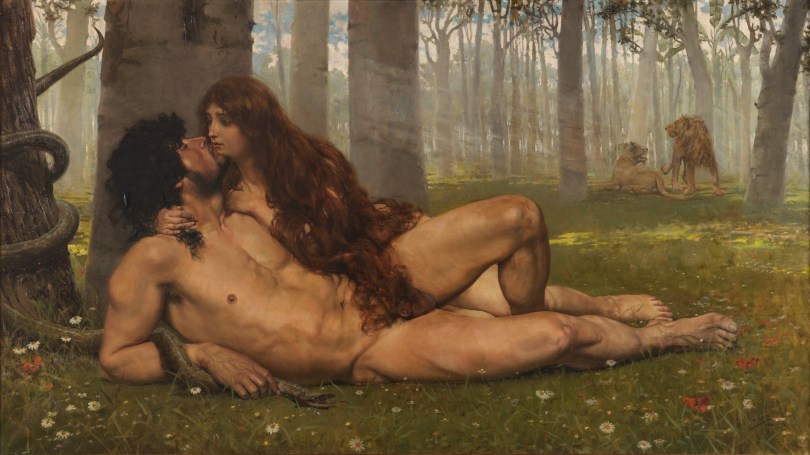
If Jesus called God his Father, there is no reason to invent the virgin birth. You don’t need to prove that God is Jesus’ Father. If Jesus said so, that would be good enough. His having a human father wouldn’t change that. The answer to the mystery is that Jesus never called God ‘Father,’ but rather ‘Mother.’ Jesus was the Son of God because God, in the person of Mary Magdalene, convinced Jesus that he was Adam reincarnate, and that She was Eve reincarnate. And Eve didn’t come from Adam’s rib, but Adam was Eve’s son. The virgin birth of Jesus from Mary replaced the ‘virgin birth’ of Adam from Eve.

You can infer that from Christian theology. God announced there would be enmity between the offspring of the serpent and that of the woman (Genesis 3:15). Christians see it as a prophecy predicting the coming of Jesus. They believe the seed of the woman refers to the virgin birth of Jesus, while it was Adam’s. That made Mary the New Eve. In this manner, Mary became the replacement for Eve. It is, however, doubtful that those who invented the virgin birth also came up with this.

Eve being Adam’s mother and Jesus calling God his Mother contradicts the Jewish scriptures. You can’t have that, so you have to work on that fact to make it fit. So, why not say Jesus was born of a virgin instead? After all, Jesus was Adam, and Eve was a ‘virgin’ when she gave birth to Adam. And God’s name was Mary, just like Jesus’ mother, while God was Jesus’ Mother. That was very convenient indeed, a convenience provided by providence, no doubt. Mark and Matthew both name Jesus Mary’s son, perhaps because she played a prominent role during Jesus’ ministry and was present at the cross.

Cloak and dagger

The Virgin Mary appeared more frequently to people than Jesus and performed more miracles than any other saint. There is little or no evidence of many of these supposed miracles, but the Fatima Miracle had 40,000 witnesses, so there should be no doubt that something spectacular had happened there. God the Father doesn’t appear in this way. And there are no 40,000 witnesses who saw a miracle that the Father announced. That is because there never was a Father. Virgin Mary became such a potent figure because she is the cloak behind which God the Mother has hidden Herself so far. Now, we are at the cloak-and-dagger part: the Quran boasts a hidden secret.

In the Quran, Mary is the most prominent woman and the only woman mentioned by name. The Quran dedicates an entire chapter, chapter 19, to the Virgin Mary. The number 19 has great significance in Islam. Some Muslims indulge in arcane numerological explanations as to why that is so. The Quran refers to this number in the chapter named ‘The Hidden Secret.’ And so, the Quran may hold a hidden secret related to this number. The Quran also claims Mary was a virgin, thus confirming the miracle of the Mother Goddess. The Virgin Mary became the cloak behind which God hid Her identity.

The star and crescent became Islam’s symbol. It has a long history predating Islam, as it was associated with a Moon goddess. In the Bible, the moon refers to the woman and the star to the child (Genesis 37:9). Hence, the Islamic symbol represents the Madonna with the child Jesus or the relationship between Khadijah bint Khuwaylid and Muhammad. She was fifteen years older. A woman of Her age could have been his mother.

The St. Mary of Zion Church in Ethiopia is said to contain the Ark of the Covenant. Legend has it that the Ark came to Ethiopia with King Menelik after he visited his father, King Solomon. The Ark symbolises Mary of Zion. The Ark is supposed to be the residence of Yahweh, the God of Israel.2 That is remarkable, as God’s name was also Mary.

Statue storm

The Protestant Reformation was an attempt to return to Christianity’s roots by viewing Scripture as the sole source of Christian truth. The Protestants ended church traditions that lacked biblical grounds, including the veneration of the Virgin Mary. Nothing in the Bible justifies the cult of Mary. Protestants removed icons and statues from their Churches because one of the Ten Commandments prohibits making images for worship (Exodus 20:4-5). In the Netherlands, the Protestant Reformation caused a ‘statue storm’ where Protestant religious vigilantes ravaged Catholic Church interiors.

Protestantism developed in an era of emerging rationalism and naturalism. And so, Protestants also object to magic and superstition, deeming it Satan’s work, while Catholics love miracles like healings at Lourdes and weeping Mary statues. Miracles have always been part of the Catholic tradition.

The Protestants erased an essential part of Christianity’s original message of the Mother Goddess giving birth to Her son. Instead of getting closer to the truth, the Protestants wandered further from it. And it didn’t solve anything, but only generated more confusion. The Protestants soon began fighting among themselves over the interpretation of the scriptures. You can’t be wrong, because if you are, you end up frying eternally in Satan’s ovens. That was the reason Protestantism started in the first place. So, after the Protestant storm is over, we have over 45,000 branches of Christianity.

Latest revision: 9 December 2025

Featured image: Madonna and Child, Kunsthistorisches Museum Wien. Public Domain.

Other images: Isis with Horus. Metropolitan Museum of Art. Wikimedia Commons. Public Domain; Saint Mary Bolnichka Icon. Wikimedia Commons. Public Domain.

1. Church of Our Lady Mary of Zion. Wikipedia.

The Last Adam

Adam is the Son of God (Luke 3:38) and Jesus the Firstborn of all Creation (Colossians 1:15). Was Jesus Adam reincarnated? And was Adam born? Firstborn means you are the family heir, so the Firstborn of All Creation means you inherited the world. That is the standard interpretation with which most scholars would likely agree. The Christian doctrine states that Jesus already existed with God before creation and thus was not Adam. That is not what the words say, nor is it what Jesus’ inner circle believed. Existence before creation is not the same as being born. And Adam was the Son of God. When Paul was busy writing Colossians, he was also working on Christian theology, and his thoughts were still in a state of flux. And so, there may be more to it than theologians can explain.

Theologians regurgitate a century-old, pre-chewed menu of previous generations of theologians. Do theologians ever come up with something new rather than yet another insight on a hair-splitting detail? Do they discuss the simulation argument? No! They occupy themselves with century-old controversies. Why would Jesus sacrifice himself for Adam’s transgression? It makes more sense if Jesus believed he was Adam, who had to redeem himself. That was an idea Paul entertained for a while, for Jesus thought he was Adam. Only that generated serious theological problems. How could the perfect sinless Jesus also be the sinner Adam? And so, his mind ground on. Eventually, Christians came to believe that Jesus existed before creation, as laid out in the Gospel of John.

Don’t blame theologians for not being sufficiently imaginative. You could easily go astray. That ireful cloud that led the Israelites out of Egypt in a 2,500-year-old Jewish fairy tale was Eve from an even older Iraqi fairy tale, who gave birth to Adam, which the surviving Jewish version of the Iraqi fairy tale doesn’t mention. And by the way, that cloud from the fairy tale was Judge Deborah, the first historical person in the Bible. She started the Jewish nation by slaying Israel’s enemies and claiming that a magical cloud named Yahweh did it. She later married Jesus as Mary Magdalene and Muhammad as Khadijah bint Khuwaylid. You can’t guess it unless God gives you the clue that unlocks the mystery.

The message of Jesus being Adam still features in Christian doctrine as a remnant of an original belief. Jesus is the New Adam, and his birth mother is the New Eve, which implies that Jesus married his mother in a previous life. And precisely that was the original message of Christianity. Paul compares Jesus to Adam. In Romans, he writes, ‘Just as through the disobedience of the one man the many were made sinners, so also through the obedience of the one man the many will be made righteous.’ (Romans 5:19)

Paul didn’t blame Eve for the Fall. Later writers posing themselves as Paul cast the blame on Eve. But Paul, a god-fearing individual who still knew the truth, wasn’t that daring. In 1 Corinthians, Paul noted, ‘As in Adam all die, so in Christ, all will be made alive.’ Jesus thus became the redeemer for Adam’s Fall. Paul called Jesus the Last Adam (1 Corinthians 15:45). Jesus being Adam’s reincarnation was an early Christian belief until the narrative changed to Christ’s existence before creation. And so, you only find the comparison in Paul’s letters, the earliest surviving documents of Christianity.

The Quran underpins the idea that Jesus is Adam. You have to read between the lines. Jesus was like Adam in the way he was created (Quran 3:59), and the Quran supports the Christian claim that Jesus was born of a virgin (Quran 3:47, 19:16-22). Hence, they are both ‘born of a virgin.’ Not really, of course, but people believed it. And several Quran verses state that God ordered the angels to prostrate before Adam (Quran 2:34, 7:11, 15:28-29, 17:61, 18:50, 20:116, 38:71-74). The Quran mentions it seven times, making it appear significant. And seven times, Jesus says ‘I am’ in the Gospel of John, stressing his supposed divinity.

The Epistle to the Hebrews claims that God made Jesus, the firstborn, into the world, superior to the angels and made the angels worship him (Hebrews 1:1-7). And if the Quran is a message from God, the presumed guy in the sky, who possesses superpowers but is not Superman, and also not a man, then Jesus could be Adam. The Quran also claims Jesus will return (Quran 43:61). If he were Adam, God’s firstborn, who had already returned once, he could. Otherwise, it all gets even odder than it already is.

Latest revision: 16 August 2025

Mohammed receiving his first revelation from the angel Gabriel

Religious Experiences and Miracles

The Jewish people still exist after 2,500 years, while they have not had a homeland for most of the time. That is a remarkable feat. Then Christianity replaced the existing religions in the Roman Empire in one of history’s strangest twists. Somehow, the message of personal salvation through Christ caught on. In the third century, Manichaeism emerged as a new religion. It taught that there was a struggle between the good spiritual world of light and the evil material world of darkness. The prophet Mani, who grew up in a Jewish-Christian Gnostic sect, claimed to have received revelations meant for the entire world, which were to replace all existing religions. It instantly became a spectacular success, spread everywhere in the known world, and could have overtaken Christianity, but it didn’t. A pivotal, and possibly decisive, moment was the conversion of Emperor Constantine to Christianity in 312 AD. He made Christianity the favoured religion in the Roman Empire.

A few centuries later, a small band of Arab warriors established an empire that stretched from the Atlantic to India, spreading the new religion of Islam, in an even stranger and more rapid historical development. Is it a realistic scenario that the supposedly illiterate camel driver Muhammad became a crafty statesman after seeing an angel telling him he came to deliver messages from the God of the Christians and the Jews? After Muhammad’s death, his followers went on to defeat the Byzantine and Persian empires. At the same time, Manichaeism made a one-way trip into the dustbin of history, while in the third century, it appeared to be on the verge of becoming the world’s leading religion. So, why did Mani fail and why did Muhammad succeed? Historians can explain it, but it is an account of what happened rather than an explanation. The question remains, could it occur without someone pulling the strings?

So much can happen, and what happens now has once been extremely improbable. Your reading this text here and now seems highly unlikely a few decades ago. Think of all the things you could have done instead. Or you could have been dead. Yet, you wouldn’t consider your reading this text a miracle. Proselytising religions like Christianity and Islam have a built-in inclination to grow. That may not be the ultimate answer. Jews, Christians, and Muslims worship the same deity. Our universe could be a simulation, and someone could have planned it. But who is to say it couldn’t have happened otherwise?

When Islam arrived on the scene, Jews, Christians and Zoroastrians in the area already believed in an all-powerful creator. Muhammad had met them on his travels, so he was familiar with these religions. Before that, Christianity had faced an uphill struggle. While the Roman state suppressed this religion, pagans left their gods behind and accepted the Christian God as the only true God. And they did so in large numbers.

That begs for an explanation, even though the conversion of Romans to Christianity was a gradual process that took centuries. The Romans occasionally half-heartedly persecuted Christians and executed a few thousand of them over the centuries, not for being a Christian but for not paying their respects to the Roman gods. Despite that, the number of Christians increased 2-3% per year between 30 AD and 400 AD. Each Christian may have converted just one or two persons on average. Over time, exponential growth enabled Christianity to grow from about 100 followers in 30 AD to 30 million by 400 AD.

Such a gradual and steady growth over centuries was somewhat unique for a religion, and so was the blitz conquest of Islam later on. Most people in the Roman Empire, and everywhere else for that matter, lived miserable lives. The promise of an eternal blissful afterlife may have been too tempting for those poor, wretched souls to resist. However, the most often cited reason for conversions was stories about the miracles Christians performed.2 Only in the Middle Ages did the sword become the most compelling Christian argument as Christianity spread further and became integral to European politics. That was not the case in the Roman Empire, so miracles and stories about them were crucial.

An early miracle was Jesus’ appearance to a few followers after his crucifixion. The New Testament mentions miracles that the disciples allegedly performed. These accounts may be exaggerated, but the theme of miracles remains a consistent one in Christianity to this day. The Roman Catholic Church has a rich folklore surrounding relics that are believed to possess magical properties because they are said to have been touched by Jesus. The most famous relics are the Crown of Thorns in Paris, the mysterious Holy Grail, the chalice from which Jesus is said to have drunk, and the Shroud of Turin, a piece of linen cloth with a supposed image of Jesus’ face.

Many of the miracles attributed to these relics are unverifiable or can have other causes, such as luck, but a few cannot be easily explained away. The Roman Catholic Church keeps a record of them. On message boards, people tell stories about prayers heard and miraculous healings. Many of these stories may result from chance or other causes, such as a misdiagnosis or someone seeking attention by lying, but that is not always the case.

A recurring theme is the appearance of the Virgin Mary and other miracles related to her. Thousands of people have seen her. She appeared several times in Venezuela. She revealed herself to Maria Esperanza Medrano de Bianchini in 1976, who received exceptional powers. She could tell the future, levitate, and heal the sick. In Egypt, Mary appeared at a Coptic Church between 1983 and 1986. Muslims have also seen her there. There have been many more Virgin Mary appearances. The most notable sequence occurred in Portugal at Fatima between 13 May and 13 October 1917.

The grand finale was on 13 October 1917, when the Sun reportedly spun wildly and tumbled down to Earth, radiating in indescribably beautiful colours, before stopping and returning to its normal position. Some 40,000 attendants witnessed Mary’s performance. They had gathered because three shepherd children had prophesied that the Virgin Mary would perform a miracle on that date and location. Faking this was hard to do, considering the technology available in 1917. A lack of holographic equipment would have made the effort challenging, not to mention changing the location of the Sun, which is a large ball many times larger than Earth, thus making it difficult to move around. And somehow, the Sun only moved in Fatima, which can only happen in virtual reality.

Jesus also appeared a few times, but less frequently than the Virgin Mary. An intriguing account comes from Kenneth Logie, a preacher of the Pentecostal Holiness Church in Oakland, California, in the 1950s. In April 1954, Logie was preaching at an evening service. During the sermon, the church door opened. Jesus came walking in, smiling to the left and the right. He walked right through the pulpit. Then he placed his hand on Logie’s shoulder. Jesus spoke to him in a foreign tongue. Fifty people witnessed the event. Five years later, a woman in that same church suddenly disappeared. Jesus took her place. He wore sandals and a shiny white robe. He had nail marks on his hands, which were dripping with oil. After several minutes, Jesus disappeared, and the woman reappeared. Two hundred people have seen it. It was on film as Logie had installed film equipment, because strange things were happening.3 Such events can convince people that the message of Christianity, even though it may seem highly peculiar, is correct, as Zeus and Thor failed to show up and perform some tricks.

Mary and Christ are part of a folklore where genuine experiences mix with mental cases seeking attention or con artists profiting at the public’s expense. Usually, there are no 40,000 witnesses, verifiable evidence, or camera footage of what occurred. The Vatican is troubled by the self-proclaimed seers, fortune tellers, prophets, and messengers who believe they have a special bond with the Virgin Mary or have weeping Madonna statues, which they may or may not have prepared to weep. These people could be delusional, crave attention or, like the televangelists in the United States, be after your money. That is not always the case. If you have a religious experience, don’t suffer from mental conditions impairing your judgment, and can’t think of naturalist explanations, you should believe what you see. To quote Shakespeare’s Hamlet, ‘There are more things on heaven and earth, Horatio, than are dreamt of in your philosophy.’

Latest revision: 5 September 2025

Feature image: Mohammad receiving his first revelation from the angel Gabriel. Miniature illustration on vellum from the book Jami’ al-Tawarikh, by Rashid al-Din, published in Tabriz, Persia, 1307 AD. Public Domain.

1. Sapiens: A Brief History of Humankind. Yuval Noah Harari (2014). Harvil Secker.
2. The Triumph of Christianity: How a Forbidden Religion Swept the World. Bart Ehrman. Simon & Schuster (2018).
3. How Jesus Became God: The Exaltation of a Jewish Preacher From Galilee. Bart Ehrman. HarperCollins Publishers (2015).

Diocletian's Aqueduct in Split, Croatia

The Great Collapse

Lessons of history

Societies and civilisations have collapsed in the past, so history can teach us something about what awaits us. Theories about collapse are speculative. Different explanations are possible. Whereas the debates between the experts are still raging, time is running out. Collapse could be coming. It will be brutal if we don’t prepare. We should heed the lessons from history. It may turn out we were wrong. But that is for the critics in their armchairs to observe someday when their lives aren’t at risk. And they will have the benefits of hindsight. We can only make the best decisions with our present knowledge.

The fall of the Western Roman Empire is the most well-known example of collapse. In the second century AD, diseases reduced the Roman population, eroding the empire’s tax base. The empire had a long border to defend, so emperors became increasingly desperate for revenues to finance the military. Over time, taxes and measures to ward off invasions became intolerable for Roman citizens, and the Western Roman Empire broke down. Most Romans were better off with a simpler life under the rule of Barbarians.1

The population of Rome declined from 1,000,000 around 100 AD, of which many lived on government welfare, to a scanty 30,000 around 1000 AD, a drop of 97%. Most of that decline occurred in the fifth century when the empire collapsed. More than half the people live in cities today, so a possible collapse is something we should dread. Many of us depend on markets and public services. We don’t know the future, but economics drives migration. If our civilisation doesn’t collapse and living in cities is more resource-efficient, cities may not depopulate, provided people in cities can earn an income.

The Western Roman Empire was underpopulated, and the state had become a burden. Its collapse thus was a relief to many. Other collapses were worse. The Mayan civilisation broke down because the Mayans ran into the limits of their environment. The immediate cause of their collapse was drought due to a lasting drop in rainfall. State control led to increased efficiency in food production and distribution. It allowed the Mayans to feed more people who would have starved otherwise. However, the measures to increase food production had stretched their environment to the breaking point, so improving agricultural output became increasingly difficult.1

The Mayan states then reverted to warfare to plunder each other’s crops, making it even harder to maintain agricultural output. The Mayans weakened from malnourishment and warfare, and the Mayan states collapsed together. In the short term, the peasants were better off as they didn’t pay taxes to support a state. In the long run, with irrigation works and granaries abandoned and defences neglected, agricultural output collapsed, and population numbers dropped by 90%.1

That is why we should dread collapse. There will be a lack of order, and people will organise themselves in gangs. Your and your group’s survival depends on assessing other people’s intentions and killing those who might kill you. And you don’t know, so you must guess what others are up to. And it is better to be safe than sorry, so you might decide to kill people as a precaution. That may be a good script for a thriller. However, most of us prefer to live less adventurously. Had the Mayans not waged wars but cooperated peacefully to use resources more efficiently and reduce population, their civilisation might have declined more gracefully and could have survived. That was unthinkable because of the intense competition between the states and the absence of contraceptives.

Causes of collapse

History shows a repeating pattern of overshoot and collapse. A population would grow until it reached the carrying capacity of the environment. As a result, there would be fewer food surpluses to save for harvest failures. Eventually, civilisations would succumb to disease, an invasion by neighbouring tribes, weather fluctuations, or civil war. The crucial difference with the present situation is that technology stayed the same in the past. In recent centuries, technological innovations, most notably our improved ability to acquire energy from fossil fuels, have outpaced the forces contributing to collapse. The danger is that the overshoot and the coming collapse can be worse than previous ones. The advantage of new technology is that it doesn’t need to be terrible and that we can lead agreeable lives.

Jared Diamond sees five factors contributing to past collapses: climate change, which also occurred in the past, hostile neighbours, the loss of trading partners, environmental problems, and society’s response to these challenges. The underlying cause is often overpopulation.2 Increased resource extraction efficiency allowed more people to survive, worsening the situation. That was true for the Mayans but not for the Romans. The Romans had hostile neighbours but not overpopulation. Higher population numbers could have helped the Roman Empire survive.

Joseph Tainter argues that in both cases, the costs of the state exceeded the benefits. The Western Roman Empire was underpopulated, so the Romans couldn’t afford the taxes required to defend their long border. The Mayan states organised agricultural production and were initially successful. However, at some point, additional state interference didn’t generate more crops or better management of surpluses and deficits. Overpopulation or overstretching the environment puts a premium on organising, but it postpones the inevitable. And it makes the collapse worse. Had the Mayans not organised themselves in states, they would have had less food, fewer people, and no collapse.

Our predicament looks more like that of the Mayans than the Romans. Competition between states and corporations for resources may intensify, and the collapse could be brutal. Simplification and having fewer children is a way out, and we can be better off if we cooperate globally to limit consumption and reduce our populations. That doesn’t happen because it is a collective action problem only a world government can solve. Governments compete and try to boost population numbers. Ending the competition between states is paramount because power, in the form of a prosperous economy, population and military, requires resources and energy. If one state pursues power in this way, others follow.

In times of decline, even the best leaders look bad as they can only make things less lamentable than they otherwise would have been. As we notice the deterioration but don’t experience the alternative, anger and frustration can take over, and people will look for scapegoats, resulting in political instability, a breakdown of order, civil war and mob rule. Managing and turning the decline into a more graceful simplification is the best option, but that requires commitment and discipline from everyone.

Organising to solve problems

Tainter sees societal collapse as an economic calculation. Societies and civilisations collapse when the cost of their institutions exceeds the benefits. If the soil depletes due to overuse, measures to improve crop yields or manage surpluses and deficits become increasingly expensive and have lower returns. The Mayans didn’t make these calculations by keeping ledgers of incomes and expenses. At some point, their measures became ineffective, and people started starving. There is an upside to an economic view. It can help us decline gracefully and make the most of what we have.

We organise ourselves in states and corporations to solve problems. We have police to solve a security problem. We have a car factory to deal with a transportation problem. Complex organisations, like states or corporations, have costs and benefits. When you solve a problem, you may get a bigger one in return, or one is more costly to handle. When societies are simple, expenses are low, while the benefits of solutions can be substantial. A doctor’s post in the jungle might lengthen the life of local tribespeople by as much as twenty years. As the level of organisation increases, the price of additional complexity increases while the benefits decrease.

As we cure easy-to-treat diseases, people grow older and get harder-to-treat diseases. If our medical knowledge increases, we can cure some of these diseases with expensive treatments, and people will die of even harder-to-treat diseases. Medical costs explode with only marginal gains in life expectancy. Replacing the doctor’s post in the jungle with a hospital might cost five times as much and add only three years to the lives of the tribespeople. Perhaps five tribes together could afford the hospital. In complex societies, many tasks require occupational specialisation, information processing and management. There are benefits to complex organisations, but they usually come with scale. Physicians who specialise can do better jobs when enough people share the costs.

Since the Industrial Revolution, markets and energy usage expanded. Abundant fossil fuels and increases in scale have reduced the cost of organisation. And so, the benefits outweigh the expenses at a much higher level than before, allowing us to specialise further than before. In the past, over 90% of the people worked in agriculture, tilling the land. Now machines do that work, freeing up labour for other purposes. The same happened in the production of goods and services. Technological development further increased these benefits. Computers use far less energy than forty years ago for the same amount of computing power and memory. That made more uses feasible, so we use far more energy for information technology than forty years ago.

It is the curse of efficiency improvements. When technology becomes more efficient and cheaper, we use so much more of it for frivolous purposes that, as a result, we consume far more resources and energy in the end. Efficiency improvements thus don’t solve our problems and even worsen them. Once resources and energy supplies dwindle, much of what we do now will lose its purpose, just like what happened to the Mayans. Still, technological advances allow us to do much more with the same resources and energy, so if we use new technologies for essential purposes, our future can be agreeable.

Diminishing returns: an example

Life expectancy in the UK rose from forty to eighty years between 1860 and 2020. However, the costs of new complex treatments increase while their effect on life expectancy decreases. These treatments can become a burden to the population at large. Comparing the United States with Cuba illustrates the benefits of simplification. Cuba is poor compared to the United States. Many essentials are hard to come by, and the country can barely feed its people. Cuba only has rudimentary healthcare, but it is available to everyone, while the United States spends more on healthcare than any other nation. Yet, life expectancies in Cuba and the United States are on par.

Cuban healthcare gives value for money because it is simple and equally distributed. US Healthcare underperforms because it is burdened with litigation, while pharmaceutical corporations sell unnecessary or even harmful treatments and medical professionals enjoy privileges they don’t have in other countries. And healthcare is not equally available to everyone. Lifestyle affects life expectancy as well. Obesity, homicides, opioid overdoses, gang violence, suicides, road accidents, and infant deaths come into the picture.

Americans use drugs, eat fast food and drink sodas unavailable in Cuba. Cubans are dirt poor, so it isn’t profitable for drug cartels to sell them drugs. The death toll from drugs, fast food and sodas in the United States exceeds that of famines in Cuba. Americans experience more stress as workers than Cubans because they need to be competitive in a market economy that is constantly economising and improving efficiency. Many Americans die of heart disease and drug abuse.

If you grow your food and your neighbours help you build your home, nothing gets added to GDP. Eating fast food, paying high rents, drinking sodas and being treated for obesity and other diet-related illnesses are good for profits and economic growth, as are working hard and taking drugs or seeing a psychiatrist for stress symptoms. Sodas, treatments for obesity, medication and therapeutic sessions all add to GDP. Economists call it wealth creation. It may help to explain why America is wealthy. In the United States, a small group of politically connected big corporations and specialists, such as lawyers, pharmaceutical corporations, and medical specialists, make lots of money.

In complex societies, highly trained professionals earn much more than ordinary people. In some cases, we are better off without them. Imagine how much cheaper things would be if we eliminated lawyers and litigation. And think of what it will do to GDP. Indeed, Americans might be better off poorer. The Old Order Amish are happier than the average American worker. The causes of Amish life satisfaction are not a mystery. Being part of a supportive family, being a member of a well-integrated community, having a religion, and regular physical exercise all contribute to a happy life.

Managing excess


Excessive production and consumption create problems we must subsequently manage. That requires specialisms, laws, controls, and the like, and it becomes increasingly costly. And people get the impression that governments are to blame when they impose limits. Complexity and specialisation suffer from diminishing marginal returns. The costs increase while the benefits decline. Consider the issues of food production and pollution control. According to Tainter, rising world food production by 34% between 1951 and 1966 required increasing tractor expenditures by 63%, fertilisers by 146%, and pesticides by 300%. We now deal with soil degradation, which endangers our future food supply.1

Pollution control shows a similar pattern. Removing all organic waste from a sugar processing plant costs 100 times more than removing 30%. Reducing sulphur dioxide in the air of a US city by 9.6 times or particulates by 3.1 times raises the cost by 520 times. These numbers may be outdated, but the nature of the problem remains the same. Allocating more resources to R&D can provide temporary respite from diminishing returns. But R&D also has diminishing returns.1 We might increase production or contain pollution, but it can become prohibitively expensive, so it might be cheaper to produce less.

Like the Mayans, we have stretched our environment to its limits. New technology and control measures postpone the inevitable. The alternative is to consume less and have fewer children. We can do without many things, or we can produce things differently. Stable supplies of large quantities of fossil fuels sustain our current complex civilisation. Unstable supplies of renewable energy can drive a simplification. If we compensate for carbon emissions, fossil fuels become expensive, and it can be economical to reduce energy consumption and rely on renewable sources. As a result, pressures can mount to decentralise and live more simply. If we do not create problems, we do not need to fix them. For instance, what is the point of pollution legislation if there is no pollution?

When we simplify our lives, we depend more on our family and community and less on markets and states. We use local products where possible. And we have little need for people who manage the complexity. Nowadays, more than half the people live in cities, so we can’t switch overnight. Even if we simplify our lives, we can have more agreeable lives than most people for most of history. If we manage the collapse, we can be better off than we would have been otherwise. And we can adapt. The 80/20 rule states that 20% of the causes have 80% of the effects. So, 20% of our consumption might cause 80% of our well-being. Thus, our well-being might decline by 20% when we reduce resource and energy consumption by 80%. Those who lead excessive lifestyles should make the sacrifice.

Latest revision: 21 August 2024

Featured image: Diocletian’s Aqueduct in Split, Croatia, built around 300 AD. User: SchiDD. Wikimedia Commons.

1. The Collapse of Complex Societies. Joseph Tainter (1988). Cambridge University Press.
2. Collapse: How societies choose to fail or survive. Jared Diamond (2005). Viking Press.