Simulation hypothesis

In ancient times, philosophers speculated that we can’t tell whether the world around us was genuine or whether other people also have minds. Perhaps I am the only one who exists, while the rest of the world is my imagination. It could all be a dream. Some religions claim that gods created this universe and that we are like them. According to the Bible, God said, ‘Let us make mankind in our image, in our likeness.’

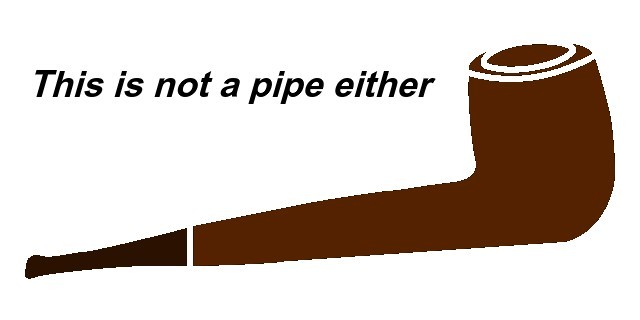
For a long time, we couldn’t tell why this world might not be authentic or how the gods could have created it. That changed with recent advances in information technology. This universe could be a simulation. We believe that our senses register an outside reality so that we ignore evidence to the contrary. You may think you see a pipe when watching an image. The caption of the famous painting, The Treachery of Images, by René Magritte, makes you notice: this is not a pipe.

In 1977, science fiction writer Philip K. Dick was the first to assert that our reality must be computer-generated. In a press conference in France, he described his psychotic experiences and strange coincidences that led him to believe this world is fake. He told the audience that his lost memories returned in full for unknown reasons. He also claimed to have had a vision. And a scenario Dick wrote came true. And so, he thought what he had found was of momentous importance to humanity, so he organised that press conference. His last name suggests our Creator, if there is one, likes sexist jokes.

The idea that we live inside a computer-generated world is known as the simulation hypothesis. We could all live in a simulation created by an advanced humanoid civilisation. Professor Nick Bostrom explored the probability of it in the simulation argument. According to Bostrom, there could be many different human civilisations. The humans in those civilisations may, at some point, enhance themselves with biotechnology and information technology, live very long, and acquire capabilities that ordinary humans don’t have. For this reason, these beings are no longer humans, making them in need of a new name, which became post-humans. A post-human might be a biological creature, a humanlike artificial intelligence or a combination of both. They might be brains in vats or have no physical bodies at all.

These post-humans might experience an urge to run simulations of their human ancestor civilisations, so we could be living in one of those simulations. Bostrom argues that at least one of the following options must be true:

  1. Nearly all human civilisations terminate before becoming post-human.
  2. In any post-human civilisation, only a negligible number of individuals develop an appetite for running simulations of their human ancestor civilisations.
  3. We almost certainly live inside a computer simulation.1

The argument comes with the following assumptions that seem increasingly plausible due to the recent developments in artificial intelligence, but are not proven:

  • The computing power of post-human civilisations suffices to run a large number of simulations of human ancestor civilisations.
  • It is possible to simulate human consciousness in a computer.1


Bostrom concludes that if you think our civilisation will one day become post-human and run many simulations of human ancestor civilisations, you must believe we already live inside one.1 It is a matter of probability. If we invent this technology in the next 10, 100 or 1,000 years, it won’t happen later than that. By then, we will have done it. But millions of years have passed when it could have happened, so it probably did. If we do it within 100 years, and it could have happened a million years ago, the chance it already happened might be (1,000,000 – 100) / 1,000,000 = 0.9999 or 99.99%.

Non-humanoid civilisations are probably not interested in running large numbers of simulations of humans. They might run a few for research, perhaps to investigate human behaviour, but it seems unlikely that our emotions and history entertain beings entirely different from us. Thus, most simulations of human civilisations will likely be run by post-humans.

Non-humanoid civilisations are probably not interested in running large numbers of simulations of humans. They might run a few for research, perhaps to investigate human behaviour. Still, it seems unlikely that our history and emotions interest beings that are entirely different from us so that they will run billions of simulations of human civilisations. And if they exist, they must first learn to travel faster than light to find humans. Thus, post-humans will likely run most simulations of human civilisations. So, our Creator, if there is one, is probably humanoid, but that doesn’t necessarily mean human.

It is a problematic argument. Philosophy is the art of not accepting the obvious because the possibilities are boundless. The obvious often isn’t the case. But with the information we do have, it is our best guess. We think of God as having a human nature because we imagine God. And so, the God in the Bible appears to have human character traits. Conversely, when God imagines us, God probably is humanoid. We would create virtual realities with humans if we could. That is the reason why. However, because we imagine God, that is what we imagine. It seems obvious, but that doesn’t mean it’s true. It is only what our imagination and the evidence suggest is most likely. But we know very little. We can’t go outside the simulation and check.

The simulation argument comes with uncertainties. Post-humans might lack sufficient computing power. Recent developments in quantum computing suggest otherwise. Alternatively, nearly all human civilisations die out before building these simulations. Alternatively, post-humans have evolved and differ from us, so they aren’t interested in running simulations of humans. We may only know this once we have become post-humans. Bostrom doesn’t try to guess the likelihood of the options. He thinks we have no information about whether this universe is real, but that is incorrect. There is evidence.

Latest update: 18 July 2025

Featured image: Inspired By The Treachery of Images.

1. Are You Living In a Computer Simulation? Nick Bostrom (2003). Philosophical Quarterly (2003) Vol. 53, No. 211, pp. 243-255.

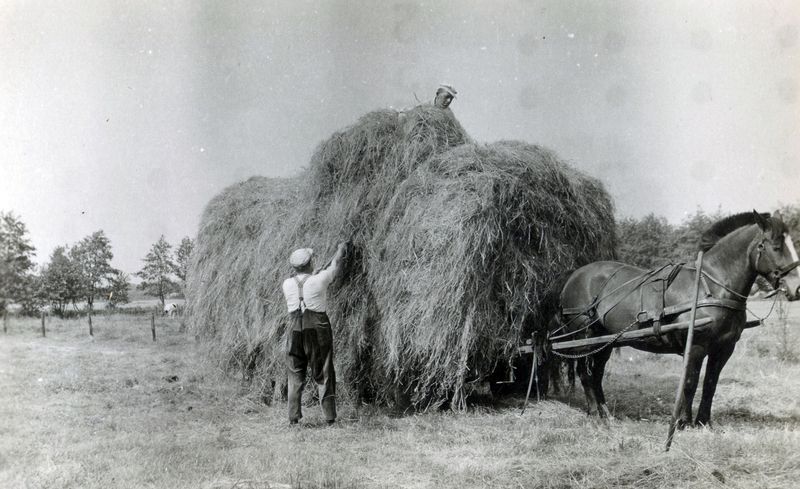
Life in Vragender in 1949

From Community To Society

The time we live in

We can’t choose the time we live in, but when and where we live determines our options. If you lived in Germany in 1620, you couldn’t go on vacation by aeroplane to Spain, watch television, or post about your life on Instagram. And you didn’t know what happened in China. Look at all the choices we have today. There are shampoos for every type of hair and from several brands. And that is just shampoo. In 1620, you washed your hair with water or not at all. Today, countless products are on the market to cater for every possible desire. Everything has been made easy. But despite the infinite options and comfort, we have no choice but to live in a civilisation heading for collapse.

My life has always been comfortable. We had a car, television and central heating. But life hasn’t always been like that. My parents had a very different childhood. It was the life most people led since time immemorial. My grandparents were subsistence farmers. They grew most of their crops themselves. They had a few animals they could slaughter. The winters were cold. There was only one stove. At first, they had no electricity, telephone, car, radio or television. And that was just two decades before I was born. My son grew up with computers, the Internet and smartphones.

My father loves to talk about the old times. Before he went to school, he milked the cows. There were lots of chores. My mother’s childhood had also been like that, but she rarely discussed it. My mother’s family was reticent, while my father’s family was outgoing. Their lives completely changed in two decades. Not so long ago, most people lived in villages and worked with their hands using their judgment. Nowadays, many of us live in cities, sitting behind screens, watching graphs and checking parameters. Our lives are very different from those of our grandparents. People in the past depended on family and community. Today, many of us rely on the market and the state.

My father’s life

My father grew up on a remote farm near Vragender, a small village in a rural area. They had no machines and relied on horses to do the heavy work. My mother grew up on an even more remote farm near Beltrum in the same region. They were Catholics. My mother had three sisters and three brothers. My father had two brothers and two sisters. My parents’ parents grew a few crops. They had a horse, a few cows, pigs, and chickens. Neighbours were important. If a farmer fell ill, they would step in and run the farm. Shortly after World War II, my father’s father erected a windmill with batteries. Electricity from the grid came in 1952.

My father recalled that the local shop owner came by and showed them a radio. My grandfather didn’t like to spend money on a luxury item, so the shop owner said he could try the radio a month for free. After a month, my grandmother and aunt discovered a radio show and wanted to keep it. And so, they pressed my grandfather into buying a radio. In the same fashion, a television came in a decade later. My father recalled when he saw a car for the first time. He was biking with his father and said, ‘When I grow up I want to have a car too.’ My grandfather tried to teach him some realism, ‘You will never own a car. Only the physician, the notary and the mayor have cars.’

In the 1960s, the Netherlands had become wealthy. I was born in 1968 and have never known poverty. It may be easy to forget that most people in history have been poor and that many people today still are. But my father often reminded me of how his life was. Our comfortable lives come from hard work. We shouldn’t take it for granted. My father worked long hours as a manager of a road construction company. ‘To give us a good life,’ he said. He truly loved his job.

My father is an outdoorsman and a hunter, and he knows how to slaughter animals. He is well aware of what happens in nature, such as the struggle for survival in the animal kingdom. Most people nowadays go to the supermarket to buy their food. At best, they have a vague notion of farmers, crops, and livestock. My father grew up on a farm, so he finds it hard to accept that city people are concerned about farm animals’ living conditions. ‘They know nothing about farm life or nature,’ he says.

My father is politically conservative, innovation-minded, and interested in improving things and new technologies. He often talks about his career at the road construction corporation, where he had worked most of his life. He started as a foreman, later became regional manager, and ended up on the board. He worked hard to get ahead. He studied while others watched television.

As a manager, he was keen on learning the newest management techniques from Japan, such as giving people in the workplace more responsibility to manage their affairs. He believed in progress. When the first home computers became available, he bought one for me. ‘Computers will be the future, so you must learn about them,’ he told me in 1984.

My father worked hard. But what good did it bring? Resources are running out because we made poor choices like building roads and driving cars. My father sees other problems. There are too many regulations, frauds with public funds, immigrants, big corporations not paying taxes, dictators starting wars, people obstructing building projects with litigation, and greedy managers. Somehow, things didn’t get better. But why? With technological change came changes in how we live. Our forbears lived in communities. Today, we live in societies.

Modernisation

Modernisation is not primarily about technological change. It is about the dramatic changes in how we live and organise ourselves. You can order a pizza with your smartphone. No one did that a century ago. Not cooking your meal is a lifestyle change. It requires organisation. The ingredients must be present at the pizza restaurant, and employees must be present at opening hours to prepare and deliver the meals. Everything has to work like clockwork.

Thus, a crucial change was living by the clock. Our forebears didn’t have clocks, agendas, or appointments. It began with the Industrial Revolution. Operating a factory requires workers to be present when the factory is in operation. Employers and employees agreed on working hours. Time became money. Being late was costly. Trains had to run on schedule to bring people to work and appointments.

Another crucial change was the transition from communities to societies. Not long ago, most people lived in villages with their families and didn’t work for corporations. Their social life happened within the family and the community. The Industrial Revolution changed that. Large-scale production requires large markets, the free movement of labour and capital, and communication between strangers.

People who had previously lived in villages moved to towns to work in factories. Nation-states and national languages replaced local governments and local dialects. Nation-states set up schools to turn people into citizens who could play their role in a larger-scale society. Individuals learned to identify with nation-states rather than villages. It changed how people lived and looked at themselves,

Consider a young peasant, Hans, who grew up in a small village in Saxony. Hans lived a fixed life in the village. He lived in the same house as his parents and grandparents. He was engaged to a girl whom his parents found acceptable. The local priest had baptised him. And he planned to continue working on the same plot of land as his father. Hans never asked himself, ‘Who am I?’ The people around him already had answered that question for him. Then he heard that opportunities were opening up in the rapidly industrialising Ruhr valley, so he travelled to Düsseldorf to get a job in a steel factory there.

Hans is now living in a dormitory with hundreds of young men like himself, coming from all over northwestern Germany. People speak different dialects. Some of the people he meets are not German at all but Dutch or French. He is no longer under the thumb of his parents and local priest and finds people with different religious affiliations than those in his village. He is still committed to marrying his fiancée, but some local women have caught his interest. He feels a bracing sense of freedom in his life.

At the same time, Hans is troubled. Back in his village, friends and relatives surrounded him. They knew him and would support him during sickness or a poor harvest. He does not have that kind of certainty about the new friends and acquaintances he has made and is wondering if his new employer, a big corporation, will look after his interests. He heard that Communist agitators were pushing to create a trade union in his factory, but he has heard bad things about them and does not trust them either. His part of Germany had become part of a large empire, of which he can feel proud, but it is barrelling forward to an uncertain future. He feels lonely, disconnected and nostalgic for his village, but for the first time, Hans can choose how to live his life.

Hans’ story characterises the transition from community to society. Industrialisation made millions of Europeans move from their villages to the cities in the nineteenth and twentieth centuries. Today, the same happens in countries like India and China. Hans didn’t think, ‘Who am I?’ Nevertheless, his view of himself changed. He had more choices than in the village. Did he become happier? That remains unclear. In areas where there is little industrialisation, cities also grew. In 1800, only 7% of the world’s population lived in cities. In 2023, it was nearly 60%.

Once traditional values become optional, you experience freedom. Or you may feel confusion and a longing for the clarity of the tradition once provided. Society, rather than your community, now answers the question of who you are and what group you belong to. Hans was no longer a villager in Saxony who was his father’s son and would inherit his farm, but a Protestant from Germany. Nationality, ideology and religion came to define us.

Twenty-first-century consumerist societies have a variety of identity groups, and the Internet makes it easier for like-minded people to find each other. Identity has become a choice like buying products in a supermarket. You can identify yourself as a Madonna fan, a supporter of a soccer club, or a prepper. Marketers use these identities to sell us their merchandise. In the case of preppers, canned foods to survive the coming apocalypse.

Larger scale

Societies are communities on a larger scale. Communities provide solidarity between individuals who know each other. In a community, there is social control. Shared values keep a community together. If the community is supportive, others help you, and you come to their aid. Not all communities are like that. And even if you live in a supportive community, life is not great if you don’t fit in. So we shouldn’t have romantic views about communities. They are a way of organising like states and markets, with benefits and drawbacks.

What was informal as a tacit agreement in communities became formalised as law in societies because people don’t know each other personally. Instead of neighbours helping each other, societies provide welfare. Bureaucratic controls replace social controls. If adequately applied, bureaucratic rules are less arbitrary because the support you get from your community may depend on the cohesion within your community and how much others like you. On the other hand, some people misuse bureaucratic systems and cheat on taxes and benefits.

The people living in a society must identify themselves with it and share its values. Otherwise, they might commit acts of violence, engage in crime, cheat on taxes, or misuse welfare. It helps when everyone identifies with that society. Societies coincide with nation-states, so nationalism has often been a way to achieve that. Sharing a culture and a language creates a common identity. A strong society with responsible citizens makes a difference because markets and governments can’t create agreeable societies alone. Sharing a culture and a language helps, but it isn’t required. A shared ideology or religion can achieve the same.

We will not gracefully return to villages and subsistence farming when civilisation breaks down. Communities have given way to societies where people rely on markets and governments rather than neighbours and family. They go to the supermarket for groceries and don’t grow food themselves, nor do they make or mend their clothes. They expect to buy what they need on the market and the government to care for them when they can’t. They won’t survive an electricity failure that lasts more than a month. What drove us into this corner? It is competition and the benefit of scale. We can’t compete in the market without specialising and innovating, and the promise of wealth lures us into leaving communities to enter societies. And so, lifestyles have entirely changed. And it may happen again in the coming decades.

Latest revision: 21 August 2024

Featured image: Picture from Vragender where my father came from (1949). http://www.oudvragender.nl.

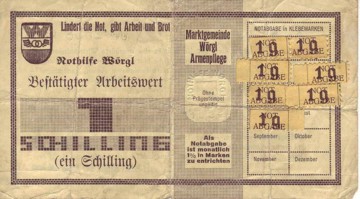
Wörgl bank note with stamps. Public Domain.

Cash for Negative Interest Rates

The problem with cash

Dealing with cash is cumbersome for both businesses and banks, so they are increasingly opting for digital payments. It helps to reduce their costs. Increasingly, people are opting for digital payments over cash. Geezers might still prefer to pay with banknotes and coins, but youngsters often don’t. These are the primary reasons why banknotes and coins could soon go extinct. The authorities have also sought to reduce the use of cash because it has long been the preferred method of payment for criminals.

Cash still plays a significant role. In the European Union, people mainly use them for small transactions. Cash can become an attractive investment when interest rates are negative. In Switzerland, where interest rates have been the most negative at -0.75%, 1,000 franc banknotes and safe deposit boxes were in short supply. And so, interest rates below -1% seem impossible as long as cash yields zero.

When depositors take their money from the bank, the bank can run into trouble. That may happen when interest rates fall below zero. A holding fee on central bank money, including cash, of 12% per year, can make it attractive to lend money at negative interest rates, like -2%, as you don’t pay the holding fee on loaned funds. Bank deposits are money lent to banks, thus loaned funds. You may keep your money in the bank when interest rates are negative because cash has a lower interest rate.

Cash as a loan to the government

In Wörgl, the townspeople bought stamps and glued them to the banknotes to keep them valid. It would be more practical if we didn’t have to glue stamps on banknotes. And a holding fee of 12% per year would make cash unattractive. The charge doesn’t need to be that low to prevent people from withdrawing their money from the bank and putting it in a safe deposit box. If the interest rate on cash were a bit lower than the interest rates on bank accounts, that would be enough to stop people from hoarding banknotes.

When cash is a loan to the government, the interest rate on cash could be the same as the interest rate on short-term loans to the government. That rate would be better than the holding fee and could be as low as -3%. There can be an exchange rate between cash and central bank money. The value of cash would gradually decrease at a rate of 3% per year, and you don’t have to glue stamps on banknotes to keep them valid. The situation resembles 3% inflation, but it is a negative interest rate.

That difference is crucial because negative interest rate currencies may not require government or central bank management. They provide financial stability themselves. There is no money shortage due to interest charges, so there is no permanent need to expand debts to sustain the usury scheme, which requires government and central bank management. With negative interest rates, the money supply can be stable or even shrink without adverse consequences for the financial system or the economy.

Human psychology

Negative interest rates visibly reduce the currency balance in your account, while inflation operates more stealthily, by robbing you while you believe you get more. Wage changes are more noticeable than price changes, as some prices decrease while others increase in value. Even when negative interest rates and deflation are a better deal, and even if we all know it, we might not opt for them. The phenomenon is known as the money illusion. We resist a reduction in monetary units, even if it would make us better off.

It also affects how we look at negative interest rates. When interest rates are negative, money disappears, so inflation is likely to be lower, and prices may even decrease. That could be a better deal for depositors if their real return were higher, but most people dislike seeing their account balance decrease due to a negative interest rate. They might get edgy about their money vanishing into thin air. Negative interest rates sparked outrage among some Belgian depositors, who demanded a ban on these rates.

We prefer the illusion of a small gain that amounts to a loss in reality to the illusion of a similar loss that is, in fact, a better deal. It is not rational, but human psychology is the way it is. We are emotional beings that can think rather than thinking creatures with emotions. There is a fix: hiding negative interest rates and making them appear as inflation. To explain how we can look at the characteristics of Natural Money:

  • The administrative currency carries a holding fee of approximately 12% per year. If you own this money, €1.00 turns into €0.88 after a year. It can make lending at negative interest rates attractive.
  • Interest rates on bank accounts might be around -2% per year. Depositors don’t pay the holding fee, but the interest rate the bank offers.
  • Cash is a short-term loan to the government and carries the interest rate of short-term government loans, which might be -3%.
  • The administrative currency and cash become separate currencies. Cash gradually loses value relative to the administrative currency.

Making cash the money in people’s minds

When bank account statements are in cash currency rather than administrative currency, the public doesn’t notice that the interest rate is below zero. The interest rate on short-term government loans is one of the lowest. Banks must be able to offer at least this interest rate so that people won’t see their balance shrink due to negative interest. And if shops express their prices in the cash currency, it will become the currency in people’s minds.

If the interest rate on cash is -3%, its value decreases by 3% per year in terms of the administrative currency. If a bank offers an interest rate of -2% and settles the account in cash, the interest on the bank account appears to be +1%. And if the deflation rate is 1%, prices go down by 1%. Meanwhile, the value of cash decreases by 3% in the administrative currency, so prices in the cash currency increase by 2%. And so, the public experiences 2% inflation.

You can see it as a deception to prevent people from deceiving themselves. People get aggravated by negative interest rates, but largely ignore inflation. They also fall for the illusion of getting more when interest rates are positive. When the interest rate on bank accounts is 1% and inflation is 3%, you would lose 2% in purchasing power per year by holding a balance in a bank account. A 1% loss is a better deal for depositors. Natural Money can improve the economy, allowing real interest rates to be higher.

Critics might argue that we could be fooled by this scheme, just like inflation fooled us before. We won’t notice the negative interest rate, just like we did inflation before. Separating cash from the administrative currency and expressing prices and the value of bank accounts in cash currency can clear the psychological barrier that stands in the way of the public adopting negative interest rates.

The administrative currency remains the accounting unit in the financial system for bank accounts, debt, and interest, as well as the prices of financial assets, such as stocks and bonds. A similar situation existed in Europe between 1999 and 2002. After introducing the digital euro, cash continued to be the national currency. With Natural Money, the maximum interest rate of zero applies to the administrative currency and not to the cash currency, so interest rates in the cash currency may be above zero.

Latest revision: 1 November 2025

Featured image: Wörgl bank note with stamps. Public Domain.

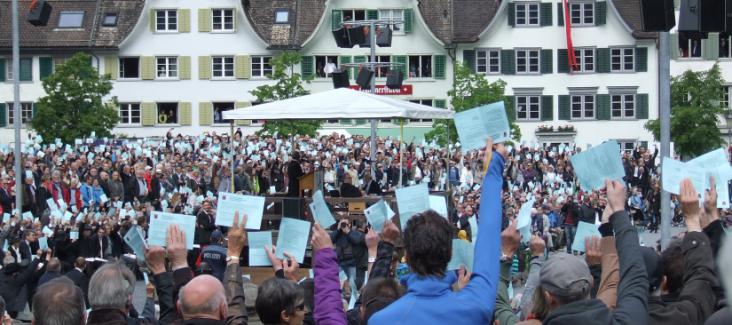
The assembly of the canton Glarus

Swiss democracy

Quality of government

The ideal of a democracy is that the people determine what their government does. Usually, citizens elect politicians every few years. These politicians then make the decisions. Quite often, these decisions differ from what their citizens wish. The reasons may include lobbying, deal-making, party politics, and political games. Leaders may also earnestly believe that going against the will of their people is for the best. Unburdened by responsibilities, citizens may have unrealistic desires.

Democracy doesn’t guarantee high-quality decisions, so there have always been pundits questioning the merits of democracy. No form of government guarantees high-quality choices. It is helpful to distinguish between the quality of the government and its decisions and the quality of democracy. Improving governance is far more complex than improving democracy, which is relatively straightforward, and the subject of this section, which can remain relatively brief for that reason.

In a well-functioning democracy, the government acts following the will of the citizens. In this respect, one political system stands out: the Swiss system. The great thing about it is that it is a proven concept rather than a figment of a political philosopher. In Swiss democracy, authority operates from the bottom up. It is a design flaw, as the world is interconnected, so our choices have consequences for people in other parts of the world. That is why, in most states, including democracies, authority operates top-down.

Features

The Swiss political system features a unique combination of representative and direct democracy. The government and parliament administer the country’s daily affairs, but if citizens feel the desire to take matters into their own hands, they can demand a referendum. The government must respect its outcome.1 Switzerland has the following referendum types:

  • mandatory referendums on changes in the federal constitution
  • optional referendums on federal laws when a specified number of citizens ask for it
  • Similar rules exist on the state and municipal levels.

Switzerland has 26 cantons, which are akin to member states, and over 2,000 municipalities that enjoy a significant degree of autonomy. The Swiss constitution promotes making decisions at the lowest possible level and delegating power to a higher level only if deemed beneficial.

The Swiss elect their National Council every four years. It has proportional representation. Citizens can vote for a political party, as well as for specific persons on the party’s candidate list. The Swiss can cast multiple votes, often one for each available seat in their constituency, allowing them to vote for several candidates and parties.

Switzerland also has a Council of States. All the Cantons have seats, for which there are also elections. Most have two, and a few smaller Cantons have one. Decisions require a majority on the national level in the National Council as well as among the Cantons in the Council of States. The Swiss citizens can overturn these decisions in referendums.

The seven-member Federal Council, elected by the National Council and Council of States together, handles the daily affairs of government. All the major political parties have seats in it. The Federal Council aims for consensus but may revert to voting if it is impossible to reach an agreement. Referendums ensure that this hardly happens.

Evaluation

Referendums have the following consequences:

  • The combination of representatives and referendums keeps citizens in control while unburdening them of daily government affairs. They don’t have to vote on every single matter, but can vote on an issue if they feel it is necessary.
  • Referendums are yes-or-no questions. Before crafting laws, the government consults with various interest groups and considers their concerns. That prevents laws from being voted out in referendums.
  • Whatever choices are made, they are the citizens’ choices. It can breed a sense of responsibility as citizens live with the consequences of their choices. If things go wrong, they can’t blame their politicians.
  • There are fewer political games, coalitions, and deals, as citizens can vote out laws they disagree with. It also promotes stability and cooperation. The largest political parties are in government and aim for consensus.

The distribution of power has the following consequences:

  • There is no single decision maker with a lot of power, such as the President in the United States. The Federal Council performs the daily task of governing, and the largest political parties all have seats in it.
  • Proportional representation in parliament enables multiple political parties that align with the preferences of voters. Small shifts in voter preferences have a minimal impact on the political landscape.
  • The Swiss National Council represents the federation, while the Council of States represents the Cantons. A decision requires a majority in both. This provision aims to safeguard the interests of the rural cantons with smaller populations.

Considerations

Switzerland doesn’t have a Constitutional Court or a House of Parliament to ensure that the Constitution and human rights are respected. Switzerland is bound by the treaties it signed. The Swiss political system is one of the most democratic, but it tends to be conservative. Women received the right to vote only in 1971, as only men could vote.

The Swiss political system is one of the most democratic in the world. And it has safeguards that provide political stability. As referendums are yes-or-no questions, laws require careful crafting and consideration of the concerns of citizens. There are several theories about democracy, but the Swiss political system has proven to work.

In the Swiss political system, authority is decentralised. Delegation of responsibilities is bottom-up. It works from lower levels to higher ones. Most states have a top-down delegation. It flows from the higher levels to the lower ones. That is preferable as decisions in one district can affect other districts as well.

It is also the case at the global level. Switzerland is sovereign. It has been a freeloading country as Swiss banks have been a haven for criminals, tax evaders and dictators from other countries. Had the people of those countries had a say in this matter, that would not have happened. In a global democracy, every world citizen has an equal say.

Latest revision: 11 July 2025

Featured image: The assembly of the canton Glarus. Democracy International (2014). [copyright info]

1. Switzerland’s Direct Democracy. http://direct-democracy.geschichte-schweiz.ch/ [link]

Most viewed posts

Over the last three years more than 70 posts were published on The Plan For The Future. That is an average of one post every fifteen days. And 65 WordPress users started following this blog. Some posts have been viewed more often than others. This is the top 5 of posts based on page views.

The miracle of Wörgl

During the great depression of the 1930s a local currency in the small Austrian town of Wörgl produced an economic miracle. It demonstrated that the economy can do well without more debt if the existing money keeps circulating. This may be the key to keeping the economy afloat without more debt.

Read More

Mother Goddess Eve

Was Eve a goddess and was she the mother of Adam? And did Jesus believe this too because Mary Magdalene told him so? And what is the evidence? Reality can be stranger than fiction, most notably when our reality itself is a fiction created by an advanced civilisation.

Read More

New World Order

The direction of history is towards a single integrated world order. The world is becoming one intellectually, economically and politically. The world is now run by a global elite of business people, politicians, bureaucrats, engineers, journalists, scientists, opinion makers, writers and artists.

Read More

The curse of The Omen

Rumours go that some films have been cursed. The evidence is not always convincing. The Omen stands out. Events took a stranger turn in the Netherlands. And when I began to investigate the most peculiar event of the curse, strange things happened.

Read More

There is a plan for the future

In 1914 Archduke Franz Ferdinand was assassinated in his car in Sarajevo. This triggered World War I. The car had licence plate number A III 118, a possible reference to the Armistice of 11 November 1918  ending the war. So could history be script? And could there be a plan for the future?

Read More

Feature image: Piet Mondriaan painting (1921). Public Domain.