The first thing someone told me about ghosts was that they are fake. That person was probably a schoolteacher. Before that, I hadn’t heard of spooks. Ghosts are fairy tales, the teacher said at primary school. Several years later, I went on a school trip and visited the Singraven Estate near Denekamp. The custodian told us that a spook dwelt inside the manor, upsetting things, but he added that we shouldn’t fear it. We could safely enter. It is better not to put faith in spooky stories about venues that depend on tourist income. The facts that are beyond doubt aren’t spectacular. They are lame indeed.
As a teenager, I also visited Twickel Castle in Delden, located near Denekamp, but it did not have such a spooky reputation. I recently learned that this castle also has ghostly phenomena. The castle doesn’t advertise itself as a ghostly venue, which makes the claim more believable. Only one source on the Internet mentions it. If it is true, the laws of physics went out the window, at least temporarily. The author preferred that I quote her work. She wrote,
Recently I heard a strange tale from the phlegmatic steward of Twickel Castle in Delden. An English restorer who had come to restore some antique cupboards was given permission by her to stay overnight in an attic room of the castle. After he had been there for a few days, she saw that he had put his mattress on the floor.
She asked him why he slept on the floor and not on the bedstead? He answered her unmoved that he had been pushed out of bed for three consecutive nights. To prevent it from happening again, he had decided to sleep on the floor from then on. He had not been bothered since then. The steward asked him if he didn’t find that creepy? His answer was calm and clear: ‘No, I’m from England.’1
That is what the stiff upper lip is about. You might not believe it if you haven’t witnessed similar things occurring in your own house. So that is why I am inclined to believe it. There are plenty of ghost tales that go around. Most are hearsay. On the Internet, you can find lists of ghost tales like 10 Eerie Real-Life Paranormal Encounters to Creep You Out on Listverse.com.2 The list is fact-checked, which means the stories happened unless witnesses lied and got away with it. You are about to read one story from that list. It was also on CNN. The CNN article allows paranormal investigators to share their unscientific claims about crisis apparitions. An explanation that doesn’t conflict with science is that we live inside a virtual reality. So, here is the story,
Nina De Santo was closing her New Jersey hair salon when she saw Michael, one of her customers, standing outside the shop’s window. He had become a good friend. He had been going through a tough time after his wife left him. Nina had tried to cheer him up. When she opened the door, Michael seemed happy and transformed. He smiled at her and said he wanted to thank Nina for everything she had done for him. They chatted, and each went their way. The following day, Nina received a call from one of her employees. Michael’s body had been found the previous morning, nine hours before Nina had spoken to him at the salon. He had committed suicide.2
In 2014, a couple named the Simpsons asked the regional news channel Fox43 in the United States to visit their haunted house in Hanover, York County. DeAnna Simpson, the wife, mentioned that entities were haunting the home. She and her husband had lived there for seven years. She caught ‘ghosts’ on film. They had scratched or even attacked the guests. DeAnna had invited priests, paranormal researchers, and the crew of the TV show The Dead Files into her home, who then uncovered ‘evidence’ of ‘grisly deaths’ that had occurred there.3 When the Fox43 staff came in, something invisible scratched their photographer.
In March 2018, my wife woke me up in the middle of the night. She said, ‘The bathroom door is locked, and our son is sleeping in his bed.’ You can only lock the door from the inside. The lock needs force, so this can’t happen by accident. My wife feared a burglar was hiding inside. I took a knife from the kitchen to unlock the door while she was standing behind me, holding a heavy object to smash into the head of the burglar. Only, I never believed there was a burglar. So many unusual things had happened already. And I was right. There was no burglar.
So, what to make of this? The goings-on at Twickel Castle and the Hanover house are undoubtedly peculiar. Nina De Santo’s story is mind-boggling. In my home, the laws of physics didn’t always fully apply either. It made me wonder. I have seen it happen, and so has my wife. And if there is no naturalistic explanation, is this evidence of ghosts? Not necessarily. If you believe ghosts are real, you think science is crap. And I don’t. The simulation can play into our imaginations and fears. And ghosts are as unreal as we are. There may not be more to it than that. That at least makes sense.
Latest revision: 18 July 2025
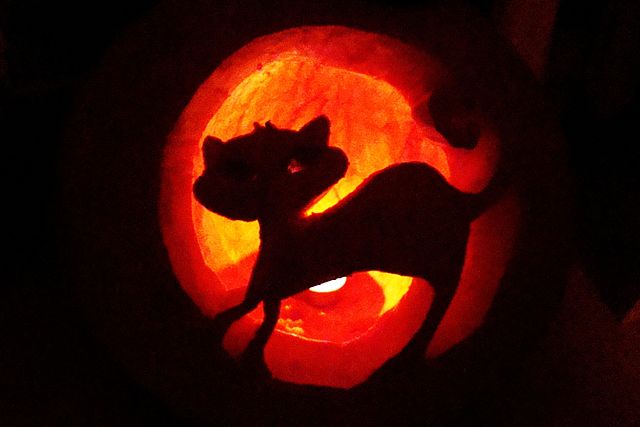
Featured image: Halloween cat from Poland. User Silar (2012). Wikimedia Commons. Public Domain.
1. Betoverd door: haunted houses. Theracoppens.nl. 2. 10 Eerie Real-Life Paranormal Encounters to Creep You Out. Listverse.com (2022). 3. A haunted Hannover home. Civilwarghosts.com. [link] 4. Why those TV ghost-hunting shows are transparently fake. Scott Craven (2019). The Republic. [link]
Whether or not we have free will is an ancient philosophical question. Ancient Greek philosophers already reasoned, ‘This happens because of that. Everything that happens could be an endless sequence of causes and effects.’ We feel we make our own choices. If I went out to buy a garden gnome yesterday, I am inclined to think I could as well have decided not to go out shopping or to buy something more useful instead, like an inflatable Santa Claus that says ‘Ho ho ho’ when you pinch his nose. If I could go back in time, I might have done something different, or so I believe. But if I had felt an uncontrollable urge to buy that garden gnome, I would have considered myself subjected to forces beyond my control.
And some things are beyond our control. Our biology and culture limit our options. You can’t simply stop breathing or run faster than the speed of sound. Those who have tried, failed, or died. And it is hard to do things that go against the prevailing will of society or your family and friends unless you don’t care about other people’s opinions, which might be something you have no control over. But it seems you have options. Choices like buying a garden gnome don’t raise controversy, and you appear free to make them.
Recent advances in neuroscience have enabled scientists to observe brain activity associated with decision-making. And that was quite revealing. Our choices originate in our brains several milliseconds or even longer before we become aware of them.1 The evidence suggests that there is no free will in the sense we traditionally believe it to exist.
This traditional idea of the will is that it is a force of its own. Nothing else causes it. It is rooted in the belief that we have a mind, a spirit or a soul that is separable from our bodies. This idea is at odds with scientific findings that our minds are a result of chemical brain processes. Not having a will is not the same as predestination, as it doesn’t rule out the possibility that we could make different choices if we were to go back in time. Our choices could still be random, like the throw of a dice. A dice doesn’t have free will, either.
Religious people face questions like, ‘If we have a free will, how can God know what we will choose?’ Or conversely, ‘If God knows what we will choose, how can we have a free will?’ The most straightforward answer is that there are two levels, so the level of us mere mortals, who make their plans, and the level above, that of the Supreme Puppet Master, who pulls the strings and determines what we will choose. That is not free will at a higher level, but at a lower level, it is. Somehow, some people remain fascinated by this question.
At least we experience making choices. These choices might be illusions, but the feelings that accompany them aren’t. It is the experience of choice that ordinary people understand as free will. When you go through an emotional struggle before buying a garden gnome, the emotions are real, even if they are chemical processes in the body. And so, free will as experience exists. And it is pointless to argue that even if you could go back in time, you could not have done otherwise, because you can’t go back in time.
Predetermination raises several questions. One is about punishing criminals as retribution rather than to protect the public. A desire for reprisal is a human emotion. But it seems unjust to hold people responsible for actions they can’t control. Often, criminals lack a proper upbringing or have psychological issues. And punishing offenders rather than addressing the underlying causes increases the likelihood of recidivism. In our experience, moral rules and punishment matter, just as free will does, and we experience having a choice. That is the point of punishing criminals. And it can deter calculating individuals. It is good to address social problems and prevent crime whenever possible. However, not catering to feelings of justice and the desire for reprisal undermines the moral fabric of society. Rules and punishment are in our nature.
Compatibilism says we have free will, even when our choices are predetermined. It is similar to the Christian concept of having a moral choice, while God knows what you will do. It becomes logically consistent if you introduce two levels: one of daily experience and another of the underlying reality. It is a practical approach which allows us to make moral choices. Morality is more than just following rules. It is about doing the right thing. However, the entire concept of morality hinges on the assumption of freedom of choice.
The second question deals with fate. If you are going to die on a preset day, then what is the point of seeing a doctor? Alternatively, you could opt for a dangerous hobby like mountaineering, for you will live until a specific date. But you don’t know that date. So, if you go to a doctor who cures you of an illness that would otherwise have been fatal, that would be predetermined. If you choose not to go to the doctor and you die, that would also be predestination. The same applies to abandoning a hobby such as mountaineering versus the alternative of perishing on the slopes of Mount Everest.
The third deals with premonitions and accurate predictions insofar as they are not attributable to fraud or chance. Why can fortune-tellers sometimes make accurate predictions? And why are their predictions unreliable at the same time? The answer is it is impossible to know the future. If I knew I would have a car accident tomorrow, I would remain home, and the accident wouldn’t happen. Predictions can influence the future, unless they are vague or hidden. In 1914, no one could have guessed that the licence plate number on Franz Ferdinand’s car referred to the end date of the upcoming world war.
So, if I pass a sign saying, ‘You will have a car accident tomorrow,’ it can only be a sign if I laugh about it and discover it was a sign the next day. Premonitions and accurate predictions require more than predestination. If you have a suspicion that proves correct, it is not you knowing the future but the one giving you the premonition. Predetermination suggests that we are like characters in a story, much like the comic book character Spiderman. Spiderman may realise he is a comic character in a story, but only if that is the script. Spiderman can’t change the script, but the script’s author can make him believe he can. That would be a delusion on the part of Spiderman, for you can’t escape destiny.
That is also how voodoo works. The practitioner of voodoo puts needles in a doll, and the targeted subject suffers intense pains simultaneously, but there is no causal relationship. There is no magic. The underlying cause is a scripted coincidence.
Predetermination allows for accurate predictions that defy chance. Actions taken to prevent these predictions from being fulfilled must fail, which requires a lack of information on the actors involved. Oedipus fulfilled the prophecy of killing his father and marrying his mother. He didn’t know that the couple he believed to be his parents were not his true parents. Fearing the prediction, he fled, which led to a sequence of events that made the prediction come true. That is why the prophecies of ancient Greek oracles only made sense in hindsight. And so, as predictions, they were pretty worthless.
Latest revision: 23 July 2025
Featured image: Aruba sunset. English Wikipedia.
1. The clockwork universe: Is free will an illusion? Oliver Burkeman. The Guardian (2021).
Evolution theory suggests we are an animal species that evolved from apelike creatures and that chimpanzees are our nearest living relatives. In other words, we are much like the other animals. Indeed, animals can experience joy and suffering like us. A central ethical rule is not to cause unnecessary pain and suffering. So, if ethical considerations apply to our fellow humans, they might as well apply to other animals. Nature does not have ethics, but ethics are part of our nature because we can place ourselves in someone else’s position and feel compassion. Compassion helped us as a species, as did aggression, but in a utopian society, ethics take precedence.
Suffering is something a conscious mind experiences, but consciousness comes in different levels. You can beat a stone, but it does not feel anything. A plant is less aware than an insect if it is aware at all. An insect has less awareness than a fish. And fish are less conscious than mammals. And we may relate more to animals that are more like us. That is why mammals elicit the most sympathy. And so, murdering a cow feels very different from killing an ant.
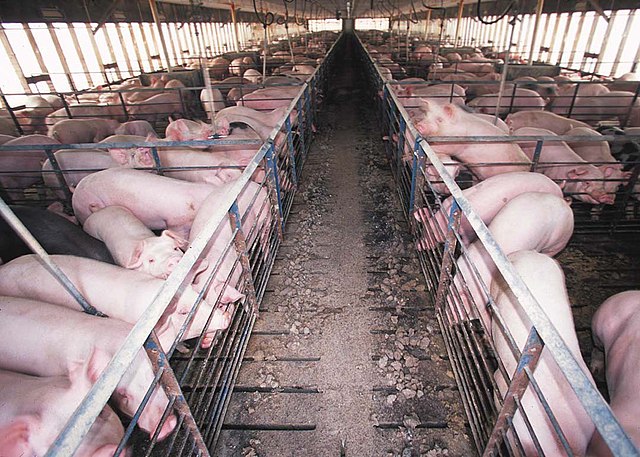
We care more about people we know than strangers, so we may also care more for our pets than people in faraway countries. The suffering that goes unnoticed does not affect us. Only when we see the misery, for instance, in factory farms and slaughterhouses, do we become aware of it. But once we know, we can react in different ways:
Not caring. You may have more urgent problems than animal welfare.
Accepting. You could argue that meat is a natural part of our diet.
Doing something. You might become a vegan.
Humans have been murdering animals since time immemorial. And our distant forebears drove several animal species to extinction. So, why stop now? Today, humans dominate the planet, and much of the remaining wildlife is under threat. Hence, it may not be a luxury to ask ourselves some questions like should there be animal rights like there are human rights? And if so, what rights should animals have? Animals themselves do not think they have rights. Respecting nature and animal suffering are reasons why we think about animal rights. But those considerations can conflict with each other. So whatever choices we make, they can raise controversy.
Even when we think animals have rights, animals transgress our moral rules, for instance, by murdering each other. After all, predators eat prey, and nature does not care. It is survival of the fittest. Should we stop them from doing that? Some species go extinct because of our actions, while others profit. Rats, cockroaches, and crows do well where humans have disrupted the balance in nature. Should we restore the balance in nature? And, if you own a cat and allow it to go outside, you contribute to a bird massacre. In the Netherlands alone, cats eliminate twenty million birds per year. Should you keep your cat inside or not keep a cat at all? And should we control pests? Probably so because pests threaten us.
And what about eating meat? Meat has been on the human menu since time immemorial. It provides us with some of the nutrients we need. There may soon be artificial meat and replacements with those same nutrients. And so, we might end the suffering of animals in the meat industry. Animals in the meat industry often live under miserable conditions, but in some areas like the European Union, there are regulations regarding the welfare of animals on farms. If animals cannot behave naturally, they experience stress and suffer, for instance, when confined to small spaces.
These European animal-welfare regulations conflict with practical economic considerations. For instance, what to do with a pig that resists stepping into the truck that brings it to the slaughterhouse and gentle prodding does not help? Transport companies and slaughterhouses must make money. Unruly beasts take time and can make the operation unprofitable. Whether animals in the wild always have a better life than those on farms remains to be seen. Wild animals must deal with predators, food shortages, and humans. Still, it is fair to say that ending factory farming promotes animal welfare. And we may need to limit meat consumption to reduce our impact on the planet.
In a caring utopian society, we should not make animals suffer unnecessarily. We can extend that to nature. For instance, if there is not enough food for the deer in a forest, is it not better to shoot the weak and eat their meat than to let them starve? Perhaps, you could introduce wolves, but that might cause even more misery. A deer suffers less from a clean shot from a rifle than a lengthy chase by a pack of wolves. And it gets worse when there are pastures with sheep nearby. Or do sheep lives not matter? Sheep, whether these are black or white, are mostly peaceful creatures who do nothing wrong.
If you prefer the wolves chasing deer, you believe the value of nature takes precedence over the rights of animals and that it justifies animal suffering. But nature itself does not suffer, nor does it care. And humans have profoundly disturbed the ecological balance, so unspoiled nature as it once was, is gone in most places. Letting wildlife coexist with humans can cause problems. For instance, bears are beautiful creatures, but it is better not to let them roam in cities as they are intelligent enough to adapt and may kill people. We can restore the original situation in areas where few people live, stop agricultural and industrial activities, and create large nature reserves. In other areas, we can better manage what remains of nature as a park.
A broken clock is right twice a day. At least that was so before clocks came with digital displays. In the same fashion, end-time prophets can be correct for once. The prophecies in the Bible aren’t much help in picking the date or the specifics. The Bible doesn’t even mention important historical events like the rise of Islam or the Industrial Revolution. If the prophecies come true, they will do so in a manner we can’t anticipate. We are nearing an apocalypse of some kind, so it might as well be now. Only when the time has come might we uncover the signs in hindsight, like the prophetic licence plate number on Franz Ferdinand’s car. Logic is a strange thing. If the end time ever comes, it is now closer than ever. And we are nearing the end of the world as we know it:
We ruin the Earth and turn it into a wasteland with our production and consumption. We are creating an apocalyptic environmental disaster.
As long as there are nation-states, we will have no enduring peace, and weapons of mass destruction can kill billions and make large parts of the planet uninhabitable.
Eternal life may soon be possible. At the same time, technology can go wrong, and artificial intelligence may make us redundant.
Existing religions and ideologies have failed, but we are religious creatures and need something to believe in. Without religion, we can’t fix our problems.
We may soon discover that we live inside a virtual reality created by an advanced humanoid civilisation for entertainment and that God exists.
The world has become interconnected, and ideas spread fast. If God plans a revolution, it can be as swift as lightning, taking the world’s leaders off guard.
Pop music, the unexpected medium
If the end is near, there may have been signs, and probably not in places people were looking, and not the type of signs they expected. A few Christians found Satanic messages hidden in pop music by playing tracks in reverse. Some of them even believe Satan is in charge of pop music entirely and that this horned fellow has been busy composing the lyrics in his state-of-the-art studio in that hot place called Hell. Few would have guessed that God was the composer and hid secret messages in pop music. That, however, might be the case. Even more surprisingly, you don’t have to play the songs in reverse to hear them. Only that was not for the faithful to guess.
God is a DJ This is my church
Faithless, God is a DJ
Clearly, God likes to joke around. The song ‘Strange Phenomena’ by Kate Bush suggests that a coincidence with the radio could be a sign of God’s arrival,
A day of coincidence with the radio … G arrives, funny, had a feeling he was on his way. … We raise our hats to the hand a-moulding us Sure ’nuff, he has the answer
Kate Bush, Strange Phenomena
We can interpret G as God, as the song alludes to the hand that moulds us and someone who has all the answers. Does a day of coincidence on the radio herald the arrival of God? For me, it did. Coincidences on the radio prompted me to search for these messages. Like literary criticism, this is not science but speculation, thus relying on guesswork to infer God’s intentions.
At secondary school, I did particularly poorly at explaining literature. It is about guessing the motives of book authors. My scores were consistently poor, the poorest in the class. I considered guessing other people’s motives and decoding hidden messages in texts a waste of time. There are so many ways in which you can interpret words. The authors themselves often marvelled at what the literature experts found out about their intentions from the books they had written. Art and literature are filled with fluff about feelings, quite often imagined.
With the final exams approaching, I began to fret and asked my teacher to provide me with additional practice exams. It didn’t help. The grades remained as poor as they had been before. Before the final exam, I prayed and asked God that the grade wouldn’t be too bad. Not only to my surprise, my result was the best of everyone, only equalled by a girl with a striking hairdo, a bit alternative, who dressed outspokenly and flaunted her interest in art and literature. Another classmate wondered how I had managed to pull this one off. I was too ashamed to tell. I didn’t need a higher grade while children were starving. It was a peculiar incident. At the time, there was no reason to think God was behind this, nor did it seem a harbinger of things to come.
Hotel California
Let’s do a text analysis on the famous song Hotel California by the Eagles. What is its meaning? On the Internet, you can find some answers. It could be about the lost Paradise caused by American decadence and burnout, too much money, corruption, drugs and arrogance, and too little humility. Her mind being Tiffany-twisted and owning the expensive car reflects that. The wine being unavailable since 1969 refers to the fact that in 1969, it was no longer legal to drink alcohol while you were in a drug rehab programme. Before that, you couldn’t do drugs, but you were allowed to drink alcohol. The hotel, thus, was a rehab. I see another message, not intended by the songwriters and unseen by the critics.
When She stood in the doorway, the mission bell sounded. He might be meeting God because of the mission bell. And then, he enters Paradise, thinking this might be heaven or hell. God is a spoiled woman who owns the place and is used to getting Her way. Her mind, thus, is Tiffany-twisted. She owns an expensive car. Most people think Paradise is perfect, but it doesn’t agree with human nature. There is a darkness to it. They can’t kill the beast. And you can’t escape. You can check out when you like, but you can’t leave. You can argue against this by pointing to the master’s chambers. If there is a master, she isn’t God. Indeed, seeing meaning is not science, and interpretations are dubious. I knew that as a teenager already, so I won’t argue. With that in mind, we can proceed.
From Almelo via Enschede to Eurovision
Ilse DeLange’s fourth studio album, The Great Escape, is overloaded with messages. If there had been a meter for hidden messages, it would blow up in your face when you play this album. If you read between the lines, this album comes with a message from God, Eve reincarnated, to Her husband, Adam reincarnated, to prepare himself. The album contains lyrics with parts that convey such a message. Noteworthy coincidences surround DeLange. DeLange was born on 13 May 1977, in Almelo, a town in the region of Twente, Netherlands. Almelo was also the hometown of Herman Finkers, a comedian who wrote ‘Kroamschudd’n in Mariaparochie’, a short animation picture about the possibility of Christ coming from Twente.
On 13 May 2000, the 23rd birthday of Ilse Delange, a fireworks plant in Enschede in Twente blew up, killing 23 people. That was exactly 11 years after I moved to Enschede to live on the campus of the University of Twente. I lived in dormitory 401 for five months, until 13 October 1989, a time lapse that precisely matches the events surrounding the Fatima Miracle of the Sun, which occurred 72 years later. This is the most spectacular religious miracle ever confirmed to have actually happened. And in that dormitory, lived that most peculiar Lady. The recurrence of 23 is also odd. The accident was on the day of the Eurovision Song Contest. Once the seriousness of the situation became manifest, the Dutch broadcast of the Eurovision Song Contest ended.
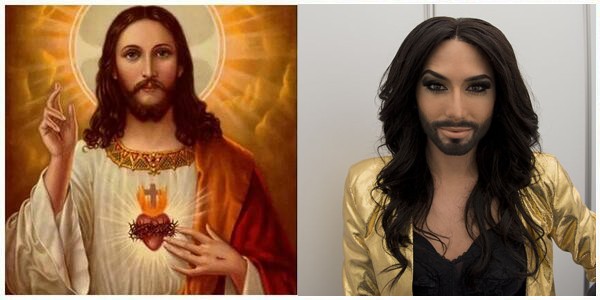
My wife had dreamt about a large fire the night before the fireworks accident. On the day itself, she visited a friend who had just given birth to a baby. Some of her other friends were also present. One of them came from Enschede. Just after my wife told this friend from Enschede about her dream, this friend received a text message asking whether she was all right. It was only then that they learned about the fireworks accident. Fourteen years later, Ilse Delange sang in the 2014 Eurovision Song Contest herself with Waylon as The Common Linnets. They came in second after Conchita Wurst, a transgender Jesus-look-alike. That is noteworthy, not only because it links DeLange to Jesus but also because early Christians performed a sex change on God in their scriptures.
Jesus and Conchita Wurst at a Meet & Greet during the Eurovision Song Contest 2014. Albin Olsson (2014). CC BY-SA 3.0. Wikimedia Commons.
The Finnish rock band Turisas dedicated a song named The Great Escape to the Norwegian king Harald Sigurdsson, who played a role in a coincidence scheme related to D-Day. His daughter died in Norway on the same day he perished on the battlefield in England, a noteworthy coincidence. The Great Escape was also the name of the fourth album made by the English rock band Blur, released on 11 September 1994, a remarkable date considering the coincidences surrounding the 11 September 2001 terrorist attacks. The total length of Blur’s album is 56 minutes and 56 seconds. Compressing these numbers results in 11:11 as 5 + 6 = 11. And 56 + 56 = 112, which is also the European emergency telephone number. The lead song of DeLange’s album, The Great Escape, lasts 4:01 minutes. I moved to Enschede to live in room 112 of dormitory 401.
The Great Escape
Ilse DeLange’s album ‘The Great Escape’ contains a message from God, the eternal Eve, asking Her prospective husband, the temporary Adam, to prepare for his task as saviour. That was not DeLange’s intention. Unwittingly, she became the channel for this particular communication. As Finkers already noted, a lot was going on in Almelo, such as traffic lights switching colours. Mediums make misses alongside accurate guesses. The messages blend into the lyrics like the accurate guesses of mediums mixed up with misses. The book ‘The Virtual Universe’ explains how mediums can be precise at times while making many misses. It is not a gift but scripted. It works the same way as meaningful coincidences. So, how can we interpret those songs?
In the first song, ‘Reach For the Light,’ God says She remembers and that everything he knew is lost. That makes sense if he is supposed to be Adam and doesn’t remember,
I know my name, but who’s the same when everything you knew is lost I’m filled with hope that echoes loud inside a forgotten mind
Ilse DeLange, Reach for the Light
In the second song, ‘The Lonely One’, God claims She used Her powers to make his life disagreeable. Only God can order the sun not to shine and the sky to fall on him. What She says about Herself would even make Louis XIV, the Sun King, blush,
I told the sun not to shine and stay away … I am the only princess, I am indestructible … Asked the sky to fall down on you
Ilse DeLange, The Lonely One
He probably thought his life was not great. The song ‘The Great Escape’ gives the album its name and is the centrepiece. The song says it’s autumn, and some force pulls him into the shadow world. For him, it was scary to be taken in this fashion. But it is a holy land in disguise. She says she comes from heaven,
In this holy land A desert made of quicksand … Some force pulls you in The shadow world … I was falling, falling, falling from heaven
Ilse DeLange, The Great Escape
In the next song, Carry Hope, She instructs him to prepare himself. She says the power is in his hands, and he has to make this land his own. She adds that faith calls out his name. In all his vanity, even Louis XIV, the Sun King, would not have said that when he lets go of hope, there is no one left you can follow. There is nothing but the power to believe in Her,
The power is in your hands, the dust will fall to sand Gotta make this land your own … Faith calls out your name When I let go of hope, there’s no one left to follow There’s nothing but the power to believe in me
Ilse DeLange, Carry Hope
It can hardly be more clear than that. The song Was It Love suggests She doesn’t care for religious people. They are locked inside their belief,
And they’re locked inside belief But they’re not inside of me
Ilse DeLange, Was It Love
You have to cherry-pick lyrics and the lines to get the message, so the critics might point at that. The coincidences relating to DeLange suggest that there is more to these messages than just an accidental slip of the songwriter’s mind. And DeLange comes from the Dutch region of Twente. I lived in Twente, met the Lady there, and She was born there as well. That makes it more remarkable. And then you have Finkers’ animation picture ‘Kroamschudd’n in Mariaparochie’ about the possibility of Christ coming from Twente. That is a bit too much to ignore.
Slippery slope
Lyrics by other performing artists contain messages from God. The song ‘Hotel California’ by the Eagles did get its fair share of literary criticism, as did ‘Gimme the Prize’ by Queen, and ‘God Is a DJ’ by Faithless. To access these messages, you must filter out the noise, thus selectively choosing the parts that fit, which is a very unscientific approach. Literary criticism is about seeing meaning. You can’t prove meaning as it is subjective, so seeing it is an art. And not seeing meaning is the art of being a moron. The song ‘Joga’ by Björk mentions accidents, coincidences and connecting the dots. The coincidences make sense only with one person. So God made these things happen to show him Her love,
All these accidents that happen Follow the dot, coincidence Makes sense only with you … This state of emergency How beautiful to be … All that no one sees, you see What’s inside of me
Björk, Joga
She adds how beautiful it is to be in an emergency. The emergency services telephone numbers are 112 and 911. When God demonstrates Her love for you by murdering people in accidents and terrorist attacks, that can be intimidating. And you might get the impression that you, like Jesus, have no choice but to go along with God’s plans.
Now the word goes around in certain circles that the song ‘Stairway to Heaven’ by Led Zeppelin contains hidden satanic messages that you can hear by playing the song in reverse, which is something normal people wouldn’t do. There was something there, and the artists said it was a coincidence.1 However, straightforwardly playing that same music, which normal people do, reveals something even more interesting. It mentions a lady we all know. That lady could be God. After all, the song is named ‘Stairway to Heaven’ rather than ‘Highway to Hell,’
With a word she can get what she came for Ooh, ooh, and she’s buying a stairway to Heaven … There walks a lady we all know Who shines white light and wants to show How everything still turns to gold The tune will come to you at last When all are one, and one is all … And she’s buying a stairway to Heaven
Led Zeppelin, Stairway to Heaven
It is therefore not a coincidence that the same album, Led Zeppelin IV, which features Stairway To Heaven, also includes the song ‘Going to California.’ It mentions a queen who is a woman who was never born, thus Eve,
Seems that the wrath of the Gods Got a punch on the nose and it started to flow … To find a queen without a king; They say she plays guitar and cries and sings. La la la la Ride a white mare in the footsteps of dawn Trying to find a woman who’s never, never, never been born.
Led Zeppelin, Going to California
The song The Infant King from the album Adieu Sweet Bahnhof by The Nits is about a boy king on his way to meet his Bride. The world is falling apart. The border is closed. People are packing. Gold can help you if you want to leave. That could be the End Times. But the infant king is on his way,
I tip-toe tip-toe through the sleeping train An infant king who meets his bride … Two eyes two ears nose uncertain smile A child reflected thousandfold Someone said the other day The border’s closed there’s no way in or out … My mood is changing every mile Someone said the other day The world is cracking up it’s plain to see … Two eyes two ears nose uncertain smile The infant king is on his way
The Nits, The Infant King
On that same album is the song ‘Woman Cactus’, describing a psychotic love affair of an indecent nature. His senses don’t make sense at all. She haunts him as the bar sign repeatedly prints Her name on the wall,
This is not comme il faut It’s no respectable affair … My heart, my head, my brain My senses don’t make sense at all The bar sign prints your name Over and over on the wall … I know it hurts to touch a woman With those needles and pins
The Nits, Woman Cactus
There is more, but it is a slippery slope. The farther you go, the more you slip-slide away. For the argument, the presented selection suffices.
Latest revision: 10 December 2025
Featured image: Watchmen cosplay at Comic-Con 2009. Taken on July 24, 2009. Ewen Roberts. CC BY 2.0. Wikimedia Commons.
1. The 10 Wildest Led Zeppelin Legends, Fact-Checked. Rolling Stone (2012). [link]
The purpose of our brains is to keep us alive so our genes can copy themselves, not to make us happy. Anxiety keeps us from doing stupid things. And happiness can make us complacent, and that could be fatal. There is a struggle for survival. So what is the point of new ideas, technological development and social struggle? Why do we have agriculture, industry, cities, writing, money, empires, science, property, human rights and democracy? If these things don’t make us happier, what is the point of pursuing them? The historian Yuval Harari asks this question in his book Sapiens: A Brief History of Humankind.1 Things often don’t happen to make us happier.
Our forefathers switched from hunting and gathering to crop planting and animal herding because agriculture feeds more people. It was a success for human genes, as there were more copies of them, and also for the genes of domesticated animals and plants. But it made the lives of humans and animals more miserable. By growing crops or herding animals, people had more food. But more children survived, so they had more mouths to feed and remained as hungry as before. Meanwhile, returning to hunter-gathering had become impossible as it would mean starvation. Compared to hunter-gatherers, farmers worked harder, their diet was less varied, and they had more violent conflicts.1
The competition between businesses and states drives the change. States are the most effective war machines. And writing made it possible to have states. Investors expect to profit from technological advances, or governments see a use for them, for instance, to win a war. And so, scientists fetch budgets for their research and get busy. We have smartphones because investors profit from making them. Your smartphone does not exist to make you feel better but to make you addicted. Many people now think their lives are meaningless without their smartphones.
Social reforms like equal rights for women intend to increase fairness, thereby making people happier. But it doesn’t always work out as planned. If there is a norm, for example, the man being the head of the family, many women might be content with the arrangement. Men might have accepted that women had been in charge if that was the norm. A norm gives clarity, and change brings discomfort. Feminism liberated women, and overall, it probably made women happier, but not always, and the process of changing these norms raised tensions. So what makes us happy? That is not easy to answer. It depends on our characters and circumstances. Several issues influence our happiness:
our needs
chemical processes in the body
money
our expectations
our desires
having a sense of purpose
social trust
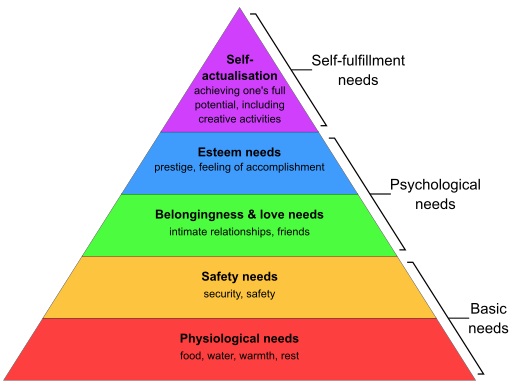
Maslov’s hierarchy of human needs
Hierarchy of human needs
Abraham Maslow thought of a hierarchy of human needs. He claimed that basic needs such as food and shelter are paramount. Once you have them, you desire security. Maslow believed that if you have food and security, you crave love and attention. And if you have all that, you want to be respected and have a sense of purpose in your life. These needs exist but not in such a neat hierarchical order.
Chemical processes in the body
Some people are always cheery despite adversity and misery. Others are always bitter and fret, even when they prosper and have nothing to worry about. That has to do with body chemistry. If cheerfulness comes from chemistry, we can be happier by taking pills. Pharmaceutics can end depression but might also give a false sense of happiness. And do pills make you better, or do you become addicted to them? The difference between prescription drugs and harmful substances like cocaine is not always clear. Nevertheless, more and more people use pills to feel better.
Money
If you are poor, some extra money will make you happier. Poor people worry about making ends meet. And that is why poor people often feel miserable. It becomes less clear once you can buy the things you need and have no financial worries. More money can make you happier, for instance, if you spend it on the right things. What is right is a personal matter. So if you can afford it, you should buy that garden gnome you always craved.
The more you have, the less extra makes you happier. Your first automobile can make you happy. You can go where you want when you want. A second car makes less of a difference. You and your husband can go to different places on the same evening, but that rarely happens. A third and a fourth car probably have no use unless you are a car collector and have a garage where you can spend your days gazing at your automobiles.
Expectations
Suppose I promised you ice cream. If you expected a small cone, but I gave you a medium-sized one, the outcome exceeded your expectations. It can make you happy. But if you anticipated a large cone and got the same medium-sized cone, the result failed to meet your expectations, and that can make you unhappy.
If you anticipated less than what you get, that could make you happy, but if you expected more, it could make you unhappy. We adapt to new situations. After a while, our happiness or sadness is gone. Having low expectations can be a path to happiness. If you expect the day to be miserable, and that does not materialise, it can make you happy.
Similarly, if you are better off than your peers, it can give you satisfaction. Alternatively, being worse off can be displeasing. Your happiness depends on the people to whom you compare yourself. The attention given to celebrities, their riches, and their beautiful husbands and wives can give you the unpleasant feeling that your life is subpar.
That can make you go to the gym or the plastic surgeon, buy things you cannot afford and turn down potential spouses who are not rich or do not look so great. The advertising industry uses this to make us buy more stuff. People in more equal societies are often happier. And we might be happier without the Internet and television.
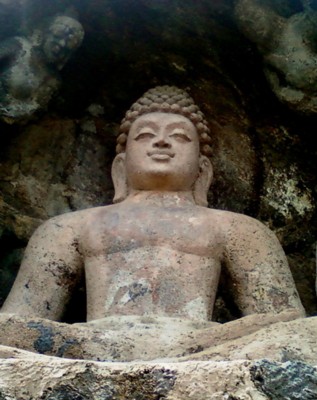
Rock cut seated Buddha statue, Andhra Pradesh, India
Craving
Gautama Buddha also weighed in on the issue. He lived 2,500 years ago and founded Buddhism. Mr Buddha taught that people crave temporary feelings and things, which causes permanent dissatisfaction. As soon as you have achieved a desired goal, such as love, or acquired a desired object, for example, a car, you will crave something else.
That ties us up in this world so our souls will reincarnate and keep suffering from craving, or so Mr Buddha said. When we stop doing that and disengage ourselves from this world, we disappear into nothingness, a state of eternal peace. So, according to Mr Buddha, happiness is about letting things go. And that became a religion.
Having a sense of purpose
Believing your life has a purpose can make you feel better. If you believe in God, you may think you play a role in God’s cosmic scheme, while atheists may believe their lives have no purpose. The psychologist Daniel Kahneman arrived at a similar conclusion. He interviewed women about their daily activities, which gave them pleasure. He also asked these women what made them happy.
Caring for their children was among the activities that gave them the least pleasure. But when he asked these women what made them the happiest, they answered that their children gave them the most joy. The children gave meaning to their lives. Maybe these women deluded themselves. Similarly, if you think your job is significant, that may give purpose to your life, but that can also be a delusion.1
Social trust
Societies can contribute to our happiness when there is social trust, which means you can trust other people and organisations. There is no social trust when your neighbours steal from you, or you fear that they do, criminal gangs roam the streets, corporations dump their toxic waste, the government spies on you, or you need to carry a knife or a gun to protect yourself. Wouldn’t life be better if you don’t need to worry about criminals, the government, or corporations, and you can go where you please without feeling unsafe?
When people do the right thing spontaneously, there is less need to check on them. And so, moral values matter. Without values, liberty is the road to hell, and Paradise is a dictatorship. Doing the right thing comes from a sense of connectedness. If I do wrong, it adds to the wrongs done, and this world becomes a worse place to live in, even though I may not notice it. That requires empathy and taking responsibility for our actions. That defines what good and evil are in Paradise.
Latest update 14 April 2024
Featured image: Smiley. Public Domain.
Other images: Maslov’s pyramid chart of the hierarchy of needs. Androidmarsexpress (2020). CC BY-SA 4.0. Wikimedia Commons. Rock cut seated Buddha statue, Andhra Pradesh, India CC BY-SA 3.0. Adityamadhav83. Wikimedia Commons.
1. Sapiens: A Brief History of Humankind. Yuval Noah Harari (2014). Harvil Secker.


 The Plan For The Future