
The problem with cash
Dealing with cash is cumbersome for both businesses and banks, so they are increasingly opting for digital payments. It helps to reduce their costs. Increasingly, people are opting for digital payments over cash. Geezers might still prefer to pay with banknotes and coins, but youngsters often don’t. These are the primary reasons why banknotes and coins could soon go extinct. The authorities have also sought to reduce the use of cash because it has long been the preferred method of payment for criminals.
Cash still plays a significant role. In the European Union, people mainly use them for small transactions. Cash can become an attractive investment when interest rates are negative. In Switzerland, where interest rates have been the most negative at -0.75%, 1,000 franc banknotes and safe deposit boxes were in short supply. And so, interest rates below -1% seem impossible as long as cash yields zero.
When depositors take their money from the bank, the bank can run into trouble. That may happen when interest rates fall below zero. A holding fee on central bank money, including cash, of 12% per year, can make it attractive to lend money at negative interest rates, like -2%, as you don’t pay the holding fee on loaned funds. Bank deposits are money lent to banks, thus loaned funds. You may keep your money in the bank when interest rates are negative because cash has a lower interest rate.
Cash as a loan to the government
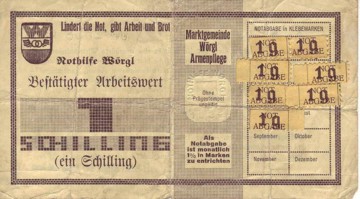
In Wörgl, the townspeople bought stamps and glued them to the banknotes to keep them valid. It would be more practical if we didn’t have to glue stamps on banknotes. And a holding fee of 12% per year would make cash unattractive. The charge doesn’t need to be that low to prevent people from withdrawing their money from the bank and putting it in a safe deposit box. If the interest rate on cash were a bit lower than the interest rates on bank accounts, that would be enough to stop people from hoarding banknotes.
When cash is a loan to the government, the interest rate on cash could be the same as the interest rate on short-term loans to the government. That rate would be better than the holding fee and could be as low as -3%. There can be an exchange rate between cash and central bank money. The value of cash would gradually decrease at a rate of 3% per year, and you don’t have to glue stamps on banknotes to keep them valid. The situation resembles 3% inflation, but it is a negative interest rate.
That difference is crucial because negative interest rate currencies may not require government or central bank management. They provide financial stability themselves. There is no money shortage due to interest charges, so there is no permanent need to expand debts to sustain the usury scheme, which requires government and central bank management. With negative interest rates, the money supply can be stable or even shrink without adverse consequences for the financial system or the economy.
Human psychology
Negative interest rates visibly reduce the currency balance in your account, while inflation operates more stealthily, by robbing you while you believe you get more. Wage changes are more noticeable than price changes, as some prices decrease while others increase in value. Even when negative interest rates and deflation are a better deal, and even if we all know it, we might not opt for them. The phenomenon is known as the money illusion. We resist a reduction in monetary units, even if it would make us better off.
It also affects how we look at negative interest rates. When interest rates are negative, money disappears, so inflation is likely to be lower, and prices may even decrease. That could be a better deal for depositors if their real return were higher, but most people dislike seeing their account balance decrease due to a negative interest rate. They might get edgy about their money vanishing into thin air. Negative interest rates sparked outrage among some Belgian depositors, who demanded a ban on these rates.
We prefer the illusion of a small gain that amounts to a loss in reality to the illusion of a similar loss that is, in fact, a better deal. It is not rational, but human psychology is the way it is. We are emotional beings that can think rather than thinking creatures with emotions. There is a fix: hiding negative interest rates and making them appear as inflation. To explain how we can look at the characteristics of Natural Money:
- The administrative currency carries a holding fee of approximately 12% per year. If you own this money, €1.00 turns into €0.88 after a year. It can make lending at negative interest rates attractive.
- Interest rates on bank accounts might be around -2% per year. Depositors don’t pay the holding fee, but the interest rate the bank offers.
- Cash is a short-term loan to the government and carries the interest rate of short-term government loans, which might be -3%.
- The administrative currency and cash become separate currencies. Cash gradually loses value relative to the administrative currency.
Making cash the money in people’s minds
When bank account statements are in cash currency rather than administrative currency, the public doesn’t notice that the interest rate is below zero. The interest rate on short-term government loans is one of the lowest. Banks must be able to offer at least this interest rate so that people won’t see their balance shrink due to negative interest. And if shops express their prices in the cash currency, it will become the currency in people’s minds.
If the interest rate on cash is -3%, its value decreases by 3% per year in terms of the administrative currency. If a bank offers an interest rate of -2% and settles the account in cash, the interest on the bank account appears to be +1%. And if the deflation rate is 1%, prices go down by 1%. Meanwhile, the value of cash decreases by 3% in the administrative currency, so prices in the cash currency increase by 2%. And so, the public experiences 2% inflation.
You can see it as a deception to prevent people from deceiving themselves. People get aggravated by negative interest rates, but largely ignore inflation. They also fall for the illusion of getting more when interest rates are positive. When the interest rate on bank accounts is 1% and inflation is 3%, you would lose 2% in purchasing power per year by holding a balance in a bank account. A 1% loss is a better deal for depositors. Natural Money can improve the economy, allowing real interest rates to be higher.
Critics might argue that we could be fooled by this scheme, just like inflation fooled us before. We won’t notice the negative interest rate, just like we did inflation before. Separating cash from the administrative currency and expressing prices and the value of bank accounts in cash currency can clear the psychological barrier that stands in the way of the public adopting negative interest rates.
The administrative currency remains the accounting unit in the financial system for bank accounts, debt, and interest, as well as the prices of financial assets, such as stocks and bonds. A similar situation existed in Europe between 1999 and 2002. After introducing the digital euro, cash continued to be the national currency. With Natural Money, the maximum interest rate of zero applies to the administrative currency and not to the cash currency, so interest rates in the cash currency may be above zero.
Latest revision: 1 November 2025
Featured image: Wörgl bank note with stamps. Public Domain.
 The Plan For The Future