Amazon Blue Front Economist

Central Bank Operations

Setting interest rates

In the current financial system, central banks manage the money supply via interest rates. When the central bank lowers interest rates, borrowing money becomes cheaper, making it more attractive to go into debt for consumption or investment. As a result, the money supply increases at a faster pace, which then boosts consumption and investment. When the central bank raises interest rates, the opposite happens, and the money supply increases at a slower pace, or even decreases.

Central banks boost the money supply because usury promotes a money shortage. Most money is a debt, on which debtors pay interest. Debtors must return more than they borrowed. That money may not be available if those with surpluses don’t spend their balances, requiring more borrowing to prevent a disruption in the money flows. Classical economics questions this idea. If the money flows become interrupted, sellers lower their prices, and those with money will spend more to pick up these bargains.

Transmission via the bond markets

Based on estimates of future short-term central bank interest rates, financial institutions such as banks borrow short-term money from the central bank at the interest rate set by the central bank to buy longer-term government bonds. If banks expect the short-term interest rate to remain below 2% in the coming year and 1-year government bonds yield 3%, they may borrow short-term money from the central bank to buy these bonds, repay them when they mature, and pocket the 1% difference.

The trade creates demand for these bonds, causing their price to rise and their yield to drop. Perhaps traders stop buying the bond when the interest rate drops to 2.5% because there is always a risk that the central bank will raise interest rates during that year. If 10-year bonds yield 4%, another trader might sell 1-year bonds and invest the proceeds in 10-year bonds, thereby lowering their yield as well. Usually, this happens in future markets, so traders often don’t own these bonds.

Altering markets

Central bank critics argue that they distort markets by eliminating the market mechanism. Central bank interventions have a profound impact on the operation of financial markets. As a result, there is more lending than would have occurred otherwise. Central banks create liquidity in financial markets by providing short-term funds that banks use to buy bonds with different maturities. It allows banks to buy and sell these government bonds, enabling them to match their lending and borrowing needs at any time.

So, how does that work? Apart from lending to customers, banks invest in government bonds, which they can sell at any time, as they can trade government bonds in financial markets. If a corporation requests a one-million-euro loan that matures in five years, the bank might sell a five-year government bond. In that case, the bank eliminates the interest risk, as it knows the amount of interest it would have received by keeping the bond and the interest it will receive from the loan.

In the past, banks had to be careful because they couldn’t borrow easily from the central bank, nor did they invest in or trade government bonds. So, if you applied for a mortgage, the bank looked for matching term deposits. Perhaps you could obtain a 5-year mortgage if there were sufficient 5-year deposits available. If, after five years, the bank lacked adequate deposits, you would not be able to renew your mortgage and might have to sell your home. And so, you would think twice before getting a mortgage.

Economists call these markets inefficient. You couldn’t get a 30-year mortgage. The operation of central banks has altered financial markets, making them more efficient. That can be beneficial for the economy. The Industrial Revolution started in England. England had the most efficient financial markets. The central bank needs the trust of financial markets. Financial markets can lose confidence, which can lead to a decline in the currency’s value. A central bank can try to restore trust by raising interest rates.

Subsidising the financial sector

Central banks reduce the risk of bank failures. When borrowers repay their debts, banks are solvent. However, they may find themselves short of cash in their vaults when depositors withdraw their deposits. Central banks create this money if needed, so banks need less cash in their vaults. Central banks can also rescue banks in trouble, thereby reducing the risk to the broader economy. After all, a financial crisis can lead to an economic crisis, such as the Great Depression. That nearly happened in 2008.

There are public benefits to stabilising the financial system, but these benefits exist due to interest on money and debts, thus usury. Usury creates a shortage of funds that requires management. Central banks subsidise the financial sector in the following ways:

  • Central banks mitigate the risk of systemic failure, enabling financial institutions to take on more risk and lend more. Banks may make risky loans to profit from higher interest rates, assuming the central bank will bail them out if things go wrong.
  • Central banks signal their intentions to financial markets. When the central bank intends to change interest rates, it provides advance notice so financial institutions aren’t caught off guard and can adjust their bond portfolios accordingly.

The supply and demand of funds in the financial markets ultimately determine interest rates. Still, these markets would operate differently without central banks, with significantly less borrowing and lending. Central banks make the financial system function more smoothly and reduce the risk of systemic failure. As a result, interest rates are lower than they would have been otherwise.

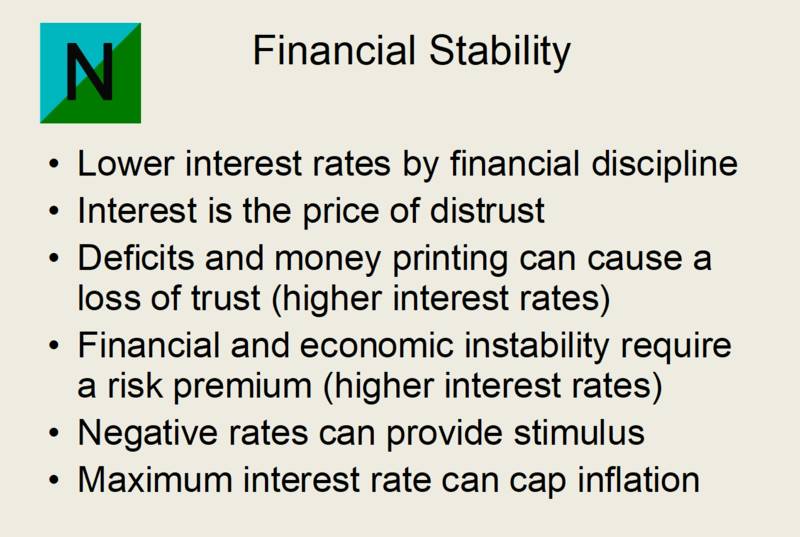
Central banks are powerful, undemocratic, technocratic institutions. Since the 1970s, they have become independent from governments. Before that time, governments used their central banks to finance their deficits through money printing, leading to inflation and a loss of trust in currencies. Making the central bank independent from politicians and giving it a mandate to keep inflation low was a move to instil confidence in fiat currencies.

The argument in favour of central bank independence is that a government must be trustworthy to its creditors. Creditors, like most of us, don’t trust politicians because they spend other people’s money. Since then, governments have borrowed in financial markets and paid interest on their debts. Central banks still buy government debt and return the interest to the government, which is the same as printing money outright.

Central banks can impede the functioning of financial markets by mispricing risk. Central banks can save banks in trouble by printing money. Without central banks, financial institutions would have to be more careful. Bank failures would occur more often, and banks would pay more interest to depositors to compensate for that risk. That negatively impacts economic growth and leads to crises. That is why central banks exist.

Signalling intentions

Central banks signal their intentions in advance to prevent traders from being caught off guard, thereby avoiding chaos in financial markets. That issue became at the centre of a drama that played out in the UK bond markets in September 2022. Interest rates spiked after the government announced a massive spending package. It suddenly became clear that the Bank of England might have to raise interest rates much further than previously thought to contain inflation. The spending plan caught financial institutions off guard. The Bank of England had to intervene in the bond market to bring down interest rates.

Financial institutions borrow short-term money from the central bank and invest it in the bond market. To borrow this money, financial institutions pledge these bonds as collateral, just like your house is the collateral for your mortgage. If interest rates rise, the value of these bonds decreases due to discounting the interest. A UK bond trader noted, ‘If there was no intervention today, yields on UK government bonds could have gone up to 7-8 per cent from 4.5 this morning, and in that situation, around 90 per cent of UK pension funds would have run out of collateral. They would have been wiped out.’

An institution might bring in £1,000,000 in equity to borrow £9,000,000 from the Bank of England at an interest rate of 1.75% and invest £10,000,000 in ten-year bonds at 3% interest, pledging the bonds as collateral for the loan. The institution could earn £142,500 per year on a £1,000,000 investment, yielding a handsome 14.25% return if market conditions remain stable. But it is a dangerous bet due to discounting. The price of a bond is its net present value. If the yield on ten-year bonds were suddenly to rise from 3 to 4%, the institution would incur a loss of £811,090, which is the difference in net present value of the bond. That would nearly wipe out the entire equity. And that happened that day.

In the past, pension funds invested in bonds for the long term, but bond yields were low. Pension funds have fixed obligations, such as paying a retiree €1,000 per month until they die. If interest rates are low, you have to pay more in pension premiums to arrive at that amount. To pump up their revenues, pension funds invested in stocks and speculated in the bond market using leverage. It seemed like easy money because central banks signal their intentions in advance. This time, however, the government took the traders by surprise, so the central bank had to rescue them.

Permanent liquidity

When there is liquidity in financial markets, you can buy or sell financial instruments like stocks and bonds at any time. In other words, you can sell them in the financial markets for currencies like the euro or the US dollar. During a financial crisis, liquidity becomes scarce, and it becomes harder to sell financial instruments. Their price collapses because there are many sellers and few buyers. Only cash and government bonds perform well in those times. Financial pundits refer to it as a flight into safety. To prevent a crisis, central banks inject liquidity into the financial system. In other words, they lower interest rates, making it attractive for investors to borrow from the central bank.

In this way, the central bank prints new money. It can end the crisis because investors can use this new cash to buy stocks. Since the 1987 stock market crash, central banks have increasingly resorted to adding liquidity or printing money to quell financial crises. If currency is plentiful, short-term interest rates drop, and stocks and bonds become more attractive investments, so there will be buyers. Once interest rates are near zero, the central bank can’t lower them; market participants may accumulate central bank currency rather than invest in stocks because they find an interest rate of zero more attractive.

In such a situation, investors will not invest but instead hold onto their cash. With interest rates near zero, traditional methods for addressing financial crises have become ineffective. That is why central banks adopted extraordinary measures, such as quantitative easing (QE), in the aftermath of the 2008 financial crisis and the 2012 euro crisis. Investors say, ‘Cash is king.’ It is the ultimate means of payment. If your bank goes bankrupt, your deposit might be gone. But you can still pay with banknotes, which are the central bank’s currency.

During a financial crisis, people worry about whether their stocks will retain value in the future, as the economy may collapse. That is why investors also prefer central bank currency. But that is only due to the interest rate on cash. If there had been a 12% annual holding fee on central bank currency and cash, investors would seek alternatives to cash and central bank currency, and the market would always maintain liquidity, so that the central bank doesn’t have to take action. In that case, we may not need a central bank, and central bank currency becomes a unit of account or administrative currency.

In times of crisis, investors often rush to buy safe financial instruments, such as government bonds. With Natural Money, administrative currency is unattractive because of the holding fee. Holding on to the currency will cost you 12% per year, which means that a euro will be worth 88 cents after a year. And so, interest rates on government debt may be as low as needed, such as -5%, to make other investments more attractive and bring liquidity back into the markets. And so, there will always be liquidity.

No one wants to own currency that costs 12% per year to hold. It will mark the end of the administrative currency’s role as a reserve. Currently, banks are required to keep the central bank’s currency to meet their reserve requirements. That is unnecessary. Equity requirements are more helpful than currency reserve requirements. Government debt can also serve as a suitable reserve. Currently, banknotes are also the central bank’s currency. A 12% holding fee would make cash unattractive to use. Cash should have a backing of short-term government debt with a more favourable interest rate.

Latest revision: 13 November 2025

Featured image: Ara Economicus. Beverly Lussier (2004). Wikimedia Commons. Public Domain.
Fiscal and Monetary Policies

Economic cycles

Mismatches between supply and demand cause economic cycles. A harvest may fail, and food prices may rise, leaving us with less money to spend on other items. Mismatches can concern the supply and demand of money, capital, labour, raw materials or consumer products. Interest charges also contribute to economic cycles. Interest rates reflect the market for funds. If all markets were perfect, economists argue, supply could adapt to demand instantly, and there would be no economic cycles. Not unlike many others, economists love fairy tales about a Paradise where everything is perfect. And so, they may advise us to make markets perfect, so that an economic Paradise will ensue.

Economic cycles occur because mismatches between supply and demand emerge periodically and eventually resolve. Economists use the term equilibrium in their models to explain the relationship between supply, demand, and price, but these models are simplifications of reality. There is rarely a stable equilibrium, and fluctuations in demand and supply cause changes in prices, inventories, and employment. There are several theories and explanations regarding those mismatches, economic cycles, and their effects. Most notably, money, credit and interest deserve attention.

According to Say’s law, supply creates its own demand because we make goods and services to use ourselves or to acquire other goods and services. It is most applicable to a simple barter economy. When money serves as a medium of exchange, we can postpone our purchases, leaving producers with excess inventory. Money hoarding can be a serious problem as it interrupts the circular flow of money. When money loses value, we are less likely to postpone purchases. It is why central banks aim for a bit of inflation. However, inflation shouldn’t be too high, as that can undermine trust in the currency.

Expectations are another factor. When consumers feel good about the future, they are more willing to spend on big-ticket items. Likewise, when investors expect brighter prospects, they anticipate higher profits, making them more willing to invest. Conversely, when consumers and investors are pessimistic, the opposite happens. And so, expectations can become a self-fulfilling prophecy. Likewise, when people expect a bank to collapse, it may collapse because that expectation triggers a bank run. Policy makers try to instil confidence in the system because a lack of confidence can break it. The reason is that credit means trust, and trust is what keeps the system going.

During good times, businesses and individuals tend to be confident. Credit is often available because businesses’ and individuals’ future income projections serve as the basis for banks to lend money. And so, companies and individuals can borrow more in good times. When the economy slows and their incomes decrease, they may struggle to make their interest payments. Consumers would have more disposable income without debt, since they wouldn’t have to pay interest. Similarly, businesses can go bankrupt even when they are profitable overall because of interest charges. And so, interest charges can exacerbate and prolong the bust.

Leverage contributes to the overall risk in financial markets. Liquid financial markets make it easier to enter and exit positions, leading investors to believe it is safe to operate with leverage. If markets were not fluid, leverage would appear more dangerous, as it would be more difficult to exit a position. For example, if you aren’t sure that you can renew your mortgage after five years, you aren’t going to buy a home. Liquidity enables risk-taking, allowing the overall level of risk in the financial system to increase. That can become apparent during a crisis. People who have to sell their home during a housing crisis may end up selling it at a low price, leaving them with a debt that takes years to repay. Therefore, maintaining a liquid market is crucial for its safety, and limiting leverage further enhances its security.

Bureaucratic interventions

In the wake of the Great Depression and World War II, government and central bank interventions have become standard tools for bureaucrats to manage the capitalist economy. Fiscal policies involve steering the economy through government expenditures. Ideally, it works as follows. When the economy is performing poorly due to sluggish demand, the government increases spending to boost demand. Conversely, when the economy is overheating due to excessive demand, the government reduces spending to curb demand. Likewise, central banks can lower interest rates to promote borrowing and boost demand, or raise interest rates to discourage lending and curb demand. These policies can have the following undesirable consequences:

  • The timing of the measures may be off, so when the measure has been decided upon and is taking effect, the economy may already be on the desired path.
  • Politicians may interfere and press for increased government spending or lower interest rates to boost the economy and get them re-elected.
  • Central bank interventions cause market participants to take more risk because they expect the central bank to intervene.
  • Due to usury, debt levels increase, so once these policies are commonplace, there are no corrections to cleanse the system from its excesses.

By failing to periodically cleanse the financial system of its excesses, either through a debt jubilee or an economic depression, the economy becomes addicted to credit expansion, and the final collapse will be even more severe. As the US dollar is the world’s reserve currency, a collapse in trust in this currency can trigger a global economic apocalypse. Usury is the primary reason for fiscal and monetary policies, because interest on money and debts generates a money shortage, driving a demand for credit. Debtors must repay more than they borrowed, but that extra money doesn’t exist. And so, governments and central banks fill the gap to prevent the usury scheme from collapsing.

Due to usury, it has become a permanent requirement. To prevent a shortage of money or a liquidity crunch from materialising, governments borrow, and central banks print money. The shortage arises when the private sector fails to borrow enough to cover the interest on existing debts. To counter the problem, the government can borrow and spend this money. Central banks can lower interest rates to make borrowing more attractive. They do so by buying up government debt, thereby decreasing the supply of government debt and increasing the supply of currency, which lowers interest rates because there are fewer debts and more currency to buy them with.

Economists assume that there is a natural interest rate at which the economy grows at its trend rate while inflation is stable. There is no direct way to measure or calculate the natural interest rate. Economists estimate it using their theories and models. The elusive natural interest rate is a crucial element in central bank decisions. The natural interest rate may differ from the actual interest rate due to credit in the financial system. Deviations from this rate trigger booms and busts. The interest rate below the natural rate can generate a boom. In that case, people borrow too much because interest rates are too low, leading to overspending and overinvesting. An interest rate above the natural rate can lead to a bust, resulting in underinvestment and underspending. By setting short-term interest rates and thereby influencing long-term rates, central banks steer credit creation.

The economy can do well by itself

With Natural Money, the economy can manage itself, making fiscal and monetary policies redundant. The holding fee removes the zero-lower bound, providing stimulus during economic slumps. The maximum interest rate curbs lending during economic booms, providing austerity. That mitigates business cycles. And so there will be fewer debt overhangs and financial crises. The market, combined with the price control of the zero upper bound, steers interest rates and the money supply, thereby reducing the role of central banks. The central bank’s currency will then become a unit of account or administrative currency. Natural Money has the following favourable consequences:

  • The holding fee on currency allows for negative interest rates to provide a stimulus, while the maximum interest rate provides austerity by curbing lending.
  • As interest is also a reward for taking risks, a maximum interest rate will take away the incentive to take risks and limit lending to the safest borrowers.
  • In the absence of usury, debt levels don’t increase, while only the safest borrowers can borrow, resulting in fewer bad debts.

There is no need for governments to engage in deficit spending, except to provide liquidity in financial markets, as government debt, rather than administrative currency, serves as a form of liquidity. The holding fee makes it unattractive to own administrative currency. Provided their finances are sound, governments can borrow at negative interest rates and earn interest on their debts. They could aim for the debt level giving the highest interest income. If market participants are willing to lend at -1% when government debt is 100% of GDP and at -2% when government debt is at 70% of GDP, the government could harvest 1% of GDP in the former case and 1.4% of GDP in the latter case.

It will be the end of fiscal and monetary policies. The economy will manage itself. Interest payments don’t create a need to add additional debts. Governments may step in during a crisis to restore trust in the financial system and the economy, but whether such intervention will be necessary is unclear, as there will likely be fewer crises. Natural Money also doesn’t require central banks to do more than handle the daily transactions between banks, as the holding fee terminates the demand for the central bank’s currency.

Latest revision: 12 November 2025

Wörgl bank note with stamps. Public Domain.

Cash for Negative Interest Rates

The problem with cash

Dealing with cash is cumbersome for both businesses and banks, so they are increasingly opting for digital payments. It helps to reduce their costs. Increasingly, people are opting for digital payments over cash. Geezers might still prefer to pay with banknotes and coins, but youngsters often don’t. These are the primary reasons why banknotes and coins could soon go extinct. The authorities have also sought to reduce the use of cash because it has long been the preferred method of payment for criminals.

Cash still plays a significant role. In the European Union, people mainly use them for small transactions. Cash can become an attractive investment when interest rates are negative. In Switzerland, where interest rates have been the most negative at -0.75%, 1,000 franc banknotes and safe deposit boxes were in short supply. And so, interest rates below -1% seem impossible as long as cash yields zero.

When depositors take their money from the bank, the bank can run into trouble. That may happen when interest rates fall below zero. A holding fee on central bank money, including cash, of 12% per year, can make it attractive to lend money at negative interest rates, like -2%, as you don’t pay the holding fee on loaned funds. Bank deposits are money lent to banks, thus loaned funds. You may keep your money in the bank when interest rates are negative because cash has a lower interest rate.

Cash as a loan to the government

In Wörgl, the townspeople bought stamps and glued them to the banknotes to keep them valid. It would be more practical if we didn’t have to glue stamps on banknotes. And a holding fee of 12% per year would make cash unattractive. The charge doesn’t need to be that low to prevent people from withdrawing their money from the bank and putting it in a safe deposit box. If the interest rate on cash were a bit lower than the interest rates on bank accounts, that would be enough to stop people from hoarding banknotes.

When cash is a loan to the government, the interest rate on cash could be the same as the interest rate on short-term loans to the government. That rate would be better than the holding fee and could be as low as -3%. There can be an exchange rate between cash and central bank money. The value of cash would gradually decrease at a rate of 3% per year, and you don’t have to glue stamps on banknotes to keep them valid. The situation resembles 3% inflation, but it is a negative interest rate.

That difference is crucial because negative interest rate currencies may not require government or central bank management. They provide financial stability themselves. There is no money shortage due to interest charges, so there is no permanent need to expand debts to sustain the usury scheme, which requires government and central bank management. With negative interest rates, the money supply can be stable or even shrink without adverse consequences for the financial system or the economy.

Human psychology

Negative interest rates visibly reduce the currency balance in your account, while inflation operates more stealthily, by robbing you while you believe you get more. Wage changes are more noticeable than price changes, as some prices decrease while others increase in value. Even when negative interest rates and deflation are a better deal, and even if we all know it, we might not opt for them. The phenomenon is known as the money illusion. We resist a reduction in monetary units, even if it would make us better off.

It also affects how we look at negative interest rates. When interest rates are negative, money disappears, so inflation is likely to be lower, and prices may even decrease. That could be a better deal for depositors if their real return were higher, but most people dislike seeing their account balance decrease due to a negative interest rate. They might get edgy about their money vanishing into thin air. Negative interest rates sparked outrage among some Belgian depositors, who demanded a ban on these rates.

We prefer the illusion of a small gain that amounts to a loss in reality to the illusion of a similar loss that is, in fact, a better deal. It is not rational, but human psychology is the way it is. We are emotional beings that can think rather than thinking creatures with emotions. There is a fix: hiding negative interest rates and making them appear as inflation. To explain how we can look at the characteristics of Natural Money:

  • The administrative currency carries a holding fee of approximately 12% per year. If you own this money, €1.00 turns into €0.88 after a year. It can make lending at negative interest rates attractive.
  • Interest rates on bank accounts might be around -2% per year. Depositors don’t pay the holding fee, but the interest rate the bank offers.
  • Cash is a short-term loan to the government and carries the interest rate of short-term government loans, which might be -3%.
  • The administrative currency and cash become separate currencies. Cash gradually loses value relative to the administrative currency.

Making cash the money in people’s minds

When bank account statements are in cash currency rather than administrative currency, the public doesn’t notice that the interest rate is below zero. The interest rate on short-term government loans is one of the lowest. Banks must be able to offer at least this interest rate so that people won’t see their balance shrink due to negative interest. And if shops express their prices in the cash currency, it will become the currency in people’s minds.

If the interest rate on cash is -3%, its value decreases by 3% per year in terms of the administrative currency. If a bank offers an interest rate of -2% and settles the account in cash, the interest on the bank account appears to be +1%. And if the deflation rate is 1%, prices go down by 1%. Meanwhile, the value of cash decreases by 3% in the administrative currency, so prices in the cash currency increase by 2%. And so, the public experiences 2% inflation.

You can see it as a deception to prevent people from deceiving themselves. People get aggravated by negative interest rates, but largely ignore inflation. They also fall for the illusion of getting more when interest rates are positive. When the interest rate on bank accounts is 1% and inflation is 3%, you would lose 2% in purchasing power per year by holding a balance in a bank account. A 1% loss is a better deal for depositors. Natural Money can improve the economy, allowing real interest rates to be higher.

Critics might argue that we could be fooled by this scheme, just like inflation fooled us before. We won’t notice the negative interest rate, just like we did inflation before. Separating cash from the administrative currency and expressing prices and the value of bank accounts in cash currency can clear the psychological barrier that stands in the way of the public adopting negative interest rates.

The administrative currency remains the accounting unit in the financial system for bank accounts, debt, and interest, as well as the prices of financial assets, such as stocks and bonds. A similar situation existed in Europe between 1999 and 2002. After introducing the digital euro, cash continued to be the national currency. With Natural Money, the maximum interest rate of zero applies to the administrative currency and not to the cash currency, so interest rates in the cash currency may be above zero.

Latest revision: 1 November 2025

Featured image: Wörgl bank note with stamps. Public Domain.