Deutsche Bank Towers in Frankfurt am Main

What Is the Use of banks?

Turning debt into money

The previous episode about money discussed some imaginary trades between you, a hatter, a lawyer, a barber and a fisherman. It is shown that if people promise to pay this might suffice for payment. So if the fisherman promises you to pay next week for the hat you just made, you could say to the lawyer that you expect the fisherman to pay in a week, and ask her if you can pay in a week too. The lawyer could then ask the same of the barber and the barber could ask the same of the fisherman. If all these debts cancel out then no cash is needed.

In most cases, debts cannot be cancelled out so easily. A hat may cost € 50, legal advice € 60, a hairdo € 30, and the fish € 20. If you are the hatter, you could lend € 10 to the barber and the lawyer could lend € 20 to the fisherman. Perhaps the lawyer doesn’t trust the fisherman because he smells fishy. But if the lawyer trusts the barber and the barber trusts the fisherman then the lawyer could lend € 20 to the barber and the barber could lend € 20 to the fisherman.

That could become complicated quite easily. And this is where banks come in. Banks can lend money because they know the financial situation of their customers. The fisherman can borrow money from his bank to make payments because the bank knows that he has an unstable but good income and a vessel that can be sold for cash if needed.

If the fisherman borrows money to pay for the hat you made, this money ends up in your account. You can use it to pay the lawyer. And so the fisherman’s debt becomes the lawyer’s money until she uses it to pay the barber. People that have a deposit lend money to the bank and the bank is lending this money to those who have a loan, in this case, the fisherman. Depositors trust the bank even though they do not know the people the bank is lending money to.

Most people think of money as coins and banknotes but more than 90% of the money just exists as bookkeeping entries in banks. When a fisherman borrows money from his bank, he can spend it on a hat. This means that the bank creates money and that this money is debt. Most of our money is debt so the value of money depends on the belief that debtors pay back their debts. This seems scary and it keeps quite a few people awake at night.

Some people argue that debts and banking are frauds because they are based on a belief. But banks and debts help to boost trade and production by creating money that doesn’t exist to start businesses that don’t yet exist to make products which will be bought by the people those businesses will hire with this newly created money. Banking and debts are the basis of the capitalist economy.

Banking as bookkeeping

Banking is more or less just bookkeeping and balance sheets. Balance sheets can be used to explain the magic trick banks do, which is creating money. Balance sheets are simple. There are no intimidating formulas, only additions and subtractions. The important thing to remember with balance sheets is that the total of the amounts on the left side must always equal those on the right side.

On the left is the value of your stuff and your money. On the right side is the value of your debts. Your net worth is what remains when you sell all your stuff and pay off your debts. It is on the right side too in order to make it equal to the left side. Your net worth can be a negative value. If that is the case, you might be bankrupt because you can’t repay your debts by selling your assets. The left side is named debit and the right side is called credit. Your balance sheet might look like this:

debit
 
credit
 
house
€ 100,000
mortgage
€ 80,000
other stuff
€ 50,000
other loans
€ 30,000
cash, bank deposits
€ 20,000
your net worth
€ 60,000
total
€ 170,000
total
€ 170,000

When you buy a car, you own more stuff, but also another loan or fewer bank deposits as you have to pay for the car. This is because debit always equals credit. When you drive the car, it goes down in value, as does your net worth, because debit always equals credit. If your salary comes in, your bank deposits as well as your net worth rise because debit always equals credit. If you pay down a loan, the amount in your bank account, as well as the amount of your loan, goes down because debit always equals credit. If debit doesn’t equal credit then you have made a calculation error.

Also for a bank, the total of the amounts on the left side must always equal those on the right side, so that debit always equals credit. Your debt is on the debit side of the bank’s balance sheet. You have borrowed this money from your bank. The bank owns this loan. Your bank deposits are on the credit side of the bank’s balance sheet. The loans of the bank are paid for by deposits. Banks lend money to each other. This may happen when you make a payment to someone who has a bank account at another bank. Your bank may borrow this money from the other bank until another payment comes the other way. The balance sheet of a bank may look like this:

debit
 
credit
 
mortgages and loans
€ 70,000,000
deposits
€ 60,000,000
loans to other banks
€ 10,000,000
deposits from other banks
€ 20,000,000
cash, central bank deposits
€ 10,000,000
the bank’s net worth
€ 10,000,000
total
€ 90,000,000
total
€ 90,000,000

How banks create money

Banks create money. How do they do that? It is easy if you understand balance sheets. Assume that you, the hatter, the lawyer, the barber, and the fisherman all have € 10 in cash. Together you decide to start a bank. You all bring in the € 10 you own so that you all have a deposit of € 10 and the bank has € 40 in cash. The bank allows everyone to withdraw deposits in cash. This is no problem as long as the total of deposits equals the total amount of cash. After everyone has put in the deposit, the bank’s balance sheet looks as follows:

debit
 
credit
 
cash
€ 40
your deposit
€ 10
  
deposit lawyer
€ 10
  
deposit barber
€ 10
  
deposit fisherman
€ 10
total
€ 40
total
€ 40

First, there was only € 40 in cash. Now there are € 40 in bank deposits too. You might think that the bank created money. Only, that isn’t true because the depositors can’t spend the cash unless they take out their deposits. In other words, the depositors don’t have more money at their disposal than before. If you look at the total, there is still € 40. This is bookkeeping. You have to write down the total twice as debit must equal credit.

But now things are going to get a bit wild. The fisherman comes to you and he wants to buy a hat. The hat costs € 50 but the fisherman has only € 10 in his account. To make the sale possible, the bank is going to do its magic. The fisherman calls the bank and asks if he can borrow some money. The bank grants him a loan of € 40 and puts the money in his deposit account so that he can spend it. And look:

debit
 
credit
 
cash
€ 40
your deposit
€ 10
loan fisherman
€ 40
deposit lawyer
€ 10
  
deposit barber
€ 10
  
deposit fisherman
€ 50
total
€ 80
total
€ 80

Who says that miracles can’t happen? The deposits miraculously increased from € 40 to € 80 so € 40 is created from thin air. There is still only € 40 in cash but the fisherman’s debt created new money. This is how banks create money. And that is only because bank deposits are money. This is all there is to it. So much for the mystery. The fisherman then pays € 50 for the hat. And so it becomes your money:

debit
 
credit
 
cash
€ 40
your deposit
€ 60
loan fisherman
€ 40
deposit lawyer
€ 10
  
deposit barber
€ 10
  
deposit fisherman
€ 0
total
€ 80
total
€ 80

And now comes the dreadful part that keeps some people fretting. Everyone can take out his or her deposits in cash. There are € 80 in deposits and only € 40 in cash. If you go to the bank and demand your € 60 in cash, the bank would go bankrupt, even when the fisherman pays off his loan the next day. You could bankrupt the bank by buying € 50 in fish with cash. If you go to the bank to get € 50 in cash it would not be there so the bank would go bankrupt before the fisherman can pay off his loan with the same cash.

A bank could get into trouble in this way even when debtors repay their debts. Clever minds already figured out a solution. Central banks can print money too. If the European Central Bank (ECB) prints € 20 on a piece of paper and lends this money to the bank, there would be enough cash to pay out your deposit. Banning the use of cash and only using bank deposits for payments would be another option. So, after the ECB deposited € 20 in cash, the bank’s balance sheet might look like this:

debit
 
credit
 
cash
€ 60
your deposit
€ 60
loan fisherman
€ 40
deposit lawyer
€ 10
  
deposit barber
€ 10
  
deposit fisherman
€ 0
  
deposit ECB
€ 20
total
€ 100
total
€ 100

After you pay the fisherman, he can pay off his loan, and the bank will have enough cash to pay out all deposits. The bank can repay the central bank and everything is fine and dandy again. In this case the bank could not meet the demand for cash but the value of cash and loans wasn’t smaller than the deposits (the bank’s debt). After the fisherman pays back his loan and the bank pays back the ECB, the bank’s balance sheet might look like this:

debit
 
credit
 
cash
€ 40
your deposit
€ 10
loan fisherman
€ 0
deposit lawyer
€ 10
  
deposit barber
€ 10
  
deposit fisherman
€ 10
  
deposit ECB
€ 0
total
€ 40
total
€ 40

If banks can’t create money, trade would be difficult. If the hat is € 50, the legal advice € 60, the hairdo € 30, and the fish € 20, and you, the lawyer, the barber and the fisherman all have only € 10, nothing can be bought or sold. If the bank lends € 40 to the fisherman, he can buy a hat from you, you can buy legal advice from the lawyer, the lawyer can buy a hairdo and the barber can buy fish. Debt is the basis of the capitalist economy. Nearly all money is debt, and without debt, the economy would come to a standstill.

How much money can banks create?

The amount of money a bank can create is limited by the bank’s capital, which is the bank’s net worth. Regulations stipulate that banks should have a minimum amount of capital. This is the capital requirement. If the capital requirement is 10%, and the bank’s capital is € 10,000,000, it can lend € 100,000,000, provided that there are enough deposits. If the bank makes a loan, a new deposit is created. If the deposit leaves the bank, the bank must borrow it back from another bank or cut back its lending. That is because debit must always equal credit.

debit
 
credit
 
mortgages and loans
€ 70,000,000
deposits
€ 60,000,000
loans to other banks
€ 10,000,000
deposits from other banks
€ 20,000,000
cash, central bank deposits
€ 10,000,000
the bank’s net worth
€ 10,000,000
total
€ 90,000,000
total
€ 90,000,000

When a deposit leaves the bank, it ends up at another bank. The other bank can use it for lending, provided that it has sufficient capital. There may be a reserve requirement, which is a minimum of cash and central bank deposits the bank must hold. If the reserve requirement is 10%, the bank can lend out as much as ten times the amount of cash and central bank reserves it has available. In the past, reserve requirements were important as people often used cash and could go to the bank to demand their deposits in cash. For that reason banks needed to hold a certain amount of cash.

Featured image: Deutsche Bank building CC BY-SA 4.0. Raimond Spekking. Wikimedia Commons. Public Domain.
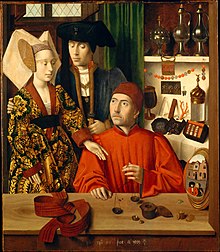
A goldsmith in his shop. Peter Christus (1449).

How the financial system came to be

A goldsmith’s tale

Once upon a time, goldsmiths fabricated gold coins of standardised weight and purity. This made them a trusted source of gold coins. The goldsmiths also owned a safe where they stored their own gold. Other people wanted to store their gold there too because those safes were well-guarded. And so the goldsmiths began to rent out safe storage. People storing their gold with the goldsmith received a voucher certifying the amount of gold they brought in.

At first, these vouchers could only be collected by the original depositor. Later on, any holder of the voucher could collect the deposit. Another innovation was making standard vouchers representing 1, 2, 5 or 10 units. From then on people began to use them as money as paper money is more convenient than gold coins. And so depositors rarely came to collect their gold and it remained inside the vaults of the goldsmiths.

Modern banking

Some goldsmiths also lent out their own gold at interest. As depositors rarely came in to collect their gold, they discovered they could also lend out the gold brought in by the depositors. When the depositors found out about this, they demanded interest on their deposits too. At this point, modern banking took off and paper money became known as banknotes.

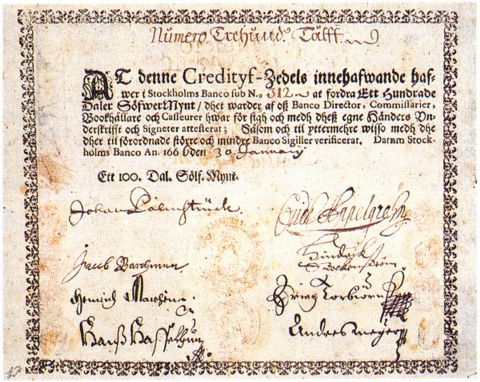
Credit note's holder, Stockholm's Banco sub no. 312
Credit note’s holder, Stockholm’s Banco sub no. 312

Borrowers preferred paper money too so the goldsmiths, who had become bankers, found out that they could lend out more money than they had gold in their vaults. They began to create money out of thin air. This is called fractional reserve banking as not all deposits were backed by gold reserves. The new money was spent on new businesses that hired new people so the economy boomed.

When depositors discovered that there were more bank notes circulating than there was gold in the vaults of the bank, the scheme could run into trouble if all depositors came in at the same time to demand their gold, but this rarely happened. Depositors received interest so they kept their deposits in the bank. They trusted their bank as long as they believed that debtors were paying back their loans.

Bank runs

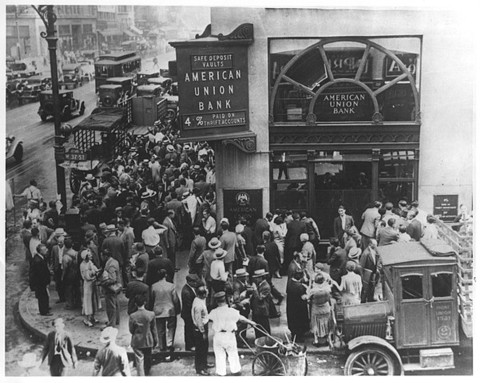
But sometimes people began to doubt that the bank was safe and worried depositors came to the bank to exchange their banknotes and deposits for gold coins. This is called a bank run. If too many people came in at the same time, the bank could run out of gold and close down because not all the gold was there. As a result, the bank’s notes and deposits could become worthless.

Bank run
A crowd at New York’s American Union Bank during a bank run in the Great Depression

People who lost their money had less money to spend. This could hurt sales so that businesses could run into trouble and default on their debts. As a consequence, depositors at other banks sometimes feared that their bank could go bankrupt too, leading to more bank runs. This could escalate into a financial crisis and an economic depression. This happened in the United States during the Great Depression of the 1930s.

Regulations and central banks

To forestall financial crises and to deal with them if they occur, banks were required to have a minimum amount of gold available in order to pay back depositors. Central banks were created to support banks by supplying additional gold if too many depositors came in to collect their gold at the same time. Central banks could still run out of gold but this was solved by ending the gold backing of currencies. Nowadays central banks can print new dollars or euros to cope with any shortfall. Regulations limit the number of loans banks make and therefore the amount of money that exists.

But everyone can lend to everyone. There are ways to circumvent the regulations imposed on banks. For example, corporations can issue bonds or use crowdfunding. And a lot of lending nowadays happens outside the official banking sector in institutions that are not subject to these regulations. Human imagination is the only limit to the amount of debt that can exist. And as long as people expect that those debts will be repaid, even if it is with new debts, there can be trust in these debts. But the financial crisis of 2008 demonstrated that this trust can disappear very suddenly.

Featured image: A goldsmith in his shop. Peter Christus (1449). Metropolitan Museum of Art. Wikimedia Commons. Public Domain.

A tenner on the street

A tenner on the street

No such thing as a free lunch

Here comes another joke about economists. Suppose you just have found a tenner on the street. You are very excited about your windfall and tell the next person you meet about your find. You say, ‘I just found a tenner on the street.’ Now, this individual happens to be an economist. And he replies, ‘That is impossible. If there really was a tenner on the street, someone would have picked it up already.’

Economists also say, ‘There is no such thing as a free lunch.’ Some people get a free lunch, but someone else has to pay for it. If you find a tenner, someone else paid for it. If there is money for free, people will take it and let others pay for it. Economists call it arbitrage. It is also what trade is about. Traders try to make money by finding money for free, but in doing so, they work and take risks.

Economics assumes humans are rational in economic matters and do not leave tenners on the street. We make the best of our money by choosing the right products. And we make as much as we can with our abilities. If we get cash for free, many would not work or only do jobs they like to do. And even though we often are not rational, it explains much of our behaviour, most notably what happens in markets. If there is a tenner on the street, it will not be there for long.

If gold costs € 50 per gramme in France and € 40 in Germany, traders can make money by buying gold in Germany and selling it in France. The demand for gold in Germany will rise, as will the supply in France. The law of supply and demand says that the price goes up when demand increases and goes down when supply increases, so the price in Germany and France will be the same.

Economists call it arbitrage. Smuggling comes from the same principle. Cigarettes are more expensive in the United Kingdom than on the European continent. You can make money smuggling cigarettes into the United Kingdom and selling them there illegally. The price difference promotes smuggling. The difference between arbitrage and smuggling is that arbitrage is legal.

Markets without morals

Even though most individuals have moral values, markets do not have them. There are always people willing to market a harmful product. Their excuse often is that if they do not, someone else will. Laws can illicit smuggling and black markets. It helps if laws and enforcement are the same everywhere. Still, supply always equals demand at a specific price. So, if you outlaw harmful substances or practices, say alcohol, prostitution, cocaine, gambling, or cigarettes, you promote crime and violence because criminals make more money.

And so, the War on Drugs is a failure, like the prohibition in the United States in the 1920s. If selling cocaine is legal, the price difference between Colombia and the United States would be close to the production and transport costs. In that case, a gramme of cocaine might cost $ 5 in Colombia and $ 6 in the United States. But if it is illegal, and governments enforce the law, a gramme of cocaine might cost $ 10 n Colombia and $ 100 in the United States, and criminals make lots of money in the trade.

As crime-related violence engulfs more and more countries, gangs of criminals undermine governments and societies by giving poor people an income, bribing officials and hiring hitmen to eliminate those who stand in their way. Seeing it as an economic problem might help to find solutions, for instance, undermining the criminal business model by letting governments supply harmful substances and gambling and regulating prostitution. If governments keep repressing the drug trade, they make the criminal enterprise unprofitable by bringing their cost above the price for which governments sell.

It brings moral dilemmas, but unlike criminals, governments do not do marketing, for instance, by giving drugs to children to turn them into addicts. Governments have no profit motive, which allows governments to help drug addicts and give them treatments. But this does not stop the fentanyl crisis in the United States. This drug is too cheap and too deadly. Only unconventional measures like taking all the addicts off the streets and locking them up might end the suffering. To solve this issue, we might need to be as committed as the Taliban and accept the human cost. The human cost will be higher if we are lax. If an addict dies because of these measures, this person would have died anyway, and the gain is in the people we save.

Trust but verify

Similar issues arise when governments tax, punish criminals, give subsidies or provide social benefits. If that elicits the desired behaviour, that is good, but that does not always happen. Businesses shift their profits to tax havens. Wealthy individuals do the same with their assets. If there are social benefits, people who do not like to work or dislike their job try to get on the dole. Many people need those benefits, but fraud undermines their legitimacy.

Reasonable people are willing to pay taxes for people who need help but not for fraudsters. Tax and welfare fraud may get understated or overstated for political reasons. If you can commit fraud and gain financially, some will do it. And if they get away with it, more will do it. That undermines trust. Regulations need enforcement. For instance, not enforcing building regulations allows contractors to make money using inferior materials. And that happens with devastating consequences.

When private contractors perform public tasks, and the government pays for them, there is an opportunity for fraud. In the Netherlands, the government decentralised several forms of social work to the municipalities. Since then, criminals and fraudsters have set up businesses in those areas. The choice is either for governments to do these tasks themselves or to work with reliable suppliers by vetting them, perhaps even licencing them, and monitoring their performance.

Trade as finding tenners

Trade is like looking for tenners on the street and keeping them, even if you know the previous owner. You might call it pickpocketing. The difference is not always clear. Hermes, the Greek god who was the protector of the merchants, was also the refuge of the thieves. Popular culture views traders with suspicion. Value is subjective. If you bought an item for € 50 but could have bought it elsewhere for € 40, did the seller dupe you, was the item worth € 50, or were you stupid?

And we cannot do without trade. Few people have the time to go to all the producers for the things they need, nor have these producers the time to handle each individual that needs their product. If you had looked around, you might have found the same item for sale for € 40, but perhaps, you were too busy and happy to get the item instantly without looking around. Trade performs the following functions:

  • Goods are made in one place and used somewhere else. Trade bridges distance.
  • Goods are produced first and consumed later. Trade bridges time.
  • Goods usually are made in large batches and used in smaller ones. Trade matches volumes.

Crucial to trade is information. A trader must know what is on offer for what price and where, and for what price it might sell when and where. Gathering that information costs time and effort. If you trade potatoes, you buy them in large quantities from farmers during the harvest and sell them in smaller quantities to greengrocers throughout the year. You must offer an attractive price to the farmers and the greengrocers. Otherwise, they will go elsewhere. And your business must make a profit. Otherwise, you might as well have stayed in bed to watch television.

Financial markets

A tenner dwells more likely on streets where others do not look. Wall Street firms hire the brightest minds on the planet to find these places. For instance, Apple stock may be for sale for € 150 in Australia while it is doing € 151 in Germany. If you want to pick up that euro, you must be there and act quicker than everyone else. Wall Street firms thus invest in the fastest computers and networks.

So if a tenner falls out of your pocket on the stock market, Wall Street firms have already picked it up before it hits the street. They may soon apply artificial intelligence to look inside your pocket and fetch the tenner before it falls. So if you are willing to sell your stock for € 150 and someone else is willing to pay € 151, Wall Street banks may snatch the securities you offer for € 150 and sell it to the other for € 151.

If the interest rate in one country is lower than in another, you can profit by borrowing money in the first country and lending it out in the other. It can be attractive to borrow yen at 1% to buy dollars to lend them at 5% and pocket the difference. Economists call this a carry trade. You might expect that, like the price of gold, interest rates would converge because the yen interest rate would rise because of the borrowing in yen, while the dollar interest rate would fall because of the lending in dollars.

That did not happen. The central bank sets the interest rate and can create money. The Japanese central bank kept lending yen at 1% and buying dollars because the Japanese government did not like the yen to rise. That could hurt their exports. If the US central bank held the interest rate at 5%, and the Japanese central bank prevented the yen from rising, that meant lots of free money for banks. The Japanese paid for it. They could have bought more with their money if it had been worth more.

One of the most troubling issues with trade, markets and capitalism, is that value is subjective and often depends on irrational emotions. The market value of an empty Gucci bag is higher than that of a shopping bag filled with potatoes. And even though we cannot establish objective value, we need food more than designer bags. The appreciation of subjective value is what makes the current economic system suicidal. A happy shopper today can be a dead one tomorrow.

Lately, I found a tenner on the street. Economists can be wrong. Well, indeed.

Latest revision: 19 August 2023

Featured image: A tenner on the street. Free Shutterstock image from Blackday.

Amazon Blue Front Economist

Currency

Political Economy and Currency

A dictionary defines currency as the system of money used in a particular country. You find both the words ‘general’ and ‘particular’ in this general definition of this particular term. A currency belongs to a specific country. Financial transactions within that country are in that currency. If you go to Sweden to do some shopping, be sure you have some Swedish crowns on you. The economist’s definition is government money. It includes coins, banknotes, and central bank deposits, but not commercial bank deposits.

Under the gold standard, each currency represented a fixed amount of gold, and national central banks held gold in their vaults to back that promise. You could exchange banknotes for the amount of gold the currency represented. That was the basis of the currency’s value. And so, the underlying currency was not the national currency, but the international currency, gold. Under the gold standard, the world had a single currency, gold. You could exchange bank deposits for currency, thus gold.

Today, we have national fiat currencies, and bank deposits are also money. But what gives fiat currencies their value? It is the national economies backing them, because of the equation known as the Quantity Theory of Money, which says that Money Stock (M) * Velocity (V) = Price (P) * Quantity (Q), so Money Stock (M) depends on Velocity (V), Price (P) and Quantity (Q), and the value of a single unit such as the Swedish crown, is M / units in circulation. The money stock includes bank deposits.

Honest money

Proponents of the gold standard argue that gold is honest money and that fiat money is a fraud. However, the scam is usury, and charging interest on gold is a fraud. There isn’t enough gold to repay all debts, and interest compounds that problem. In that sense, fiat is honest money because it merely promises to pay in fiat, which a government can make good on. Everyone knows that this money will be worth less in the future, and no one knows by how much, which everyone knows. Usury turns money into a Ponzi scheme. And so, only usury-free fiat money is honest money.

Usury may seem victimless, but it corrupts everything, bringing down nations and civilisations. It is the gravest crime against humanity. As a result, honest people become increasingly rare. A society or a civilisation collapses due to scams and greed. Crimes seem victimless when you are unaware of the consequences, don’t care about them, or even deny them. But everything you do affects people, animals, plants, and future generations. Today’s economy is an orgy of planetary destruction, transforming energy and resources into waste and pollution, driven by the pursuit of profit.

Interest is the price of distrust, not only in the currency, but also in debtors. Usury-free money requires honest debtors. Planning not to repay your debts, or hiding the risk that you might not be able to, is a most serious offence, as harmful as demanding interest. Many financial frauds are comparable to usury. These crimes often seem victimless, but they cause distrust. They are worse than murder, because distrust causes interest rates to rise, and usury is a destroyer of civilisations.

A usury-free financial system requires a political economy with high ethical standards. The moral foundation of our civilisation is the ethics of the merchant, which is no ethics at all. And as long as there is no permanent world peace, nation-states will do anything to finance their war effort, such as offering interest on loans. Humans are a self-destructive species that may only do the right thing when inspired by fairy tales. And so, an honest political economy and permanent world peace remain unthinkable unless an inconceivable event, such as the emergence of a new world religion, were to occur.

Import and export

International trade also affects a currency’s value. When a country exports more than it imports, demand for its currency exceeds supply, driving its currency higher against other currencies. That makes foreign products more affordable than domestic products, allowing exports and imports to balance. Conversely, the opposite happens if a country imports more than it exports. After World War II, the German mark became a strong currency because Germany was exporting more than it imported.

That isn’t always the case. Countries lend and borrow in international markets. The central bank of Japan printed yen to buy US dollars, thereby increasing the supply of yen and decreasing the supply of US dollars by lending those yen to traders. As a result, Japan continued to export more than it imported for decades. The Japanese central bank set interest rates at a low level. Traders borrowed yen to buy US Treasuries with higher interest rates, pocketing the difference, subsidised by Japan’s willingness to depress the value of their currency. Without usury, that would have been impossible.

Likewise, countries that import more than they export can borrow foreign currency to cover their import costs. These countries can run into trouble as they borrow a currency they can’t print. They can borrow because, in a usury-based financial system with national currencies, interest is a reward for the risk of default. Had borrowing at interest been impossible, deficit nations would have to balance imports and exports. Instead, they go into debt and export more than they import to pay the interest on their debts.

The primary reasons for these persistent imbalances are usury and the existence of independent nations with national currencies and economic policies. The alternative would be to let these imbalances correct themselves, which would require the free movement of people around the world so they can settle where the opportunities are, or government policies to support weaker regions, such as ordering corporations to employ people in these areas. That becomes possible with a single world government and currency.

Reserve currency

Reserve currencies facilitate international trade. Since World War II, the US dollar has been the most widely used reserve currency. The arrangement allowed the United States to enjoy a higher standard of living and have a large military paid for by foreign nations. In the 1960s, the French Minister of Finance, Valéry Giscard d’Estaing, referred to it as the US’s ‘exorbitant privilege’. The US dollar and Wall Street have been the pillars upon which the US financial empire rested. Previously, Great Britain had a similar privilege.

The arrangement also gave exporting industries in foreign nations a competitive advantage. By buying US dollars for their currency reserves, competitors of the United States were able to suppress the value of their own currencies and sell their products at a lower price, leading to the deindustrialisation of the US. If you own a money printing press, printing money is also an easy way out. The US dollar reserve status harmed US exports and allowed other countries, such as China and Japan, to build their industries.

The US Dollar’s reserve status also made the FED responsible for the international financial system. The FED had to rescue foreign banks during the 2008 financial crisis. Americans felt they ended up paying to prop up foreign banks. That is incorrect, as the holders of US dollar-denominated debts paid for it, not indebted Americans. And had the Fed not acted, and the global economy had collapsed, they would have discovered that the rest of the world had been funding the United States.

Due to usury, debtor nations face a shortage of US dollars, making them hostages to the US dollar-based usury financial system. Meanwhile, creditor nations, lured by interest payments, store their wealth in US dollar-denominated debt. That has been the basis of the US empire. It was a deliberate choice by US policy makers to financialise the US economy under the guise of Reaganomics and neoliberalism, and to generate financial profits in the bullshit economy to attract investment capital.

Belief in the US dollar’s value and the promise of financial profits fueled the neoliberal economic boom. The imbalances in the system accelerated the conversion of energy and resources into waste and pollution, a process that economists refer to as wealth creation. The US dollar reserve status meant that Americans have lived beyond their means, paid for by austerity in the rest of the world. In other words, Americans could spend their way into prosperity while other countries had to export their way into it.

Government debt and liquidity

A government doesn’t need to borrow if it can print currency. Such a scheme doesn’t instil confidence in currencies. For that reason, central banks became independent of governments to promote trust in their currencies, as creditors don’t trust politicians. Instead of printing currency outright, the usurers made governments borrow and pay interest. Still, when a government borrows in its own currency, it can always repay the loan with interest, if needed, by printing currency. That makes government debt as safe as the currency itself, so banks could use it as a liquidity reserve in the financial system.

It has become unthinkable that a sovereign government would go bankrupt, so banks use government debt as an investment or collateral, thereby promoting liquidity in the financial system and generating profits for the usurers who operate the system. When a bank lacks cash, it can sell government bonds or pledge them as collateral for a loan from another bank. Government debt is a central pillar upon which trust in the financial system rests. US banks hold more in government debt than in commercial loans. Therefore, when the government goes bankrupt, the financial system collapses with it.

With fiat currencies, the currency is as good as the political economy backing it. Ideally, a stable society, industrious people, and a prudent, honest government help a fiat currency maintain its value. In reality, tax evasion also plays a role. High-net-worth individuals take their wealth from the societies that helped them generate it, because they don’t want to pay for the public education and infrastructure that made their wealth possible, and transfer it to tax havens that parasitise on productive economies. A single tax regime for the entire world can remedy that issue.

Under a gold standard, there was no guarantee that a government could repay its debts in gold. And so, only gold itself was a safe reserve, which constrained liquidity in the financial system. Fiat currencies in the usury financial system are not a store of value, but they usually suffice as a medium of exchange. With inflation rates of 10%, lending and borrowing can continue at higher interest rates. Therefore, under normal circumstances, interest-bearing investments in a fiat currency can retain their value.

Gold money requires interest, as you can store it without loss. Therefore, gold can’t be money in a usury-free financial system. Other forms of backing, such as food reserves, are also problematic as they generate a monetary demand for these items, which can make them more expensive. By owning gold, you can protect yourself against the failures of the political economies backing the world’s fiat currencies. Precious metals, however, offer little protection against societal collapse or revolution. Gangs or revolutionaries may take your possessions and murder you, so you are as safe as the society you live in.

Single currency

The member states of the eurozone have embarked on a monetary experiment. What is novel about the single currency is that the member states are sovereign, yet they share a single fiat currency. Eurozone member states can still issue debt, despite having agreed to limit their debt and deficits under the Stability and Growth Pact. The problems that arose demonstrate the relationship between sovereign governments and the currencies they issue. In a broader historical context, the euro is a prelude to a single world currency, and the euro experiment highlights the problems that come with it:

  • Under the gold standard, there was a single currency, gold.
  • After the gold standard had ended, states began issuing fiat currencies.
  • Under the euro standard, the Eurozone has a single fiat currency, the euro.

A state’s prerogative to issue currency hands it a degree of independence in making political choices that impact the economy. If France still had the franc, and the country decided to lower the retirement age, it could finance the entitlements by printing francs. The franc would have lost value, and prices in France would have increased, with the French ultimately paying the cost. The Quantity Theory of Money makes it clear. The money printing makes M rise, and the lowering of the retirement age makes Q fall, so that P increases, and to compensate for the loss in purchasing power, lenders will demand higher interest rates.

The French socialists would then blame the higher prices on price-gouging corporations and the higher interest rates on usurious bankers, and the French would go on strike to demand lower prices and lower interest rates. However, now that France has entered the Eurozone, the consequences of its political and economic choices are felt across the entire Eurozone, and going into debt or printing currency to lower the retirement age has become a scam at the expense of other Eurozone member states.

In a fiat currency regime, government debt is ‘safe’, meaning that the government borrows in its own currency and promises to repay both the principal and interest in that same currency. In the past, France could borrow French francs in the market and repay them with interest, as it could print francs if needed. And so, France could always repay its debts in French francs. In today’s world, banks hold government debt as a liquidity reserve based on its presumed safety. Government debt is a pillar upon which trust in the financial system rests. So, to make the eurozone work, its member states must underwrite each other’s debts.

The underwriting was not part of the initial eurozone setup. That problem came to light during the eurozone crisis that escalated in 2012. ECB President Mario Draghi decided to do ‘whatever it takes’ to save the euro. Investors were losing trust in the debts of several eurozone countries. The recession following the 2008 financial crisis had deteriorated their finances. Due to the higher interest rates they had to pay on their debts, these countries were heading toward default, which would bring down the euro. It forced the ECB to underwrite these debts by buying them until their interest rates dropped.

The underlying cause of the crisis is usury. High interest rates pushed these countries toward default, while lower interest rates made their debts safe again. The fiscal irresponsibility, insofar as there was one, also relates to usury. Had these governments not been allowed to borrow at interest rates above zero, their finances would have been in excellent shape. And finally, the crisis began with subprime lending in the United States, which wouldn’t have occurred without usury, as there would be no reward for the risk of default. And so, a global fiat currency can only work when it is usury-free.

International Currency Unit

The euro experiment has shown that a single world currency, or International Currency Unit (ICU), doesn’t require a one-world government if all the world’s governments yield their prerogative to issue the currency, as the Eurozone members have done, and accept that they can’t issue debt if no lenders are willing to lend at a negative interest rate. In a Natural Money usury-free financial system based on a currency with a holding fee, the ICU becomes a unit of account only, as no one wants to pay the 10-12% holding fee. Government debt, rather than currency, will be the liquidity in the financial system.

All the world’s governments can issue their debt in the ICU, provided lenders are willing to lend them at interest-free rates. Hence, a global usury-free financial system founded on the International Currency Unit (ICU) can be politically neutral. It doesn’t require reserve currencies that can benefit specific nations. The ban on usury ensures the system’s integrity, as there is no reward for taking on risk, while debt issuance depends on a lender’s willingness to lend without interest. That includes government debt. Enforcement still requires a higher authority to oversee nation-states.

Governments can only issue debt to the extent that lenders are willing to lend them funds at a negative or zero rate of interest. When a government can’t borrow, it must either raise taxes or reduce spending. With Natural Money, government debt becomes a separate currency that also backs banknotes and coins. If nation-states continue to exist, these will be the national currencies. The same applies to a world government. The world government needs a tax base and may issue ICU-denominated debt that may become the Global Reserve Currency (GRC).

Private vouchers and crypto vouchers

Private vouchers and crypto vouchers, touted as currencies by their sales teams, are not currencies because no government has issued them, and there is no law requiring us to accept them for payment. They are comparable to supermarket chains’ value stamps and value tokens in computer games. If your employer proposes to pay you in Dogecoin, you can refuse and request payment in the national currency. It is your prerogative by law. But you can’t refuse the national currency. The government doesn’t accept crypto vouchers for tax payments unless it can’t issue a credible currency.

The proponents of crypto vouchers promise that they provide an alternative payment system independent of governments and banks. For criminals, they may do so. You can also legally invest in crypto. Those who hold crypto vouchers see them as a hedge against state-issued currencies. In that sense, crypto vouchers have a role similar to that of precious metals, as they are also eternal. As a result, a few crypto vouchers have seen spectacular value increases. Crypto vouchers don’t offer as much protection as gold, as they depend on a technological infrastructure that may fail.

National currencies hand nation-states a degree of political and economic autonomy. Governments have usurped the prerogative to issue currency and, through legal tender laws, to determine what is money. A contentious issue is that governments permit private banks to exploit their national money systems for private gain through usury, thereby undermining the currency. The crypto vouchers don’t have that issue, as lending and borrowing can’t increase their supply, so their sales teams market them as a store of value. But they aren’t gold, so the question is: who will end up empty-handed?

Latest revision: 13 December 2025

Featured image: Amazon Blue Front Parrot. Beverly Lussier (2004). Wikimedia Commons. Public Domain.