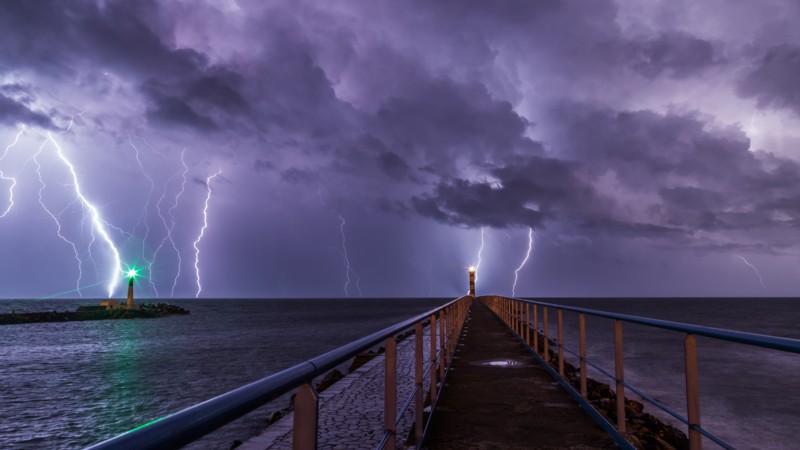
Port and lighthouse overnight storm with lightning in Port-la-Nouvelle in the Aude department in southern France. Maxime Raynal.

The Curse of The Omen

Rumours go that some films, such as The Poltergeist, Superman, and Rosemary’s Baby, have been cursed. Numerous accidents have occurred, causing people to believe that these films have a jinx.1 Not all of these arguments are particularly convincing, as accidents happen. They usually have no relation to a movie, even when several actors of the same cast have had bad luck. However, there is one noteworthy exception, the infamous curse of The Omen, the curse of curses in the film scene.

Danny Harkins wrote on Cracked.com: ‘No film in history has had worse luck than The Omen. Hell, nothing in history has had worse luck than The Omen.’2 The Omen came with billboards featuring a 666 logo inside the title and the uplifting slogan, ‘You have been warned. If something frightening happens to you today, think about it. It may be The Omen.’ And the cheery notice, ‘Good morning, you are one day closer to the end of the world,’ and a conclusion stating, ‘Remember, you have been warned.’

In the script of The Omen, the wife of the American ambassador to Italy gave birth to a son. The child died almost immediately. A priest then convinced him to switch his son with an orphan without telling his wife. Mysterious events soon started to haunt them. The child turned out to be the Antichrist. The Omen was first released on 6 June 1976 (6/6), also the anniversary of D-Day. The date refers to the number 666, as the last digit of 1976 is also a 6. The film’s length is 111 minutes, thus a triple-digit number like 666.

These ominous ingredients made The Omen an ideal candidate for a hefty curse. Two months before the filming started, the son of lead actor Gregory Peck committed suicide. In the film, he is the father of the child who died. When Peck went to the film set of The Omen, lightning struck his plane. A few weeks later, lightning struck executive producer Mace Neufeld’s flight. A lightning bolt in Rome just missed producer Harvey Bernhard, which you might call unbelievable luck, but the number of lightning bolts involved was also incredible. Later, the IRA bombed the hotel in which Neufeld was staying.1 He also survived that.

A plane hired by the studio to take aerial shots was switched at the last moment by the airline. The people who took the original aeroplane were all killed when it crashed on take-off. That is, again, incredible luck, but if you think there is a curse in operation, it is eerie nonetheless. An animal handler who worked on the film set died two weeks after working on the film when he was eaten alive by a large feline, possibly a tiger.1

And then there is the non-fatal accident of Stuntman Alf Joint that seriously injured and hospitalised him when a stunt went wrong on the set of A Bridge Too Far in Arnhem in the Netherlands, less than a year after the production of The Omen. He jumped off a building and missed the inflatable safety bags. It nearly killed him. Joint said he felt a push even though nobody was near him.1 These accidents weren’t exceptional. These things happen. Their number might be noteworthy, but so far, they are not evidence of the infamous Curse of the Omen.

However, the following should make you wonder. On Friday, 13 August 1976, special effects consultant John Richardson drove through the Netherlands with Liz Moore. Both were working on A Bridge Too Far. They became involved in a car accident that killed Moore. The gruesome accident is said to have been eerily similar to a scene Richardson had designed for The Omen. The story goes that the accident happened near a road sign stating a distance of 66.6 kilometres to the town of Ommen, a name very similar to Omen. And it happened on Friday the thirteenth.1 Now, that begins to look like a curse.

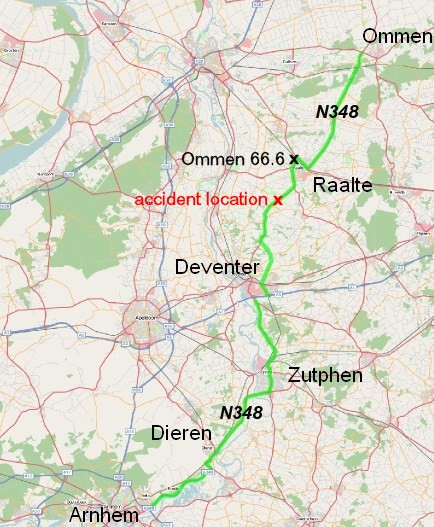
That caught my attention. Road signs in the Netherlands don’t give distances in fractions of kilometres. Only kilometre markers come with fractions. Near Raalte is a junction where Route N348 to Ommen meets Route N35, connecting to Enschede via Nijverdal. This location corresponds with kilometre marker 66.6 on Route N348. I am familiar with the area because I lived nearby, in Nijverdal, as a child. Road signs indicating the direction to Ommen are near this Anti-Christ marker, which I first noticed after returning from a funeral. It appeared to me that this junction should be the site of the crash.

Route N348 from Arnhem to Ommen

And so I came to investigate the curse. In 2015, I started an inquiry. A journalist from the local newspaper, De Stentor, helped me. He delved into the issue and emailed me on 14 April. He had managed to find a former police officer from the area. According to the police officer, the accident indeed occurred near Raalte on Route N348, but not at the intersection near marker 66.6, but between Raalte and Deventer, near Heeten, where Route N348 intersects with the Overmeenweg. This location corresponds with the kilometre marker 60.0. The police officer told the journalist he remembered the car crash very well.3

According to the police officer, the accident happened when he was on duty. A man and a woman had parked their car in a parking lot alongside Route N348. When they drove away in the direction of Deventer, they entered the wrong lane and collided head-on with an oncoming vehicle driven by a resident of Nijverdal. The view was somewhat limited because of two gentle curves in the road. He added that there was no road sign with ‘Ommen’ near the crash site.3

The woman died on the spot. The car was destroyed and disposed of at a fire station. It turned out that the couple were foreigners involved in the production of A Bridge Too Far, the police officer told the journalist. He suspected that Richardson, accustomed to driving on the left side of the road, was not paying attention to the traffic.3

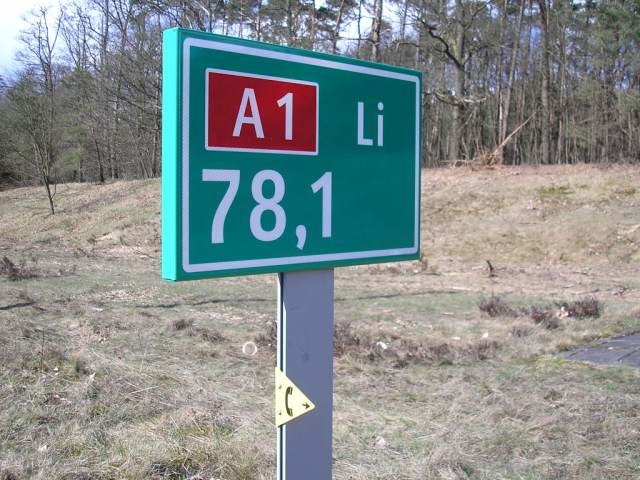
On television, Richardson said, ‘It was certainly very odd because it happened on Friday the thirteenth.’ He added, ‘Right opposite the point where the accident happened, was an old mile-post with nothing but sixes on it.’ He also noted, ‘What spooked me even more was when I discovered it was on a road to a place called Ommen.’ It appears that Richardson has misread kilometre marker 60.0 and has taken the zeroes for sixes. The numbers might have been worn out if it were an old post, like Richardson said.

Kilometre marker at the A1 at km 78.1. Public Domain.

Producer Alan Tyler, who made a documentary about the curse of The Omen, noticed odd things while working on it. The strangest thing was that he had two different camera crews filming in separate locations, but all the footage showed the same fault. It did not seem satanic to him, but it made him wonder. It is at least remarkable that kilometre marker 66.6 is near a road sign stating the direction to Ommen on the same road where the car crash occurred, so I came to investigate the curse, most notably because of what happened next.

When I compiled my findings after receiving the email from the journalist, a few curious events occurred. After reading the email, I took a glance at my stock portfolio. Apart from a few mutual funds, I owned stocks in three corporations. One of them was Heymans, a constructor. It came with a quote of € 13.13. Another position was Macintosh, a retail company. I owned 500 of these, and the price was € 2.626. Hence, the total value was € 1,313. It was peculiar because the car crash happened on Friday the thirteenth. Meanwhile, Macintosh is bankrupt. Heymans’ stock dropped 60% after the company ran into trouble.

That seems a bit of a curse already, and it suggests poor stock-picking skills on my part. But there was more to come. That evening, I had an appointment with a contractor who came to make a tender for renovating my bathroom. He came from Almelo while I lived in Sneek. He cancelled because his van had broken down earlier that day. He could take two routes from Almelo to Sneek: via Nijverdal, crossing Route N348 near kilometre marker 66.6, or the alternative route via Ommen.

My Google search for ‘Ommen 666’ was linked to the Hondentrainingsneek.nl website. At first glance, it appeared to be a site for dog training in Sneek, but it seemed a bit fishy. Somehow, ‘Ommen 666’ had been inserted into topic titles such as ‘Dog Training Terry Ommen 66.6km.’5 The texts on the website were incoherent, with a few references to Ommen 66.6. It is noteworthy that I currently live in Sneek and previously lived in Nijverdal, as my enquiry revealed that Richardson crashed into the car of a resident of Nijverdal.

A final, and also highly peculiar, titbit is that my wife has a heart condition that caused her to visit the St. Antonius hospital in Sneek around the same time I began investigating the curse. Her doctor’s name was Oomen, which sounds like the word ‘omen.’ She visited Dr. Oomen several times over a few years and underwent an operation in 2018 at the St. Antonius hospital in Nieuwegein. Nieuwegein translates to ‘New Joke.’ There are two St. Antonius hospitals in the Netherlands: the one in Sneek and the group to which the hospital in Nieuwegein belongs. There is something odd about The Omen, or perhaps this universe, where strange incidents occur.

If you like this post, then you might also like:

History’s oddities

US Presidents Thomas Jefferson and John Adams were both involved in drafting the US Declaration of Independence that was signed on 4 July 1776. Both died on 4 July 1826, fifty years after the Declaration of Independence. There are more of such oddities in history.

Read More

11 September coincidences

What may strike you about the coincidences surrounding 11 September 2001 is that many of them could have happened accidentally but that the combination of these incidents might be too improbable to be just coincidence.

Read More

Featured image: Port and lighthouse overnight storm with lightning in Port-la-Nouvelle in the Aude department in southern France. Maxime Raynal from France. CC BY 2.0. Wikimedia Commons.

Other image: Route N348 from Arnhem to Ommen. User Michiel1972 (2007). Wikimedia Commons.

1. Curse of The Omen and other Hollywood hexes. Barry Didcock (2012). Scotland Herald. [link]
2. The Insane True Stories Behind 6 Cursed Movies. Danny Harkins (2008). Cracked.com. [link]
3. Email exchange with De Stentor. Theplanforthefuture.org. [link]
4. Curse or coincidence?… ‘Conspiro Media’ re-examines the grisly chain of events connected to those involved in the ’70s horror flick, ‘The Omen’… Matt Sergiou (2014).
conspiromedia.wordpress.com. [link]
5. Dog training Terry Ommen 66.6km. Theplanforthefuture.org. [link]

Getting Used to Strangeness

Eleven is the fool’s number in the Netherlands. 11 November (11-11) is when the Councils of Eleven are elected. It marks the beginning of the carnival season, which culminates in the celebrations of Carnival in February. In the former Roman Catholic areas of the Netherlands, forty days of fasting ended with a feast of excessive eating and drinking, in which people dressed in costumes. Nowadays, people only opt for feasting and excess. Fasting and contemplation are bad for business. In any case, in the Netherlands, eleven is associated with oddity.

Eleven is also the first double-digit number. To me, eleven symbolises a strange event. After all, it is the fool’s number. 11:11 symbolises a repetition of such an event or two related peculiar incidents. That is the nature of coincidences. Something unusual might happen. That can make you wonder, but if something similar or related happens again shortly afterwards for unexplained reasons, that could be amazing.

Several incidents in my life are noteworthy because of a repetition in an unlikely manner. One, while visiting my father in Nijverdal, I drove on a narrow road nearby. An oncoming car hit my rear-view mirror, and it broke off. A few weeks later, my father had the same type of accident in his car. To the best of my knowledge, no one I know has ever had an accident of this kind.

My son Rob had two bicycle accidents that injured him. The first was near our home, just before the home of a retired physician who could help him with his injuries. The second accident occurred during our holiday in Ameland, just before the home of a retired physician who could have helped him. That is odd, even more so because these were the only two bicycle accidents he had ever had.

In the Autumn of 2008, a strange accident occurred before our house in Sneek. A car had crashed into a lamppost. The lamppost broke off. Two men stepped out and hared away. A few years later, I realised the accident may have been a prelude to the array of unusual events that followed. That day, I bicycled towards IJlst, a village near home. Near IJlst, I found the remains of a broken-off lamppost. That was remarkable, even more so because our house is on the road to IJlst, which is the same road.

In August 2014, we were waiting for a traffic light near our home in Sneek. In the car ahead of us sat a guy who looked like my cousin. And so I told my wife. My cousin and I had been best friends for over a decade. We made a funny newspaper together. Immediately after I finished speaking, four trucks from the transport company Leemans came from the right. My cousin had once decorated a truck of Leemans. When I was eighteen, I went on holiday with him, hitchhiking through Scandinavia. A truck driver from Leemans brought us to Sweden.

I hadn’t seen a Leemans truck in my home town before. They were there because of railroad construction work. My cousin came from Haaksbergen, a village near Enschede. In June 2015, we left Nijverdal after visiting my father. Haaksbergen was in the news because of a shooting incident.1 Haaksbergen had been on the news a few times because of electricity failures,2 3, skating contests,4 and a monster truck accident.5 I told my wife, ‘Haaksbergen is often in the news.’ Just after I had finished speaking, we passed a truck of Leemans parked by the side of the road.

In 2014, a woman rang our doorbell. Her father was about to turn eighty. He had lived in our house during the 1950s. She wanted to give him a tour of his old home as a birthday present. She made an appointment to visit us the following Saturday. She showed up with her sister and father. I gave them a tour around the house. A few hours later, the doorbell rang again. My wife opened the door to an elderly lady with her daughter and son-in-law. They asked if they could see the house because she had lived there in the 1960s. Both families had taken up this idea independently and hadn’t spoken to each other. And nothing of that kind had transpired before or afterwards.

In July 2014, we went on holiday to Sweden and Norway. My son wanted to visit Hessdalen Valley in Norway. People have spotted mysterious lights there. Those lights look like orbs and are known as the Hessdalen orbs. Some people have claimed they were UFOs. When we were in Hessdalen, we went to a viewing point on a hilltop. A few Norwegian guys had been there already for hours, hoping to photograph a UFO. We did not see anything unusual. We took some pictures of the surroundings. After we had returned home, we noticed orbs in one of the photos we had taken there. Orbs on photographs are a phenomenon unrelated to the Hessdalen orbs. Still, it is remarkable.

My wife and I had one specific person with whom we couldn’t get along. What is remarkable about it is that they both have the same last name, and there is no connection between these conflicts. And their last name is not very common. In my wife’s case, the person had been a friend previously. This friend wanted the friendship to become closer, but my wife didn’t. My wife doesn’t dare to offend others, so instead of stating plainly what she wanted, she decided not to see this friend again. Now, this former friend wasn’t easy-going, and nearly all her friendships ended in conflict, so there may be more to it. She was rich, volatile, overbearing, and easily offended. She didn’t have to work for a living but could buy anything she wanted because she had inherited a fortune, making her spoiled. She sometimes drove her husband crazy, but he couldn’t leave her because she had the money, or so my wife said. And so, he lived in a golden cage. My wife had succeeded in remaining her friend for decades, which is probably an epic achievement.

I had trouble with the lawyer in the office next door. He wanted me to cut down the trees in my garden, which I did not. That displeased him. Most notably, he took offence at the pine tree in my front yard, which dispensed needles in the Autumn and also had branches that invaded his territory, or at least the air above it. I was accommodating, trying not to let the dispute escalate, so I allowed him to prune the trees, and I also pruned them. When pine needles ended up in his garden, I often removed them, which I was not obliged to do, as these legally were his needles in his garden. But that wasn’t enough. He believed he could order me. And he became angry when I didn’t do what he wanted or forgot to remove the needles from his garden. You know how lawyers are. They try to intimidate you, even when they have a weak hand. There is a Dutch television programme, De Rijdende Rechter (The Travelling Judge), where neighbours fight out their petty judicial conflicts, and a judge makes rulings, so I proposed bringing the case there.

There was no risk that we would have ended up on television. Otherwise, I would have had second thoughts before making such a proposal. Losing a petty conflict with me would make him lose face, as he was a lawyer. He came from a poor family and had long been a car salesman, but had become a lawyer. He talked with a slight elite accent, so a bit with ‘a hot potato in the mouth’ as the Dutch would say, but not much, and so close to Dutch without a local accent that it is hard to tell the difference, so that I might just be imagining it because I don’t like him. At least he gave me the impression that he saw me as a peasant he could order around. Such a man wouldn’t risk losing face. He backed off, perhaps not for that reason, but who knows? Out of frustration, he dumped the pine needles he found in his garden in my garden several times. For several years, I avoided him so the conflict would not escalate. He later turned the office into his home and became my next-door neighbour. Assuming he had had years to calm down and think it over, I contacted him again. Now, we have a reasonable understanding. I later realised that it is indeed odd that he has the same last name as my wife’s former friend.

Latest revision: 28 August 2025

Featured image: Orbs on a photograph taken at Hessdalen, Norway (2014).

1. Schietpartij Haaksbergen, politie geeft beelden vrij en toont auto schutter. RTV Oost (7 May 2015) [link]
2. Leger helpt Haaksbergen bij stroomstoring. Nu.nl (26 November 2005). [link]
3. Stroomstoring treft Haaksbergen en omgeving. De Volkskrant (29 March 2007). [link]
4. Natuurijsbaan. Wikipedia. [link]
5. Derde dode door ongeluk monstertruck Haaksbergen [link]

Master of my own destiny?

It’s a miracle

In early 1993, I started to look for a job. My first application was for an IT traineeship at Cap Gemini. They had sixteen vacancies. Some 1,600 people applied, of which they selected 200 for a series of tests. I was one of them. Before these tests began, other applicants told stories about assessments and job interviews they had gone through. The economy fared poorly, so there weren’t a lot of jobs. Many graduates were already searching for a long time. It was discouraging, so I expected to remain unemployed for quite a while.

That was not meant to be. The tests went well, and they invited me for an interview and some more psychological tests. On my way to the appointment, a guy I knew from dormitory Witbreuksweg 389-2 came sitting on the opposite seat on the train. He asked me why I was wearing a suit. I told him about the interview. Then he started to laugh loudly. ‘Your tie is a mess,’ he said, ‘Let me fix it for you.’ He then arranged the tie correctly.

If this event, which appeared accidental at the time, hadn’t happened, they may not have hired me. The interview and the tests went well. My misfortune because of not fitting in during my student years made me investigate cultures and cultural differences. It wasn’t hard for me to translate the expectations of Cap Gemini concerning its employees into test answers. And so, the test results made it appear as if I fitted perfectly into the corporate culture of Cap Gemini. Cap Gemini stressed I was the master of my own destiny. It was one of their company slogans.

They hired me and sent me to a junior programming class to prepare for my first assignment. My self-confidence was low as I had manipulated the test. Perhaps, I didn’t fit in. And it was shortly after the encounter with Suzanne. I was afraid to turn up because I felt unfit for the job. These feelings receded once the class had started. We learned about programming. I was often joking about a programme I was planning to write. I nicknamed it DoEverything as it was supposed to do everything, which is noteworthy because we may be part of such a programme.

My classmates often discussed what car they would choose once they were on the job. I was the only one planning to use public transport. Not surprisingly, I was not a model employee. One classmate, a cheerful guy from the Eindhoven area named Ad, expressed his amazement about the fact that I passed all the tests. ‘There were 1,600 applicants. And they picked you? It’s a miracle! How could that happen?’ Ad and I had a good laugh about it. His last name referred to Burgundy. In the Netherlands, a Burgundian lifestyle denotes enjoyment of life and good food, most often found in the vicinity of Eindhoven. And Ad radiated this lifestyle. He seemed the personification of it. His first name and the region he came from make another peculiar coincidence in light of later developments.

With regard to the work that awaits us

My first assignment was on a project at the Groningen office of Cap Gemini. I became part of a team of six with a few colourful personalities. Our customer had hired us but didn’t come up with work. For months we had nothing to do, but we had a lot of fun. And I had more fun than I ever had during my student years. Our project manager was ambitious. He organised project meetings and demanded progress reports he could present to senior management even though we did nothing. One of us was a graduated linguist, so he used his skills to produce eloquently written progress reports. For instance, he wrote, ‘With regard to the work that awaits us, we can only assume a wait-and-see attitude.’

Another guy was a hippie and had been part of the squatters’ movement. He always wore the same orange sweater. Perhaps, he had two orange sweaters, but I am not sure. He was the type of guy who might wear the same sweater for months. He often made fun of the project leader and his ambitions. At the time, Windows was gradually becoming the standard operating system. It had new features like WAF files for sounds. Some team members played around with these features, so if I started my computer, it sometimes made an unexpected noise. I had so much time on my hands that I familiarised myself with database administration. After a few months, the work came in, so the project manager was busy managing our work. He constantly demanded progress updates.

We soon realised we would miss our deadline at the end of July. Before the project manager went on a holiday, he discussed the situation with our customer and arranged a new deadline date at the end of August. Once he was gone, things suddenly went smoothly, so we met the original deadline date in July, possibly because the project manager stopped managing us. When he returned, the programmes were already running at the customer’s site. His superiors praised him for delivering a month ahead of schedule. He was on his way to a great career. Perhaps he received a bonus too.

There is room for improvement

The next job was restructuring a database at a telecommunications company. I had some database knowledge. And my managers were impressed that I had familiarised myself with database administration. And so, I did get that job. The company doubted the capabilities of their database administrator, so they hired me to reorganise one of their databases. They took this delicate task out of the hands of their own database administrator and gave it to me, a novice with little experience. And so, their database administrator didn’t like me from the start. And I didn’t follow his advice because he was a bungler. After all, that was the reason they hired me. And he was showing off his expertise by using incomprehensible language, so I often had no clue what he was talking about.

It was a highly political environment. The telecommunications company had been a government operation for a long time, but the government had just privatised it and put its shares on the stock market. The board wanted to purge the old-fashioned government bureaucrats from management positions. And the department I worked for was led by a risk-averse bureaucrat fearing for his job. If something went wrong, his head might roll. And the database administrator might have felt that his position was on the line too. He often complained about me to his manager. And the manager passed on these complaints to Cap Gemini. I also had a team leader who knew the situation and gave a more accurate depiction of what I was doing to his manager and my account manager. That is why they didn’t take me off the job.

And I caused a major accident. To reorganise the database, I needed a list of the tables in the production database and their sizes. Production is the database that matters. The data in the production database is precious. For that reason, I had no access to the production database. There are also databases for development and testing. But I needed production data, so I prepared a file named tablelist.sql containing a query that delivered the necessary data. And for once, they allowed me to access the production database using a tool called SQL Plus. I could start the script by typing @tablelist and pressing enter. I started typing @t. The system didn’t respond, so I pressed enter to see if there was any response at all. And then, I saw the system respond with table dropped, table dropped, table dropped. I cancelled it, but it was already too late. Some precious data was already gone. The operators restored a backup of the previous night, so a day’s work was lost. The database administrator had left a file named t.sql in the SQL Plus directory, dropping all the tables. It was an accident waiting to happen. And even though everyone knew that, the incident reflected poorly on me. With the benefit of hindsight, it was odd. How much bad luck can you have?

Because of the fuss, Cap Gemini sent me to a course called Professional Skills. I was not politically sensitive, and that could be a handicap when you work at the site of a customer. I was aware of that as I had a way of formulating things clearly, so I considered it a good idea. And the course taught me something. For instance, positive framing can contribute to a better atmosphere. You can call it political correctness. So if it is a complete mess, you can say, ‘There is room for improvement.’ Even though it is the same mess, it sounds a lot better. After all, a consultant’s primary responsibility is not to solve problems but to make money for Cap Gemini by making the customer happy. I let it all pass by, concentrated on my task and successfully finished the database restructuring job.

My next assignment was at the real estate department of the telecommunications company. They hired me to make database queries in their financial system for management information. Usually, managers or salespeople wanted a report promptly. It was always very important and, of course, very urgent. I called them jokingly life-and-death queries. It took a few hours to write a query, check the validity of the output, and deliver the report. By then, it often wasn’t needed anymore. The availability of the data rather than necessity created a demand for these reports. In other words, the reporting usually wasn’t that important. Over time, I found patterns in their requests, so I made a set of standard queries with parameters and delivered 90% of the reports on the spot. No one had ever thought of that, so they saw me as a genius and hired me for a longer time to work on their systems.

Hit the moving target

Cap Gemini emphasised the concept of employability. You were responsible for your employment by ensuring your skills were in demand. ‘Hit the moving target,’ is what they called it, referring to the constantly changing market for skills. You must be there where the demand for skills is. During a company meeting, they once gave us toy guns to aim at moving targets on a large projection screen in the front of the room.

Times were changing, and I had been working on the obsolete systems of the real estate department for a few years. My manager and I agreed I had to catch up with the latest developments. In 1995 and 1996, two new development tools, Oracle Developer/2000 and Designer/2000, came to the market. And so, they sent me far away from home, to Zeist, where Cap Gemini had started an Oracle Developer/2000 software factory, a marketing term for a group of people working with Oracle Developer/2000. Zeist was far from home, so I stayed in a hotel nearby. The newest tool was Oracle Designer/2000, and Oracle introduced it when I worked at the software factory. It had a promising future. Designer/2000 could generate Developer/2000 programmes, so you didn’t need to write them yourself. I gained experience with Developer/2000 and also Designer/2000. After a year, I hoped for a Designer/2000 assignment near home.

My manager agreed, but there was trouble brewing once again. An account manager came up with a prospective assignment. I knew him. He was a rough guy who only cared about his bonus. People like him might have done well in the Wild West, playing poker, staring down opponents and engaging in brawls in saloons. I told him that I specifically aimed for a Designer/2000 assignment as I had invested much time and effort in Designer/2000. He said, ‘The customer is planning to switch to Designer/2000, and you can play a role in that process.’ He didn’t disclose any additional information. His vagueness put me on high alert, and I presumed he was planning to dupe me. And so, I warned him that I would decline the job if it wasn’t Designer/2000.

I contacted my manager and discussed the situation with him. I had invested much time in Developer/2000 and Designer/2000 and had been away from home for a year. I would rather stay away from home a few months more if needed to get a proper Designer/2000 assignment. Designer/2000 was just released, so work had yet to come in. If you intend to hit a moving target, you must aim just in front of it, considering the direction of the movement. It takes time for the bullet to arrive at the target. By then, the target had already moved a bit further. So, I was already there, where the target would soon be. And there was plenty of work at the software factory. And so, I asked him if I could decline the job if it wasn’t Designer/2000. He said that sales targets were important and we all must do our bit. But I was supposed to be the master of my own destiny. Knowing that my Designer/2000 skills would soon be in high demand, I said I would look for another employer if that would be his stance. He then gave in.

But the account manager pressed on, ready to make the kill. Before the interview with the customer, another department of the telecommunications company, we once more discussed the assignment. And again, he didn’t say much more than, ‘They are planning to switch to Designer/2000, and you can play a role in that process.’ Once more, I warned him in no uncertain terms. And despite his name being Warner, he didn’t appear to understand what a warning was. Still, his name was endowed with a whiff of coincidence. Then came the interview. The department manager told me they planned to use Designer/2000, but their people would do the Designer/2000 work. They needed me to maintain their obsolete systems. And my resume was perfect as I had been looking after the old programmes of their real estate department for a long time. That was the role I could play in the process. And the account manager knew that all along.

Assuming that the account manager was ready to close the deal and seal my fate, I declined and said I wasn’t informed about the nature of the assignment. And so, I humiliated the account manager in front of the customer and made Cap Gemini lose face. The account manager probably had believed he could get away with it. Indeed, I didn’t want to cause a fuss again, but I thought Designer/2000 to be crucial for my future employment. After all, life is a bitch. If you end up with obsolete skills, you end up unemployed. A few weeks later, I did get a Designer/2000 assignment in Groningen, so close to home that I could bike to work again. Later, my manager said that my actions were unprecedented and had raised several eyebrows. On closer inspection, I could have been a model employee, and more than Cap Gemini might have hoped for.

Walking out of Paradise, once again

After moving to Sneek, I looked for a job near home. There was a vacancy for a software designer at FBTO, an insurer in Leeuwarden. It later turned out that the job included being a project leader. The insurer had split the IT department into smaller teams working for a business unit. Every three weeks, we planned our tasks for the coming three weeks, and a business unit representative determined the priorities. It worked well as we had fewer political games, like business units competing for resources. The IT department was well organised compared to what I had seen elsewhere. This way of running IT departments has become commonplace two decades later.

The team knew what they were doing, so I felt redundant as a project leader. There is no point in managing people who know what to do. The atmosphere was friendly. I had grown accustomed to grim conditions, so I felt out of place. I could have gotten used to the friendliness but not the job itself. All those documents, meetings, and priorities were boring. Building information systems was much more fun. I was qualified for Oracle, but FBTO didn’t use Oracle. I decided to try my luck as a freelance Oracle Designer/2000 developer and database administrator. And so, I walked out of Paradise again, but this time out of my own will. After all, Cap Gemini had taught me that I was the master of my own destiny. But an ominous incident would soon suggest that I was not.

Latest revision: 7 January 2023

Featured image: Cap Gemini logo

parking licence

Events In My Life Related To 11 September

All these accidents
That happen
Follow the dot
Coincidence
Makes sense
Only with you

State of emergency
How beautiful to be
State of emergency
Is where I want to be

– Björk, Joga

Accidents, emergency, coincidence and connecting the dots. Behind it all could be some kind of love affair. Emergency and 11 September are closely linked to each other, not only because of the number 911 being the emergency services telephone number in the United States. Was someone destined to make sense of these coincidences? If there are messages hidden in pop-music then this could be true. In any case, there have been a few peculiar coincidences related to 11 September in my life.

Marcel is my brother in law and 11 September is his birthday. On 11 September 2001 he turned 33 years old. My sister Anne Marie had booked a trip to New York for them both as a birthday present. In the morning she told him that they were going to New York the next weekend. That afternoon the terrorist attacks took place. They had to cancel the trip. They went to a holiday park in the Netherlands instead.

On 11 September 2010, just after midnight, I turned around in my bed. Suddenly the bed collapsed, leaving me wondering on the ground. After standing up I saw that the time was 0:33. A few moments later I realised that it was 11 September and that Marcel had turned 33 on 11 September 2001. That was nine years before while nine is three times three. On the same day two plane incidents occurred at Eindhoven Airport.1 There have been several intriguing coincidences in my life referring to the lady from the dormitory. She now lives in a suburb of Eindhoven.

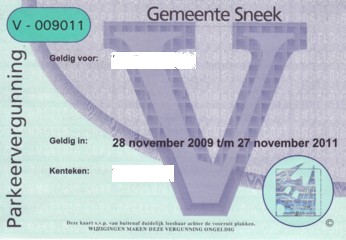
On 11 November 2009 (11/11/11 as 2 + 0 + 0 + 9 = 11) I went to the town hall to pick up my new parking licence. The number of the parking licence turned out to be 009011. It was valid until 27 November 2011. If you compress the numbers as numerlogists often do, then 27 November refers to 9/11 as 2 + 7 = 9 and November is the 11th month of the year. The years (20)09 and (20)11 also refer to 9/11. The remaining digits are 20 and 20 = 9 + 11.

The initials of my last name are KI. When translated into digits (A=1, B=2), you get: 11/9 or 11 September in European notation. My first name starts with B, which can be translated into 2. Hence, my initials consist of the numbers making up the emergency services number 911 and 112. Perhaps that is not impressive but the following will make you wonder. I was born on the Iepenstraat, which means Elm Street in English. The horror picture A Nightmare on Elm Street was released on 9 November 1984 (11/9 American notation) in the United States and on 11 September 1986 (9/11 American notation) in the Netherlands. Now that is spooky.
Aaahhh!!
In the spring of 2011 I saw a German car with licence plate KLE-KI-911 in Leeuwarden while biking to my work. This car passed by a few times around the same time near the same spot. The first time I only noticed the number 911 so seeing the car multiple times made me notice the extent of the coincidence. KLE are the first three letters of my last name, while KI are the initials of my last name. Dutch licence plates linking my name to 9/11 in this way do not exist. The car appeared in the Netherlands where I was going to my work some 200 kilometres from the home town of its owner.

In the spring of 2013 I put the apartment on the ground floor of our house up for rent. A young woman applied for it. She was born on 11 September 1990 it turned out, and so she had turned 11 years old when the attacks of 11 September 2001 took place. A few days later I called her to inform her that she could rent the apartment. When I called her, her father had just been hospitalised. He died a few days later.

Featured image: Plumes of smoke billow from the World Trade Center after the September 11 attacks. Michael Foran (11 September 2001). Public Domain.

1. Vliegtuig in problemen landt op vliegveld Eindhoven. Nu.nl (2010). [link]

Church tower in pond

Psychics, Mediums, and Premonition

Our intuition processes a lot of information, much more than we realise. Sometimes, it seems like magic. When you drive your car, you may suddenly discover you have travelled a long distance without realising it. That is more likely to happen when you are a frequent driver using the same route. Research has demonstrated that we can train specific abilities to the point that they become a subconscious process. An important domain of our intuition is social information. Unless you are autistic, you intuitively read body language and facial expressions and adapt your actions to the clues others give. Mediums might be so good at asking the right questions to influence minds and reading body language and facial expressions that they appear psychic.

Between 2002 and 2010, a medium named Char appeared regularly on a Dutch television show. She performed readings and claimed to be in contact with the spirits of the dead. Sometimes, she seemed to retrieve specific information that only the person receiving the reading and the deceased could have known. In 2008, journalists from the Dutch television programme Zembla investigated her performances. People wanted to hear that their deceased loved ones were doing fine. And guess what? They were always doing fine up there somewhere.

Zembla claimed that the television show aired only the best parts of Char’s readings, making her performance appear better than it actually was. Char was often wrong, but the programme didn’t air many of her misses. James Randi, always willing to enlighten us, was kind enough to weigh in once again. Randi is sceptical of paranormal claims. He argued that Char could have extracted the information from the people receiving the reading.

The name Char equals the first four characters of the word charlatan. Notice the mention of characters in the previous sentence because this word starts with the same four characters. Interestingly, Zembla was discussing Char’s character, so this is indeed a remarkable coincidence. Yet, I still remember a few guesses she made that defy conventional explanation and left everyone on the scene dumbfounded. It seemed impossible to obtain this information from the individuals who received the reading. Zembla didn’t delve into these cases. If there had been fraud, like using actors, Zembla would have mentioned it.

So, can mediums do better than guessing? That must be possible if we live in a simulation running a script. A so-called gift can be an array of accurate guesses. These guesses are not coincidences. Otherwise, they couldn’t stand out in such a manner. It can make mediums believe they have a gift. The phenomenon is widespread and persistent enough to have caught the attention of scientists like cognitive neuroscientist Julia Mossbridge, who has investigated it. The following is one of the accounts of precognition that she has learned about.

On an October night in 1989, a phone call and a scream awoke a four-year-old girl. She tiptoed barefoot through the hallway. Her mother’s voice said, ‘He died in a car accident!’ That hadn’t happened yet. When she threw her arms around her father before he boarded his flight for that fateful business trip, she knew she would never see him alive again.

Her own experience with psychic gut feelings led Mossbridge to study them. Scientists are seeking explanations. They come up with speculations reminiscent of New Age beliefs, such as the idea that precognition suggests that our consciousness reaches beyond the linear perception of time. And that time behaves in a much stranger way than how we experience it. Several experiments have demonstrated the existence of such precognition. In 1995, the CIA declassified its own precognition research after statisticians had reviewed it and declared it reliable.1

An incident in my life showed how premonitions can come true, and that the likely cause is scripted reality rather than time behaving strangely. On 9 February 2009, a severe storm struck northern France. A storm of this strength occurs only once or twice a decade. I predicted such a storm on this exact date two months earlier. Only I feared that it would be more severe and strike the Netherlands. It was a miss of 400 kilometres (250 miles), but that is still remarkable, most notably because of the events that made me make the prediction. On 19 December 2008, I posted a warning on an internet message board.2 On 9 February 2009, Charles De Gaulle Airport in Paris had to be closed because of the storm.3

Somehow, I got a hunch that a superstorm might strike the Netherlands that day, causing widespread flooding in large parts of the country. It began with an article on an alternative website about the web bot, a piece of computer software that allegedly made accurate predictions in the past. The word ‘alternative’ is a bit deceptive here, as the website was about conspiracies, UFOs and the like. In the autumn of 2008, the web bot predicted that large areas of land would suffer permanent flooding in the first half of 2009. The website reported on it. The article didn’t mention a location or a date, but the word ‘permanently’ suggested that this area is below sea level. That narrowed it down to the Netherlands.

That came after I was haunted by time prompts like 2:22, 3:33, 4:44, and 5:55 on the clock at night, which pushed me into psychosis and made me open to suggestion. The date 9 February came up as I believed it was the birthday of a peculiar Lady I had learned to know as a student on the campus of the University of Twente. My memory for dates can be accurate. I remember the birthdays of some of my former schoolmates from secondary school and the exact date my father quit smoking. A genealogy site, however, states that her birthday is 7 February. And so, I might be wrong. However, this possible mistake made me think of 9 February, so it is like slipping on a banana peel to find a clue, which is in the true tradition of slapstick like Chief Inspector Jacques Clouseau.

That came after I was haunted by time prompts like 2:22, 3:33, 4:44, and 5:55 on the clock at night, which pushed me into psychosis and made me open to suggestion. The date 9 February came up as I believed it was the birthday of a peculiar Lady I had learned to know as a student on the campus of the University of Twente. My memory for dates can be accurate. I remember the birthdays of some of my former schoolmates from secondary school and the exact date my father quit smoking. A genealogy site, however, states that her birthday is 7 February. And so, I might be wrong. However, this possible mistake made me think of 9 February, so it is like slipping on a banana peel to find a clue, which is in the true tradition of slapstick like Chief Inspector Jacques Clouseau.

And I found more clues. A blogger on the website Sargasso.nl wrote on 2 September 2008 (2/9) about a storm that would strike the Netherlands on 9 February 2009 (9/2), potentially flooding large parts of the Netherlands. The author wrote it as a what-if scenario, not as a prediction. The article on Sargasso.nl featured animated graphics that showed the flooding of parts of the Netherlands on 9 February 2009, making the images more impressive. The numerical coincidence of the dates was a bit peculiar. Compressing numbers makes them refer to 11:11 as 9 + 2 = 11. And it was precisely the date that I had guessed. Now, what are the odds of that? That frightened me even more. I saw this as an eerie warning sign. A flood of this kind would put millions of people in danger.4 And I had never come across this blog before. I found it as a result of searching for clues supporting my hunch. If you have a suspicion, you look for clues to confirm it. But you wouldn’t expect to find this. And it was about to get stranger yet.

On 13 December 2008, I went to Enschede with my son. We visited the University of Twente. My son didn’t know of my foreboding. I hadn’t discussed it with anyone yet. On the campus was a work of art, a church tower in a pond. It seems to refer to flooded land. It was evening. It was dark, the moon was shining, and a thin layer of ice had settled on the pond. Suddenly, my son told me he saw the coastline of the Netherlands reflected in the moonlight on the ice surface. I didn’t see it, but he kept pointing at the ice until I saw it, too, and very clearly. The Dutch coastline has a peculiar shape that is unlikely to be mimicked by some random incident. That was as eerie as it can get.

Dutch coastline. NASA.

That freaked me out. The church tower in the pond refers to flooded land, and this storm threatened the Netherlands’ coastline. A lunar eclipse was to occur on 9 February 2009, another eerie coincidence. There were a few more strange things. The Dutch singer Boudewijn de Groot had made an album named Lage Landen (Low Countries). The 11th track, Lage Landen, is about a superstorm hitting the Netherlands. The song suggests that the storm will hit on a Monday, while 9 February 2009 was a Monday. Monday is the day dedicated to the Moon (Moon-day), which is noteworthy because of the lunar eclipse and the coastline of the Netherlands reflected in the moonlight.

Lage Landen album cover
Album cover of Lage Landen of Boudewijn de Groot

The song was the 11th track and lasted 5:55 minutes, which was peculiar as the date, 9 February 2009, becomes 11:11 after compressing the numbers. It can be rewritten as 9-2-2009 while 9 + 2 = 11 and 2 + 0 + 0 + 9 = 11. When I first came to the University of Twente campus during the introduction weeks, I stayed at Club 9-2, the most notorious residence hall on the entire campus. This address refers to 9 February. It was indeed intriguing because there was a link with the campus and the Lady.

On 18 December 2008, I issued a warning on two message boards. I expected everyone to ignore it, except perhaps a few nutters. What proof did I have? I had never been psychic. I don’t have prophetic foresight. Only this unique long-term weather forecast was more accurate than chance allows. The events that caused me to make the prediction make it an incredible story. As a prediction, it was pretty useless, and luckily, no one took it seriously. Imagine that a large-scale evacuation had taken place. That is why I refrain from making predictions. Still, the incident sheds some light on why mediums can be highly accurate at times, and beyond what chance and mere guessing allow for, while making countless misses on other occasions.

Latest revision: 2 September 2025

Featured image: Church tower in pond on the campus of the University of Twente. Source Unknown. [copyright]

1. Your Consciousness Can Jump Through Time—Meaning ‘Gut Feelings’ Are Memories From the Future, Scientists Say. Elizabeth Rayne (2025). Popular Mechanics. [link]
2. De duistere zijde van de Maan. Maroc.nl (2008).
3. Storm shuts Paris airports. The Guardian (2009). [link]
4. Wat als het toch fout gaat? Sargasso.nl (2008). [link]