
Satan has always been God’s trustworthy servant. Some experts on the matter say he began his career as a serpent in Eden and later took charge of the furnaces that burn the evildoers for eternity. Others disagree and claim he is a fallen angel named Lucifer who didn’t do any grovelling in Eden. His task was to make God look good. We like to believe God cares for us, but prayers often remain unanswered while bad things transpire, such as misfortune and unpleasant neighbours. How can an almighty, good God allow this to happen? The obvious answer is that there is no god, or God doesn’t care. That is not what we like to hear. Once the Israelites had done away with Baal, Astarte and the others and switched to monotheism, they had to address this uncomfortable issue.
Suddenly, they had no one to blame for their misfortune except themselves. How could that happen? After all, the Israelites were God’s chosen people. Did they do something wrong? So, if things went wrong, it was time to repent, prophets like Isaiah and Jeremiah claimed. There usually was some idolatry or depravity occurring in their midst. That must have made God angry, the prophets proposed. But even when the Israelites prayed relentlessly, lived according to the Ten Commandments, and did all the prescribed rituals and offerings, things often didn’t improve. Why? It was a tricky question.
The Israelites dedicated an entire book, the Book of Job, to the issue, dubbed the problem of evil. Job was a particularly pious and virtuous man who was doing well. But on a fateful day, Satan challenged God by claiming that Job’s devoutness was due to his prosperity. His belief was insincere, Satan argued. God could not allow the mere possibility of insincerity and agreed to test Job and let Satan ruin Job. Even after the loss of his possessions, his children, and finally, his health, Job still refused to curse God. Job did everything God could expect of a faithful servant and more, or so it seemed.
Job’s friends tried to comfort him and figure out why he was suffering and what he could do about it. They suggested Job might have done something wrong. But Job proclaimed his innocence and complained about his fate. In the end, God showed up, telling him to shut up. His sin was hubris because he thought he didn’t deserve to suffer. Everything happens for a reason. It wasn’t entirely satisfactory, so Satan’s role gradually enlarged over time, and he came to do the dirty work so God’s hands remained clean. Still, in the Bible, God killed millions, while Satan only murdered a dozen. And nothing ever happens without God willing it, so God is responsible for Satan’s mischief also. The problem of evil remains unresolved and continues to boggle many minds today. How can a good God let evil happen or even do evil? That we are mere amusement was something few could think of, let alone accept.
The Quran says Satan is a fallen angel named Lucifer (Iblis) who, unlike the other angels, refused to bow to Adam. It alludes to Isaiah, where the morning star fell from heaven (Isaiah 14:12-14). Isaiah probably referred to a Babylonian king, but Luke says that Jesus saw Satan falling from heaven (Luke 10:8). A scribe probably noticed the similar phrasing and had his eureka moment. He could explain how Satan popped up and couldn’t resist sharing his findings with the other scribes, so it became the Christian interpretation of Isaiah’s words, which Islam took over. Also, Satan’s unwillingness to bow to Adam comes from an obscure Christian source. The Quran notes, ‘The angels prostrated themselves, all together. Except for Satan. He refused to be among those who prostrated themselves.’ (Quran 15:30-31) Then follows a conversation between God and Satan (Quran 15:32-42),
God said, ‘O Satan, what kept you from being among those who prostrated themselves?’
Satan said, ‘I am not about to prostrate myself before a human being, whom You created from clay, from moulded mud.’
God said, ‘Then get out of here, for you are an outcast. And the curse will be upon you until the Day of Judgment.’
Satan said, ‘My Lord, reprieve me until the Day they are resurrected.’
God said, ‘You are of those reprieved until the Day of the time appointed.’
Satan said, ‘My Lord, since You have lured me away, I will glamorise for them on earth, and I will lure them all away except for Your sincere servants among them.’
God said, ‘This is a right way with Me. Over My servants you have no authority, except for the sinners who follow you. And Hell is the meeting-place for them all.’
Like in the Book of Job, God and Satan appear to be on speaking terms, or even better, work together on a grand scheme and discuss what to do. Many Jews see Satan as an agent of God who tempts us into sinning so that he may accuse us in the heavenly court. That is also what the Quran says. A Christian might ask why the angels should have prostrated themselves before Adam. Jesus was the second Adam, so God made Jesus, the firstborn of the world, superior to the angels and made the angels worship Him (Hebrews 1:1-7). Satan is an imaginary character like Spike or Suzy. Satan is not the only red herring. The End Times are another. Suppose there will come an End Times. What can we know about it? So, what is the worth of the prophecies in the Bible and the Quran?
The book ‘The Virtual Universe’ addresses the consequences of predestination. A prophecy is like a premonition. Why can fortune-tellers sometimes make accurate predictions? And why are their predictions unreliable at the same time? The answer is that the scriptwriter knows the future, but we don’t. And so, the script can make predictions come true to the point that we notice that something is off, while the proof of foreknowledge remains elusive. Furthermore, and that is a warning, a God who wrote the script is far more powerful than one who can merely send plagues and smite us for being ungrateful or disobedient or for any other frivolous reason. It is indeed next level.
We can’t know the future because our knowing will alter it. If I know I will have a car accident tomorrow, I will stay home, and the accident will not happen. If I am to have that accident, then I shouldn’t know. I may pass a sign saying, ‘You will have a car accident tomorrow’ and laugh about it, and the next day, I will find out it was a sign. As long as I don’t believe it is a sign, it can be precise.
And so, the prophecies of the ancient Greek oracles only made sense in hindsight. In 1914, no one could have guessed that the licence plate number on Franz Ferdinand’s car, in which he was assassinated, referred to the end date of the upcoming world war triggered by that same assassination. The prophecy in Revelation can’t be accurate because too many people take it too seriously. If many people expect the End Times, they can’t know the specifics about that event. And no one knows the hour, not even Jesus knew. The specifics mentioned in the Bible may turn out to be correct in unsuspected ways, such as the prophecies of the Greek oracles. But we will only know in hindsight.
Latest revision: 10 February 2026
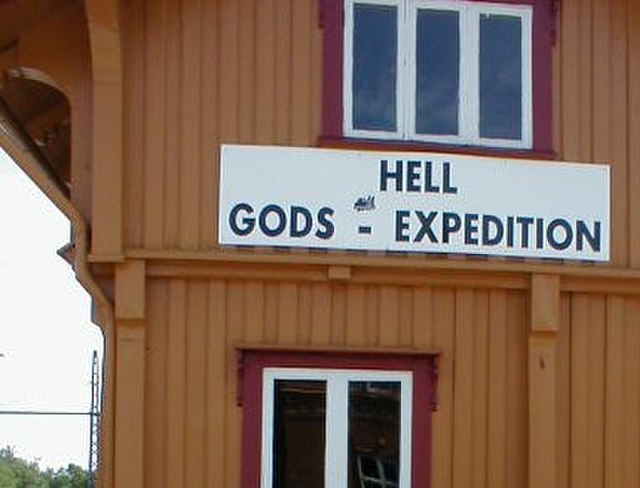
Featured image: Photo of a sign in Hell, Norway, taken by Matthew Mayer in 2001, released under GFDL. ‘Gods’ means cargo or freight in Norwegian, while the old spelling of ‘expedition’ has since become ‘ekspedisjon’. God’s Expedition, however, is a popular reading with English-speaking tourists.

 The Plan For The Future