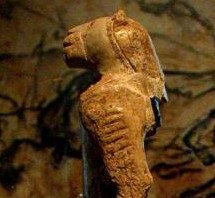
Lionheaded figurine from Stadel in the Hohlenstein cave in Germany

On The Origin of Religions

We, humans, have become the dominant species on Earth. That is because we collaborate flexibly in large numbers. Social animals, such as monkeys and dolphins, work together flexibly but only in small groups. Ants and bees cooperate in large numbers but only in fixed ways. Language enables our large-scale, flexible collaboration. Some animals use signs and calls or give each other names, but we use far more words.1 That allows us to cooperate in more ways and for a wide range of purposes. Language allows us to make and communicate agreements. And we can describe things in detail. We can write, ‘Please read these safety instructions carefully before using model T92.’ Then follow many pages of instructions. Butterflies don’t observe a written list of safety instructions before leaving their cocoons like NASA does when launching a spacecraft. That is why butterflies have never landed on the Moon.

We are also imaginative creatures. We imagine things into existence. We envision laws, money, property, corporations, social classes and states. We imagine that there is a law, and that is how the law works. In other words, we envision the law, and lo and behold, it exists. The same is true for money and corporations. We humans say, ‘Let there be corporations.’ And lo and behold, there are corporations. Only humans do that. No other species envisions money and corporations. I can’t give a dog a debit card to go to the supermarket to buy dog food. A dog lacks the imagination for that. A dog can’t think of money, laws and corporations. And so, you can’t make dogs work together in a corporation to produce dog food by paying them money. Our fancifulness existed long before civilisations emerged. Archaeologists uncovered a 32,000-year-old sculpture of a lion’s head upon a human body. These lion-men only existed in the imagination of humans.

We are also religious creatures. We cooperate using myths. People of the same religion can go on a holy war together. Faith can also motivate people to engage in charitable work and provide for the poor. Religions promote social stability by justifying the social order and promising rewards in the afterlife for those who support it. As societies grew more stratified, the elites, such as kings and priests, tried to justify their existence and lavish lifestyles, and why peasants had to toil. And so, creation myths emerged, explaining that the gods created humans to work the ground. Established religions were often schemes to exploit peasants. You can’t let a dog submit to you by saying obedient hounds will go to heaven and enjoy everlasting bliss after they die, and unruly canines will be fried forever in a tormenting fire. A dog lacks the imagination to even think of it, let alone believe it. We have a religious nature. We make up stories and believe in them. We are social beings and need a group to survive. Beliefs hold groups of humans together, so it is a matter of survival to believe in our own imagination

Small bands of people cooperate because their members know each other and see what everyone contributes. In larger groups, that becomes more difficult as people can cheat. That is where states, money, and religions come in. They facilitate collaboration between strangers, allowing us to operate on a larger scale. States do so by coercion, money by trade, and faith by inspiration. As there has always been a survival-of-the-fittest-like competition between societies, those who cooperated most effectively survived and subjugated others. Religions forge bonds and help maintain peace within a group, or inspire group members to go to war. Religions played a crucial role in the survival of humans. If believing means surviving, it is rational to have faith, regardless of how curious the belief may be. It is in our nature to be religious, and usefulness rather than correctness is the essence of religion. And so, it is better to view a religion not as a set of lies, but as something people agree on to believe in, which helps them to cooperate and survive.

We make up stories and believe them. Hollywood films featured reptiles disguised as humans. Since then, some people have claimed that reptiles live among us disguised as humans. You can see how we can go collectively crazy in this way. When we retell stories, they change. We forget parts of a tale, add new elements or alter their meaning. And so beliefs and religions evolve. The evolution of religions has been a process in which ideas emerged and interacted. Early humans were hunter-gatherers who believed that places, animals, and plants possessed awareness, feelings, and emotions. They asked them for favours, like ‘Please, river, give me some fish.’ Hunter-gatherers felt they were more or less on an equal footing with the plants and animals around them.1 Animism is the name for these beliefs. These beliefs were local and concerned visible objects like a tree or a mountain. Over time, people began to imagine invisible entities like fairies and spirits. A crucial step in the development of religions was ancestor veneration.

The first humans lived in small bands based on family ties. Their ancestors bound them together. And so, they began to venerate the dead. It was a small step to imagine that the spirits of the dead are still with us and that our actions require the approval of our late ancestors. Ancestor veneration made it possible to envision a larger-scale relatedness in the form of tribes. A tribe is much larger than a band. The belief that its members share common ancestors holds a tribe together. Tribes are too large to identify their common ancestors, so tribespeople imagined their ancestors, and the stories about them are myths. The Romans started as a tribe. They had a myth about their founders, Romulus and Remus. As the tale goes, a she-wolf raised them. Tribes are much larger and can muster more men for war. That is why tribes replaced bands. It helps when people attribute magical powers to their ancestors and fear the consequences of angering them. In this way, ancestor veneration turned into the worship of gods. The previous beliefs didn’t disappear completely. Many people still believe in ghosts.

Hunter-gatherers can move on in the event of conflict, but farmers invest heavily in their fields, crops, and livestock. Losing their land, animals, or harvest meant starvation. With the arrival of agriculture, property and territorial defence became paramount. States defend their territory and can afford larger militaries. Kinship is an obstacle as states enlist the people within their realm, regardless of family ties. States thus needed a new source of authority, and the worship of gods replaced ancestor veneration. When humans subjugated plants and animals for their use, they needed to justify this new arrangement. Myths emerged in which the gods created this world and ordained that humans rule the plants and animals. In Genesis, God says, ‘Rule over the fish in the sea and the birds in the sky and over every living creature that moves on the ground.’ (Genesis 1:28) Most of the world’s major religions originated in agricultural societies.

Religions emerged from ancestor worship. And so, gods could be like mothers and fathers. People gave devotion to several ancestors. Each ancestor had a specific admirable quality. Consequently, early religions featured multiple gods and goddesses, each with a distinct role. That is called polytheism, which is the belief in several gods. Henotheist religions emerged later when people became emotionally attached to one particular deity. Henotheism is the belief that multiple gods exist, but that we should worship only one of them. Even polytheists can believe there is a supreme being or principle. However, that supreme being is indifferent to our concerns, so it doesn’t make sense to direct prayers to it in the hope of receiving help. The gods, being on a lower level, have desires, so we can befriend them by making offerings, polytheists believed.1

The next step is monotheism, or believing there is only one God. Monotheists believe that there is only one God who rules the universe. Monotheistic religions were successful because monotheists, most notably Christians and Muslims, have missionary zeal. They believe that God craves our worship. Converting others is an act of mercy, as unbelievers will end up in hell. The worship of other deities is an offence to monotheists. After all, it contradicts their belief that there is only one God worthy of infinite adoration. Failing to take action against the unbelievers could anger God. Polytheists are less likely to feel offended when some choose to worship just one of the many deities or invent a new one.

In the first centuries AD, Christianity replaced the worship of local deities. To help pagans accept Christianity, the Church replaced these deities with saints, who often had the same purpose, and took over existing holidays. Each saint had specific qualities, just like the previous deity. In Ireland, St. Brigid of Kildare replaced a Celtic goddess with the same name. Both occupy themselves with healing, poetry, and smithcraft, and their feast day, 1 February, is the same, which is not a coincidence. And so, polytheism didn’t disappear entirely, as Christians continued to pray to saints. The Church also took over the Roman holiday commemorating the winter solstice, which was on 25 December. It turned pagan rites to celebrate the rebirth of the Sun into a Christian feast commemorating the birth of Christ.

Monotheism comes with a few logical difficulties. We hope that God cares for us and answers our prayers. However, prayers are often not answered, and bad things are happening. So, how can an almighty Creator allow this to happen? The obvious answer is that there is no god, or God doesn’t care. That is not what we want to hear. And so people imagined Satan, God’s evil adversary, who makes all these bad things happen.1 And we hope that the people we hate receive punishment, if not now, then in the afterlife or a final reckoning on Judgement Day. Religions cater for our sentiments, a psychologist might say.

In modern times, Europeans developed ideologies, such as liberalism, socialism, and fascism, which, like moral philosophies, describe how we should live. These ideologies are much like religions. They have prophets, holy books, missionary zeal, and preachers. The prophets of communism were Marx and Lenin. They had theologians who explained their writings. The communists had public holidays, such as 1 May, and heresies like Trotskyism. The Soviet army units had chaplains to oversee the faithfulness of the troops, although the Soviets named them as people’s commissars. The communists further expected an end time, the proletarian revolution, after which they would enter Paradise, world communism. A fanatic missionary zeal further characterised Soviet communism.1 And so, communism is much like a religion. The foundations of the ideologies of liberalism and socialism are the Christian values of freedom and equality. Fascism developed from nationalism, and the struggle for survival in nature inspired Nazism, which helped to make it especially cruel.

After the Middle Ages, educated Europeans began to doubt Christianity. The contradictions in the Scriptures began to attract attention. And then came the party pooper, Charles Darwin, who wrote On The Origin Of Species. Plant and animal species are the outcome of a struggle for survival. Despite the frantic efforts of religious people to fiddle with the facts, the evidence continued to mount. Religions exist because we invent stories to promote cooperation, and that contributes to our success, not because there is an invisible fellow in the sky. But human imagination reigns supreme. We live in such a universe created by an advanced humanoid civilisation. That already happened. We live in such a universe. And so there is a God after all.

Latest revision: 23 September 2025

Featured image: Lion-headed figurine from Stadel in the Hohlenstein cave in Germany.  J. Duckeck (2011). Wikimedia Commons.

1. A Brief History Of Humankind. Yuval Noah Harari (2014). Harvil Secker.

Post-human motivations

Once we realise that reality is unrealistic, we discover that we live in a simulation. That doesn’t require spending massive budgets on scientists. But that doesn’t tell us why we exist. We can explore the possible motives behind those who run simulations of human civilisations to understand their motivations. Again, that doesn’t require scientists. There is no point in speculating beyond the obvious, because the possibilities are infinite. Modern humans place great value on their inner selves, so we may not alter our human essence once we can. Hence, the motives of post-humans could be similar to ours. And so, post-humans might run simulations of human civilisations for research or entertainment.

Research could involve running what-if scenarios. What if a giant meteor hits the planet’s surface? What if China never becomes unified? Alternatively, what if religions such as Christianity and Islam never existed? Or what if a deadly infectious disease breaks out? Countless scenarios are possible. Post-humans might be interested in running them to see how we cope. These simulations are likely realistic. After all, playing what-if with unrealistic assumptions is not playing what-if. What if humans suddenly transformed into koala bears? Some individuals might entertain that thought. And so, that is entertainment.

Possible entertainment applications include games or dream worlds that bring your imagination to life. Such a simulation may be unrealistic in some aspects, as it reflects the rules of a game or someone’s imagination. Minor changes can have a dramatic impact on future developments. And simulations of civilisations are complex. If you desire to make your imagination come true, you need control over everything that happens. That doesn’t apply to games. Unpredictable developments make games more interesting.

What we know about human nature suggests the number of simulations for entertainment will vastly outstrip those run for research. If we live inside a simulation, we should expect its purpose to be entertainment. That could be either a game or a script, thus a story someone wrote. The owner or owners may use avatars and appear like ordinary human beings to us. If reality is unrealistic in some aspects, this suggests that our purpose is entertainment, as a simulation run for research is more likely to be realistic. Evidence of control further indicates that the purpose of this simulation is not to play a game, but to stimulate someone’s imagination through a story.

We live by stories, so there is nothing typically modern or Western about the idea of using the existing technological means to run stories. We have books, theatres and films. What is more speculative is the degree of individualism in the supposed motives of the post-humans. Humans are originally social animals who live in groups. It is particularly Western to see ourselves as precious individuals. It is an inheritance of Christianity that sees each human soul as precious. That individualism allowed Europeans to organise more flexibly, which eventually made them conquer the world, so it is not far-fetched to assume that an individualist culture is at the basis of the civilisation that created us, and that we are a product of a consumerist economy.

If the beings inside the simulation are sentient, that might raise ethical questions like whether they have rights that the creators should respect. Rights don’t exist in objective reality. We only imagine that we have them. And, considering how humans treat each other, it is not a given that our creators would respect these rights even when they acknowledge them. In a realistic simulation, bad things happen to people. And if the simulation is the stage of a story, and there is a script like a film, the beings inside the simulation, thus us, aren’t sentient beings but mindless bots. We would be less than worms. Real worms at least decide for themselves how to grovel and when, so there would be no reason whatsoever for our creators to respect the rights we imagine we have.

Latest revision: 16 August 2025

Simulation hypothesis

In ancient times, philosophers speculated that we can’t tell whether the world around us was genuine or whether other people also have minds. Perhaps I am the only one who exists, while the rest of the world is my imagination. It could all be a dream. Some religions claim that gods created this universe and that we are like them. According to the Bible, God said, ‘Let us make mankind in our image, in our likeness.’

For a long time, we couldn’t tell why this world might not be authentic or how the gods could have created it. That changed with recent advances in information technology. This universe could be a simulation. We believe that our senses register an outside reality so that we ignore evidence to the contrary. You may think you see a pipe when watching an image. The caption of the famous painting, The Treachery of Images, by René Magritte, makes you notice: this is not a pipe.

In 1977, science fiction writer Philip K. Dick was the first to assert that our reality must be computer-generated. In a press conference in France, he described his psychotic experiences and strange coincidences that led him to believe this world is fake. He told the audience that his lost memories returned in full for unknown reasons. He also claimed to have had a vision. And a scenario Dick wrote came true. And so, he thought what he had found was of momentous importance to humanity, so he organised that press conference. His last name suggests our Creator, if there is one, likes sexist jokes.

The idea that we live inside a computer-generated world is known as the simulation hypothesis. We could all live in a simulation created by an advanced humanoid civilisation. Professor Nick Bostrom explored the probability of it in the simulation argument. According to Bostrom, there could be many different human civilisations. The humans in those civilisations may, at some point, enhance themselves with biotechnology and information technology, live very long, and acquire capabilities that ordinary humans don’t have. For this reason, these beings are no longer humans, making them in need of a new name, which became post-humans. A post-human might be a biological creature, a humanlike artificial intelligence or a combination of both. They might be brains in vats or have no physical bodies at all.

These post-humans might experience an urge to run simulations of their human ancestor civilisations, so we could be living in one of those simulations. Bostrom argues that at least one of the following options must be true:

  1. Nearly all human civilisations terminate before becoming post-human.
  2. In any post-human civilisation, only a negligible number of individuals develop an appetite for running simulations of their human ancestor civilisations.
  3. We almost certainly live inside a computer simulation.1

The argument comes with the following assumptions that seem increasingly plausible due to the recent developments in artificial intelligence, but are not proven:

  • The computing power of post-human civilisations suffices to run a large number of simulations of human ancestor civilisations.
  • It is possible to simulate human consciousness in a computer.1


Bostrom concludes that if you think our civilisation will one day become post-human and run many simulations of human ancestor civilisations, you must believe we already live inside one.1 It is a matter of probability. If we invent this technology in the next 10, 100 or 1,000 years, it won’t happen later than that. By then, we will have done it. But millions of years have passed when it could have happened, so it probably did. If we do it within 100 years, and it could have happened a million years ago, the chance it already happened might be (1,000,000 – 100) / 1,000,000 = 0.9999 or 99.99%.

Non-humanoid civilisations are probably not interested in running large numbers of simulations of humans. They might run a few for research, perhaps to investigate human behaviour, but it seems unlikely that our emotions and history entertain beings entirely different from us. Thus, most simulations of human civilisations will likely be run by post-humans.

Non-humanoid civilisations are probably not interested in running large numbers of simulations of humans. They might run a few for research, perhaps to investigate human behaviour. Still, it seems unlikely that our history and emotions interest beings that are entirely different from us so that they will run billions of simulations of human civilisations. And if they exist, they must first learn to travel faster than light to find humans. Thus, post-humans will likely run most simulations of human civilisations. So, our Creator, if there is one, is probably humanoid, but that doesn’t necessarily mean human.

It is a problematic argument. Philosophy is the art of not accepting the obvious because the possibilities are boundless. The obvious often isn’t the case. But with the information we do have, it is our best guess. We think of God as having a human nature because we imagine God. And so, the God in the Bible appears to have human character traits. Conversely, when God imagines us, God probably is humanoid. We would create virtual realities with humans if we could. That is the reason why. However, because we imagine God, that is what we imagine. It seems obvious, but that doesn’t mean it’s true. It is only what our imagination and the evidence suggest is most likely. But we know very little. We can’t go outside the simulation and check.

The simulation argument comes with uncertainties. Post-humans might lack sufficient computing power. Recent developments in quantum computing suggest otherwise. Alternatively, nearly all human civilisations die out before building these simulations. Alternatively, post-humans have evolved and differ from us, so they aren’t interested in running simulations of humans. We may only know this once we have become post-humans. Bostrom doesn’t try to guess the likelihood of the options. He thinks we have no information about whether this universe is real, but that is incorrect. There is evidence.

Latest update: 18 July 2025

Featured image: Inspired By The Treachery of Images.

1. Are You Living In a Computer Simulation? Nick Bostrom (2003). Philosophical Quarterly (2003) Vol. 53, No. 211, pp. 243-255.

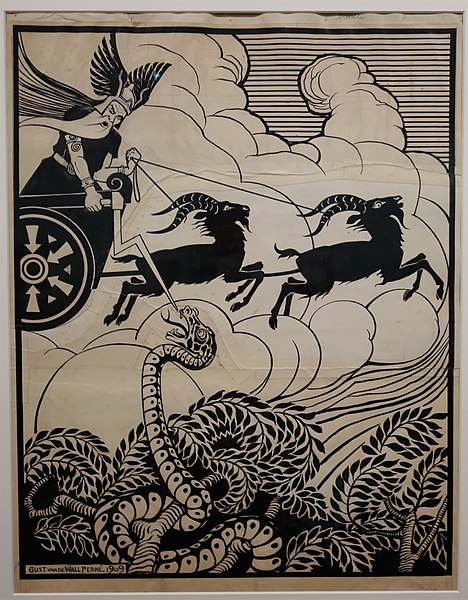
Donar by Gustaaf van de Wall Perné (1911)

Imagined Gods Versus One True Faith

Throughout history, humans have imagined thousands of gods and goddesses. Among them were Zeus of the Greeks, Venus of the Romans, and Thor of the Vikings. And there were countless others. Originally, God was one of the gods from Canaan, so Israel and Palestine, one of the sons of the deities El and Asherah, named Yahweh, thus a minor figure barely above the level of an angry spirit. Apart from Yahweh, the Canaanites worshipped several other local deities. Yet, due to some remarkable course of events, billions of people now believe that this former local nuisance is the all-powerful owner of the universe. And by some other remarkable incident, the Levant, thus Canaan and the surrounding area, is the cradle of civilisation, the birthplace of the Agricultural Revolution. Jericho is thousands of years older than the pyramids and the Sumerian civilisation. So, forget about Mesopotamia, Egypt and China. Our story begins there.

Humans are religious creatures. We are social animals who cooperate in groups. Sharing beliefs helps us do that. If we all believe in the magical powers of the forest spirit, we can establish rituals, such as special dances, to bond the group members. And when we expect the protection of the forest spirit when we go to war, we fight more confidently and have a better chance of winning. If you believe the forest spirit doesn’t protect you, you can easily panic and flee. However, if your belief is strong enough, you may be able to overcome adversity and persevere. Whether there is a forest spirit or not doesn’t matter. If the belief in it helps the faithful survive, it is beneficial in the struggle for survival. It is survival of the fittest rather than survival of the most accurate. The religions we have now have been the fittest in the past.

There is, however, a piece of historical evidence that atheists prefer to ignore, perhaps because they consider it irrelevant even though it is not. Somehow, the worship of the Jewish deity in all its forms survived and grew, so by now, nearly half the people believe that Yahweh, also known as The Father or Allah, is the only true God who rules our world. No one worships Thor anymore, except a few eccentrics who think that choosing a religion is like going to a supermarket and picking a faith you like. You almost hear them think, ‘Look how special I am. I worship Thor.’ A coward like Blaise Pascal, the world-famous guy who invented Pascal’s Wager, would never take up that bet. It is unlikely that Thor exists. And if he does, he must be weaker than the Christian God.

Otherwise, Thor could have prevented the Christian God from taking over his turf. Or better yet, Thor could have expanded his franchise into new regions by sending priests to convert the infidels. Pascal’s Wager is that the risk of not believing in God is eternal damnation instead of eternal bliss, while the risk of believing in God is merely wasting time in church and having no spectacular sex life, without getting a reward for that discomfort. It is thus rational to believe in God and act accordingly because the sacrifice is small compared to the possible gain. That makes Satan worshippers appear stupid. You almost hear them think, ‘Look how naughty I am. I risk eternal damnation by worshipping Satan.’

But then again, I gradually came to think there is no evidence for the existence of God and that the morality of religious people is not better or worse than that of non-believers. Even worse, people betting on God by believing something that makes no sense, only to get a reward, are morally corrupt. And if insincerity would get you in heaven, I preferred to burn in hell with the sincere. That was indeed a careless thought. I didn’t believe God existed, but if He did, He would not appreciate those grovelling worms who merely hoped to cash in their reward. At the time, I still thought of God as a He. Things took an unexpected turn later on, so the latter part of my thought might be correct. In hindsight, I had severely underestimated the risks associated with inverting Pascal’s Wager. Like Blaise Pascal, I am not a hero. If I had thought that believing something nonsensical could protect me from harm, I would have had faith.

To appreciate the long-term historical trend, you can go back 2,500 years, when the insignificant nation of Israel began to develop visions of grandeur and imagined that all the nations would receive blessings through Israel and its special relationship with that local nuisance called Yahweh. Nothing of that kind appeared to be in the making for over 500 years. But then came Paul, who turned the teachings of Jesus of Nazareth, who might otherwise have remained an obscure prophet claiming to be the Son of God, into a religion with universal appeal. Everyone could join and receive salvation, and who doesn’t want that? A suspicious mind might wonder why this unusual religion sprouted from Judaism and has gained over two billion followers 2,000 years later. But then again, God has advised us not to ask too many questions, while Christians think they already know the answer. And thanks to Muhammad, the worship of Israel’s God spread even further.

That wrathful cloud that allegedly led the Israelites out of Egypt, which then went into hiding for over 500 years to supposedly father Jesus, then 600 years later sent an angel to whisper messages in Muhammad’s ear, then waited for another 900 years to give us Martin Luther and even more confusion, and then left us in suspense for another 500 years so we could develop computers and invent the simulation argument to find out that we live inside a virtual reality and merely exist as amusement, has been the veil behind which the owner of this universe is hiding. Perhaps you are unconvinced, but even if you believe in the theory of evolution and the survival of the fittest, you must admit that of all those imagined deities, this one has won the competition by a wide margin. Who knows what the future brings, but if we look at the past, there can be only One, or perhaps none. There are a few atheists who think they are so smart, so when someone says ‘God’, they ask, ‘Which one?’ That is a silly question.

Looking at the trail of confusion, you could also have realised your beliefs were incorrect. Christianity has 45,000 branches, all claiming to be the one true faith. Only they will go to heaven. You might call it Pascal’s Nightmare. You are fuel for Satan’s furnaces forever unless one of those 45,000 is correct, and you happen to have that belief. Place your bets, ladies and gentlemen. Rien ne va plus! Islam is a bit more inclusive and promises that faithful Jews and Christians can join the party in heaven. And the Jews believe they are the chosen people. Israel’s history was one of setbacks, but Israel survived while nearly all the other nations disappeared. Israel had little military power, so the Israelites clung to hope. One day, a Messiah will come, liberate Israel, destroy its enemies, and restore its glory, which it is said it once had when David and Solomon were kings. Jesus was not good enough. He didn’t rout the Romans. And so, they kept on waiting.

Judaism, Christianity, and Islam share an apocalyptic worldview featuring a final battle between good and evil in the Holy Land. Many Christians, adherents of the Religion of Love, support Zionism to make that happen, including the murder and displacement of Palestinians. That infuriates Muslims, followers of the Religion of Peace. They hardly care how many Muslims are slain by other Muslims. To them, the suffering of the Palestinian people at the hands of the Jews is worse than any atrocity in the history of humankind, including the Crusades.

The Book of Revelation raves about 144,000 Jews protected from divine judgment who would convert the other Jews to Christianity and save them. It all has to happen in the Holy Land in the End Times, the Christian Zionists think, so the Jews must move back to Israel and kick out the Palestinians. Some religious Jews would like to blow up the mosque on the Temple Mount and replace it with a proper house of prayer. Perhaps that will kick off the End Times.

So what about that final battle between good and evil? John’s utterings reveal a precise location and suggest it will materialise at a place named Armageddon near the border between Israel and the West Bank, where the armies of the world will gather. Depending on which side you are on and the mushrooms you have consumed, you may see those forces gathering. There have been wars since time immemorial in the area, but since the inception of the state of Israel, the number and intensity of wars in the Holy Land have significantly increased. But why would it be now? If you are neutral, sober or not religious, you may see a bunch of religious crazies fighting for a small patch of land that is not particularly worthwhile. Is this the End Time? Only God knows.

Latest revision: 6 September 2025

Featured image: Donar by Gustaaf van de Wall Perné (1911). Public Domain.