1919 Cover of The Natural Economic Order

Feasibility of Interest-Free Demurrage Currency

Setup

Natural Money is an interest-free demurrage currency. It features a holding fee on currency and a maximum interest rate of zero on money and loans. The Natural Money currency is an accounting unit only, as the holding fee, which may range from 0.5% to 1% per month, makes the currency unattractive to hold. Therefore, the currency will not circulate, nor will someone invest in it. Cash, bank deposits, bonds, stocks, real estate, and other investments aren’t currency and therefore not subject to the holding fee. Not paying the holding fee and the curtailment of credit, and thereby inflation, caused by the maximum interest rate, can make lending at negative interest rates attractive.

Natural Money features a separation between regular banking, also known as commercial banking, which involves lending and borrowing, and investment banking, also referred to as participation banking, which involves participating in businesses. Regular banks guarantee returns to their depositors and use their capital to cover losses. Participating banks have shareholders who share in the profits and the losses. These two bank types should remain separated, even though one bank might offer both in distinct accounts. A commercial bank’s funds should be used only for lending. The maximum interest rate limits lending, allowing equity to replace debt in the financial system.

Evidence from history

There is little historical data on the subject of interest-free demurrage currency. Financial systems founded on interest-free money with a holding fee have never existed. There were holding fees and interest bans, but the combination of both has never existed. More importantly, a usury-free financial system requires a high-trust society founded on moral values where investments are safe, and is only feasible with the help of several relatively modern financial innovations. That all seems too good to be true, but we can have dreams. And so, the evidence from history is of limited value.

Several ancient societies have seen usury-induced economic crises. Extreme wealth inequality, often accelerated by usurious lending, regularly coincided with societal collapses. It is a recurring pattern that has existed since time immemorial. The Sumerians were already familiar with charging interest and its disastrous social consequences. Sumerian rulers began implementing debt jubilees as early as 2,400 BC, cancelling debts and freeing debt slaves. Other cultures, such as those in Israel, have banned charging interest. Israel also had debt jubilees every fifty years.

The Egyptian grain-backed currency existed for over 1,000 years, suggesting it provided monetary stability. Nevertheless, ancient Egypt has seen economic crises, often due to droughts causing crop failures, high taxation during warfare, or a weakening central government. The government mitigated famines with its grain reserves, but prolonged famines depleted these facilities, leading to civil unrest and, sometimes, a collapse of order. There is no evidence of social benefits of this money for Egyptian society. Charging interest was common, and Egypt had debt cancellations.

In the Middle Ages, the Church forbade charging interest. Christians, like Jews, were each other’s brothers and couldn’t charge each other interest. When economic life became more developed, the ban on interest became difficult to enforce. In the 14th century, partnerships emerged where creditors received a share of the profits from a business venture. As long as the share remained profit-dependent, it was not illegal, as it was a participation in a business rather than lending at interest.1 Islamic finance works with similar principles.2

In the 17th and 18th centuries, interest ceilings replaced bans. To circumvent the interest ceilings, a creditor and debtor could secretly agree on a fraud, whereby the creditor handed over less money than stated in the loan contract, so that the borrower actually paid more interest.3 More recent experiences with Regulation Q in the United States, which imposed maximum interest rates on bank accounts, suggest that a maximum interest rate is enforceable only if it does not significantly impact the bulk of borrowing and lending.4

An effective ban on usury requires a society grounded in moral values rather than profit. It requires us to live modestly and within the planet’s limits. It also requires societies to care for vulnerable individuals, so that they don’t fall prey to usurers. You shouldn’t charge interest, not merely because it is illegal, but because it contributes to something profoundly evil. That points to a broader problem. We should care about the world and consider the consequences of our actions. Even when what we do is legal, it doesn’t mean that it is good.

Implementation

To implement Natural Money, interest rates must already be low or negative. Attempting to lower interest rates when market conditions don’t justify that move would likely scare investors. Low interest rates require trust, which requires financial discipline, including fiscal discipline from governments. That doesn’t equal austerity, since governments earn interest on their debts when interest rates are negative. The transition preferably is a gradual process that the authorities communicate in advance. Whether that is possible at all remains to be seen, as the implementation may occur in exceptional times.

If there is still a functional currency, the first step is for the government to balance the budget. The second step is to decouple cash currency from the administrative or central bank currency. The move encompasses retiring central bank-issued banknotes and replacing them with treasury-issued banknotes. Not everyone will hurry to a local bank office to exchange banknotes, so the central bank-issued banknotes must be exchangeable at par for the new banknotes for a considerable period.

As long as interest rates are significantly above zero, a holding fee won’t bring them down. Setting a maximum interest rate can lower interest rates by curtailing credit, thereby cooling the economy. To avoid disrupting financial markets, the implementation must be gradual. The maximum interest rate should be high enough to avoid disrupting the economy. Initially, authorities could set the holding fee at a low percentage, or not at all. As interest rates fall, authorities can lower them.

The zero lower bound is a minimum interest rate. It operates like a price control by preventing interest rates from moving freely to the rate where supply and demand for money and capital balance. That is to the advantage of the wealthy, as they can take the economy hostage by demanding a minimum return on their investments. When returns are low, investors may prefer cash over investments, which can hinder an economic recovery. Economists call it liquidity preference.

Low interest rates can prompt lenders to seek higher yields and take on more risk. Low interest rates allow borrowers to take on more debt. Low interest rates can promote investments that become unprofitable when the economy slows down. A maximum interest rate can prevent these situations from happening. A maximum interest rate caps the risk lenders are willing to take and promotes a deleveraging of balance sheets, so that even low-yielding ventures don’t go bankrupt because of interest-bearing debts.

Issues with the maximum interest rate

A holding fee will cause few difficulties, but a maximum interest rate is more problematic. Insofar as the maximum interest rate affects questionable segments of credit, such as credit card debt and subprime lending, this is beneficial overall. More serious issues can emerge with financing small and medium-sized businesses. Partnership schemes can fill in the gap, but it is hard to predict how that will play out. The maximum yield on loans is zero, making partnerships more attractive, as they can offer higher returns.

There may be objections to the limits Natural Money imposes on consumer credit. Still, there is little doubt that a maximum interest rate can improve consumers’ purchasing power, as borrowers won’t have to pay interest. As a result, there are fewer borrowing options, which may lead to the emergence of black markets. To make illegal schemes unattractive for lenders, lenders who charge interest could lose the money they have lent.

Zero is the only non-arbitrary number, making it more difficult to change the maximum interest rate. That may happen for political or other reasons. The salespeople of usury can find plenty. If it is one, why not two? Zero is a clear line. A positive interest rate, no matter how small, contributes to financial instability. All positive growth rates compound to infinity, so once we start the fire of usury, it will eventually consume us.

A maximum interest rate seems feasible if it is above the rate at which most borrowing and lending occur, thereby limiting the effects on liquidity in the fixed-income market. A maximum interest rate creates room for alternatives, such as private equity and partnership schemes. These alternatives can supplement the fixed-income market and mitigate the effects of the maximum interest rate. A maximum interest rate is beneficial overall if it mainly affects questionable segments of credit, such as subprime lending.

In the case of bonds, the maximum interest rate of zero applies at the time of issuance. Due to economic circumstances or issues with the debtor, the interest rate may rise and enter positive territory. Likewise, governments may issue long-term bonds that may have positive yields if interest rates rise later on. That is not a serious issue, as long as the interest rate was zero or lower at the time of issuance.

A more serious issue is the risk of liquidity problems. When interest rates rise, less credit becomes available at interest rates of zero or lower. Interest rates might increase due to a strong economy with inflationary pressures. There are always economic agents that must borrow at all costs to meet their present obligations, so if they can’t borrow, they might go bankrupt. Businesses and individuals need to deleverage and arrange credit in advance, such as an overdraft facility, with their banks.

Another equally serious question is the profitability of banks with Natural Money. The lending business of banks will likely shrink significantly. The assumption is that risk-free lending will be profitable. But what if it isn’t? In that case, banks may need to lower the interest rates on deposit accounts to a level below the interest rate on short-term government debt. In that case, the cash interest rate may need to be lower than the interest rate on short-term government debt to make it work.

Inherent stability

Ending usury is impossible without investors having trust in the political economy or the political and economic institutions of the polity issuing the currency. The most trusted political economies have the lowest interest rates because their governments are fiscally responsible. Natural Money requires taking it to the next level. With Natural Money, to borrow, the government must find lenders willing to lend in the currency at negative interest rates. The government will be better off borrowing at negative interest rates, which provides an incentive for budgetary discipline. That is the foundation of stability.

Extracting a fixed income from a variable income stream contributes to financial instability. Fixed interest payments can bankrupt a corporation even when it is profitable overall. Interest contributes to moral hazard, as it serves as a reward for taking risks. Investors expect to earn higher yields on riskier debt, so lenders take on these risks. The more uncertain an income source, the higher the interest rate needs to be to compensate for the risk of lending, but the higher the fixed interest rate, the more likely failure becomes, which reveals the destructive consequence of interest being a reward for taking risks.

All parts of the financial system are intertwined. Individual banks can transfer these risks to the system. And so, the risk management of individual agents can increase the overall level of risk in the system. The payment and lending system is a key public interest, so governments and central banks back it. Banks take risks and reap rewards in the form of interest, while public guarantees back up the financial system. The arrangement leads to moral hazard, a mispricing of risk and private profits at the expense of the public. A maximum interest rate can end these problems.

A maximum interest rate causes a deleveraging and a reduction in problematic debts, which has a stabilising effect on the financial system and the economy. Individuals and businesses must already take action before their debts become problematic. Maximum interest rates can distort financial markets. Most notably, there will be fewer options for smaller firms to borrow. Partnership schemes should fill that void.

Interest payments also affect business cycles. The mainstream view is that central banks should raise interest rates during economic booms to curb investment and spending, thereby preventing the economy from overheating. A rosy view of the future prevails during a boom, so higher interest rates seem justified and borrowing continues for some time. When the bust sets in, the picture alters, and an overhang of debt at high interest rates worsens the woes. It would have been better if these debts hadn’t existed in the first place.

That makes a usury-based financial system inherently unstable. Natural Money changes this dynamic. When the economy improves, higher interest rates increase the attractiveness of equity investments relative to debt. That reduces the funds available for lending. The curtailment of credit will prevent the economy from overheating and avoid a debt overhang. When the economy slows, negative interest rates provide stimulus. In the absence of a debt overhang, the economy is likely to recover soon. A Natural Money financial system is inherently stable.

Featured image: 1919 Cover of The Natural Economic Order. Wikimedia Commons.

1. Simon Smith Kuznets, Stephanie Lo, Eric Glen Weyl (2009). The Doctrine of Usury in the Middle Ages. Simon Smith Kuznets, transcribed by Stephanie Lo. An appendix to Simon Kuznets: Cautious Empiricist of the Eastern European Jewish Diaspora.
2. Sekreter, Ahmet (2011). Sharing of Risks in Islamic Finance. IBSU Scientific Journal, 5(2): 13-20.
3. K. Samuelsson (1955). International Payments and Credit Movements by the Swedish Merchant Houses, 1730-1815. Scandinavian Economic History Review.
4. R. Alton Gilbert (1986). Requiem for Regulation Q: What It Did and Why It Passed Away. Federal Reserve Bank of St. Louis.

Amish family, Lyndenville, New York. Public domain.

Economic Development

Before the Industrial Revolution

Before the Industrial Revolution began in England, European crafts and sciences had already advanced. During the Middle Ages, inventions such as gunpowder, eyeglasses, the compass, the printing press, the mechanical clock, the windmill, and the spinning wheel had reached Europe from China or the Middle East. What made Europe culturally different was its individualism. In the 14th and 15th centuries, a new spirit emerged in Italian merchant towns like Venice, Florence, and Genoa. It was the spirit of the merchant which subsequently spread throughout Europe.

And so, Europeans gradually abandoned their traditional Christian values and developed a capitalist spirit by pursuing worldly wealth and pleasure rather than modesty and bliss in the afterlife. There were merchants elsewhere, but the populace held them in low regard because of their depraved ethics, as greed was their core value. It was the pursuit of profit that drove European explorations and colonialism. Making money became the new moral virtue, alongside inquisitiveness, creating a dynamic that would change the world.

During the 16th and 17th centuries, Europeans explored the world and invented the microscope, the steam turbine, the telescope, and the steam pump. Modern science began when Nicolaus Copernicus calculated the trajectories of the planets by assuming that they revolved around the Sun. Isaac Newton later formulated the laws of motion. Europeans expanded their colonial empires, thereby increasing the size of their markets, a prerequisite for the mass production that industrialisation was to bring.

The British were the most successful. Supported by a strong navy, they built the largest colonial empire. They also invented modern banking, creating money out of thin air or financing capital by imagining future revenues. In 1689, the British had the Glorious Revolution, which, like many revolutions, was about taxation. Businesspeople then took over the government. Taxation henceforth required the consent of the taxed, thus, property owners. And the state became a venture of the propertied classes, like the Dutch Republic, the wealthiest nation at the time, already was.

The taxpayers didn’t like to pay for ineptitude and corruption, so the quality of the British state improved, and the state used its military to support the colonial business ventures of the propertied classes. Great Britain had easily accessible coal deposits and developed a large coal mining industry. Due to a lack of firewood, coal had become England’s primary heating source. As mine pits grew deeper, they became prone to flooding. With no transport costs, a coal-fired steam engine to pump water out of the mine became cheaper than manually pumping with buckets.

Ignition

Trade with the colonies promoted British industries, resulting in high living standards and wages in England. In England, coal was easily accessible, so energy was cheap. In Great Britain, the aristocracy had an entrepreneurial spirit and paid taxes, making the British government a reliable borrower. Banking innovations, most notably the creation of money, made British capital markets more efficient. And so, Great Britain had low interest rates, so a low price for capital. The first machines were clumsy and inefficient, but high wages, cheap capital and affordable energy made them profitable.

This combination of factors is why the Industrial Revolution started in England rather than elsewhere. Wages in France were lower, while the banking system was less developed. The rent-seeking French aristocracy didn’t pay taxes, making the French government an unreliable borrower. Thus, interest rates in France were higher. Once the first machines were in operation, inventing new ones or improving existing ones became profitable, so British engineers got busy enhancing the steam engine’s efficiency and inventing contraptions like the spinning jenny and the cotton gin.

The fuel consumption of steam engines dropped from 44 pounds of coal per horsepower-hour in 1727 to 3 pounds in 1847, making it economical to use the steam engine for other purposes, such as trains. The dramatically improved fuel efficiency, combined with other improvements, made it economical to mechanise production elsewhere where wages were lower, interest rates were higher, or energy was more expensive. That allowed the Industrial Revolution to spread to other countries.1

It was a watershed moment. Until then, inventions were rare. Scientists made them out of curiosity. However, from then on, the profit motive generated a permanent drive to pursue knowledge and new technologies and to invent new products. In this way, economising through innovation and scale became a constant, unstoppable process that economists call creative destruction. Factories needed scale to operate profitably, while inventions birthed new industries and made others obsolete.

Humans have started a fire in their midst that continues to grow. We can’t stop it. A classic book on the Industrial Revolution used at universities is David Landes’ The Unbound Prometheus. According to Greek mythology, Prometheus stole fire from the gods and gave it to humans. The Greek supreme deity, Zeus, punished him for his act. The story parallels the biblical story of the Fall. The Industrial Revolution unleashed the unlimited fire of the gods that will devour us.

Since the Industrial Revolution, the general level of opulence has risen dramatically, though it was hardly noticeable at first. Industrialisation made craftspeople in the clothing industry destitute as they couldn’t compete with factories. Everyone else profited from cheaper cloth. Mechanisation made existing products like cloth more affordable, so people had money to spend on new products like light bulbs, making investing in new inventions profitable. Economists call it Say’s Law. More supply generates new demand.

Due to these innovations, production costs decreased, and industrialisation became profitable where wages were lower, energy was more expensive or interest rates were higher. Industrialisation first took off in Europe and North America, but not elsewhere. One reason is that Europeans had become innovation-minded and eagerly adopted new technologies like railroads and telegraphs. These first technologies were simple, thus easy to apply, but the Chinese and others remained reluctant to use them.2

Standard development recipe

Western Europe followed quickly, helped by the French Revolution and Napoleon Bonaparte’s reforms. The French Revolution wiped out the corrupt old French regime and replaced it with a modernised, efficient bureaucracy. The aristocrats lost their power. The French introduced civil registries, rationalised the law code, standardised weights and measures by introducing the metric system with kilograms and metres, and made everyone drive on the right side of the road. Napoleon’s armies then spread these reforms over Europe. Napoleon did to Europe what the first Chinese emperor did to China 2,000 years earlier. Both reigned shortly but left a lasting legacy.

Countries Napoleon didn’t conquer, such as Great Britain, continued to drive on the wrong side of the road and use arcane measures like miles and ounces. And only in Great Britain do aristocrats still influence politics through the House of Lords. To catch up, Western Europe and the United States followed a standard recipe consisting of the following elements:

  • Creating a national market by eliminating internal tariffs and building railroads.
  • Developing domestic industries by using external tariffs.
  • Instituting banks to finance investments and stabilise the national currency.
  • Establishing a mass education system to upgrade the labour force.

These measures had enormous social consequences, which we now refer to as modernisation. Societies came to replace communities. It was the age of nationalism. With the help of mass education, everyone learned the national language, and local dialects disappeared. People learned to identify with their nation rather than their kin and village. The outcome was that modern humans rely on markets and the state more than on their family and community.

Other countries implemented the same recipe but with modifications due to local economic factors. Factory layouts that operated at a profit in Europe were loss-making elsewhere. If energy were expensive, the operation would become more cost-effective using fewer machines and more labour. Japan was the first non-Western country to follow. The Japanese had to deal with local circumstances. High interest rates made investment capital expensive, so Japanese factories held no stockpiles of raw materials and semi-finished products but let their suppliers make them when needed. So, when interest rates rose in the late 1970s and early 1980s, Western industries couldn’t compete with Japan.

There are varying views on why industrialisation succeeded in some countries but not in others. If you dare to generalise, you can make the following observations:

  • East Asian countries like Japan, South Korea, Taiwan, and later China modernised successfully. They had a sense of nation and experience with rational government administration. Their bureaucrats and businesspeople successfully implemented modernisation projects.
  • Latin American countries were less successful. They were former colonies lacking national identities. Their white elites neglected the education of indigenous people. There were a few large estates and hardly any small-scale farmers. Wealth inequality prevented the development of a middle class.
  • The Soviet Union modernised with the help of state planning. Industrialisation of heavy industries succeeded, allowing the Soviet Union to defeat Nazi Germany. Agricultural reforms were a disaster, and consumer products were of poor quality. By the 1970s, it became clear the Soviet Union couldn’t keep up with the West.
  • Several countries in the Middle East modernised with dictators implementing socialist development models based on the experiences in the Soviet Union. Some Arab countries became wealthy from oil revenues. Few countries in the Middle East have developed industries that compete in international markets.
  • Africa lagged. African borders didn’t match the tribes living there, so there was no sense of nationhood. There have never been states in most of Africa. European colonisers ended traditional forms of government and property rights, contributing to poor governance and corruption. Africans started with a disadvantage.

Industrial politics

There are requirements for a modern economy, though a country doesn’t need to meet all of them. A capable government and an educated workforce can turn a situation around. Japan has few natural resources, but has become one of the most advanced countries in the world. It was the first non-Western country to industrialise. Japan was also lucky. After World War II, it had access to US markets because it was a close ally of the United States, which needed it to help it export its way into prosperity. Argentina had fertile land and was one of the wealthiest countries by 1900, but it has since then gone downhill. To successfully modernise, a country probably needs:

  • a capable government that understands economics and is business-friendly
  • an educated workforce as workers must read, write and use technology
  • businesspeople, investment capital, and sufficiently ensured property rights
  • a large enough market, thus a sizeable middle class
  • an industrial policy, thus picking industries to compete in international markets, helping to develop them, and supporting them with tariffs or subsidies

There are several kinds of industrial politics. Neo-liberal politics aim to pursue economic growth by promoting trade, lowering taxes, and reducing regulations. Unrestricted trade allows areas and people to specialise and compete to produce more and better products, enhancing overall opulence. It also promotes a race to the bottom at the expense of our future. Industries go where wages are lowest or where they can dump their waste and avoid paying for government services.

Making the economy sustainable and people-friendly also requires industrial policies, such as reducing competition and introducing regulations and controls. And it requires ending imports from countries that don’t adhere to the same ethical standards. A sustainable, people-friendly economy can only exist on a level playing field with other economies that adhere to the same standards. These measures increase costs and reduce living standards. An extreme case is the Old Order Amish. They choose to be self-sufficient and live simple lives. Their economic model resembles community economics.

Community economics aims to enable people in a community to help each other by buying and selling goods and services using local currencies. It never became a worldwide success because communities lack the scale for self-sufficiency. There is also a lack of commitment, which is something the Amish do have. Few people barter their labour or goods in their community if they can get better deals elsewhere. Commitment is vital. Without it, there will be black markets with merchants smuggling in illicit goods.

Featured image: Amish family, Lyndenville, New York. Public domain.

1. The British Industrial Revolution in Global Perspective. Robert C. Allen (2014). Cambridge University Press.
2. Sapiens: A Brief History of Humankind. Yuval Noah Harari (2014). Harvil Secker.

1919 Cover of The Natural Economic Order

Discovery of Interest-Free Money

In September 2008, the banking crisis was getting out of hand. Things were falling apart. It seemed as if the financial system could collapse at any moment and that civilisation, as we know it, would end. Today, the 2008 financial crisis is a distant memory, but at the time, not only did the financial press worry. Panic was setting in. It was like 1929. I had long feared an apocalyptic financial collapse and believed that usury, or charging interest on money and debts, would be the underlying cause. On the surface, the cause may appear irresponsible lending, but interest is a reward for the risk of default. Without interest charges on debts, there would be no irresponsible lending.

The events prompted me to watch the animated picture ‘Money as Debt’ on YouTube and reflect once again on Silvio Gesell’s ideas about charging a holding fee on money and using it to eliminate interest charges. I penned down my thoughts about interest-free money with a holding fee, and tried to make an ordered, coherent whole of them. The idea had never seemed workable. Why should you lend out money interest-free if you can receive interest elsewhere? It is why economists didn’t look into it more seriously and why interest-free money remained a fringe idea, mainly attracting eccentrics like me.

Then, in the first days of October, I made a startling discovery. Banning interest promotes financial stability by preventing usurious lending, irresponsible lending, and unproductive financial schemes. That would improve the economy. Think of it like so. When credit card debt and payday lending at high interest rates disappear, people will have more disposable income, and you will have no usurers living off the work of others. That would be more efficient. It also reduces the need for government and central bank interventions to manage the interest-bearing debt. Usury requires government deficits and the creation of money by central banks.

That is because most of our money is debt. If you go to a bank and take out a loan, the bank creates money out of thin air, but you must pay back the loan with interest. You repay the loan with money borrowed by someone else. And the money you need to pay the interest doesn’t exist. Someone else must borrow that as well. On a larger scale, due to interest charges, we need to add extra debt to pay off existing debts with interest. To prevent the usury scheme from collapsing, governments run deficits and central banks print money, which leads to inflation. The inflation rate is often higher than the interest rate you get on a bank account. The profits are for the bankers, who receive huge bonuses.

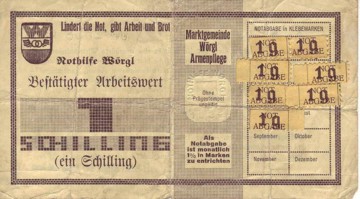
Now comes the explosive discovery. The economy would do better without usury. If the economy performs better, the yield on investments would be higher, so an investor would receive better returns with negative interest rates. The difference comes from inflation. Without interest charges, there is no need for government deficits and money printing. The economy can thrive without more debt, so there would be no inflation. During the Great Depression, the Austrian town of Wörgl issued a currency with a holding fee. Those holding the money had to pay a 1% monthly fee to keep the money valid, so they would spend it rather than save it. And so, the money kept circulating, and Wörgl’s economy boomed while Austria suffered from the depression.

And so I figured that if the money is interest-free, the currency’s value rises more than the interest you would receive on an interest-bearing currency. Think of it like so. You can have 2% interest with 5% inflation or -2% interest with 0% inflation. The latter would be a better deal. The question then becomes, why lend out money with interest when interest-free money offers better returns? If the idea is that good, and the ‘Miracle of Wörgl’ suggests so, investors would bring their money to the interest-free economy, and the usury economy would collapse. If this became more widely known, the idea would spread and terminate the usury financial system forever.

Until then, I had always believed that interest-free money was sound in theory, but impossible in reality, because rather than good intentions, efficiency drives changes in this world, which is also the reason why we are doomed. The only constant in history is the strong killing the weak. But this money could be the terminator of usury, and a better future for humankind suddenly seemed possible. An incredible power seemed to lurk behind it. And making this knowledge public, I speculated, could unleash an unspeakable force. The Austrian central bank banned the Wörgl money, so we don’t know how it would have ended if it had continued. Perhaps, we would have lived in an entirely different world. A similar type of money lasted for over a thousand years in ancient Egypt. Had I discovered the secret that explains these successes?

That gave me serious doubts. How could the experts have missed it? I was an amateur. And amateurs who think they know better than the experts have become a plague recently. ‘Think for yourself and do your own research,’ has become the motto of a growing squad of nutters that the Dutch would call Wappies. ‘If it snows, that proves climate change is a hoax.’ You know the type. Everyone can gather random posts and articles from the Internet and create their own version of the truth out of thin air. I was anxious about getting it wrong, which made me doubt the greatness of the discovery. It might be a good idea, but it can’t be that good. And that is correct, a decade of research later confirmed, but it is possible nonetheless. And the proof also came as we have seen negative interest rates in the next decade.

Then, on a website promoting Gesell’s ideas, I found the following quotes,

‘The creation of money that cannot be hoarded will lead to a different and more real kind of property.’

– Albert Einstein

‘Gesell’s name will be a leading name in history once it has been disentangled.’

– H.G. Wells

‘The application of Gesell’s principle of circulation of money will lead the nation out of the depression within two to three weeks. I am a humble student of this German-Argentine businessman.’

– Irving Fisher

‘The future will learn more from the spirit of Gesell than from that of Marx.’

– John Maynard Keynes

‘Gesell’s work will initiate a new epoch in the history of mankind.’

– Prof. Dr. B. Uhlemayr

‘Gesell’s discoveries and proposals are of the greatest importance for centuries to come.’

– Dr. Theophil Christen

These brilliant minds agreed that something epic lay beneath the surface and that it could change the future forever. John Maynard Keynes and Irving Fisher were among the greatest economists of their time. If Keynes believed Gesell would make us forget Marx, I might have found out why. And so, the Miracle of Wörgl and the grain money in ancient Egypt may not have been freak accidents but a sign of something more. Ending usury, the scourge that had haunted humankind for thousands of years, seemed within reach. While considering the implications, the following song played on the radio,

Summer has come and passed
The innocent can never last
Wake me up when September ends
Like my father’s come to pass
Twenty years have gone so fast
Wake me up when September ends

– Green Day, Wake me up when September ends

September had just ended. Silvio Gesell first proposed money with a holding fee in his book ‘Natural Economic Order,’ which he first published in German in 1916 as ‘Natürliche Wirtschaftsordnung.’ I figured that its abbreviation could be NWO, which stands for New World Order, not knowing that the German ‘Wirtschaftsordnung’ was, unlike in English and Dutch, one word. So, was my discovery meant to happen? Was it part of something bigger? These thoughts arose, ironically, because I didn’t see ‘Wirtschaftsordnung’ as a single word. It made me feel small and insignificant. Paranoia was creeping in.

What is less known, but definitely worth noting, is that the German Nazis also aimed to abolish interest and contemplated Gesell’s ideas. Gesell himself was not a Nazi, but a liberal and an internationalist. Adolf Hitler was more impressed by the ideas of Gottfried Feder, who had the same kind of moustache Hitler had. Feder had written ‘The Manifesto for the Abolition of Interest-Slavery’ around the same time Gesell wrote ‘The Natural Economic Order’ and proposed nationalising all banks and abolishing interest. Gesell argued for charging a holding fee on currency and not interfering with markets and banks.

I named the discovery Natural Money as a reference to the Natural Economic Order. Strange things began to happen. When I woke up at night, the clock always showed times like 2:22, 4:44 or 5:55, with no exception. That was creepy. Something seemed seriously off with reality. Then, my wife told me she was seeing those time prompts as well. Until then, I hadn’t told her that I was seeing them. Once you enter the Twilight Zone, it begins to affect you. Meaningful coincidences started to occur, making me open to suggestions. What happened around me and in the world seemed to interact with my thoughts. Even the covers and titles of the books in the bookshop at the train station in Leeuwarden radiated a sense of spookiness, with references to my situation. They call it synchronicity.

The animated picture Money as Debt started with a list of assassinated US Presidents who supposedly opposed the banking system, suggesting evil bankers were behind these assassinations, making me fear death under suspicious circumstances if Natural Money would get serious attention. Still, if a repetition of the miracle of Wörgl were to occur, the news would spread fast, and if it were that good, it would be impossible to stop. Killing me wouldn’t help. The Secret Service would be too late. Of course, I had worried far too much. I posted the idea on several message boards. Most people didn’t get it. I mailed the findings to 200 Dutch economic researchers. None of them was interested.

Natural Money had a more favourable reception on the message board of Opednews.com. It generated some discussion as some visitors saw the potential. Still, it didn’t lead to a further propagation of the idea. I also went to Strohalm’s office in Utrecht. They had been working on interest-free currencies for decades. The people of Strohalm received me politely, but they had other priorities. They had a promising project in Uruguay. Doubt crept in again. I didn’t know enough about monetary economics and the financial system to see whether it was an idea worth pursuing. And even if I was right, no one would listen, so I planned to give up and resume my life.

It was disappointing, but not as bad as being evicted from the dormitory by A* nineteen years earlier. To remind myself of that and make me feel better, I played the Sleepwalking album by Gerry Rafferty, the album I had come to associate with the events at the dormitory because of the lyrics of the first song, ‘Sleepwalking.’ And then I wondered whether A* had something to do with the discovery of Natural Money. Over the years, several incidents had occurred, suggesting that She was still interfering with my life. It didn’t take long before clues came up. There is a thin line between paranoia and psychosis. The lyrics of the fourth song of the album ‘On The Way’ were noteworthy,

Drifting along with the wind, telling yourself you can’t win
It’s over, and now we begin, oh yeah, we are on the way

Only one woman, one man, just doing the best that we can
There’s so much we don’t understand,
Oh yeah, but we’re on the way
Light shining down from the east,
bringing a love that won’t cease

– Gerry Raffery, On The Way

In my bed, I was imagining again. By giving up, I had just told myself I couldn’t win. Was this just the beginning? The beginning of what? What did I not understand? What was this love that won’t cease? Was my destiny connected with that of A*? I had loved Her in secret all that time, but never thought, or even hoped, that we could be together. The distinction between my make-believe world and reality, which had been there since I was a child, began to blur. The lyric wasn’t specific, so the suggestion came from me linking the album to the events in the dormitory. And I might still have ignored it if it weren’t for the fifth song,

People come and people go, friends, they disappear
There’s only one thing that I wanna know, tell me where do we go from here
Everybody’s on the make, everybody’s trying to get ahead
In a world like this, you just exist to feed the walking dead.

Lookin’ out on a world gone crazy, waitin’ for the fun to begin
The race is on, yeah, they’re gettin’ ready, Jesus, what a state we’re in
Meanwhile, down in my backyard, I’m sitting doing solitary
Now that I’ve milked the sacred cow, I just worry ’bout the military.

Get ready
Get ready

– Gerry Raffery, Sleepwalking

It is a strange lyric, and it made me think. Is the world about to go crazy, and is something about to start? We exist to feed the walking dead, which could be the defunct banking system, I reasoned. The phrase probably refers to what Karl Marx once wrote, ‘Capital is dead labour, that, vampire-like, only lives by sucking living labour, and lives the more, the more labour it sucks.’ I didn’t know that, so I made up my own interpretation. The sacred cow made me think of Joseph explaining the Pharaoh’s dreams, which is also not so obvious. Now, the story originates from a holy book, and one of the Pharaoh’s dreams involved cows, so that was the connection. Joseph introduced the granaries in Egypt, the story goes. Grain stored in these granaries became the basis of the Egyptian grain money, which, like Natural Money, had a holding fee to cover the storage costs.

These are some incredible leaps of thought that you wouldn’t make if you aren’t psychotic, so by then, I had crossed that line. Sleepwalking was the only album Gerry Rafferty had recorded outside the United Kingdom, and it was in the Netherlands, where I was living at the time. That was not a coincidence, I supposed, and I was right about that at least as it turned out. I had grown open to suggestions. Natural Money could change the world, some of the most brilliant minds had agreed on, and it was something epic, and it had to do with A*. And so, I was well on my way towards the shadow world where I was about to meet A* again after nineteen years. That evening, I felt A * trying to do a mind melt with me, like the Vulcans do in Star Trek, once again. This time, I didn’t resist. And there She was, on the other side. It seemed like a telepathic connection. By then, it was 11 November 2008.

Latest revision: 25 September 2025

Featured image: 1919 Cover of The Natural Economic Order. Wikimedia Commons.

Amazon Blue Front Economist

Central Bank Operations

Setting interest rates

In the current financial system, central banks manage the money supply via interest rates. When the central bank lowers interest rates, borrowing money becomes cheaper, making it more attractive to go into debt for consumption or investment. As a result, the money supply increases at a faster pace, which then boosts consumption and investment. When the central bank raises interest rates, the opposite happens, and the money supply increases at a slower pace, or even decreases.

Central banks boost the money supply because usury promotes a money shortage. Most money is a debt, on which debtors pay interest. Debtors must return more than they borrowed. That money may not be available if those with surpluses don’t spend their balances, requiring more borrowing to prevent a disruption in the money flows. Classical economics questions this idea. If the money flows become interrupted, sellers lower their prices, and those with money will spend more to pick up these bargains.

Transmission via the bond markets

Based on estimates of future short-term central bank interest rates, financial institutions such as banks borrow short-term money from the central bank at the interest rate set by the central bank to buy longer-term government bonds. If banks expect the short-term interest rate to remain below 2% in the coming year and 1-year government bonds yield 3%, they may borrow short-term money from the central bank to buy these bonds, repay them when they mature, and pocket the 1% difference.

The trade creates demand for these bonds, causing their price to rise and their yield to drop. Perhaps traders stop buying the bond when the interest rate drops to 2.5% because there is always a risk that the central bank will raise interest rates during that year. If 10-year bonds yield 4%, another trader might sell 1-year bonds and invest the proceeds in 10-year bonds, thereby lowering their yield as well. Usually, this happens in future markets, so traders often don’t own these bonds.

Altering markets

Central bank critics argue that they distort markets by eliminating the market mechanism. Central bank interventions have a profound impact on the operation of financial markets. As a result, there is more lending than would have occurred otherwise. Central banks create liquidity in financial markets by providing short-term funds that banks use to buy bonds with different maturities. It allows banks to buy and sell these government bonds, enabling them to match their lending and borrowing needs at any time.

So, how does that work? Apart from lending to customers, banks invest in government bonds, which they can sell at any time, as they can trade government bonds in financial markets. If a corporation requests a one-million-euro loan that matures in five years, the bank might sell a five-year government bond. In that case, the bank eliminates the interest risk, as it knows the amount of interest it would have received by keeping the bond and the interest it will receive from the loan.

In the past, banks had to be careful because they couldn’t borrow easily from the central bank, nor did they invest in or trade government bonds. So, if you applied for a mortgage, the bank looked for matching term deposits. Perhaps you could obtain a 5-year mortgage if there were sufficient 5-year deposits available. If, after five years, the bank lacked adequate deposits, you would not be able to renew your mortgage and might have to sell your home. And so, you would think twice before getting a mortgage.

Economists call these markets inefficient. You couldn’t get a 30-year mortgage. The operation of central banks has altered financial markets, making them more efficient. That can be beneficial for the economy. The Industrial Revolution started in England. England had the most efficient financial markets. The central bank needs the trust of financial markets. Financial markets can lose confidence, which can lead to a decline in the currency’s value. A central bank can try to restore trust by raising interest rates.

Subsidising the financial sector

Central banks reduce the risk of bank failures. When borrowers repay their debts, banks are solvent. However, they may find themselves short of cash in their vaults when depositors withdraw their deposits. Central banks create this money if needed, so banks need less cash in their vaults. Central banks can also rescue banks in trouble, thereby reducing the risk to the broader economy. After all, a financial crisis can lead to an economic crisis, such as the Great Depression. That nearly happened in 2008.

There are public benefits to stabilising the financial system, but these benefits exist due to interest on money and debts, thus usury. Usury creates a shortage of funds that requires management. Central banks subsidise the financial sector in the following ways:

  • Central banks mitigate the risk of systemic failure, enabling financial institutions to take on more risk and lend more. Banks may make risky loans to profit from higher interest rates, assuming the central bank will bail them out if things go wrong.
  • Central banks signal their intentions to financial markets. When the central bank intends to change interest rates, it provides advance notice so financial institutions aren’t caught off guard and can adjust their bond portfolios accordingly.

The supply and demand of funds in the financial markets ultimately determine interest rates. Still, these markets would operate differently without central banks, with significantly less borrowing and lending. Central banks make the financial system function more smoothly and reduce the risk of systemic failure. As a result, interest rates are lower than they would have been otherwise.

Central banks are powerful, undemocratic, technocratic institutions. Since the 1970s, they have become independent from governments. Before that time, governments used their central banks to finance their deficits through money printing, leading to inflation and a loss of trust in currencies. Making the central bank independent from politicians and giving it a mandate to keep inflation low was a move to instil confidence in fiat currencies.

The argument in favour of central bank independence is that a government must be trustworthy to its creditors. Creditors, like most of us, don’t trust politicians because they spend other people’s money. Since then, governments have borrowed in financial markets and paid interest on their debts. Central banks still buy government debt and return the interest to the government, which is the same as printing money outright.

Central banks can impede the functioning of financial markets by mispricing risk. Central banks can save banks in trouble by printing money. Without central banks, financial institutions would have to be more careful. Bank failures would occur more often, and banks would pay more interest to depositors to compensate for that risk. That negatively impacts economic growth and leads to crises. That is why central banks exist.

Signalling intentions

Central banks signal their intentions in advance to prevent traders from being caught off guard, thereby avoiding chaos in financial markets. That issue became at the centre of a drama that played out in the UK bond markets in September 2022. Interest rates spiked after the government announced a massive spending package. It suddenly became clear that the Bank of England might have to raise interest rates much further than previously thought to contain inflation. The spending plan caught financial institutions off guard. The Bank of England had to intervene in the bond market to bring down interest rates.

Financial institutions borrow short-term money from the central bank and invest it in the bond market. To borrow this money, financial institutions pledge these bonds as collateral, just like your house is the collateral for your mortgage. If interest rates rise, the value of these bonds decreases due to discounting the interest. A UK bond trader noted, ‘If there was no intervention today, yields on UK government bonds could have gone up to 7-8 per cent from 4.5 this morning, and in that situation, around 90 per cent of UK pension funds would have run out of collateral. They would have been wiped out.’

An institution might bring in £1,000,000 in equity to borrow £9,000,000 from the Bank of England at an interest rate of 1.75% and invest £10,000,000 in ten-year bonds at 3% interest, pledging the bonds as collateral for the loan. The institution could earn £142,500 per year on a £1,000,000 investment, yielding a handsome 14.25% return if market conditions remain stable. But it is a dangerous bet due to discounting. The price of a bond is its net present value. If the yield on ten-year bonds were suddenly to rise from 3 to 4%, the institution would incur a loss of £811,090, which is the difference in net present value of the bond. That would nearly wipe out the entire equity. And that happened that day.

In the past, pension funds invested in bonds for the long term, but bond yields were low. Pension funds have fixed obligations, such as paying a retiree €1,000 per month until they die. If interest rates are low, you have to pay more in pension premiums to arrive at that amount. To pump up their revenues, pension funds invested in stocks and speculated in the bond market using leverage. It seemed like easy money because central banks signal their intentions in advance. This time, however, the government took the traders by surprise, so the central bank had to rescue them.

Permanent liquidity

When there is liquidity in financial markets, you can buy or sell financial instruments like stocks and bonds at any time. In other words, you can sell them in the financial markets for currencies like the euro or the US dollar. During a financial crisis, liquidity becomes scarce, and it becomes harder to sell financial instruments. Their price collapses because there are many sellers and few buyers. Only cash and government bonds perform well in those times. Financial pundits refer to it as a flight into safety. To prevent a crisis, central banks inject liquidity into the financial system. In other words, they lower interest rates, making it attractive for investors to borrow from the central bank.

In this way, the central bank prints new money. It can end the crisis because investors can use this new cash to buy stocks. Since the 1987 stock market crash, central banks have increasingly resorted to adding liquidity or printing money to quell financial crises. If currency is plentiful, short-term interest rates drop, and stocks and bonds become more attractive investments, so there will be buyers. Once interest rates are near zero, the central bank can’t lower them; market participants may accumulate central bank currency rather than invest in stocks because they find an interest rate of zero more attractive.

In such a situation, investors will not invest but instead hold onto their cash. With interest rates near zero, traditional methods for addressing financial crises have become ineffective. That is why central banks adopted extraordinary measures, such as quantitative easing (QE), in the aftermath of the 2008 financial crisis and the 2012 euro crisis. Investors say, ‘Cash is king.’ It is the ultimate means of payment. If your bank goes bankrupt, your deposit might be gone. But you can still pay with banknotes, which are the central bank’s currency.

During a financial crisis, people worry about whether their stocks will retain value in the future, as the economy may collapse. That is why investors also prefer central bank currency. But that is only due to the interest rate on cash. If there had been a 12% annual holding fee on central bank currency and cash, investors would seek alternatives to cash and central bank currency, and the market would always maintain liquidity, so that the central bank doesn’t have to take action. In that case, we may not need a central bank, and central bank currency becomes a unit of account or administrative currency.

In times of crisis, investors often rush to buy safe financial instruments, such as government bonds. With Natural Money, administrative currency is unattractive because of the holding fee. Holding on to the currency will cost you 12% per year, which means that a euro will be worth 88 cents after a year. And so, interest rates on government debt may be as low as needed, such as -5%, to make other investments more attractive and bring liquidity back into the markets. And so, there will always be liquidity.

No one wants to own currency that costs 12% per year to hold. It will mark the end of the administrative currency’s role as a reserve. Currently, banks are required to keep the central bank’s currency to meet their reserve requirements. That is unnecessary. Equity requirements are more helpful than currency reserve requirements. Government debt can also serve as a suitable reserve. Currently, banknotes are also the central bank’s currency. A 12% holding fee would make cash unattractive to use. Cash should have a backing of short-term government debt with a more favourable interest rate.

Latest revision: 13 November 2025

Featured image: Ara Economicus. Beverly Lussier (2004). Wikimedia Commons. Public Domain.

Wörgl bank note with stamps. Public Domain.

Complementary Currencies

The collapse of complex societies

In today’s globalised economy, imports and exports account for 40-60% of most nations’ GDP, so nearly every country has integrated into the world economy. That may change if the world economy collapses. A possible cause is a sudden loss of confidence in the US dollar, which is the world’s reserve and trade currency. A collapse of the world economy may trigger a reduction in complexity, commonly referred to as the collapse of world civilisation. Such a scenario is plausible, so it is prudent to plan for it. Perhaps, we can rebuild our civilisation with local initiatives. Usually, a collapse is involuntary. Things fall apart, not because we want to, but because we can’t afford our lifestyles anymore.

In ‘The Collapse of Complex Societies,’ Joseph Tainter argues that collapse is a sudden loss of complexity because the cost of complexity outstrips its benefits, leaving us better off with simpler lives. If you can’t afford food, life can be better without mortgages, taxes, medical bills, tuition costs, and most other things you buy if it means that you have something to eat. It is not that housing, government, education, and businesses have no use. After all, complexity solves problems. Still, we could do with less, accept life as it is, and lead agreeable lives without social media and new treatments for cancer. It may seem disagreeable, but the Amish are content with that lifestyle. And we may have to.

In such situations, communities and families take on a greater role at the expense of markets and states. Village life in the past wasn’t ideal. Abusive parents could do as they pleased and get away with it. The state didn’t interfere. And if you were gay, you had better not tell. Today, the idea of community has changed. You can set up a community with like-minded people. And there has been some progress in the degree of diversity people accept, so you may not have to. Collapse means that states and markets retreat, even though the degree to which they will is unknown at present. Ideally, self-sufficiency and widely agreed-on moral values will fill in the void, but we will not return to the dark ages.

Perhaps we can learn to live in harmony with one another and with nature. That is unlikely to happen, unless a new world religion emerges. Another requirement is breaking free from the stranglehold of usury and trade. Local money enabled Wörgl to achieve some economic independence by keeping money circulating within the local economy and encouraging townspeople to buy local products. When you use regular money, such as the euro, you can buy on international markets. The money will leave the local economy and may end up on the other side of the world. You don’t know what your money will do there. It might facilitate drug trades or child labour.

Breaking free from markets

Today, there are thousands of local and regional vouchers, but few were as successful as the Wörgl scrip. One notable exception was the Red Global de Clubes de Trueque (Global Network of Barter Clubs) during the Argentine Great Depression of 1998-2002. It was an even more spectacular success. The network emerged from local initiatives following the collapse of the Argentine banking system, enabling millions to exchange goods and services using local vouchers called créditos. Argentinians lacked a reliable medium of exchange, so barter clubs, which had initially been a lifeline for the unemployed, eventually helped a significant portion of the middle class, many businesses, and some factories.

You can see the role of usury and international trade and finance in these crises. In Wörgl, a holding fee on money brought the local economy back to life, indicating that the global economy required negative interest rates, which were impossible in a usury-based financial system. To maintain a stable currency for their payments, the Argentinians could have borrowed US dollars in global markets. Due to Argentina’s creditworthiness, it could only do so at a high interest rate, which would have further eroded the country’s finances. The Argentinians would have used these US dollars to purchase foreign goods on international markets, leaving the Argentinians soon without a means of payment again.

Had Argentina been a closed economy that had only bartered with the outside world, the crisis wouldn’t have happened. That is only hard to carry out. Traders would undermine the scheme by smuggling marketable goods in and out of the country. Only a few totalitarian regimes, like Nazi Germany, succeeded in doing this. Still, the thought experiment of a closed economy explains why barter clubs were successful. And it partly explains the economic miracle of Nazi Germany. The Argentinians participating in the barter clubs had nothing to offer to international markets. Or, they supported the clubs to help their communities and were willing to forego better deals available in global markets.

Limitations

Amid a worsening depression, the Wörgl economy improved, and unemployment dropped. Wörgl achieved this by breaking free from usury and the market. The Argentinian network of barter clubs also did. And there lies a significant issue. Modern economies utilise goods and services that require a scale that only larger markets or global initiatives can provide. One of them is finance. It is probably impossible to develop local financial markets for scrip, let alone make them usury-free. The options for spreading risks in small markets are limited. The day you can go to the bank to get a mortgage in local scrip may never come.

The initiatives were successful because of an emergency. There was a lack of a reliable medium of exchange. The Argentinian barter vouchers weren’t legal tender and had no backing of a national currency. Millions of people joined the network, but it declined after 2001. The network had no organised structure. There were thousands of barter clubs in the network, each with its own notes. The clubs accepted each other’s vouchers, so some clubs committed fraud by printing additional vouchers. The Argentinian economy recovered in 2002, so the need for the barter clubs also diminished.

Whether the local or regional money is a currency or a voucher depends on the setup. An exchangeable government currency inspires trust. Most initiatives issue vouchers, but some have a currency reserve backing them. Most are private, and the money is hardly ever legal tender. Typically, these initiatives have a specific goal, such as strengthening the local community or economy. The money issued by the Austrian town of Wörgl was as close to a currency as local money can get. A government issued it, accepted it for tax payments, and guaranteed the exchange rate with the regular currency.

The Wörgl scrip and the Argentinian barter clubs demonstrate that local currencies and vouchers can succeed in times of crisis when the circular money flows have collapsed, either due to deflation (leading people to hoard money) or inflation (making the country’s currency worthless). It is also possible to integrate these local economies into a larger economy through these monetary exchanges. However, when the economy is doing well and the circular flows are functioning, the role of these monies becomes marginal. And so, they complement the regular financial system and are complementary currencies.

If you can receive internationally accepted currency, such as euros, you prefer them to barter vouchers because they inspire more trust. In times of crisis, you may be willing to take less trustworthy money if that is the only one available. It will be impossible to have a global network of local vouchers. Money operates in a hierarchy of trust. Exchangeability in a regular currency makes them more trustworthy. Imagine that there are 1,000,000 barter clubs issuing vouchers worldwide. How can you know that a note is genuine, and, if so, that the club issuing it is not scamming the system? And so, a voucher or currency can best only circulate in the area where everyone knows it.

Credit means trust, and as a Dutch proverb says, trust comes on foot and leaves on horseback. It is hard to build, but easy to lose. There are always individuals trying to scam the system. The human desire to live off the work of others is eternal. It is the foundation of capitalism, as it is what investors seek to do. And people try to use the government for their gain by demanding benefits, favourable regulations, or lower taxes. It is also a reason why trade and usury exist, not the only one, of course, but it is good to keep this in mind. The Greek god of the merchants was also the god of the thieves. It is a cynical view, as most people are honest, but systems of trust are often as strong as their weakest link.

A local economy typically offers fewer choices and often poorer-quality products than international markets. You may accept these drawbacks to support your local community, since the best deal in the market may not be the best deal for your village or country. Walmart might be cheaper and offer a wider variety of choices, but buying at Walmart comes at the expense of local stores, factories, and suppliers, so that if you buy at Walmart, your sister or neighbour ends up unemployed and must move to the city to find a telesales job in the bullshit economy.

Making it work

Imagine that everyone does something helpful rather than wasting energy and resources in the bullshit economy, that no one is on the dole, and that people with limited abilities contribute what they can. Imagine that we respect nature and that the economy is sustainable. That might be possible when we end the dictatorship of usury and markets. In that case, we may work only twenty hours per week, have enough to live on, and can do as we please for the remainder of our time. Okay, we can’t visit Disney World or watch Formula 1 car racing, which are senseless, wasteful activities, so we must entertain ourselves with other things, like playing soccer or singing in a choir.

Since 1934, Switzerland has had a business-to-business barter cooperative, WIR, which issues credit, the WIR franc backed by assets the members have pledged in collateral. Businesses trade goods and services without using cash, allowing them to work with less financial capital, clear excess inventory, and build new business relationships. The United States has several barter organisations with varying credibility. Most are for-profit, so serving a community is not their primary objective.

Another scheme that can strengthen the local community is the Farmer-Citizens Initiative, also known as the Pergola Association. The market for agricultural produce is competitive, subjecting farmers to international finance and global markets. Farmer-citizens’ initiatives have varying setups. Usually, citizens pay a subscription fee to cover the farm’s expenses in exchange for a share of the produce. It enables farms to diversify and offer a broader range of food products. Rather than exploiting immigrants, farmers may hire locals to do chores. That is possible because these farmers don’t produce for global markets. The transactions can be in local scrip.

Government support can help. The Wörgl municipality accepted its currency for tax payments. Complementary currencies are not a recent invention. Accepting a currency as payment for taxes, or even requiring payment in that currency, has been a way for governments to generate demand for it, allowing them to issue currency without backing it in precious metals. In England, tally-stick money circulated within the country, as it had value only there, allowing local state money to coexist alongside the merchant’s money, gold coin, insulating the nation’s economy from the whims of international trade.

In a Natural Money financial system, local governments, such as municipalities, can issue local and regional currencies backed by national currencies or the global reserve currency (GRC), which are debts of national governments or the world government in the International Currency Unit (ICU). In a more decentralised world with a uniform law system, nation-states aren’t the highest authority. They, however, issue debts in the ICU, so there can be national currencies based on these debts. Municipalities can issue debts in the ICU. Using them as backing for local currencies makes maintaining parity with the national currency a challenge. And so, a full backing is of the essence.

To end usury and have lending, you not only need trust, but also efficient financial markets. Interest rates below zero can only exist when lenders expect repayment and the currency to have a stable value. In a small community, there are few lenders and borrowers, resulting in limited options. Raising capital for a new business or a mortgage in a local currency is probably impossible. And if a single business fails, a small bank can get into trouble. In larger financial markets, banks can diversify their investments.

Local monies are complementary, supplementing the regular financial system rather than replacing it. Preferably, their value stays on par with the regular currency. Only a full backing like in Wörgl can guarantee that. Small-scale lending and borrowing in these currencies based on personal trust is possible. It is not feasible to develop financial markets in them. Still, in a future where communities become increasingly self-sufficient, complementary currencies will play a more significant role than they do today.

To make it work, we should have motives beyond securing the best deal or maximising profit. So far, these other motives haven’t moved mountains. That is because only faith can. Money gives us a false sense of security. It promises us that we can buy anything we want, at any time we want. But money is not a basement full of foodstuffs or safety to walk the streets. Once we have ruined this planet and society falls apart, we will find out. Still, we put our faith in money. If it is not the euro, we put our faith in gold and silver rather than our communities. That is because trade and usury have destroyed them.

Latest revision: 12 November 2025

Featured image: Wörgl bank note with stamps. Public Domain.