
Khadijah, Mother of the Believers

Bride of Muhammad

Mother of the Believers is a title Muslims give to the wives of Muhammad. It best suits his first wife, Khadijah bint Khuwaylid. According to Islamic sources, Khadijah was a wealthy widow and Muhammad’s employer. She had been married twice and had children from those marriages. Khadijah was a very successful merchant. Khadijah’s trade caravan equalled the caravans of all other traders of the Quraysh put together. Khadijah neither believed in nor worshipped idols, which was uncommon. Khadijah didn’t travel with Her trade caravans but employed others to trade on her behalf. Muhammad was one of them.

Muhammad attracted Her interest. He was twenty-five, and Khadijah was forty when She proposed to him. The woman proposing a marriage to the man was indeed unusual, most notably given the time and place where it occurred. She was wealthy and way out of Muhammad’s league, so that he wouldn’t have considered it. The marriage between Khadijah and Muhammad was both happy and monogamous. When he was without Her on one of his journeys, Muhammad never had any desire for other women. They had six children, of whom four daughters survived.

Muhammad returned home, shocked after the Archangel Gabriel appeared to him for the first time. He told Khadijah what had happened, trembling, no doubt. She comforted him like a mother and supported him thereafter. Khadijah’s moral support made Muhammad believe in his mission, and Her financial support was indispensable. Apart from a wife, Khadijah was thus like a mother to Muhammad, in the likeness of Eve and Adam. She was Muhammad’s boss in more ways than one. Like Jesus, Muhammad married God. However, unlike the Bride of Christ, the Bride of Muhammad is still well-known. Only after Khadijah’s death did Muhammad marry several other women.

Quran origins

Muslims believe that the Quran was revealed to Muhammad by God, with the Archangel Gabriel serving as the intermediary. The Quran lacks chronological order and repeats itself. Scholars believe its historical accuracy is inferior to that of the Bible in describing the same events. And so, you might find it hard to believe that this scratchy collection of sayings, which Muslims claim has unparalleled artistic value and is so brilliantly composed that it is beyond the capabilities of even the brightest minds to reproduce, is the word of God and meant to correct corruptions in previous Jewish and Christian scriptures, as Muslims claim. But God works in mysterious ways. The first Muslims memorised the verses and didn’t write them down.

Memorising such a lengthy text for decades is prone to errors. And the Muslims fought several battles that took the lives of some of those who knew these verses. To reduce the risk of verses going lost in this manner, the early Muslims divided the task of memorising the Quran and assigned multiple men to recall the same verses. How well they did that is anyone’s guess. It explains a great deal about why the Quran is the way it is. Those who later wrote down the Quran didn’t edit the verses or present them chronologically because humans shouldn’t distort God’s words. If only early Christians had shown that kind of reverence for their scriptures, Christianity would have been an entirely different religion.

Historical analysis suggests that much of the Quran originated from previously extant Zoroastrian, Jewish, and Christian sources. The Arab desert was far from Rome, so local Christians could hold deviant views that the Church considered heretical, such as that Jesus didn’t die for our sins, that Jesus was human and not the Son of God and that Jesus didn’t die on the cross but that there had been some ploy to make people believe that. The Quran mentions that Jesus created birds from clay and breathed life into them (3:48-49, 5:109-110). The Gospel of Thomas mentions this. Speaking from the cradle, Jesus defended his mother against accusations of sexual immorality (Quran: 19:27-30).

Parts of the Quran have no previously known sources. They could have been part of God’s message that the Archangel Gabriel supposedly dispatched to Muhammad. The Quran also adds a few juicy details to existing stories that the Jews have failed to mention in their Bible. These might have been local tales circulating in the area. An example is King Solomon gathering an army of ghosts, men and birds, entering the valley of the ants, and ants talking to each other (Quran 27:15-18),

Indeed, We granted knowledge to David and Solomon. And they said in acknowledgement, ‘All praise is for God Who has privileged us over many of His faithful servants.’

And David was succeeded by Solomon, who said, ‘O people! We have been taught the language of birds, and been given everything we need. This is indeed a great privilege.’

Solomon’s forces of ghosts, humans, and birds were rallied for him, perfectly organised.

And when they came across a valley of ants, an ant warned, ‘O ants! Go quickly into your homes so Solomon and his armies do not crush you, unknowingly.’

In virtual reality, these things can happen. We have no evidence, but some things are more plausible than others. Talking ants are as believable as a serpent talking to Eve. Still, Muslims claim Muhammad was the last prophet before the End Times and that the Quran corrects mistakes and omissions in the Jewish and Christian scriptures. At first glance, this is not particularly convincing, but the Quran contains a few discrepancies that seem more meaningful in hindsight:

  • The Quran discusses Adam’s creation extensively but says little about how Eve came to be. The story of the rib is absent. The Quran claims that humans originate from one soul (Quran 39:6), like the creation in God’s image (Genesis 1:27).
  • The Quran doesn’t blame Eve for the Fall. Eve and Adam transgressed together. One passage explicitly blames Adam (Quran 20:120-121).
  • There is no original sin in Islam. The Quran states that Eve and Adam repented, and God forgave them (Quran 2:37, 7:23). The Quran doesn’t claim that Jesus was a redeemer for the sins of humankind.
  • The Quran names Jesus the Son of Mary and confirms the virgin birth, thereby implying that Jesus had no father, and because Christians call him the Son of God, it opens up the possibility that God’s name was Mary.
  • In the Quran, God orders the angels to prostrate before Adam, while the New Testament says that the angels must bow before Jesus, implying that Jesus could be Adam. The repeated mention could signal importance.
  • Finally, the Quran stresses the return to Paradise 147 times. Although the Jewish and Christian scriptures pay little attention to our return to Eden, the Quran mentions it so often that it could be of the utmost importance.

God ordering the angels to bow before Adam and Satan refusing to do so was a Jewish theme that some Christians, and later the Muslims, took over. One of the earliest accounts of Satan’s fall as a result of the conflict with Adam comes from the Life of Adam and Eve, a retelling of their lives from around 200 AD. God first formed, animated, and endowed Adam with the image and likeness of his creator. The archangel Michael brought him to bow before God. God then confirmed the creation of Adam in His image and likeness. Then, Michael summoned the rest of the angels and ordered them to bow before Adam, but Satan refused. The sevenfold repetition of this theme in the Quran suggests that there may be more to it than some obscure story entering the Quran by accident.

The Hidden Secret

The Quran claims that God is the greatest schemer (Quran 3:54, 7:99, 8:30, 10:21, 13:42) and capable of deception (Quran 4:88, 5:41, 11:34, 14:4). The existence of different religions and theological disputes is part of God’s plan. Otherwise, the message of Islam would have been more convincing. After 1400 years, that message has yet to convince 80% of the world’s population. The Quran is said to contain a hidden secret. Chapter 74 of the Quran is named The Cloaked One or The Hidden Secret. The former name is the translation of its title, while the latter refers to its content. The cloaked one is Muhammad. The chapter further mentions that 19 angels guard hell. The conflating of cloak and hidden secret suggests a disguise. About the number 19, the Quran says (Quran 74:31),

“We have made their number [that of the angels] only as a test for the disbelievers so that the People of the Book [Jews, Christians and Zoroastrians] will be certain, and the believers [Muslims] will increase in faith, and neither the People of the Book nor the believers will have any doubts, and so that those hypocrites with sickness in their hearts and the disbelievers will argue, ‘What does God mean by such a number?’ In this way, God leaves whoever He wills to stray and guides whoever He wills. And none knows the forces of your Lord except He. And this description of hell is only a reminder to humanity.”

Muslims insist it contains a clue proving the divine origin of the Quran. The verse suggests that the number 19 holds significance beyond the number of angels mentioned. In 1974, a fellow named Rashad Khalifa claimed to have discovered a mathematical code hidden in the Quran based on the number 19. It gave rise to a numerological cult and countless films on YouTube made by beard-wearing men that can bore you to death.

Numbers are meaningless, but the Quran implies there is more to that number and that it contains a proof of some kind, a hidden secret. So, what could the hidden secret be? Chapter 19 is titled ‘Mary’ and is about the Virgin Mary, the stand-in for God, the Mother Goddess. The hidden secret may be that God’s name was Mary, something only God could know. The cloak may refer to God appearing as a man while being a woman, or to the Virgin Mary, as the veil that conceals God’s identity.

Virgin birth

The Quran corroborates the virgin birth of Jesus (Quran 4:171) and claims that Jesus is not the Son of God, thereby implying that Jesus had no father. The virgin birth is a miracle of the Mother Goddess. Christians invented that tale because, if God is Jesus’ Father, then he can’t have a human father. Jesus was Adam, the Son of Eve, so it also replaced Adam’s birth from the Virgin Eve. The Quran consistently names Jesus the Son of Mary (Quran 2:87, 4:171, 61:6), while Christians call him the Son of God. Perhaps there was a Christian tradition in the Middle East that did so. Archaeologists excavated near the location commonly known as Armageddon, a 5th-century AD Greek inscription stating ‘Christ, born of Mary.’1 The odd thing is that it doesn’t say Son of God.

The Quran claims God has no children and that Jesus was not God’s son (Quran 6:100-102, 17:111, 18:4-5, 19:88-92). The reason is that the Meccan supreme deity, Allah, had a wife and children before God claimed this title. And the Virgin Mary wasn’t God either. The repetition of the phrase Son of Mary suggests importance. It stresses that God is not Jesus’ father, and it may imply that God’s name is Mary.

The star and crescent became the symbol of Islam. This symbol has a long history predating Islam, as it was associated with a Moon goddess. The moon represents the woman, and the star the child (Genesis 37:9). Hence, the Islamic symbol is akin to the Madonna and Child, or to the relationship between Khadijah bint Khuwaylid and Muhammad. She was fifteen years older and could have been his mother. The Son of God thus means Son of Mary, as Mary Magdalene was God. The appropriate picture is the Madonna and Child, along with the crescent-and-star symbol of Islam. And so, the same symbolism sneaked into Islam in the same sneaky fashion as it did with the Madonna and Child in Christianity, which is very sneaky indeed, and adds substance to the saying, ‘God works in mysterious ways.’

Return to Eden

Like Christians, Muslims believe Jesus will return (Quran 4:159, 43:61). Even more crucial, however, is our return to Eden, only sparsely mentioned in the Jewish Bible (Ezekiel 36:22-38) and the New Testament (Revelation 22:1-5). The Quran refers to Eden using terms like Gardens and Paradise 147 times, or 3 * 7 * 7. If you’re into numbers with religious significance, that is most remarkable. It is even more significant because humans wrote and edited the Bible, so if there are magic numbers in it, some scribe probably did that during a lifetime of boredom and number crunching. The Quran, however, is the result of decades of oral recitation, during which parts were changed or lost. And none of the reciters knew the entire Quran by heart. After several decades, they wrote down the verses as the reciters remembered them, without a significant redaction process.

God ordering the angels to prostrate before Adam seven times in the Quran is more miraculous than Jesus saying seven times ‘I am’ in the Gospel of John. The latter is not even a miracle, because someone could have done that intentionally, and probably did. In that sense, the Quran is uncorrupted by humans. The numerological signs, such as verse 36:36, which says that God created everything in pairs, and the fact that 36 is six times six, are God’s jokes. In all likelihood, no human ever decided to arrange the verses to create such a pair within a pair in a verse that says God created everything in pairs. Paradise is supposedly the final destination of the righteous. The Quran refers to the Garden of Eden with phrases such as ‘fruits from that garden’ and ‘spouses.’ For instance (Quran 2:25),

And give good tidings to those who believe and do righteous deeds that they will have gardens [in Paradise] beneath which rivers flow. Whenever they are provided with a provision of fruit from there, they will say, ‘This is what we were provided with before.’ And it is given to them in likeness. And they will have therein purified spouses, and they will abide therein eternally.

The promise of spouses in Paradise was a ploy to make horny young men fight for Islam without fear of death. And it worked well as the initial blitz of Islam was nearly as spectacular as Hitler’s. The New Eden is a central theme in the Quran, while the Jewish Bible and the Gospel hardly mention it. The repetition implies that it is of the utmost significance. Here, the Quran corrects Judaism and Christianity. Jews and Christians view God’s plan as a journey from the depraved city of Babylon to God’s city of Jerusalem, the New Jerusalem. Instead, we might go to the New Eden, as it is the core of the final revelation given to Muhammad, at least if we take repetition as a sign of importance. God’s plan, thus, is to bring us to the Final Gardens of Paradise, modelled after Eden.

The idea of a New Jerusalem in Judaism and Christianity has a historical origin. The Jews compiled most of their scriptures during their exile in Babylon and shortly after. Babylon was a centre of empire and civilisation. After the Jews had returned to Israel, they interpreted their journey as a move from the depraved city of Babylon to God’s city of Jerusalem. They received assistance from the Persian leader Cyrus the Great, who conquered the Babylonian Empire and permitted the Jews to return to their homeland. Christians took over this theme. If we go from Babylon to Eden, we get a new theme. Babylon represented advanced civilisation. In Eden, life was simple. That is where this seems to be heading.

Latest revision: 16 October 2025

1. 1,500-year-old ‘Christ, born of Mary’ inscription found in Israel. Mark Milligan (2024). Heritage Daily.

Featured image: top small written Arab phrase “Umm ul Muminin”(Mother of the believers), then in centre Big written “Khadijah”, and bottom small written Arab honour phrase ‘Radhi allahu anha.’

The Last Adam

Adam is the Son of God (Luke 3:38) and Jesus the Firstborn of all Creation (Colossians 1:15). Was Jesus Adam reincarnated? And was Adam born? Firstborn means you are the family heir, so the Firstborn of All Creation means you inherited the world. That is the standard interpretation with which most scholars would likely agree. The Christian doctrine states that Jesus already existed with God before creation and thus was not Adam. That is not what the words say, nor is it what Jesus’ inner circle believed. Existence before creation is not the same as being born. And Adam was the Son of God. When Paul was busy writing Colossians, he was also working on Christian theology, and his thoughts were still in a state of flux. And so, there may be more to it than theologians can explain.

Theologians regurgitate a century-old, pre-chewed menu of previous generations of theologians. Do theologians ever come up with something new rather than yet another insight on a hair-splitting detail? Do they discuss the simulation argument? No! They occupy themselves with century-old controversies. Why would Jesus sacrifice himself for Adam’s transgression? It makes more sense if Jesus believed he was Adam, who had to redeem himself. That was an idea Paul entertained for a while, for Jesus thought he was Adam. Only that generated serious theological problems. How could the perfect sinless Jesus also be the sinner Adam? And so, his mind ground on. Eventually, Christians came to believe that Jesus existed before creation, as laid out in the Gospel of John.

Don’t blame theologians for not being sufficiently imaginative. You could easily go astray. That ireful cloud that led the Israelites out of Egypt in a 2,500-year-old Jewish fairy tale was Eve from an even older Iraqi fairy tale, who gave birth to Adam, which the surviving Jewish version of the Iraqi fairy tale doesn’t mention. And by the way, that cloud from the fairy tale was Judge Deborah, the first historical person in the Bible. She started the Jewish nation by slaying Israel’s enemies and claiming that a magical cloud named Yahweh did it. She later married Jesus as Mary Magdalene and Muhammad as Khadijah bint Khuwaylid. You can’t guess it unless God gives you the clue that unlocks the mystery.

The message of Jesus being Adam still features in Christian doctrine as a remnant of an original belief. Jesus is the New Adam, and his birth mother is the New Eve, which implies that Jesus married his mother in a previous life. And precisely that was the original message of Christianity. Paul compares Jesus to Adam. In Romans, he writes, ‘Just as through the disobedience of the one man the many were made sinners, so also through the obedience of the one man the many will be made righteous.’ (Romans 5:19)

Paul didn’t blame Eve for the Fall. Later writers posing themselves as Paul cast the blame on Eve. But Paul, a god-fearing individual who still knew the truth, wasn’t that daring. In 1 Corinthians, Paul noted, ‘As in Adam all die, so in Christ, all will be made alive.’ Jesus thus became the redeemer for Adam’s Fall. Paul called Jesus the Last Adam (1 Corinthians 15:45). Jesus being Adam’s reincarnation was an early Christian belief until the narrative changed to Christ’s existence before creation. And so, you only find the comparison in Paul’s letters, the earliest surviving documents of Christianity.

The Quran underpins the idea that Jesus is Adam. You have to read between the lines. Jesus was like Adam in the way he was created (Quran 3:59), and the Quran supports the Christian claim that Jesus was born of a virgin (Quran 3:47, 19:16-22). Hence, they are both ‘born of a virgin.’ Not really, of course, but people believed it. And several Quran verses state that God ordered the angels to prostrate before Adam (Quran 2:34, 7:11, 15:28-29, 17:61, 18:50, 20:116, 38:71-74). The Quran mentions it seven times, making it appear significant. And seven times, Jesus says ‘I am’ in the Gospel of John, stressing his supposed divinity.

The Epistle to the Hebrews claims that God made Jesus, the firstborn, into the world, superior to the angels and made the angels worship him (Hebrews 1:1-7). And if the Quran is a message from God, the presumed guy in the sky, who possesses superpowers but is not Superman, and also not a man, then Jesus could be Adam. The Quran also claims Jesus will return (Quran 43:61). If he were Adam, God’s firstborn, who had already returned once, he could. Otherwise, it all gets even odder than it already is.

Latest revision: 16 August 2025

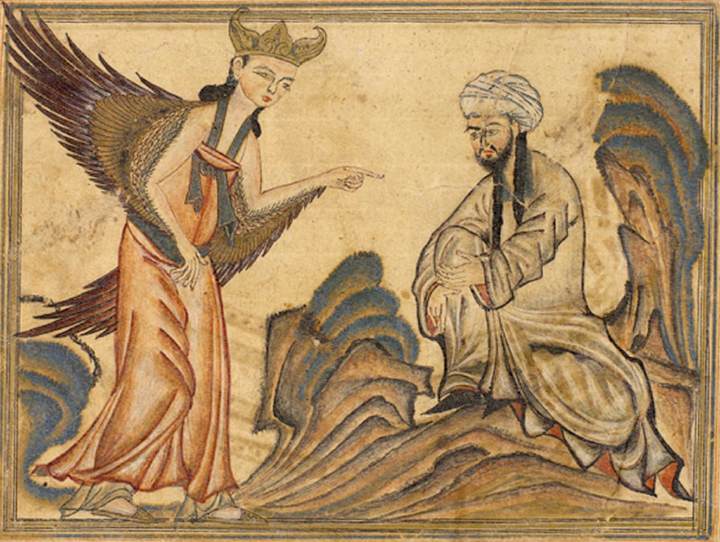
Mohammed receiving his first revelation from the angel Gabriel

Religious Experiences and Miracles

The Jewish people still exist after 2,500 years, while they have not had a homeland for most of the time. That is a remarkable feat. Then Christianity replaced the existing religions in the Roman Empire in one of history’s strangest twists. Somehow, the message of personal salvation through Christ caught on. In the third century, Manichaeism emerged as a new religion. It taught that there was a struggle between the good spiritual world of light and the evil material world of darkness. The prophet Mani, who grew up in a Jewish-Christian Gnostic sect, claimed to have received revelations meant for the entire world, which were to replace all existing religions. It instantly became a spectacular success, spread everywhere in the known world, and could have overtaken Christianity, but it didn’t. A pivotal, and possibly decisive, moment was the conversion of Emperor Constantine to Christianity in 312 AD. He made Christianity the favoured religion in the Roman Empire.

A few centuries later, a small band of Arab warriors established an empire that stretched from the Atlantic to India, spreading the new religion of Islam, in an even stranger and more rapid historical development. Is it a realistic scenario that the supposedly illiterate camel driver Muhammad became a crafty statesman after seeing an angel telling him he came to deliver messages from the God of the Christians and the Jews? After Muhammad’s death, his followers went on to defeat the Byzantine and Persian empires. At the same time, Manichaeism made a one-way trip into the dustbin of history, while in the third century, it appeared to be on the verge of becoming the world’s leading religion. So, why did Mani fail and why did Muhammad succeed? Historians can explain it, but it is an account of what happened rather than an explanation. The question remains, could it occur without someone pulling the strings?

So much can happen, and what happens now has once been extremely improbable. Your reading this text here and now seems highly unlikely a few decades ago. Think of all the things you could have done instead. Or you could have been dead. Yet, you wouldn’t consider your reading this text a miracle. Proselytising religions like Christianity and Islam have a built-in inclination to grow. That may not be the ultimate answer. Jews, Christians, and Muslims worship the same deity. Our universe could be a simulation, and someone could have planned it. But who is to say it couldn’t have happened otherwise?

When Islam arrived on the scene, Jews, Christians and Zoroastrians in the area already believed in an all-powerful creator. Muhammad had met them on his travels, so he was familiar with these religions. Before that, Christianity had faced an uphill struggle. While the Roman state suppressed this religion, pagans left their gods behind and accepted the Christian God as the only true God. And they did so in large numbers.

That begs for an explanation, even though the conversion of Romans to Christianity was a gradual process that took centuries. The Romans occasionally half-heartedly persecuted Christians and executed a few thousand of them over the centuries, not for being a Christian but for not paying their respects to the Roman gods. Despite that, the number of Christians increased 2-3% per year between 30 AD and 400 AD. Each Christian may have converted just one or two persons on average. Over time, exponential growth enabled Christianity to grow from about 100 followers in 30 AD to 30 million by 400 AD.

Such a gradual and steady growth over centuries was somewhat unique for a religion, and so was the blitz conquest of Islam later on. Most people in the Roman Empire, and everywhere else for that matter, lived miserable lives. The promise of an eternal blissful afterlife may have been too tempting for those poor, wretched souls to resist. However, the most often cited reason for conversions was stories about the miracles Christians performed.2 Only in the Middle Ages did the sword become the most compelling Christian argument as Christianity spread further and became integral to European politics. That was not the case in the Roman Empire, so miracles and stories about them were crucial.

An early miracle was Jesus’ appearance to a few followers after his crucifixion. The New Testament mentions miracles that the disciples allegedly performed. These accounts may be exaggerated, but the theme of miracles remains a consistent one in Christianity to this day. The Roman Catholic Church has a rich folklore surrounding relics that are believed to possess magical properties because they are said to have been touched by Jesus. The most famous relics are the Crown of Thorns in Paris, the mysterious Holy Grail, the chalice from which Jesus is said to have drunk, and the Shroud of Turin, a piece of linen cloth with a supposed image of Jesus’ face.

Many of the miracles attributed to these relics are unverifiable or can have other causes, such as luck, but a few cannot be easily explained away. The Roman Catholic Church keeps a record of them. On message boards, people tell stories about prayers heard and miraculous healings. Many of these stories may result from chance or other causes, such as a misdiagnosis or someone seeking attention by lying, but that is not always the case.

A recurring theme is the appearance of the Virgin Mary and other miracles related to her. Thousands of people have seen her. She appeared several times in Venezuela. She revealed herself to Maria Esperanza Medrano de Bianchini in 1976, who received exceptional powers. She could tell the future, levitate, and heal the sick. In Egypt, Mary appeared at a Coptic Church between 1983 and 1986. Muslims have also seen her there. There have been many more Virgin Mary appearances. The most notable sequence occurred in Portugal at Fatima between 13 May and 13 October 1917.

The grand finale was on 13 October 1917, when the Sun reportedly spun wildly and tumbled down to Earth, radiating in indescribably beautiful colours, before stopping and returning to its normal position. Some 40,000 attendants witnessed Mary’s performance. They had gathered because three shepherd children had prophesied that the Virgin Mary would perform a miracle on that date and location. Faking this was hard to do, considering the technology available in 1917. A lack of holographic equipment would have made the effort challenging, not to mention changing the location of the Sun, which is a large ball many times larger than Earth, thus making it difficult to move around. And somehow, the Sun only moved in Fatima, which can only happen in virtual reality.

Jesus also appeared a few times, but less frequently than the Virgin Mary. An intriguing account comes from Kenneth Logie, a preacher of the Pentecostal Holiness Church in Oakland, California, in the 1950s. In April 1954, Logie was preaching at an evening service. During the sermon, the church door opened. Jesus came walking in, smiling to the left and the right. He walked right through the pulpit. Then he placed his hand on Logie’s shoulder. Jesus spoke to him in a foreign tongue. Fifty people witnessed the event. Five years later, a woman in that same church suddenly disappeared. Jesus took her place. He wore sandals and a shiny white robe. He had nail marks on his hands, which were dripping with oil. After several minutes, Jesus disappeared, and the woman reappeared. Two hundred people have seen it. It was on film as Logie had installed film equipment, because strange things were happening.3 Such events can convince people that the message of Christianity, even though it may seem highly peculiar, is correct, as Zeus and Thor failed to show up and perform some tricks.

Mary and Christ are part of a folklore where genuine experiences mix with mental cases seeking attention or con artists profiting at the public’s expense. Usually, there are no 40,000 witnesses, verifiable evidence, or camera footage of what occurred. The Vatican is troubled by the self-proclaimed seers, fortune tellers, prophets, and messengers who believe they have a special bond with the Virgin Mary or have weeping Madonna statues, which they may or may not have prepared to weep. These people could be delusional, crave attention or, like the televangelists in the United States, be after your money. That is not always the case. If you have a religious experience, don’t suffer from mental conditions impairing your judgment, and can’t think of naturalist explanations, you should believe what you see. To quote Shakespeare’s Hamlet, ‘There are more things on heaven and earth, Horatio, than are dreamt of in your philosophy.’

Latest revision: 5 September 2025

Feature image: Mohammad receiving his first revelation from the angel Gabriel. Miniature illustration on vellum from the book Jami’ al-Tawarikh, by Rashid al-Din, published in Tabriz, Persia, 1307 AD. Public Domain.

1. Sapiens: A Brief History of Humankind. Yuval Noah Harari (2014). Harvil Secker.
2. The Triumph of Christianity: How a Forbidden Religion Swept the World. Bart Ehrman. Simon & Schuster (2018).
3. How Jesus Became God: The Exaltation of a Jewish Preacher From Galilee. Bart Ehrman. HarperCollins Publishers (2015).

Lucretia Garfield. Library Of Congres

The Identity of God

We live inside a virtual reality created by an advanced civilisation to entertain an individual we call God. Like it or not, it is why we exist. That civilisation probably is humanoid, which means that God is like us, with human imaginations and desires. What is also worth noting, and what can hurt your ego, is that all that happens goes according to a script, so that thinking of us as mere worms would be a delusion of grandeur. Think of it. Real worms decide for themselves how they grovel and when. And we don’t. Welcome to the Theatre of the Absurd. We are mere actors in a play, and no one thinks. We follow the script, and there is no exit, no life outside, like in the film The Matrix. The road to enlightenment starts with the acceptance of our complete insignificance.

So what about René Descartes, that world-famous fellow who once said, ‘I think, therefore I exist.’ Was he wrong? As the reasoning above painfully lays out, he starts with a debatable assumption: ‘I think.’ He then arrives at a logical conclusion: ‘Therefore, I exist.’ That made him stamp a realness certificate on his person. But logic in fantasy land is just basing conclusions on imagined assumptions. At least the logic is infallible. So, did Descartes think? Not really. Even then, he might still have had an existence. That is also dubious, however, because God imagined us. You can ask yourself: Do Spike and Suzy exist? They are comic characters created by Willy Vandersteen, who no longer exists, if he had ever done so, because he has stopped breathing. If you go down that road, everything you imagine exists. I just imagined a unicorn. Do unicorns now exist?

That is the question of being. Philosophers discuss such questions. Scientists agree that merely thinking of a unicorn doesn’t make it real. Saying ‘be’ doesn’t generate a bee. You can give such a command to a computer, and you get a simulation of a bee. Now you get how God could have created this world in six days. It might as well have been six seconds. So, if God exists, we don’t, and we are imaginations like unicorns. Countless non-existent minds have wasted their time and energy on the question, ‘Does God exist?’ Indeed, the gods we imagine also don’t exist because we imagine them, and that includes the God of Abraham. There is only God who exists in reality.

If we exist to entertain an individual from an advanced civilisation, God must be a person who, unlike us, might be real. Yes, God might be yet another virtual reality character in a simulation layer above us, but that is beyond our possibilities to find out. And let’s not waste our time on questions we can’t answer. So, who is this person, God? That we cannot know. Still, we might uncover something, at least. If we are here to entertain God, what is the fun of standing on the sidelines? Why not take part yourself? If God plays roles and becomes one of us, we might identify some of those individuals. The starting point for the inquiry is Jesus. No one had ever felt a closer relationship with God than he, so there is a good chance he knew God as a person.

The Gospels tell us that Jesus called God ‘Father’. They suggest a close personal relationship, so Jesus thought of himself as the Son of God. There is something off about Jesus’ Father as He can give birth (John 1:12-13). All four official Gospels imply that Jesus was the bridegroom (Mark 2:19-20, Matthew 9:15, Luke 5:34-35, John 3:27-30), but don’t mention the bride, which is also quite mysterious. The Church tells us that Jesus married the Church. Now, the Church didn’t exist when Jesus lived, so a historian would call it an anachronism. It is like saying that the Roman Emperor Caesar took an aeroplane to Egypt to spend his holidays with Cleopatra. That is impossible because there were no aeroplanes 2,000 years ago. The Gospels don’t say Jesus married the Church. The Church didn’t exist yet, and Jesus wasn’t planning to found it either. So, why would the Church lie about Jesus’ marriage? Are we not allowed to know the truth?

You can smell a rat here. And it is a huge and smelly one. Christians claim that God is love. Jews and Muslims don’t. Do they not worship the same deity? Is there something missing that Jesus’ inner circle knew about? And is it the identity of the Bride? That is indeed the case. The Bride of Christ was God in the person of Mary Magdalene. She was one of God’s avatars. She made Jesus believe he was Adam reincarnated and that She was Eve reincarnated, that Eve didn’t come from Adam’s rib but that Eve gave birth to Adam, and that they were an eternal couple living from the beginning of Creation until the End of Times. That is why Jesus believed he was the Son of God.

Simon Peter said to Jesus, ‘You are the Messiah, the Son of the living God.’ (Matthew 16:16) This phrase appears in the Jewish Bible (Deuteronomy 5:26, Jeremiah 10:10, Psalm 42:2), but Simon Peter’s use of it is noteworthy. In Deuteronomy, the living God refers to God’s active presence on Earth, meaning that God is not some mythical figure, of which we only have tales, nor some lifeless statue, but someone present in our midst. In Moses’ time, it was a pillar of fire. With the Bride gone, these words have lost their meaning, which led some later Christians to believe that Jesus was God.

Jesus was God’s son because Adam was. Hence, Adam is the Son of God (Luke 3:38), Jesus is the Firstborn of all Creation (Colossians 1:15), and Jesus gave us the right to become children of God who are born of God (John 1:12-13). As Adam, he was the father and God the Mother of humankind. The Jewish scriptures about the fantasy character, Yahweh, also known as the God of Abraham, don’t mention that. And so, Paul, who took these scriptures as seriously as a Pharisee, perhaps because he was a former Pharisee, made God male in his theology and persuaded the early Church to do the same. He succeeded because his work made it possible to unite the early Church. Muhammad also married God in the person of Khadijah bint Khuwaylid. Unlike Jesus, he didn’t know.

Those who take offence at God in the person of Eve marrying Her son Adam, but accept that God allowed millions of people to be slaughtered in wars or die of terrible diseases, or even chose to do so, have a problem with their priorities. And by the way, you are not in a position to judge God. In any case, the story of Eve and Adam is a myth. Eve never took Her son as Her husband, as Eve and Adam never existed. It is only what Mary Magdalene made Jesus believe. So, you can rest assured that nothing of that kind ever happened, except for the millions of people that God let die due to wars and diseases. A possible excuse for doing so is that it makes the simulation more realistic. Apart from that, everything being peachy all the time doesn’t make for a good story.

Jesus and Muhammad have lived. The accounts of their lives may be inaccurate because they date from decades after they died, but the early history of the Israelites in the Jewish Bible – the Jews call it Tanakh – is a fantasy. Archaeological evidence doesn’t support it. Moses never brought the Israelites from Egypt into the Promised Land. The story still has a historical origin. Around the time Moses allegedly lived, the Egyptians who governed Canaan went home, thereby liberating Israel from Egyptian oppression. Later on, the account in the Bible often has a closer relationship to historical events.

That leaves us with a question: how did God meddle with the Jewish nation and their religion? Historians have discovered that the Canaanites gradually formed tribes and, later, petty kingdoms after the Egyptians had departed, in what the Jewish Bible refers to as the Era of the Judges. Local leaders organised warfare and settled disputes. They were the judges. The Jewish Bible says they had nationwide authority, but that is incorrect.

The oldest source of the entire Jewish Bible is the Song of Deborah. Historians believe the song dates back to shortly after the Egyptians left. It likely didn’t pop up out of nowhere. Deborah brought victory to a tribe that later became part of the Jewish nation. Deborah attributed that victory to Yahweh, who, as a son of the Canaanite supreme deity El, would otherwise have remained an obscure, inferior deity. In this way, Deborah initiated the Yahweh cult, which today has four billion followers. The historical genesis of the Bible is not Creation but Deborah. She is the Mother of Israel and likely the earliest historical figure in the Jewish Bible, the founder of the Jewish nation, and an avatar of God.

The God of Abraham, known as Yahweh, the Father, and Allah, thus is a veil behind which the owner of this universe has operated so far. She only revealed Herself to Jesus. It made Jesus a unique prophet who came to see himself as the eternally living Son of God. No evidence suggests that Jesus was Adam, but God made him think he was. God, as Mary Magdalene, convinced Jesus that someone had corrupted the story of Eve and Adam. She appealed to rational thinking, as Eve’s creation from Adam’s rib makes less sense than Adam having been Eve’s son. God could have pointed out traces of fraud, such as Eve being the Mother of All the Living. So, what about Adam, who called her like so? Apart from that, Mary Magdalene must have had a very persuasive personality because She made him die on the cross. Jesus thus placed evidence and logic over religious dogmas. He was a true religious revolutionary. Sadly, logical evidence-based religion was a tradition that soon died with him. He was 2,000 years ahead of his time.

That God is a Mother who can appear as an ordinary woman is not that far-fetched. The leader of the Church Ministry of Mother of All Creation cult claimed she was God and that God had had 534 lives, including Jesus, Cleopatra, Joan of Arc, and Marilyn Monroe. The latter three guesses might be spot-on, but her claim of having been Jesus proves she made it all up. Mary Magdalene, however, may not only have claimed it, but also succeeded in convincing Jesus of it, and then let him start a world religion that now has over two billion followers. We have yet to see the leader of the Church Ministry of Mother of All Creation cult pull that off.

Jesus’ inner circle knew that God had wedded Jesus, but the Gospels don’t mention this crucial factoid that everyone would have wanted to know. Scholars didn’t ask themselves why there were no surviving eyewitness accounts. Isn’t that suspicious? Here is your answer. And why did the early leaders of the Church do it? To religious Jews, the idea of God being a woman who married Jesus was alien or even blasphemous. Most early Christians were Jewish followers who had heard of Jesus and his miracles but lacked detailed knowledge of his life and teachings.

Jewish prophets were human, and they expected a human messiah rather than a godlike being. In their view, Jesus was a mere human, so if you read Mark, Matthew or Luke, Jesus appears human, not godlike. And so, the Jews couldn’t handle that God is a woman who can take a human form and marry Jesus. Gentiles had no problem with it. They have tales about female deities and gods having sex with humans. That is why the Gospel of John is so different from the others. It was a controversy that tore the early Church apart.

A compromise, the Christian theology invented by Paul, resolved the conflict. Paul turned Jesus into a godlike Jewish messiah, the eternally living Son of God, the one promised by the Jewish scriptures. It required some imagination and twisting of the facts to reconcile these two irreconcilable viewpoints. Paul’s theology became the Christianity we know today. Try to understand it from God’s perspective. She lives eternally, or at least thousands of years, and uses us to pass Her time. Girls just want to have fun. That brings us to messages in pop music. The song ‘Gimme the Prize’ by Queen has the following lines,

Here I am, I’m the master of your destiny
I am the one, the only one, I am the God of kingdom come

Give me your kings, let me squeeze them in my hands
Your puny princes
Your so-called leaders of your land
I’ll eat them whole before I’m done
The battle’s fought, and the game is won

Queen, Gimme the Prize

Queen is the performing artist, so the hidden message is that the God of the coming kingdom is a Queen. The song features threats against the so-called leaders of the world. That looks like an end-of-time scenario. It is a queer pun, and Freddy Mercury was the performing artist. In the video clip of another Queen song, ‘I Want to Break Free,’ Mercury and the band members dressed in women’s clothing. In Western Europe, we found it funny. That was different elsewhere. The song had a lukewarm reception in the United States, a country that has culturally enriched us with websites like godhatesfags.com. Today, the hatred of LGBTQ people by conservative Christians is getting out of hand. The joke is on them. Early Christians have performed a sex change on God in their scriptures.

Muslims take blasphemy very seriously. Hurt Muslim feelings have made the headlines. Making cartoons of Muhammad can be your death sentence. But why only Muhammad? He isn’t God. Is he of a higher stature than Moses or Jesus? God made those mockers do what they did. The reward for killing a comedian will not be 72 desperate virgins trying to abuse you. Abrahamic religions have restricted the freedom of women, but Islam more than the others. Like Jesus, Muhammad married God, but unlike Jesus, he didn’t know. He had a loving marriage after his wife, Khadijah bint Khuwaylid, proposed to him. Islam may be a funny religion, but Christianity is even more comical.

Paul’s obfuscation of the relationship between God and Jesus gave Christianity its unique and baffling theology. Drinking Christ’s blood, eating his body, and the resurrection of the dead could be good ingredients for a motion picture called Zombie Apocalypse. Indeed, these rituals and beliefs are odd and could suit a cannibalistic sect. The outlandishness of Christianity begins with the idea that we are all cursed because Eve and Adam sinned. And then came Jesus, who sacrificed himself for our sins, so you can save yourself by following him. It seems outlandish, but Paul’s intervention is the most ingenious part of God’s plan. Humans are the most destructive species that have ever roamed this planet, and we are about to destroy ourselves. Only our ability to believe in fairy tales can unite us and make us perform extraordinary deeds. Thinking we are morally depraved, unworthy of God’s grace and in dire need of a saviour can save us from our collective stupidity.

Latest revision: 29 November 2025

Featured image: Lucretia Garfield