
Israel emerging
The Jews started as tribal people in Canaan, the area currently covered by Israel and Palestine. For a long time, the area was under Egyptian control. The earliest known reference to Israel is on an Egyptian stone engraving from around 1200 BC. It lists the enemies the Pharaoh Merneptah defeated during his campaigns. Among them was Israel, which had revolted against its Egyptian overlords. The engraving lacks detail. There was no state of Israel, so quite possibly the uprising was no more than a few skirmishes with local hill dwellers. However, the Egyptians had already called the land Israel, named after the principal local deity, El, so the tribes living there had their own distinct religious beliefs.
Around 1150 BC, Egypt faced droughts, food shortages, civil unrest, corruption, and court intrigues. This period is known as the Late Bronze Age Collapse. Similar crises in neighbouring civilisations led societies to turn inwards and focus on local issues. Egypt retreated from Canaan. Setbacks at home were the reason the Egyptians gave up Canaan, which was an insignificant border province to them, filled with unruly hill dwellers who caused nothing but trouble. It was a footnote in Egyptian history, nothing more. The Egyptians, who had been there for centuries, suddenly went home,1 leaving the Israelites a victory they had not fought for. The locals may have viewed it as a miracle and came to suspect that their favourite deity, El, or perhaps Yahweh, had done some magic. Poof. The Egyptian army, which had been there for centuries, had suddenly vanished due to setbacks at home.
Stories retold grow more sensational over time, so the Bible now tells us that God sent seven devastating plagues to Egypt, and appointed a fellow named Moses to lead the Israelites out of Egypt, under the guidance of an irate and fiery cloud, split the Red Sea, drowned the Egyptian army and let the Israelites escape. The Song of the Sea (Exodus 15:1-18) could be the oldest text in the Bible, together with the Song of Deborah, and it mentions the drowning of the Egyptian army in the Red Sea. The song seems much older than the rest of Exodus, and it doesn’t mention Moses. Scholars disagree on whether the account has a historical basis, and therefore, also the song. It could date back to the Babylonian captivity 600 years later. In that case, the author used archaic language in the Song of the Sea to make it appear older. That would require the author to have knowledge of ancient Hebrew, which seems a stretch. Likely, parts of the song are ancient.
It took several centuries for new civilisations to take over, creating room for small local polities in Canaan until that time. Several small kingdoms emerged, including Israel and Judah. These petty kingdoms existed for a few centuries until new imperial powers overran the area. At first, the Israelites worshipped several gods and goddesses, among them Yahweh. Archaeological finds indicate that El was the supreme deity in the Canaanite belief system. The goddess Asherah was his wife.2
They were the parents of the other Canaanite deities, Baal, Anat, Yahweh, and Yam. Asherah is Yahweh’s mother and El his father. El was often depicted as a bull and was also known as Shor-El, the bull god. And so, we have the highly peculiar situation that half the world’s population now worships one of the children of El and Asherah, two deities of an insignificant tribe living somewhere between the more advanced civilisations of Egypt and Mesopotamia 3,000 years ago, as the supreme God who rules the entire universe. That might have been a hilarious observation if people hadn’t been murdering each other in the millions for their delusions.
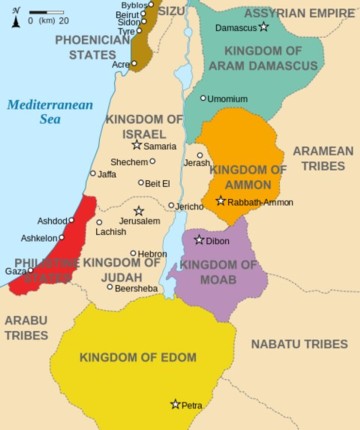
States and kings used religion to justify themselves. It matters whether a powerful entity like a god or a goddess supports the state and the king, for only the stupid and the suicidal defy the gods. The kings of Judah, and perhaps also those of Israel, promoted a national religion centred around Yahweh. Other kingdoms in the region also adopted national deities. Milcom was the deity of Ammon, while Moab had Chemosh to defeat its foes and supply the country with blessings (1 Kings 11:33).
Yahweh thus became the deity of the state religion in Judah and possibly Israel. Many in the area also worshipped other gods alongside Yahweh, as having multiple options is prudent. If Yahweh forsakes you, perhaps Baal or some other deity will still assist you. The Bible testifies to tensions between those who still worshipped different gods and goddesses alongside Yahweh and those insisting on worshipping Yahweh alone. As Yahweh had become the favourite deity of the Israelites, El became the word for ‘god’, and Asherah became Yahweh’s wife.
Writing the Bible
As time passed by, new empires arrived on the scene and set their eyes on Canaan. The Assyrians overran Israel in 720 BC. The Babylonians conquered Judah in 597 BC, following their takeover of the Assyrian Empire. The Babylonians deported many of the Judeans. Others fled to Egypt. It was the beginning of the diaspora. The Jewish communities in Egypt, Babylon, and Judah became dispersed. The authors of the Jewish Bible tried to reconnect them by showing that they belonged to a larger group, a nation with common ancestors. Judah already had religious writings. They became part of the Bible. The Jewish Bible became a compilation of tales from these communities and the royal archives of the former kingdom of Judah. The Jewish Bible presents the history of Israel and Judah from the perspective of the Kingdom of Judah.
After the Persians had conquered the Babylonian Empire, the Persian emperor Cyrus the Great allowed the Jewish people to return to Canaan. He commissioned the rebuilding of the Jewish temple. Those still living in the area were not keen on a group of religious zealots entering their country. They opposed the plan, and a political struggle unfolded. After seven decades, Ezra and Nehemiah succeeded in rebuilding the temple. Jewish society was on the brink of being wiped out. Israel and Judah no longer existed. The remaining Jews were mixing with the surrounding population. Jewish leaders had to find a way to keep their people together. Marrying outside the community became frowned upon, and the Jews became a seclusive group. That has caused them a great deal of trouble in the centuries that followed.
The authors of the Jewish Bible sought to preserve Jewish identity through a shared religion, history, and cultural heritage. The Jewish religion gradually became monotheistic. At the time, Zoroastrianism, a dualistic religion, became the official religion in the Persian Empire. The prophet Zoroaster believed in a good creator and an opposing evil power. And it had considerable influence. It brought Judaism monotheism, messiahs, free will, heaven, hell, and, of course, that horned fellow named Satan. Zoroastrianism not only affected Judaism. Some Greek philosophers around 400 BC were also monotheists.
The polytheist origin of the Jewish religion may explain why God says in Genesis, ‘Let us make mankind in our image, in our likeness.’ Later, the Jews became henotheists. They believed that other gods existed, but that they should worship only Yahweh. That is why the commandment says, ‘You shall have no other gods before me’ rather than ‘You shall believe there is only one God.’ Yahweh was jealous and didn’t appreciate offerings to other gods, such as Baal. Several texts in the Jewish Bible have that henotheist perspective.
The Jews wrote most of their scriptures between 600 BC and 300 BC, but there are older parts that date back to the royal archives of Judah. The Ketef Hinnom amulets are the oldest surviving evidence of texts that are now part of the Jewish Bible. They date back to 600 BC. So, before the Jews went into exile to Babylon, they already had an established religion with scriptures. And that later helped them maintain their Jewish identity. The Song of Deborah is one of the oldest texts in the Bible, dating back to the 12th to 10th century BC. Only, the Song of the Sea might be older. Little evidence supports the historical account in the Jewish Bible of the period before the kingdoms of Judah and Israel. However, that doesn’t mean that all these stories are entirely fictional.
Scholars believe David may have been the king of Judah, rather than the king of a united kingdom, as the Jewish Bible states. Based on archaeological excavations, experts have estimated that Jerusalem had around 1,000 inhabitants at the time David supposedly lived, suggesting that Jerusalem was a minor regional centre rather than the capital of a larger kingdom. However, archaeologists have also uncovered a 9th-century BC stone engraving with the lettering BYTDWD in northern Israel, possibly referring to the House of David. Another engraving found in the former kingdom of Moab contains the same lettering. That could raise questions, such as whether a larger kingdom existed.
Creating a nation
Whether or not it was fiction, the authors of the Jewish Bible employed the concept of a united kingdom to foster unity among people originating from Israel and Judah. A shared history united the inhabitants of Israel and Judah, as well as their offspring, into one great nation. The purpose of the Jewish Bible was to establish the Jewish nation based on a shared history and religion. That can be a reason to imagine a united kingdom that once existed. If you go back in time to before the kingdoms of Israel and Judah, the history of the Jews becomes murky. No written records exist from these times. The tales about Abraham, Isaac, and Moses may have originated from different communities, merged into a single narrative to promote a single Jewish identity.1 To make the proposition more attractive, the Jews believed they were the chosen people.
The survival of the Jewish people has been hanging by a thread for a long time. They were a small nation between great powers. They hoped for a Messiah who would save them from oppression, just as Moses had once done. Great powers came and went, but the Jewish people remained. After more than 2,500 years, the Jews are still around, so their nation-building project proved a successful long-term survival strategy. They managed to reclaim their original homeland. It is also remarkable that Judaism stood at the cradle of Christianity and Islam. The Jews have played a central role in world history, unmatched by any other nation. It is an impressive feat, considering their numbers. Today, Jews have an imposing power, and they slay their enemies at will. So, what do they need a Messiah for?
Historical analysis
How do historians and scholars look at the Jewish Bible? Apart from the lack of archaeological evidence, they find the early Jewish history in the Jewish Bible too neat to be correct. It presents an agreeable genealogical line extending from Abraham to Isaac to Jacob, who had twelve sons who, coincidentally, became the twelve tribes of the nation. The number twelve has religious significance, so the facts must have undergone some religiously inspired processing. Jacob and his family went to Egypt during Joseph’s days. Later, Egypt began to oppress the Israelites, and they escaped under the leadership of Moses. The Egyptians kept records, and they tell nothing about the Exodus. The reason is probably not that the Egyptian defeat was too embarrassing.
After Moses’ death, the story goes, Joshua took over and led the Israelites into the Promised Land. Following the death of Joshua, a series of judges took over. They governed Israel and saved it from its enemies. Each judge came from a different tribe, which is also unbelievably neat. It smells like fiction. Then Saul, Israel’s first king, was not up to his task, so David replaced him. The kingdom fell apart into two after the death of Solomon, David’s successor. From then on, the descendants of David ruled only in the south, thus in Judah. The northern part, called Israel, had several dynasties.
Many of the people described in the Jewish Bible may have once lived. Probably, they had very little to do with each other. The authors of the Jewish Bible compiled them to create a unified history of Israel. Abraham was probably not Jacob’s father, Moses was not Miriam’s brother, and David was not Saul’s successor. They may have figured in local tales from tribes and petty kingdoms that later became part of the Jewish nation. The stories in the Jewish Bible originate from several sources and have been revised and retold multiple times throughout the centuries. And the stories have undergone some religiously inspired processing. Think of God sending plagues to Egypt because the Pharaoh took Sarah as his wife. The Jewish Bible is a nation-building project rather than a historical account.1
Textual analysis
It might be interesting to see how scholars analyse the texts to understand biblical history and arrive at their conclusions. Professor Jacob Wright explained the basics using the example of Genesis 26 to illustrate how the authors of the Jewish Bible have woven the story of Isaac and Rebecca into the broader historical narrative of Israel.1 Biblical scholars attempt to uncover the construction process of the texts by examining various sources within biblical texts, including additions and other editing techniques. Genesis 26 tells the story of Isaac living in the Philistine land of Gerar, located west of Judah.
Isaac’s wife, Rebecca, was a beautiful woman. When his neighbours asked Isaac about Rebecca, he claimed she was his sister, so Isaac followed Abraham’s footsteps. Isaac feared the Philistine men in Gerar would kill him and take his beautiful wife. One day, Abimelech, the king of the Philistines, gazed out his window and spotted Isaac and Rebecca making out. He demanded an explanation. Abimelech feared one of his subjects might have slept with her, which could make his kingdom subject to divine retribution.
Abimelech then issued a decree stating that whoever touched Isaac or his wife would be put to death. Rebecca would become one of the matriarchs, a crucial figure in Israel’s history. Isaac prospered among the Philistines and eventually became mightier than them. Everywhere Isaac went in the waterless environs of Abimelech’s kingdom, he discovered water wells. His success aroused jealousy among local inhabitants. That amount of luck captures the imagination like Gladstone Gander’s in a Donald Duck tale.
Instead of fighting for his territories, Isaac moved on and ended up in Beer-Sheba in the south. Abimelech visited Isaac there. The Philistine king blessed him. Isaac invited him to a feast. After eating and drinking all night long, they exchanged oaths of peace. Later that day, Isaac’s servants discovered another water source, in yet another stroke of unbelievable luck. Isaac named this well Beer-Sheba, referring to his treaty with the Philistines. The story served a political agenda, which was to demonstrate that Beersheba was part of Israel.
A closer look at Genesis 26
Genesis 26 contains two kinds of material, which are the story about Isaac’s clan and how he came to possess towns in the far south and Beer-Sheba, and the broader narrative of the book of Genesis, which links this story with the other parts of Genesis to make it a coherent history of the nation. There are multiple ways of looking at the text. Hence, different scholars may come to different conclusions. One way of viewing Genesis 26 is as follows, with the parts that link the story into a broader narrative underlined:
1 Now there was a famine in the land, besides the previous famine in Abraham’s time, and Isaac went to Abimelek, king of the Philistines, in Gerar. 2 The Lord appeared to Isaac and said, ‘Do not go down to Egypt; live in the land where I tell you to live. 3 Stay in this land for a while, and I will be with you and will bless you. For to you and your descendants I will give all these lands and will confirm the oath I swore to your father Abraham. 4 I will make your descendants as numerous as the stars in the sky and will give them all these lands, and through your offspring all nations on earth will be blessed, 5 because Abraham obeyed me and did everything I required of him, keeping my commands, my decrees and my instructions.’
6 So Isaac stayed in Gerar. 7 When the men of that place asked him about his wife, he said, ‘She is my sister,’ because he was afraid to say, ‘She is my wife.’ He thought, ‘The men of this place might kill me on account of Rebecca because she is beautiful.’ 8 When Isaac had been there a long time, Abimelek king of the Philistines looked down from a window and saw Isaac caressing his wife Rebecca. 9 So Abimelek summoned Isaac and said, ‘She is really your wife! Why did you say, ‘She is my sister’?’ Isaac answered him, ‘Because I thought I might lose my life on account of her.’ 10 Then Abimelek said, ‘What is this you have done to us? One of the men might well have slept with your wife, and you would have brought guilt upon us. 11 So Abimelek gave orders to all the people: ‘Anyone who harms this man or his wife shall surely be put to death.’
12 Isaac planted crops in that land and the same year reaped a hundredfold because the Lord blessed him. 13 The man became rich, and his wealth continued to grow until he became very wealthy. 14 He had so many flocks and herds and servants that the Philistines envied him. 15 So all the wells that his father’s servants had dug in the time of his father Abraham, the Philistines stopped up, filling them with earth. 16 Then Abimelek said to Isaac, ‘Move away from us; you have become too powerful for us.’
17 So Isaac moved away from there and encamped in the Valley of Gerar, where he settled. 18 Isaac reopened the wells that had been dug in the time of his father Abraham, which the Philistines had stopped up after Abraham died, and he gave them the same names his father had given them. 19 Isaac’s servants dug in the valley and discovered a well of fresh water there. 20 But the herders of Gerar quarrelled with those of Isaac and said, ‘The water is ours!’ So he named the well Esek because they disputed with him. 21 Then they dug another well, but they quarrelled over that one also; so he named it Sitnah. 22 He moved on from there and dug another well, and no one quarrelled over it. He named it Rehoboth, saying, ‘Now the Lord has given us room and we will flourish in the land.’
23 From there, he went up to Beersheba. 24 That night, the Lord appeared to him and said, ‘I am the God of your father Abraham. Do not be afraid, for I am with you; I will bless you and will increase the number of your descendants for the sake of my servant Abraham.’ 25 Isaac built an altar there and called on the name of the Lord. There he pitched his tent, and there his servants dug a well.
26 Meanwhile, Abimelek had come to him from Gerar, with Ahuzzath his personal adviser and Phicol the commander of his forces. 27 Isaac asked them, ‘Why have you come to me, since you were hostile to me and sent me away?’ 28 They answered, ‘We saw clearly that the Lord was with you; so we said, ‘There ought to be a sworn agreement between us’—between us and you. Let us make a treaty with you 29 that you will do us no harm, just as we did not harm you but always treated you well and sent you away peacefully. And now you are blessed by the Lord.’ 30 Isaac then made a feast for them, and they ate and drank. 31 Early the next morning, the men swore an oath to each other. Then Isaac sent them on their way, and they went away peacefully. 32 That day, Isaac’s servants came and told him about the well they had dug. They said, ‘We’ve found water!’ 33 He called it Shibah, and to this day, the name of the town has been Beersheba.
34 When Esau was forty years old, he married Judith, daughter of Beeri the Hittite, and also Basemath, daughter of Elon the Hittite. 35 They were a source of grief to Isaac and Rebecca.
The first five verses are part of the larger narrative, except for the first part of verse 1. In verse 6, the story itself starts. Abraham comes up in verses 15 and 18. The intervention of the Lord in verses 24 and 25 is also part of the larger narrative. The mention of Esau at the end is part of the encompassing story. That raises the question of where Jacob and Esau were all that time. They were adults at the end of Genesis 25. One explanation is that Genesis 26, without the underlined parts, was once a separate story.
The stories about their sons, Jacob and Esau, seem wrapped around the story of Isaac and Rebecca and their dealings with the king of the Philistines. In this way, the authors created a larger narrative. Genesis 25 contains the story about the birth of Esau and Jacob and how Esau sold his birthright to Jacob. That story resumes at the end of Genesis 26. In Genesis 27, Jacob deceived his father into giving him his blessing with the help of his mother. These interweaving narratives come from different sources.
One is the P-source or priestly source. It tells an independent story of Israel. The authors merged it into the narrative. According to the P-source, Jacob didn’t flee from Esau because of stealing the birthright but because he was in danger of a mixed marriage. The P-source describes how Esau married a Hittite woman and how Rebecca asked Isaac to send Jacob away so he would find a woman who would not make her life miserable.
There is an older account of Isaac and Rebecca and how they came to possess Beersheba. Around it is wrapped a story of their children, where Isaac is the son of Abraham and the father of Esau and Jacob. Another small story tells how Rebecca sent Jacob off to find wives from her own family. Another source tells us how Jacob stole his birthright from his brother Esau. The authors of the Jewish Bible thus wove an older story and two other sources into a broader narrative.1
Theories from scholars
The P-source is a late source from after the exile in Babylon. It deals with Israel’s identity and its relationship to others. Mixed marriages outside the Jewish people became a huge issue after the defeat of Judah. Marrying within the clan or nation helped to maintain a community defined by a shared culture. Therefore, the marriages of Esau to Hittite women caused Rebecca concern.
Another source is the Jahwist source, also dubbed J-source. A part of Genesis 25 comes from the J-source. It tells about the birth of Jacob and Esau. It continues in Genesis 27 and 28, where Jacob stole Esau’s birthright and pursued the deal with the help of his mother, Rebecca. Jacob then had to flee from Esau. According to the J-source theory, the J-source has incorporated an older source into the broader narrative. Later, the P-source altered the reason why Jacob had to flee.
The formation of the earliest sources, the histories of Israel, whether it be the history of Israel’s ancestors and the lives of Abraham, Isaac, and Jacob, or the exodus leaving Egypt and the conquest of the land, is built upon the linking of stories. The authors brought separate individual representatives of clans together in a larger narrative to create the idea of a Jewish nation. Many scholars believe that the first chapters of the Jewish Bible, known to Jews as the Torah, comprise four distinct sources.1
Countless authors have contributed to the Jewish Bible over the centuries. The Bible even reveals how a book came into existence. King Josiah had commissioned artisans to work on the Temple, where they ‘discovered’ the Book of Law (2 Kings 22:8), probably Deuteronomy. Likely, King Josiah had ordered the writing of the book to advance his political agenda of centralising the worship of Yahweh in the Temple of Jerusalem. That could increase his standing as a king. And so, these artisans stumbled upon this work that had supposedly been gathering dust there for centuries.
Much of the writing and editing took place to serve purposes other than accurately presenting the facts, so you can’t expect that the Jewish Bible is an accurate account of historical events. There is more to say about scholarly research into the Jewish Bible. For our purposes, this brief explanation is sufficient. It illuminates how the first chapters of the Jewish Bible, which describe Israel’s earliest history, evolved and how scholars interpret the texts to arrive at their conclusions. Likewise, scholars attempt to reconstruct the origins of the Gospels, as that is an even greater mystery.
Latest revision: 5 December 2025
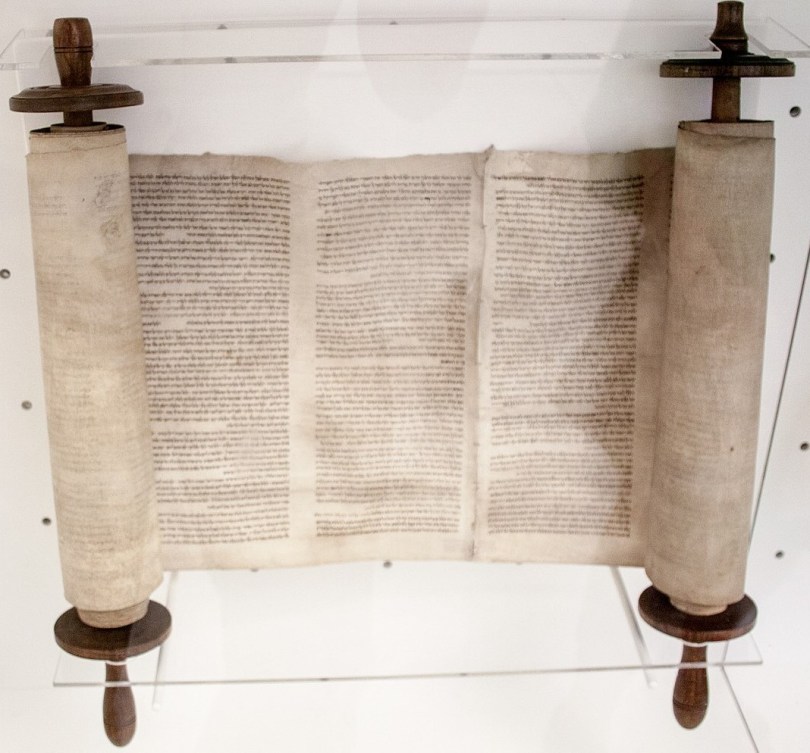
Featured image: Torah scroll (public domain)
1. The Bible’s Prehistory, Purpose, and Political Future. Wright, Jacob L. (2014). Coursera.
2. El the God of Israel-Israel the People of YHWH: On the Origins of Ancient Israelite Yahwism. In Becking, Bob; Dijkstra, Meindert; Korpel, Marjo C.A.; et al. Only One God?: Monotheism in Ancient Israel and the Veneration of the Goddess Asherah. Dijkstra, Meindert (2001).
 The Plan For The Future