
The Religion of Love
Christians tell us that God is love. There is something about this love that the Church Fathers found so troubling that they didn’t want us to know. Jesus’ deeds might make more sense once you know what it is. Love is a central theme in Christianity. And so this religion is known as the Religion of Love. According to the Gospel, Jesus said we should love God with all our heart, soul, mind and strength (Mark 12:30-31). Paul wrote the First Epistle to the Corinthians around 54 AD. It is one of the earliest written sources of Christianity. It contains a remarkable poem (1 Corinthians 13),
If I speak in the tongues of men or of angels, but do not have love, I am only a resounding gong or a clanging cymbal.
If I have the gift of prophecy and can fathom all mysteries and all knowledge, and if I have a faith that can move mountains, but do not have love, I am nothing.
If I give all I possess to the poor and give over my body to hardship that I may boast, but do not have love, I gain nothing.Love is patient, love is kind. It does not envy, it does not boast, it is not proud.
It does not dishonour others, it is not self-seeking, it is not easily angered, it keeps no record of wrongs.
Love does not delight in evil but rejoices with the truth.
It always protects, always trusts, always hopes, always perseveres.Love never fails. But where there are prophecies, they will cease; where there are tongues, they will be stilled; where there is knowledge, it will pass away.
For we know in part and we prophesy in part, but when completeness comes, what is in part disappears.
When I was a child, I talked like a child, I thought like a child, I reasoned like a child.
When I became a man, I put the ways of childhood behind me.
For now we see only a reflection as in a mirror; then we shall see face to face.
Now I know in part; then I shall know fully, even as I am fully known.And now these three remain: faith, hope and love. But the greatest of these is love.2
Paul informed us that love is more important than faith and good works. That is quite informative, as God is love (1 John 4:8, 16). The Christian story became that God loved the world so much that He gave His one and only son so that whoever believes in him shall not perish but have eternal life (John 3:16). The author of the Gospel of John shares his views on God’s love in the First Epistle of John (1 John 4:7-10),
Dear friends, let us love one another, for love comes from God. Everyone who loves has been born of God and knows God. Whoever does not love does not know God, because God is love. This is how God showed his love among us: He sent his one and only Son into the world that we might live through him. This is love: not that we loved God, but that he loved us and sent his Son as an atoning sacrifice for our sins.
God loving us and sending His one and only son into the world to die as a sacrifice for our sins seems peculiar, outrageous even, unless you are a Christian. Christians claim that Adam sinned, so we are all cursed, but then came Jesus, who saved us by his crucifixion. Jews and Muslims don’t believe that God has a son, nor do they think that Adam’s transgression justifies this sacrifice. When God ordered Abraham to offer his son, and Abraham was about to comply, God called it off. So why did Jesus do it? The odds are that it has to do with love. Ephesians gives a possible clue (Ephesians 5:25),
Husbands, love your wives, just as Christ loved the church and gave himself up for her.
Christians believe Jesus married the Church. Only the Church didn’t exist when Jesus lived. The verse suggests that Jesus died out of love, as in a marriage. It asks husbands to love their wives just like Christ loved the Church and gave himself up for her. That was as close to the truth as the church fathers dared to venture. Jesus was married and gave himself up for his Bride. And men should do the same for their wives. This vantage also sheds new light on Jesus’ views on marriage as a bond forged by God (Matthew 19:3-9),
Some Pharisees came to him to test him. They asked, ‘Is it lawful for a man to divorce his wife for any and every reason?‘
‘Haven’t you read,’ he replied, “that at the beginning the Creator made them male and female, and said, ‘For this reason a man will leave his father and mother and be united to his wife, and the two will become one flesh.’ So they are no longer two, but one flesh. Therefore what God has joined together, let no one separate.’
‘Why then,’ they asked, ‘did Moses command that a man give his wife a certificate of divorce and send her away?’
Jesus replied, ‘Moses permitted you to divorce your wives because your hearts were hard. But it was not this way from the beginning. I tell you that anyone who divorces his wife, except for sexual immorality, and marries another woman commits adultery.’
Here, Jesus departed from Moses’ law, referring to the beginning, thus Eden. Jesus’ disciples argued it would be hard for men to love their wives this way. Jesus replied that not all men can do this. Concerning marriage, Jesus promoted a high standard that was untenable for many men. It would be better to live in celibacy than not to live up to it. In the Gospel of Matthew, Jesus compares the kingdom of heaven to a king who prepares a wedding banquet for his son (Matthew 22:2-14). The wedding symbolises the kingdom of God. It may seem odd to compare the kingdom of God to a wedding, unless it is one.
The Pharisees indulged themselves in some additional testing of Jesus when they caught a woman in the act of adultery (John 8:1-11). They asked Jesus, ‘Teacher, this woman was caught in the act of adultery. In the Law, Moses commanded us to stone such women. Now what do you say?’ They were using this question as a trap, as stoning should be the verdict according to Numbers 5, perhaps because they expected Jesus to rule in favour of the woman. Jesus’ answer was, ‘Let any one of you who is without sin be the first to throw a stone at her.’ But according to Rabbinic literature, the man being free from sin was a precondition for the trial of the woman, as Hosea 4:14 reads,
I will not punish your daughters when they turn to prostitution, nor your daughters-in-law when they commit adultery, because the men themselves consort with harlots and sacrifice with shrine prostitutes.
Jesus’ answer was the correct interpretation of the law, as recorded in Rabbinic literature, so it wasn’t merely a clever rebuttal. By knowing the law better than they did, Jesus made the Pharisees appear foolish. The witnesses weren’t free from sin, and as for the husband, we learn nothing.
Surviving records of Jesus’ words and teachings suggest Jesus believed women to be equal to men. The equality of the sexes is at odds with the patriarchal society of Jesus’ time. Paul probably also saw women as equals, but his views concerning marriage are remarkable. In his first letter to the Corinthians, Paul says (1 Corinthians 7:1-2, 3-4, 10-11),
Now for the matters you wrote about: ‘It is good for a man not to have sexual relations with a woman.’ But since sexual immorality is occurring, each man should have sexual relations with his own wife, and each woman with her own husband.
The husband should fulfil his marital duty to his wife, and likewise the wife to her husband. The wife does not have authority over her own body but yields it to her husband. In the same way, the husband does not have authority over his own body but yields it to his wife.
To the married, I give this command (not I, but the Lord): A wife must not separate from her husband. But if she does, she must remain unmarried or else be reconciled to her husband. And a husband must not divorce his wife.
To Paul, celibacy was preferable to marriage, but only for the strong, who can resist their urges. Marriage is to keep the weak, who can’t control their desires, on the right path, so that Satan will not tempt them (1 Corinthians 7:5). That is a rather specific interpretation of Jesus’ saying that only men who are capable of loving a woman should marry, and that if one cannot love a woman, it is better to remain unmarried (Matthew 19:3-11). After explaining that, Jesus went on to discuss eunuchs, noting that some choose to live like eunuchs for the sake of the kingdom of heaven (Matthew 19:12). That may have inspired Paul’s views on celibacy.
The Didache, an early Christian text dating back to the first century, implies the equality of the sexes. It helped to make Christianity monogamous, as opposed to Judaism at the time, and later Islam. As many early Christians were Jewish and had heard about Jesus and the miracles he did, but didn’t know about his marriage to God and believed God was an invisible being in the sky, Paul faced a theological problem.
Patriarchy returning
Paul resolved that issue by aligning Christianity with the Jewish scriptures. He wrote that the head of every man is Christ and the head of the woman is man (1 Corinthians 11:3) and that a man is the image and glory of God, as man did not come from woman, but woman from man; neither was man created for woman, but woman for man (1 Corinthians 11:7-9). Paul must have known better, but it was the biblical account from Genesis. As a religious Jew, he considered these scriptures infallible, so the facts are secondary, which may seem strange, but that’s how many religious people reason. Most early Christians were Jews who didn’t know the specifics about the relationship between God and Jesus, so they wouldn’t have believed the truth anyway. Worse still, it would be blasphemous to them. And so, Paul did God’s work by making the new religion more palatable to them.
Paul makes up for it by adding that the head of Christ is God. He goes on to say that a woman ought to have authority over her own head, and that woman is not independent of man, nor is man independent of woman, and that woman came from man, but also man is born of woman (1 Corinthians 11:10-12). In his view, men and women were equal. It is a juggling with words, as Paul is beating around the bush.
Over time, Christianity became increasingly patriarchal. Scholarly analysis of the letters of the early church fathers underlines this. Scholars think 1 Corinthians 11:2-16 is a later addition.1 It claims that the man is the head of the family. The same applies to 1 Corinthians 14:34-35. It orders women to be silent in the churches. A reason for suspecting that the latter passage is an addition is that several manuscripts have it at the end of the chapter instead of its usual location. Scholars view it as a sign that a scribe copied a note into the body of the text.2 A previous scribe likely added that note.
If you ask yourself how scribes could justify falsifying their scriptures, here lies an answer. It happened in small steps that appeared reasonable. You might not consider adding a note a falsification. As Paul wrote, the head of the woman is the man. You can interpret this as the man being the head of the family, as traditional Jews did. Once the comment is there, it becomes part of the text’s context as a clarification. Once it is part of the context and has become an instruction to read the passage that way, it might not seem falsifying to include it in the text. In this way, a few generations can make an astounding difference. And so, the First Epistle to Timothy reads (1 Timothy 2:11-15),
A woman should learn in quietness and full submission. I do not permit a woman to teach or to assume authority over a man; she must be quiet. For Adam was formed first, then Eve. And Adam was not the one deceived; it was the woman who was deceived and became a sinner. But women will be saved through childbearing—if they continue in faith, love and holiness with propriety.
Paul never wrote this letter, despite the letter claiming otherwise. An unidentified Christian scribe likely penned it down more than fifty years after Paul’s death. Scholars uncover falsifications by comparing the wording of this epistle with that of Paul’s genuine letters. The passage above suggests women spoke publicly and felt they had authority over men. Otherwise, the author would not have written it. These modifications suggest an equality of the sexes, a prominent position for women in the early Christian movement, and the gradual re-establishment of male supremacy.
Sacrifice for love
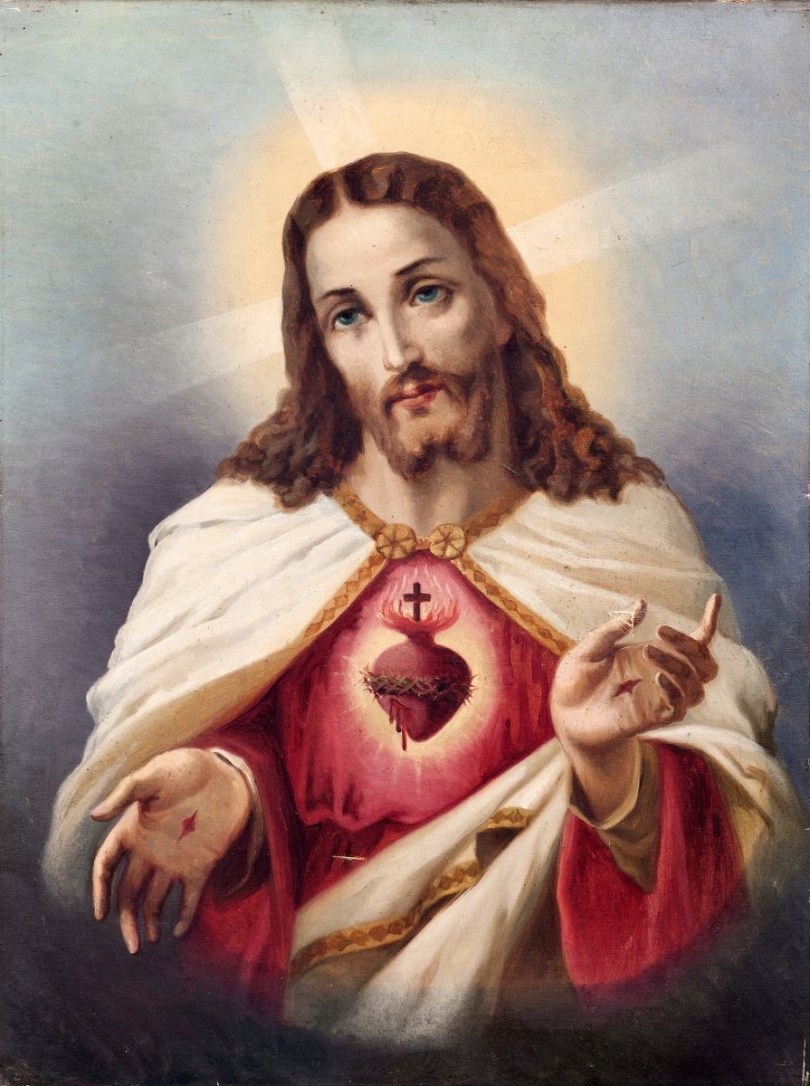
As Jesus sacrificed himself for love, devotion to the Sacred Heart of Jesus is a noteworthy peculiarity, as is some of the accompanying imagery. Within the Roman Catholic tradition, the Sacred Heart is a symbol of God’s boundless and passionate love for humankind. Nothing of the sort existed during the first ten centuries of Christianity. The Crusades revived religious life and inspired monks and nuns to revere Jesus’ wounds, including his heart, as sacred. The Franciscan monk Bonaventure wrote in 1274, ‘Who is there who would not love this wounded heart? Who would not love in return Him, who loves so much?’ Over time, Jesus’ heart came to the centre stage of these devotions.
Women mystics played a crucial role in that development. Among them were Lutgardis of Aywières (1182–1246), Mechtilde of Hackeborn (1241–1298), and Gertrude of Helfta (1256–1302). The devotion to the Sacred Heart in its present form began with Margaret Mary Alacoque (1647–1690), a nun of the Order of the Visitation of Holy Mary, who claimed to have received revelations about the Sacred Heart from Jesus Christ between 1673 and 1675 in the Burgundian French village of Paray-le-Monial. Later, Mary of the Divine Heart (1863–1899), a religious sister of the Congregation of Our Lady of Charity of the Good Shepherd, reported receiving locutions and visions of Jesus Christ.
So, did Jesus sacrifice himself for God’s love, and did God not care about Jesus? And if so, why would God care about us? If that thought had occurred to the Church Fathers, they would have found it disturbing. If someone else were to find himself in the position Jesus once was, he might not be instantly enthusiastic about the proposition. But no one can go against the will of God. And you can fall in love with someone who has taken you hostage. It is a natural reaction known as Stockholm Syndrome. Having no choice makes things easier. You must try to save humankind if there is a slight chance of success. He knows he has to play his role in the script. And he can succeed, like Chief Inspector Clouseau, if that is the plot of the story. And if the absurd has hunted you down and cornered you, and you see no escape, you can better embrace it.
And is it so terrible to die for love? Everyone dies, usually for less agreeable reasons like a fatal encounter with a deadly disease, some random accident, old age or a war fought for the ego of a leader, or even worse, his stupidity. In hindsight, Jesus’ sacrifice was exceptionally functional. It created Christianity, a religion that claims we are unworthy of God’s grace and need to accept a saviour and follow him. It is an idea that can save us because we can’t fix our problems ourselves. We are religious creatures who need a fairy tale to believe in. And as Paul explained in his poem, you can speak every language, know all the secrets, and give your money to those in need, but it is pointless if you don’t have love. If it is a delusion, you can enjoy it for as long as it lasts. And if you must go down in infamy and die, you can better do it laughing. So, always look on the bright side of life,
Life’s a piece of shit
When you look at it
Life’s a laugh and death’s a joke, it’s true
You’ll see it’s all a show
Keep ’em laughin’ as you go
Just remember that the last laugh is on you
AndAlways look on the bright side of life
Always look on the right side of lifeMonty Python, Always Look on the Bright Side of Life
Latest revision: 12 February 2026
Featured image: A cross in a heart formed with candles. Photos taken in Camp Tejas, Giddings, Texas, USA. Wingchi Poon. CC BY 3.0. Wikimedia Commons.
1. Forgery and Counter forgery: The Use of Literary Deceit in Early Christian Polemics. Bart D. Ehrman (2013).
2. The Oxford Bible Commentary. John Barton; John Muddiman, eds. (2001). New York: Oxford University Press. p. 1130. ISBN 978-0-19-875500-5.
 The Plan For The Future