
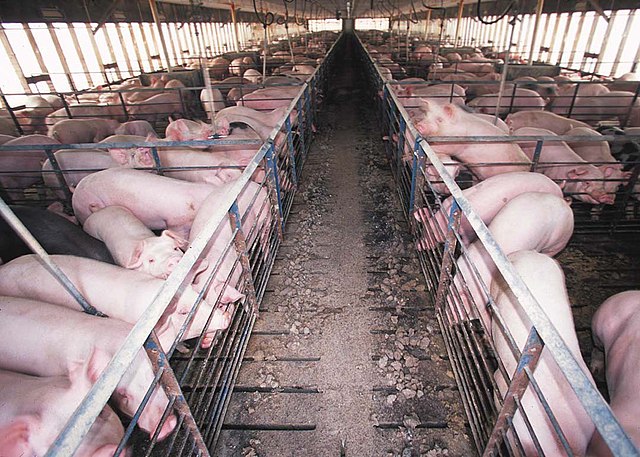
Evolution theory suggests we are an animal species that evolved from apelike creatures and that chimpanzees are our nearest living relatives. In other words, we are much like the other animals. Indeed, animals can experience joy and suffering like us. A central ethical rule is not to cause unnecessary pain and suffering. So, if ethical considerations apply to our fellow humans, they might as well apply to other animals. Nature does not have ethics, but ethics are part of our nature because we can place ourselves in someone else’s position and feel compassion. Compassion helped us as a species, as did aggression, but in a utopian society, ethics take precedence.
Suffering is something a conscious mind experiences, but consciousness comes in different levels. You can beat a stone, but it does not feel anything. A plant is less aware than an insect if it is aware at all. An insect has less awareness than a fish. And fish are less conscious than mammals. And we may relate more to animals that are more like us. That is why mammals elicit the most sympathy. And so, murdering a cow feels very different from killing an ant.
We care more about people we know than strangers, so we may also care more for our pets than people in faraway countries. The suffering that goes unnoticed does not affect us. Only when we see the misery, for instance, in factory farms and slaughterhouses, do we become aware of it. But once we know, we can react in different ways:
- Not caring. You may have more urgent problems than animal welfare.
- Accepting. You could argue that meat is a natural part of our diet.
- Doing something. You might become a vegan.
Humans have been murdering animals since time immemorial. And our distant forebears drove several animal species to extinction. So, why stop now? Today, humans dominate the planet, and much of the remaining wildlife is under threat. Hence, it may not be a luxury to ask ourselves some questions like should there be animal rights like there are human rights? And if so, what rights should animals have? Animals themselves do not think they have rights. Respecting nature and animal suffering are reasons why we think about animal rights. But those considerations can conflict with each other. So whatever choices we make, they can raise controversy.
Even when we think animals have rights, animals transgress our moral rules, for instance, by murdering each other. After all, predators eat prey, and nature does not care. It is survival of the fittest. Should we stop them from doing that? Some species go extinct because of our actions, while others profit. Rats, cockroaches, and crows do well where humans have disrupted the balance in nature. Should we restore the balance in nature? And, if you own a cat and allow it to go outside, you contribute to a bird massacre. In the Netherlands alone, cats eliminate twenty million birds per year. Should you keep your cat inside or not keep a cat at all? And should we control pests? Probably so because pests threaten us.
And what about eating meat? Meat has been on the human menu since time immemorial. It provides us with some of the nutrients we need. There may soon be artificial meat and replacements with those same nutrients. And so, we might end the suffering of animals in the meat industry. Animals in the meat industry often live under miserable conditions, but in some areas like the European Union, there are regulations regarding the welfare of animals on farms. If animals cannot behave naturally, they experience stress and suffer, for instance, when confined to small spaces.
These European animal-welfare regulations conflict with practical economic considerations. For instance, what to do with a pig that resists stepping into the truck that brings it to the slaughterhouse and gentle prodding does not help? Transport companies and slaughterhouses must make money. Unruly beasts take time and can make the operation unprofitable. Whether animals in the wild always have a better life than those on farms remains to be seen. Wild animals must deal with predators, food shortages, and humans. Still, it is fair to say that ending factory farming promotes animal welfare. And we may need to limit meat consumption to reduce our impact on the planet.
In a caring utopian society, we should not make animals suffer unnecessarily. We can extend that to nature. For instance, if there is not enough food for the deer in a forest, is it not better to shoot the weak and eat their meat than to let them starve? Perhaps, you could introduce wolves, but that might cause even more misery. A deer suffers less from a clean shot from a rifle than a lengthy chase by a pack of wolves. And it gets worse when there are pastures with sheep nearby. Or do sheep lives not matter? Sheep, whether these are black or white, are mostly peaceful creatures who do nothing wrong.
If you prefer the wolves chasing deer, you believe the value of nature takes precedence over the rights of animals and that it justifies animal suffering. But nature itself does not suffer, nor does it care. And humans have profoundly disturbed the ecological balance, so unspoiled nature as it once was, is gone in most places. Letting wildlife coexist with humans can cause problems. For instance, bears are beautiful creatures, but it is better not to let them roam in cities as they are intelligent enough to adapt and may kill people. We can restore the original situation in areas where few people live, stop agricultural and industrial activities, and create large nature reserves. In other areas, we can better manage what remains of nature as a park.
Latest revision: 6 June 2023
Featured image: Hog barn interior. Public Domain.
 The Plan For The Future