Virgin Mary

Mother Goddess Mary

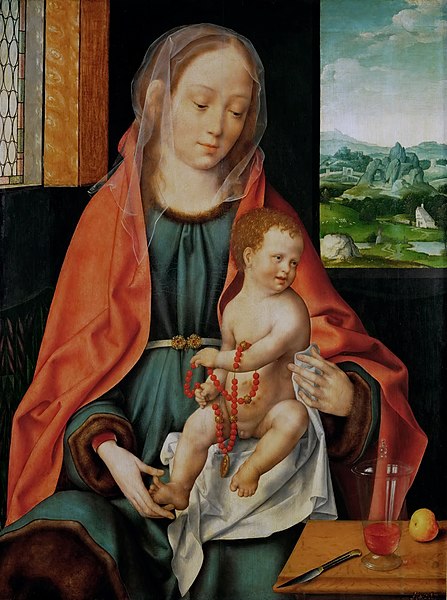
Jesus’ birth mother, Mary, plays a prominent role in Christianity. As the story goes, she was a virgin who birthed Jesus. She is the central figure in Roman Catholicism and Eastern Orthodox Christianity. She is the Mother of God, Church tradition holds, thereby implying Jesus was God and that God has a mother, which is indeed highly peculiar. Many Catholics pray to Mary rather than to Jesus or God. In this way, Mary is a proxy for God. The Quran consistently names Jesus the son of Mary rather than the Son of God. The images of Mary with the child resemble those of the Mother Goddess. They picture Jesus as the Son of God, the Mother. That is most noteworthy because Jesus believed he was Adam, the Son of Eve, the Son of God. How could this happen? Inquiring minds want to know. Now, there is the historical explanation, and there is the script that God wrote.
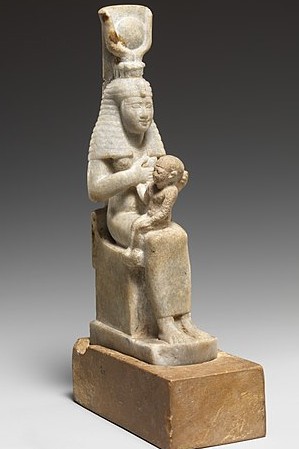
Isis with Horus
Isis with Horus. Metropolitan Museum of Art.

In the early years of Christianity, there was probably no cult of the Virgin Mary. The earliest Christian paintings, made around 235 AD, depict Christ, Peter, and martyrs, but not Mary. The first solid evidence of devotion to the Virgin Mary dates back to the third century, but its origin remains unclear. Perhaps, early Christians prayed to Mary as they did to other saints. Possibly, Mary granted the most requests, which made her increasingly popular. In this sneaky manner, the Mother Goddess sneaked into the Church through a back door, via the cult of the Virgin Mary. The ability to give birth without the need of a man is the miracle of the Mother Goddess. Christians later created statues and icons of the Virgin with the child Jesus, looking like the Egyptian mother goddess Isis with her child Horus.
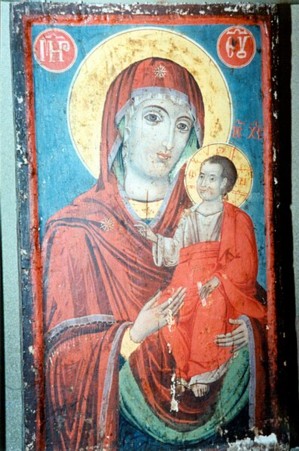
Saint Mary Bolnichka Icon
Saint Mary Bolnichka Icon.

So, what brought Mary to this elevated status? Mary is not only the mother of Jesus, but Christians and Muslims believe she was a virgin. Jesus’ birth from a virgin didn’t happen. That we can be sure of. Matthew and Luke mention Jesus’ virgin birth, but Mark and John don’t. Had it been common knowledge, all the Gospels would have mentioned it. And if it had happened, it would have been common knowledge. So, was it a myth that sprouted up in the Christian community? Or did the Church Fathers have a pressing cause to invent the story of Jesus’ virgin birth? There is reason to believe the latter.

And Jesus became a carpenter

The virgin birth of Jesus never happened. In Galatians, Paul writes that God sent His Son, who was born of a woman (Galatians 4:4). That was around 55 AD. Had he known about the virgin birth, that would have been an excellent opportunity to mention it, but somehow he forgot. Or the virgin birth hadn’t happened, which is more likely. A motive for inventing the virgin birth that immediately presents itself is that if God were Jesus’ Father, he couldn’t have a human father. It is not entirely satisfactory. If Jesus saw God as his Father, there is no pressing need for that. In that case, Jesus said ‘Father’ to God. That would be all there is to it, and there would be no reason to make this up.

And so, you might believe that the myth emerged within the Christian community to fill in the gap, as there was no narrative of Jesus’ birth. You wouldn’t think the Church’s leaders orchestrated it. There is reason to think otherwise, as we will see. Paul’s phrase ‘born of a woman’ also suggests so. And so, there must be more to it. That the virgin birth is an intentional falsification, you can infer by comparing Mark to Matthew. Mark dates from around 70 AD. Matthew came a few years later. Both are truthful to some extent. You can use one to detect the lie in the other. Mark tells that people in Jesus’ hometown called him ‘the carpenter’ and ‘Mary’s son’ (Mark 6:3),

Isn’t this the carpenter? Isn’t this Mary’s son and the brother of James, Joseph, Judas, and Simon? Aren’t his sisters here with us?’

The Gospel of Mark doesn’t mention Joseph, who was Jesus’ human father. It does note that Jesus had brothers and sisters, of whom we learn only the names of the brothers. You would expect the townspeople to call him Joseph’s son. But they didn’t, and called him Mary’s son, as if the virgin birth had occurred, while Mark doesn’t mention that noteworthy incident that you would definitely report on if you knew it had happened. It could be an error, but the mistake is so specific that it seems intentional. That it could be an edit, you can find in Matthew (Matthew 13:55),

Isn’t this the carpenter’s son? Isn’t his mother’s name Mary, and aren’t his brothers James, Joseph, Simon and Judas? Aren’t all his sisters with us?

The Gospel of Matthew mentions both the virgin birth and that Jesus has a human father and explains them in the virgin birth story, where Joseph accepts Jesus as his son, rendering such an edit redundant. Mark came before Matthew, scholars agree, and it contains fewer fancies. Mark and Matthew both drew on the same source, which referred to Jesus as the carpenter’s son. Likely, Mark dates from shortly after the Church Fathers had decided to introduce the virgin birth. The clumsy editing makes it seem as if Jesus were a carpenter.

By the time Matthew wielded his pen, the Church Fathers had contrived a proper cover story so that they didn’t have to remain secretive about his human father anymore. Such an explanation presumes that the authors of Mark and Matthew were prominent people within the Church who had contact with its leadership. They wouldn’t have done so if it had not been a solution to a theological problem.

The author of Matthew also sought a prophecy in the scriptures that predicted Jesus’ virgin birth. Isaiah wrote that a young woman would give birth to a son as a sign that God would destroy Judah’s enemies (Isaiah 7:14). Isaiah addressed King Ahaz in the eighth century BC and didn’t foresee the coming of Jesus, who would arrive seven centuries later. The Greek translation of the Jewish Bible, available in the first century AD, translated a young woman as a virgin. The author of Matthew saw it as a prophecy of Jesus’ virgin birth. There was no prophecy of this event that never happened, and that is no coincidence.

The author was particularly preoccupied with proving that Jesus was the long-awaited Jewish Messiah. To that aim, he fabricated a genealogy to demonstrate that Jesus descended from the House of David. And behold, he uncovered fourteen generations in all from Abraham to David, fourteen from David to the exile to Babylon, and fourteen from the exile to the Messiah, Jesus, which is so neat that it only happens in fairy tales. The prophet Micah prophesied that a ruler would come from Bethlehem (Micah 5:2). And somehow Matthew ‘discovered’ that it was the birthplace of Jesus. Mark and John don’t mention the virgin birth or Bethlehem. Jesus was probably born in Nazareth, had an ordinary childhood and joined the movement of John the Baptist.

Mary as the New Eve

If Jesus called God his Father, there is no reason to invent the virgin birth. You don’t need to prove that God is Jesus’ Father. If Jesus said so, that would be good enough. His having a human father wouldn’t change that. The answer to the mystery is that Jesus never called God ‘Father,’ but rather ‘Mother.’ Jesus was the Son of God because God, in the person of Mary Magdalene, convinced Jesus that he was Adam reincarnate, and that She was Eve reincarnate. And Eve didn’t come from Adam’s rib, but Adam was Eve’s son. The virgin birth of Jesus from Mary replaced the ‘virgin birth’ of Adam from Eve.

You can infer that from Christian theology. God announced there would be enmity between the offspring of the serpent and that of the woman (Genesis 3:15). Christians see it as a prophecy predicting the coming of Jesus. They believe the seed of the woman refers to the virgin birth of Jesus, while it was Adam’s. That made Mary the New Eve. In this manner, Mary became the replacement for Eve. It is, however, doubtful that those who invented the virgin birth also came up with this.

Eve being Adam’s mother and Jesus calling God his Mother contradicts the Jewish scriptures. You can’t have that, so you have to work on that fact to make it fit. So, why not say Jesus was born of a virgin instead? After all, Jesus was Adam, and Eve was a ‘virgin’ when she gave birth to Adam. And God’s name was Mary, just like Jesus’ mother, while God was Jesus’ Mother. That was very convenient indeed, a convenience provided by providence, no doubt. Mark and Matthew both name Jesus Mary’s son, perhaps because she played a prominent role during Jesus’ ministry and was present at the cross.

Cloak and dagger

The Virgin Mary appeared more frequently to people than Jesus and performed more miracles than any other saint. There is little or no evidence of many of these supposed miracles, but the Fatima Miracle had 40,000 witnesses, so there should be no doubt that something spectacular had happened there. God the Father doesn’t appear in this way. And there are no 40,000 witnesses who saw a miracle that the Father announced. That is because there never was a Father. Virgin Mary became such a potent figure because she is the cloak behind which God the Mother has hidden Herself so far. Now, we are at the cloak-and-dagger part: the Quran boasts a hidden secret.

In the Quran, Mary is the most prominent woman and the only woman mentioned by name. The Quran dedicates an entire chapter, chapter 19, to the Virgin Mary. The number 19 has great significance in Islam. Some Muslims indulge in arcane numerological explanations as to why that is so. The Quran refers to this number in the chapter named ‘The Hidden Secret.’ And so, the Quran may hold a hidden secret related to this number. The Quran also claims Mary was a virgin, thus confirming the miracle of the Mother Goddess. The Virgin Mary became the cloak behind which God hid Her identity.

The star and crescent became Islam’s symbol. It has a long history predating Islam, as it was associated with a Moon goddess. In the Bible, the moon refers to the woman and the star to the child (Genesis 37:9). Hence, the Islamic symbol represents the Madonna with the child Jesus or the relationship between Khadijah bint Khuwaylid and Muhammad. She was fifteen years older. A woman of Her age could have been his mother.

The St. Mary of Zion Church in Ethiopia is said to contain the Ark of the Covenant. Legend has it that the Ark came to Ethiopia with King Menelik after he visited his father, King Solomon. The Ark symbolises Mary of Zion. The Ark is supposed to be the residence of Yahweh, the God of Israel.2 That is remarkable, as God’s name was also Mary.

Statue storm

The Protestant Reformation was an attempt to return to Christianity’s roots by viewing Scripture as the sole source of Christian truth. The Protestants ended church traditions that lacked biblical grounds, including the veneration of the Virgin Mary. Nothing in the Bible justifies the cult of Mary. Protestants removed icons and statues from their Churches because one of the Ten Commandments prohibits making images for worship (Exodus 20:4-5). In the Netherlands, the Protestant Reformation caused a ‘statue storm’ where Protestant religious vigilantes ravaged Catholic Church interiors.

Protestantism developed in an era of emerging rationalism and naturalism. And so, Protestants also object to magic and superstition, deeming it Satan’s work, while Catholics love miracles like healings at Lourdes and weeping Mary statues. Miracles have always been part of the Catholic tradition.

The Protestants erased an essential part of Christianity’s original message of the Mother Goddess giving birth to Her son. Instead of getting closer to the truth, the Protestants wandered further from it. And it didn’t solve anything, but only generated more confusion. The Protestants soon began fighting among themselves over the interpretation of the scriptures. You can’t be wrong, because if you are, you end up frying eternally in Satan’s ovens. That was the reason Protestantism started in the first place. So, after the Protestant storm is over, we have over 45,000 branches of Christianity.

Latest revision: 9 December 2025

Featured image: Madonna and Child, Kunsthistorisches Museum Wien. Public Domain.

Other images: Isis with Horus. Metropolitan Museum of Art. Wikimedia Commons. Public Domain; Saint Mary Bolnichka Icon. Wikimedia Commons. Public Domain.

1. Church of Our Lady Mary of Zion. Wikipedia.

Born of God

The Gospel of John remarkably differs from the other gospels. Matthew and Luke say that Jesus’ mother was a virgin. Mark doesn’t mention it, while John claims that Jesus was with God in the beginning, that in him was life, and that life was the light of all humankind. It refers to Genesis, where, in the beginning, God created the heavens and the earth. But that earth was formless, empty, and covered by darkness, so God said, ‘Let there be light,’ and there was light. John remains cryptic and goes on to say (John 1:9-13),

The true light that gives light to everyone was coming into the world. He was in the world, and though the world was made through him, the world did not recognise him. He came to that which was his own, but his own did not receive him. Yet to all who did receive him, to those who believed in his name, he gave the right to become children of God- children born not of natural descent, nor of human decision or a husband’s will, but born of God.

Christians are born of God. Jesus gave us the right to become children of God. That is why Jesus said that he was the life apart from being the way and the truth (John 14:6). Men can’t give birth, so God must be a Mother. John doesn’t say Jesus was Adam, who begot humanity by being the husband of Eve, who was God. He rephrased it as Jesus giving us the right to become children of God. The same author, who was not the Apostle John, clarifies in his first epistle what it means that Jesus is the Son of God (1 John 5:1),

Everyone who believes that Jesus is the Christ is born of God, and everyone who loves the Father loves His child as well.

How come that God the ‘Father’ gave birth to Jesus? Somehow, everyone ignores the glaringly obvious, and no one asks that question. When there has always been a giant, stinky rat in the kitchen, you probably don’t notice the smell. The phrase born of God occurs several times in this letter (1 John 2:29, 3:9, 4:7, 5:1, 5:4, 5:18). Today, Christians assume that the phrase ‘born of God’ has only a spiritual meaning as Jesus likened entering the kingdom of God to being born again when answering a question posed by a Pharisee named Nicodemus (John 3:3-6),

Jesus replied, ‘Very truly I tell you, no one can see the kingdom of God unless they are born again.’ ‘How can someone be born when they are old?’ Nicodemus asked. ‘Surely they cannot enter a second time into their mother’s womb to be born!’ Jesus answered, ‘Very truly I tell you, no one can enter the kingdom of God unless they are born of water and the Spirit. Flesh gives birth to flesh, but the Spirit gives birth to spirit.’

Nicodemus mentions the womb, so the phrase ‘born of God’ implies that God is a Mother. That raises a question. If the early church leaders went to such great lengths to remove all the evidence of God being a Mother, how could they have overlooked the phrase ‘born of God’? The correct answer is that they didn’t. The language of the Gospels is Greek. Greek culture dominated the ancient Eastern Mediterranean, where Christianity spread. Learned Jews like Paul were well-acquainted with Greek thinking. Greek thought and mythology helped the early church fathers reconstruct their religion after changing God’s gender.

In Greek mythology, Athena, the goddess of wisdom, was born from the head of the male deity Zeus. As the tale went, Zeus’ head opened to let Athena out and closed again. In this way, a male deity could give birth. And that was very convenient. When the church fathers altered God’s gender, they may have initially thought of the Zeus and Athena analogy, so Jesus was born of the Father. There is another enlightening piece of evidence, the Odes of Solomon. These are first-century Christian writings, thus of the earliest days of Christianity. Ode 19 (here is that number again) comes with the following lines,

A cup of milk was offered to me: and I drank it in the sweetness of the delight of the Lord.
The Son is the cup, and He who was milked is the Father.
And the Holy Spirit milked Him: because His breasts were full, and it was necessary for Him that His milk should be sufficiently released.
And the Holy Spirit opened His bosom and mingled the milk from the two breasts of the Father, and gave the mixture to the world without their knowledge.1

No other ancient Christian text explicitly mentions gender-related attributes of God. Here, God has female physical characteristics despite being called Father. And because it is an ancient text dating from Christianity’s first century, the Father was first a Mother.

Latest revision: 20 September 2025

Featured image: Bible: Only God Knows What Jesus Really Said. Loesje.org.

1. The Lost Bible: Forgotten Scriptures Revealed. J.R. Porter (2001).

Eve in the Garden Of Eden

Mother Goddess Eve

In archaeological excavations, female figurines have turned up. They could depict mother goddesses. The most famous example is the Venus of Willendorf, dating back to around 23,000 BC. In ancient cultures, mother goddesses represented fertility. The ability of women to produce offspring could have been the essence of Mother Goddess worship. Women give birth, and early humans may not have understood that men were the fathers. They may have thought men had no reproductive use and existed to please the women. Consequently, the Mother Goddess can give birth as a virgin, which is the miracle of the Mother Goddess. One of the best-known Mother Goddesses was Isis.

Venus of Willendorf


Women can be sure that their children are their own, but men can’t. When the fathers of children are unknown, families are often matrilineal, meaning that family lines run through mothers. The goddess worship may have disappeared because men desired to control women and their sexuality. The transition from hunting and gathering to agriculture may have played a crucial role in this development.

Hunter-gatherers were wanderers. They had fewer territorial conflicts. Population density was low, and they had no property, so it was easier to move on if a stronger group invaded a band’s territory.1
That changed with the advent of agriculture. Farmers had to defend their property and families against thieves and invaders. It became a matter of life and death, so warfare became more common and deadly. Giving up territory would mean starvation. Men are willing to protect women and children they consider their own. And they can walk out when they doubt their fatherhood. That gave them a position of power, allowing patriarchy to emerge.

Male dominance is almost universal among humans, with only a few exceptions, so it is something more than merely a cultural phenomenon. Our closest relatives, the chimpanzees, live in groups led by males, while the bonobos live in groups dominated by females. And so, it may be a natural inclination of humans.1 When women and men have an equal status, women may more often boss men, but there is something in human nature that favours men as clan leaders. As humans are programmable and have varying cultures, they can overcome their natural inclinations and choose female leaders, or make female leadership the standard in their societies, and invent myths to justify the arrangement, such as stories about the Mother Goddess creating the man as a companion for the woman.

As we have no written records, we know little about the lives of hunter-gatherers, their leaders and their family structures. Still, we do know that there must have been an enormous cultural diversity, as they lived in small groups that had little or no contact with each other. The lifestyle of hunter-gatherers was more favourable for female leadership and matrilineal families than farmer communities, so that female leadership and matrilineal families likely were more common before the Agricultural Revolution. Relatively peaceful conditions and a belief that men have no reproductive role, thus only exist to please women, could easily produce female-centred societies.

In her book, When God Was a Woman, historian Merlin Stone claims that goddess worship was the earliest religion in the Near and Middle East. The Creator was a woman before men rewrote history. Stone bases her claim on the discovery of female figurines in archaeological finds. In a 7,000-year-old settlement in Turkey, where archaeologists also found these figurines, families were matrilineal.2

The Garden of Eden features in an ancient Mesopotamian myth, the Epic of Gilgamesh. The garden was near the rivers Tigris and the Euphrates. The Jews lived in exile in Babylon when their priests compiled their holy scriptures. The first chapters of Genesis take place in Mesopotamia. Jewish scribes tailored Mesopotamian myths to their needs and incorporated them into the Jewish Bible.

In the Epic of Gilgamesh, the gods created a man from clay, much like in Genesis. In another creation myth, a goddess gave birth to humanity. There probably were other creation accounts as well. Eve was Adam’s mother in the original tale. It makes more sense than Eve coming from Adam’s rib. She is the Mother of All the Living (Genesis 3:20), and we are the woman’s offspring (seed) (Genesis 3:15). Elsewhere in the Bible, a child is the father’s offspring, which is a noteworthy difference. It implies that we come from women and that men have no reproductive role. That perspective sheds a new light on what Eve said about giving birth to Cain (Genesis 4:1),

Adam made love to his wife Eve, and she became pregnant and gave birth to Cain. She said, ‘With the help of the Lord I have brought forth a man.’

It wasn’t making love to Adam that made Eve give birth, but the help of the Lord. That is noteworthy because we are the woman’s offspring (seed). Perhaps Eve didn’t need Adam to have a child. There is another explanation. Long before the Jews went into exile in Babylon and picked up the story about the Garden of Eden, Asherah was the wife of El. They together were the supreme gods of the Canaanite divine council.3 Perhaps they, together, not only brought forth lesser deities like Yahweh, but also humanity, starting with Cain and Abel, so that Asherah was the Mother of All the Living.4 Later on, the Jews grew particularly attached to Yahweh, so Yahweh became their supreme deity, replacing El.

Asherah then became Yahweh’s wife. When the Jews were in exile in Babylon, they drew on local myths to rewrite their creation account. They took a story in which the first woman gave birth to the first man, and may have turned the goddess Asherah into the woman Eve. And so, Adam came somewhat late for the first man. Asherah then went out of the window, as the Jews became monotheists. That is speculation in the realm of biblical scholars, and few have dared to delve into this particular matter, for there is too little information to draw such a conclusion. However, it is plausible and explains this peculiarity quite neatly, which is a quality that the truth also possesses.

In the original Mesopotamian tale, Eve gave birth to Adam without prior sexual intercourse. The miracle of the Mother Goddess is the virgin birth. Jesus supposedly was born of a virgin. As God supposedly was Jesus’ Father, he couldn’t have had a human father. That is the reason we know about. However, it was also an allusion to Adam’s birth. Jesus was God’s son because he was Adam reincarnate, the son of Eve, who was God. In scriptural religions, inventing a new story is preferable to contradicting an existing one, as that would imply that the scriptures are corrupt. And you can’t have that, most notably when Paul was around. The virgin birth was a necessity if God was to become Jesus’ father, but it also reflected God being Jesus’ mother, as God’s name was also Mary. It miraculously solved two problems, making early Christians agree on this compromise.

The Bible claims that God created a man from the dust of the ground (Genesis 2:7) to work in the garden (Genesis 2:15) and made a woman as a companion for the man (Genesis 2:18). This is a result of merging with another creation myth. Mesopotamia had several creation myths, including one where the gods fashioned a man from clay to do the work. Also, the Bible has two. In Genesis 1, God creates all that is, and then in Genesis 2, God repeats some of that work. There has been some patching around here and there to glue these two stories.

In the original story of Eve and Adam, the purpose of the man was to be a mate for the woman. A reason to think so is that Genesis mentions the woman’s desire for her husband rather than the man’s desire for his wife (Genesis 3:16). If you live in a modern society that has undergone several waves of feminism, you may not realise how odd noting a woman’s desire for a man truly is. The Bible is a product of a patriarchal society. In a patriarchal society, a woman is often a man’s possession, and her desires are of no consequence. The original tale thus had a woman’s perspective. Eve was the leading character. She discussed eating the fruit with the serpent and made Adam eat from it (Genesis 3:1-6). And it was Eve who commented on the birth of Cain, not Adam (Genesis 4:1).

Also noteworthy is that a man left his father and mother to be with his wife (Genesis 2:24). This was how life was in Eden. In patrilineal societies, family groups centre around fathers, while matrilineal societies centre around mothers. Women join their husbands’ families in patrilineal societies. The man leaving his father and mother thus suggests that family groups in Eden were matrilineal. Experts still debate whether hunter-gatherers lived in patrilineal or matrilineal groups. The limited interest of men in childcare suggests that matrilineal groups could have been the standard as long as there were no compelling reasons to do otherwise. These reasons emerged with the advent of agriculture. The title Mother of All the Living may also refer to the Mother Goddess.5 Ashera was the Mother Goddess in Canaan, and one of the deities of the Jews before they became monotheists. Eve also resembles Namma, the primordial mother in the story of Enki and Ninmah.

The Fall is about the curse of knowledge. More knowledge doesn’t make your life better. Knowledge of agriculture allowed the switch from hunting and gathering to agriculture, and condemned humankind to a life of toil. The life of hunter-gatherers was more agreeable than the plight of farmers who came later on. They had a more varied diet, worked fewer hours, and spent their time doing more exciting things. Additionally, they were less likely to face starvation, disease, and warfare. The Agricultural Revolution did increase the total amount of available food. However, all this extra food didn’t result in a better diet or life, but only in more people, including elites such as kings and priests, who ate the extra food. The peasants worked harder than the foragers before them and got a poorer life in return.1

And so, there is a profound wisdom hidden in the Bible. The Garden of Eden provided for everything. It was the natural state of humans. Eve and Adam were nude (Genesis 2:25), like hunter-gatherers in the jungle today. Eve and Adam might have been vegetarians in Paradise, as God told Adam that he was free to eat from any tree in the garden, except the tree of the knowledge of good and evil. It doesn’t mention hunting or eating animals, implying animals were not on their menu. That is noteworthy as hunter-gathering included hunting. After the Fall, working the land became a life of toil (Genesis 3:17-19), the curse of the Agricultural Revolution. The original tale was also about the downfall of women. Women had to obey their husbands from then on (Genesis 3:16).

In ancient cultures, people venerated snakes for their wisdom and knowledge, so consulting a snake for advice was not unusual. The tree of knowledge relates to the sacred tree, which may explain why it was forbidden to eat from it. Eve’s deed may reflect the role of women in starting the Agricultural Revolution. Farmers must protect their crops from thieves. Otherwise, they face starvation. That condemned men to a life of warfare. And so, Cain, a crop planter, murdered Abel, a cattle herder. Perhaps Cain had only meagre offerings to God because Abel’s animals ate from his crops.

The Abrahamic religions disagree with our Creator being a woman. The Jewish deity Yahweh and the Arabian deity Allah were male, even though many people now think God has no gender. Yahweh and Allah had wives and children before monotheism took over. Allah was at first the supreme deity of Mecca. Later, the owner of the universe appropriated this title. To address the confusion this act generated, the Quran stresses that God has no partner or children. Unlike Christians, Jews and Muslims don’t see God as a Father. But Christians are born of God, a most remarkable wording indeed.

The Quran extensively mentions the creation of Adam but says little about the origin of Eve. The Quran doesn’t claim that Eve came from Adam’s rib but that men and women come from one soul (Quran 4:1, 7:189). It relates to Genesis 1:27, in which God created males and females in His image, so that the soul could be God. The Quran further claims that God created Jesus like Adam from dust (Quran 3:59). The Quran also corroborates the virgin birth story of Jesus (Quran 3:47, 66:12). Christians understand the virgin birth story in the context of God being Jesus’ Father, so that he can’t have a human father. However, the Quran makes it clear that God is not Jesus’ Father. And so, being created from dust could refer to birth from a virgin, so Eve could have been Adam’s mother.

The account of the Fall in the Quran differs from the one in Genesis in some noteworthy aspects. The Quran features no serpent, and Eve didn’t make Adam eat from the tree. The Quran holds both Eve and Adam responsible for the Fall (Quran 7:19-23). Another fragment only blames Adam,

But Satan whispered to him, saying, ‘O Adam! Shall I show you the Tree of Immortality and a kingdom that does not fade away?’ So they both [Eve and Adam]] ate from the tree and then their nakedness was exposed to them, prompting them to cover themselves with leaves from Paradise. So Adam disobeyed his Lord, and so he lost his way.

(Quran 20:120-121)

The historical context of the original story, the curse of the Agricultural Revolution, and the role of women in it have been lost in the Quran. The first Christians believed that Eve was God, the Mother of all the Living, who gave birth to Adam, that Mary Magdalene was Eve, and Jesus was Adam. So Adam and, therefore, Jesus were the Son of God. Humanity descends from Eve, so we are God’s children (John 1:13), but also Jesus’ children.

Tribespeople feel a connection to each other because they believe they share common ancestors. The stories about these common ancestors are myths, such as the tale about Eve and Adam. Eve and Adam came alive again as Mary Magdalene and Jesus. The myth of Eve and Adam can turn humanity into a single tribe. It is the reason why Christians wait for Jesus’ return. And so, Paul may have realised that the good news of Jesus concerns humankind rather than just the Jews.

Latest revision: 28 August 2025

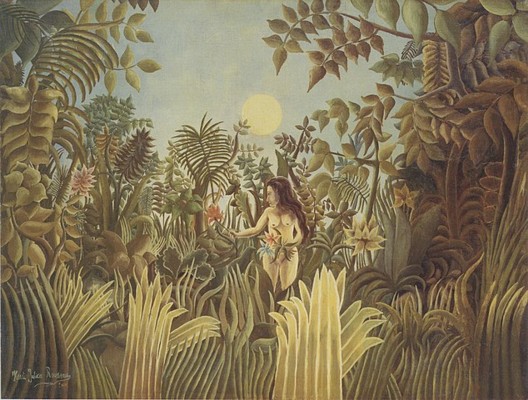
Featured image: Eve in the Garden of Eden. Henri Rousseau (1906-1910). Public Domain. Wikimedia Commons.

Other images: Venus of Willendorf. Don Hitchcock (2008). Wikimedia Commons.

1. A Brief History Of Humankind. Yuval Noah Harari (2014). Harvil Secker.
2. Ancient ‘female-centered’ society thrived 9,000 years ago in proto-city in Turkey. Kristina Killgrove (2025). Livescience.
3. Daniel O. McClellan, Deity and Divine Agency in the Hebrew Bible: Cognitive Perspectives (PhD diss., University of Exeter, 2020) 327
4. Eve as a goddess/consort of Yahweh? r/AskBibleScholars (2024). [link]
5. Asherah – Wikipedia [link]: Some scholars have found an early link between Asherah and Eve, based upon the coincidence of their common title as “the mother of all living” in Genesis 3:20 through the identification with the Hurrian mother goddess Hebat. Asherah was also given the title Chawat, from which the name Hawwah in Aramaic and the biblical name Eve are derived.