Slums in Jakarta

From scarcity to abundance

The road to prosperity

Until very recently nearly everyone lived in abject poverty. Most people had barely enough to survive. In 1651 Thomas Hobbes depicted the life of man as poor, nasty, brutish, and short. Yet a few centuries later a miracle had happened. Many people are still poor but more people suffer from obesity than from hunger while the life expectancy in the poorest countries exceeds that of the Netherlands in 1750, the richest country in the world in the wake of the Industrial Revolution.

In 1516 Thomas More wrote his famous novel about a fictional island named Utopia. Life in Utopia was nearly as good as in the Garden of Eden. The Utopians worked six hours per day and took whatever they needed. His book inspired writers and dreamers to think of a better world while leaving the hard work to entrepreneurs, labourers and engineers. Today many of us have more than they need but still we work hard and feel insecure about the future.

Why is that? The answer lies within the nature of capitalism. It is not enough that we just work to buy the things we need. We must work harder to buy more, otherwise businesses go bankrupt, investors lose money, and people will be unemployed and left without income. In other words, the economy must grow. That worked well in the last few centuries, and it brought us many good things, but it may be about to kill us now.

People in traditional cultures didn’t need much. They were easily satisfied. Many modern people in capitalist societies believe they never have enough. You can always go for a bigger house, a more expensive car, or more luxury items. Many of us do not need more but the advertisement industry makes us believe that we do. We believe in scarcity even when there is abundance. And so the economy must grow. That is what they tell us.

But what are the consequences of this belief? If you eat too much this is great for business profits. And if you become obese as a consequence and need drugs for that reason, you again contribute to business profits so this is even better. Meanwhile we are using the resources of this planet in a much faster pace than nature can replenish. Humanity is standing before the abyss. Civilisation as it is will not continue for much longer. The end is near.

What has this to do with interest? If we want more products and services, we need more businesses, so we need investments. To do investments, we need savings. And to make people save, we need interest to make saving attractive. Consequently investments need to be profitable to pay for the interest. But there can be too much of a good thing. If we don’t need more stuff, we don’t need more savings, and interest rates go down.

A sustainable and humane economy?

Is it possible for humanity to live in harmony with itself and nature? We work harder than ever before and in doing so we destroy life on this planet. It seems hard to change this. If you organise production differently then your products might not be sold at a price that covers the cost to make them. In a market economy the value of a product is the price it fetches in the market. Marketing often comes down to inflating the market price of a product or a service to make more profit.

In the past there have been two fundamentally different approaches to the economy. For instance, before Germany became united in 1990, there were a capitalist and a socialist Germany. Socialist Germany ensured that everyone was employed. People in socialist Germany had enough but they had little choice as to what products they could buy. For instance, in socialist Germany there were two kinds of yoghurt while there were sixty in capitalist Germany.

And there was little freedom in socialist Germany. The secret police were everywhere. When Germany became united the socialist economy collapsed. Socialist corporations suddenly were bankrupt because no-one wanted to buy the products they produced. The ensuing reorganisation of the economy led to mass lay-offs and a staggering rise in unemployment. Ultimately 60% of the jobs in the former socialist firms disappeared.

Many lives and communities in former socialist Germany were destroyed. And people suddenly felt insecure about their future as businesses had to compete and make a profit in order to survive. In a market economy efficiency considerations determine what is produced. These efficiency considerations are the result of customer preferences as well as the requirement to make a profit. Loss-making businesses usually can’t attract capital in a market economy.

The quest for efficiency results in fewer and fewer people producing the things we need. To keep everyone employed in a capitalist economy unnecessary products and services must be produced, causing a rapid depletion of scarce resources as well as lots of waste. At least in theory we work can a few hours per day so we have more time for our mobile phone and each other. It may also be possible to free up resources to address poverty and other social problems.

And what has this to do with interest? The profit a corporation is expected to make should be higher than the interest rate in the markets for money and capital. Because what’s the point in making the effort and taking the risk of running a business if you can get the same return on a savings account? And so it appears that with negative interest rates corporations with zero profits can survive and that the economy doesn’t need to grow.

Share of Labour Compensation in GDP at Current National Prices for United States

The road to inequality

Not so long ago an economist wrote a book that sent a shock-wave through the economic world because of stating a major cause of wealth inequality, which is that the return on capital usually is higher than the rate of economic growth. Capitalists reinvest most of their profits so capital usually grows faster than the economy most of the time. It can be proven beyond any doubt that capital can’t grow faster than the economy forever. Something will have to give at some point.

And what has this to do with interest? Interest is any return on capital. Interest income is the income of capitalists. That includes business profits and interest on bonds. The graph shows that labour income as part of the economy has diminished in recent decades in the United States. And that is because the capital share of national income has risen. In the past depressions and wars destroyed a lot of capital. Since 1945 there hasn’t been a serious depression or a world war.

The capitalist economy is like a game of monopoly. First everyone is doing great and capital is built in the form of housing and hotels. At some point some people can’t pay their bills anymore. To keep the game going, the winners can lend money to the losers. But at some point the losers can’t pay the interest any more. To keep the game going, interest rates must be lowered, so they can borrow more. But at some point some people can’t pay the interest again.

This happens in the real economy too. In a game of Monopoly we can start all over again. In the real economy that’s not an option. It would mean closing down factories in another great depression or destroying houses in another world war. So the game must continue. In Monopoly the rich can lend money at negative interest rates to the rest so that they can pay their bills. In the real economy this may be possible too.

Monopoly features a scheme that looks like a universal basic income. Every time you finish a round you get a fixed sum of money from the bank. At some point the bank may end up empty. The rich can then lend money to the bank at a negative interest rate to pay for it. It might seem a stupid thing to do because Monopoly is just a game. But the real economy is not. It may need an income guarantee for everyone financed by the rich.

An outline of the future economy

Can we have an economy that is humane and in harmony with nature? A few centuries ago no-one would have believed that we could live the way we do today and most people would have believed that it is more likely that unicorns do exist. If excess resource consuming consumption is to be curtailed, fewer options for consumers remain, for instance there may only be organic products, and supermarkets in the future might look a bit like those in former socialist Germany.

That may not be so bad. People in socialist Cuba live as long as people in the United States despite the United States spending more on healthcare than any other country in the world. Cubans eat no fast food so they live a healthier life style. And Cubans suffer less from a negative self image than people who are exposed to the advertisement industry. Advertisements aim to make us unhappy with ourselves and what we have in order to make us buy more products and services.

Like in former socialist Germany there isn’t much freedom in Cuba. If the government is to regulate the fat content in fast food or the sugar content in sodas then we lose our freedom to become obese. Alternatively, the government could even end our freedom to destroy life on this planet and kill our children. That may be oppression. But the alternative may be a collective suicide of humanity. Even though socialism failed we may have to pick the best parts out of it and integrate them into a market economy.

If the most resource consuming non-essential activities are to be axed, entire industries will be wiped out like in socialist Germany. One can think of making air travel sustainable and what that will with ticket prices. It is bad for economic growth. Many people would not like this. Still, life in a future sustainable market economy can be much more agreeable than life in Cuba or former socialist Germany.

So what has this to do with interest? A dramatic change to make the economy sustainable can cause a massive economic shock like the Great Depression. The economy can soon recover if interest rates can go negative. Before you say that it is more likely that unicorns exist, this has been tested during the Great Depression. The outcome is dubbed the Miracle of Wörgl. And evidence for the existence of unicorns has not yet been so forthcoming.

If interest rates are low then the creators of ideas and makers of things are rewarded more. They are the entrepreneurs and labourers rather than the owners of capital. It is in the spirit of Silvio Gesell who believed that labour and creativity should be rewarded and not the passive ownership of capital. Only when there is a shortage of capital or more demand for goods and services than there is supply, people need to be encouraged to save.

The economy is already constrained by a lack of demand rather than supply. That will be even more so when excessive consumption is to be curtailed and the rich have fewer options to spend their money on. And so it may become possible to fund an income guarantee with income taxes as well as negative interest on government debt. This can improve the bargaining position of labourers.

It is better to have an income guarantee rather than a universal basic income because that would be cheaper. There is little to gain from handing out money to people that already have enough. And the scheme should provide an incentive to work. A simple example can explain how that might work out. Assume there is an income guarantee of € 800 per month and a 50% income tax. The following table shows the consequences for different income groups.

Perhaps it doesn’t feel right that people are being paid for doing nothing. But nowadays people are paid for producing and selling things we do not really need and by doing so they endanger our future. Someone who does nothing at all can be worth much more for society than a travelling salesperson, a trader on Wall Street or a constructor who builds mansions for the rich. Of course it is better that people do something useful and useful people should be rewarded for their efforts, but doing nothing is always better than doing something stupid, and having zero value is always better than having negative value.

Another question is how this can be paid for? The Miracle of Wörgl shows us that the economy can flourish without growth when interest rates are negative so that most people will be employed. Money can still be a motivator to run a business or to go to work but less so than in the present. It doesn’t have to stop people from starting a business. Many entrepreneurs didn’t intend to become rich. They just wanted to be an entrepreneur or believed in the product they were making or selling. Still, there is no doubt whatsoever that a humane economy in harmony with nature will be very different from the economy of today.

Featured image: Slums built on swamp land near a garbage dump in East Cipinang, Jakarta Indonesia. Jonathan McIntosh (2004).

Other images: Share of Labour Compensation in GDP at Current National Prices for United States. FED. Public Domain
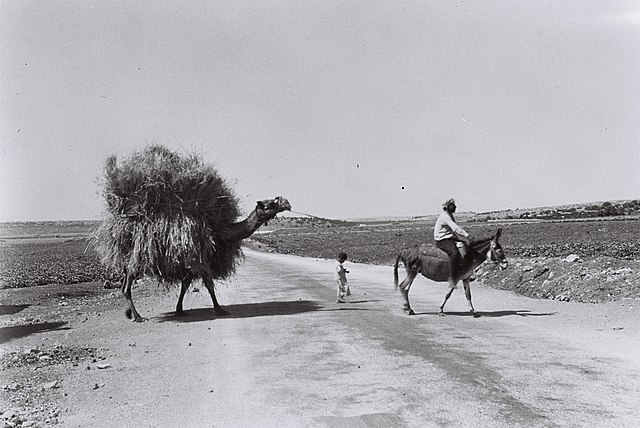
Arab farmer taking straw to his farm. Public domain.

Clutching at a straw

I read The Limits of Growth in my late teens. Perhaps, I was twenty already. I was young and hoped to live for another sixty years or so. And suddenly, a computer told me that I would live to see the end. The evidence and the logic were convincing. For a long time, I had hardly thought about the impending doom. As a child, I sometimes feared the future when hearing the disturbing song Vluchten Kan Niet Meer or Fleeing Is No Longer Possible on the radio. It unnerved me profoundly as it painted a dismal time ahead where nature would be gone. But that faded once I went to secondary school. After finishing my studies, I became an environmentalist and joined a local Friends of the Earth group in Groningen in 1993.

Friends of the Earth is an international environmental organisation known in the Netherlands as Mileudefensie. They had local groups of activists, most notably in student towns like Groningen. The organisation researches environmental issues and tries to convince people they should change their lifestyles. Friends of the Earth also lobbies with politicians and pressures corporations. Our group was a hodgepodge of students, people with a job, unemployed, activists and ordinary people led by a woman in her thirties, who acted as an Akela at the boy scouts. A 22-year-old student was her boyfriend.

We were not militant like Greenpeace, but sometimes we protested. One day we blocked the entrance of Groningen Airport to protest against the government subsidies for the airport. The police came and told us to leave, which we did. I then concluded that activism would not help. We will not give up our comfortable lifestyles and vote out politicians if they are serious about solutions. And businesses will go bankrupt if they do more to save the environment than others. Their products would be more expensive, and we wouldn’t buy them. And so there were underlying economic and political issues to address. We organised ourselves around themes, for instance, vegetarianism, air pollution, and economic issues. And these caught my interest.

We were short of money, but that changed when I became the treasurer. I took measures to make expenses match income, but I also had some luck. Every year, we obtained a small grant of 2,500 guilders from both the Groningen province and the Groningen municipality. But when I became treasurer, the provincial administration had just denied the allowance we had received the previous years. And so I wrote an appeal to the Appeals Commission. I then went to the Provincial House to discuss the issue with the official responsible for the grant. He explained that it was because we had been late filing our request, and the money jar was already empty. And so, I asked him whether there was any point to the appeal. He said no. It was a done deal. Then I received an invitation for a hearing at the Appeals Commission. I decided not to waste my time by going there, so a commissioner called me that evening, asking me why I hadn’t shown up. And I told him. That probably touched a nerve, as I gave him the impression that no one took the Appeals Commission seriously. And so, our appeal was granted, and we received the subsidy. As I had made a budget that did not anticipate this money and had implemented budgetary discipline, we ended up with income exceeding expenses.

Once over a cliff, a cartoon character can only clutch at a straw. And only in animation pictures the straw holds. The Dutch saying clutching to a straw means grasping to your last hope. On economic issues, our local group worked together with Strohalm, or more precisely, Rinke. He lived in Groningen and was actively engaged in Strohalm and their ideology. As I remember, he was on social benefits, and working for Strohalm and Friends of the Earth was his job. He was serious about it and worked hard. The meaning of the Dutch word strohalm is straw. According to Strohalm, the economy must grow because of interest, and that’s destroying our planet. It is ‘grow-or-die’ because interest rates need to be positive. Interest charges also cause escalating debts, poverty and financial instability. And in the end, the scheme will collapse because the interest adds to the principal until infinity. Any solution begins with ending that, they believed. And as you may have inferred already, I was into sound accounting, so this made me think. Strohalm aimed to ban interest and charge a fee on money, as Silvio Gesell had proposed. You didn’t have to pay the fee on money lent. In this way, it could be attractive to lend money without interest.

In those days, Strohalm started a LETS (Local Exchange Trading System) in Groningen. We exchanged goods and services using fictitious currency. We had a camp to train our persuading skills as environmentalists. Rinke was one of the organisers. He praised me several times and called me an example for others. That was not because of my social skills but because I knew what other people thought and how they would react. My parents and some friends frowned upon me joining the environmentalist movement.

I soon realised that there were serious issues. If you can receive interest elsewhere then why would you lend out money without interest? And if you can borrow money at an interest rate of zero, you would borrow as much as you can and put it in a bank account at interest. Therefore, interest-free money with a holding tax would not work. Only, that wasn’t particularly satisfactory. If you accept doom then you might as well commit suicide. If interest is the root of many social and environmental problems, and can destroy human civilisation, you should make it work. And perhaps it could work. During the Great Depression, it had been tried in a small Austrian village and it was a stunning success.

I am concerned about the planet. For years, I used public transport. And I still do it for work. But at some point, I realised it was pointless. More and more people started driving SUVs. They didn’t care about the planet. So if I saved petrol by taking a train, there was only more for those people. It didn’t matter what I did. A car makes your life comfortable, and I didn’t aspire to higher moral standards than others. So, I bought a car in 2003.

In 1998, I became a freelance IT specialist. I worked for a small bureau named Betamax, led by Martien, a retired manager. I made lots of money, so I had some capital to invest. My first investments were small and unprofitable, as I believed that profits matter. At the time, loss-making internet startups did very well in the stock market, while profitable corporations did poorly. But I had trouble understanding it. And so I thought I had to stay informed about the financial markets. In 2000, I joined the investment message board Iex.nl. At the time, I still said occasionally, ‘With SuperBart,’ when taking up the phone. That was fun and it sometimes caused hilarious moments, for instance, once I expected a call from Ingrid, but it turned out to be Martien. And so, I chose this name as my avatar.

Later I changed my avatar into niphtrique after someone noted that SuperBart sounded arrogant. And since then, I never took up the phone anymore saying, ‘With SuperBart.’ I didn’t need that to feel better anymore. A strange thing about avatars is that you somehow become this person, SuperBart, on the Internet because people do not know you. And so, I introduced a few other avatars to be someone else and have some fun. Most avatars didn’t last long, except dikkevettebeer, or plumpy fat bear, who believed the stock market would crash to zero and the gold price would rise to infinity.

A colourful investment fund manager, Michael Kraland, ran the message board. He also wrote commentaries about his investments. At the time, he rode the hype of the internet and telecom bubbles. His strategy was risky and not sound advice to inexperienced investors. And because he was a bit of a boaster, he received nasty negative comments on the message board, including unproven accusations of wrongdoing. And perhaps also because he was a Jew, which might not be accidental, as he worked in finance. And even though, as far as I know, he never did anything illegal, I nevertheless found him a dubious character.

After some time, a day trader named Cees joined the message board and began sharing conspiracy theories with us. He found them on US message boards and websites. If the markets were about to collapse, a secret group called Plunge Protection Team would come to the rescue. A stock market crash could undermine confidence in the financial system run by Wall Street, so they didn’t allow that to happen. Many readers first ridiculed Cees. But after the internet bubble had popped, and even more so after 9/11, markets often miraculously recovered when they were about to crash. And so, his credibility gradually rose. And the gold price regularly cratered because of sudden selling at peculiar times when most markets were closed. Cees believed central banks were behind this to promote confidence in their currencies. He wrote that if the gold price were to rise, the public would lose trust in our money. When there is little trade, you can sell a bit of gold to make the price drop. The trick was to break a trend. Trend traders, called technical traders, would then join the bandwagon by selling more gold, bringing down the price even further.

That was new to me, and perhaps it wasn’t all true, but there was ample reason to be suspicious. I had already bought some gold for other reasons. I didn’t trust financial markets and those operating them. Those people make a living from your money, so these stories intrigued me. They might be pulling out all the tricks to keep the Ponzi scheme of interest-bearing debt going. After all, debts continued to grow, as did interest payments, so there could soon be a day of reckoning. And I had read The Limits of Growth, so I feared collapse was inevitable. And if the sky has come down on you once, you worry it might happen a second time. Hence, I was constantly on edge concerning my investments, which was not helpful for profits. And I was not good at picking stocks. And so, I bought gold as a long-term investment. I also hoped that gold ownership could help me weather a financial collapse.

I bought my first gold in 1999 before I joined Iex.nl when I learned on the news that the gold price had reached historic lows. And so, I went to my bank to open a gold account. They sent an investment advisor to talk me out of it. He said, ‘No one does that anymore. I know a man who has a silver account with us for two decades. And silver has gone nowhere all that time. Gold mines are making losses because the price of gold is only going down. You should invest in the stock market instead.’ I smelled apathy concerning the precious metals and concluded it could be the beginning of a long-term trend of rising gold and silver prices that might run for decades, which indeed has happened. And so, I pressed on and opened a gold account. Perhaps, they had a good laugh that day at my bank office.

In 2001, after the Internet bubble had popped, I pitched the idea of interest-free money on the message board of Iex.nl. My lack of knowledge of the financial system didn’t deter me. Everyone can participate in a debate on a message board, and you can exchange thoughts with people you would never meet otherwise. Others rebutted me time after time, but I didn’t give up. Lengthy discussions followed, and they took several years. As these discussions proceeded, my knowledge of the financial system increased. And with the benefit of hindsight, debates on the Internet can be more fruitful than academic debates, which often occur in closed circles, because you get more perspectives.

In theory, interest-free money is a sound idea because fixed-interest payments destabilise the financial system. But practical issues stood in the way. The supporters of interest-free currencies didn’t address them. And economists never took interest-free money seriously because if you can receive interest elsewhere, you will not accept interest-free money. Via gold websites, I became familiar with the Austrian School of Economics and their adherents. They question money creation by banks and the need for central banks and point at the inflation caused by money creation. Some hoped to limit money creation or to return to a gold standard. Usually, they were libertarians who saw the government as the root of all evil. And unlike St. Paul, they saw sound money and free markets as the root of all blessings. They were a most peculiar and fanatic bunch, and even though they were on the opposite side of the political spectrum, a comparison with communists is most apt.

Both ideologies are like religions. Like the communists have their prophets, such as Marx, Lenin and Engels, libertarians have them, like Mises, Hayek, and Rand. And both religions have holy books. Communists have Marx’ Das Kapital or the Communist Manifesto, and libertarians have Rand’s Atlas Unshrugged or Ludwig von Mises’s book The Theory of Money and Credit. If their ideology fails, communists blame the capitalists, while libertarians blame the government. They appear to see money as a goal, not a tool. If you held alternative views like me, they might accuse you f being Keynesian, which seemed worse than being Satan himself. To me, these people seemed misers obsessed with money. Perhaps it is not a coincidence that their hero, after which they named their website, is Ludwig von Mises. So Mises for misers, if you didn’t get it already. And even though Wall Street is much eviler than they are, they represent the worship of Mammon in its purest form. They believed they were always right, so they tried hard to convince me I was wrong with my ideas about interest. And so, I learned as much from the Austrians as I learned from Strohalm. And if you come to think of it, perhaps it is also not a coincidence that the miracle of Wörgl happened in Austria.

Two opposing fringe ideas, interest-free money with a holding tax and the Austrian School view of hard money, challenged each other in my mind. It is how Hegelian Dialectic is supposed to work. It was not so that I was constantly brooding on this issue, but I also couldn’t let it go. In 2008 this resulted in a synthesis, Natural Money. In a gold standard, you need positive interest rates to get the economy going. As a result, you end up with unsustainable debt levels that you can never repay in gold, so you must leave the gold standard. But when you do that, the sky is the limit, and debts can escalate to infinity. But limiting the interest rate to zero can curb money creation too, and stop irresponsible lending. If the money supply is stable and the economy grows, prices drop, including the gold price. And so, a well-managed currency with a holding fee could be stronger than gold. As the economy can do better without interest, interest-free money can give better returns. That was the beginning. In the following decade, I produced a more comprehensive theory with the help of modern monetary economics.

Latest revision: 30 January 2023

Featured image: Roadrunner and Wile E. Coyote. Warner Bros. [copyright info]

Of Usury, from Brant's Stultifera Navis (the Ship of Fools)

The Problem Of Interest

Compounding

Imagine that Jesus’ mother had put a small gold coin weighing 3 grammes in Jesus’ retirement account at 4% interest just after he was born in the year 1 AD. Jesus never retired but he promised to return. Suppose now that the account was kept for this eventuality. Imagine now that the end is near, and that Jesus is about to return. How much gold would there be in the account in 2018?

It is an amount of gold weighing 11 million times the mass of the Earth. The yearly interest would be a gold nugget weighing 440,000 times the mass of the Earth. There is a small problem, a fly in the ointment so to say. It would be impossible to pay out Jesus because there simply isn’t enough gold.

It might seem that the bank had to close long ago because of a lack of gold, but that isn’t true. As long as Jesus doesn’t show up it can remain open, at least if the borrowers are allowed to borrow more to pay for the interest. If the economy grows 4% it may not be such a big deal. The interest can be created out of thin air by making new loans that allow borrowers to pay for the interest. And if Jesus doesn’t claim his gold when he returns and accepts bank credit, everything will be fine.

There is a limited amount of gold while compound interest is infinite. As long as bankers can create money out of thin air to pay for the interest and people accept bank deposits for payment, everything is fine. Problems only arise when people demand real gold. A bank can go bankrupt when depositors want to take out their deposits in gold.

Central banks

Perhaps Jesus’ retirement account isn’t such a big problem after all. Our money isn’t gold but currencies central banks can print. Assume now that Jesus’ mother had put one euro in the account instead. One euro at 4% interest makes 22,000,000,000,000,000,000,000,000,000,000,000 euro after 2017 years. That may seem an intimidating figure, but the European Central Bank can take 22 pieces of paper and print 1,000,000,000,000,000,000,000,000,000,000,000 euro on each of them. And there you are. Something like this happened during the financial crisis of 2008. This is called quantitative easing. You may have heard that word before.

Central banks can print new dollars and euros to cope with a shortfall. In fact, this is what central banks often do. There is always a shortfall because of interest because most money is debt and interest on this debt needs to be paid. To make up for the shortfall, there are two options. First, people can borrow more. Second, central banks can print new currency. Both things can happen at the same time. Central bank decisions about interest rates are also about dealing with the shortfall caused by interest charges.

When central banks lower interest rates, people can borrow more because interest rates are lower. Central banks lower interest rates when people are borrowing less than is needed to cope with the shortfall. If central banks raise interest rates, people can borrow less because interest rates are higher. Central banks raise interest rates when people are borrowing more than is needed to cope with the shortfall and the extra money makes people want to buy more stuff than can be made. And if people don’t borrow at all, this is a crisis, and central banks may print more currency to cope with the shortfall.

Interest on capital versus economic growth

There is a problem central banks can’t fix by printing more currency. Interest is more than just interest on money. Interest is any return on investment. Throughout history returns on investments were mostly higher than the rate of economic growth. Most of these returns have been reinvested so a growing share of total income was for investors. This can’t go on forever because who is going to buy the stuff corporations make in order to keep these investments profitable? A simple example can illuminate that.

interestvers
Interest income (red) versus total income with interest income growing faster than total income

The graph above shows how total income and interest income (in red) develop with an economic growth rate of 2% and an interest rate of 5% when interest income starts out as 10% of total income and all interest income is reinvested. After 25 years the economic pie has grown faster than interest income and wages have risen. At some point interest income starts to rise faster than total income, and wages go down. After 80 years there’s nothing left for wages. This graph explains a lot about what is going on in reality.

In the short run it was possible to prop up business profits and interest rates by letting people go further into debt to buy more stuff. In the long run, the growth rate of capital income cannot exceed the rate of economic growth. Interest rates depend on the returns on capital so this can explain why interest rates went down in recent years. In the past interest rates below zero weren’t possible but from time to time there were economic crises and wars that destroyed a lot of capital. This created new room for growth.

Wealth inequality and income inequality

When interest rates go down, the value of investments tend to rise. If savings yield little this benefits the wealthy as most people have their money in savings while the wealthy own most investments. But it is important to know the cause otherwise you might think that interest rates should rise. The graph above shows that wealth inequality causes interest rates to go lower, hence redistributing income, for example via higher wages or taxes on the wealthy, can bring higher interest rates.

There is a difference between wealth inequality and income inequality. Your labour income and the returns on your investments are your income. If you are rich but make no money on your investments, your wealth doesn’t contribute to your income. In reality wealthy people make better returns on their investments than others because they have better information and can take more risk. Still, the graph shows that income and wealth inequality can’t increase indefinitely, and that returns on investments can’t exceed the reate of economic growth in the long run, hence interest rates need to go lower.

Most people pay more interest than they receive. The interest paid on mortgages and loans is the proverbial tip of the iceberg. Interest is hidden in rents, in taxes because governments pay interest on their debts, and the price of every product and service because investments have to be made to make these products and services. German research has shown that 80% of the people pay more in interest than they receive, while only the top 10% of richest people receive more in interest than they pay. Lower interest rates benefit most people despite some side-effects that work in the opposite direction.

Economic cycles

Humans are herd animals. They buy stuff and even go into debt to buy stuff when others are going into debt to buy stuff too. Suddenly they may realise that they have bought too much or have gone too deeply into debt, and all at the same time. One day they may be borrowing money, queueing up before the shops, and bidding up prices. The next day, they may decide to pay off their debts, leaving the shop owners with unsold inventories they have to get rid of at fire sale prices. So prices may go up when people are in a buying frenzy and may go down when sales dry up.

When there is a buying frenzy business owners are optimistic and do a lot of investments, and often they go into debt to make those investments. But if suddenly customers disappear, they may be stuck with unsold inventory and debts they cannot repay. Businesses may then have to fire people. Those people are then left without income, and cannot repay their debts too, so sales will go down further. If their debts are not repaid, banks could get into trouble. In most cases the economy will recover. In the worst case banks go bankrupt, money disappears, the economy collapses, and an economic depression takes off.

Interest can make things worse. Assume that you have a business and expect to make a return of 8%. You have € 100,000 yourself and you borrow € 200,000 at 6%. You expect to make 8% so borrowing money at 6% seems a good idea. If you only invest your own € 100,000 you can make € 8,000, but if you borrow an additional € 200,000 you can make € 12,000 (8% of € 300,000 minus 6% of € 200,000, which is € 24,000 minus € 12,000). The balance sheet of your business might look like this:

debit
credit
inventory
€ 250,000
loan 6%
€ 200,000
cash, bank deposits
€ 50,000
owner’s equity
€ 100,000
total
€ 300,000
total
€ 300,000

If sales disappoint and you only make a return of 2% on your invested capital of € 300,000, which is € 6,000, you make a loss because you pay € 12,000 in interest charges. You may have to fire workers. Businesses can go bankrupt because they have borrowed too much and have to pay interest, even when they are profitable overall. Sales often disappoint when the economy fares poorly. This means that more businesses face the same difficulties and make losses because of interest payments. They may have to fire workers and these workers lose their income. This can worsen the slump.

Interest, economic depressions and war

Silvio Gesell discovered that interest rates can’t go below a certain minimum because lending would then stop. Money would go on strike as he put it. Why is that? Low yields make investing and lending money unattractive because of the risks involved. Debtors may not repay and banks may go bankrupt. Depositors then prefer to take their money out of the bank and keep it with themselves.

This can cause economic crises and depressions. Silvio Gesell lived around 1900. Interest rates below zero weren’t possible because of the gold standard. Depositors could go to the bank and withdraw their deposits in gold so that they didn’t have to accept negative interest rates. From time to time there were bank runs, economic crises and wars that destroyed a lot of capital. And this created new room for growth.

There may be a relationship between interest, economic depressions and war. In 1910 the amount of capital income (the red circle in the graph) relative to total income (the two circles together) was close to what it was in 2010. This could have led to an economic depression but then came World War I. The war destroyed a lot of capital so that there was new room for capital growth and interest rates could remain positive.

A few decades later the Great Depression arrived. If interest rates could have gone below zero in the 1930s, the Great Depression might not have happened, Adolf Hitler would not have risen to power and World War II would not have occurred. The currency of Wörgl demonstrates that negative interest rates could have ended the depression. After World War II interest rates never came near zero again. Governments and central banks printed more money. This caused inflation, which eroded trust in money.

People feared that inflation would make their money worth less so interest rates rose. In the 1970s the link between money and gold was abandoned because there was a lot more money than there was gold to back it. In the 1980s governments and central banks started policies to bring down inflation and to promote trust in money. As of 1983 interest rates went down gradually as a consequence of a renewed trust in money and central banks. Debt levels rose and interest rates went near zero.

Promoting inflation might not be a good idea. The end result is unpredictable. The best one can hope for is a poor performing economy and a lot of inflation like in the 1970s. But if interest rates rise because lenders lose their trust in money and debts, people may not be able to repay their debts, and the financial system might get into serious trouble. This can cause another great depression or another great war. But if the alternative is negative interest rates, stability and prosperity, then why not opt for that?
eou_31_questions

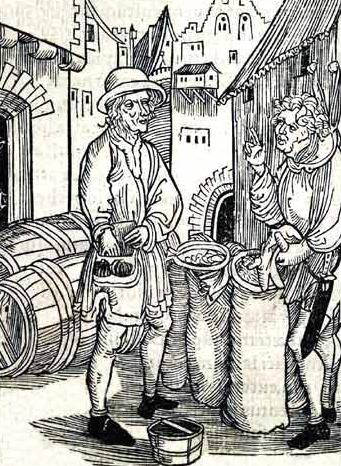
Featured image: Of Usury, from Brant’s Stultifera Navis (the Ship of Fools). Albrecht Dürer (1494). Public domain.

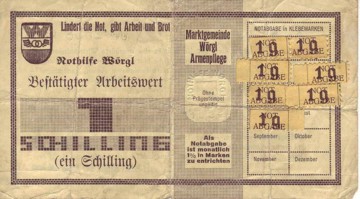
Wörgl bank note with stamps. Public Domain.

Miracle of Wörgl

In the middle of the Great Depression, the Austrian town of Wörgl was in deep trouble and prepared to try anything. Of its population of 4,500, 1,500 people were without a job, and 200 families were penniless. Mayor Michael Unterguggenberger had a list of projects he wanted to accomplish, but there was not enough money to carry them out. These projects included paving roads, erecting streetlights, extending water distribution across the whole town, and planting trees along the streets.1 2

Rather than spending the remaining 32,000 Austrian Schilling in the town’s coffers to start these projects, he deposited them in a local savings bank as a guarantee to back the issue of a currency known as stamp scrip. A crucial feature of this money was the holding fee. The Wörgl money required a monthly stamp on the circulating notes to keep them valid, amounting to 1% of the note’s value.1 2 An Argentine businessman named Silvio Gesell had come up with this idea in his book The Natural Economic Order.

Nobody wanted to pay for the monthly stamps, so everyone spent the notes they received. The 32,000 schilling deposit allowed anyone to exchange scrip for 98 per cent of its value in schillings. Hardly anyone did this because the scrip was worth one Austrian schilling after buying a new stamp. But people did not keep more scrip than they needed. Only 5,000 schillings circulated. The stamp fees financed a soup kitchen that fed 220 families.1 2

The municipality carried out the intended works, including new houses, a reservoir, a ski jump and a bridge. The key to this success was the fast circulation of the scrip money within the local economy, fourteen times higher than the schilling. It increased trade and employment. Unemployment in Wörgl dropped 25% while it rose in the rest of Austria. Six neighbouring villages copied the idea successfully. The French Prime Minister, Édouard Daladier, visited the town to witness the ‘miracle of Wörgl’ himself.1 2

In January 1933, the neighbouring city of Kitzbühel copied the idea. In June 1933, Mayor Unterguggenberger addressed a meeting with representatives from 170 Austrian towns and villages. Two hundred Austrian townships were interested in introducing scrip money. At this point, the central bank decided to ban scrip money.1 2

Since then, several communities have issued local scrip currencies. None of them was as successful as the currency of Wörgl. The reasons probably are:

  • There was no economic depression, and the economy could support interest, so introducing scrip money had little effect.
  • If scrip money is not widely accepted, people will exchange it for regular currency if they can’t use it.

In Wörgl, the payment of taxes in arrears generated additional revenues for the town council, which the town council spent on public projects. Once the townspeople had paid their taxes, they would have run out of spending options and might have exchanged their scrip for schillings to avoid paying for the stamps. That never happened because the central bank halted the project.

There are, however, a few issues to consider. The economy of Wörgl did well without issuing debt because the money kept circulating. A negative interest rate induces people to spend the money they have, so no new money has to be borrowed into existence to stimulate the economy. A holding fee makes negative interest rates possible as you do not have to pay it when lending money. For instance, lending out money at an interest rate of -2% is more attractive than paying 12% for the stamps. If we can uncover the conditions for it to work, remove its flaws, and plan for the consequences, we can have a usury-free financial system.

Natural Money

Introducing negative interest rates in the global financial system may have great benefits. The website Naturalmoney.org features an in-depth research of the feasibility and consequences of negative interest rates.

Read More

If you like this post, then you might also like:

Joseph in Egypt

Ancient Egypt had a similar type of money for more than 1,000 years. There is an account in the Bible that may explain how this money came into existence.

Read More

The future of interest rates

In the long run most capital ends up in the hands of the capitalists. Negative interest rates are the logical consequence.

Read More

Latest revision: 6 April 2024.

Featured image: Wörgl bank note with stamps. Public Domain.

1. The Future Of Money. Bernard Lietaer (2002). Cornerstone / Cornerstone Ras.
2. A Strategy for a Convertible Currency. Bernard A. Lietaer, ICIS Forum, Vol. 20, No.3, 1990. [link]