

Negative electricity prices
Solar is the cheapest source of energy, but only when it is available. When the Sun doesn’t shine, there is no solar energy. And there can be too much. The cost of solar power and electricity storage is dropping, so renewable energy may, at some point, overtake fossil fuels as an energy source. But is it economically feasible? Electricity prices in the Netherlands fall below zero for most of the day on sunny, windy summer weekends. In 2023, electricity prices reached a negative €0.40 per kilowatt-hour on a few occasions. Taxes and delivery costs were €0,15, so you could make money using electricity in those instances. As one energy expert put it, ‘This is nuts.’1 Since then, shutting down solar and wind farms during peak hours has helped keep prices in check.
The Netherlands has invested in solar and wind energy. Changing weather and limited battery storage cause fluctuations in the power supply, and, combined with rising electricity consumption, they strain the power grid. In 2022, 40% of the Netherlands’ electricity and 15% of its total energy consumption came from renewable sources. Plans are in place for additional wind and solar farms. To manage all that, you need large batteries to store electrical energy, as well as nuclear or fossil-fuel plants to bridge periods with little sun and wind. It is costly, so investors are starting to have second thoughts, putting the plans for new wind farms in jeopardy. The Dutch might be better off by curbing energy use. What are all those new businesses that need more power going to do? Apparently, it is nothing we need, as they are not yet in business. Only no one dares to say that.
In the drive to reduce carbon emissions, households are increasingly electrifying their energy use, adopting electric heating and electric cars, which is resulting in higher winter electricity demand and further strain on the grid. There is only so much shifting of energy demand that flexible pricing can achieve. Businesses can’t start or expand due to a shortage of grid capacity. That is also because the Netherlands has become an international hub for data centres. Power outages during peak hours, once unthinkable, become possible. Further down the road, the Dutch might end up shutting down energy-intensive industries during periods of renewable energy shortage.
The costs of halting climate change will be staggering, so some say renewable energy is a religion. Critics had a field day in 2023 when the Dutch Climate Minister said that the proposed measures to combat climate change would cost €28 billion over seven years, or €222 per person per year, and reduce global temperatures by only 0.00036°C. ‘This is nuts,’ they said. New estimates indicate that the combined national plans, if executed, will reduce the increase in global temperatures from 4.0°C to 2.5°C this century, which is not enough. The first part was the easiest. The second part could run into a cost wall, even if the price of solar energy itself nears zero. Something has to give. The climate is warming, but the costs are becoming prohibitive. We believe economic growth should fund the switch, which is thinking that the problem, growth, is the solution.
Sri Lanka’s organic farming disaster
In the spring of 2021, Sri Lankan farmers went organic overnight. It was not their choice. The government had banned synthetic fertilisers and pesticides, a move intended to save Sri Lanka $ 400 million a year and protect Sri Lankans from the adverse health and environmental impacts of these substances. It led to a 20% fall in rice and tea production. The price of rice rose by 30%, and the prices of vegetables like tomatoes and carrots rose by 400%. It was another blow to a tourism-dependent economy already devastated by the coronavirus pandemic. After five months, the government made a U-turn and reduced the restrictions. By mid-2022, the economy had gone into free fall. Inflation was above 50%, with 90% of Sri Lankans missing at least one meal per day.2 Some say organic farming is a religion. Current farming methods are highly dependent on synthetic fertilisers and pesticides.
The recent explosion in human population is made possible by these recent innovations. Synthetic fertilisers make crops grow faster. Around 1910, two German scientists developed the Haber-Bosch Process, which produces ammonia from atmospheric nitrogen. This powerful fertiliser became critical for wheat, corn and rice varieties. Their adoption since the 1960s, advertised as the Green Revolution, which also included mechanisation and seed-breeding, has helped lift countries like Sri Lanka out of poverty. In Sri Lanka, rice yields tripled. Synthetic fertilisers and pesticides ruin our health and the environment. Soil degradation endangers our food supplies. Yet, a sudden discontinuation of fertiliser and pesticide use will lead to famine.
There is also the issue of agricultural subsidies. In developed countries, governments subsidise farmers to purchase fertilisers and fuel their tractors. Of the total energy used to produce maize in high-input agriculture, about 70% comes from fossil fuels. The manufacture of chemical fertilisers takes more than 30% of this energy. Cleaning the groundwater from excess fertiliser nitrates may be so costly that it will be impossible.3 When these subsidies disappear, less intensive farming methods become more economical. Yet, that will reduce the food supply and make food more expensive, and poor people can barely afford it already.
Organic farming requires twice as much land for the same output. There could be ten billion people by 2050, so the world’s farmers may need to increase their production even further. That is, unless we stop breeding and change our diets. Livestock use nearly 80% of global agricultural land, while producing less than 20% of our calories.4 Holy cow! Meat and dairy are also a religion. By reducing our meat and dairy consumption, we may feed the world through sustainable, or even organic, farming methods.
Replacement
It is sometimes hard to tell which country I live in by looking at the people walking on the street before my home. And I don’t live in Amsterdam, Rotterdam or The Hague, but in a minor regional centre. It was not like that in 1997 when I moved here. What fascists call the replacement is happening over here. It is not a conspiracy. As a result of demographic trends such as immigration and higher birth rates among immigrants, the newcomers and their descendants gradually replace the natives and their descendants. Now, I never felt unsafe here, nor did my wife, nor did I witness violent incidents. When I could overhear them, so when they spoke Dutch, those who looked like newcomers often showed good manners, including the youngsters. Yet, it is not all good. A few times, I have seen suspicious things, possibly drug-related. At the swimming pool, I overheard a man of my age say,
My children are 28 and 25. Both still live with us. They can’t find a home. Homes are too expensive. That is partly the government’s doing. If you walk around in this town, it looks like the Middle East. And those Syrians. They say many of them are physicians and surgeons. Well, they are. They bring their knives with them.
He said that the town looks like the Middle East, but he might as well have said that it looks like Africa. As for his remark about Syrians, when the Syrians came, the mainstream media told us that there were many qualified people, including doctors and surgeons, among them. Yet, on social media you learn about knife violence. Some of the Syrians are traumatised, as they have lived under a brutal regime. This man’s words reflect the mood among many Dutch. There are youths on fat bikes causing trouble, and these youths are often descendants of immigrants. About one-third of the Dutch would now vote for a fascist, nationalist or anti-immigration party. Most don’t hate immigrants, but believe that it can’t go on like that. Yet, resistance to immigrants is increasing, which includes violence.
The statistics indicate that crime has declined in recent decades. It might be due to a lower willingness to report crime, since the police do little about minor offences like bicycle theft and vandalism. As for the housing shortage, migration accounted for 60% of new-home demand in the Netherlands between 2015 and 2024, with half of that attributable to asylum seekers. 11% of the Dutch aged 25-34 live with their parents, below the European average of 30%, but above the Scandinavian countries, where it is between 4% and 8%. And the Dutch have among the most living space per person. Home prices and rents have exploded. If you depend on social housing, you may wait 10 years or more to get a home.
That it has worked so far without too much trouble looks like a miracle. Most newcomers find a place thanks to the efforts of volunteers who help them integrate. In my town, blacks seem to mingle more with the natives than the Muslims. The Netherlands is an agreeable country. A 2026 survey claims it is the best place to live in. That is a subjective measure, as the outcome depends on the variables you consider and how you weigh them. Still, it says something. People move where they can find a better life. That cultures do change over time, also due to immigration, is a fact of life. Yet if newcomers don’t adapt to and integrate into the culture that has made the Netherlands the best place in the world to live, conditions will likely deteriorate, and things will be less agreeable in the future. Modernisation and the ensuing demise of traditional village life were equally profound. The difference is as great as that between Western, Islamic, and African cultures. Our traditional cultures are already dead.
If there is to be a future world society, it will be a multicultural one, but if there is not enough that unites us, a society will fall apart. And if the Netherlands is an agreeable country that many wish to live in, the rest of the world should become more like the Netherlands. Excessive consumption in wealthy countries should stop. That would be the end of the main reasons for migrants to move. The fascists are worried and call immigration an invasion. Since World War II, the ethnic makeup of several Western countries has undergone profound changes. Those who came to the Netherlands since 1960, along with their descendants, now comprise over 25% of the population.
We don’t know the future, so our choices are a matter of faith, also on the issue of the multicultural society. Science can’t even predict tomorrow’s headlines, let alone what happens a few decades from now. So, can you call the mass migration an invasion? Can the fascists be right? What seems rational depends on the future you expect. And so, some say that the multicultural society is a religion.
Had the Native North American tribes in 1650 rallied around a fascist leader who claimed whites were an evil race with nefarious inclinations, not humans, but subhuman trolls from a dark place where the Sun never shines who were planning to take their land, and united to eliminate these pale abominations, they might have fared better. And see how these pale faces have culturally enriched the land by replacing the forests with strips of tarmac surrounded by concrete constructs with neon lights. So, if you see people giving the Hitler salute, think of that. Hitler led Germany to destruction. The Native Americans who violently opposed white immigration into their lands also perished. But had the natives succeeded in exterminating the whites and prospered, critics might later have argued that it had been unnecessarily cruel to genocide these pale-faced ones.
The rear-view mirror pundits are a particularly annoying species. They can predict the past with uncanny precision, and claim they knew it all along. We can’t foresee the long-term consequences of migration. It can lead to civil war, but so can divisive politics. In Bosnia, three faiths have lived relatively peacefully alongside each other for five centuries until the 1990s, when they fought a bloody civil war. The Bosnians shared the same ethnicity, culture, and language, differing only in their religion. Nationalist and religious politics plunged them into a civil war.
The multicultural fairy tale is that people of different races, ethnicities, and nationalities live together in the same community, where individuals retain, pass down, celebrate, and share their unique cultural ways of life, languages, art, traditions, and behaviours. It is not a reality in many cases. Ethnic groups frequently reside in separate quarters. Cultural differences cause tensions. Chicago has separate neighbourhoods for whites, Mexicans, blacks, Poles, Koreans, Jews, Indians, Italians, Greeks, and they all have their neighbourhood grocery stores. The purpose of the multicultural fairy tale is to provide a story that maintains the peace long enough for us to work out our differences. That requires us to share a belief in a common destiny.
Goodbye, fossil fuels?
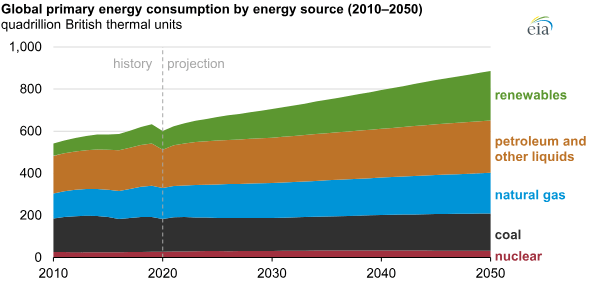
Fossil fuels provide 80% of humanity’s energy consumption. Perhaps you have heard tales about phasing out fossil fuels, that solar is the cheapest source of energy, and that it will all be nice and dandy with solar and wind. A 2021 International Energy Agency (IEA) projection of future energy use tells a different story. The IEA expected a 30% increase in world energy use between 2020 and 2050. Renewable energy will not even fully cover that increase.5 It is the reason Big Oil keeps drilling. And so, saying goodbye to fossil fuels and switching to renewable energy begins with reducing global energy consumption by 50%, and that will require drastic lifestyle changes.
The IEA concludes that the pledges by governments to date—even if fully achieved—fall well short of what is required to bring global energy-related carbon dioxide emissions to net zero by 2050 and give the world a 50% chance of limiting the global temperature rise to 1.5 °C.6 The IEA presented a plan to achieve net-zero carbon emissions by 2050. It bets on cheaper solar energy and technology to store it. Achieving 50% renewable energy use may be feasible, but beyond that, the costs may become prohibitive if the bet-on technologies don’t arrive on time. We are about to find out.
A global power grid could make switching to renewable energy feasible, as it would require less spare capacity and batteries. Long-distance electricity transport incurs limited losses (26% per 10,000 kilometres). It might be profitable to transport electricity over thousands of kilometres from locations with predictable solar availability to other locations. It is mainly a political problem as nation-states have conflicting political objectives, so it requires a global government. We may have already surpassed the 1.5°C global average temperature rise, at which point things supposedly become critical. Due to the measures already taken and planned measures, the expected temperature rise may be limited to 2.6°C by 2100 AD, significantly less than the worst-case scenario of a 4°C rise.
What is our religion?
Once we accept a story as the truth, it becomes a matter of faith, whether it is renewable energy, organic farming or a multicultural society. The bottom line is often that we may disagree on whether we need to do it and whether it is possible. Yet our belief about whether we need to do it may depend on our belief about whether it is possible. Underneath lies the problem that we may have to do it, but that it may be impossible. Maybe we should do something about climate change, but it is not going to happen, so why ruin our industries with energy shortages? And if other countries aren’t switching to organic agriculture, why bankrupt our farmers? And why should we have an open multicultural society, and go through the trouble of accommodating various cultures, when others do not? And should the migrants not adapt in the first place?
Then there are the unforeseen consequences. When the Dutch began electrifying their energy consumption, few foresaw that they might end up with power shortages requiring businesses and consumers to adapt their demand to electricity availability. And there are extremes, like no Sun and no wind during winter, when energy demand is at its peak. The waiting list for grid connections is growing. The Sri Lankans suffered much more from their sudden switch to organic farming. We accept the consequences of our choices if we believe that they are right. Our future and our children’s are on the line. Only, we don’t know the future, so our choices on these matters are a matter of faith.
In the Middle Ages, most Europeans were dirt poor. Their houses were mere sheds. They often barely had enough to eat. Still, medieval Europeans built magnificent cathedrals. God was more important to them. Were they right, or were they wrong? Today, money is our religion, and we are committing suicide by subjecting ourselves to the rule of money. Renewable energy, organic agriculture and the multicultural society are choices of faith with uncertain outcomes. They can go wrong, but so can the alternatives. We often don’t know what the right choices are. Something unforeseen can happen any time, making what seems sensible today appear ill-conceived tomorrow. Yet, the doom that the pursuit of profit will cause is certain, and few see it coming.
Latest revision: 12 August 2026
Featured image: The Lady Chapel of Exeter Cathedral. User Diliff. Wikimedia Commons.
1. ‘This is nuts:’ European power prices go negative as springtime renewables soar. Joshua S Hill (2023). Renew Economy. [link]
2. Sri Lanka’s organic farming disaster, explained. Kenny Torrella (2022). VOX. [link]
3. Can conventional agriculture feed the world? Pablo Tittonell. Wageningen University.
5. How much of the world’s land would we need in order to feed the global population with the average diet of a given country? Hannah Ritchie (2017). Our World In Data. [link]
5. EIA projects nearly 50% increase in world energy use by 2050, led by growth in renewables. EIA (2021). [link]
6. Net Zero by 2050: A Roadmap for the Global Energy Sector. IEA (2021). [link]

